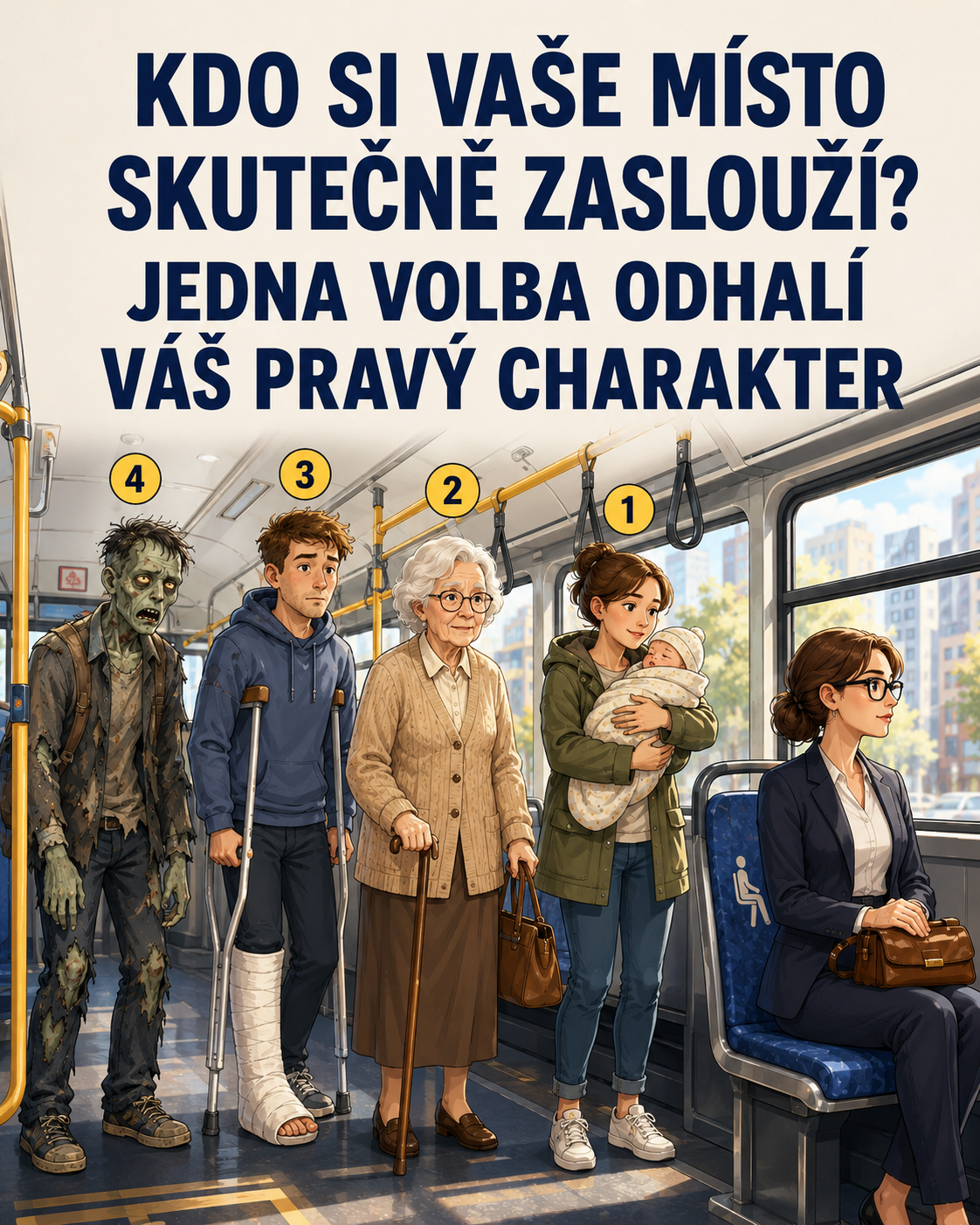
Who really deserves your seat? One choice reveals your true character
We’ve all been in this situation at least once. You’re sitting on a packed train or bus after a long, exhausting day at work. Your legs are aching, your head is tired, and all you want to do is close your eyes and ride out the journey in peace until your stop. But then the doors open, a new wave of passengers comes in, and suddenly you find yourself face to face with people who seem to need a seat far more than you do.
It is in that split second that a quiet psychological battle begins in your head. Pretend you’ve fallen asleep? Stare at your phone screen and not look up? Or get up and offer your seat after all?
This familiar everyday dilemma is perfectly captured in a viral illustration that poses a simple yet surprisingly profound question: ‘Who deserves your seat? And why?’ At first glance, it looks like a standard riddle or a basic test of good manners. But take a closer look. Here are several options: a mother holding a sleeping baby, an elderly woman leaning heavily on a walking stick, a young man with a badly broken leg, and a real zombie. Each of them forces you to make a choice. And, as psychologists and behavioural experts claim, the option you choose reveals not only your manners; it can reveal deep-seated personality traits, your core values, and how you interact with the world.
Let’s break down each option and see what your answer might reveal about your true character.
Option 1: Mother with baby (Protective empath)
If your first instinct was to give up your seat to character 1 — the young mother holding a swaddled, sleeping baby in her arms — then you are driven by deep compassion and a strong protective instinct.
Standing on moving public transport with a baby in your arms is not just tiring, but also dangerous. A single sharp brake or sudden turn could cause her to lose her balance, putting the child’s safety at risk. By choosing her, you show that you instinctively put the most vulnerable and the next generation first.
What this reveals about your character:
You are caring by nature: You find it hard to watch children or parents struggling. Family is likely one of your core values in life.
You possess strong empathy: You don’t just see a person standing there; you imagine their strain. You think about how tired their hands must be and how anxious they must feel trying to keep their balance in the crowd.
You choose long-term safety over momentary comfort: It is important to you to protect life and innocence. Among friends, you are most likely the ‘parent-like’ person who makes sure everyone gets home, has something to eat and is all right.
Choice 2: An elderly woman (Traditional, respectful type)
If you chose character 2—the elderly woman leaning on her walking stick—your character is largely based on respect, tradition and a strong sense of civic duty.
In almost every culture around the world, respect for elders is one of the first moral lessons we are taught as children. This woman has lived a long life; her body has weakened, and she simply no longer has the physical strength to easily endure a journey on bumpy transport.
What this reveals about your character:
You value tradition and respect: You believe in society’s unspoken rules. For you, giving up your seat to an elderly person is not a matter of choice, but an unconditional duty.
You have high moral principles: It is important to you to act ‘correctly’ and ‘with dignity’. You believe that the standard of a society can be judged by how it treats its elderly citizens.
You are grateful and reflective: Choosing the elderly woman shows that you value those who came before you. You have a mature outlook on life: you understand that youth is fleeting and that one day everyone may need help.
Choice 3: The injured young man (Logical Pragmatist)
If your gaze immediately fell on character 3 — the young man on crutches with a heavily bandaged leg — then your choice is guided by logic, fairness and an assessment of immediate physical need.
The mother and the elderly woman are indeed vulnerable and tired, but the young man is currently suffering from an acute, painful medical condition. It is extremely difficult and risky to balance on one leg with crutches on moving transport. If he falls, he could injure his leg again, which would lead to surgery or significantly worsen his condition.
What this reveals about your character:
You are a logical problem-solver: you do not allow emotions to completely cloud your judgement. You look at the facts: who is in the most immediate physical danger right now? The man with the broken leg.
You value fairness and objectivity: You do not fixate on age or gender. Although he is a young man, you understand that his current physical limitation makes him the most vulnerable person in this particular situation.