Before Sunrise, Her Father Tried to Steal Her Mother’s House

Before Sunrise, Her Father Tried to Steal Her Mother’s House

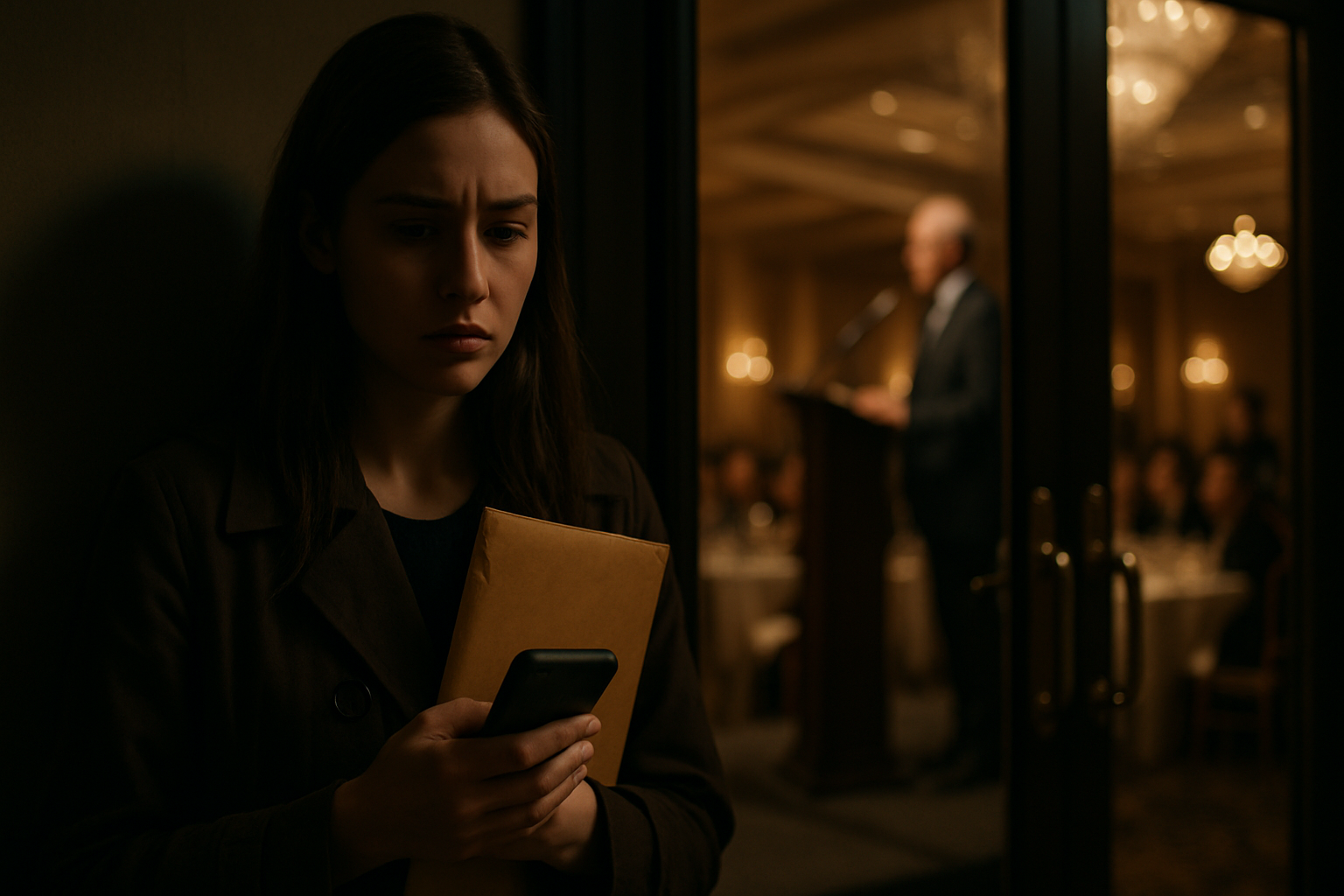
Clara Vale stood outside the ballroom of a grand hotel in Briarhaven, holding a worn manila envelope against her ribs.

Her phone shook in her hand.

Behind the glass doors, her father was still onstage.

Roland Vale smiled into a microphone, praising Tessa, the daughter he showed the world like a medal. Guests clapped. Crystal glasses chimed. A photographer drifted between tables, capturing bright faces, fresh flowers, silver forks, and polished lies.

But in the quiet hallway, Clara heard the words that made the whole room disappear.

“Your father is at a notary office with a young woman claiming to be you,” Attorney Samuel Reed said. “Clara, listen carefully. Do not confront him alone.”

Clara stared through the glass.

Roland was right there. Champagne in hand. Proud as a king.

His wife, Marissa, sat near the front in a silver dress, calm and pleased, as though the evening had already delivered exactly what she wanted.

“But he’s standing right in front of me,” Clara whispered. “I’m looking at him.”

For a moment, Samuel said nothing.

Then his voice turned hard.

“Then either someone is using his identity, or the papers were arranged before the party began. Either way, they are acting tonight because they think you’re alone, scared, and too worn down to fight.”

Clara’s eyes shifted to Marissa.

Marissa was no longer watching the stage.

She was reading something on her phone.

Then she glanced toward the exit.

And Clara knew.

Her father was the distraction.

Marissa was the hand behind the curtain.

Somewhere across the city, a stranger was trying to put Clara’s name on papers that would steal the last thing her mother had fought to leave her.

The house.

The blue-tiled house on the east side of Briarhaven. The house with old oak floors, climbing roses over the gate, and her mother’s recipe cards still tucked in the kitchen drawer, written in that familiar slanted hand.

Clara stepped away from the glass.

“What do I do?” she asked.

“Go to the notary’s office,” Samuel said. “I’ve called the police. I’m on my way. Don’t speak to Roland yet. Let them keep thinking you don’t know.”

Clara looked back one last time.

Onstage, Roland lifted his glass.

“To my daughter Tessa,” he said warmly. “A living example of what discipline, hard work, and a strong family can do.”

Clara almost laughed.

A strong family.

He had thrown one daughter out with nothing.

Now he was toasting another with money he hoped to steal from a dead woman’s legacy.

Clara slipped down the hallway and vanished before anyone thought to look for her.

Outside, Aunt June waited at the curb in her old blue sedan.

She had insisted on driving Clara to the party. Not because Clara had asked for protection, but because June had known Lillian, Clara’s mother, better than anyone.

And June knew something else too.

When a woman like Marissa smiled too sweetly, there was usually a knife close by.

Clara slid into the passenger seat.

“They’re doing it now,” she said. “They found someone to pretend to be me.”

June did not waste breath on shock.

She put the car in drive.

“Address.”

Clara gave it to her.

The ride through Briarhaven felt unreal.

Stoplights changed. Restaurants glowed. Couples walked hand in hand. Students laughed outside cafés as though the night were ordinary.

As though a father was not trying to erase his own daughter with a forged signature.

Clara opened the envelope in her lap.

Her exam results.

Her birth certificate.

Her driver’s license.

Her mother’s will.

The recording.

And the letter.

The letter was still sealed.

For years, Clara had been afraid to open it.

Lillian had written it before the cancer turned cruel. Before the house went quiet. Before Roland married Marissa and turned grief into resentment.

Samuel had told Clara her mother wanted her to read it after she turned eighteen, when she could legally take full control of the house.

Clara had imagined opening it alone.

Not like this.

Not while racing through the city to stop her own father from selling her future to himself.

June glanced at the envelope.

“Your mother knew,” she said softly.

Clara turned. “Knew what?”

“That Roland was weak.”

Clara swallowed.

June kept her eyes on the road.

“She loved him once. I believe that. But near the end, she saw what happened when money got tight and no one was watching. That’s why she protected the house. Not because she hated him. Because she loved you more than she trusted him.”

Clara looked out the window.

For years, she had wondered why her mother had not simply trusted Roland to manage everything.

Now the answer sat cold in her chest.

Her mother had seen the storm long before anyone else could name the clouds.

When they reached the notary’s office, two patrol cars were already parked outside.

The building was small and too brightly lit, wedged between a tax office and a nail salon. Betrayal should have looked darker than that, Clara thought. More dramatic. More ashamed.

The sign on the glass read Riverbend Notary & Legal Services.

Clara opened the door before June had fully stopped the car.

“Clara!” June called.

But Clara was already moving.

Inside, the office smelled like printer ink, stale coffee, and fear.

A pale receptionist stood behind the desk. Two officers spoke with a notary in a navy blazer. Near the back wall, a young woman with straight dark hair and heavy makeup sat stiffly in a chair, arms locked across her chest, eyes fixed on the floor.

From far away, she looked a little like Clara.

Not close.

Not if anyone had truly looked.

Samuel stood beside the officers, folder in hand.

The moment Clara entered, his shoulders lowered with relief.

“There she is,” he said.

Every head turned.

The false Clara looked up.

For one empty second, she did not understand.

Then she breathed, “Oh, no.”

Clara walked toward her.

The girl could not have been much older than twenty-one. She wore a cream blouse, black trousers, and a delicate necklace that looked exactly like something Marissa would choose for someone she meant to control.

Her hands shook in her lap.

Clara looked at the papers spread across the desk.

A property transfer agreement.

A sworn identity affidavit.

A quitclaim deed.

Her name sat typed neatly at the top.

Clara Lillian Vale.

Seeing it there made her stomach twist.

Her name.

Her mother’s house.

Her entire future, arranged in tidy lines for someone else to take.

One officer stepped forward.

“Are you Clara Vale?”

Clara pulled out her license.

“Yes.”

The notary pressed a hand to her mouth.

“Oh my Lord. I checked ID. She had identification.”

Samuel placed another paper on the desk.

“A forged one,” he said. “And not a very good one.”

The girl began to cry.

“I didn’t know it was a house,” she blurted. “I swear I didn’t know.”

Clara stared at her.

“What did you think you were signing?”

“They told me it was family paperwork,” the girl sobbed. “They said the real daughter was out of state and couldn’t come in person. They said she knew. They paid me five hundred dollars.”

June entered behind Clara and froze.

One officer asked, “Who paid you?”

The girl lowered her head.

“A woman named Marissa.”

There it was.

Not a suspicion.

Not a sick feeling.

Proof.

Samuel’s jaw tightened.

“And who gave you the false ID?”

The girl hesitated.

The officer leaned closer. “You’re already in serious trouble. Don’t make it worse.”

The girl trembled harder.

“Marissa gave it to me. She said her husband had handled the legal side. She said his daughter was selfish and trying to destroy their family.”

Clara gave a broken little laugh.

Selfish.

That was what they called her for wanting to keep the only thing her dead mother had protected.

Samuel moved closer to Clara.

“You need to call your father,” he said quietly. “Put him on speaker.”

Clara’s hand went cold.

“No,” June said at once. “She doesn’t owe him that.”

Samuel looked at her gently.

“She doesn’t. But if Roland thinks this worked, Marissa may tell him to start destroying evidence. We need him talking before he knows where we are.”

Clara looked at the officers.

They nodded.

Her heart beat so hard she could hear it.

She called her father.

He answered on the fourth ring, already irritated.

“What do you want now?”

Clara put him on speaker.

The office went completely still.

She made her voice small.

“Dad, I need help.”

Roland exhaled with disgust.

“I told you not to call unless you were ready to admit what you did.”

“What did I do?”

“You humiliated me. You failed. After everything I paid for.”

Her eyes flicked to the exam results in the envelope.

“You said if I came back, maybe we could talk.”

His voice softened.

That old voice.

The one she remembered from childhood.

Smooth when he wanted something. Almost tender when cruelty needed a mask.

“So now you understand,” he said. “The world is harsh when no one is paying your bills.”

Clara’s throat tightened.

“I don’t have anywhere to go.”

“That isn’t my problem.”

“Please, Dad.”

There was a pause.

Then he said the words that stripped away the last piece of hope.

“There is one way to solve this. You sign the house over to me, and I’ll give you ten thousand dollars to get started somewhere else. That is more than fair.”

June shut her eyes in fury.

Clara gripped the phone.

“The house Mom left me?”

“That house should never have been yours,” Roland snapped. “Your mother made decisions while she was sick. She wasn’t thinking clearly.”

Samuel’s face darkened.

Clara glanced at him.

He signaled for her to continue.

“But Mom signed the will before the worst of it,” Clara said. “Mr. Reed told me—”

“Reed is a leech,” Roland cut in. “That house belongs to the family.”

“I am family.”

Roland laughed.

Not loudly.

That made it worse.

“You are a legal obstacle.”

The room seemed to turn to ice.

Even the officers looked sick.

A legal obstacle.

Not daughter.

Not child.

Not blood.

An inconvenience with a signature.

Clara looked at the crying girl. At the deed. At June, whose face was tight with grief and rage.

Then Clara asked one last question.

“Dad, did you send someone to sign my name tonight?”

Silence.

Long and heavy.

Then Roland said, “You should have signed when I gave you the chance.”

The officer beside Samuel nodded once.

That was enough.

Clara ended the call.

For several seconds, she could not move.

Then the false Clara broke apart completely.

“I’m sorry,” the girl sobbed. “I didn’t know. I swear I didn’t understand.”

Clara looked at her for a long time.

She wanted to hate her.

But the girl looked young, frightened, and poor in the exact way Marissa knew how to use.

Five hundred dollars had been enough to pull her into a crime that could ruin her life.

Clara’s voice was low.

“You still chose to wear my name.”

The girl covered her face.

The police began taking statements.

The notary handed over every document. Security footage was saved. The fake license was sealed as evidence. Marissa’s name was written again and again until it stopped looking like a name and started looking like a confession.

Then Samuel turned back to Clara.

“We’re not finished.”

Clara looked at him.

“The party,” he said. “Your father is still standing in front of a room full of people pretending to be honorable. He doesn’t know this failed.”

June narrowed her eyes.

“You want her to walk back in there?”

“I want Roland and Marissa to lose control of the story,” Samuel said. “But it has to be Clara’s choice.”

Clara looked down at the envelope.

For years, her father had taught her that truth was disrespect.

Marissa had smiled through every insult.

Tessa had learned to look away.

They had counted on Clara being quiet. Ashamed. Grateful for scraps. Afraid.

Not tonight.

She turned toward the door.

“I’m going back.”

By the time Clara returned to the ballroom, Tessa’s celebration was loud and glittering.

Music filled the room. Guests danced near the stage. A huge screen showed Tessa’s childhood in bright little flashes: party dresses, school plays, beach trips, birthday cakes, family portraits.

Clara was missing from most of them.

In the few where she appeared, she stood at the edge, like someone accidentally caught in the frame.

Marissa saw her first.

Her smile vanished.

She stood so fast her champagne glass tipped over, spilling across the white tablecloth.

Roland was near the stage, laughing with two businessmen.

When Marissa grabbed his arm and whispered, his expression changed.

Only for a heartbeat.

But Clara saw it.

Fear.

Then arrogance covered it again.

He came toward her.

“What are you doing here?” he demanded under his breath.

Clara did not step back.

“I was invited by the truth.”

His eyes hardened.

“Leave before you embarrass yourself.”

Clara looked past him at the microphone.

“I think the embarrassment is already here. It just hasn’t been introduced.”

Marissa stepped between them.

“Clara, this is your sister’s night,” she hissed. “Don’t make a scene.”

Clara looked at Tessa.

Her younger half-sister stood near the cake table in a blush dress, confused and suddenly frightened.

For once, she did not look spoiled.

She looked like a girl handed a crown without ever asking who had paid for it.

Clara walked past Marissa.

Roland grabbed her wrist.

Most of the room had not noticed.

But June had.

She stepped forward.

“Take your hand off her.”

Roland turned sharply.

“This is none of your business.”

June’s voice cut through the music.

“I stayed quiet for years because Lillian asked me to keep peace for Clara. I won’t make that mistake again.”

Several guests turned.

Clara pulled her wrist free and climbed the steps to the stage.

The music faded.

The room shifted uneasily.

Clara picked up the microphone.

Her hands shook.

Her voice did not.

“Good evening,” she said.

The ballroom quieted.

Roland moved fast.

“Clara, put that down.”

She looked at him from the stage.

“For eighteen years, my father told people he sacrificed everything for me.”

Murmurs ran through the tables.

Marissa’s face hardened.

“Tonight,” Clara continued, “he stood here praising discipline, ambition, and family. But while all of you were applauding, someone across town was trying to sign my name on legal papers and steal the house my mother left me.”

The room went silent.

Tessa’s mouth fell open.

Roland’s face flushed dark red.

“That is a lie!” he shouted.

Clara lifted the envelope.

“I have the will. I have the recordings. I have my real ID. And the police have the fake ID used by the girl Marissa paid to pretend to be me.”

Gasps spread like fire.

Marissa stepped back.

Tessa turned to her.

“Mom?”

Marissa grabbed her purse.

“Do not listen to her,” she snapped. “She’s jealous. She failed her exams and now she wants attention.”

Clara smiled sadly.

Then she pulled out the printed results.

“I didn’t fail.”

Roland went very still.

Clara held up the paper.

“I scored in the 98.7th percentile. I was accepted into Bellmont University’s honors program with a scholarship package that covers almost everything.”

Whispers rose everywhere.

Tessa stared at Clara as if seeing her for the first time.

Clara looked straight at her father.

“I told him I failed because I heard him and Marissa planning to throw me out, cut me off, and pressure me into surrendering my mother’s house. They thought if I had nowhere to sleep, I would crawl back.”

She paused.

“But my mother did not raise a daughter who crawls.”

At the back of the room, June began to cry.

Roland climbed onto the stage.

“That is enough.”

Clara did not move.

“No. You told me that without you, I would be nothing. But tonight I found out exactly what I am without you.”

Her voice grew stronger.

“I am my mother’s daughter. I am the legal owner of that house. I am a student who earned her place. And I am the witness who will tell the police how you tried to steal from me.”

Two officers entered the ballroom.

Everything changed.

Marissa saw them and started toward a side exit.

June pointed.

“She’s there.”

An officer stopped Marissa before she reached the hallway.

Roland looked around the room, waiting for someone to defend him.

No one did.

The men who had laughed with him moments before turned away. The women at Marissa’s table stared into their plates.

Tessa stepped toward her mother.

“Mom, tell me she’s lying.”

Marissa’s face twisted.

“She’s trying to destroy us.”

Tessa’s voice cracked.

“Did you pay someone to pretend to be Clara?”

Marissa did not answer.

That silence did more damage than a confession.

Tessa turned to Roland.

“Dad?”

His eyes flashed.

“Everything I did was for this family.”

Clara lowered the microphone.

“No. Everything you did was for control.”

The officers escorted Marissa out first.

She fought with words, not hands. She shouted about misunderstandings, paperwork errors, greedy stepdaughters, ungrateful children.

But her voice shrank as she crossed the room and every guest watched her mask peel away.

Then the officers came for Roland.

He did not resist.

He only looked at Clara with a hatred so calm it chilled her.

“You think you’ve won?” he said.

Clara stepped down from the stage.

“No,” she said. “I think Mom did.”

That struck him harder than the officers’ hands.

For one moment, all his power fell from his face.

He looked older. Smaller. Uglier.

Not because he had lost everything.

Because everyone had finally seen what he had used power to hide.

As they led him away, Tessa began to sob.

Clara had expected to feel satisfaction.

Instead, she felt hollow.

Justice did not sound like applause.

It sounded like chairs scraping back. People whispering too loudly. A girl crying because her parents had used her celebration as a curtain for a crime.

Tessa walked toward Clara.

For years, Tessa had been the golden child.

The chosen daughter.

The one whose wishes became emergencies, whose dreams were paid for, whose mistakes were excused before anyone named them.

Clara had hated her for that.

But now Tessa looked sixteen, lost, and terrified.

“Did you really get accepted?” Tessa asked weakly.

Clara nodded.

Tessa wiped her face.

“I didn’t know about the house.”

Clara studied her.

“Did you know they were throwing me out?”

Tessa looked down.

That was answer enough.

Clara’s chest tightened, but she did not reach for her.

Not yet.

Tessa whispered, “I thought Dad was just being strict.”

Clara’s voice stayed quiet.

“Strict doesn’t make someone homeless. Strict doesn’t steal a dead woman’s house.”

Tessa cried harder.

“I’m sorry.”

“I hope one day you mean that,” Clara said. “Not because tonight embarrassed you. Because it was wrong before anyone got caught.”

Then she walked away.

June met her near the exit and wrapped an arm around her shoulders.

“You were brave,” June whispered.

Clara looked back at the ruined party.

“No,” she said. “I was tired.”

June kissed the top of her head.

“Sometimes tired women become the bravest people in the room.”

The legal aftermath was ugly.

Roland claimed Clara had staged everything.

He called her unstable.

He said Lillian had been confused when she signed the will.

He insisted the recordings had been taken out of context.

But lies sound different when documents, audio files, witnesses, security footage, and police reports are all sitting on the same table.

Samuel filed emergency motions to protect the property.

The house was locked down legally. No sale, transfer, loan, or lien could touch it without Clara’s verified consent.

Then Samuel found something worse.

Roland had already tried to secure a private loan by implying the house could be used as collateral, even though his name was nowhere on the deed.

That changed everything.

Clara had not simply interrupted a theft.

She had stopped her father from dragging her into the wreckage of his financial collapse.

Three weeks later, she finally opened her mother’s letter.

She did it alone in the kitchen of the blue-tiled house.

Without Roland, Marissa, and Tessa moving through it, the house felt different.

Quiet, but not abandoned.

Morning light crossed the tile. The roses outside had grown wild over the window, as though trying to look in.

Clara sat at the old wooden table where her mother had rolled pie dough, helped with homework, and sung off-key while dinner simmered.

Her hands trembled as she broke the seal.

The letter began with her name.

“My Clara, if you are reading this, then you are old enough to understand why I had to protect what should have come to you freely and joyfully.”

Clara covered her mouth.

Her mother’s handwriting looked exactly as she remembered.

Graceful. Leaning. Warm.

The letter continued.

“I love your father, but love does not turn an unsafe man into a safe one. There are parts of Roland that reach for control whenever he feels powerless. I have prayed he heals before that hunger reaches you. But if he does not, I need you to know this: you are not responsible for making broken people gentle.”

Clara began to cry.

Not softly.

Not prettily.

The tears came from years deep. From every insult swallowed. Every night she wondered why no one protected her. Every moment she believed her mother had left her alone with a man who no longer loved her.

Now, through ink and paper, Lillian was saying, I knew. I saw. I tried.

Clara kept reading.

“The house is yours because it was the first place I ever felt free. I want it to become that for you, too. Do not sell it to please anyone. Do not sign it away because someone calls it love. Do not trade your safety for another person’s approval. If you leave it one day, let that choice come from your dreams, not your fear.”

Clara pressed the letter to her chest.

For the first time since her mother died, she did not feel abandoned.

She felt protected.

The months that followed did not heal everything.

But they gave her room to breathe.

Clara began classes at Bellmont University. She studied public policy and pre-law, not because she had dreamed of it as a child, but because she could not stop thinking about how many people lost homes, savings, and futures simply because someone else understood paperwork better than they did.

She took a part-time job at a legal aid clinic near campus.

At first, she answered phones.

Then she sorted documents.

Then she sat beside older women who had signed papers they did not understand because sons, husbands, nephews, landlords, or charming men in fine suits had said, “Trust me.”

Every time Clara heard those words, she thought of Roland.

And every time, she became more determined.

The house did not become a mansion.

It did not become a monument to revenge.

It became a home again.

June helped her repaint the kitchen. Neighbors brought cuttings from their gardens. Samuel helped her create a trust so no one could ever pressure her into signing away the property without legal review.

Clara rented one bedroom to a graduate student named Nora, who paid modest rent and filled the house with coffee, textbooks, and late-night laughter.

Slowly, the rooms stopped smelling like fear.

Almost a year after Tessa’s party, there was a knock at the door.

Clara saw Tessa through the front window and almost walked away.

Tessa looked different.

No perfect dress. No styled hair. Just jeans, sneakers, and red eyes.

She held a small cardboard box against her chest.

Clara opened the door but did not move aside.

“What do you want?”

Tessa swallowed.

“I found some of your mom’s things in storage. Mom had them.”

Clara’s face hardened.

“Marissa had my mother’s things?”

Tessa nodded.

“I didn’t know until last week. I was clearing out the apartment because Mom’s lawyer told me to collect what belonged to me. I found this behind her closet.”

She held out the box.

Clara did not take it at first.

“What’s inside?”

“Photos. A necklace. Recipe cards. And an old video camera.”

Clara’s breath caught.

Her mother’s video camera.

The one Lillian had used every Christmas, every birthday, every plain little day she wanted to keep.

Clara took the box.

Tessa stepped back.

“I’m not asking you to forgive me.”

Clara looked at her.

Tessa’s eyes filled.

“I liked being the favorite,” she admitted. “I told myself you were cold or jealous or difficult, whatever made it easier to enjoy what they gave me. I didn’t steal the house. But I benefited from the way they treated you.”

Clara said nothing.

Tessa wiped her cheeks.

“I am sorry for that.”

For once, the apology did not sound rehearsed.

Clara looked down at the box.

“Where are you staying?”

“With my aunt in another city. I put design school on hold. Dad and Mom spent money they didn’t have. There’s debt everywhere.”

The old bitterness rose in Clara.

The party. The flowers. The speech. The glitter.

All built on money Roland did not have and property he did not own.

Tessa looked past Clara at the house.

“She really left it to you?”

Clara nodded.

Tessa smiled sadly.

“Good.”

That one word did something Clara did not expect.

It did not fix anything.

But it opened a small window.

Clara stepped aside.

“You can come in for coffee. One cup.”

Tessa looked stunned.

“Really?”

“One cup,” Clara said. “And we don’t pretend anything is normal.”

Tessa nodded quickly.

“I can do that.”

Inside, the sisters sat at Lillian’s old table.

For the first time, Roland was not there deciding which daughter mattered more. Marissa was not steering the conversation with poison hidden under polish.

There were only two young women sitting in the wreckage of choices adults had made before either of them understood the cost.

Clara opened the box.

On top lay a photograph of Lillian holding baby Clara in the front yard, laughing as sunlight caught in her hair.

Beneath it were recipe cards, a silver necklace, and the small video camera.

Nora helped charge it that evening.

Only six videos remained.

Most were brief.

Clara at five, spinning badly in the kitchen.

Clara at seven, missing a front tooth.

Lillian laughing behind the camera.

Roland appeared in one clip, younger and smiling, and Clara felt a complicated ache, because monsters do not always begin as monsters.

The last video had been recorded two months before Lillian died.

Clara watched it alone.

Her mother appeared on the screen, thin but smiling, wrapped in a soft blue cardigan.

“My baby,” Lillian said, “if you found this, I hope you are standing inside the house as its owner. I hope these walls kept you safe when I couldn’t.”

Clara’s tears fell silently.

Lillian continued.

“People may tell you love means sacrifice. Sometimes it does. But love should never require you to disappear. Remember that. Build a life so full that the people who tried to make you small will never be able to find the edges of it.”

The video ended.

Clara sat in the dark kitchen long after the screen went black.

Two years later, Roland was released after serving time and completing probation tied to the fraud case.

He wrote Clara a letter.

It did not sound like a father’s letter.

It sounded like a negotiation.

He said prison had changed him. He said he had been under pressure. He said Marissa had influenced him. He said he wanted to see his daughter before it was too late.

Clara read it once.

Then she gave it to Samuel.

“Do I have to respond?”

“No,” Samuel said.

So she didn’t.

A month later, Roland came to the house.

He stood outside the gate, thinner and grayer, wearing a cheap jacket and holding a plastic grocery bag full of papers.

Clara saw him from the porch.

For one brief moment, the child inside her wanted to hide.

Instead, she walked to the gate.

She did not open it.

Roland looked at her through the iron bars.

“Clara,” he said.

His voice was softer now.

But softness after consequences is not the same as remorse.

“What do you want?” she asked.

He looked at the house.

“I wanted to see you.”

“No,” Clara said. “You wanted to see whether the door was still closed.”

His mouth tightened.

“I made mistakes.”

Clara almost smiled.

“Mistakes?”

He looked away.

“I was desperate.”

“So was I when you threw me out.”

He flinched.

“I’m still your father.”

Clara held the gate firmly.

“You were my father when you called me useless. You were my father when you planned to make me homeless. You were my father when you sent another girl to steal my name. Being my father didn’t stop you then. It won’t protect you now.”

Roland’s eyes filled, but Clara could not tell whether the tears came from guilt or defeat.

“I have nowhere to go,” he said.

There it was.

The sentence he once wanted from her.

Years before, he had expected Clara to crawl back with those words in her mouth.

Now he stood outside her mother’s gate saying them himself.

And for the first time, Clara understood what power truly was.

It was not revenge.

It was not opening the gate just to prove she could close it again.

Real power was choosing peace without asking cruelty for permission.

She reached into her pocket and pulled out a folded sheet of paper.

It was a list of shelters, legal aid offices, job placement centers, and public assistance resources Samuel had prepared, because Clara had known this day might come.

She slipped it through the bars.

Roland stared at it.

“That’s it?”

Clara met his eyes.

“You offered me ten thousand dollars to surrender my mother’s house after throwing me out. I’m offering you help without asking for anything in return.”

His face twisted with humiliation.

“I raised you.”

“No,” Clara said softly. “Mom raised me. You tested what she taught.”

Roland crushed the paper in his hand.

“You’re cruel.”

Clara shook her head.

“No. I’m free.”

Then she turned and walked back toward the house.

He called her name once.

She did not turn around.

Inside, the blue tiles glowed in the late afternoon sun. The kitchen smelled of cinnamon coffee. On the wall hung a framed copy of Lillian’s final letter.

Not for guests.

Not for drama.

For Clara.

A daily reminder that love can still protect a daughter from beyond the grave.

That evening, Tessa came over with takeout.

The sisters were not best friends. They did not pretend their childhood had been fair. But they were building something honest, slowly, with boundaries strong enough to hold the truth.

Nora joined them at the table.

June arrived later with dessert.

They ate, laughed, argued about movies, and cleaned the kitchen together while music played from someone’s phone.

After dinner, Clara stepped onto the porch and looked at the roses spilling over the gate.

Her mother’s house was no longer a trap.

It was no longer a battlefield.

It was hers.

Not only because a document said so, though it did.

Not only because Roland had failed to steal it, though he had.

It was hers because she had finally stopped waiting for the man who broke her heart to tell her she was worth keeping.

Years earlier, Roland had told Clara that without him, she would be nothing.

He had been wrong.

Without him, she became honest.

Without him, she became brave.

Without him, she became the woman her mother had protected, prayed for, and believed in before Clara knew how to believe in herself.

And when she locked the front door that night, she did not lock it out of fear.

She locked it because peace was precious.

And some people only understand the value of a home after they lose the right to walk inside.

Before Sunrise, Her Father Tried to Steal Her Mother’s House
You won’t believe your eyes: here’s what happened live in the studio!