The Day the Widow Came Home

The Day the Widow Came Home

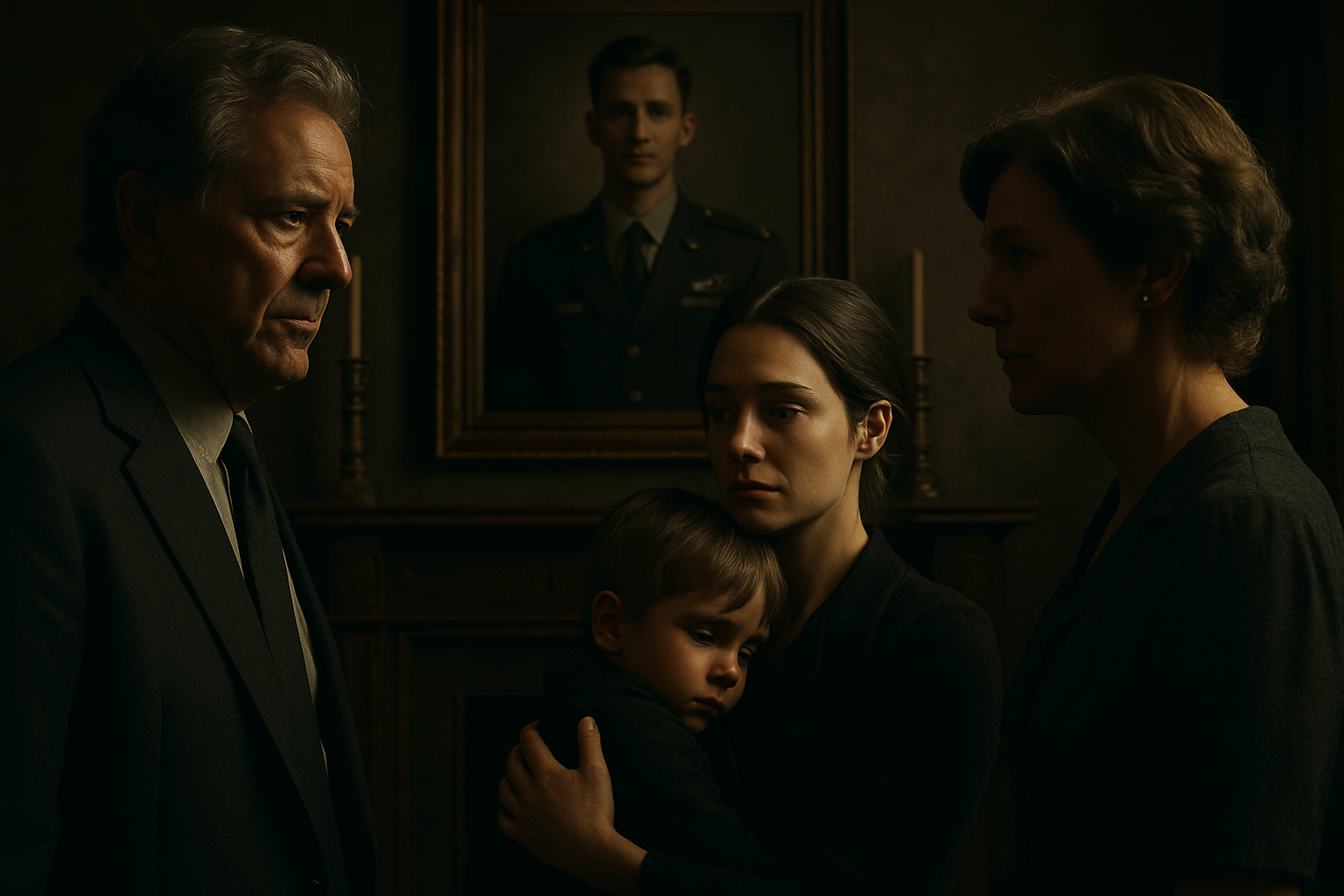
Gideon Vale stood in the grand drawing room of the Vale estate outside Lake Placid with his widowed daughter-in-law beside him and his small grandson pressed against her shoulder.

Across from him stood his sister, Marjorie.

Only an hour earlier, she had been smiling over a charity luncheon, pouring champagne beneath the portrait of Gideon’s dead son, Captain Rowan Vale, who looked down from the mantel in his Air Force dress uniform, young and bright and forever beyond reach.

But now the room had gone still.

The donors stopped whispering.

The trustees stared at the floor.

The polished women in pearls suddenly looked as if they wished the wallpaper would open and swallow them whole.

Gideon did not raise his voice.

He never had to.

“Mr. Price,” he said to his attorney. “Read it.”

Samuel Price opened the first folder.

Marjorie’s eyes narrowed. “Gideon, there is no need for this.”

“There was no need,” Gideon said, “to send two private guards after a grieving mother and a four-year-old boy and have them removed from a home that was never yours to take from them.”

The silence turned heavy.

Lila Vale lowered her eyes, but Gideon placed one hand gently on her shoulder.

“Don’t,” he murmured. “You have nothing to be ashamed of.”

Lila lifted her chin.

Little Finn, still sleepy from the long, frightening day, whispered, “Granddad?”

Gideon looked down at him, and for the first time his face softened.

“Yes, my boy?”

“Are we in trouble?”

That question broke the room.

A woman near the piano covered her mouth. The driver, Thomas Bell, stared hard at the carpet. Even one of Marjorie’s oldest friends stopped pretending to study her champagne.

Gideon held his grandson’s frightened gaze.

“No,” he said. “You are home.”

Marjorie’s jaw tightened. “Don’t make a performance of this. I was protecting the estate.”

Samuel Price looked up from the document. “Mrs. Marjorie Vale has no legal authority over this residence, the Vale Family Trust, the Rowan Vale Memorial Fund, or the custody, residence, inheritance, or financial protections of Finn Vale.”

A murmur rippled through the room.

Color rose in Marjorie’s neck. “That is a selective reading.”

“It is the legal reading,” Price said.

Gideon turned to the gathered guests beneath Rowan’s portrait.

“My sister told Lila that because Rowan was dead, she and her child no longer had a place in this family.”

“That is not what I said,” Marjorie snapped.

Lila’s voice trembled, but she spoke.

“You said I was a widow by accident. You said Finn would be better raised away from my small-town thinking. You said Rowan was not here anymore to speak for me.”

The words landed like stones.

Marjorie gave a brittle laugh. “She was upset. She heard what she wanted to hear.”

Gideon lifted a creased envelope from Lila’s hand.

“Did she invent the one-way ticket to Cleveland? The motel address you printed for her? The guards? The statement you tried to make her sign, saying she left this house willingly?”

Marjorie went rigid.

That paper had been her mistake.

Cruel people trust fear too much. They forget that frightened people sometimes hold on to proof because proof is all they have left.

Price opened another folder.

“The document Mrs. Vale attempted to obtain from Lila would have created a false record that Lila voluntarily abandoned the residence and waived any future housing claim connected to the family trust.”

Lila’s face went pale.

She had not understood that part.

Gideon saw it, and his anger turned colder.

Marjorie had not merely humiliated her.

She had tried to trap her grief in legal language.

Lila turned to Marjorie. “You wanted it to look like I walked away from my husband’s home?”

Marjorie lifted her chin. “You were never meant to live here forever.”

“The trust says otherwise,” Gideon said.

Price read aloud.

“Upon the death of Captain Rowan Vale, his surviving spouse, Lila Mercer Vale, and his minor child, Finn Rowan Vale, shall retain residential use of the Lake Placid family property, or any designated Vale residence, with maintenance, security, medical, and educational protections funded by the Rowan Vale Memorial Trust until Finn reaches twenty-five years of age.”

One trustee whispered, “Good Lord.”

Gideon stepped closer to his sister.

“You threw them out of the house my son made sure would shelter them.”

At last, Marjorie’s mask cracked.

“She is not one of us.”

The sentence hung in the air, ugly and bare.

Lila flinched.

Gideon did not.

He looked at Rowan’s portrait, then back at his sister.

“She became one of us the day my son chose her. She became more one of us the day she carried his child through his funeral with more dignity than this family deserved.”

Marjorie scoffed. “She married into money.”

“No,” Gideon said. “She married Rowan. Money is what people like you mistake for worth.”

A woman beside Marjorie quietly set down her glass and took one step away.

It was small.

It mattered.

Marjorie saw it.

“You are humiliating me in front of my guests,” she hissed.

“You humiliated a widow in front of armed men and her little boy.”

Marjorie had no answer.

Then the foundation administrator, Peter Halloway, stepped forward with another folder clutched to his chest.

“Mr. Vale, as you instructed, we completed an emergency review of foundation access and spending during your absence.”

Marjorie’s face changed.

This time, everyone saw the fear.

“Go on,” Gideon said.

Peter swallowed. “Several disbursements from the foundation’s community housing program appear to have been redirected to vendors connected to Mrs. Vale’s private event planner. We also found invoices for luxury flowers, private transportation, and catering filed as outreach expenses.”

The room seemed to tilt.

Marjorie laughed once, too sharply. “An accounting mix-up.”

Price opened another file.

“There are also payments to the two private security contractors who removed Lila and Finn today. Those payments were processed through the foundation’s domestic support budget.”

Gideon stared at his sister.

“You used charity money to throw my grandson out of his home?”

“I used available resources to resolve a family issue.”

Lila covered one of Finn’s ears.

Gideon took one measured step forward.

“My grandson is not a family issue.”

Marjorie’s eyes flashed. “You were gone. Someone had to make decisions.”

“Yes,” Gideon said. “And now I am here.”

He turned to Peter.

“Effective immediately, Marjorie Vale is suspended from every role, public title, spending authority, and board access within the Vale Foundation pending a full audit.”

Marjorie gasped. “You cannot do that.”

Peter answered quietly, “He can.”

Price added, “And he already has.”

Marjorie looked around the room for rescue.

No one moved.

That was the truth about people who worshiped status. Friends came close when the champagne was cold and the music was sweet. But legal trouble made a lonely woman very quickly.

Gideon looked toward Thomas.

“Take Lila and Finn upstairs. Put them in the east suite. Tell Agnes to make dinner. Real dinner. Not scraps from this performance.”

Lila hesitated. “I don’t want to leave you alone with this.”

His voice softened.

“You are not being sent out of the room. You are being returned to your home. Those are different things.”

Finn stirred against her shoulder.

“Can I see Daddy’s airplane room?”

Gideon’s throat tightened.

Rowan’s old room still had model planes hanging from the ceiling and flight manuals lined on the shelves.

“Yes,” he said. “Thomas will take you.”

Lila passed Marjorie without looking at her.

That wounded Marjorie more than anger would have.

Because Lila no longer looked beaten.

She looked protected.

When Lila and Finn were upstairs, Gideon faced the room.

“Everyone may go.”

No one needed to be told twice.

Within minutes, cars rolled down the long drive. The music stopped. Champagne vanished. The drawing room became what it should have been from the beginning.

A family battlefield with the decorations stripped away.

Only Gideon, Marjorie, Price, and Peter remained.

Marjorie folded her arms. “You are doing this because you feel guilty.”

“Guilty?”

“You were in Paris while your family fell apart.”

“Brussels,” Gideon said coldly.

“What?”

“I was in Brussels. You didn’t even care enough to remember which trip you used as your chance.”

Her face tightened.

Gideon walked to a side table and picked up a framed photograph of Rowan, Lila, and Finn.

Someone had turned it face down.

He lifted it slowly.

“Was this your doing too?”

Marjorie said nothing.

He turned the frame upright.

In the picture, Rowan was laughing. Finn sat on his shoulders. Lila looked up at them with the soft happiness of a woman who still believed life would give them time.

Gideon set the frame beside Rowan’s portrait.

Then he turned back.

“You hated her because he loved her.”

Marjorie’s eyes filled with something almost like pain.

“She changed him.”

“No,” Gideon said. “She showed us who he already was.”

“He was meant to lead this family. He was meant to marry someone who understood us. Someone polished. Someone connected. Instead, he brought home a girl who acted grateful every time she was allowed into a room.”

“She was grateful because people like you made her think kindness had to be earned.”

Marjorie’s mouth twisted. “She knew what she was marrying.”

“She married a pilot with a dangerous job and a decent heart.”

“She married the Vale name.”

“No,” Gideon said. “You are the one who married yourself to the Vale name without ever earning the cost of carrying it.”

She went pale.

He did not stop.

“You did not build the foundation. You posed beside it. You did not hold this family together. You fed on it. You never protected our name. You polished it in public and poisoned it in private.”

Her hand trembled. “You owe me respect.”

“I owed you patience,” Gideon said. “I overpaid.”

Price cleared his throat.

“There is one more matter.”

Marjorie turned. “What now?”

Price placed a sealed envelope on the table.

“Captain Rowan Vale left a letter with his trust instructions. It was to be opened only if anyone in the family attempted to displace Lila or Finn after his death.”

Gideon closed his eyes.

Of course.

Rowan had always seen more than he said.

“Read it,” Gideon whispered.

Price opened the envelope.

Marjorie suddenly looked smaller.

The attorney read Rowan’s words aloud.

“Dad, if you are hearing this, then someone did exactly what I feared. I hope it was not Aunt Marjorie. But if it was, do not let grief make you gentle with cruelty. Lila will try to leave quietly before anyone can accuse her of being a burden. Do not let her. She is my wife. Finn is my son. They are not visitors in our family. They are my family.”

Gideon’s eyes burned.

Price continued.

“If something happens to me, I want Finn raised knowing his mother was respected, not merely tolerated. I want him to hear our name and think of safety, not punishment. If anyone uses my death as a chance to push them out, that person is not defending the Vale legacy. That person is the threat to it.”

Silence filled the room.

Marjorie looked away first.

His son had known.

He had known Lila’s gentleness might be used against her. He had known Marjorie’s contempt would sharpen once he was gone. He had even known his father might need permission to fight someone who shared his blood.

Gideon looked at his sister.

“You are leaving tonight.”

Her head snapped up. “This is my family home too.”

“No. It is trust property. You stayed here as a courtesy. That courtesy is revoked.”

“You would put your own sister out?”

“You put out my son’s widow and child.”

“I sent them to an airport. You act as if I left them in the street.”

“You left them afraid,” he said. “That was enough.”

Price spoke evenly.

“You will be given temporary accommodations at the Albany hotel where the foundation keeps guest rooms. Seven days will be paid. After that, you are responsible for yourself.”

Marjorie stared. “Seven days?”

Gideon’s eyes hardened.

“That is more notice than Lila received.”

For once, Marjorie had no elegant reply.

That night, the estate changed.

Marjorie’s belongings were packed under supervision. The guards she hired were reported to their agency. The young lawyer who had pressured Lila was warned that the family would file a bar complaint if he had misrepresented his authority.

Upstairs, Lila bathed Finn and dressed him in borrowed pajamas Agnes the housekeeper had kept tucked away for visits.

Finn fell asleep with his green dinosaur pressed to his chest.

Gideon stood in the doorway for a long time.

Lila noticed him. “Mr. Vale?”

“May I?”

She nodded.

He walked in and looked down at his grandson.

Finn had Rowan’s eyelashes.

That nearly undid him.

“I failed you today,” Gideon said quietly.

Lila shook her head. “No. You came back.”

“I should have made everything clear before I left.”

“You trusted your sister.”

“That was my mistake.”

Lila looked toward the dark window.

“I kept thinking if I was quiet enough, polite enough, small enough, she might stop despising me.”

Gideon sat beside the bed.

“People like Marjorie do not stop when you make yourself smaller. They stop when someone takes their power away.”

Lila’s eyes filled.

“She told Finn his father’s room didn’t belong to him anymore.”

Gideon’s face tightened.

“He may sleep there tomorrow if he wants.”

“He will,” Lila said, with a broken little laugh. “He still talks to Rowan’s flight helmet.”

Gideon looked down.

“So do I.”

That was what made her cry.

For a moment, neither of them hid their grief. It sat between them plainly. Not the polished grief Marjorie wore like black silk, but the raw kind that still reached for a missing hand at the dinner table.

A soft knock came.

Thomas entered with a tray.

“Soup, sandwiches, fruit, and tea,” he said. “Agnes says nobody in this room is permitted to pretend they aren’t hungry.”

Lila smiled through tears.

“That sounds exactly like her.”

Gideon stood.

“Eat,” he said. “Tomorrow will not be easy.”

“What happens tomorrow?”

He looked down the hall, where Marjorie’s heels clicked as she was escorted out.

“Tomorrow we learn how much of the family name she tried to spend while I was away.”

The audit began at eight the next morning.

By noon, Marjorie’s careful life began to collapse.

The foundation had paid for personal clothing labeled as gala representation. A scholarship donation had been delayed because she diverted money to redecorate her office. A housing grant had paid for private floral arrangements.

Staff members reported being told to “make Lila uncomfortable enough that she chooses to leave.”

One email was especially damning.

“The widow needs to understand that Rowan’s death changed her position. We cannot allow her and that child to behave like permanent heirs.”

Gideon read it twice.

Then he forwarded it to the board.

By three o’clock, an emergency meeting had been scheduled.

By six, Marjorie was removed permanently from the foundation.

By the following morning, newspapers had heard whispers.

Gideon knew Marjorie would blame Lila.

She always blamed the person with the least power.

But this time, Lila was not standing alone.

At the board meeting, Gideon placed Rowan’s letter on the table.

“My son served this country,” he said. “He died in uniform. Before his death, he protected his wife and child in writing because he feared exactly what happened while I was overseas.”

No one spoke.

“My sister used a decorative position in this foundation to intimidate that widow, remove her from trust property, and attempt to cut a child off from his father’s home. She used foundation resources for private purposes and exposed this institution to damage we are now legally required to repair.”

A trustee cleared his throat.

“Are you recommending criminal review?”

Gideon looked at Price.

“Yes.”

Marjorie had expected embarrassment.

She had not expected consequences.

A week later, she arrived at Gideon’s office without an appointment.

She looked different without the estate behind her. Still elegant. Still wearing pearls. But strained around the eyes.

“You are enjoying this,” she said.

Gideon did not rise.

“No.”

“You always resented my place in the foundation.”

“You had a place because I allowed you to have one.”

“Our father would be ashamed of you.”

Gideon looked at her then.

“Our father would ask why you bought centerpieces with charity money while veterans’ widows waited for housing help.”

She flinched.

“It wasn’t that simple.”

“It was exactly that simple.”

Marjorie sat down though he had not invited her.

“I made mistakes.”

“Yes.”

“I was grieving Rowan too.”

Gideon’s expression changed.

“No. Do not use his name as shelter.”

Her eyes filled. With Marjorie, tears and theater had long ago learned to hold hands.

“He was my nephew,” she whispered.

“And you threw out his son.”

She looked down.

For the first time, something like shame entered the room.

Not enough.

But some.

“I wanted the family to go back to what it was,” she said.

Gideon leaned back.

“That family never existed. It was only everyone arranging themselves around your comfort.”

“What happens to me now?”

“There will be an investigation. The board will decide on civil action. Price will handle the legal side.”

“And you?”

Gideon looked at the photograph of Rowan on his desk.

“I am going home to my grandson.”

Marjorie laughed bitterly.

“She won.”

Gideon stood.

“No. Lila survived you. There is a difference.”

Three months later, the Vale Foundation released a public statement.

It acknowledged misuse of funds, promised restitution, and announced a new program for military widows, surviving spouses, and children of service members.

The Rowan Vale Family Support Initiative.

Its director would be Lila Mercer Vale.

Lila almost refused.

“I’m not qualified,” she told Gideon.

They were sitting in the Lake Placid kitchen before sunrise. Finn was at the table coloring airplanes while snow moved past the windows.

Gideon poured coffee.

“You know exactly how it feels when people treat grief as if it makes you disposable.”

“That does not make me a director.”

“No,” he said. “But compassion, discipline, and a refusal to let another widow sit in an airport holding a one-way ticket might.”

A small smile touched her mouth.

“I’m frightened.”

“Good,” Gideon said. “Arrogant people rarely are. That is why they hurt others so easily.”

So Lila accepted.

At first, donors watched her with careful smiles. Some thought she had been given a symbolic role. A young widow with a touching story. Someone to stand at luncheons while older, richer people made the real decisions.

They underestimated her.

That was their first mistake.

Lila read every file.

She called widows herself.

She asked what they needed before announcing what the foundation could offer. She simplified applications, removed humiliating requirements, created emergency travel funds, and built a housing network so no spouse of a fallen service member would ever be told, after a funeral, that they no longer belonged.

Within a year, her program became the foundation’s most respected work.

Finn began laughing again too.

Not all at once.

Grief does not leave a child simply because adults finally behave decently.

But slowly, he returned to himself.

When they visited Lake Placid, he slept in Rowan’s old room. He wore his father’s Air Force cap around the house. He asked Gideon to tell stories about “Daddy above the clouds,” and Gideon told them, even when his voice broke halfway through.

One evening, Finn stood before Rowan’s portrait.

“Did Daddy know we would come back?”

Lila froze.

Gideon knelt beside him.

“Your daddy made sure you always could.”

Finn touched the frame.

“Then Aunt Marjorie was wrong.”

Gideon looked at Lila.

“Yes,” he said. “She was.”

Marjorie’s fall was not the dramatic ruin people expected.

There was no screaming arrest. No sudden prison sentence. No scandal that shattered society overnight.

There were audits. Repayments. Legal settlements. Board expulsions. And the slow, humiliating disappearance of invitations.

Her friends stopped calling.

Gala committees replaced her.

That wounded her more than any legal notice.

People like Marjorie can survive guilt.

They cannot survive becoming irrelevant.

Nearly two years after the airport, Marjorie asked to meet Lila.

Gideon refused at first.

Lila surprised him.

“I’ll hear her.”

“You owe her nothing.”

“I know,” Lila said. “That is why it will be my choice.”

They met in a quiet café in Albany.

Gideon sat nearby, close enough to intervene, far enough away to let Lila own the moment.

Marjorie looked older. Not ruined. Not poor. But stripped of the stage lighting she had always carried with her. Her pearls were smaller. Her posture remained perfect. Her eyes were tired.

For a long time, she said nothing.

Then she whispered, “I was cruel to you.”

Lila waited.

“I told myself I was defending Rowan’s legacy. The truth is, I resented you because he loved you without asking us for permission.”

Lila’s fingers tightened around her cup.

“He loved all of you too.”

“I know,” Marjorie said. “But with us, he was always negotiating. With you, he was free.”

That hurt because Lila knew it was true.

Marjorie’s eyes filled.

“I wanted to punish you for having the part of him I could not control.”

Lila looked out the window. Snow drifted over the sidewalk.

“You punished my son.”

Marjorie flinched.

“Yes.”

“That is the part I cannot make gentler for you.”

“I know.”

“Do you?”

Marjorie nodded, crying now.

“I see him sometimes in photographs. At foundation events. He looks so much like Rowan. And I remember his face that day when the guards carried your suitcases down the stairs. He asked if he could bring his dinosaur.”

Lila closed her eyes.

Marjorie covered her mouth.

“I told him no.”

That detail was new.

Lila’s face tightened.

Marjorie whispered, “I am sorry.”

Lila drew a slow breath.

“I believe you are sorry now. But my forgiveness is not a doorway back into his life.”

Marjorie nodded.

“You may write him a letter. I will keep it. When he is older, if he chooses to read it, he can. Until then, you do not get access to him simply because guilt finally found you.”

Marjorie cried harder.

Lila stood.

“Goodbye, Marjorie.”

When Lila walked back to Gideon, he rose.

“Are you all right?”

She nodded.

Then she said, “I am not the woman she put on that plane anymore.”

Gideon looked at her with pride so deep it nearly hurt.

“No,” he said. “You are not.”

Years passed.

Finn grew tall, curious, and stubborn like his father. He loved airplanes, dinosaurs, and asking impossible questions at impossible times.

He carried the Vale name, but Lila never let him believe it made him better than anyone.

That was her rule.

A name was not a crown.

It was a responsibility.

On the fifth anniversary of Rowan’s death, the foundation held a memorial event at an Air Force museum in Dayton. Families of fallen service members filled the hall. Children ran between display aircraft. Widows held one another without needing to explain a thing.

Lila stood at the podium with Finn beside her.

Gideon sat in the front row.

Behind them was a large photograph of Rowan in uniform.

Lila looked out over the room.

“After my husband died,” she said, “someone told me my son and I no longer belonged to his family. For a little while, I believed her. Grief can make you believe terrible things about your own worth.”

The hall went quiet.

“But one person found us at an airport and reminded me that family is not decided by the cruelest voice in the room. Family is proven by who comes for you when you have nowhere else to go.”

Gideon looked down, his eyes wet.

Lila rested her hand on Finn’s shoulder.

“This program exists so no surviving spouse, no child, no parent, no family left behind after service ever has to beg for belonging. If someone served, if someone loved them, if someone was left carrying the grief, then they matter.”

Applause rose slowly, then filled the room.

Finn leaned toward the microphone.

“My dad flew planes,” he said.

The crowd softened.

“And my mom says he made sure we always had a home.”

Lila covered her mouth.

Gideon stood with everyone else, clapping through tears.

That night, after the event, Gideon and Lila walked outside while Finn slept in the back seat of the car, holding the same green dinosaur he had kept since the airport.

The air was cold and clear.

Gideon looked at Lila.

“I never thanked you.”

“For what?”

“For staying.”

Lila seemed surprised.

“You gave us a home.”

“No,” Gideon said. “Rowan did that. I only enforced what he left behind. You stayed when this family gave you every reason to disappear.”

She looked through the car window at her sleeping son.

“I stayed because Finn deserved to know where his father came from.”

Gideon nodded.

“And because you belonged.”

Lila smiled softly.

“I know that now.”

A year later, Marjorie died quietly after a brief illness.

She had spent her final years far from society rooms, volunteering at a veterans’ hospice under her middle name, where almost no one knew who she had once been.

Whether it was penance, loneliness, or finally a little honesty, Lila never knew.

The letter Marjorie wrote to Finn remained sealed in Lila’s desk.

When Finn turned sixteen, he asked for it.

He read it alone beneath the old maple tree behind the Lake Placid house.

When he came back inside, his face was thoughtful.

“What did she say?” Lila asked gently.

He sat at the kitchen table.

“She said she was sorry she made me feel like I didn’t belong. She said Dad would have been ashamed of her.”

Lila nodded.

“What do you feel?”

Finn looked toward Rowan’s portrait.

“I feel sad for her.”

“That is allowed,” Lila said, touching his hand.

“Do I have to forgive her?”

“No.”

He thought about that.

“I think I do. But I don’t want to forget.”

Lila smiled sadly.

“That is often the wisest kind of forgiveness.”

Years later, people would remember Marjorie’s scandal as a family power struggle.

They would whisper about the airport, the one-way ticket, the audit, and the luncheon where Gideon came home early and dismantled his sister in front of every guest who mattered.

But Gideon remembered something else.

He remembered Lila sitting on an airport bench with a sleeping boy and three battered suitcases.

He remembered the shame in her voice when she said she did not want to cause trouble.

He remembered Finn asking whether they were in trouble.

And he remembered realizing that the Vale name had never been protected by wealth, galas, foundations, or speeches.

It had been protected by the people willing to stand between cruelty and the vulnerable.

By a widow who refused to sign a lie.

By a driver who ran toward the truth.

By a dead son who left instructions because he understood that love sometimes needs paperwork too.

And by an old father who finally understood that family legacy means nothing if it cannot shelter the people grief leaves behind.

Lila never became loud.

She did not have to.

She became steady.

She raised Finn with dignity. She built a program Rowan would have been proud of. She entered rooms where people once looked past her and spoke with the quiet authority of someone who had survived the cruelest table and no longer needed permission to sit.

As for Gideon, every time he returned from a business trip, he no longer looked first for his driver.

He looked for his family.

Sometimes they waited together at the airport.

Lila with coffee in one hand.

Finn taller every year, waving the way his father once had.

And every time Gideon saw them, he remembered the day his sister tried to decide who belonged.

She had been wrong.

Because belonging was not something Marjorie could grant.

It had already been given by love, protected by law, and sealed in the memory of a son who had known exactly who his family was.