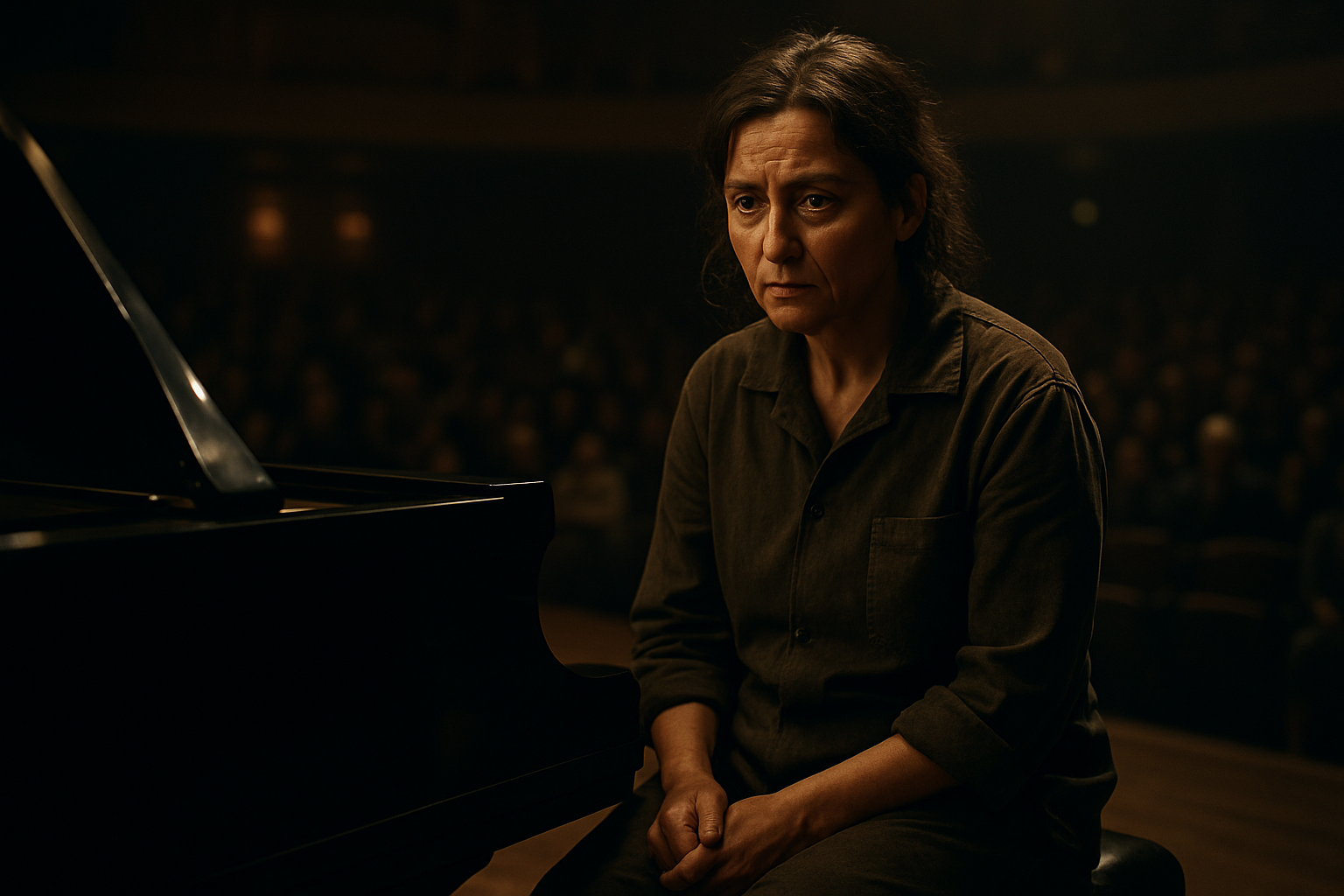
The Cleaning Woman at the Grand Piano

The Cleaning Woman at the Grand Piano

I felt every eye in that hall settle on me.

Heavy eyes.

Curious eyes.

Cruel eyes.

They were waiting to see how long it would take for the cleaning woman to break.

For a few seconds, I could not move. My knees felt hollow. My hands trembled in my lap. My heart beat so loudly I could barely hear the whispers rising around me.

“Is she staff?”

“Poor thing.”

“Why would he do that?”

“She won’t go up there.”

That last one hurt the most.

Not because it was unkind.

Because it was pity.

They had already decided what I was. What I could be. Where I belonged.

Sebastian Vale stood beneath the stage lights, smiling down at me as if he had offered me a gift instead of a trap. Behind him, the black grand piano shone like something sacred.

It was not the old upright my grandmother had kept in her kitchen. It was not the dusty church keyboard I sometimes touched when no one was looking.

This was a grand piano in one of the finest halls in the city.

And everything about it seemed to say, Not for hands like yours.

I looked down.

My hands were rough. Dry at the knuckles. Cracked near the nails from bleach, soap, and years of cleaning other people’s messes.

But then I remembered my grandmother’s hands.

They had looked like mine.

Hard-working hands. Laundry hands. Cooking hands. Hands that had never worn diamonds.

Yet when she sat at the piano, those hands became birds. Rain. Prayer.

“Never be ashamed of hands that have worked, Elena,” she told me when I was seven. “Hands that work know how to pray. Hands that suffer know how to make music tell the truth.”

I had not thought of those words in years.

Now they came back like a door opening.

Sebastian tilted his head, still smiling.

“Come now,” he said into the microphone. “We are all friends here.”

A soft laugh moved through the hall.

Not a warm laugh.

A laugh with teeth.

Something in me changed.

It was not courage. Not yet.

It was weariness.

I was tired of being invisible until someone needed a joke. Tired of scrubbing floors in rooms where no one learned my name. Tired of people looking past me as if my life had no music in it.

So I stood.

The hall went silent.

I stepped into the aisle. Left my purse on the seat. Walked toward the stage.

Each step felt longer than the last.

I could feel them measuring me. My plain black dress. My worn shoes. My ordinary face. But with each step, my grandmother’s kitchen grew clearer.

Coffee on the stove.

Rain against the window.

Her silver hair pinned back as she played, eyes closed, listening to something only angels could hear.

A young usher helped me up the stairs. His face was red with embarrassment. I took his hand, not because I needed it, but because he seemed to need to offer it.

When the lights hit me, I almost stepped back.

From the audience, the hall had looked grand.

From the stage, it looked endless.

Sebastian came close, lowering the microphone.

“Brave woman,” he murmured.

I said nothing.

He leaned nearer. His smile stayed in place, but his eyes were cold.

“Just press a few keys. Smile. Then sit down before you make this worse for yourself.”

There it was.

He did not want music.

He wanted surrender.

I looked at the piano.

“What would you like me to play?” I asked.

For the first time, his smile slipped.

Then he turned to the audience.

“She asks what she should play,” he announced. “How delightful.”

The crowd gave a nervous chuckle.

“Anything you know,” he said.

“Anything?”

His eyes narrowed. “Something simple.”

I nodded.

“My grandmother used to say simple songs are the hardest ones to play honestly.”

A few people shifted in their seats.

Sebastian’s smile froze.

He had expected me to tremble. To apologize. To shrink.

He had not expected me to bring my grandmother with me.

I sat at the piano.

The bench was set for him, so I adjusted it. That small scrape echoed through the hall like a secret being dragged into the open.

For thirty years, I had told myself music was over for me.

Music belonged to childhood.

To people with money.

To teachers, quiet rooms, and time.

My life had become night shifts, rent, sore knees, overdue bills, and trains before dawn. I had buried the girl who played because there was no room for her to breathe.

But she had not died.

She had been waiting.

I lifted my hands and played the first notes of “Twinkle, Twinkle, Little Star.”

The reaction came at once.

Laughter.

Relieved laughter.

Cruel laughter.

Of course, they thought.

Of course the cleaning woman knew a children’s song.

Sebastian stepped aside, folding his arms.

For four measures, I let them believe it.

Then I changed the left hand.

The little tune deepened. Warmed. Opened.

The laughter faded.

I moved into the first variation, light and quick, the melody dancing above a rolling current. My fingers felt stiff for a moment.

Then memory took over.

The body remembers what the world tries to bury.

By the second variation, the hall was still.

The children’s song had become a river.

I dressed it in longing. Then joy. Then sorrow. My right hand rose in bright runs while my left hand carried the melody underneath, like a voice singing from another room.

The piano answered me.

It did not resist.

It opened.

I forgot the audience.

I forgot Sebastian.

There was only sound, and beneath it, my grandmother’s voice.

“Do not play to impress them, Elena. Play so the truth has somewhere to go.”

Then I let the melody shift.

Out of that little song came another one.

Older.

Deeper.

A song my grandmother had called “The Rain Song.”

She had written it after leaving her island, after burying my grandfather, after arriving in the city with one suitcase, one daughter, and a heart full of music no one had paid to hear.

It began with three falling notes, soft as a sigh.

Then it rose, as if grief had remembered hope.

The moment those notes entered the hall, Sebastian changed.

I saw it from the corner of my eye.

His face drained of color. His arms dropped. He stared at my hands as though they had reached into his chest and taken something from him.

He knew that song.

I kept playing.

The first part was rain on a kitchen window.

The second was a woman walking through a city that did not know her name.

The third was prayer. Not pretty prayer. The kind that comes when you have nothing left but breath.

By the final chord, my eyes burned.

The sound faded into the rafters.

No one moved.

Then someone clapped.

Slowly.

Deliberately.

Another joined. Then another.

Within seconds, the applause became a roar. People stood. A woman in the front row, glittering with crystals, was crying openly. The young couple who had leaned away from me were now on their feet, staring as if I had become someone they had failed to see.

I sat frozen.

For one impossible moment, I thought it was over.

Then Sebastian stepped forward.

He lifted the microphone over the applause.

“Remarkable,” he said tightly. “A charming little improvisation.”

The applause weakened.

Something was wrong, and the room felt it.

“A very emotional performance,” he continued. “Unexpected, certainly. But let us not get carried away. This evening still has a program to complete.”

He reached toward me as if to help me stand.

I did not take his hand.

“That wasn’t an improvisation,” I said.

The microphone caught my voice.

The hall fell silent.

Sebastian turned slowly.

“I beg your pardon?”

I stood. My legs shook, but I stood.

“That piece was written by my grandmother, Amalia Torres.”

The name moved through the hall like a match struck in darkness.

Most people did not know it. Why would they?

Amalia Torres had never played in famous halls. She had taught neighborhood children in church basements. She had written music in cheap notebooks at the kitchen table. When she died, the city did not pause.

But Sebastian knew.

I saw it.

His mouth tightened.

“I have never heard of her.”

It was a clean lie.

Before I could answer, an old man in the third row rose slowly, leaning on a cane.

“Mr. Vale,” he said, his voice thin but clear, “I have heard that name.”

Sebastian stiffened.

“Professor Harrow?”

A murmur passed through the crowd.

The old man looked at me, not with pity, but with startled respect.

“Amalia Torres taught at the Northside Community Music School in the late seventies and early eighties,” he said. “I served on a grant committee there before the funding disappeared.”

Then he looked back at Sebastian.

“And if memory serves, a young pianist named Tomás Calderón attended that program before he became Sebastian Vale.”

The hall seemed to inhale.

Tomás Calderón.

The name struck me like a bell.

My grandmother had once spoken of a boy named Tomás.

Not often.

Never without sadness.

He had been gifted, she said. Hungry in the way lonely children are hungry. His mother cleaned offices. His father was gone. He came to her with shoes too small and anger too large for his body.

She fed him.

Taught him.

Defended him.

Then one winter, he vanished.

So did one of her notebooks.

“Some people steal because they are hungry,” my grandmother once said. “Some steal because they cannot bear to be grateful.”

Sebastian’s face had gone gray.

“This is absurd,” he said. “This is a concert, not a courtroom.”

“No,” Professor Harrow replied. “But the piece she just played bears a striking resemblance to the unpublished theme you used in your first major composition, ‘Rain Over the City.’ The one that made your career.”

Whispers exploded through the hall.

I had heard that piece years ago while cleaning an office tower at two in the morning. I had frozen with a trash bag in my hand because the opening melody made my bones cold.

I told myself I was imagining it.

Music echoes music, I thought.

Maybe grief has common shapes.

But now I understood.

My grandmother had known.

Or suspected.

And she had carried that wound quietly, the way poor women carry so many wounds, because fighting would have required money, time, and a belief the world had trained out of her.

Sebastian raised a hand.

“Ladies and gentlemen, please. This misunderstanding is being encouraged by emotion. I will not stand here and have decades of work slandered by—”

He stopped.

Too late.

By a cleaning woman.

He did not say it.

Everyone heard it.

The hall changed.

The same crowd that had laughed at me now turned on him.

I knew better than to trust it fully. Crowds are easily moved. They can pity you one minute and abandon you the next.

Still, something had shifted.

I stepped toward the microphone.

Sebastian pulled it away.

A small gesture.

The whole hall saw.

Professor Harrow said, “Let her answer.”

A woman in the balcony called, “Let her speak.”

Then others joined.

“Let her speak.”

“Let her speak.”

Sebastian had built his life on applause. Now the crowd used its voice against him.

He handed me the microphone.

It felt heavier than I expected.

“My grandmother was not famous,” I said. “She had no wealthy patrons. No reviews. No grand stage. She taught children whose parents sometimes paid her with groceries. She wrote music after working all day.”

I looked at Sebastian.

“She taught me a song called ‘The Rain Song.’ She told me it was hers. She also told me about a boy named Tomás. A boy she loved like family. A boy she believed would become great if the world did not break him first.”

His jaw tightened.

“She said he disappeared with one of her notebooks. Tonight, when I played her song, you recognized it.”

“Recognition is not guilt,” he said.

“No,” I answered. “But fear is.”

A young woman in the aisle stood, holding up her phone.

“I recorded all of it,” she said. “From the moment he called her up.”

Another voice called, “I did too.”

Then someone shouted, “Play the piece again!”

The words spread.

“Play it again!”

“Let her play!”

“Play Amalia Torres’s song!”

Professor Harrow looked at me gently.

“Ms. Cruz, would you play the original as your grandmother taught it?”

Original.

The word hung in the air.

I sat again.

This time, I did not begin with a children’s song.

I began with rain.

I played it as my grandmother had taught me. Not with thunder. Not with the grand flourishes Sebastian had added for concert halls. Her song was not about victory.

It was about endurance.

A woman at a window.

A strange city.

Everything familiar gone.

And still deciding to wake up tomorrow.

By the end, even those who knew nothing about music understood.

Sebastian had not merely borrowed from her.

He had taken the bones of her song and built a mansion, then locked the door.

When I finished, I did not wait for applause.

I placed the microphone on the piano and walked offstage.

No one stopped me.

Not the ushers.

Not the donors.

Not Sebastian.

The applause rose behind me, but I could not hold it. I wanted air. I wanted the train. I wanted my grandmother, dead twelve years and suddenly nearer than anyone alive.

At my seat, I grabbed my purse.

The woman in crystals touched my arm.

“Dear,” she whispered, tears on her cheeks, “who are you?”

For most of my life, that question had felt like an accusation.

Tonight, it sounded like an invitation.

“I’m Elena Cruz,” I said.

Then I walked out.

The cold night air struck my face like mercy.

The city moved as if nothing had happened. Taxis rolled by. People laughed. A siren wailed somewhere far away.

I had no lawyer. No plan. No proof beyond memory, an old professor, and a song passed from grandmother to granddaughter.

By morning, Sebastian’s people might call me a liar.

They might call me confused.

They might bury me under expensive statements.

That should have terrified me.

Instead, I laughed.

Not happily.

But with the wild breath of someone who has fallen and found herself still standing.

My grandmother’s song had been heard.

No one could make that untrue.

I took the train home after midnight.

No limousine came.

No fairy-tale patron stepped from the shadows.

My feet hurt. A man slept across from me with his chin on his chest. A tired mother boarded with a stroller. Two teenagers argued over headphones.

The city returned me to the world I knew.

I was grateful.

When I reached my building, Lucia was waiting on the stoop in a bathrobe under her coat, her hair wrapped in a scarf.

“What happened?” she demanded. “You look like you saw a saint and punched a banker.”

I stared at her.

Then I began to cry.

She pulled me into her arms.

I cried for the girl I had buried. For my grandmother’s stolen notebook. For every night I had hummed music while emptying trash cans in offices where no one knew my name.

Only after the worst passed did I tell her.

By the end, her eyes were furious.

“That man is finished,” she said.

“No,” I whispered. “Men like him are never finished that easily.”

Lucia pulled out her phone.

“Maybe not. But Elena, you’re everywhere.”

The video had already been shared thousands of times.

The caption read:

Famous pianist invites cleaning woman to play as a joke. Big mistake.

By morning, millions had seen it.

My phone would not stop ringing. Reporters called the church. Strangers found my page. Some messages were kind. Others were cruel. People wanted proof, interviews, tears, outrage.

They wanted a heroine.

A victim.

A symbol.

Very few wanted a human being.

I still went to work that night.

Lucia called me crazy. Father Gabriel told me to rest.

But rent did not care about viral videos.

So at ten o’clock, I tied back my hair, put on my uniform, and took the train to the office building where I cleaned six floors every night.

For an hour, work steadied me.

Trash bins.

Conference tables.

Restrooms with stone sinks.

Then I reached the executive floor.

Mr. Whitaker, one of the senior partners, stood by the windows. I had cleaned his office for five years.

He had never learned my name.

That night he turned and said, “Elena.”

It startled me more than the concert.

“Yes, sir?”

“I saw the video,” he said. “Everyone has.”

I gripped my cleaning cart.

“I’m sorry if it causes trouble for the company.”

He looked embarrassed.

“No. That’s not what I meant.”

He handed me a business card.

“My wife sits on the board of a legal arts foundation. They handle intellectual property cases. If what you said about your grandmother is true, you should talk to them.”

I took the card slowly.

“Why would you help me?”

The question came out sharp.

He looked toward the dark windows.

“My mother cleaned houses,” he said quietly. “I spent years pretending that was not part of my story. Last night, watching that man shame you, I recognized something in myself I didn’t like.”

He swallowed.

“Take the card. You don’t owe me gratitude.”

That was the first crack in the wall.

Not justice.

Not yet.

But a crack.

The lawyers were careful at first. Memory was not enough, they said. Family stories were not enough. They needed documents, witnesses, recordings, anything linking Amalia Torres to the song before Sebastian published his famous piece.

With every explanation, hope shrank.

Then Father Gabriel called.

“Elena,” he said, voice trembling. “Come to the church.”

I found him in the basement storage room, surrounded by boxes that smelled of dust, candle wax, and old hymnals. Lucia was already there, kneeling beside a metal cabinet no one had opened in years.

Inside were programs, photographs, and notebooks bound with cracked elastic bands.

“Mrs. Navarro remembered,” Father Gabriel said. “Your grandmother donated some music materials before she died. We thought they were lesson books.”

I dropped to my knees.

The first notebook held children’s exercises in my grandmother’s careful hand.

The second had folk songs.

The third was water-stained along the edges.

Then I turned a page and stopped breathing.

There it was.

“The Rain Song.”

Written in blue ink.

Amalia Torres, 1979.

Below the title, in smaller letters, she had written:

For the children who must learn to dream in rented rooms.

I pressed my hand over my mouth.

Lucia began crying before I did.

Tucked into the back was a recital program from the Northside Community Music School. The date was April 12, 1980.

Among the students was a fifteen-year-old named Tomás Calderón.

Beside his name was the piece he performed:

“The Rain Song” by Amalia Torres.

It was not just proof.

It was my grandmother’s voice returning from a box no one had thought to open.

After that, the lawyers moved quickly.

They verified the ink, paper, and program. Professor Harrow gave a sworn statement. Two former students came forward. One had played the song as a child. Another had an old cassette, warped but usable, where my grandmother could be heard explaining the piece before a recital.

The story grew bigger than me.

Newspapers wrote about Amalia Torres.

People argued about theft, class, art, and power.

Sebastian released a statement. He regretted any “misunderstanding.” He denied wrongdoing. He claimed he had heard many melodies as a young man and any resemblance was unconscious.

He said he respected working people.

He said he respected women composers.

He said many pretty things.

But everyone had seen the video.

Two weeks later, he asked to meet me.

My lawyer warned me not to go alone. Lucia came with me, carrying pepper spray in her purse and murder in her eyes.

We met in an old rehearsal studio. Scratched wooden floors. Gray afternoon light. A small grand piano in the corner.

Sebastian arrived without cameras, assistants, or tuxedo.

He looked tired.

For the first time, I could see the boy my grandmother had described beneath the famous man’s face.

It did not soften me as much as I expected.

Pain may explain a wound.

It does not erase the blood.

“Ms. Cruz,” he said.

“Mr. Vale.”

His mouth tightened.

“My name was Tomás Calderón.”

Lucia muttered, “Was?”

He looked at me.

“I changed it when I was twenty-one.”

“Because Calderón didn’t fit on posters?” I asked.

He flinched.

“Because I thought no one would listen to a poor boy from the neighborhood,” he said. “Because teachers told me I needed polish. Because donors smiled at me like I was a charity case. Because my first manager said Sebastian Vale sounded like someone who could fill European halls.”

He looked at the piano.

“And because I was ashamed.”

The room went quiet.

I understood shame.

Not his theft. Not his cruelty.

But shame? Yes.

The world teaches it early to people with worn shoes and tired mothers.

“What did my grandmother do to you?” I asked. “Why steal from her?”

His face changed.

“She saved me.”

Those words hit harder than any excuse.

“My mother worked nights,” he said. “I was angry. I fought. I stole food. Rosa—Amalia—found me outside the community center one rainy afternoon. She brought me in, gave me soup, and made me listen while she taught a little girl scales. I told her scales were stupid. She told me arrogance without discipline was stupider.”

Despite myself, I heard my grandmother.

“She taught me for free,” he continued. “For years. When I got a scholarship audition, she gave me a notebook. Exercises. Pieces. Some of them hers. I knew ‘The Rain Song’ was hers.”

His voice broke.

“I played it at my audition because it was the only piece that made the room go quiet. They loved it. Not me. It. Someone said it sounded like an old folk tune, something anonymous, something I must have arranged. I meant to say her name.”

He closed his eyes.

“I didn’t.”

Lucia stood. “So you paid for your career with her life.”

He said nothing.

I thought of my grandmother hearing his music on the radio. Recognizing her own song wearing another man’s name. Turning down the volume. Washing dishes. Carrying the wound because she believed no one would listen.

“She died thinking the world had forgotten her,” I said.

He shook his head in pain.

“No,” I said. “You don’t get to grieve like that. The world remembered you.”

He had no answer.

I stepped closer.

“You humiliated me because you saw someone you used to be,” I said. “Didn’t you?”

His breath caught.

That was the deeper twist.

The man who mocked the cleaning woman was once the son of a cleaning woman himself.

“I hated what you reminded me of,” he whispered. “The cheap fabric. The fear. The hunger to belong. I wanted to crush it before it could accuse me.”

Lucia turned away, crying from anger.

I stood still.

Part of me wanted to strike him.

Part of me wondered if my grandmother had forgiven him long before I knew there was anything to forgive.

But forgiveness is too often demanded from wounded people like one more service.

So I did not offer it.

“What do you want from me?” I asked.

“I want to make it right.”

“You can’t.”

He nodded.

“No. I can’t.”

That was the first honest thing he said plainly.

“But you can stop lying,” I told him. “And you can give back what can still be given.”

“What do you want?”

I looked at the piano.

Then at Lucia.

Then out the window, toward a city full of people making beauty behind walls no audience ever sees.

“I want Amalia Torres’s name on every score, recording, and program connected to that melody. I want a public admission. Not a polished statement. I want royalties directed to a foundation for children who cannot afford music lessons. I want that foundation in her name. And I want you to play a benefit concert where you tell the truth from the stage you used to shame me.”

Lucia smiled for the first time that day.

Sebastian stared at me.

Then he said, “Yes.”

It did not heal anything.

But it opened a path.

The legal process took months. His team wanted soft words.

“Inspired by.”

“Unintentional omission.”

“Shared heritage.”

My lawyers fought. Professor Harrow fought. Lucia fought everybody, including me when I grew tired.

And I did grow tired.

There were days I wished I had never gone to that concert. Days strangers stopped me on trains. Days commentators argued whether I was talented enough to deserve sympathy, as if theft became acceptable when the victim was unknown.

But each time I wanted to quit, I returned to the church basement and opened my grandmother’s notebook.

For the children who must learn to dream in rented rooms.

That sentence became a command.

The settlement was announced in spring, on a rainy Tuesday.

Sebastian acknowledged that the central theme of “Rain Over the City” came from Amalia Torres’s unpublished “The Rain Song.” Future publications would credit her. A large portion of past and future royalties would fund the Amalia Torres Music Foundation, offering free instruments and lessons to children from low-income families.

The headlines lasted a few days.

The world moved on.

But in the places that mattered, everything changed.

The church basement filled with donated keyboards. Retired teachers volunteered. A violinist from the city orchestra offered Saturday classes. Mr. Whitaker’s wife joined the board and, to my surprise, worked harder than anyone.

Children came after school with backpacks, shy smiles, and hands that did not yet know what they could become.

I kept my cleaning job at first.

Reporters found that strange.

But dignity did not require me to abandon honest work just because a famous man had tried to use it against me.

Still, I reduced my hours.

Then I began teaching three afternoons a week.

My first student was a girl named Sofía. She would not look adults in the eye. Her mother worked in a laundromat. When Sofía made a mistake, she whispered, “Sorry,” as if the piano might punish her.

I sat beside her.

“Do not apologize to the keys,” I said. “They are not rich people.”

She looked startled.

Then she laughed.

After that, she played louder.

One year after the night Sebastian called me to the stage, the benefit concert was held in the same hall.

I did not want to return.

The thought of those lights made my stomach twist.

But Father Gabriel told me, “A wound is not healed because you avoid the room where it happened. Sometimes you return with witnesses.”

So I returned.

Lucia helped me choose a deep blue gown, simple enough that I still felt like myself.

My hands were still rough.

I no longer hid them.

The hall looked the same. Marble. Lights. Polished people stepping from polished cars.

But I was not the same woman climbing those stairs.

Inside, the lobby held donors and critics, yes, but also children from the foundation. Mothers in work uniforms stood beside men in tuxedos. Grandparents took pictures beneath chandeliers. Little girls stared up as if the ceiling itself were music.

One concert could not undo the world.

But for one night, the doors were wider.

Sebastian waited backstage.

He looked thinner. The scandal had cost him. Concerts canceled. Friends gone silent. Awards reconsidered.

But he was not destroyed.

And I had never needed him destroyed.

Destruction is an easy fantasy.

Accountability is harder.

And better.

“Maria—Elena,” he said softly.

I nodded.

“Tomás.”

The name landed between us.

This time, he did not flinch.

“I’m nervous,” he admitted.

“Good,” I said. “It means you understand where you are.”

He looked toward the curtain.

“I don’t expect forgiveness.”

I appreciated that more than another apology.

“I’m still angry,” I said.

“You should be.”

“But anger is not all I have anymore.”

“What else?”

I thought of Sofía laughing at the piano. Of children carrying violins through the church basement. Of my grandmother’s notebook preserved at last. Of her name printed where it belonged.

“Work,” I said. “Memory. Music.”

The concert began with the children.

That was my condition.

Not the famous man first.

Not the donors.

Children first.

Sofía played a short piece with both hands. She made two mistakes and did not apologize to the keys.

A little boy played cello with his eyes squeezed shut. Three sisters performed a simple island folk song, and their father wept so openly that half the row passed him tissues.

Then Sebastian walked onto the stage.

The applause was complicated. Some clapped. Some did not. Some were unsure what justice required.

He stood at the microphone.

“One year ago,” he said, “I stood on this stage and used my power to humiliate a woman I believed could not answer me.”

The silence became absolute.

“I was wrong about her. More than that, I was wrong about myself. I thought I had escaped shame by hiding where I came from. Instead, I carried it into every room and called it refinement.”

His hands shook.

“The melody that made my career was not mine. Its central theme was written by Amalia Torres—a teacher, composer, immigrant, mother, grandmother, and woman of extraordinary musical gifts. She taught me when I was a boy. She fed me when I was hungry. She believed in me before anyone with money did. I repaid her by erasing her name.”

A sound moved through the crowd.

Not quite a gasp.

Not quite a sigh.

He turned toward me in the wings.

“Elena Cruz forced the truth into the light. For that, I owe her more than thanks. I owe her a changed life.”

Then he sat at the piano.

For a moment, I feared he would make the song grand again.

But he played softly.

Humbly.

Not perfectly.

Truthfully enough.

Halfway through, he stopped.

The audience shifted.

He looked toward me.

“Elena,” he said, loud enough to carry. “Will you finish it?”

I had not known he would do that.

My first instinct was no.

I did not want another spectacle. I did not want anyone to think music made everything neat.

But then I remembered my grandmother beginning a song and asking me to finish the phrase.

Inheritance, she taught me, is not something you only receive.

You carry it forward.

So I walked onto the stage.

The audience did not roar.

They simply watched.

Sebastian rose from the bench.

I sat where he had been.

For one second, our hands nearly touched above the keys. His famous hands. My working hands.

Both shaped by the same woman’s music.

Then I played.

Not for revenge.

Revenge was too small for that melody.

I played for Amalia Torres, who wrote beauty in rented rooms. For my mother, who died too young to see her mother’s name restored. For Lucia, who never let me shrink in peace. For every child in that hall who had been told art lived somewhere beyond their reach.

And, though it cost me something to admit it, I played for the boy named Tomás Calderón too.

Not to excuse the man he became.

But to mourn the child who believed survival required betrayal.

The final notes rose and faded.

This time, the silence felt like prayer.

Then the audience stood.

I stayed seated, overwhelmed not by applause, but by the peace underneath it.

For years, I had believed my life had narrowed beyond recovery.

Work.

Sleep.

Bills.

Repeat.

I thought music had left me.

But beauty had not left.

It had waited in my hands.

Months later, the Amalia Torres Music Foundation moved into a permanent home in the North Borough. Nothing fancy. Warm yellow walls. Small practice rooms. Donated pianos that did not match. Radiators that clanged during lessons.

But every afternoon, the building filled with music.

Not perfect music.

Human music.

Scales stumbling upward. Violins squeaking. Children counting beats under their breath. Parents resting in folding chairs after long shifts while their children learned to turn sound into shape.

In the front room, above the largest piano, we hung a photograph of my grandmother.

She was younger than I remembered, standing beside her old upright, one hand resting on the wood like an old friend.

Beneath the photograph were her words:

For the children who must learn to dream in rented rooms.

On the first anniversary of the foundation’s opening, I arrived early for the student recital.

Rain tapped against the windows.

I unlocked the door, turned on the lights, and stood in the empty room.

Empty rooms once meant work waiting for me.

Trash to collect.

Floors to mop.

Surfaces to wipe before invisible people returned.

Now an empty room meant possibility.

Soon it would fill with children, missed notes, nervous bows, and applause that did not ask anyone to be rich before being heard.

I sat at the piano.

My hands still bore the marks of labor.

They always would.

I still cleaned some evenings, partly for money, partly because I refused to believe one honest kind of work canceled another.

I was a teacher now.

Sometimes a performer.

A woman strangers recognized.

But I was also the woman who had scrubbed office desks while humming lullabies.

There was no contradiction.

I began to play “The Rain Song.”

The melody moved gently through the room.

I imagined my grandmother beside me, correcting my posture, telling me not to rush sorrow because sorrow had earned its full measure.

Then the door opened.

Sofía stood there with her backpack, rain shining in her hair.

“Sorry,” she said automatically.

Then she caught herself.

“I mean… good morning.”

I smiled.

“Good morning.”

She stepped inside.

“Can I practice before everyone comes?”

“Of course.”

I moved over on the bench.

She sat beside me, placed her small hands on the keys, and began the first scale I had ever taught her.

Her fingers stumbled.

Corrected.

Continued.

Outside, rain fell soft and steady against the glass.

And I understood at last.

This was the ending my grandmother would have wanted.

Not a famous man ruined.

Not a poor woman turned into a miracle for strangers to applaud and forget.

Not even a stolen song returned to its rightful name, though that mattered deeply.

The real ending was this:

A child sitting at a piano without apology.

A room where no one had to prove they belonged before touching beauty.

A song once stolen, now multiplied.

And my grandmother’s music moving forward through hands that had not yet learned to be ashamed.