The Widow They Tried to Move Out
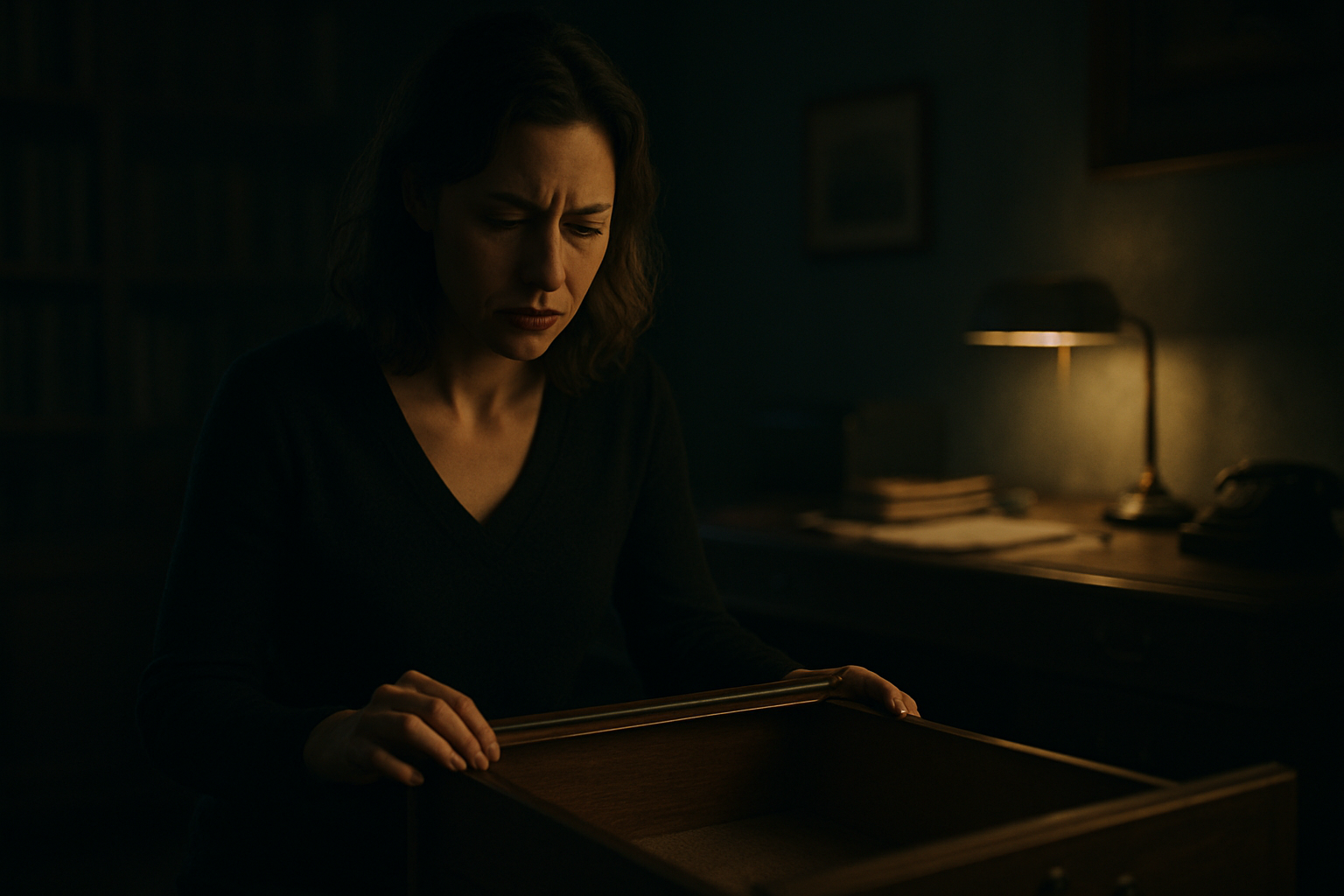
I stood in Thomas’s office long after midnight, staring into the empty drawer.
The property papers were gone.
So was the envelope tied to the little brass bank key I had found in his coat pocket after the funeral.
Thomas Mercer did not misplace things. He labeled warranties. He clipped tax returns by year. He kept every birthday card from our son, Peter, in a blue tin box because, as he once told me, “Even careless love deserves a place to rest.”
So if those papers were gone, someone had taken them.
And if someone had known where to look, then someone had been waiting for Thomas to die.
I closed the drawer and sat in his chair. The house was quiet. Too quiet. Five days earlier, my daughter-in-law, Cassandra, had stood in my kitchen and told me I should “go live on the streets” if I could not manage the house alone.
Peter had stood beside her.
Silent.
That silence hurt more than her words.
I pressed my hand over the key in my pocket, and for the first time since Thomas’s burial, grief gave way to anger.
Not loud anger.
The dangerous kind.
The next morning, I called the bank.
The woman on the phone became very careful when I gave Thomas’s name. She told me to come in person with identification, the key, and a certified death certificate.
So I dressed in the navy suit Thomas loved, tucked the key deep in my purse, and drove downtown through a gray rain.
Crown & Harbor Trust sat between the courthouse and an old brick law office. Thomas and I had passed it a hundred times. He had never once mentioned a safe deposit box.
That hurt too.
After forty-three years of marriage, I thought I knew every corner of that man’s life. I knew which knee ached before storms. I knew how he took his coffee. I knew he hummed when he fixed a hinge. I knew he pretended not to cry during old war movies.
And still, he had carried a secret heavy enough to make him whisper in his final days.
A bank manager named Mr. Alden Whitcomb met me in a private office. He checked my papers, then returned with a woman I recognized from Thomas’s funeral.
Helena Price.
Thomas’s attorney.
She had stood at the back of the church in black, watching everything with quiet eyes. Now she sat across from me with a leather folder on her lap.
“Mrs. Mercer,” she said gently, “Thomas instructed me to meet you here if you came with the key.”
My fingers tightened around my purse.
“You knew?”
“I knew only what he wanted me to know,” she said. “And he was very specific.”
Down in the vault, the air felt cold enough to preserve a secret forever. Mr. Whitcomb used his key. I used mine.
Inside the box were three things.
A sealed envelope in Thomas’s handwriting.
A thick binder.
And a small velvet pouch.
Back in the office, Helena placed the envelope before me.
“Read this first.”
My hands shook.
Ruth,
If you are reading this, then I am gone, and I failed to tell you everything while I still had time.
My father did not die broke as I allowed everyone to believe. He left land, mineral rights, investments, and old company shares. I kept them separate because I wanted our life to belong to us, not to his shadow.
But the assets grew. Far more than I expected.
Helena will explain the trust. Listen to her. Trust her.
Do not trust anyone suddenly interested in your signature, your house, or your grief.
Especially not Peter.
I know that hurts. It hurt me to write it. Our son has debts. Worse, he has let Cassandra believe she can solve them with what belongs to you. I found documents I never signed. I ran out of time before I could confront him properly.
The house is yours. The money is yours to control.
Use mercy, Ruth. But not blindness.
I love you beyond words.
Thomas
I read it once.
Then again.
Then a third time, because my mind could not hold it all.
Twenty-eight million dollars.
Helena said the number softly, as if gentleness could make it smaller.
“Roughly twenty-eight million in total assets,” she explained. “Some liquid, some real estate, some mineral rights. Thomas created the Mercer Legacy Trust seven years ago and amended it six weeks before he died. You are the primary beneficiary and trustee.”
My mouth went dry.
“Peter?”
“He was once listed as a secondary beneficiary. Thomas changed that after discovering suspected fraud.”
Fraud.
The word tilted the room.
Helena opened the binder to a marked page. At the top was an address.
Peter and Cassandra’s house.
I stared at it.
Helena explained that Thomas had quietly bought the property three years earlier through the trust after Peter’s business failed and their mortgage went into default. Peter had begged him not to tell Cassandra. Thomas paid the debt, transferred the house into the trust, and let them stay under a private occupancy agreement.
They paid reduced rent.
Sometimes.
“So their house…” I whispered.
“Belongs to the trust,” Helena said. “And you now control that trust.”
Rain tapped the window.
Cassandra’s words came back to me.
Go live on the streets.
She had said that beneath my roof, wearing shoes that cost more than my old hospital paycheck, while living in a house my husband had saved for her.
I did not feel victory.
I felt shame.
The kind only a mother feels when her child becomes someone she would have protected him from when he was small.
Helena leaned forward.
“Thomas wanted you warned. Do not sign anything Peter or Cassandra gives you. Not a sympathy card. Not an insurance form. Not a moving agreement. Nothing.”
I told her then about the missing papers in Thomas’s desk.
Her face changed.
“Tell me everything.”
So I did.
When I left the bank, I carried copies of trust papers, Thomas’s letter, and the velvet pouch. Inside the pouch was my twenty-fifth anniversary ring, the one I thought I had lost years ago.
Thomas had tucked in a note.
Found it under the laundry cabinet. Saved it because one day you might need to remember: not everything lost stays lost forever.
I cried in the parking lot.
Not for the money.
Not even for the betrayal.
I cried because even while dying, Thomas had found a way to put one last kindness in my hand.
Then I drove home a different woman.
Helena gave me one rule.
“Say nothing.”
So I became quiet.
Grief makes quiet believable. People mistake it for weakness, especially when they have already decided you are old, alone, and easy to move.
Cassandra certainly did.
A week later, she arrived with cardboard boxes and a clipboard. Peter hovered behind her like a boy caught stealing cookies.
“Ruth,” she said, using that patient tone people use when they are trying to own you, “we’re just making this manageable. You can’t rattle around in this big house alone.”
“I didn’t ask you to worry,” I said.
Her smile tightened.
“This is reality. Taxes. Maintenance. Utilities. It’s too much for someone in your position.”
“My position?”
“You know what I mean.”
I did.
Widow.
Older.
Alone.
Easier to push.
She slid a paper across the kitchen counter.
“This lets Peter help with administrative matters.”
“What is it?”
“A power of attorney.”
I did not touch it.
“No.”
Her face changed.
“No?”
“No.”
Peter finally spoke.
“Mom, don’t make this harder.”
That nearly broke me.
He had not asked if I was sleeping. He had not asked if I was afraid. He had not asked how it felt to wake in a bed that still smelled faintly like his father.
He only wanted my cooperation so his discomfort could end.
“I am keeping my own affairs in my own hands,” I said.
Cassandra snatched back the paper.
“You’re being emotional.”
“Probably.”
“That is exactly why Peter should step in.”
“No.”
She waited for an explanation.
But Helena had told me explanations are gifts, and I had no desire to give Cassandra one.
When they left, Peter lingered on the porch.
“Mom,” he said softly, “you don’t understand the pressure I’m under.”
“What kind of pressure?”
He glanced toward Cassandra’s car.
“Business stuff. Loans. People I owe.”
“Your father helped you with the house,” I said.
His head snapped up.
For one second, my son looked like a man caught in a locked room when the lights come on.
“What do you mean?”
“I mean your father helped you more than you admitted.”
Cassandra called his name.
Peter backed away.
“You shouldn’t talk about things you don’t understand.”
That night, Helena called.
A title company had received inquiries about my home two weeks before Thomas died. Someone had requested payoff information for a loan application.
The request included a scanned signature.
Mine.
Except it was not mine.
Helena told me to change locks, install cameras, and freeze my credit.
I did all of it.
Action gave shape to grief.
Three nights later, a camera woke me just after midnight.
On my phone screen, my sister Lenora stood on my back porch in a beige coat, trying a key in my new lock.
Not my key.
She tried twice.
Then gave up.
I did not call her. I saved the video and sent it to Helena.
At nine the next morning, Lenora called brightly.
“Ruth, I thought I’d stop by later and help sort Thomas’s things.”
“No.”
A pause.
“No?”
“I’m not sorting anything.”
“Well, honey, you can’t just freeze.”
“Neither can you enter my house at midnight.”
Silence.
Then a brittle laugh.
“What are you talking about?”
“I changed the locks. I installed cameras.”
Another silence.
“I was worried,” she said. “I wanted to check on you.”
“With a key you never told me you had?”
“Thomas gave it to me years ago.”
Maybe.
But Thomas would have told me.
“Don’t come here without calling again,” I said.
Her voice cooled.
“Cassandra was right. You’re becoming difficult.”
There it was.
The crack in the wall.
“You’ve been talking to Cassandra.”
“I’ve been talking to family,” she snapped. “Something you might try before you turn into a bitter old woman haunting an empty house.”
She hung up.
I stood at the kitchen window, looking at the maple tree Thomas planted when Peter was born.
I remembered Peter at six, climbing it in July, Thomas below with his arms raised, me pretending to scold them both.
Memory is cruel that way.
It brings back the child while the man is standing against you.
The following Monday, Helena took me to the county recorder’s office.
That was where the ugly became criminal.
A clerk named Mrs. Rosa Lujan brought us a stack of recent filings connected to my address.
“There was an attempted electronic transfer,” she said. “We flagged it. The notary commission number didn’t match.”
The packet gave Peter limited authority to sell or refinance my home.
My name appeared at the bottom.
A shaky imitation.
The notary stamp was fake.
The witness signature belonged to Lenora.
I felt the blood leave my face.
Helena put her hand over mine.
“Breathe.”
I did.
That evening, I read Thomas’s letter again.
Use mercy, Ruth. But not blindness.
All my life I had called it peace when I kept the table steady while others kicked the legs.
I swallowed insults so holidays would stay pleasant. I lent money without asking why. I accepted apologies that were only pauses before the next demand.
Thomas had loved my softness.
Maybe he had feared it too.
The next day, Cassandra posted a picture of Thomas on Facebook. Under it, she wrote about “protecting vulnerable elders” and “hard decisions when a parent refuses help.”
She did not name me.
She did not have to.
Calls began.
A woman from church said she hoped I would “listen to the children.”
Someone sent an article about seniors losing judgment after bereavement.
For an hour, I shook with humiliation.
Then I called Helena.
“Do not respond online,” she said.
“I won’t.”
“Good. Send screenshots.”
Two days later, Helena sent formal notices to Peter, Cassandra, and Lenora. The letters named the trust, my authority, the forged documents, the protections around my home, and the occupancy agreement for Peter and Cassandra’s house.
They were ordered to preserve records, devices, messages, and financial documents.
Any further harassment would be treated as elder exploitation.
Cassandra called me seventeen times.
I let each call go to voicemail.
At first she was sweet.
“There’s been a misunderstanding.”
Then indignant.
“Peter and I have rights.”
Then furious.
“You think you can threaten us?”
By the last message, her voice had turned low.
“Peter is Thomas’s son. That money should have been his. You’re punishing us because you’re lonely.”
I saved every word.
Peter came alone the next morning.
He looked terrible. Red eyes. Wrinkled shirt. Hair uncombed.
For a moment, the old mother in me rose up. I wanted to feed him. Comfort him. Forgive him before he even confessed.
He stood on my porch.
“Mom,” he said, “Cassandra didn’t know everything.”
That was the first honest sentence he had spoken in weeks.
I opened the door but left the chain latched.
“What did she know?”
He looked away.
“Enough.”
“And Lenora?”
He flinched.
“Peter, did you forge my signature?”
“No,” he said too fast.
Then his shoulders collapsed.
“Not exactly.”
There are phrases that confess before the mouth is ready.
“What does that mean?”
“Cassandra handled the paperwork. I gave her samples. Old cards. Checks. She said it wasn’t really fraud. We were just trying to get ahead of the estate process.”
“The estate process?”
“We thought Dad left things messy.”
“You thought stealing my house was administrative?”
He recoiled.
“I wasn’t trying to steal it from you.”
“Then who were you stealing it from?”
He had no answer.
Then came the number.
“I owe almost nine hundred thousand dollars.”
It hit me hard. Not because of the amount, not after twenty-eight million. Because of what it revealed.
Peter had not come because he missed me.
He came because desperation had grown larger than pride.
“How?” I asked.
“Business loans. Personal guarantees. Private lenders. Cassandra kept saying we had to maintain appearances.”
Maintain appearances.
A phrase that has buried more families than poverty ever did.
“Did your father know?”
“Some.”
“He knew enough to protect me.”
Peter’s face twisted.
“He protected you from me.”
“Yes,” I said.
The word hurt us both.
Before he left, he told me Thomas had visited him two weeks before he died.
“He said if I let Cassandra hurt you, he would make sure I lost everything.”
“What did you say?”
Peter looked down.
“I told him he was choosing you over me.”
My hand tightened on the door.
“And what did he say?”
Peter’s voice broke.
“He said, ‘No, son. I am choosing the truth over the lie you want me to live in.’”
For the first time since Thomas died, I heard my husband clearly.
Not in memory.
In the choice he had made.
I unlatched the chain, stepped outside, and touched Peter’s cheek the way I had when he was feverish as a boy.
“I love you,” I said. “But I will not save you with my silence.”
He nodded once and walked away.
The next month became a season of documents.
Helena’s office smelled of coffee and paper. We built a timeline from bank records, emails, texts, and title reports.
The truth was not one dramatic act.
It was a chain of small permissions.
Peter let Cassandra handle accounts because numbers frightened him.
Cassandra contacted Lenora because Lenora knew where Thomas kept papers.
Lenora gave access because Cassandra promised I would be “taken care of” and hinted there would be money when the house sold.
Peter provided old signatures.
Cassandra used a false online notary.
Lenora signed as witness.
The title company caught it before my home was taken.
It would have been pathetic if it had not been so dangerous.
Helena filed for a protective injunction. She notified the district attorney. She also addressed Peter and Cassandra’s house.
They were behind on reduced payments and had tried to use the trust-owned property as collateral for a private loan.
Legally, the answer was clear.
Emotionally, it felt like standing at the edge of a cliff and being told to push my own child.
Helena did not press me.
“If you ignore this,” she said, “the trust could be dragged into litigation. Thomas created these protections because he expected this pressure.”
“What would you do?” I asked.
“I would enforce the agreement,” she said. “But enforcement does not have to be cruelty. You can offer a cure period. You can offer Peter resources. Accountability and revenge are not the same thing.”
That became my anchor.
We sent the Notice to Cure or Quit.
Peter called Helena and agreed to cooperate.
Cassandra hired an attorney who sent a letter so aggressive Helena laughed.
Lenora left me a voicemail calling me cold and brainwashed.
I saved it.
Church became difficult. People watched me with that hungry politeness that follows scandal.
I almost stayed home.
But Thomas and I had sat in the same pew for thirty-one years. So I went.
During the hymn, Mabel Crane from the church pantry slid in beside me.
“I don’t know what’s true,” she whispered. “I don’t need to. I know you. That is enough.”
I nearly cried.
After service, Reverend Ellis brought soup and said, “Forgiveness without truth is just another way to protect the person who caused harm.”
I laughed for the first time in weeks.
Cassandra escalated.
She came to my house despite the injunction, wearing oversized sunglasses and carrying a folder.
“You’re not allowed here,” I said through the cracked door.
“I’m here to apologize.”
“No, you’re not.”
Her smile fell.
“You always act simple. Then judge everyone from behind that innocent little face.”
“Leave, Cassandra.”
She shoved the folder onto my porch.
“Any decent mother would make sure her son was provided for.”
“Thomas did provide for him. You are living in one example.”
“That house was a gift.”
“No,” I said. “It was mercy. You mistook it for entitlement.”
For the first time, fear flickered beneath her polish.
“You don’t know what it’s like,” she said. “To build a life where everyone is waiting for you to fail.”
“No,” I said. “I don’t understand living a life built entirely for spectators.”
After she left, I opened the folder.
Medical articles about grief, cognitive decline, guardianship.
Highlighted.
I sent them to Helena.
Her response was swift. Cassandra’s attorney was warned that any fabricated guardianship claim would be met with evidence of financial exploitation.
Soon after, Cassandra deleted her posts.
Too late.
Screenshots had reached a woman named Paige Rowan, Cassandra’s former assistant. Paige contacted Helena.
She had emails.
Invoices.
Texts.
One message from Cassandra read:
Peter is useless under pressure, but his mother is sentimental. Once Thomas is gone, we push hard and fast. She’ll fold if we make her feel like a burden.
I read that sentence several times.
“She never saw me at all,” I said.
Helena looked at me sadly.
“No. She saw what she needed you to be.”
Peter came to Helena’s office for a recorded statement. He admitted providing signature samples. He admitted knowing Cassandra and Lenora planned to pressure me. He claimed he did not know about the fake notary until after the filing failed.
When he came out, I was waiting in the lobby.
“I’m sorry,” he said.
I looked at him.
“Are you?”
He closed his eyes.
“I don’t know how to be the kind of sorry that fixes this.”
That sounded real.
“You cannot fix it all,” I said. “You can only stop making it worse.”
He nodded.
Then he warned us.
“Cassandra knows about some trust properties. She thinks if she proves Dad wasn’t competent when he amended the trust, the old version might stand. The one where I inherit later.”
“Thomas was competent,” I said.
“I know. But Lenora is willing to say he wasn’t.”
Then Peter lowered his voice.
“Dad recorded conversations near the end. He told me he didn’t trust what people would claim after he died.”
Helena went still.
“Where are the recordings?”
Peter swallowed.
“Cassandra has them.”
Two days later, Cassandra’s attorney filed a petition challenging the trust amendment.
They painted Thomas as confused and paranoid. They painted Helena and me as manipulators. They painted Cassandra as a devoted daughter-in-law trying to protect the family.
I read it at my kitchen table while rain slid down the windows.
For the first time, I wanted to quit.
Not give in.
Just stop defending my own life.
I wanted Thomas to be there, angry on my behalf. I wanted Peter to be ten again so I could begin differently. I wanted Lenora to call and say she had been jealous, foolish, afraid—anything that made her betrayal smaller.
Instead, the house stayed quiet.
I walked into Thomas’s office. The drawer was still empty.
Then I remembered the coffee table.
Years earlier, after a rash of burglaries, Thomas had built a hidden compartment beneath it for emergency cash. We had laughed about it. I had forgotten.
I knelt beside the table, my knees complaining, and felt beneath the carved edge.
There it was.
A tiny latch.
Inside was a flash drive wrapped in a note.
Ruth,
If Helena does not already have the copies, give this to her. I hope you never need it.
T.
I laughed.
A shaky, wild laugh.
Thomas had hidden the truth in the room where Cassandra had stood and told me to leave.
Helena came within the hour.
The drive held audio files, scanned papers, and a video Thomas recorded three weeks before his death.
In the video, he sat thin and pale near a hospital window.
“My name is Thomas Mercer,” he began. “I make this statement voluntarily, fully aware of my condition and my estate decisions.”
He explained the trust.
He explained Peter’s debts.
He explained Cassandra’s pressure.
He said clearly that no one influenced him. He wanted me protected.
Then he looked into the camera.
“Ruth, if you see this, I am sorry I left you to fight people I should have confronted sooner. I thought keeping peace was kindness. It was not. It only taught our son that truth could be postponed until someone else paid the cost.”
Helena reached for a tissue and pretended it was for me.
The audio files were worse.
Thomas confronting Peter.
Peter denying, then admitting enough.
Thomas speaking to Lenora.
“You confuse kindness with weakness,” he told her, “because you have spent your life resenting both.”
Then Cassandra.
Her voice was smooth.
“You can’t expect Peter to watch everything go to Ruth while he struggles.”
“My wife is not an obstacle between my son and my money,” Thomas answered. “She is the woman who made every decent part of my life possible.”
“You think she’ll know what to do with that kind of money?”
“I think she will know better than people who see it before they see her.”
Then Cassandra said softly, “People get confused at the end. Families challenge wills all the time.”
Thomas’s voice weakened, but did not shake.
“Try it, and you will prove every fear I had about you.”
The hearing came in late March, almost three months after the funeral.
I wore the navy suit again.
Outside the courthouse, Peter stood alone. Cassandra stood with her attorney. Lenora stood beside her in pearls, wearing wounded dignity like perfume.
When Lenora saw me, she looked away first.
That hurt too.
In court, Cassandra’s attorney tried to make Thomas sound weak and manipulated.
Helena answered with medical records, attorney notes, bank verification, the video, and parts of the recordings.
Hearing Thomas’s voice in that courtroom was comfort and torture.
Peter cried silently when his recording played.
Lenora turned gray.
Cassandra stared straight ahead, as if refusing to react could erase her own voice.
Then Helena called Paige Rowan.
Paige testified about Cassandra’s failed business, unpaid vendors, falsified invoices, and messages about my house.
When Helena presented the text about “unlocking the old lady’s house money,” Cassandra finally moved.
The judge denied the challenge.
He upheld Thomas’s amendment, recognized my authority as trustee, and referred the forged documents and exploitation concerns to the proper authorities.
Outside the courtroom, Cassandra came toward me.
Helena stepped between us.
“Are you happy now?” Cassandra snapped.
I looked at her perfect lipstick and blazing eyes.
“No,” I said. “Happy is not what this feels like.”
“You ruined us.”
“No. I stopped paying the cost of your pretending.”
Peter approached.
Cassandra turned on him.
“You did this, you weak coward.”
He closed his eyes.
Months earlier, that tone would have folded him.
This time, he opened his eyes and said, “Yes. I was weak. That’s why we’re here.”
For the first time, Cassandra looked afraid of him.
Then she walked away, Lenora trailing behind.
Peter stood before me.
“I’m moving out,” he said. “Helena gave me the papers. I’ll sign.”
“And Cassandra?”
“She won’t.”
“Then the court will handle it.”
He looked toward the steps.
“I filed for separation.”
I had expected many things.
Not that.
“Because of the case?”
“Because I heard Dad’s recording,” he said. “And because when I listened to myself, I realized I kept waiting for someone else to become the person I should have been.”
It did not repair anything.
But it opened a door.
The eviction notice landed on Cassandra’s front door on a Thursday afternoon.
Three months after she told me to pack my things and find somewhere else to live, a deputy taped legal papers to the glossy black door of the house Thomas had saved.
I was not there.
I chose not to be.
Helena called afterward. Service was complete. Peter had already left with two suitcases and a box of old photographs I had asked him to take before Cassandra threw them away.
Cassandra stayed inside.
Lenora’s car was in the driveway.
I sat still for a long time.
I had imagined that moment on hard nights. I imagined Cassandra feeling a little of what she wanted me to feel.
But satisfaction did not come.
Only sadness.
Not regret.
Sadness.
There is a difference. Regret asks if you chose wrong. Sadness knows the right thing can still hurt.
That evening, Peter came by with Helena’s permission.
He stood in my kitchen like a guest unsure of his welcome.
I made coffee because habit is stronger than resentment.
He looked around.
“I forgot how much this place smells like cinnamon.”
“I baked yesterday.”
“Dad loved your apple bread.”
“He pretended not to because of his cholesterol.”
Peter smiled faintly, then broke.
“I miss him.”
That was the first time he said it without making it about himself.
“So do I,” I said.
He sat at the table.
After a while, he said, “Cassandra says you’re proving you never loved me.”
I poured coffee into his cup.
“What do you think?”
He stared into it.
“I think I used love like a credit card. I kept charging things to it and acted shocked when the bill came.”
It was awkward.
Painful.
Honest.
“Your father and I helped teach you that,” I said.
“No. You don’t have to take blame.”
“I’m not taking blame. I am taking responsibility for my part. There is a difference.”
Before he left, he asked if I would go with him someday to Thomas’s grave.
Not yet, I thought.
But I said, “Someday.”
The next week, Lenora came.
In daylight this time.
No folder. No perfume. No pearls.
I opened the door but did not invite her in.
“Ruth,” she said, “I need to talk.”
“Call Helena.”
“No. Sister talk.”
That almost made me laugh. “Sister talk” had always meant Lenora wanted something without witnesses.
“I don’t think we have that anymore.”
Her eyes filled. I did not soften. Tears came easily to Lenora when useful.
“I lied,” she said.
“I know.”
“Not just about the papers.”
I waited.
“Thomas came to me before he died. He asked me to protect you if Peter and Cassandra pushed too hard. He knew I had been talking to them. He offered me money to stay out of it.”
“How much?”
“Two hundred thousand.”
The number sat between us.
“I told him he couldn’t buy my loyalty,” she said. “He told me loyalty was not what he was buying. He said he was offering me one last chance not to sell myself cheaper to Cassandra.”
I could hear Thomas saying it.
“I hated him for that,” Lenora whispered.
“So you helped them.”
“Yes.”
“Why are you here?”
She pulled an envelope from her purse.
“Because he was right. Cassandra promised me a percentage after the sale. Then, after the hearing, she said if charges came, I should take responsibility because I was old enough for sympathy.”
That sounded like Cassandra.
“I have messages,” Lenora said. “Recordings too. I kept them because I didn’t trust her either.”
I did not take the envelope at first.
“You did not come because you were sorry. You came because Cassandra turned on you.”
Lenora flinched.
“At first, yes.”
“At first?”
Her face crumpled.
“When I heard Thomas in court, when he said I confused kindness with weakness, I wanted to hate him. Then I realized I had spent my whole life proving him right.”
That was the most honest thing my sister had ever said to me.
It did not erase what she had done.
But it changed the shape of the moment.
I took the envelope.
“I’ll give this to Helena.”
Lenora nodded.
“Am I going to jail?”
“I don’t know.”
“Do you want me to?”
I thought of two little girls sharing a thin blanket after our mother died. Lenora always grabbed more than half because she feared there would never be enough warmth.
Then I thought of her key in my lock.
Her forged witness signature.
“No,” I said. “But I want the truth to reach you without me standing in its way.”
That night, I read the messages.
Cassandra had planned more than a house transfer. If I resisted, she intended to push for guardianship, use Peter’s debt and Lenora’s testimony to argue that selling my home was in my best interest, and place me in a facility two counties away.
One message said:
Once Ruth is placed, Peter can breathe again.
Placed.
Like furniture.
Like a problem moved from one room to another.
For the first time, I felt something close to hatred.
The next morning, Helena forwarded everything to the district attorney.
Cassandra was arrested two weeks later.
The arrest made local news because people love stories about money, fraud, and family disgrace, so long as they happen to someone else.
I did not read the articles.
Peter called after the arrest.
“She wants bail money.”
“I assumed.”
“I told her no.”
“How did that feel?”
He was quiet.
“Like learning to use a muscle I should have had years ago.”
Peter moved into a small apartment near the community college and enrolled in a bookkeeping course. He sold his expensive watch, his second car, and most of the furniture Cassandra had chosen. He began working with a debt attorney.
He also started attending meetings for financial compulsion.
“It’s not exactly gambling,” he told me.
“Maybe not,” I said. “But chasing rescue can become its own addiction.”
He did not argue.
Lenora cooperated with prosecutors. She would likely avoid prison, Helena said, but not consequences. Probation. Restitution. Community service.
Lenora called once to thank me for not asking the prosecutor to destroy her.
“Mercy is not rescue,” I told her.
“I’m beginning to understand,” she said.
As for me, I had to decide what to do with twenty-eight million dollars.
At first, the number felt unreal. It did not change the way I woke at six because Thomas had always woken at six. It did not stop me from making coffee for two. It did not keep me from standing in the laundry room with one of his flannel shirts pressed to my face.
Grief is not impressed by net worth.
But money did give me space.
Space to think.
Space to choose.
Space to stop treating other people’s emergencies as weather I had to stand in.
One afternoon, while reviewing trust files, I learned Thomas had quietly purchased small medical debt portfolios and forgiven them anonymously through a nonprofit.
“He never told me,” I said.
Helena smiled.
“He said you would insist on adding half your hospital coworkers to the list and ruin the anonymity.”
I laughed because he was right.
That discovery became a seed.
Thomas had left me money.
Cassandra had tried to make it a weapon.
I decided to make part of it shelter.
With Helena’s help, I created the Thomas Mercer Home Fund, for widows, widowers, and older adults facing housing insecurity after abuse, medical debt, or family exploitation.
The first board meeting happened at my dining room table.
Mabel Crane joined because she knew every struggling family within thirty miles.
Reverend Ellis joined because he understood shame.
Helena joined because predators often use paperwork.
Peter asked if he could volunteer someday.
“Someday,” I said, “will depend on consistency, not intention.”
The first person we helped was a retired school bus driver whose nephew had tricked her into signing over her home after surgery.
The second was a widower whose hospital bills nearly swallowed his pension.
Each case felt like putting one stone back into a broken wall.
Cassandra pleaded guilty before trial.
She admitted the forged document scheme, attempted financial exploitation, and fraudulent collateral arrangement. Her sentence included prison time, probation, restitution, and a ban from handling elder-care or fiduciary authority.
Helena asked if I wanted to make a victim statement.
I thought about it for days.
In the end, I went.
Cassandra stood in court in plain clothes, her hair pulled back, her face stripped of performance.
I had written a speech, but when I unfolded the paper, the words felt too polished.
So I spoke plainly.
“Cassandra, when you came to my home five days after Thomas’s funeral, you thought grief had made me empty. It had not. It had made me quiet.
“You thought age made me disposable. It had not. It made me observant.
“You thought family love meant I would surrender anything to avoid conflict. For many years, you might have been right.”
The courtroom was still.
“You did not just try to take property. You tried to take my place in my own life. You tried to use my son’s weakness, my sister’s resentment, and my husband’s death as tools.
“I am not asking the court to be cruel. But I am asking it to be clear. Mercy without truth only teaches us to repeat the harm.”
Afterward, Cassandra asked to speak to me.
Helena stayed by my side.
“I hated you,” Cassandra said.
“I know.”
“Not because of the money. Before I knew about the money. I hated that Peter relaxed around you. I hated that Thomas respected you without you demanding it. I hated that your house felt real.”
It was ugly.
But it was honest.
“My mother was like you,” she said. “Quiet. Always making do. My father left her with nothing, and she kept saying we had enough when we didn’t. I promised myself I would never be pitied.”
“So you became a woman people feared instead,” I said.
Her eyes filled.
“I don’t know how to be anything else.”
“You can learn,” I said. “But not from me.”
For once, she did not try to have the last word.
A year after Thomas died, I visited his grave with Peter.
It was early spring. The grass was damp. Peter brought grocery-store daffodils, uneven and bright as little suns.
He knelt by the stone and began to cry.
“I’m sorry, Dad,” he whispered. “I’m sorry I made you protect Mom from me.”
I looked away to give him what privacy a mother can give while her child breaks.
When he stood, his face was wet.
“I keep thinking he died disappointed in me.”
“He died loving you,” I said. “Those are not opposites.”
Peter breathed in sharply.
“I don’t know if I deserve to believe that.”
“Deserving has little to do with grief. Believe it because it is true. Then live in a way that honors the cost.”
He nodded.
Peter did change.
Not magically. Real change is rarely theatrical.
He was still anxious. Still ashamed. Still tempted to avoid hard conversations. But now he noticed the temptation. He worked a modest inventory job. He lived with thrift-store furniture. He paid small honest bills and said they were teaching him about the large dishonest ones.
He and Cassandra divorced quietly while she served her sentence.
He visited her once, then told me, “I wish her healing, but I cannot be her ladder out of consequences.”
That was when I believed my son might survive himself.
Lenora and I did not become close. Life is not tidy enough for every wound to become a reunion.
But she wrote letters.
Real letters.
She wrote about her court-ordered service at a senior legal aid clinic. She wrote about women who reminded her of me. Once she wrote, “I spent years thinking I got less than you. Now I wonder if I simply made less out of what I had.”
I answered some.
Not all.
Boundaries, I learned, are not walls unless you build them from hatred. Sometimes they are fences with gates that open only when safety has returned.
On the anniversary of Thomas’s death, I hosted dinner.
Peter came early and repaired a loose cabinet hinge. Mabel brought a store-bought pie and announced honesty was now the theme of the house. Reverend Ellis brought flowers. Helena brought sparkling cider because, she said, lawyers should never be trusted with wine at emotional gatherings.
We ate at the dining room table Cassandra had once marked with a yellow sticky note that said:
SELL.
I had kept that note.
Not out of bitterness.
As a reminder of how easily people label what they do not understand.
Later, after everyone left, I opened Thomas’s desk drawer. Inside were new property records, trust documents, his letter, and that yellow note.
SELL.
DONATE.
TRASH.
Beside it, I placed a new note in my own handwriting.
PROTECT.
RESTORE.
GIVE.
Then I closed the drawer.
Two years later, the Thomas Mercer Home Fund opened its first transitional cottage.
A small white house with blue shutters.
Nothing fancy.
Sturdy.
We named it Maple House, after the tree Thomas planted when Peter was born.
The first resident was a widow named Beatrice, whose stepchildren had tried to sell the house she had lived in for thirty years. She arrived with two suitcases, a wedding photograph, and a distrust so deep she apologized before asking where the bathroom was.
I recognized that look.
I had not been homeless. Thomas’s planning saved me from that.
But I had stood in my own living room while someone tried to make me feel temporary.
I knew what it meant to have your place questioned.
On move-in day, Peter carried boxes. Lenora sorted pantry items quietly. Mabel pretended to inspect the mailbox when Beatrice cried, giving her the dignity of not being watched.
On the kitchen counter, we left bread, tea, a notebook, and a card.
I had written the words myself.
You are not a burden. You are not a problem to be moved. You are home for as long as you need to become steady again.
A week later, I received a letter from Cassandra in prison.
She wrote that she was not asking forgiveness. She said a counselor had asked when she first confused safety with control.
I watched my mother lose everything slowly, she wrote. First money, then friends, then dignity. I decided being feared was safer than being pitied.
When I met you, I saw a woman with a real home who did not worship it. I wanted to prove it could be taken from you, because then it would mean it had never been real.
I am sorry I tried to erase you from your own life.
I folded the letter carefully.
That evening, Peter came to fix a porch railing.
“How do you feel?” he asked.
That question, from him, was proof of change.
“Sad for her,” I said. “Still angry. Relieved those feelings do not have to become action.”
“Will you answer?”
“Not now.”
“Maybe someday?”
“Maybe.”
We stood beneath the maple tree. Its leaves shifted in the summer air.
“Dad would like Maple House,” Peter said.
“Yes,” I answered. “He would.”
On the third anniversary of Thomas’s death, I took flowers to his grave.
“I kept the house,” I told him. “I kept myself too.”
The wind moved softly through the grass.
“Peter is trying. Lenora is learning. Cassandra wrote. I don’t know what comes of any of it. But I am not afraid of the unfinished parts anymore.”
I touched the stone.
“And you were right about the ring. Not everything lost stays lost forever.”
When I came home, late sunlight lay across the hardwood floors.
The same floors Cassandra had crossed as if she owned my future.
The marks of that day were gone, polished away by time and care, but I remembered where she had stood.
I adjusted Thomas’s photograph on the mantel and looked around my home.
It was not silent anymore.
It held grief, yes.
But it also held laughter from dinners, calls from people Maple House had helped, Peter’s uneven progress, Lenora’s careful letters, and my own footsteps moving freely from room to room.
For years, I thought surviving betrayal meant becoming hard.
I was wrong.
Hardness would have been easy.
Hardness would have let me punish everyone and call it justice.
What saved me was clarity.
Clarity let me say no without hatred.
It let me love Peter without rescuing him.
It let me hear Lenora’s remorse without handing her keys to my life.
It let me read Cassandra’s apology without absolving her too soon.
And it taught me this:
A home is not protected by locks alone.
It is protected by the courage of the person inside who refuses to be moved.

