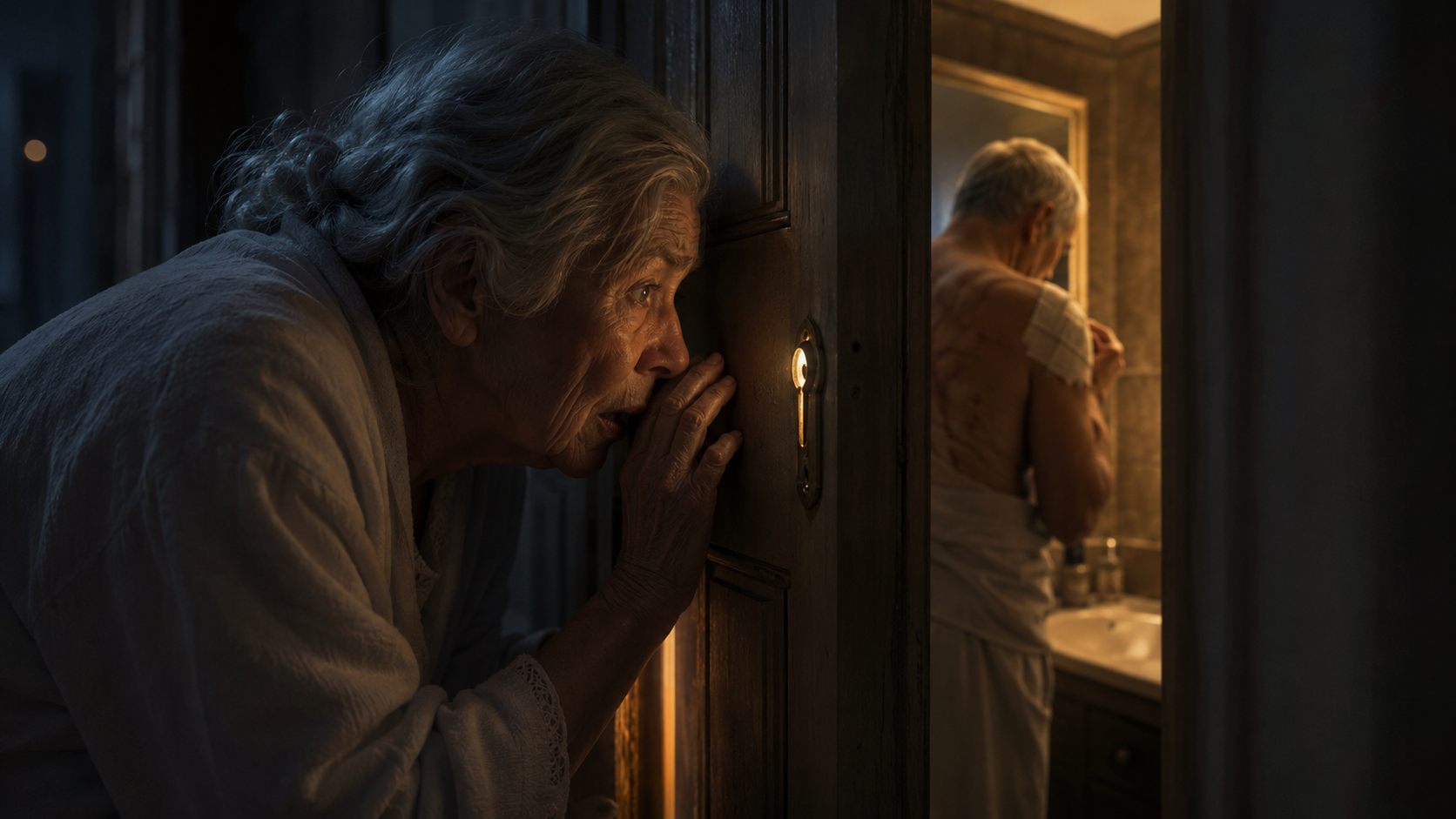
My Husband Locked the Bathroom Door Every Dawn for 35 Years — When I Finally Looked Through the Keyhole, I Learned the Secret That Had Been Killing Him Quietly

For thirty-five years, Evelyn Hart woke to the same sound.

Not the birds.

Not the pipes shuddering awake in the old walls.

Not the first delivery truck coughing its way down Harbor Street before sunrise.

It was the bathroom door.

Every morning, at exactly four-seventeen, her husband slipped out of bed as carefully as a thief and walked barefoot down the narrow hallway. Evelyn would lie still beneath the quilt, eyes closed, breathing slowly, pretending not to hear what she had heard for more than half her life.

The soft scrape of the bottom drawer opening.

The click of a small metal box.

The whisper of plastic.

Then the bathroom door closing.

Then the lock.

For the first years of their marriage, she had told herself it was nothing. Men had their little rituals. Her father had polished his shoes before dawn every Sunday even when he no longer went anywhere important. Her brother used to smoke on the porch at sunrise and say the quiet helped him think. Thomas was private. That was all. Private, disciplined, old-fashioned.

But privacy did not usually sound like a man trying not to cry.

They lived in a small blue house near the Oregon coast, the kind of house that leaned a little toward the sea as if listening for storms. Thomas had painted it himself in the summer of 1982, standing on a ladder in long sleeves while everyone else in the neighborhood wore T-shirts and complained about the heat. He had built the kitchen shelves, fixed the roof twice, planted lavender along the front path because Evelyn once said the smell reminded her of her mother’s garden.

People loved Thomas Hart.

They called him dependable.

They called him quiet.

They called him the last decent man left on Harbor Street.

At the grocery store, widows asked him to carry their bags. Children on bicycles slowed down when he was in the driveway because he never shouted, only raised one eyebrow, which was somehow worse. When the church boiler broke, Thomas fixed it without sending a bill. When Mrs. Bell’s son didn’t come home for Christmas, Thomas shoveled her walk before sunrise for three straight mornings and never mentioned it.

Everyone thought Evelyn had married safety.

Sometimes she had thought so too.

She met him when she was twenty-two and working at a diner outside Astoria. Thomas came in every Thursday at six in the evening, ordered black coffee and toast, and left a dollar tip even when the meal cost less than that. He was not handsome in the easy way some men were handsome. He was too thin, too serious, with watchful gray eyes and hands that looked older than the rest of him. But he listened when Evelyn spoke, and that was rare enough to feel like romance.

He never talked about his childhood.

When she asked, he said, “There isn’t much worth telling.”

When she asked again, he said, “I got out.”

She had thought he meant poverty. Or a bad father. Or some family shame people from small towns buried because they believed silence was cleaner than truth.

They married in autumn, under a maple tree behind her aunt’s house, with twelve guests and a cake that leaned dangerously to one side. Thomas wore a dark suit despite the warm weather. Evelyn remembered touching his sleeve during the vows and feeling the tension in his arm, hard as a board, as if he were preparing for someone to strike him.

She mistook it for nerves.

For years, Evelyn mistook many things.

She mistook his sleeplessness for discipline.

She mistook his silence for strength.

She mistook the way he flinched from sudden touch for a dislike of affection.

She mistook the locked bathroom for a habit.

Until habits began leaving stains.

At first it was only the smell: antiseptic, sharp and medicinal, drifting into the bedroom when Thomas returned before dawn. Then there were towels in the hamper with tiny rust-colored marks folded carefully inside, as if he believed linen could keep secrets. Once she found strips of gauze wrapped in newspaper at the bottom of the trash. Another time she opened the drawer beneath the sink and discovered bottles of ointment hidden behind the cleaning powder.

When she asked him about it, Thomas went still.

Not annoyed.

Not embarrassed.

Still.

It frightened her more than anger would have.

“What is this?” she asked, holding up a roll of bandage.

His face lost color. “Leave it alone, Evelyn.”

“Are you sick?”

“No.”

“Are you hurt?”

“No.”

“Then what are you doing every morning?”

He stepped toward her, and for one terrible second she thought he might take the bandage from her hand like a man taking evidence from a witness.

Instead, he said very softly, “Please.”

That word ended the conversation.

Please.

Not stop.

Not don’t.

Please.

Evelyn put the bandage back.

After that, she learned to carry her questions quietly. They went with her to the market, to church, to her job at the library, to bed. They sat beside her at the dinner table while Thomas asked about the tomatoes in the garden or whether the car needed gas. They grew heavier when their children were born.

Mara came first, all red cheeks and furious lungs. Thomas held her like something sacred and dangerous. He wept when he thought Evelyn was asleep. Two years later came Simon, calm and round-faced, with Thomas’s gray eyes and Evelyn’s stubborn chin.

Thomas loved them. Of that Evelyn was sure.

But he loved carefully.

He never tossed them high into the air the way other fathers did. Never wrestled with Simon on the carpet. Never let Mara sneak up behind him. When the children were small, they learned without being told not to surprise their father from the back. Once, at a birthday party, Simon jumped onto Thomas’s shoulders without warning. Thomas dropped a glass and staggered as if he had been stabbed.

Everyone laughed nervously.

Thomas laughed too.

But Evelyn saw his hands shaking.

That night, after the children slept, she found him sitting on the edge of the bed in the dark.

“You scared Simon today,” she said.

“I know.”

“He thinks he did something wrong.”

Thomas rubbed his face. “I’ll talk to him.”

“Why are you like this?”

He turned toward her. The room was too dark to see his expression, but she heard his breathing change.

“I am trying not to be worse.”

It was such a strange answer that Evelyn had no reply.

Years passed the way years do when people are busy surviving them. Children grew. Bills arrived. Roofs leaked. Cars failed. Parents died. Holidays came wrapped in noise and left behind crumbs, photographs, and exhaustion.

The morning lock remained.

Four-seventeen.

Every day.

For thirty-five years.

Evelyn grew older beside a door she was not allowed to open.

At sixty-eight, she stopped pretending the mystery was harmless.

By then Mara had moved to Portland and become a nurse practitioner with the brisk tenderness of a woman used to frightened patients. Simon ran a boat repair shop and had three children who adored their grandfather but knew not to climb into his lap unless invited. Evelyn had retired from the library, and Thomas had finally stopped taking repair work around town after a fall from a ladder left his right knee unreliable.

But the bathroom ritual continued.

Even when his hands trembled.

Even when his back bent.

Even when Evelyn heard him gasp behind the locked door.

One winter morning, she found blood on the bathroom mat.

Not much.

Just a small dark crescent near the sink.

She held it in her hand until Thomas came into the kitchen.

He saw it immediately.

His coffee cup stopped halfway to his mouth.

“Explain this,” Evelyn said.

Thomas placed the cup down.

His face closed in that old familiar way, as if shutters had been pulled across every window inside him.

“I cut myself shaving.”

“You haven’t shaved with a razor in twenty years.”

He looked away.

“I am tired of being lied to,” she said.

“I am not lying to hurt you.”

“That does not make it kinder.”

He gripped the back of the chair. His knuckles whitened.

“Some doors stay closed because opening them destroys the house.”

Evelyn stared at him.

“Our house is already haunted,” she said. “Only I don’t know by what.”

For a moment, she thought he might answer.

His mouth moved. His eyes filled with such naked fear that Evelyn almost stepped back.

Then he whispered, “You would not look at me the same.”

And he walked away.

That sentence stayed with her all day.

You would not look at me the same.

It followed her while she folded laundry. While she watered the half-dead basil in the kitchen window. While she stood in the bedroom before Thomas’s side of the closet and looked at the rows of long-sleeved shirts hanging like uniforms.

In thirty-five years, she had never seen her husband’s bare back.

The realization struck her so hard she had to sit on the bed.

Never.

Not on their wedding night.

Not on summer mornings.

Not in illness.

Not in age.

Thomas changed in darkness. Bathed behind locked doors. Slept in undershirts even when the room was hot. If her hand slid beneath his shirt, he gently moved it away. If she kissed his shoulder, he stiffened. If she asked why, he said, “It’s not you.”

But after enough years, not you begins to sound exactly like you.

That night, Evelyn did not sleep.

At four-ten, Thomas stirred.

She kept her eyes closed.

At four-seventeen, the mattress lifted as his weight left it.

She heard his careful steps.

The drawer.

The metal box.

The plastic bag.

The hallway.

The bathroom door.

The lock.

Evelyn waited until the water started running.

Then she got out of bed.

The floor was cold beneath her feet. The house was dark except for the yellow line of light beneath the bathroom door. She moved slowly, one hand against the wall, feeling suddenly foolish, cruel, old, and young all at once. Her heart hammered so loudly she thought Thomas might hear it over the faucet.

She lowered herself to her knees.

For a second, she could not make herself look.

Marriage, she thought, is not supposed to come to this.

But then she heard a sound from inside.

A broken breath.

Not a sigh.

Not a cough.

Pain.

Evelyn bent and looked through the keyhole.

What she saw stole thirty-five years of anger from her in one breath.

Thomas stood at the sink without a shirt.

His back was a landscape of damage.

Not one scar. Not two. Not the clean pale marks of surgery or accident. His entire back was crossed with old wounds, raised and sunken, silver and red, some thin as threads, some wide and twisted like melted rope. There were burns along his shoulder blades. Deep puckered marks beneath his ribs. Long scars down his sides, as though someone had carved history into him with hatred and patience.

Evelyn pressed both hands over her mouth.

Thomas had a towel between his teeth.

He was trying to clean an open wound near his left shoulder, reaching awkwardly, shaking with the effort. The wound looked angry, raw, torn open where old scar tissue had split. He dabbed at it with gauze soaked in antiseptic, and every touch made his knees bend.

He did not make a sound.

He bit down harder.

Evelyn’s eyes filled.

Then he turned slightly.

Below his collarbone, almost hidden by shadow, she saw a mark that made her stomach twist.

Numbers.

Not tattooed.

Burned.

Three digits and a letter.

Old.

Faded.

Deliberate.

Evelyn jerked backward.

Her elbow struck the wall.

Inside, everything stopped.

The water shut off.

“Evelyn?”

His voice was not angry.

It was terrified.

She tried to stand, but her knees would not obey. The lock clicked. The door opened.

Thomas stood there holding gauze in one hand, his bare chest exposed to the hallway light, his robe hanging uselessly over one arm. Evelyn had imagined this moment for decades. She had imagined finding a bottle, a letter, proof of another woman, some private weakness she could name and forgive or condemn.

She had never imagined this.

Her husband looked smaller without his secrets.

Not weaker.

Smaller.

Like a boy who had been discovered hiding in a place too narrow for him.

“Oh, Thomas,” she whispered.

He stepped back as if her pity had struck him.

“You weren’t meant to see.”

“Who did this?”

“No one.”

“Do not insult me with another lie.”

His jaw tightened. He looked toward the bedroom, then at the bathroom floor, anywhere but her face.

“Go back to bed.”

“No.”

“Evelyn.”

“No.”

He closed his eyes.

She rose slowly, holding the wall for balance. Her body shook, but her voice became steadier than she felt.

“I have spent half my life outside this door. I am not going back to bed.”

Thomas’s face crumpled.

Only for a second.

Then he turned away.

“I kept it from you because I loved you.”

Evelyn wanted to be angry. Part of her was. But anger had no room to stand in the hallway with all that pain.

“Sit down,” she said.

He laughed once, bitterly. “You don’t know what you’re asking.”

“I am asking my husband to sit before he falls.”

Something in that sentence reached him.

Thomas sat on the closed toilet lid like a punished child. Evelyn stepped into the bathroom. The room smelled of medicine, old tile, and fear. On the counter lay his hidden tools: gauze, ointment, disinfectant, medical tape, scissors, cotton pads, and a small black metal box.

She took the gauze from his hand.

He flinched before she touched him.

She stopped.

The flinch was not distrust of her.

It was older than her.

Older than their marriage.

Older than the house.

“I will be gentle,” she said.

“I know.”

“No,” Evelyn whispered. “You don’t.”

He looked at her then, and the shame in his eyes nearly broke her.

She cleaned the wound slowly. Her fingers trembled so badly that twice she had to stop. Thomas stared at the floor, breathing through his nose, hands clenched on his knees. When she placed the bandage over the torn scar, he whispered, “Sorry.”

Evelyn stopped.

“For bleeding?”

“For making you see me.”

She turned his face toward her with two fingers under his chin.

“I am seeing you now,” she said. “That is not the same as losing you.”

Thomas looked away, but not before she saw tears.

They sat at the kitchen table before sunrise.

Thomas wore his robe closed tight around him. Evelyn made coffee neither of them drank. The house around them seemed to hold its breath. On the refrigerator were old photographs: Mara missing her front teeth, Simon holding a fish nearly as long as his arm, Thomas standing stiffly beside Evelyn at their twenty-fifth anniversary party, sleeves buttoned to his wrists in July.

Evelyn looked at those photographs and wondered how many versions of her husband had been hiding in them.

“Tell me,” she said.

Thomas shook his head.

“Tell me enough to begin.”

He stared into the cup.

“My name was not Thomas Hart when I was born.”

Evelyn’s hands tightened around her mug.

“What was it?”

“Adam Vale.”

The name entered the kitchen like a ghost.

“I grew up in a county home in northern Idaho,” he said. “Not an orphanage exactly. Not a school, though they called it one. Children ended up there when no one wanted them, or when courts didn’t know where else to put them. Some of us had parents. Some didn’t. Some were simply inconvenient.”

Evelyn did not interrupt.

Thomas’s voice was flat, almost distant, as if he were reading from a report instead of opening his own chest.

“There was a doctor. A director. Men who came and went. We were told we were being helped. We were told our behavior was being corrected. We were told pain made us honest.”

Evelyn felt cold spread through her.

“How old were you?”

“When it started? Nine.”

She covered her mouth.

Thomas continued because stopping would have been worse.

“They used numbers because names made us too human. Mine was 317B. They burned it here when I was eleven after I tried to run.”

His hand went to the place below his collarbone.

Evelyn felt sick.

“I had a friend there,” he said. “A girl named Lila. She was smaller than me. Brave in a way children should never have to be brave. She stole food. Hid medicine. Lied to protect the younger ones. I thought she was fearless.”

His mouth trembled.

“She wasn’t fearless. She was tired of being afraid.”

“What happened to her?”

Thomas stared toward the window, where dawn had begun turning the glass gray.

“She got me out.”

Evelyn already knew the next part would hurt.

He swallowed.

“There was a fire in the east wing. I don’t know who started it. Maybe Lila. Maybe one of the older boys. Maybe faulty wiring, like the papers later said. Smoke everywhere. Doors locked. Alarms screaming. She found a key ring. Opened the laundry door. Pushed three of us out.”

He stopped.

Evelyn waited.

Thomas pressed both palms flat against the table as if trying to hold himself in the present.

“I went back for her,” he whispered. “I swear I did. But someone grabbed me outside. A firefighter, I think. Or police. I fought. I screamed. I told them there were children inside.”

His face twisted.

“No one listened fast enough.”

Evelyn reached across the table.

This time, he did not pull away.

“Lila died?” she asked.

Thomas nodded once.

The movement was barely visible.

“After the fire, there were investigations. Records disappeared. Names changed. Some people were charged for neglect, not for what they did to us. A woman from a church helped me. She said Adam Vale was dead on paper because the home had listed several children incorrectly. She gave me a choice no child should have to make: keep the name and be dragged through courts and reporters, or become someone else and survive.”

“So you became Thomas Hart.”

“I became nobody first.”

His eyes lifted to hers.

“Then I met you.”

Evelyn closed her eyes.

For decades, she had thought there was a locked room in her marriage because Thomas did not trust her enough.

Now she understood.

There had been a burning building inside him.

And every morning, he woke in it again.

“Why every dawn?” she asked.

Thomas looked ashamed.

“The fire started before dawn. Four-seventeen was the time they wrote in the report. The time the alarm was logged. My body remembers even when I don’t want it to.”

“And the wounds?”

“Old burns tear. Nerve damage. Skin that never healed correctly. I saw doctors when I was young, but they asked questions. Questions meant records. Records meant names. Names meant people finding me.”

“Who?”

He gave a small, exhausted smile.

“The living. The dead. Myself.”

Evelyn stood abruptly.

Thomas flinched.

She hated that he still expected punishment from movement.

“I’m calling Mara,” she said.

“No.”

“She is a medical professional.”

“No.”

“And Simon.”

“No, Evelyn.”

His voice rose, not with authority, but panic.

“They cannot see this.”

“They already live with it.”

He stared at her.

“They live with your silence,” Evelyn said. “They live with the way you step back when they reach for you. They live with the father who loves them from behind glass. You thought you hid the wound, Thomas. You only hid the reason.”

He covered his face.

“I wanted to protect them.”

“I know.”

“I didn’t want their lives stained by mine.”

“They are your children. Their lives are already made of yours.”

That broke something in him.

He bent forward, shoulders shaking, and the sound that came from him was not the cry of an old man. It was the cry of a child who had waited fifty years for someone to open a locked door from the outside.

Evelyn went to him.

Slowly.

Carefully.

She placed one hand on his shoulder.

He trembled beneath her touch.

But he did not move away.

Mara arrived first, still wearing scrubs beneath her coat, hair pulled into a careless knot, face pale with alarm. Simon came twenty minutes later smelling of rain and engine oil, his jaw set the way Thomas’s used to be when he was pretending not to feel anything.

They found their father at the kitchen table wrapped in an old robe.

Mara looked from Evelyn to Thomas.

“What happened?”

Thomas opened his mouth.

No words came.

Evelyn answered gently. “Your father has been hurt for a very long time.”

Simon frowned. “What does that mean?”

Thomas’s hands shook as he untied the robe.

“Dad,” Mara said softly, already sensing the shape of the moment.

He opened the robe enough to show his chest, his shoulder, the burned numbers, the edges of the scars.

Mara went completely still.

Simon turned away, one hand over his mouth.

No one spoke.

The clock above the stove ticked with unbearable cheerfulness.

Finally Mara whispered, “Who did this to you?”

Thomas looked at his children and saw the little girl who used to bring him seashells, the little boy who fell asleep in his truck after fishing trips. He saw all the times he had stepped away when they wanted closeness, all the love he had rationed as if tenderness might expose them to danger.

“I don’t know how to tell it,” he said.

Mara knelt beside him.

“Then don’t tell it all at once.”

Simon leaned against the counter, eyes wet and angry.

“How long?”

Thomas knew what he meant.

“All my life.”

Simon laughed once, a harsh sound with no humor in it.

“You let us think you were just cold.”

Thomas closed his robe.

“I thought cold was safer than broken.”

Simon looked as if he wanted to shout.

Instead, he walked out to the porch.

Evelyn followed him.

Rain fell in thin silver lines beyond the awning. Simon stood with his hands on the railing, breathing hard.

“He hugged other people,” Simon said.

“What?”

“At church. Neighbors. People he barely knew. He’d shake hands, pat backs, fix things for everyone. But when I was a kid, I used to wait for him to put his arm around me. I thought I’d done something wrong.”

Evelyn’s throat tightened.

“I know.”

Simon wiped his face angrily.

“No, Mom. You don’t know what it’s like to want your father to touch your shoulder and feel him pull away like you burned him.”

Evelyn looked through the window at Thomas sitting under the kitchen light, Mara beside him, both of them crying quietly now.

“No,” she said. “I don’t know that exactly.”

Simon looked at her.

“But I know what it is to lie next to someone for thirty-five years and wonder why love has to happen in the dark.”

His anger softened.

Inside, Thomas lifted his head as if he could feel them talking about him.

Simon looked away.

“I’m mad,” he said.

“You’re allowed.”

“I’m mad at people who are probably dead.”

“You’re allowed.”

“I’m mad at him too.”

Evelyn took her son’s hand.

“Then be mad near him. Not away from him.”

That was the first lesson the family learned after the door opened: pain did not disappear when given a name. It simply stopped wandering the house disguised as something else.

Mara arranged a doctor’s visit that afternoon. Thomas tried to refuse twice. Evelyn ignored him twice. By three o’clock, he sat in a private examination room with paper beneath him and terror in his eyes.

The doctor was a woman named Dr. Raines, older, calm, with silver hair and steady hands. She did not gasp when she saw his scars. She did not ask for every detail. She explained what she was doing before she touched him, and when Thomas said, “Stop,” she stopped so quickly he looked confused.

“You can say that here,” Dr. Raines told him.

Thomas blinked.

“What?”

“You can say stop. You can say no. You can ask questions. You can leave. This is your body.”

Evelyn saw his face change.

Not dramatically.

Just a crack in an old wall.

Later, in the car, he sat silent for miles. Then he whispered, “No one ever told me that.”

Mara, driving, pulled over because she was crying too hard to see.

The months that followed were not easy.

Healing, Evelyn discovered, was not a sunrise. It was weather. It changed. It circled back. Some days Thomas spoke. Some days he locked himself in silence without locking any doors. Some mornings he still woke at four-seventeen, drenched in sweat, already halfway down the hallway before he remembered where he was.

But now the bathroom door stayed open.

Sometimes Evelyn found him standing in front of the mirror, looking at the scars as if seeing someone else’s body. Sometimes she helped him change dressings. Sometimes Mara came by before work. Sometimes Simon appeared with coffee and pretended he had stopped in only because he was nearby.

The first time Simon helped tape a bandage to his father’s shoulder, his hands were clumsy.

Thomas said, “You don’t have to do this.”

Simon kept his eyes on the gauze.

“I know.”

“I mean it.”

“So do I.”

Thomas said nothing.

Simon smoothed the tape down.

After a moment, he said, “When I was twelve, I thought you didn’t come to my baseball games because you were disappointed in me.”

Thomas looked up sharply.

“I went to every game.”

“You stood by the fence.”

“I didn’t want to embarrass you.”

“I wanted you in the stands.”

Thomas closed his eyes.

“I didn’t know how to sit with other fathers.”

Simon’s mouth tightened.

“You could’ve just sat with me.”

The words struck deeper than blame.

Thomas nodded slowly.

“I’m sorry.”

Simon finished the bandage.

Then, awkwardly, almost roughly, he placed his hand on his father’s good shoulder.

Thomas froze.

Simon almost pulled away.

Evelyn watched from the doorway, not breathing.

Then Thomas leaned into his son’s hand.

Only a little.

But enough.

A week later, Thomas gave Evelyn the black metal box.

It had sat in the bathroom drawer for decades. She had seen it only in glimpses, heard it open in the dark, imagined it full of shame. Now it rested on the kitchen table between them.

“What’s in it?” she asked.

“My proof,” he said. “And my punishment.”

Inside were things wrapped in cloth: a hospital bracelet with a name that was not his, a brittle newspaper clipping about the fire, a black-and-white photograph of four children standing in front of a brick building, and a small brass button.

Evelyn picked up the photograph.

“Which one is Lila?”

Thomas pointed.

The girl was thin, maybe thirteen, with chopped dark hair and fierce eyes. She looked directly at the camera as if daring the world to lie about her.

“She saved you,” Evelyn said.

Thomas swallowed.

“I left her.”

“She saved you,” Evelyn repeated.

His hands curled into fists.

“For fifty years, I have lived because she didn’t.”

“No,” Evelyn said. “For fifty years, you have carried the life she handed you.”

He looked at the photograph for a long time.

“I didn’t know how to make it worth what it cost.”

Evelyn reached for his hand.

“You married me. You raised Mara and Simon. You fixed boilers, roofs, bicycles, kitchen drawers, broken fences. You planted lavender because I missed my mother. You lived quietly, yes. Fearfully, yes. But you lived. Maybe that was the first way of honoring her.”

Thomas’s face folded.

He did not cry loudly.

He never did.

But he cried with the exhaustion of a man who had finally set down a weight and discovered it had shaped his bones.

In spring, Mara found a survivors’ advocacy group that investigated abuses in closed state institutions. Thomas refused at first. He said he was too old. He said no one would care. He said the dead did not need his voice anymore.

Then Simon said, “Maybe the living do.”

Thomas looked at his son for a long time.

Three weeks later, he attended a meeting in Portland.

Evelyn went with him but waited in the hallway because he asked her to. When he came out, he looked pale and drained, but different. Not healed. Not free. Different.

“There was a woman there,” he said as they walked to the parking lot.

“Yes?”

“She was at the home two years after me.”

Evelyn stopped.

“She knew about Lila.”

The name hung between them.

Thomas looked at the sky as if he expected smoke.

“She said Lila opened more doors than I knew.”

Evelyn took his hand.

This time, he held it in public.

That summer, Thomas gave a recorded statement.

He sat in a plain room with two investigators, a lawyer from the advocacy group, Mara, Evelyn, and a pitcher of water he never touched. Simon waited outside because he said if he heard too much, he might break something.

Thomas spoke for four hours.

He gave names.

Rooms.

Smells.

Rules.

Punishments.

He described the east wing, the locked laundry door, the key ring, the fire, the girl who pushed him into smoke and shouted, “Run like you owe me your life.”

At that part, Thomas stopped.

Evelyn reached for his hand under the table.

He looked at the recorder.

“I did,” he said. “I ran like I owed her my life. Then I spent fifty years afraid to spend it.”

The investigation did not bring perfect justice. Most of the guilty were dead. Some records had been destroyed. Some names remained protected by time, money, and official cowardice. But the advocacy group uncovered enough to correct several death records, restore names to children listed only by numbers, and place a memorial plaque where the old building had once stood.

In October, Thomas stood before that plaque wearing a blue shirt with the sleeves rolled to his forearms.

Not all the way.

But enough.

Evelyn saw people glance at the scars.

Thomas saw them too.

His hands shook.

But he did not roll the sleeves down.

Mara stood on one side of him. Simon on the other. Evelyn held the photograph of Lila in both hands.

The plaque listed twenty-three names.

Lila Warren was number seventeen.

Thomas touched her name with two fingers.

For a long time, he said nothing.

Then he whispered, “I lived.”

The wind moved through the trees.

“I’m sorry it took me so long to mean it.”

Simon stepped forward and placed the small brass button from the metal box at the base of the plaque. Thomas had once told him it came from Lila’s coat, torn loose the night of the fire.

Mara wiped her eyes.

Evelyn slipped her hand into Thomas’s.

He did not flinch.

On their thirty-sixth wedding anniversary, their children threw them a dinner in the backyard. It was simple: folding chairs, grilled salmon, potato salad, too many pies, grandchildren running between adults with the wild joy of people who did not yet understand how many ghosts had been invited to the table.

Thomas wore short sleeves for the first time since Evelyn had known him.

Not confidently.

Not comfortably.

But willingly.

The scars showed.

So did his arms, thinner now, sun-spotted, human.

His youngest granddaughter, Lucy, climbed into his lap without asking. Everyone froze for half a second. Thomas froze too. Then he placed one careful hand on her back.

Lucy touched a scar near his wrist.

“Did that hurt, Grandpa?”

Mara inhaled sharply.

Simon looked down.

Evelyn waited.

Thomas looked at the child in his lap.

“Yes,” he said. “A long time ago.”

“Does it still hurt?”

“Sometimes.”

Lucy considered this with serious eyes.

Then she kissed the scar because children understand healing in ways adults forget.

Thomas closed his eyes.

When he opened them, they were full of tears.

But he was smiling.

Later that night, after the family left and the house returned to its old quiet, Evelyn found Thomas in the hallway outside the bathroom. The door stood open. The light was off.

In his hand was the little key.

He turned it over in his palm.

“I kept this like it protected me,” he said.

“Maybe once it did.”

“Maybe.”

“What do you want to do with it?”

He walked through the kitchen and out the back door. Evelyn followed. The night smelled of damp earth and lavender. Thomas crossed to the garden bed he had planted decades earlier and knelt slowly, his bad knee protesting.

With his thumb, he pressed the key deep into the soil beneath the lavender.

Evelyn watched from the porch.

“You’re burying it?” she asked.

Thomas covered it with dirt.

“No,” he said. “I’m retiring it.”

She smiled through tears.

He stood, brushed soil from his hands, and looked toward the dark windows of their house.

“I don’t know how to be a man without locked doors,” he admitted.

Evelyn came down the steps and took his hand.

“Then we learn the house again.”

The next morning, Evelyn woke before him.

For a moment, she panicked.

The room was pale with dawn. The clock read six-forty-two.

Thomas was still asleep beside her.

No hallway footsteps.

No drawer.

No metal box.

No lock.

His face was turned toward the window, softened by light. One hand rested open on the blanket, palm up, as if he had released something in his sleep.

Evelyn did not wake him.

She lay beside him, listening to the quiet.

For thirty-five years, silence had been a wall in their marriage.

That morning, for the first time, it felt like a room with open windows.

When Thomas finally opened his eyes, he blinked at the daylight.

“What time is it?” he asked, confused.

Evelyn smiled.

“Late.”

He sat up too quickly. “How late?”

“Almost seven.”

His eyes moved toward the hallway.

The bathroom door was open.

For a long moment, he simply stared.

Then he laughed.

It was not a big laugh. Not at first. It was rusty, uncertain, almost embarrassed, like something rescued from a locked drawer. But then it grew warmer. Realer. Evelyn laughed too, and soon both of them were sitting in bed with tears on their faces, laughing at the impossible mercy of an ordinary morning.

Thomas reached for her hand.

“I don’t know what to do now,” he said.

Evelyn looked toward the open door, the bright hallway, the house that had held both secrets and love for longer than either of them had understood.

“Now,” she said, “we make coffee after sunrise.”

And for once, he let the morning come to him unlocked.

My Husband Locked the Bathroom Door Every Dawn for 35 Years — When I Finally Looked Through the Keyhole, I Learned the Secret That Had Been Killing Him Quietly
A rising star has appeared in a rare photo wearing a bikini! Who is she?