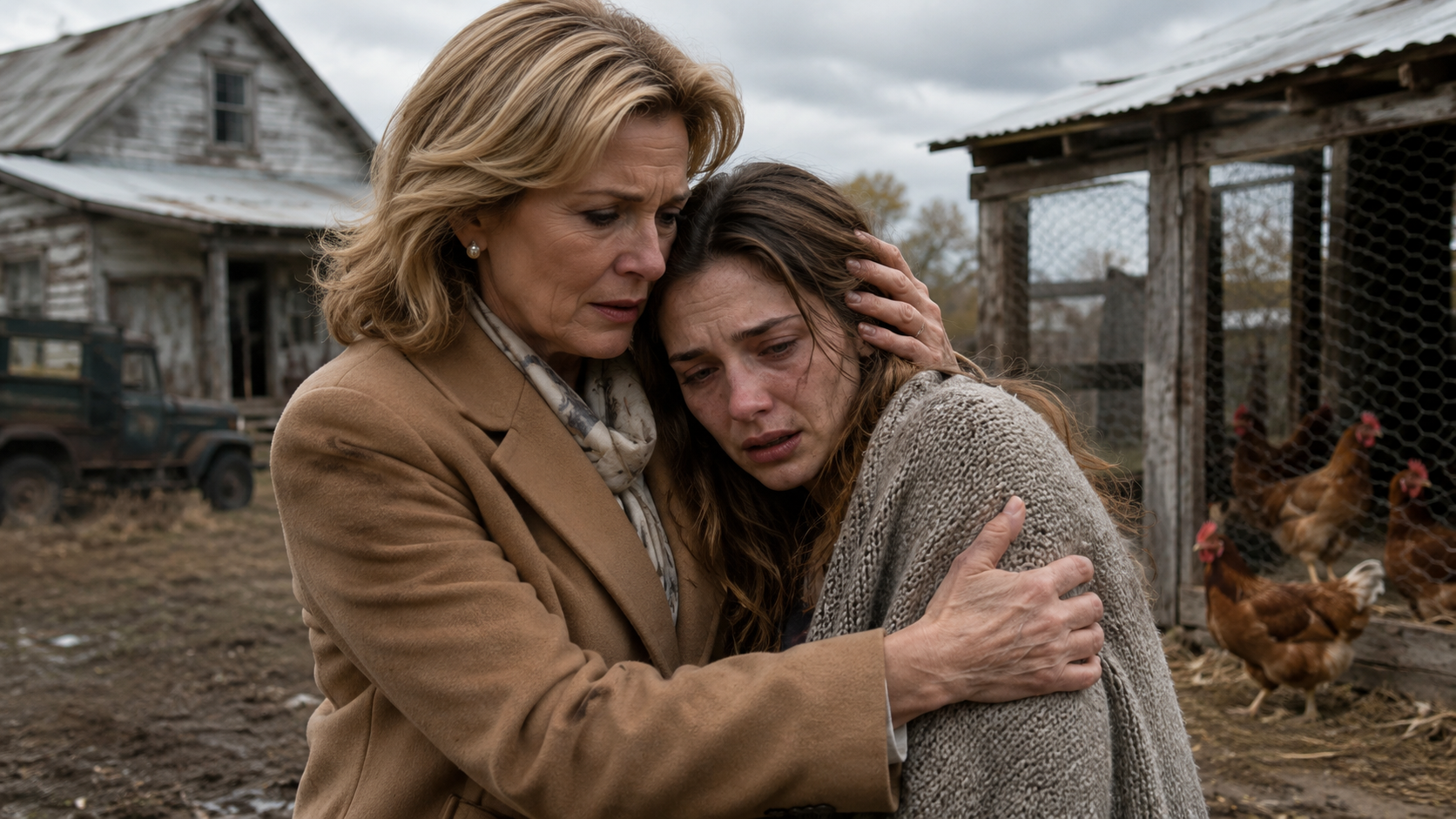
The first thing Elaine Whitmore noticed was the silence.
Not the peaceful silence of the countryside, not the gentle quiet of a farm at sunset, not the kind of silence that rests over fields after a long day of work. This was different. It was heavy. Watchful. A silence that seemed to hold its breath.
She stepped out of her black sedan and stood in the dirt yard of the Harrow family property, one hand still on the car door, her eyes moving slowly from the peeling farmhouse to the sagging barn, from the rusted tractor to the narrow trail of muddy footprints leading toward the chicken enclosure.
For two years, she had tried to be patient.
For two years, she had told herself that her daughter was busy building a marriage, adjusting to another family, learning a new rhythm of life. She had accepted the unanswered calls, the short messages, the excuses.
Mara is resting.
Mara is overwhelmed.
Mara does not feel like talking today.
Mara needs space from you.
The words had always come from someone else. From her son-in-law, Adrian Harrow. From his mother, Beatrice. Sometimes from his younger sister, Lillian, who spoke with the sweet false concern of someone enjoying a secret.
But that morning, Elaine had woken before dawn with a pain under her ribs that no doctor could name and no cup of tea could soothe. She had looked at Mara’s wedding photo on the mantel and realized something that made her hands go cold.
She no longer recognized her daughter’s smile in that picture.
So she had driven four hours without warning anyone.
Now she stood in the Harrow yard, wearing a pale wool coat and city shoes that were already gathering dust, while the house stared back at her with dark windows.
“Mrs. Whitmore?”
The voice came from behind her.
Elaine turned.
Adrian Harrow crossed the yard with long, controlled steps. He was still handsome in the way that had once impressed strangers: tall, neat, dark-haired, with the confident expression of a man who had learned early that charm could open doors faster than honesty. He wiped his hands on a cloth as he approached, though there was nothing on them.
“You should have called,” he said.
Elaine closed the car door.
“I did,” she replied.
His smile twitched. “We’ve been having trouble with the signal.”
“Since January?”
The smile disappeared for half a second before returning, thinner than before.
“Mara has been tired,” he said. “She gets anxious when people pressure her.”
“I am her mother.”
“And that,” he said softly, “is exactly why she gets anxious.”
Elaine studied him. She had negotiated with bankers who wanted to swallow her company whole. She had faced contractors who lied through perfect teeth. She had listened to men in expensive suits explain why a widow should sell the business her husband had helped her build. She knew a rehearsed sentence when she heard one.
“Where is she?” Elaine asked.
Adrian glanced toward the farmhouse.
“Resting.”
“Then I’ll see her.”
“That isn’t a good idea.”
Elaine took one step toward the house.
Adrian moved just enough to block her path.
It was a small movement. Polite, almost. But Elaine saw the truth of it.
He was not stopping a visitor.
He was guarding a prisoner.
The cold pain under her ribs sharpened.
“Move,” Elaine said.
His eyes hardened. “You can’t arrive here uninvited and give orders on my land.”
Elaine looked past him.
That was when she heard it.
A faint sound from the far side of the yard.
Not quite a cry.
Not quite a word.
Something between a breath and a plea.
Elaine turned her head toward the chicken enclosure.
Adrian’s face changed.
Only slightly. Only for a second.
But it was enough.
Elaine began walking.
“Mrs. Whitmore,” he said behind her, no longer pretending to be calm. “Do not go over there.”
She did not stop.
The smell reached her before she opened the crooked wooden gate. Damp feathers. Rotting straw. old feed. Waste. The sour, living stink of neglect. Chickens scattered as she stepped inside, their wings beating against the wire fencing.
At first she saw only shadows.
Then a figure moved near the back wall.
Elaine froze.
Her daughter sat on the filthy ground beside a broken feed bucket, knees drawn to her chest, one hand cupped around cracked yellow corn kernels. Her once-bright hair hung in tangled ropes around her face. Her dress was torn at the hem and stained with mud. Her bare arms were thin enough that Elaine could see every angle of bone. A bruise, fading green at the edges, shadowed one cheek.
Mara looked up.
For one terrible second, she did not seem to know who Elaine was.
Then her lips parted.
“Mom?”
The word came out small and dry.
Elaine felt the world tilt.
“Mara,” she whispered.
Her daughter tried to stand, then winced and sank back down. Corn spilled from her hand into the straw.
Behind Elaine, Adrian entered the enclosure.
“She does this,” he said quickly. “She hides. She refuses proper meals. She becomes dramatic when she wants sympathy.”
Elaine did not look at him.
She moved toward Mara and knelt in the filth without caring what ruined. Her daughter flinched when Elaine reached for her face.
That flinch broke something open inside her.
Not because Mara feared her.
Because someone had trained her to fear kindness.
“Oh, my darling,” Elaine said, her voice shaking.
Mara’s eyes filled with panic. She looked past her mother at Adrian.
“Please don’t make him angry,” she whispered. “Please. He’ll lock the pantry again.”
Elaine turned slowly.
Adrian’s jaw tightened.
“You see?” he said. “She says strange things. We have been trying to manage her condition privately.”
“Her condition?” Elaine repeated.
“She has episodes.”
Elaine stood.
For most of her life, people had mistaken her softness for weakness. She spoke gently. She dressed simply. She believed in thanking waiters by name and paying invoices early. But anyone who had ever sat across a legal table from Elaine Whitmore knew there was another woman beneath that softness.
A woman made of iron.
“You had my daughter eating animal feed,” she said.
Adrian laughed once. “Don’t be ridiculous.”
Elaine pulled out her phone.
His expression changed immediately.
“What are you doing?”
“Recording.”
“You have no right to record on private property.”
Elaine lifted the phone and aimed it at Mara, at the bucket, at the stained straw, at the locked side gate, at Adrian standing in the doorway with his polished boots in chicken waste.
“My name is Elaine Whitmore,” she said, her voice becoming clear and steady. “I am at the Harrow family farm. I have found my daughter, Mara Harrow, formerly Mara Whitmore, severely malnourished and sitting in a chicken enclosure with raw corn in her hand. Her husband, Adrian Harrow, is present.”
Adrian stepped forward. “Turn that off.”
Elaine kept recording.
“Adrian, why is my daughter in here?”
He reached for the phone.
Elaine screamed.
Not a helpless scream.
A command.
“Help! Somebody call the police!”
The sound ripped across the yard. Birds exploded from the roof of the barn. A dog barked from somewhere near the porch. The farmhouse door opened.
Beatrice Harrow appeared in a blue cardigan and pearl earrings, her gray hair pinned into a perfect knot. She was the kind of woman who looked respectable even while standing beside cruelty. At the wedding, she had held Elaine’s hands and promised to love Mara like her own child.
Now she looked into the chicken enclosure and did not seem surprised.
“What is this unpleasant noise?” Beatrice asked.
Elaine turned the phone toward her.
Beatrice’s eyes narrowed.
“Elaine,” she said, forcing a smile. “You should have told us you were coming. Mara is unwell today.”
“My daughter is starving.”
“Mara has always been delicate,” Beatrice replied. “You raised her with too much comfort. She never learned discipline.”
Mara began trembling.
Elaine heard the truth then.
This was not one cruel husband losing his temper.
This was a household that had built a language around abuse.
Hunger became discipline.
Fear became instability.
Isolation became privacy.
Pain became marriage.
Elaine put her phone into the inside pocket of her coat and helped Mara stand. Her daughter’s body was so weak that Elaine had to hold most of her weight.
Adrian blocked the gate.
“She isn’t leaving,” he said.
Elaine looked at him.
“She is.”
“She is my wife.”
“She is not your property.”
Beatrice’s face hardened. “Elaine, you are making a terrible mistake. Mara signed papers. She made choices. She belongs with her husband.”
Mara made a broken sound.
Elaine felt her daughter’s fingers clutch her sleeve.
“What papers?” Elaine asked.
No one answered.
A truck engine growled near the driveway. A farmhand came around the corner carrying a coil of rope. Behind him, a delivery driver stood beside an open van, staring. Two witnesses. Then three, as Lillian Harrow stepped onto the porch and froze.
Elaine raised her voice.
“If anyone touches my daughter, every recording on this phone goes to the police, to my attorney, and to every local news station before sunset.”
Adrian’s face flushed dark red.
Beatrice’s mask cracked.
“You would ruin a family over a misunderstanding?” she asked.
Elaine gave a cold smile.
“No, Beatrice. I am saving mine.”
Adrian stepped aside.
Elaine half-carried Mara across the yard. Every step seemed to hurt her. Mara kept whispering, “I’m sorry, I’m sorry, I’m sorry,” as if rescue were another crime she might be punished for later.
Elaine opened the passenger door and eased her inside.
“Look at me,” she said.
Mara’s eyes lifted.
“You are not going back.”
Mara shook her head, tears sliding down her dirty cheeks.
“He’ll come for me.”
“Let him try.”
Elaine locked the doors, started the car, and reversed down the long dirt road while Adrian shouted behind them. Beatrice stood on the porch with one hand at her throat, her eyes sharp with calculation.
Only when the farm disappeared behind a row of winter trees did Mara speak again.
“The house,” she whispered.
Elaine glanced at her. “What about the house?”
“The wedding house.”
Elaine’s hands tightened on the wheel.
The house.
The beautiful cream-colored cottage in Bellhaven, with blue shutters, a garden gate, and a sunlit kitchen Mara had once said looked like something from a dream. Elaine had bought it as a wedding gift, but not for the marriage. For Mara. She had wanted her daughter to always have a place that was hers, a door she could open if love ever turned into a cage.
“I put that house in your name,” Elaine said.
Mara closed her eyes.
“They made me sign things.”
Elaine felt the road blur for a second.
“What things?”
“I don’t know. Adrian said it was for insurance. Beatrice said married women should not hide property from their husbands. They kept me awake. They wouldn’t let me call you. They said if I refused, Adrian would leave me and everyone would know I was a selfish wife.”
Elaine forced herself to breathe.
“Did you sign the house over?”
“I don’t know,” Mara whispered. “I was so tired.”
Elaine drove faster.
At the hospital, Mara collapsed before they reached the entrance.
Two nurses rushed out with a wheelchair. A doctor began asking questions. A social worker arrived. Photographs were taken. Bruises were documented. Blood tests confirmed dehydration and severe malnutrition. The hospital room filled with quiet, urgent movement.
Elaine gave the police the video.
She gave them the address.
She gave them Adrian’s name, Beatrice’s name, Lillian’s name, and every detail Mara could manage between waves of exhaustion.
Then Elaine called her lawyer, Naomi Vale.
Naomi had represented Elaine for fourteen years. She was calm, precise, and terrifying to people who mistook paperwork for protection.
“Elaine?” Naomi said when she answered. “What happened?”
Elaine looked through the glass wall at Mara lying beneath a white blanket, smaller than she had looked at twelve years old.
“I found my daughter in a chicken enclosure eating raw corn.”
There was a pause.
Then Naomi’s voice changed.
“What do you need?”
“The house. Find out who owns it.”
“I’ll pull the records now.”
“And Naomi?”
“Yes?”
“Prepare for war.”
By evening, Adrian had called twenty-seven times.
Elaine did not answer.
Beatrice called nine times.
Elaine did not answer.
Then a message arrived from an unknown number.
You have taken a sick woman from her lawful husband. Bring her back before this becomes public.
Elaine showed it to the officer.
He read it twice and said, “Do not respond.”
Elaine gave a tired, humorless smile.
“I wasn’t planning to. My attorney uses better grammar.”
That night, Mara woke to the soft beep of machines and the dim glow of hospital lights. For a moment, she looked around as if she expected someone to drag her back to the farm.
Then she saw Elaine beside the bed.
“Mom,” she whispered.
Elaine took her hand carefully.
“I’m here.”
Mara’s face crumpled.
“I thought you forgot me.”
Elaine lowered her head, pressing her forehead to her daughter’s knuckles.
“No,” she said. “Never.”
“He told me you didn’t want me anymore.”
Elaine closed her eyes.
“He lied.”
“He said you were ashamed of me.”
“He lied.”
“He said the house proved you were trying to buy my love.”
Elaine lifted her head.
“That house was never meant to buy anything. It was meant to protect you.”
Mara stared at the ceiling.
“I lost it.”
“We don’t know that yet.”
But by morning, they did.
Naomi arrived in person with a folder, her face pale with controlled anger. The deed had been transferred eight months earlier. Mara’s signature appeared on the documents. So did Adrian’s. The cottage had been placed into a limited company controlled by Beatrice Harrow. A rental agreement had already been signed with strangers. The money had never reached Mara’s account.
“They planned this,” Naomi said.
Elaine sat very still.
Mara covered her face.
“I’m sorry.”
Elaine turned sharply.
“Do not apologize for what they stole.”
“But I signed.”
“Under pressure. Under isolation. Under abuse.” Naomi opened the folder. “And possibly under fraud.”
The next weeks moved like a storm.
Police questioned the farmhand, who admitted he had seen Mara sleeping in the chicken enclosure more than once but had been told she was “acting out.” The delivery driver confirmed Elaine’s condition when she left the property with Mara. Medical reports supported a pattern of long-term neglect. A neighbor came forward after seeing emergency vehicles at the Harrow farm and told investigators she had heard screaming from the property at night.
Adrian’s first defense was charm.
He told everyone Mara was fragile. He told police she refused food. He told relatives Elaine was a controlling mother who had never accepted his marriage.
Then Elaine’s recording surfaced in court.
Not online.
Elaine refused to turn her daughter’s suffering into entertainment.
But in the courtroom, the video spoke.
It showed the filth.
It showed Mara’s body.
It showed Adrian saying she wanted attention.
It showed Beatrice calling cruelty discipline.
After that, charm became less useful.
Beatrice tried a different strategy. She arrived in court wearing a modest navy dress and a silver cross around her neck. She spoke of family values, privacy, and the burden of caring for a troubled daughter-in-law.
Mara listened from beside Elaine, hands folded in her lap.
She was still thin. Still pale. Still startled by sudden noises. But she was no longer silent.
When the judge asked if she wished to speak, Mara stood.
Elaine reached for her hand.
Mara squeezed once, then let go.
“My husband did not save me from illness,” she said. “He made me ill. His family did not protect my dignity. They used that word to hide what they did. I was hungry. I was afraid. I was told I was crazy so many times that I started to wonder if it was true. But crazy people do not become crazy because they ask for food, or sunlight, or a phone call to their mother.”
The courtroom was still.
Mara looked at Adrian.
“You told me no one would believe me.”
Her voice shook, but it did not break.
“You were wrong.”
The legal battle over the house took longer.
Adrian’s lawyers argued that Mara had signed willingly. Naomi brought phone records, medical reports, witness statements, and evidence of financial manipulation. She proved that Mara had been isolated from her mother before the transfer. She proved that Beatrice’s company had benefited. She proved that the rental income had gone into accounts Mara had never accessed.
The judge reversed the transfer.
The house returned to Mara.
But Mara did not move back immediately.
For months, she stayed with Elaine in the city apartment above the bakery office, where the smell of cinnamon and warm bread rose through the floorboards every morning. She learned how to sleep with the lights off again. She learned how to eat without asking permission. She learned that footsteps in a hallway did not always mean danger.
Some days she cried because a spoon fell.
Some days she laughed for no reason at all.
Both were signs of life returning.
One spring afternoon, Elaine drove Mara to the Bellhaven cottage.
The garden was overgrown. The blue shutters needed painting. The tenants had left scratches on the floor and holes in two walls. The lemon tree by the kitchen window had died from neglect.
Mara stood at the gate for a long time.
Elaine waited beside her.
“I thought I would feel happy,” Mara said.
“What do you feel?”
Mara looked at the house.
“Angry.”
Elaine nodded.
“Good.”
Mara turned to her.
“Good?”
“Anger means some part of you still knows you deserved better.”
Mara’s eyes filled with tears.
“I don’t know how to live here now.”
“Then don’t live here yet,” Elaine said. “Repair it first. Room by room. Only as fast as you want.”
So they began.
Not with decorators or grand plans, but with gloves, buckets, open windows, and music playing from Elaine’s old radio. They scrubbed the kitchen together. They tore down stained curtains. They planted rosemary by the steps. Mara chose new locks herself and watched the locksmith install each one.
The first night Mara slept there, Elaine stayed in the guest room.
At two in the morning, Mara knocked on her door.
Elaine sat up instantly.
“What is it?”
Mara stood in the hallway holding a blanket.
“I heard something outside.”
Elaine got up and checked every window, every door, every shadow on the porch. There was nothing but wind moving through the garden.
When she came back, Mara looked ashamed.
“I’m sorry.”
Elaine took the blanket from her hands and wrapped it around her shoulders.
“No more apologizing for being afraid.”
Mara nodded.
Then, after a moment, she asked, “Can you sit with me?”
Elaine smiled softly.
“Always.”
They sat on the living room floor until dawn painted the walls gold.
A year later, the house looked nothing like it had before.
The shutters were green now. Mara had chosen the color because it reminded her of new leaves. The dead lemon tree had been replaced by two young pear trees. The kitchen shelves held jars of tea, bowls of fruit, and a blue ceramic pitcher Elaine had given Mara when she moved in permanently.
Mara started working part-time at a women’s shelter, first helping with donated clothes, then answering phones, then sitting with women who arrived shaking and ashamed.
She never told them what to do.
She only said, “You are allowed to leave before you have proof good enough for everyone else. Your fear is already proof enough for you.”
One afternoon, Elaine found her daughter standing on the back porch, watching sunlight move over the garden.
“You look peaceful,” Elaine said.
Mara smiled.
“I was thinking about the chicken coop.”
Elaine’s heart tightened. “Why?”
“Because for a long time, I thought that was the end of my story.”
Elaine stepped beside her.
Mara looked at the pear trees.
“But it wasn’t.”
“No,” Elaine said. “It wasn’t.”
Mara took a slow breath.
“He took so much from me.”
“Yes.”
“But not everything.”
Elaine reached for her hand.
Mara squeezed it.
Inside the cottage, the kettle began to whistle.
It was a small sound. Ordinary. Safe.
Mara smiled again, and this time the smile reached her eyes.
Two years earlier, Elaine had bought her daughter a house because she wanted Mara to have a place to run if love ever became dangerous.
She had not known then that the house would be stolen, dirtied, emptied, and turned into evidence.
She had not known she would one day find her daughter sitting on a filthy floor with animal feed in her hand.
She had not known how close she would come to losing her.
But now, standing on the porch of the restored cottage, Elaine understood something.
A house could be taken.
A name could be changed.
A woman could be lied to, isolated, frightened, and made to feel smaller than her own shadow.
But love, real love, did not lock doors.
It opened them.
And when Mara finally stepped back inside her own home, she did not ask permission.
She simply entered.

