The Bride Smiled for the Cameras—Until Her Sister Unmasked the Monster at the Altar

The Bride Smiled for the Cameras—Until Her Sister Unmasked the Monster at the Altar

“Celeste, what are you talking about?”

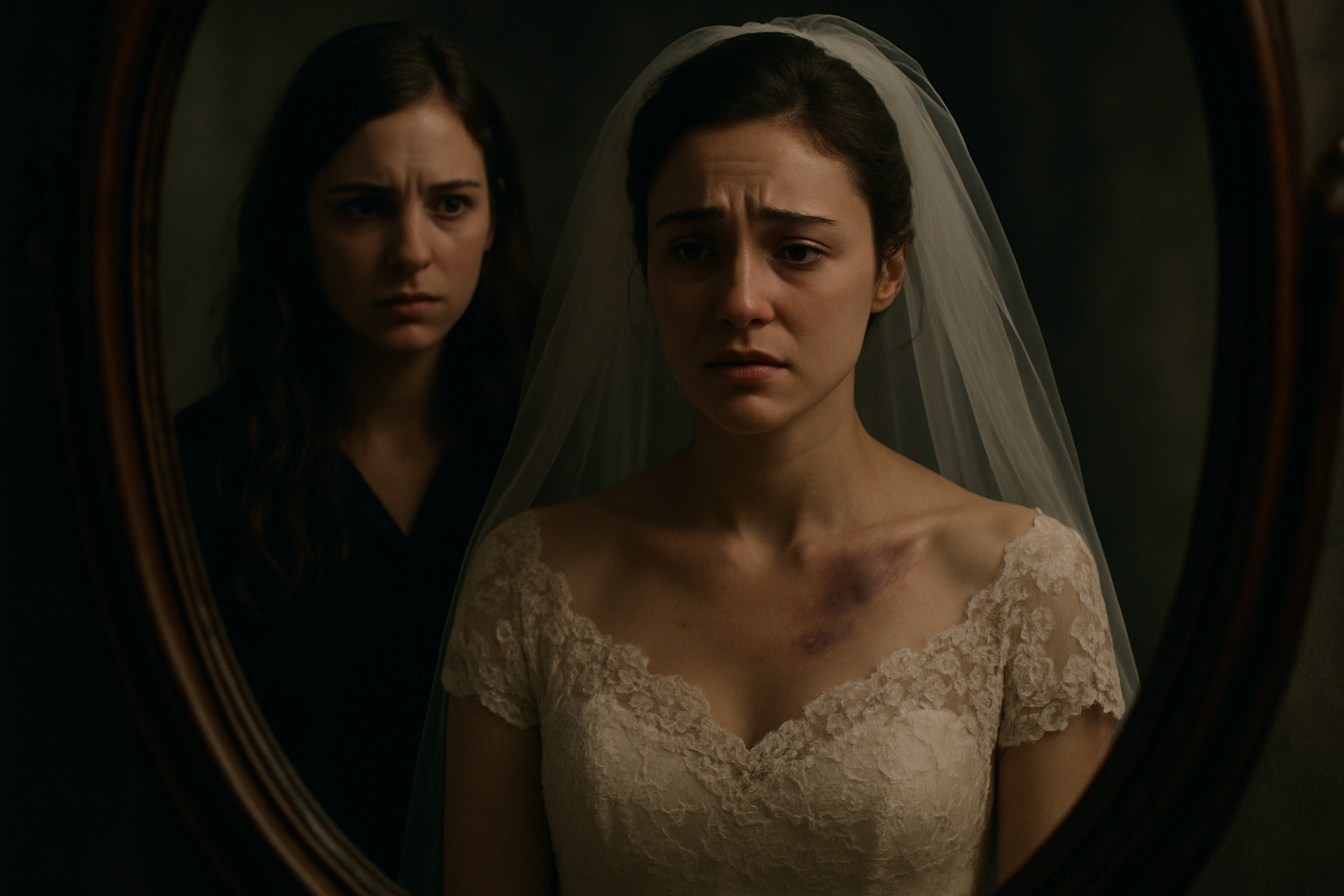
Celeste Rowan stood behind her younger sister in the bridal shop, staring at the mirror.

Not at the dress.

At the bruises.

Purple shadows bloomed beneath the ivory lace, half-hidden where a future husband had thought no one would notice.

Lila’s face crumpled.

Celeste did not scream. She did not cry. Not yet.

She only looked at her sister and said, very softly, “We are going to let them walk themselves all the way to the altar. And when they get there, everyone will see exactly what kind of family they’ve been clapping for.”

The rehearsal dinner was the next evening at the Meridian Club, high above the city, where the windows glittered over rain-dark streets. Waiters drifted between white tablecloths with wine bottles and practiced faces, pretending not to see the tension gathering like thunder.

Sterling Vale arrived as if the room belonged to him.

Tall. Silver-haired. Broad-shouldered. The kind of man whose handshake lingered too long and whose smile never reached his eyes.

His wife, Corinne, wore diamonds and a polished expression. Their son, Grant, walked beside them in a charcoal suit, handsome enough to be mistaken for decent.

His hand rested on Lila’s lower back.

Not tenderly.

Possessively.

Celeste saw Lila stiffen.

Sterling noticed Celeste watching and raised his glass.

“Well,” he said loudly, “the older sister made it. The one with courtroom eyes.”

A few guests laughed.

Rich men knew how to train a room.

Celeste did not laugh.

“I prefer observant,” she said.

Grant hugged her with cologne sharp enough to sting.

“Try not to make tomorrow about you,” he murmured near her ear. “Lila has enough stress without your drama.”

Celeste patted his shoulder once.

“That sounds like something a nervous man would say.”

His smile stayed.

His eyes changed.

Across the room, Lila stood near their parents. Their father, Amos Rowan, looked proud and worried all at once. He was sixty-one, with worn hands, a bad knee, and the soft heart of a man who loved quietly and completely. Their mother, Elise, wore a pale blue dress and the pearls she saved for weddings and funerals.

They did not know yet.

Lila had made Celeste promise not to tell them until there was a plan.

That promise had cost Celeste sleep.

But it had bought Lila time.

Dinner began with speeches that sounded like advertisements. Sterling talked about “joining two strong families.” Corinne said Lila had brought “grace” into Grant’s life. A local official praised the Vales for “building communities,” though Celeste knew men like Sterling usually built fortunes first and excuses later.

Then Sterling rose again.

“I want to say something about Rowan & Sons,” he said.

Amos smiled uneasily.

Sterling turned toward him with the warmth of a wolf at a gate.

“Amos, you’ve built a fine little business. Real craftsmanship. Real tradition. Of course, small businesses are fragile things these days. One shaky loan. One delayed shipment. One unpleasant audit. Suddenly tradition becomes a liability.”

The room gave an uncertain chuckle.

Amos’s smile faded.

Elise touched the tiny cross at her throat.

Celeste took a slow sip of water.

“Liabilities are interesting,” she said. “Most people don’t recognize them until they’re already on the balance sheet.”

Sterling looked at her.

“Consultant humor?”

“Forensic accounting humor.”

The word forensic cooled the table.

Grant leaned close to Lila and whispered something Celeste could not hear. But she saw Lila’s shoulders draw inward. She saw Grant’s thumb press into the back of Lila’s hand until the skin whitened.

Before dessert, Celeste excused herself.

In the marble bathroom, she locked herself in the largest stall and opened the folder Lila had sent her.

The first files were terrible, but expected.

Texts from Grant saying she would “learn how marriage works.”

Voice messages where he sounded drunk and cruel.

Photos of bruises taken in bathroom mirrors.

A hospital discharge form listing “contusions” and “patient reports fall,” though the intake notes said Lila had hesitated before answering.

Then Celeste found another folder.

SHOP.

She opened it.

Invoices.

Vendor agreements.

Wire confirmations.

At first glance, they looked like ordinary business records. Lumber purchases. Renovation deposits. Subcontractor fees.

But Celeste had spent too many years reading numbers that lied.

The amounts were too neat.

The vendors were too new.

Addresses overlapped.

Several invoices used the same wording, the same formatting mistakes, even the same scanned signature block.

She opened one vendor profile.

No real website.

No employee records.

A registered agent shared by four other companies.

She opened another.

Same pattern.

Then one wire transfer stopped her cold.

Money had moved through an account tied to Rowan & Sons into a political committee supporting judges, commissioners, and candidates.

Celeste’s fingers went still.

Sterling was not only threatening her family.

He was using them.

The woodworking shop her father had built with his father’s tools had become a pass-through for campaign money, fake vendors, bribes, and offshore transfers.

Amos Rowan, who still wrote measurements on scrap paper and refused to rush heirloom cabinets, had unknowingly become the signature on a criminal pipeline.

And when Sterling no longer needed him, he would leave Amos holding the match in a room full of gasoline.

Celeste felt anger.

But this was sharper than anger.

This was clarity.

She stepped out and called a number she had not used in months.

A woman answered on the second ring.

“Celeste?”

“Nina, I need you to listen carefully.”

Nina Calder had once worked with Celeste on a federal fraud investigation after a storm destroyed hundreds of homes. Now she was a special agent in public corruption.

She was not the friend you called for gossip.

She was the friend you called when a powerful man had victims, paperwork, and friends in dark places.

“Tell me this is not about Sterling Vale,” Nina said.

“It is absolutely about Sterling Vale.”

A slow breath.

“That case died because witnesses got scared and records vanished.”

“Then you’ll be happy to know I have records, a witness, assault evidence, extortion, financial coercion, shell vendors, political money movement, and my family’s company being used as a front without consent.”

Nina’s voice changed.

“Where are you?”

“At the rehearsal dinner.”

“You’re joking.”

“I wish I were.”

“When is the wedding?”

“Tomorrow afternoon.”

Silence.

Then Nina said, “Send me everything. And do not confront him alone.”

Celeste looked at herself in the mirror.

“I’m not alone,” she said. “He just doesn’t know who’s standing behind us yet.”

That night, while wedding guests slept in hotel suites and dreamed of champagne, the Rowan family sat around Amos’s kitchen table beneath the yellow light of an old wagon-wheel fixture.

Lila told her parents everything.

Not neatly.

Pain never leaves the body in neat sentences.

It came out in fragments. In apologies she did not owe. In trembling hands. In long silences.

When Elise saw the photos, she made a sound so raw Amos grabbed her before she slipped from the chair.

Amos did not cry at first.

He stared at the phone.

Then at his own hands.

“I shook his hand,” he whispered. “I let that boy into my house.”

Lila slid from her chair and knelt in front of him.

“Daddy, this isn’t your fault.”

Amos’s face broke.

“I taught you to check the oil in your car,” he said. “I taught you to tell oak from ash by the grain. I didn’t teach you how to run from a man who smiles at your mother while hurting you.”

Elise gripped Lila’s shoulders.

“No,” she said fiercely. “He taught you how to survive. That is why you kept evidence. That is why you told your sister. That is why you are here.”

Celeste connected Amos’s old desktop computer to an external drive. She downloaded contracts, loan documents, bank notices, vendor emails, and signature authorizations.

Amos kept saying he did not understand.

Celeste explained gently. Sterling had purchased their debt through layers of companies. Then he had used routine business paperwork to slide dirty money through their accounts.

Amos looked sick.

“I signed some of those forms.”

“You signed forms under pressure and false pretenses,” Celeste said. “There’s a difference.”

“Will I go to prison?”

Lila gasped.

Elise covered her mouth.

Celeste put a hand on her father’s shoulder.

“Not if we tell the truth before Sterling tells his version.”

By 2:17 a.m., Nina joined them on a secure video call. Two federal prosecutors listened without interrupting. By 3:40, Lila had recorded a formal statement. By 4:25, Amos had signed consent for investigators to access company systems.

By dawn, agents had enough to move.

Especially because several Vale-linked accounts had tried to transfer money after midnight.

At 6:03 a.m., Celeste’s phone buzzed.

An unknown number.

Tell your sister to smile today. Your family eats because I allow it.

Celeste stared at the words.

Sterling had sent it himself. She knew it. Men like Sterling did not delegate threats when they wanted to enjoy them.

Lila, sitting beside her in sweatpants while her wedding dress hung unzipped from a kitchen chair, read over Celeste’s shoulder.

Her face went white.

“Maybe we shouldn’t go,” Lila whispered.

Celeste forwarded the message to Nina.

Then she turned to her sister.

“We’re going,” she said. “But you are not walking into that place alone. Not for one second.”

The wedding was held at a restored vineyard estate in the hills.

By noon, the sky had turned a hard, polished blue. White chairs lined the lawn in perfect rows. The altar stood beneath roses, eucalyptus, and pale ribbon. Beyond it, clipped vines rolled toward low hills, tidy as if even nature had been told to behave.

Three hundred guests arrived in linen suits, silk dresses, spotless cowboy hats, and sunglasses expensive enough to insure.

They had come to witness the union of two “good families.”

Though most of them knew only one family mattered.

Sterling moved among them like a king without a crown. He shook hands with donors, judges, developers, pastors, and officials. He laughed loudly. He accepted compliments on the weather as if he had arranged it.

Grant waited near the altar in a black tuxedo, handsome as a magazine cover and just as empty.

He believed the bruises were hidden.

He believed Lila’s silence meant surrender.

He believed Celeste sitting in the front row meant she knew she had lost.

Celeste sat beside Elise.

Amos sat on Elise’s other side.

He was not walking Lila down the aisle. Not from the beginning.

That had been Lila’s choice.

“I need to walk myself at least halfway,” she had said that morning. “Then Dad can meet me. I need to prove to my body that my legs still belong to me.”

When the quartet began, the guests turned.

The doors opened.

Lila appeared alone.

A murmur moved through the chairs.

She was breathtaking. The ivory dress fit perfectly. Her veil floated behind her. Her bouquet held white roses and bluebonnets, soft and stubborn at the same time.

Her face was pale.

But her eyes were forward.

She walked slowly.

One step.

Then another.

Halfway down the aisle, Amos rose and stepped into her path.

For a moment, the ceremony lost its careful rhythm.

He looked at his youngest daughter, grief and pride twisting his face.

“You sure?” he whispered.

Lila nodded.

“I’m sure.”

He offered his arm.

She took it.

Together, they walked toward the altar.

Grant’s smile sharpened.

Sterling leaned back, satisfied.

The minister opened his book.

“Family and friends,” he began, “we are gathered here today to witness the joining of Grant Vale and Lila Rowan in holy matrimony—”

The doors opened again.

No music.

No scream.

No thunder splitting the sky.

Six federal agents walked into the courtyard, with Nina Calder at the front. Her badge was visible against her dark blazer. A warrant folder rested in her hand.

The quartet stopped.

A cello note died in the air.

Every head turned.

Sterling stood so fast his chair scraped stone.

“What is the meaning of this?” he demanded.

Nina’s voice carried cleanly.

“Grant Vale, you are under arrest for aggravated assault, coercive control, witness intimidation, extortion, and interstate threats related to financial harm.”

For half a second, Grant looked confused.

As if those words belonged to some other man.

Then he laughed.

Thin. Ugly.

“This is insane.”

Two agents moved toward him.

Grant stepped back.

“Dad?”

Sterling’s face hardened.

“You do not have the authority to interrupt a private religious ceremony.”

Nina lifted the warrant.

“We do.”

Whispers exploded. Phones rose like birds from grass.

When an agent took Grant’s wrist, his mask slipped.

“Lila,” he snapped. “Tell them this is a misunderstanding.”

Lila looked at him from beneath her veil.

“No.”

It was quiet.

But it changed the air.

Grant stared.

“Lila.”

“No,” she said again, stronger now. “I already told them the truth.”

Someone gasped.

Someone whispered, “What truth?”

Someone else said, “Don’t record this,” while recording it.

Grant’s eyes darkened.

“You are my bride.”

Lila took one step back.

“I was your target,” she said. “That is not the same thing.”

The courtyard went still.

Then Sterling moved.

He surged toward Nina with the fury of a man used to doors opening before he touched them.

“You have no idea who you’re dealing with.”

Nina turned to him.

“Yes,” she said. “We do. That’s why we’re also here for you.”

Another agent stepped behind Sterling.

“Sterling Vale, you are under arrest for money laundering, bank fraud, tax fraud, conspiracy, obstruction of justice, unlawful coercion, and bribery of public officials.”

Sterling’s face flushed deep red.

“You have made a career-ending mistake.”

Celeste stood from the front row.

All eyes shifted.

Sterling looked at her as if seeing her for the first time.

Celeste smoothed the front of her black dress.

“You had shell vendors, fake invoices, political pass-throughs, offshore transfers, threatening texts, and the unfortunate habit of assuming women save everything in a folder labeled ‘miscellaneous.’”

His mouth tightened.

“You.”

“Yes,” Celeste said. “The bitter divorced consultant with no power.”

Grant twisted in the agents’ grip.

“Lila, baby, please. Tell them you love me. Tell them we fought, but it wasn’t like that.”

Lila lifted her veil and let it fall behind her shoulders.

Her makeup was flawless.

But her face had changed.

Fear had become something steadier.

“I was afraid of you,” she said. “You taught me to confuse fear with love. I’m done confusing them.”

The first camera flash came from the society photographer Sterling had hired himself.

Then another.

Then phones rose higher.

But the worst part for Sterling was not the arrest.

It was that nobody rushed to help him.

The judges looked away.

The donors stepped back.

The pastors lowered their eyes.

Corinne Vale sat frozen in the front row, one diamond bracelet trembling against another.

The kingdom Sterling had built from favors and fear began collapsing in public. Every person who once wanted his attention now wanted distance.

As agents cuffed him, Sterling turned toward Amos.

“You think this saves you?” he spat. “Your name is on documents you don’t even understand.”

Amos rose slowly.

He was not tall like Sterling. He owned no towers. His suit was rented. His shoes hurt.

But his voice carried with the dignity of a man who had finally stopped apologizing for being honest.

“My name is on a business I built with my father,” Amos said. “Your lies are on the rest.”

Sterling lunged half a step before an agent pulled him back.

Then Nina opened another folder.

“Celeste,” she said, “there is one more thing your family needs to hear now, before it leaks through the press.”

For the first time that day, uncertainty flickered through Celeste.

Lila turned toward her.

Nina looked at Elise, then Amos.

“The Vale financial trail includes internal communications from someone inside your family. Someone who helped Sterling identify the shop’s debt, pressure points, vendor relationships, and inherited property.”

Elise tightened her grip on Amos’s hand.

“No,” she whispered.

Nina’s eyes moved across the front rows.

“Victor Rowan.”

A sound passed through the crowd.

Celeste turned.

Uncle Victor sat near the aisle in a tan suit, his face slack.

He was Amos’s younger brother. The fun uncle. The one who brought smoked brisket on holidays and told the same football stories until everyone begged him to stop.

He had been telling Lila for months that Grant was “a blessing.”

He had been telling Amos that Sterling’s refinancing offer was “smart business.”

He had been telling Elise that rich families were different and pride sometimes had to bend for survival.

Victor half stood.

Then sat again, as if his knees had forgotten their purpose.

Amos stared at him.

“Victor?”

Victor opened his mouth.

Nothing came out.

Nina continued.

“Mr. Rowan received consulting payments through a Vale-controlled entity. In exchange, he provided private family financial information and encouraged the acceptance of predatory loan restructuring.”

Elise looked as though someone had slapped her.

“You sold my daughter?” she asked.

Victor shook his head quickly.

“No. No, Elise. I didn’t know Grant was hurting her. I swear, I didn’t know that.”

Celeste stepped into the aisle.

“But you knew Sterling was cornering Dad.”

Victor’s eyes filled.

“I was trying to save the shop.”

Amos made a broken sound.

“By handing it to him?”

“You wouldn’t listen,” Victor said. “You kept saying we could work our way out, but you were drowning. Sterling said he could stabilize everything after the wedding. He said family helps family.”

“Family?” Amos’s voice cracked. “You fed my child to wolves and called it help.”

Victor covered his face.

“I made a mistake.”

Elise’s grief hardened.

“No,” she said. “A mistake is forgetting a birthday. A mistake is denting a truck. You made a choice.”

As agents moved toward Victor, he began crying.

“I didn’t know about the bruises,” he kept saying. “Amos, I didn’t know.”

Amos did not answer.

Lila watched her uncle taken away, and her strength wavered.

Celeste moved to her side.

“This part isn’t your burden,” she whispered.

Lila swallowed.

“He told me I was lucky,” she said. “Uncle Victor told me I was lucky Grant wanted me.”

Celeste looked at the ruined altar, the flowers, the guests, the cameras, the machinery of power and shame lying exposed in the sun.

“Then let this be the last day we let people call cages luck.”

By sunset, the story was everywhere.

The headlines were cruel and hungry.

Powerful Developer Arrested at Son’s Wedding.

Groom Handcuffed at Altar.

Family Business Used in Political Money Scheme.

Then the videos spread.

Not the polished wedding footage Sterling had planned.

The shaky clips.

Lila saying, “I was your target.”

Lila saying, “I’m done confusing fear with love.”

Those words traveled farther than any press release.

Women shared them with captions like, I needed this twenty years ago.

Mothers sent them to daughters.

Sisters sent them to sisters.

Some men mocked her.

More men went quiet.

Within days, sponsors withdrew from Vale charity events. A hospital quietly removed Sterling’s name from a donor wall pending investigation. Officials promised to return campaign contributions, though reporters asked why they had accepted them in the first place.

Federal agents searched Vale offices in three cities.

Employees who had been afraid for years began calling tip lines.

Grant’s attorney released a statement calling Lila unstable.

That was a mistake.

With Lila’s permission, her lawyer released a limited set of evidence.

One voice mail.

Three text messages.

One medical record.

Not the photos.

Lila kept those private. She had already been turned into enough of a spectacle.

The voice mail was enough.

Grant’s voice slurred with rage.

After tomorrow, you don’t get to say no like that. You understand me? You belong to me once that ring is on.

No publicist could soften it.

No family friend could explain it away.

No pastor could call it a misunderstanding without sounding like an accomplice.

But justice was not a lightning strike.

Celeste knew that.

Justice was weather.

Slow. Heavy. Relentless.

The months after the wedding were harder than the arrest.

Lila moved into Celeste’s small brick house, where the floors creaked and a pecan tree dropped branches in storms.

At first, she slept with the lamp on.

She jumped when delivery drivers knocked.

She apologized for taking too long in the shower. For crying during breakfast. For forgetting to eat. For laughing at a television show and then stopping, as if joy required permission.

Celeste did not rush her.

Every morning, she made coffee and left Lila a mug.

Every afternoon, if Lila felt strong enough, they walked the neighborhood.

Some days they made it three blocks.

Some days Lila saw a black SUV turn the corner and went back inside shaking.

“That’s not failure,” Celeste told her.

Lila sat on the stairs with her head in her hands.

“It feels like failure.”

“It’s your nervous system trying to keep you alive.”

“I hate that he still gets to be in my body like this.”

Celeste sat beside her.

“He doesn’t get to stay forever.”

“How do you know?”

“Because you told the truth while wearing the dress he thought would silence you.”

Lila laughed through tears.

“That sounds like something you’d put in a deposition.”

“I write excellent depositions.”

Their parents nearly lost the shop anyway.

Sterling’s damage ran deep.

Accounts were frozen. Vendors panicked. Banks requested meetings, as banks do when morality collides with paperwork.

Amos had to sit in glass conference rooms and explain signatures he had not understood, loans he had accepted under pressure, and invoices he had trusted because his own brother had vouched for them.

Celeste helped untangle the records.

But she could not make consequences disappear.

They sold a delivery truck.

Closed the smaller warehouse.

Laid off two workers with severance Amos paid from his retirement account.

Afterward, Amos cried in the parking lot.

The men hugged him and said they knew he would hire them back one day.

Elise began bringing lunch to the shop again. Not because anyone asked. Because shame grows in empty rooms, and she refused to let Amos sit alone with it.

She made sandwiches.

Swept sawdust.

Answered phones.

Then learned enough bookkeeping to ask uncomfortable questions.

Three months later, Lila walked into the shop for the first time since the wedding.

The smell of cedar and varnish stopped her at the door.

Amos looked up from a workbench.

For a moment, father and daughter stared across the same floor where she had learned to ride a scooter at six years old.

“I don’t want everyone to look at me like I’m broken,” she said.

Amos removed his safety glasses.

“Then I won’t.”

He went back to sanding a walnut tabletop.

Lila stood there.

After a minute, Amos said, “Could use another set of hands on this finish, if you remember how.”

“You want me to work?”

“I want you to tell me whether this edge feels smooth enough. Your hands were always better than mine.”

She walked to the bench.

Touched the wood.

Her fingers moved along the grain.

“It needs another pass,” she said.

Amos nodded.

“Then grab the fine paper.”

From that day on, Lila came twice a week.

Not for pity.

Not for therapy, though it became a kind of therapy.

She sanded. Stained. Measured. Answered emails.

At first, she kept her back covered.

By summer, when the heat pressed into every corner, she wore tank tops.

The scars had faded from purple to pale silver.

They were visible if someone looked.

Most people looked once.

Then learned not to stare.

One afternoon, a customer in pearls stared too long between Lila’s shoulder blades.

The shop went quiet.

Amos’s hand tightened around a pencil.

Celeste, standing near the office door with bank papers, watched.

The woman flushed.

“I’m sorry. I didn’t mean—”

Lila turned.

“It’s okay,” she said. “They’re scars. People notice scars.”

The woman’s eyes filled.

“My daughter has some too,” she whispered.

Lila’s face softened.

“Then I hope she has people who believe her.”

After the woman left, Amos disappeared into the back room. Celeste found him pretending to search for screws.

“You okay?” she asked.

He wiped his eyes.

“No.”

“Fair.”

He looked toward the front, where Lila was writing measurements on an order form.

“She’s stronger than me.”

“No,” Celeste said. “She’s strong because you gave her somewhere safe to come back to.”

Amos shook his head.

“I missed it.”

“Yes,” Celeste said gently. “We all missed pieces. That’s part of how men like Grant get away with things. They count on love being polite.”

Amos leaned against a shelf.

“I don’t want polite anymore.”

“Good.”

The criminal cases moved slowly.

Grant eventually accepted a plea deal after prosecutors presented the voice mails, medical records, and testimony from two former girlfriends who came forward after the wedding video spread.

His sentence was not as long as Lila had privately hoped.

But the protective order was strict.

If he violated it, he would go back.

Sterling fought harder.

He hired expensive attorneys. Claimed political persecution. Claimed rogue employees. Claimed Amos had been a willing participant.

That last lie nearly broke Amos.

But the paper trail held.

It showed pressure. Deception. Victor acting as the bridge.

Victor, desperate to save himself, cooperated.

The day his cooperation agreement became public, Elise sat in Celeste’s kitchen with a cup of tea going cold between her hands.

“He sent me a letter,” she said.

Celeste looked up.

“What did it say?”

“That he prays we’ll forgive him.”

Lila went still.

Elise took the letter from her purse but did not unfold it.

“I wanted to burn it,” she said. “Then I wanted to read it. Then I wanted your father to read it and tell me what to feel.”

“What do you feel?” Celeste asked.

Elise’s eyes shone.

“I feel like forgiveness is too often demanded from the people still bleeding.”

Lila reached across the table and took her mother’s hand.

Elise squeezed it.

“I may forgive him someday,” she said. “But not because he asked nicely from a safe distance. And not because the family wants Christmas to be comfortable.”

Celeste nodded.

“That sounds honest.”

Elise gave a tired smile.

“Honest is exhausting.”

“Yes,” Lila said. “But it weighs less than pretending.”

By fall, the shop survived the worst of the collapse.

Orders increased after a local paper told the story of how a small family business had been used by powerful men. Former clients returned. A church commissioned benches. A women’s shelter asked Amos whether he could build bookshelves at a reduced rate.

He built them at cost.

Then refused to charge for labor.

Lila began volunteering there on Tuesday evenings.

At first, she sorted donated clothes and kept to herself.

Then one night, a nineteen-year-old named Tessa came in with a split lip and a baby on her hip.

She insisted she had slipped.

Everyone in the room recognized the sentence.

No one challenged it directly.

Lila sat beside her on a couch while the baby slept.

“I used to say I fell too,” Lila said quietly.

Tessa stared at the floor.

Lila did not push.

“My sister asked me who did it,” she continued. “I lied the first time. Then I told her. Both things were part of surviving.”

Tessa’s eyes filled.

“If I say it out loud, everything changes.”

Lila nodded.

“Yes.”

“I’m scared.”

“I know.”

“What if nobody believes me?”

“Then you start with one person who does,” Lila said. “One is enough for the first step.”

Tessa cried silently, the baby sleeping against her chest.

Lila stayed with her until midnight.

When Celeste picked her up, she found Lila sitting outside under a yellow security light, wrapped in a cardigan.

“You okay?” Celeste asked.

Lila looked older somehow.

Not in a bad way.

“I thought helping her would make me feel powerful.”

“And?”

“It made me feel sad.”

Celeste sat beside her.

“Sad is not the opposite of powerful.”

Lila leaned her head against Celeste’s shoulder.

“I hate how many of us there are.”

Celeste looked toward the shelter windows, each one glowing with a private story.

“I know.”

Six months after the wedding, Lila asked Celeste to drive her back to the estate.

Celeste lowered her coffee cup.

“Why?”

“I want to see it without him there.”

“You don’t have to.”

“I know. That’s why I want to.”

They went on a cold Sunday morning.

The vineyard was dormant. The hills were brown. The sky was soft and colorless.

The estate had resumed hosting weddings, because beautiful places often return to business before people return to themselves.

The courtyard looked smaller without three hundred guests.

No altar.

No chairs.

No roses.

No federal agents crossing stone.

Only trees, limestone, and wind.

Lila stood where Grant had been arrested.

Celeste stayed a few feet behind.

For a while, neither spoke.

Then Lila unbuttoned her coat and slipped it off.

Underneath, she wore a dark green dress with a low back.

The scars were pale now, raised in places, silver against her skin.

The cold air touched them.

Lila inhaled sharply.

But she did not cover herself.

“I thought this place would swallow me,” she said.

Celeste waited.

“It didn’t.”

“No,” Celeste said. “It didn’t.”

Lila turned around.

Her eyes were wet.

But she was smiling.

“Take my picture.”

Celeste did.

Lila stood beneath an old tree, shoulders back, scars visible, face lifted toward the winter sun.

She did not look like a bride.

She did not look like a victim.

She looked like a woman who had walked through the life someone else chose for her and come out carrying the pen.

That evening, the Rowans gathered at Celeste’s house for dinner.

Amos brought a pecan pie from a bakery, since his own pie had once been banned by unanimous family vote. Elise brought roast chicken, mashed potatoes, and green beans with too much butter. Lila brought flowers. Celeste burned the rolls and called it a culinary choice.

They laughed more than anyone expected.

After dinner, Amos stood awkwardly and tapped a spoon against his water glass.

“Oh no,” Lila said. “Dad has a speech.”

Amos pointed at her.

“You hush. I practiced this in the truck.”

Elise smiled.

“He did. Three times.”

Amos cleared his throat.

“I don’t have fancy words,” he said. “That’s Celeste’s department.”

“Objection,” Celeste said.

“Sustained,” Lila added.

Amos chuckled.

Then grew serious.

“I spent a lot of nights thinking about what I should have seen. What I should have done. I can’t go back. None of us can. But I can say this now. No business, no house, no family name, no debt, no reputation is worth a person’s safety.”

His voice trembled.

“If I ever made either of you feel like keeping peace mattered more than telling the truth, I am sorry.”

Lila’s face changed.

Amos looked directly at her.

“You did not shame this family. You saved it.”

Elise cried quietly.

Lila stood and went to her father.

He wrapped his arms around her carefully, the way he had learned to do after asking whether touch was okay.

She nodded into his shoulder.

Celeste watched, feeling something loosen inside her.

For years, she had thought being the strong sister meant standing between Lila and every danger.

Now she understood.

Strength was not always a wall.

Sometimes it was a witness.

Sometimes it was a phone call.

Sometimes it was letting someone walk halfway down the aisle alone because she needed to know her legs still belonged to her.

Later that night, after their parents left and the dishes sat stacked in the sink, Lila and Celeste sat on the back porch beneath blankets.

The pecan tree creaked above them.

“Do you ever think about what would’ve happened if you hadn’t come to that dress fitting?” Lila asked.

Celeste looked into the dark yard.

“Yes.”

“Me too.”

Celeste turned to her.

“But I did come.”

Lila nodded.

“And I did tell you.”

“You did.”

Lila pulled the blanket tighter.

“I used to think the worst day was when everyone saw what happened to me.”

Celeste waited.

“But it wasn’t,” Lila said. “The worst days were the ones where I smiled and nobody knew I was disappearing.”

Celeste’s throat tightened.

“I don’t want to be only the girl from the wedding video,” Lila said.

“Then don’t be.”

Lila gave a soft laugh.

“That simple?”

“No. But simple and easy aren’t the same.”

Lila looked out at the yard.

“I want to build something.”

“The shop?”

“Maybe. Maybe something for women leaving men like Grant. Not just emergency help. Practical help. Bank accounts. Documents. Storage. Job references. People always say ‘just leave,’ like leaving isn’t a thousand tiny locked doors.”

Celeste smiled.

“That is the most Rowan thing you’ve ever said.”

“What? Turning trauma into paperwork?”

“Turning pain into furniture,” Celeste said. “Something useful. Something that holds weight.”

Lila was quiet.

Then she said, “Will you help me?”

Celeste looked at her sister, at the woman emerging from the ruins.

“Always.”

One year after the wedding that never happened, Rowan & Sons hosted an open house.

Not a grand reopening.

Amos refused to call it that.

“We never closed,” he said. “We just cursed more than usual for a while.”

But the shop had changed.

A new sign hung above the office door.

Rowan Custom Woodworks.

Lila had designed it herself, dropping “& Sons” not out of bitterness, but truth.

Amos cried when he saw it.

Then blamed sawdust.

In the back corner stood a new worktable made from salvaged walnut.

Above it hung a brass plaque:

FOR THE PEOPLE WHO NEED A FIRST STEP.

The table belonged to Lila’s new nonprofit, First Step Fund.

It helped survivors gather documents, open safe bank accounts, pay for emergency transportation, and store evidence securely.

Celeste handled compliance.

Elise organized volunteers.

Amos built lockboxes, bookshelves, and desks for women moving into new apartments.

The shelter director said the Rowans were impossible because they kept doing more than they promised.

On the day of the open house, families wandered through the shop eating cookies and admiring furniture. Former employees had returned. New apprentices swept floors and asked Amos too many questions.

Near closing, a woman arrived with a teenage daughter.

Celeste recognized her.

The customer in pearls.

The one who had once stared at Lila’s scars.

The woman approached carefully.

“My daughter wanted to meet you,” she said.

The girl looked embarrassed and brave.

“I saw your video,” she said. “The one from the wedding.”

Lila’s expression softened.

“I’m sorry you had to see something like that.”

The girl shook her head.

“No. I mean, I’m sorry it happened. But seeing you say no in front of everybody…” She swallowed. “It helped my mom leave.”

The woman began crying.

The girl took her hand.

Lila’s eyes filled, but she smiled.

“I’m glad you’re here.”

The girl looked around the shop.

“My mom said this place almost got taken from you.”

“It did,” Lila said.

“But it didn’t.”

“No,” Lila said. “It didn’t.”

The girl studied the plaque over the walnut table.

“Is this where people start over?”

Lila glanced toward Celeste, who stood near the doorway pretending not to cry.

“Yes,” Lila said. “Sometimes. But starting over doesn’t always look dramatic. Sometimes it looks like filling out a form. Sometimes it looks like sleeping through the night. Sometimes it looks like learning your own laugh again.”

After they left, Lila walked outside.

The evening sun lay warm across the parking lot. The shop windows glowed behind her.

Celeste followed.

“You okay?”

Lila smiled.

“I think so.”

“That sounded almost convincing.”

Lila laughed.

“I am okay. Not every minute. Not every day. But right now, yes.”

Across the lot, Amos locked the front door while Elise reminded him twice to check the side entrance.

Inside, the new sign caught the light.

Rowan Custom Woodworks.

A family name altered.

Not erased.

“Do you still have the picture from the estate?” Lila asked.

“Of course.”

“Can you send it to me again?”

Celeste looked at her.

“You lost it?”

“No. I want to print it for the office.”

Celeste opened her phone and found the photo.

Lila beneath the tree.

Back bare to winter light.

Scars visible.

Face lifted.

For a long time, Celeste had thought the most important image from that year would be Grant in handcuffs. Or Sterling’s face when his kingdom cracked.

She had been wrong.

The real image was not punishment.

Not revenge.

Not even justice.

It was Lila standing in the place meant to bury her, no longer asking permission to be seen.

Celeste sent the photo.

Lila looked down when it arrived.

Then she smiled.

“I used to hate those scars,” she said.

“You don’t now?”

“I still hate how they got there.” Lila touched the screen lightly. “But I don’t hate the woman who survived them.”

Celeste did not blink away her tears.

“That woman is pretty hard to hate.”

For a while, they watched the sun sink behind the low buildings and power lines. Traffic hummed in the distance. A train horn sounded far off.

Life, stubborn and ordinary, kept moving.

The world would not become safe all at once.

Powerful men would still buy silence.

Families would still mistake appearances for peace.

Women would still smile in photographs while hiding bruises under lace, denim, makeup, or excuses.

But in one woodworking shop, beneath the smell of cedar and varnish, a different inheritance had begun.

Not fear.

Not silence.

Not the old belief that scandal was worse than suffering.

A table.

A form.

A phone number.

A sister who noticed.

A father who listened.

A mother who stopped asking what people would say.

And a woman who learned that walking away from the altar was not the end of her story.

It was the first honest sentence.

Whenever someone asked Lila why she kept the picture from that ruined wedding day, she gave the same answer.

“Because that was the day everyone thought I lost everything,” she said. “But really, it was the day I got myself back.”