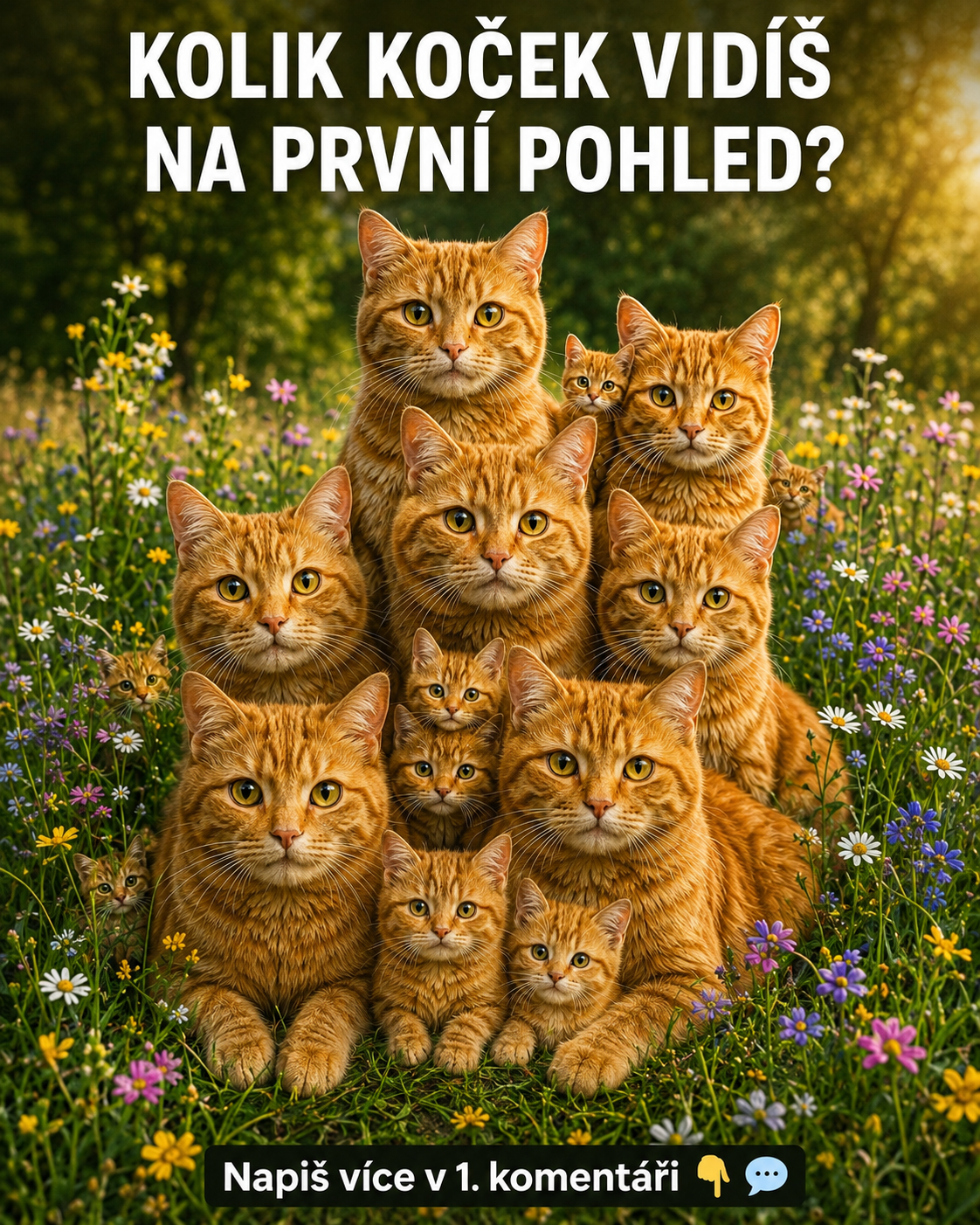
How many cats can you spot? The viral optical illusion that has baffled the internet
At first glance, the picture seems very simple: a cute illustration of a fluffy ginger cat family, sitting cosily together in a bright spring meadow.
Charming, warm and completely harmless.
But don’t be fooled by those big round eyes and soft ginger fur. In fact, what you’re looking at is a cleverly crafted visual puzzle that has already stumped thousands of people.
The task seems straightforward:
How many cats can you see in the picture?
Many people quickly suggest the following answers:
5
7
9
But, according to the solution to this riddle, the correct number is much higher.
So why is this picture so tricky? And why does our brain keep missing the cats that seem to be hidden right before our eyes?
Let’s take a closer look.
Why the brain is so easily tricked
When you first look at the image, your brain automatically focuses on the largest and most obvious shapes.
This happens because human perception usually takes in the whole picture first, and only then moves on to the finer details.
Psychologists sometimes call this global information processing. In other words, our mind quickly searches for recognisable images and patterns to determine as quickly as possible what exactly is in front of us.
In this puzzle, the eye is immediately drawn to:
- A huge cat at the top
- Larger cats in the middle
- Clearly visible faces at the bottom
- As soon as the brain decides it has grasped the overall picture, it often stops looking any closer.
This is precisely how the illusion tricks the viewer.
The secret to getting it right
To count all the cats, you need to stop seeing the image as one large group.
It’s better to look at it slowly, as if you were checking the picture cell by cell.
Pay attention to:
- Small gaps
- The corners of the image
- Where the fur intersects
- Hidden outlines
- Gaps between the larger cats
The tiny kittens are very skilfully blended into the picture using:
- Similar shades
- Repeating facial features
- A well-thought-out arrangement
- This is precisely why they are so easy to miss at first glance.
Hidden answer: 14 cats in total
According to the puzzle’s explanation, there are actually 14 cats hidden in the image.
Here’s how they are thought to be arranged.
Top row — 2 cats
The large cat at the very top is the easiest to spot.
But hidden next to its cheek is the much smaller face of a kitten, which blends in with the surrounding fur.
Second row — 2 cats
Beneath the top cat are two medium-sized cats, looking straight ahead.
Most people find them without much effort.
The middle section — 4 cats
Three larger cats are clearly visible in the central part of the image.
But closer to the left edge, amongst the leaves and reddish hues, another small kitten’s face is hidden, which many people completely miss.
The cat in the gap — 1 cat
Between the two large cats, there is another little face hidden in the empty space.
It is particularly hard to spot because the brain perceives this area as ordinary background.
The bottom section — 4 cats
At the bottom of the image are several cats, partially overlapping one another.
Most people spot two or three straight away, but the small hidden face under the chin of the central cat often goes unnoticed.
The last hidden cat — 1 cat
The last cat, as the solution reveals, is hidden closer to the bottom right-hand corner and carefully camouflaged amongst the grass.
For many viewers, this is the hardest one to find.
What your answer might reveal about your personality
Interestingly, some people link this puzzle to personality traits — depending on how many cats they spotted at first glance.
If you saw between 5 and 7 cats, you are likely someone who notices the obvious details first. You are practical, quick-thinking and prefer clear information rather than lengthy analysis of every little detail.
If you found between 8 and 11 cats, you probably have well-developed powers of observation. You notice more than many others, are naturally curious and patient, and are willing to look beneath the surface.
If you managed to spot between 12 and 14 cats, you probably have a particularly keen eye for detail. You are likely to be observant, analytical and able to spot subtle patterns that others easily miss.
Of course, this is all just for fun, not a real psychological test. But this interpretation adds another interesting layer to the puzzle and makes people even more eager to compare their answers.
Why optical illusions are so fascinating
Visual puzzles like this are popular because they show exactly how the brain processes what we see.
Our eyes are technically capable of perceiving a multitude of details, but the brain filters the information to avoid becoming overloaded.
This is linked to a phenomenon known as inattentional blindness: a person may fail to notice a visible object if their attention is focused on something else.
This puzzle is particularly tricky because:
- All the cats are the same ginger colour
- Their facial features are very similar
- The cats vary greatly in size
- Their shapes overlap noticeably
- All of this forces the brain to constantly readjust its focus, depth of perception and image recognition.
Were you able to find all 14?
If you managed to spot all the hidden cats without any clues — congratulations. You probably do have a very keen eye for visual detail.
But if a few cats have slipped past you, there’s certainly no need to get upset.
Most people miss a few hidden faces on their first look, because the image is deliberately designed to throw the brain off.
That’s exactly why optical illusions like this are so captivating.
They make us slow down, look more closely and question what we thought we’d already seen.
And sometimes the hardest things to spot are the ones hiding in plain sight.