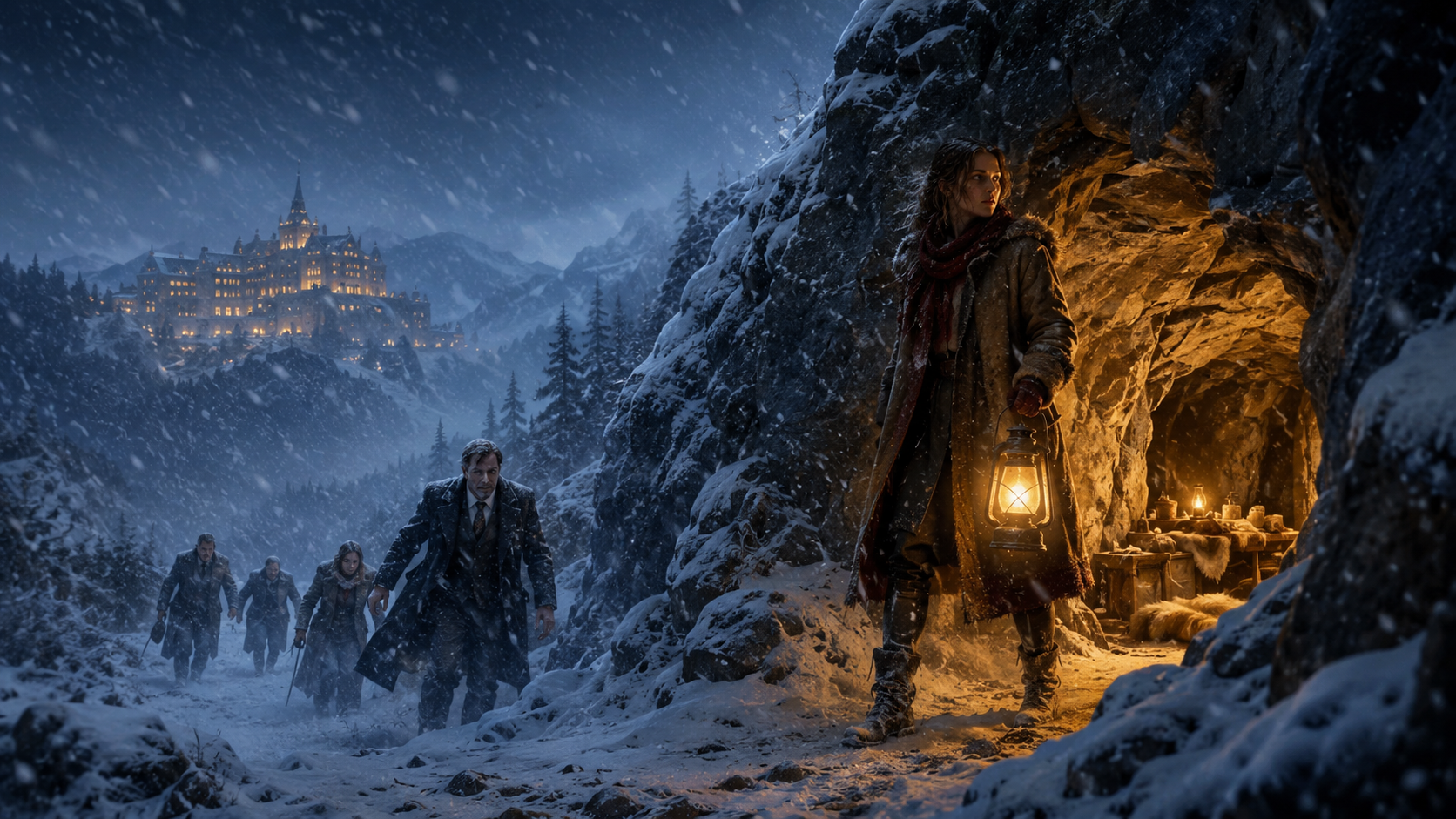
The Warmest Place Before Winter

When Adrian Vale told Mara Ellis she would freeze before Thanksgiving, he said it with the calm certainty of a man who had never once been cold without knowing a thermostat was within reach.

He stood beneath the arched stone entrance of Grayhaven Lodge, wrapped in a black cashmere coat, one gloved hand resting on the brass head of his walking cane. Behind him, through the tall windows, chandeliers burned like captured suns. A fire roared in the great hall, servants moved silently between polished tables, and somewhere inside, a pianist was playing a soft piece meant to make rich people feel tragic.

Mara stood on the gravel drive with one suitcase, one torn wool coat, and the kind of silence that forms when a person has been humiliated too many times to waste breath defending herself.

Snow had not fallen yet, but the mountains were already warning everyone. The air smelled metallic. Frost clung to the iron gates. Clouds lowered over the pine forest like a ceiling about to collapse.

“You cannot stay here,” Adrian said.

His voice was smooth. Educated. Practiced. A voice that made cruelty sound like administration.

Mara looked past him toward the lodge, toward the place where she had cooked breakfasts before dawn, mended curtains after midnight, and memorized every creak of the old house because she had once believed loyalty might become safety.

“I worked here for nine years,” she said.

“And you were paid for nine years.”

“My mother died here.”

“She was employed here too.”

That struck harder than the cold.

Mara’s mother had spent half her life keeping the Vale estate alive. She had known which pipes froze first, which guest rooms collected damp, which roads became deathtraps after the first real storm. She had also known, better than anyone, what kind of man Adrian Vale had become after inheriting his father’s fortune: elegant, powerful, and empty in the places where warmth should have been.

Mara lifted her chin. “The storm season is coming early.”

Adrian smiled, barely. “Then you should have planned better.”

A few people watched from inside. Not openly, of course. Grayhaven had rules about dignity, and dignity meant never staring too long at another person’s ruin. But Mara saw their pale faces between the curtains: Mrs. Bell, the housekeeper; Dorian, Adrian’s cousin; two investors from the city who had arrived that morning to discuss turning part of the mountain land into private luxury cabins.

Adrian took one step closer.

“You’ve become inconvenient,” he said quietly. “You ask questions. You refuse instructions. You keep bringing up old promises my father supposedly made to your mother.”

“He did make them.”

“My father was sentimental when drunk. That is not a legal contract.”

“He said we would always have a place here.”

“And yet here you are,” Adrian said, looking around the drive as if the evidence pleased him. “Without one.”

For a moment, something hot rose behind Mara’s eyes. Not tears. She had already spent those. This was sharper. Cleaner.

“Winter humbles everyone in these mountains,” she said.

Adrian’s expression hardened.

“Do not threaten me.”

“I’m not.”

“Good. Because no one survives up here without my roads, my fuel, my generators, my storage barns, or my permission.” He leaned in, his breath faintly visible. “You’ll come crawling back by the first hard frost. By Thanksgiving, if you haven’t frozen, you’ll be begging.”

Mara picked up her suitcase.

“No,” she said. “By Thanksgiving, you’ll remember what my mother taught me.”

Then she turned and walked toward the service road, leaving Grayhaven’s golden windows behind her.

No one followed.

That was their first mistake.

The second was assuming Mara had nowhere to go.

The third was forgetting that servants hear everything.

For years, Mara had listened while wealthy men spoke freely around her because they saw her as furniture with hands. She had heard about supply shortages before the village did. She had heard about Adrian cutting costs on winter fuel, delaying generator maintenance, selling off emergency reserves to impress investors with cleaner balance sheets. She had heard Dorian joke that mountain people were “dramatic about weather” and that panic made them easy to manage.

Most importantly, she had heard about the geological survey.

Three summers earlier, before Adrian fully took over, surveyors had mapped the ridge behind the northern cedar line. They had found old mining tunnels, collapsed in places, but not all. The company abandoned the project, calling the mountain unstable. Adrian dismissed the report. Mara’s mother did not.

“There are older places than houses,” her mother had whispered one night, coughing by the kitchen stove. “Stone keeps secrets better than people.”

After her mother died, Mara found the marked map hidden inside a flour tin.

And while everyone at Grayhaven believed she spent her rare days off visiting the village, Mara had been preparing.

The cave was not beautiful at first. It was a wound in the mountain, half-hidden by thorn bushes and black spruce, its mouth narrow enough that a grown man would have to turn sideways to enter. Inside, the passage widened into a chamber with a low ceiling, dry stone walls, and a natural vent that carried smoke through a crack high above the ridge.

Mara had found it in late spring. By summer, she had cleared debris. By early autumn, she had reinforced the entrance with salvaged beams, lined the coldest wall with old wool blankets and tarred canvas, and built shelves from broken crates no one at Grayhaven thought worth saving.

Then she began stocking it.

Not all at once. Never enough to be noticed.

A sack of lentils from a merchant who owed her mother a kindness. Jars of beans. Flour sealed in metal tins. Salt. Dried apples. Candles. Matches wrapped in wax paper. Kerosene lamps. A small cast-iron stove dragged up the ridge in pieces over six exhausting nights. Coils of rope. Medicine. Bandages. Blankets. Tools. A hand-crank radio. Two water barrels fed by a spring that seeped clean from the rock.

She stored books too, because survival without beauty was just waiting to die.

When Adrian threw her out, Mara did not walk to the village.

She walked uphill.

By dusk, she reached the hidden entrance. Her hands were numb, her suitcase handle had cut a red groove into her palm, and the first pellets of ice were beginning to tick against the trees. She pushed through the brush, shifted the camouflaged screen of branches, and stepped into the mountain.

The cave smelled of cedar smoke, dried herbs, stone, and patience.

Mara shut the entrance behind her.

Then she lit the stove.

A small flame became a steady one. The metal warmed. The chamber slowly softened around the edges. Mara removed her torn coat, wrapped herself in a blanket, and sat on a wooden crate with her mother’s map across her knees.

For the first time that day, she laughed.

It was not a happy laugh. Not yet.

But it was alive.

The first snow came three days later.

It fell politely at first, a white dusting on pine needles and roof tiles. Grayhaven posted photographs of it on its social pages, though Mara never saw them. Guests smiled beside the windows. Adrian held meetings by the fire. The village children ran outside with open mouths and red mittens.

Then the wind changed.

By the sixth day, the road to the eastern pass closed.

By the ninth, the lodge’s lower generator failed.

By the tenth, the village lost power after a frozen branch tore down a line.

Adrian Vale discovered, with some irritation, that money could order helicopters but could not make them fly through whiteout conditions.

At first, Grayhaven was merely uncomfortable.

The west wing grew cold. Guests complained. Pipes knocked in the walls. The chef announced that fresh deliveries had not arrived. Adrian told everyone it was temporary. He wore confidence like another expensive coat.

But storms in the North Crown Mountains did not care about confidence.

Snow kept falling.

The lodge’s remaining generator began to cough.

Fuel ran low.

Phone signals flickered and died.

By the time Thanksgiving week arrived, Grayhaven’s chandeliers were dark, its grand hall smelled of damp ash, and the rich people inside had stopped pretending cold was picturesque.

Mara heard about it through the radio.

She sat in the cave beside the stove, mending the sleeve of a wool jacket, while the village emergency channel crackled with voices.

“Grayhaven requesting assistance again.”

“Road team unable to pass mile marker twelve.”

“Any available shelter with heat, report capacity.”

“Repeat, any available heated shelter, report capacity.”

Mara turned the radio dial lower.

The cave was not silent anymore.

By then, she had guests.

The first had been old Tomas Reed, a trapper from the lower valley who arrived at the entrance half-frozen after his cabin roof split under snow weight. He nearly fainted when Mara pulled him inside.

“Saints preserve me,” he whispered, staring at the shelves. “Girl, you built yourself a kingdom in a hole.”

“It’s not a kingdom,” Mara said, helping him sit by the stove. “It’s a shelter.”

The second was Elise Ward and her eight-year-old son, Noah, from the village store. Their furnace had failed, and Elise had tried to reach her sister’s house before the trail vanished. Mara found them beneath a leaning pine, the boy too tired to cry.

Then came two brothers from the road crew. Then Mrs. Bell’s nephew with frostbitten fingers. Then a nurse named Lina carrying a backpack of medicine and a face full of exhaustion.

Mara took them all in.

The cave had two chambers beyond the first, and she had prepared more space than she needed because her mother had always said fear makes people selfish unless they decide beforehand not to be. They hung blankets for privacy. They melted snow. They rationed carefully. They told stories to keep panic away. Tomas repaired the stove pipe. Lina checked everyone’s hands and feet. Elise cooked soup so good that even the frightened children fell asleep smiling.

No one called it a cave after the third night.

They called it Hearthstone.

On Thanksgiving morning, Mara woke before dawn.

The storm had thinned, but the cold had deepened. It pressed against the mountain like a living thing. Frost feathered the inside edges of the entrance. The stove glowed low and red. Around the chamber, people slept beneath layers of blankets, their breathing steady.

Mara added wood, then stepped into the narrow outer passage to check the screen.

That was when she heard the bell.

Not a real bell. A metal-on-stone sound, irregular and weak.

She froze.

Again.

Clink.

Clink.

Someone was striking the old pipe marker down the slope.

Mara wrapped herself in her coat, took the lantern, and pushed outside.

The world had become almost unrecognizable. Trees bowed under ice. The trail was a pale scar through drifts as high as her waist. Wind moved snow across the ground in ghostly sheets.

At first, she saw nothing.

Then a dark shape shifted beside the marker.

A man was on his knees in the snow.

Behind him, half-buried near the tree line, were three others.

Mara held up the lantern.

The kneeling man lifted his face.

Adrian Vale looked nothing like a billionaire now.

His hat was gone. Ice clung to his hair. His beautiful coat was torn at one shoulder. His lips were blue, and one gloved hand clutched the metal marker as if pride alone had kept him from collapsing.

For a second, neither spoke.

Then Adrian said, hoarse and barely audible, “Mara.”

She looked past him at the others. Dorian was there, shaking violently. Mrs. Bell lay curled beneath a snow-crusted blanket. One of the investors leaned against a tree, eyes unfocused.

“What happened?” Mara asked.

“The lodge…” Adrian swallowed. “The last generator failed. A chimney fire took the north hall. We tried to reach the village.”

“In this?”

“We had no choice.”

Mara almost laughed again, but this time there was nothing alive in it.

“No choice,” she repeated.

Adrian lowered his eyes.

The wind moved between them.

Inside Mara, two memories stood facing each other.

One was Adrian on the lodge steps, warm and merciless, telling her she would freeze before Thanksgiving.

The other was her mother, thin and tired, pressing a cup of broth into the hands of a stranger during a storm years ago.

“Cold is not a courtroom,” her mother had said. “You don’t ask if someone deserves fire before you let them near it.”

Mara closed her eyes.

Then she opened them and shouted toward the cave, “Tomas! Lina! I need help!”

Adrian stared at her.

She pointed the lantern toward the entrance.

“Get up if you can. Crawl if you must. No one dies outside my door.”

He made a sound that might have been a sob or only pain.

They brought them in one by one.

Dorian cried when the heat touched his face. Mrs. Bell woke long enough to whisper Mara’s name and grip her hand. The investor vomited from shock. Adrian said nothing. He sat near the stove with a blanket around his shoulders, staring at the shelves of supplies, at the water barrels, at the people moving with purpose under Mara’s direction.

He looked like a man watching a world he had dismissed become the only world left.

Lina checked his pulse. Tomas forced warm broth into his hands.

Mara kept working.

She did not comfort him.

That came later.

By afternoon, the cave smelled of onion, smoke, wet wool, and survival. Everyone was awake. Outside, the storm muttered but no longer screamed. Elise had managed, somehow, to make a Thanksgiving meal from beans, dried herbs, hard bread, and a jar of preserved cranberries Mara had forgotten she stored.

Noah declared it better than turkey.

No one argued.

They ate from mismatched tins and enamel cups. The rich sat beside the poor because cold had rearranged the seating chart. No one had private rooms. No one had servants. No one had status except those who knew how to keep others alive.

Adrian ate slowly, as if ashamed to be hungry.

When the meal was over, he approached Mara near the entrance.

She was checking the outer latch.

“I was wrong,” he said.

Mara did not turn. “About many things.”

“Yes.”

The simple answer surprised her.

She looked at him.

Without the architecture of wealth around him, Adrian seemed smaller. Not harmless. Never that. But human in a way she had not allowed herself to imagine.

“I thought ownership meant control,” he said. “The lodge, the roads, the land, the people who worked for us. I thought if everything depended on me, that made me powerful.”

“And now?”

He glanced back at the chamber, where Tomas was teaching Noah how to tie a knot and Mrs. Bell was sleeping near the stove.

“Now I think dependence and power are not the same thing.”

Mara folded her arms. “That realization came at a convenient time.”

“I know.”

“You threw me out.”

“I know.”

“You mocked my mother’s promise.”

His face tightened.

“That,” he said quietly, “was unforgivable.”

“Yes.”

“I cannot undo it.”

“No.”

“I can make it legally true.”

Mara stared at him.

Adrian reached into the inner pocket of his torn coat and pulled out a leather document case, warped from melted snow. His hands shook as he opened it. Inside were folded papers, some damp at the edges.

“I brought estate documents when we left,” he said. “I thought… I thought if Grayhaven burned or froze, I needed proof of ownership.”

“Of course you did.”

A shadow of shame crossed his face.

“There is an old conservation trust attached to the north ridge. My father never dissolved it. I ignored it because it limited development.” He held out the papers. “Your mother’s name appears in the correspondence. Mine does too, after inheritance. I can transfer stewardship of this section. Not sell. Not lease. Transfer. To a community trust.”

Mara did not take the papers.

“You expect forgiveness because you found paperwork?”

“No.” He lowered his hand. “I expect nothing. I am telling you what I will do when we get out.”

“When?”

“If,” he corrected.

They stood in silence.

Then Mara took the papers, not as a gift, but as evidence.

“People like you always promise after the fire starts,” she said.

Adrian nodded. “Then do not trust the promise. Trust witnesses.”

He looked toward the others.

Mara understood.

By evening, everyone in Hearthstone knew what Adrian had said.

Tomas insisted on hearing it twice. Mrs. Bell, wrapped in blankets, cried silently. Lina asked sharp questions about legal language. Elise said the trust must include village emergency storage, public winter access, and elected oversight. Dorian, still pale with fever, muttered that Adrian had lost his mind.

Adrian looked at his cousin.

“No,” he said. “I think I misplaced it years ago and am only now noticing.”

That made Tomas laugh so hard he coughed.

They remained in the cave for four more days.

During that time, Mara did not become soft toward Adrian. She gave him chores. Hard ones. He hauled snow for melting until his shoulders trembled. He chopped kindling badly, then better. He cleaned pots. He listened while villagers described years of being priced out, ignored, dismissed, and made dependent on decisions from rooms they were never allowed to enter.

At first, he answered like a man defending a position.

Then, gradually, like a man hearing a verdict.

On the fifth day, the rescue crews broke through.

A convoy from the state emergency service reached the lower road, guided by flares the road brothers had set before coming to Hearthstone. Snow machines climbed the ridge. The first rescuer who entered the cave stopped dead at the sight of twenty-three people warm, fed, organized, and alive inside the mountain.

“Who’s in charge here?” he asked.

Every face turned to Mara.

She hated how that made her throat tighten.

“I suppose I am,” she said.

The story spread faster than thaw.

By December, newspapers called it the Miracle Cave. Reporters wanted photographs. Investors wanted interviews. Adrian’s public relations team wanted to rename it The Vale Emergency Mountain Initiative.

Mara refused all of it.

The legal transfer took longer, but Adrian did not back away. Too many witnesses. Too much public attention. Perhaps, Mara thought, a little real shame too.

The north ridge became Hearthstone Trust before New Year.

Grayhaven Lodge reopened in spring, but not as it had been.

Part of it became a winter response center. Its fuel reserves were audited publicly. Its emergency stores were shared with the village. The luxury cabin project was canceled. Dorian left for the city and complained loudly to anyone who would listen that his cousin had been bewitched by a housemaid in a cave.

Mara did not become a housemaid again.

She became director of the Hearthstone Trust, though she hated the title and preferred “the person with the keys.” She hired local workers, stocked shelters along the ridge, trained volunteers, and made every wealthy donor carry boxes before they were allowed to pose for photographs.

Adrian came often.

At first, people watched him closely. So did Mara. Trust, she believed, was not a door that opened because someone knocked once. It was a path through deep snow, made passable only by walking it again and again.

He walked it.

He arrived without cameras. He brought supplies and stayed to stack them. He learned the names of children in the village. He repaired the roof of Elise’s store after a windstorm. He sat with Mrs. Bell when her hands ached. He read every report Mara put in front of him and stopped pretending he understood things he did not.

One evening the following autumn, almost a year after he threw her out, Adrian found Mara outside the cave entrance.

The trees were copper and gold. The air was cold but not cruel. Below them, Grayhaven’s windows glowed in the distance, no longer like captured suns, but like ordinary lamps.

Mara was checking the new reinforced door.

“You still come here alone?” Adrian asked.

“It was mine when I had nothing,” she said. “That makes it hard to leave.”

He nodded.

After a while, he said, “I used to think the lodge was the strongest place on the mountain.”

Mara smiled faintly. “It looked stronger.”

“It wasn’t.”

“No.”

He looked at the cave, then at her.

“What made this place strong?”

Mara thought of her mother’s hands, cracked from soap and cold. She thought of hidden shelves, quiet preparation, strangers sharing soup, proud men learning to carry water.

“Not stone,” she said. “Not supplies either.”

“Then what?”

“The decision to let people in.”

Adrian absorbed that as if it were both answer and sentence.

“I am still sorry,” he said.

“I know.”

“Does it matter?”

“Some days.”

“And other days?”

Mara closed the door and slid the bolt into place.

“Other days, work matters more.”

A small wind moved through the pines. Somewhere far below, a dog barked near the village. The sky held the first hard stars of the season.

Adrian offered to carry the empty crates.

Mara let him take half.

They walked down together, not as savior and saved, not as master and servant, not even as friends exactly.

But as two people who had both survived the cold, and who understood that winter always returned.

The difference was this: now the mountain had more than one warm place.

And no one would ever again need Adrian Vale’s permission to reach it.