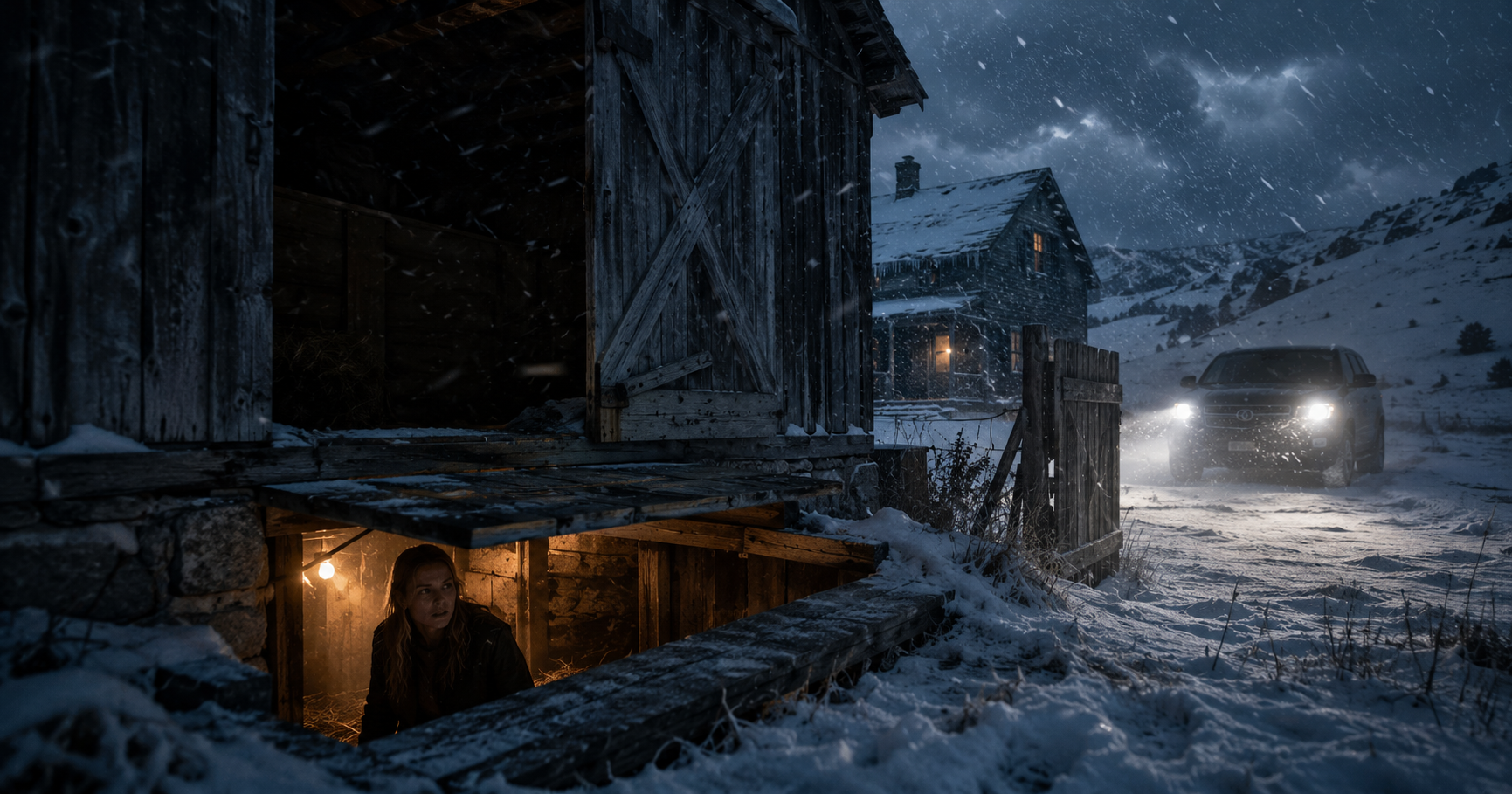
By the time winter found the valley, Lena Harrow had already learned how to disappear.
Not the dramatic kind of disappearance people imagined when they watched crime shows and whispered over coffee. Not a midnight bus ticket, not a motel under a false name, not a dyed haircut and sunglasses at a gas station. Those things belonged to people who were running from ordinary danger.
Lena had been running from Victor Caine.
Ordinary danger got bored. Ordinary danger made mistakes. Ordinary danger forgot.
Victor never forgot.
He owned glass towers in three cities, private roads in two states, and enough lawyers to turn truth into paperwork. Newspapers called him a visionary investor. Charity boards called him generous. Judges called him persuasive. Men who owed him money called him sir. Women who feared him learned to call him nothing at all, because even his name felt like a hand closing around the throat.
Lena had once called him husband.
Now she called him a weather system.
Because Victor did not chase. He arrived.
He appeared in places where he should not have known to look. He sent white orchids after she changed hotels. He paid the manager of a shelter to say whether a woman with gray eyes had come in. He knew when she opened a bank account, when she bought a prepaid phone, when she paid cash for a winter coat in Helena. He found the church basement where she attended one support meeting and sent a donation large enough to have his name engraved near the door.
So Lena stopped asking the world to hide her.
She built a hiding place herself.
The old Alder Creek property had been abandoned for almost twelve years when she bought it through a company with a name so dull even she forgot it twice. A farmhouse with a sinking porch. A stable with a leaning roof. Forty acres of frozen grass, cottonwoods, and wind. The nearest neighbor lived six miles away and hated visitors. The county road closed whenever the snow got serious. No one came out there unless they were lost, desperate, or born there.
Lena liked it immediately.
In spring, she patched the farmhouse enough to survive rain. In summer, she repaired fences she did not need and planted potatoes she barely knew how to grow. By August, she began work beneath the stable.
She chose the last stall, the one where the floorboards had already rotted soft. Each night, after the sky turned purple and the valley went quiet, she pried boards loose, dug earth into feed sacks, and carried the sacks into the dry creek bed behind the property. She worked with a headlamp, gloves, a shovel, and the stubborn fury of a woman who had been told too many times that she was fragile.
The room took shape slowly.
First a hole. Then a chamber. Then a shelter.
Twelve feet long. Nine feet wide. Deep enough that a man standing above it would hear only old wood and winter wind.
She reinforced the walls with block and steel. She poured a rough concrete floor with shaking arms and bloody knuckles. She sealed the seams against water. She framed a ceiling strong enough to hold the stable’s weight. She installed a narrow cot, shelves, a folding table, jugs of water, food tins, batteries, flashlights, a hand-crank radio, a small heater, a chemical toilet behind a canvas curtain, and a lockbox filled with copies of everything Victor had done.
Threatening emails. Medical records. Photographs of bruises. Bank documents. A notarized letter from her father’s estate lawyer, the letter Victor had spent two years trying to steal.
The shelter had two air pipes disguised outside as broken drainage lines. Power came from batteries hidden under old tack trunks above. A tiny camera watched the stable aisle. A microphone caught sounds through the floor.
The entrance was the hardest part.
Lena built a steel hatch, covered it with reclaimed boards, rubbed dirt into the cracks, and placed a cracked stone water trough over the seam. The trough was empty, but it looked impossibly heavy. To open the hatch, she had to slide out a hidden pin, press a pedal under the feed bin, and lift from below. Anyone else would see only a dead stall in a dead stable on a dead farm.
When she finished in late November, Lena climbed down the ladder, shut the hatch, and sat on the cot while one amber lamp glowed over her knees.
No windows.
No footsteps.
No orchids.
For the first time in four years, she slept without dreaming of Victor’s voice.
The blizzard came thirteen days later.
It started as a warning on the radio. Then another. Then a third, sharper than the rest.
A storm system had turned north faster than expected. Temperatures would fall below zero by evening. Wind gusts could reach seventy miles an hour. Power failure was likely. Roads would become impassable. Sheriff Amos Reed came on the emergency channel just after noon, his voice flat and tired.
“Listen carefully. If you’re outside town limits, prepare now. Once the wind crosses the pass, my deputies are not driving blind roads for anybody. Not for a stalled truck, not for a loose animal, not because you forgot batteries. Fill water. Stack wood. Call whoever needs calling. After dark, you are on your own.”
Lena stood in the farmhouse kitchen, one hand gripping the counter, watching the western mountains vanish behind a bruised wall of cloud.
She should have left.
She knew that.
She should have driven into town, paid cash for a motel room near the sheriff’s office, and slept with the light on. But town meant cameras. Cameras meant records. Records meant a trail. Victor had built his life by following trails other people did not even know they left.
So Lena stayed.
By two o’clock, the wind had teeth. Snow crossed the field sideways, slicing through fence lines and swallowing the driveway. Lena filled the bathtub, charged the last battery pack, stacked wood beside the stove, and repeated one sentence until it sounded true.
The room below the stable is for him, not for weather.
She would not let fear turn the whole world into a box.
Then, at 2:26 p.m., she looked through the kitchen window and saw a black SUV stopped by the mailbox.
The vehicle did not belong there.
It was too clean. Too expensive. Too certain of itself.
The driver’s door opened.
A man stepped out wearing a dark overcoat and no hat, as if storms were something servants handled.
Lena stopped breathing.
He walked to the mailbox, opened it, removed an envelope, and looked toward the house.
Even through snow, even through glass, she knew the way he tilted his head.
Victor.
For three seconds, her mind went white.
Then her body remembered every night she had dug while exhausted. Every stone she had carried. Every document she had hidden. Every promise she had made to herself when no one else believed her.
She moved.
First, she made the house lie.
She yanked open drawers, scattered clothes down the hallway, tipped a chair near the back door, left the kettle shrieking on the stove, and dropped one bootprint-heavy scarf on the porch steps. Then she grabbed her coat, a pack, and one glove. She ran into the storm, leaving frantic footprints toward the cottonwoods.
At the tree line, she ducked low, circled back behind the old pump house, and slipped into the stable through the side door.
Inside, the air smelled of hay dust, rust, and cold animal ghosts.
Her hands were numb by the time she moved the feed bin. The hidden pin stuck once, and terror nearly tore a sound from her throat. Then it slid free. The pedal sank under her boot. The hatch lifted with a soft hydraulic sigh.
Outside, an engine growled up the drive.
Lena climbed down, pulled the hatch shut, and threw the deadbolt.
Steel met steel.
It was the most beautiful sound she had ever heard.
She turned on the lamp.
The little room bloomed around her: cot, shelves, water, blankets, radio, table, papers. A kingdom no larger than a pantry. A country built from terror.
Then footsteps entered the stable above.
Lena froze.
The boots did not hurry. Victor never hurried when he wanted someone to know he had control. He walked the aisle as if inspecting a house he had already purchased.
A bucket rolled.
A stall door creaked.
Then his voice came through the speaker, smooth and close.
“Lena.”
She backed away from the ladder.
“I saw your little performance in the house,” he said. “The kettle was a charming touch. The scarf was too much. You always overdecorate a lie.”
Lena pressed both hands to her mouth.
Victor laughed softly.
“Did you really think I would follow footprints into a blizzard? What do you imagine I am, sentimental?”
The boots crossed above her.
“You bought this place well. I’ll give you that. Dead company. Cash transfer. Local lawyer who drinks too much and asks too little. Almost elegant.” His voice lowered. “But property taxes are so wonderfully boring. Boring things save me time.”
He stopped.
Directly over the hatch.
Lena’s skin went cold under her coat.
There was silence.
Then a faint knock.
Once.
Twice.
The water trough scraped an inch.
Lena could not move. Every muscle in her body prepared for the ceiling to open.
Victor exhaled with pleasure.
“Oh, Lena,” he murmured. “You built yourself a grave.”
The storm answered before she could.
The stable doors blew open with a crash so violent the speaker screamed with static. Wind exploded through the aisle. Something metal tore loose from the roof and banged against the rafters. Snow poured inside like thrown sand.
Victor swore.
For the first time in Lena’s life, nature interrupted him.
The old stable groaned around him. Boards slammed. A window shattered. The wind rose until even Victor’s voice disappeared under it. He stood above her for several long seconds, close enough that she could feel him as pressure in the room.
Then he said, “Stay down there and think. Cold improves obedience.”
His footsteps retreated.
The side door slammed.
Lena sank onto the cot, shaking so hard her teeth hurt.
He knew.
Not everything. Not yet.
But enough.
For hours, the storm swallowed the world.
Through the monitor, she heard the farmhouse shutters banging, the stable beams moaning, the high shriek of metal bending somewhere above. Victor was inside her house. That knowledge made the shelter feel smaller. Dirty. As if his shadow could leak through concrete.
Near midnight, the room held at forty-eight degrees. Cold, but survivable. Lena ate beans from a tin and counted supplies because counting was a kind of control.
Water. Food. Batteries. Blankets. Medicine. Radio. Flashlights. Crowbar. Documents.
He would leave when the road cleared, she told herself.
Victor loved power too much to die in a valley nobody could pronounce.
At 3:12 a.m., Lena woke with a headache.
At first, she blamed fear. Then nausea rolled through her stomach. Her breath came fast and shallow. The air felt thick.
She turned toward the ventilation pipe.
The intake fan hummed weakly.
Too weakly.
“No,” she whispered.
She had planned for rain. For mice. For ordinary snow.
She had not planned for a blizzard that packed ice sideways against the stable wall until every vent vanished under white weight.
Her shelter was becoming a sealed jar.
Panic rushed up so hard she almost screamed. Instead, she grabbed the emergency cleanout cap and twisted. It did not move. She wrapped her sleeve around it and tried again. Her fingers slipped. The room tilted.
In her memory, Victor said, You never finish anything without me.
Lena bared her teeth.
“Watch me.”
The cap cracked loose.
She pulled the fiberglass rod from beneath the cot and drove it up through the pipe. Six feet. Seven. Eight. Then it struck something solid.
Packed snow.
She rammed the rod upward.
Nothing.
Again.
Nothing.
Her lungs burned. Black specks moved at the edge of her sight. She dropped to one knee, shoved from the floor, and drove the rod upward with everything she had left.
A plug of snow collapsed through the pipe, striking her face and chest.
Then air came.
It was not gentle. It was a blade of subzero wind that slapped tears from her eyes and stole warmth from the room.
Lena fell beneath it laughing like a woman who had been handed one more minute.
“I’m still here,” she whispered.
The monitor crackled.
She sat up.
Someone had entered the stable.
Not walking now. Staggering.
Breathing filled the speaker. Wet. Ragged. Furious.
“Lena!” Victor shouted, his voice broken by coughing. “Open it!”
She smelled smoke.
Not clean woodsmoke. Bitter, damp, poisonous smoke.
The farmhouse.
Victor had tried to make a fire in the old stove. He had probably stuffed wet wood into the box, ignored the flue, and filled the house with smoke. A man who could buy a forest had never learned how to burn a log.
Now the storm had driven him back to the stable.
Back to her door.
“I know you’re under there!” he yelled. “You think I can’t hear machines? You think I don’t know what you are? A frightened little thief in a hole!”
Metal crashed above. Wood splintered. He was tearing the stall apart.
The trough scraped.
Once.
Again.
Then harder.
“There,” he breathed.
A blow struck the hatch.
The whole room rang.
Lena covered her ears.
Another blow.
The hatch held.
Another.
The deadbolt held.
“Open it!” Victor screamed.
Lena stared up at the steel plate.
For years, she had imagined him as more than human because every system around him had treated him that way. Banks obeyed him. Attorneys defended him. Friends excused him. Police officers smiled for his donations. Reporters polished his lies until they shone.
But above her now was not a system.
It was one man with frozen hands.
One man coughing smoke.
One man losing strength in a storm he could not purchase.
“Lena,” he said suddenly, softer. “Please. I’m sorry. I was angry. I didn’t know how to lose you.”
Her body betrayed her with an old reflex.
Listen. Be kind. Calm him. Make him less dangerous.
Then Victor said, “I brought the papers.”
Lena went still.
“I only need one signature,” he continued. “Then we can both walk away. You can have money. Real money. I’ll let you disappear properly.”
There it was.
Not love.
Not remorse.
A signature.
Her father’s estate. The hidden shares. The voting rights Victor had tried to steal before anyone discovered the fraud beneath Caine Meridian Holdings.
He had come into a killing storm because paperwork still stood between him and everything.
Lena switched on the tiny camera. Static filled the monitor, then a broken image appeared.
Victor stood above the hatch, face pale, lips blue, a sledgehammer in one hand. A leather document case hung from his shoulder. His fine coat was torn. Snow clung to his hair. Smoke streaked his face.
He looked smaller than she remembered.
And more dangerous.
“Open the door,” he said. “Or I swear to God, Lena, I’ll bury you in that room.”
The stable roof screamed.
The sound began low, somewhere inside the beams. A long wooden complaint. Then another. Then the deep, terrible crack of old timber giving up.
Victor looked up.
For one perfect second, fear rearranged his face into honesty.
The roof came down.
The impact hit like the mountain itself had fallen. The room shook. One lamp died in a spray of sparks. Dust burst from the ceiling seams. Lena hit the floor, arms over her head, as the world above collapsed in layers: beams, boards, roofing, snow, tools, the stone trough, and the full weight of a building too tired to fight the storm.
The hatch boomed once.
Held.
Then nothing.
No hammer.
No voice.
No pleading.
Only wind moving over a grave that had failed to become hers.
Lena lay on the concrete for a long time.
When she finally moved, she looked at the black monitor. Then at the hatch. Then at the shelves of food and water she had once stocked because fear told her no one would come.
Above her, Victor Caine was silent.
The storm lasted three days.
On the fourth day, Lena climbed the ladder and unlocked the hatch.
It rose less than an inch.
Then stopped.
She pressed the lift again.
The motor whined, strained, and screamed.
Nothing moved.
Lena killed the power.
The collapsed stable had sealed her in.
Not hiding now.
Buried.
For a moment, terror filled the room so completely there seemed no space left for air. She slid down the ladder, stood in the center of the shelter, and turned in a slow circle.
Twelve feet.
Nine feet.
Eight feet under.
“No,” she whispered.
Then louder.
“No.”
The word struck the walls and came back to her unchanged.
She screamed once. A raw, animal sound that tore her throat.
Then she stopped.
Screaming used oxygen.
Survival became arithmetic.
One bottle of water a day, then less. Half a tin of food. Lights one hour after dark. Vent check morning and evening. Exercise even when her legs trembled. Journal every day, even if she wrote only one sentence.
On the first page, she wrote:
If I die here, this room will not be my silence. It will be my witness.
Days narrowed.
Hunger made her careful. Cold made her humble. Darkness made time strange. She learned every sound above her: melting snow dripping through debris, wood shifting during thaw, the scratch of small animals, the sigh of wind passing over wreckage. Sometimes she imagined Victor speaking from the ruin.
Nobody is looking.
Nobody knows your name.
You built your own coffin.
On day twenty-three, she answered him aloud.
“I built a door.”
On day forty-one, she cried because she could not remember the smell of coffee.
On day fifty-seven, she read every document in the lockbox. Her father’s letter. The trust records. The transfer Victor had forged. The physician’s note proving sedatives had been found in her blood the night he claimed she had signed away her rights. Evidence, evidence, evidence. Paper bones waiting for daylight.
On day seventy-two, she found a second emergency whistle taped beneath the table and laughed until she became dizzy.
On day eighty-nine, she heard engines.
At first, she thought they were part of a dream. Then came voices. Real voices. Men shouting above. Metal scraping. A chainsaw. A dog barking.
Lena grabbed the pry bar and struck the hatch.
Once.
Again.
Again.
Her arms felt like sticks. Her hands split open. She kept striking.
A voice shouted, “Quiet! Listen!”
Lena struck three times.
The world stopped.
Then someone yelled, “There’s someone under here!”
The next hours came in pieces.
Light cutting through darkness.
Hands reaching down.
Cold air pouring in.
A deputy saying, “Easy, ma’am, easy.”
A coat around her shoulders.
The sky, enormous and blue, hurting her eyes.
Sheriff Amos Reed knelt in front of her, gray-bearded, solemn, kinder than his radio voice.
“Ma’am,” he said gently, “are you Clara Bell? The woman who owns this property?”
Lena swallowed. Her throat felt made of paper.
“No.”
The sheriff leaned closer.
She looked past him.
A black body bag lay beside the ruins of the stable. Beyond it, half-buried in thawing snow, was Victor’s SUV.
Lena lifted her face to the sky.
“My name is Lena Harrow.”
The sheriff’s expression changed.
Recognition.
Then sorrow.
Then respect.
A deputy behind him whispered, “The missing Caine wife?”
Lena’s voice came stronger than she expected.
“Ex-wife.”
The investigation tried to make her survival into a spectacle.
Reporters called her the woman beneath the stable. Podcasts wanted diagrams. Producers wanted tears. Business magazines wanted the fall of Victor Caine explained in clean language suitable for men who liked their monsters wearing expensive watches.
Lena wanted soup.
For two weeks, she gave no interviews. She slept in a hospital bed with the door open and woke every hour reaching for a flashlight. Nurses found crackers hidden under her pillow. Sheriff Reed visited three times, never asking too much, always leaving before pity could make the room heavy.
On his fourth visit, he placed a sealed evidence photograph on her tray.
“The document case survived,” he said.
Lena looked at it.
“Enough?”
“Enough,” he answered. “Contracts. Sedatives. A forged transfer. A prepared statement saying you had returned to him willingly. Federal investigators are already asking questions.”
Lena closed her eyes.
“And my father’s trust?”
“Real. The attorney confirmed it. Those shares give you standing.”
Standing.
Such a small word for a key.
By summer, Caine Meridian Holdings began to fall. Not because Lena became powerful overnight. Not because justice suddenly grew teeth. But because one buried woman had preserved one box of papers a rich man had failed to destroy. Standing opened sealed records. Sealed records exposed forged consent agreements, stolen pensions, shell companies, and a chain of quiet crimes hidden beneath polished philanthropy.
Victor had not chased love into the storm.
He had chased the last loose thread.
And the thread had survived him.
In June, Lena returned to Alder Creek with Sheriff Reed, an engineer, and a therapist who spoke softly but never treated her like glass.
The farmhouse was gone, burned and crushed beyond saving. The stable had been cleared down to its foundation. Wildflowers grew where snowdrifts had melted. The bunker entrance stood open beneath the sun.
For a while, Lena only looked at it.
The therapist asked, “Do you want to go down?”
Lena almost said no.
Then she understood that fear still owned whatever she refused to face.
“Yes,” she said.
She climbed down slowly.
The room smelled of dust, plastic, and old survival. Sunlight fell through the open hatch, touching the cot, the empty tins, the water jugs, the table, the journal.
Lena picked up the journal and opened to the last page.
Day 89. I hear something. If this is not rescue, I am still here.
She pressed the book to her chest.
Above, Sheriff Reed called, “You all right down there?”
Lena looked around at the walls she had built from terror, labor, and stubbornness. Then she looked up at the square of blue sky.
For once, the room did not feel like a grave.
It felt like proof.
“I’m here,” she said.
And this time, she did not whisper.

