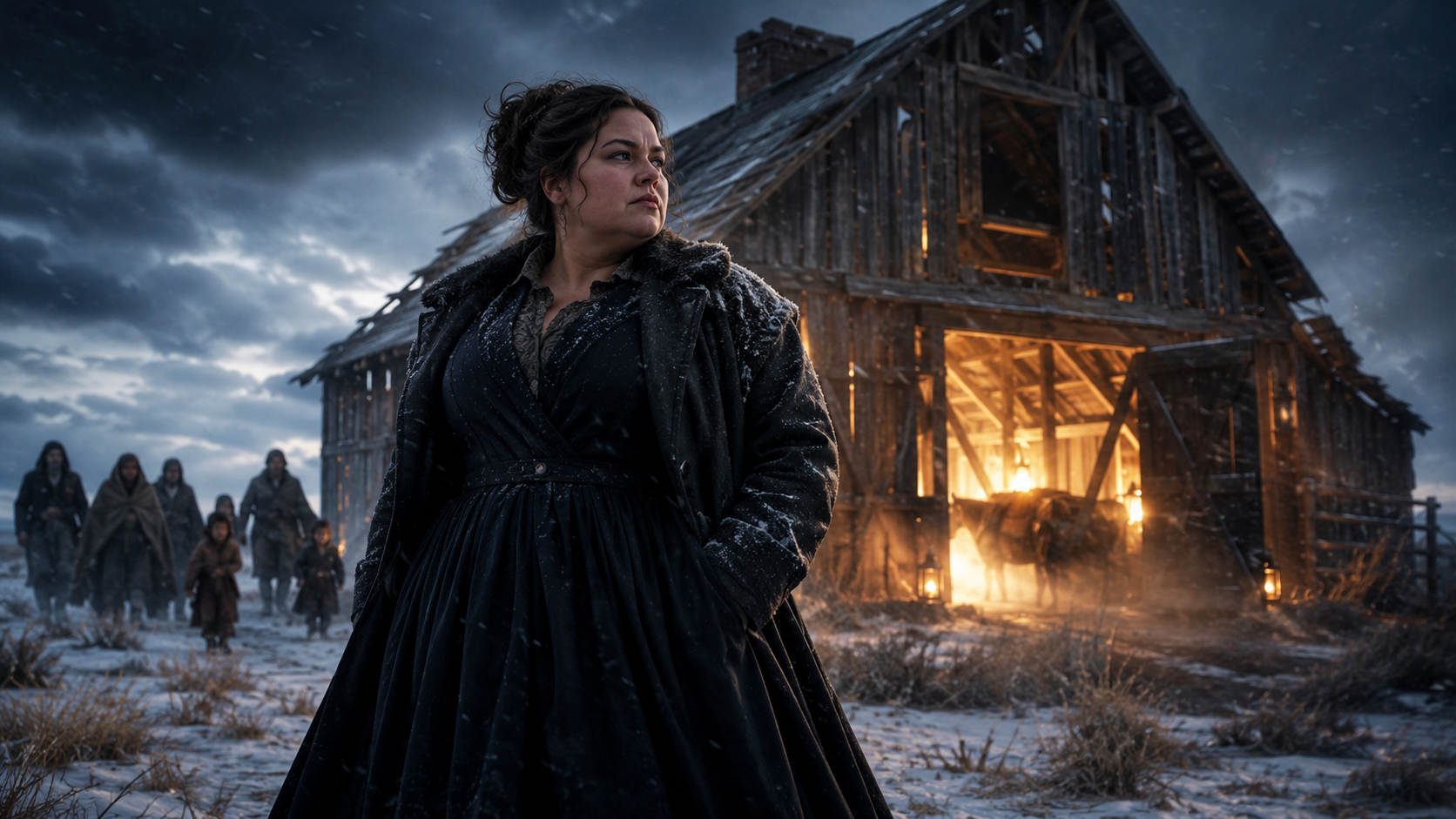
The Barn They Left for Mercy

The day they read the will, the whole family learned what kind of cruelty could wear black gloves.

Ada Crowell sat at the far end of the parlor in a chair too narrow for her hips and too delicate for her grief. The wallpaper behind her was patterned with little blue flowers, the same flowers her mother had once called “too polite to survive winter.” Outside, snow pressed against the windows of the Crowell house like a crowd trying to listen.

Her sisters sat close to the fire.

Celestine, the oldest, wore a mourning dress with pearl buttons and a face arranged for sympathy. She had always known how to look wounded without losing her beauty. Beside her, Marnie dabbed her eyes with a handkerchief that had not absorbed a single tear. Their husbands stood behind them, solemn as fence posts, already measuring what could be sold, divided, mortgaged, or blamed on Ada.

Ada said nothing.

She had learned long ago that silence made people nervous. They expected her to apologize for taking up space, for breathing loudly, for eating, for sweating, for being the daughter whose body did not fold neatly into rooms designed by smaller people. When she was a girl, her sisters called her “the ox.” When she became a woman, they improved their cruelty with lace.

Big-boned, they said in public.

Unfortunate, they whispered in kitchens.

Useful, their mother had said.

That was the only word Ada kept.

Lillian Crowell had died four days earlier during the first hard freeze of December. She had gone the way she had lived: privately, stubbornly, with unfinished work on the table and a kettle singing in the next room. She left behind debts, land, three daughters, and more questions than comfort.

Mr. Pennick, the town solicitor, unfolded the will with fingers that trembled slightly. He was a thin man with a nervous mouth and a habit of clearing his throat before bad news.

“To my eldest daughter, Celestine Wray, I leave the south pasture, the main house, and the household furnishings, excluding those items specifically named elsewhere.”

Celestine bowed her head as if receiving a blessing.

“To my youngest daughter, Marnie Bell, I leave the river meadow, the two milk cows, the silver service, and the contents of the east pantry.”

Marnie let out a soft little sob. Her husband squeezed her shoulder, already smiling with one corner of his mouth.

Ada kept her hands folded.

Mr. Pennick swallowed.

“To my middle daughter, Ada Crowell, I leave the north parcel, including the old winter barn, the dry slope, the abandoned well, and all contents above and below the structure.”

For a heartbeat, no one moved.

Then Marnie laughed.

She tried to stop it, covering her mouth with her handkerchief, but the sound had already escaped. Celestine turned her face toward the fire, shoulders shaking once. One of the husbands coughed into his fist.

“The old winter barn?” Celestine said at last, her voice sweet enough to rot teeth. “Mama left Ada the dead barn?”

“It is legally described as the north parcel,” Mr. Pennick said.

Marnie leaned toward Ada. “At least it’s large enough for you, dear.”

The room went still, waiting to see whether Ada would break.

She had broken before. Quietly. In pantries, in haylofts, behind wash lines, under quilts. She had broken so often in secret that people thought she never felt anything at all. But grief had done something strange to her. It had hollowed her out until insults passed through without finding enough flesh to stick.

Ada looked at her sisters.

“If Mama left it to me,” she said, “then she had a reason.”

Celestine smiled. “Yes. She knew you were the only one sentimental enough to keep a collapsing barn.”

“No,” Ada said. “She knew I was the only one strong enough to open it.”

That ended the laughter for a moment.

But only for a moment.

By noon, half of Briar Glen knew what Lillian Crowell had done. By sundown, nearly everyone had an opinion. Ada heard the whispers as she drove her wagon through town with her mother’s old trunk tied behind the seat.

There goes the barn queen.

Give the big girl the big ruin.

Maybe she can sleep with the horses.

She kept her eyes forward.

The north parcel lay beyond the last line of houses, past the cemetery ridge and the frozen creek. It had once been the first place travelers saw when they came into Briar Glen from the mountains. Now it stood alone under a bruised winter sky, its roof sagging in the middle, its boards weather-gray, its doors hanging crooked from iron hinges.

Ada pulled the wagon to a stop.

For years she had avoided this place. Not because it frightened her, but because her mother had always told her, “Leave the north barn alone unless I send you there.”

Ada had obeyed. She had obeyed even when she became old enough to wonder why her mother spent so many nights riding out here with sacks tied to the saddle. She had obeyed when she found mud on Lillian’s boots during dry weeks. She had obeyed when strangers appeared in town and disappeared before sunrise.

Now Lillian was in the ground.

And the barn belonged to Ada.

She climbed down from the wagon, boots sinking into snow crust. The cold bit through her coat. A loose shutter banged against the wall in the wind, slow and hollow, like a knock from someone too tired to insist.

Inside, the barn smelled of dust, old straw, pine pitch, and mice. Faint light came through cracks in the siding. The stalls were empty. The loft ladder was broken. A rusted plow leaned in one corner, half buried in hay.

“A fine inheritance,” Ada muttered.

Then she felt it.

Warmth.

Not from the stove; there was no stove. Not from sun; the sky was iron. It rose through the floorboards in the center aisle, soft but steady, like the breath of some sleeping animal beneath the earth.

Ada took off one glove and pressed her palm against the boards.

The wood itself was cold.

But between the planks, heat slipped upward.

Her heart began to pound.

She searched the walls, the stalls, the corners. On the third post from the back, half hidden behind a strip of old harness leather, hung a pry bar. It had been oiled recently. Not yesterday, perhaps, but not years ago either.

Ada stared at it.

Her mother had left her the barn.

Her mother had left her the tool.

Her mother had left her the word below.

All contents above and below the structure.

Ada took down the pry bar.

The first board resisted. The second cracked. By the fifth, she found the iron ring set into a trapdoor so cleverly fitted that straw and dust had hidden it completely. It took all her weight to lift it. The hinges groaned. Warm air rushed up and wrapped around her face.

Below, stone steps descended into darkness.

Ada lit the lantern she had brought from the wagon.

Then she went down.

The chamber beneath the barn was not a cellar.

It was a world.

The walls had been reinforced with stone and timber. Shelves stretched from one end to the other, packed with flour, beans, preserved fruit, candles, lamp oil, blankets, wool socks, boots, coats, medicines, bandages, tools, rope, seed sacks, and locked boxes marked with symbols Ada did not understand. A narrow channel of steaming water ran along the far wall and emptied into a stone basin.

Ada knelt beside it.

The water was warm.

Clear.

Alive.

In the center of the chamber stood a long table. On it lay a stack of leather-bound notebooks, a tin cup, a folded quilt, and a letter addressed in her mother’s unmistakable hand.

Ada sat down slowly.

The letter contained only nine words.

Ada, when they laugh, let them. Then look deeper.

For the first time since the funeral, Ada wept.

Not loudly. Not prettily. She bent over the table with her hand pressed to her mouth while the secret room blurred in the lantern light. Her mother had known. She had known they would mock her. She had known Ada would be humiliated, dismissed, underestimated. She had built the insult into the trap.

When Ada could breathe again, she opened the first notebook.

Three hours later, the woman who climbed out of that hidden room was not the same woman who had gone down.

Lillian Crowell had not been careless with money.

She had been saving lives.

For twelve years, her mother had used the north barn as a refuge. Women escaping violent men. Children sent away from mining camps swallowed by fever. Farmhands cheated out of wages. Widows threatened with false debts. Girls who had answered advertisements for work and found locked doors waiting. Lillian had hidden them beneath the barn, warmed them, fed them, clothed them, and sent them onward with new names, train fare, and instructions written in code.

The debt everyone mocked had bought tickets.

The missing silver had bought medicine.

The late nights had carried people through snow.

And the warm spring beneath the barn had kept them alive.

Ada read until the lantern burned low.

Then a floorboard creaked above her.

She froze.

Another step.

Slow.

Deliberate.

Ada grabbed the pry bar and stood at the foot of the stairs.

A man appeared in the opening above, his hat in one hand and snow on his shoulders. He was tall, dark-haired, and lean in the way of men who had survived on less food than pride. A pale scar crossed his brow and disappeared near his temple.

“I am armed,” Ada said.

The man looked at the pry bar. “So I see.”

“This is private property.”

“Yes, ma’am.”

“Then you are trespassing.”

“Yes, ma’am.”

His calm annoyed her almost as much as his trespass.

“Come down where I can see you properly,” Ada said. “Or leave before I decide which part of you to break first.”

The man hesitated, then descended.

When his boots touched the chamber floor, he did not look at the shelves first. He looked at the water. Then at the table. Then at the notebooks.

His face changed.

Not with greed.

With sorrow.

“My name is Rowan Hale,” he said. “Your mother asked me to come if the barn passed to you.”

“My mother never mentioned you.”

“She would not have.”

“How convenient.”

His mouth twitched, but he did not smile. “That is fair.”

Ada lifted one of the notebooks. “You knew about this place?”

“Yes.”

“You helped her?”

“When she let me.”

“Why would she trust you?”

Rowan removed his gloves slowly. His hands were scarred, the knuckles bent from old breaks.

“When I was fifteen, I ran from a work camp north of here,” he said. “I had frost in my feet and a chain mark on my ankle. I collapsed outside this barn. Your mother brought me down here, cut the iron off me, and fed me for eighteen days. She never asked whether I deserved mercy. She only asked whether I could stand.”

Ada’s grip loosened on the pry bar.

“She never told me.”

“She kept the saved people hidden even after they were safe. That was part of the saving.”

Ada looked down at the notebooks. “There are names in here. Some coded. Some not. One name appears too often.”

Rowan’s face hardened. “Benedict Shaw.”

“The minister?”

“The minister.”

Ada turned another page. “And Silas Rook.”

“The banker.”

Outside, the wind struck the barn hard enough to make dust fall from the beams.

Rowan lowered his voice. “Rook has wanted this land for years. He knows about the warm spring, though not the chamber. He wants the water rights for a storage company tied to the new rail spur. Warm water means power in winter. Controlled water means controlled ranches. Controlled ranches mean every family in Briar Glen eventually kneeling at his desk.”

“And Shaw?”

“Shaw sells suffering twice. First from the pulpit, when he collects donations for widows and orphans. Then in private, when he gives desperate people’s names to anyone willing to pay.”

Ada felt cold in spite of the warm room.

“My mother knew.”

“Your mother had proof.”

Ada looked at the notebooks again. “Where is the proof now?”

“Some of it is here,” Rowan said. “Some of it she sent to a federal judge in Westhaven ten days before she died.”

“Did it arrive?”

“I do not know.”

Ada hated that answer because it sounded honest.

Before she could speak, a horse screamed outside.

Rowan moved first. Ada followed him up the steps, through the barn, and into the storm-gray afternoon.

A riderless horse stood near the wagon, reins dragging, foam on its neck. Tied to the saddle was a woman’s scarf.

Ada knew the scarf.

Marnie’s.

She untied it with numb fingers.

Inside the knot was a scrap of paper, torn from hotel stationery.

Ada, I did something foolish. Rook knows about the will. He has papers. He says you are unfit. He says by tomorrow the barn will not be yours. Do not come to town alone.

No signature.

It did not need one.

Ada folded the paper and put it in her pocket.

Rowan watched her. “What will you do?”

For years, Ada had answered that question in the way people expected. She had lowered her voice, lowered her eyes, lowered herself. She had stepped aside in doorways. She had laughed at jokes that cut her. She had pretended not to notice when chairs were pulled away or plates were counted.

But beneath her feet was a hidden refuge her mother had built in secret.

Behind her were shelves of supplies bought with sacrifice.

Ahead of her was a town about to freeze under a storm and a lie.

Ada climbed onto the wagon.

“I am going to Briar Glen,” she said.

Rowan frowned. “That is exactly where Rook wants you.”

“No,” Ada said. “He wants me ashamed. There is a difference.”

The town was busy pretending not to watch when Ada drove in.

Men paused outside the livery. Women looked from shop windows. Children whispered and were hushed. The sky hung low and ugly over the street, promising a storm large enough to erase roads.

Ada stopped in front of Pennick’s office.

Celestine came out before Ada could climb down. Her cheeks were pale, her mouth tight.

“Ada,” she said. “We need to discuss the property.”

“Which property?”

“The north parcel. Be reasonable. You cannot maintain it. Mr. Rook is prepared to make a generous offer before the land becomes a danger to everyone.”

Ada looked past her sister.

Across the street, Silas Rook stood on the bank steps in a black coat trimmed with fur. He was smiling. Beside him stood Reverend Benedict Shaw, his silver hair shining beneath his hat, one hand resting on a Bible as if God were something he kept for balance.

Ada turned back to Celestine.

“What did you sign?”

Celestine blinked.

“What did you sign?” Ada repeated.

Her sister’s composure cracked.

“I signed a concern statement,” Celestine whispered. “Only a statement. Mr. Rook said it would protect the estate from mismanagement.”

“Mismanagement by whom?”

“Ada—”

“Say it.”

Celestine’s eyes filled, but Ada did not look away.

“By you,” Celestine said.

A hot, clean anger moved through Ada, but she held it still.

Marnie appeared from the alley, breathless, without gloves. “I told you not to come alone.”

“I am not alone,” Ada said.

Marnie glanced at Rowan and swallowed.

Rook crossed the street, moving with the leisure of a man who had never been forced to hurry for bread. Shaw followed at his shoulder.

“Miss Crowell,” Rook said. “My condolences. Your mother was a complicated woman.”

“She was a good one,” Ada said.

Rook’s smile thinned. “Goodness does not settle debt.”

“No. But fraud sometimes creates it.”

The word struck the street like a dropped pan.

Shaw stepped forward. “Grief can make the mind unstable. No one here wishes to shame you, child.”

“I am thirty-two years old,” Ada said. “Do not child me from behind a Bible you use as a ledger.”

A murmur moved through the gathered people.

Shaw’s face flushed.

Rook lifted a hand. “Let us not turn private family matters into spectacle.”

“Why not?” Ada asked. “You did.”

His eyes sharpened.

Ada reached into her coat and removed one of her mother’s notebooks. She had brought only one, and not the most dangerous. She was grieving, not foolish.

“My mother kept records,” she said.

Rook’s smile vanished for half a second.

Only half.

But Ada saw it.

Shaw saw it too.

Celestine whispered, “Ada, what is that?”

“The reason Mama died with debt,” Ada said. “The reason she left me the barn. The reason Mr. Rook wants me declared incompetent before anyone can ask what is under his paperwork.”

Rook’s voice dropped. “Careful.”

“No,” Ada said. “I have been careful all my life. It did not make cruel people kinder. It only made them comfortable.”

The first flakes began to fall.

Large ones.

Heavy.

A bell rang from the church tower, though no one had pulled the rope. The wind had caught it. Once. Twice. Then again.

From the west road, a boy came running, slipping in the snow.

“Storm took the mill bridge!” he shouted. “Mercer’s row is flooding with ice water! The poor houses are losing roofs!”

The street broke into movement.

Rook cursed under his breath.

Shaw lifted both hands. “Everyone remain calm. The church basement can take perhaps twenty—”

“No,” said a woman from the crowd. “It cannot. The stove is broken.”

“The hotel?” someone asked.

“The hotel wants payment,” another answered.

Ada looked at the sky.

Then at the people.

Then at Rook.

And she understood her mother at last.

The barn was not only proof.

It was shelter.

It was warmth.

It was the town’s salvation, hidden beneath the one place everyone had been taught to despise.

Ada climbed onto the wagon seat.

“My barn has heat,” she called. “Food. Blankets. Water. Bring the children first. Bring the old. Bring anyone who cannot survive the night.”

Rook shouted, “That structure is unsafe!”

Ada looked down at him. “Then stay out of it.”

A laugh rose from somewhere in the crowd, startled and bright.

Rowan swung up beside her. “You realize this will bring everyone to your door.”

Ada took the reins.

“Yes,” she said. “That is the point.”

By nightfall, the north barn was no longer a ruin.

It was a beating heart.

Lanterns hung from beams. Horses steamed in the stalls. Children slept in rows of blankets. Women stirred soup over iron pots. Men patched cracks in the walls while snow screamed across the fields. The trapdoor remained open, and warm air rose from below like a blessing too stubborn to die.

Ada stood at the entrance, counting heads.

Forty-three.

Then fifty-one.

Then sixty.

She stopped counting after that.

Marnie arrived with three frightened children whose mother had collapsed from cold. Celestine arrived an hour later, hair undone, carrying medicine from the main house and shame she had not yet learned how to hold.

“I was wrong,” Celestine said.

Ada looked at her sister. “Yes.”

Celestine flinched.

Ada handed her a kettle. “Boil water.”

That was all.

Forgiveness could wait. Work could not.

Near midnight, Rowan found Ada beneath the loft, reading by lantern while the storm battered the roof.

“You should rest,” he said.

“I have been told that by people who wanted me quiet.”

“I am not one of them.”

Ada looked up.

No, she thought. He was not.

Before she could answer, hoofbeats thundered outside.

The barn fell silent.

Rowan moved toward the door. Ada stopped him with one hand.

“No,” she said. “Let them see who owns it.”

She opened the barn doors herself.

Silas Rook stood outside with four armed men, Reverend Shaw, and a county clerk half frozen in a borrowed coat.

Rook held up a paper.

“By emergency petition and witness statement,” he said, “the north parcel is to be placed under temporary administrative control pending review of Ada Crowell’s competency.”

Ada stared at the paper.

Then she laughed.

It surprised everyone, including her.

Rook’s mouth tightened. “You find the law amusing?”

“No,” Ada said. “I find you desperate.”

Shaw stepped forward. “Ada, this spectacle only proves our concern. You have filled an unstable barn with vulnerable people. You are endangering lives.”

From behind Ada, a voice called, “She saved mine.”

A woman stepped out of the warmth. Her name was Tamsin Vale, though Ada had known her only six hours. She had come from Shaw’s charity house with a bruised wrist and a memory full of secrets.

Shaw went pale.

Tamsin looked at the gathered town and raised her voice.

“Reverend Shaw keeps a second book. Not for charity. For blackmail. He writes down who is hungry, who is afraid, who is running, and who will pay to find them.”

The barn erupted in whispers.

Shaw pointed at her. “Lies.”

Another voice answered. “No.”

An old man stepped forward, then a widow, then a stable boy, then a mother holding a sleeping baby. One by one, people spoke. Not loudly at first. But truth grows braver when it hears itself repeated.

“He took my donation and gave my sister nothing.”

“He told my husband where I was hiding.”

“Rook’s men came after I spoke to Shaw.”

“My land papers changed after the bank held them.”

Rook backed away one step.

Only one.

But Ada saw it.

Then sleigh bells sounded from the ridge.

Everyone turned.

A black carriage emerged through the snow, escorted by two federal marshals carrying lanterns. The carriage stopped beside Rook’s men. A woman stepped down in a dark traveling coat, silver hair pinned beneath a plain hat.

“I am Judge Verity Hale,” she said. “I have ridden through miserable weather and worse roads because Lillian Crowell sent me twelve years of evidence and a letter predicting that Silas Rook would attempt an unlawful seizure of this property within ten days of her death.”

No one breathed.

Judge Hale looked at Ada. “Are you Lillian’s daughter?”

Ada stepped forward. “Yes.”

“Which one?”

“The one she left the barn.”

The judge studied her for a moment.

Then she smiled faintly.

“Of course.”

Rook tried to speak. “Your Honor, this is a local estate matter—”

“It is now a federal fraud investigation,” Judge Hale said. “And if half of what I read is true, it is also conspiracy, coercion, charity fraud, unlawful confinement, witness intimidation, and attempted theft of protected water rights.”

Shaw clutched his Bible.

A marshal took it from him and shook it open.

Papers fell out.

Names.

Payments.

Locations.

The reverend sank onto the snow as if his bones had been cut.

Rook did not sink. Men like him rarely collapsed when exposed. They calculated. His eyes moved to the horses, the road, the dark beyond the lanterns.

Rowan stepped into his path.

“Going somewhere?”

Rook looked at Ada. For the first time, he did not bother smiling.

“You have no idea what you are standing in the way of.”

Ada looked past him, into the barn.

At Celestine carrying soup.

At Marnie wrapping a child’s feet.

At Tamsin standing upright.

At the townspeople warmed by her mother’s impossible mercy.

Then she looked back at Silas Rook.

“Yes,” she said. “I do.”

By morning, the storm had buried the road, but not the barn.

Smoke rose from patched vents. Warm water steamed in basins. Children woke hungry and alive. Men who had mocked Ada split wood without meeting her eyes. Women who had whispered about her size now asked where she wanted supplies stacked. The church bell hung silent. The bank doors stayed closed.

Judge Hale remained at the north parcel for three days, taking statements at the long table beneath the barn. The hidden chamber became a courtroom, a kitchen, a hospital, and a confession room. Lillian Crowell’s notebooks lay open beneath lantern light, and every page made the dead woman larger.

Not flawless.

Not gentle.

Not safe.

Larger.

Celestine apologized on the second morning.

Not with pretty words. With swollen hands, red eyes, and a full account of everything she had signed.

Marnie apologized on the third.

She cried. Ada let her.

But Ada did not rush to comfort either sister.

Some wounds deserved air before bandages.

Rowan stayed through the thaw.

He repaired the roof, then the south wall, then the broken loft ladder. He never asked to be paid. Ada paid him anyway. On the fifth week, when the snow had softened and the first mud appeared in the yard, he found her standing outside the barn at sunset.

“You could sell now,” he said.

Ada looked at him sharply.

He lifted both hands. “I am not saying you should. I am saying you could. Rook’s company is ruined. The land is worth more than anyone admitted.”

Ada watched steam drift from the cracks beneath the barn doors.

“And what would I buy with the money?” she asked.

“Comfort.”

“I have had comfort offered to me before. It usually comes with a smaller cage.”

Rowan leaned against the fence. “Then what will you do?”

Ada smiled.

It felt strange on her face. Not because she had never smiled, but because this one did not ask permission.

“I will keep the barn,” she said. “I will fix what is rotten. I will open what was hidden. I will build rooms above and keep the refuge below. I will make sure no woman, child, worker, widow, or fool with frostbitten pride has to earn warmth before receiving it.”

Rowan’s eyes softened. “Your mother would like that.”

“No,” Ada said, looking at the barn. “She would tell me the roofline is crooked and the hinges need replacing.”

He laughed then.

So did she.

By spring, people stopped calling it the rotten barn.

They called it Mercy House.

Travelers found meals there. Widows found legal help there. Children found boots there. Men who had been cruel found work there, if they were willing to take orders from Ada Crowell and keep their opinions quieter than their hammers.

The warm spring flowed beneath it all.

And sometimes, when the evening light turned the fields gold, Ada would stand in the doorway and remember the parlor, the laughter, the sentence meant to shame her.

Give the big girl the rotten barn.

They had said it like a curse.

Her mother had made it an inheritance.

And Ada, who had spent her life being told she was too much, finally understood the truth.

She had never been too much.

The world around her had simply been built too small.