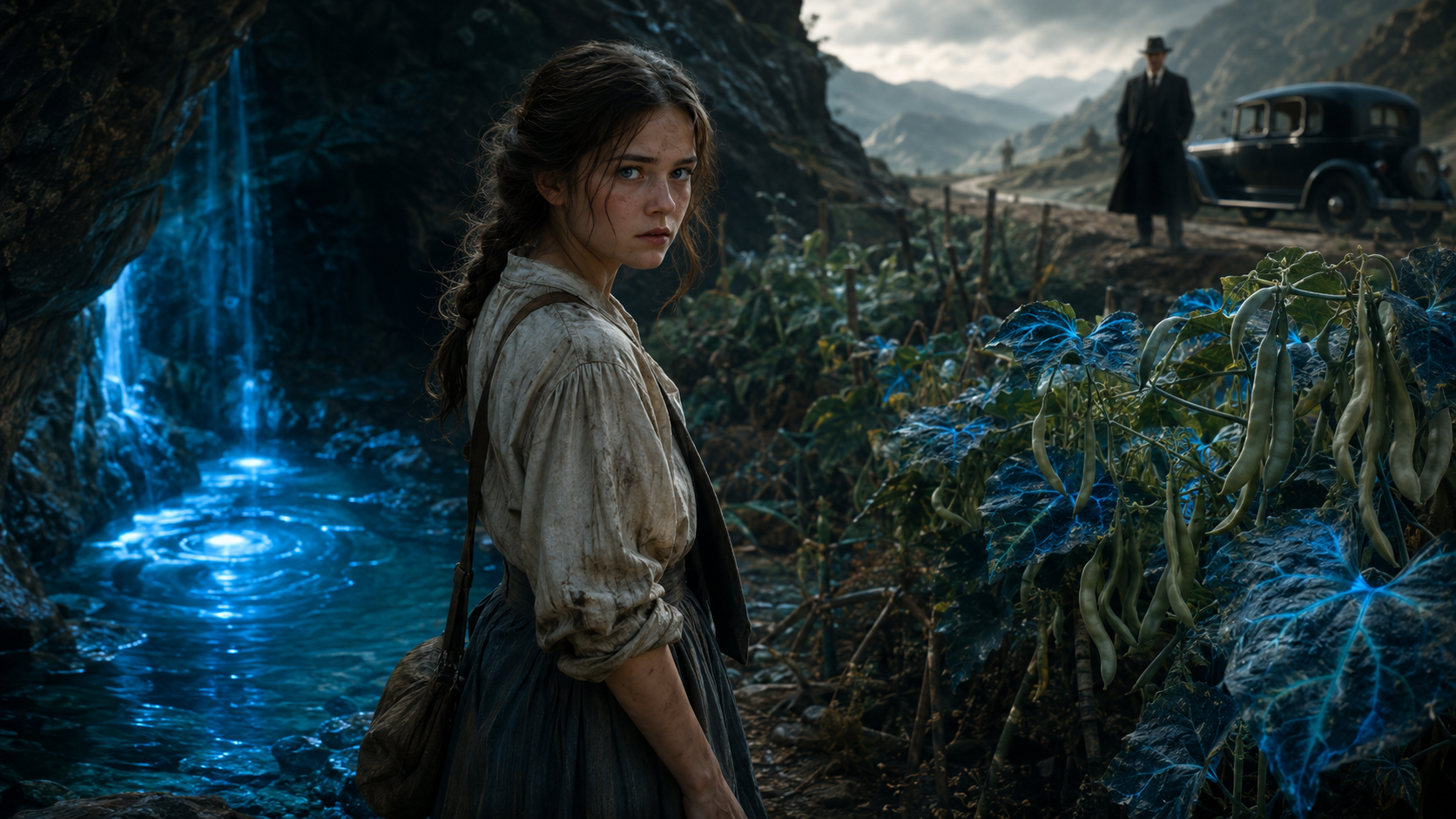
“Keep Your Cursed Water,” the Tycoon Said — So the Orphan Bought the Forgotten Blue Well for One Dollar and Grew the Only Thing His Empire Could Never Own

When Leona Voss was thrown out of Saint Brigid’s Home for Unwanted Girls, she owned three things: a cracked leather satchel, a pair of boots with one heel nailed crooked, and a silver dollar she had stolen from no one.

That last part mattered to her.

The matron, Mrs. Greaves, stood on the front steps with her keys hanging from her waist like a jailer’s medals. She did not hug Leona goodbye. She did not give her bread for the road. She did not say, “You were a child here, and children should leave with blessings.”

She said, “You are seventeen. That makes you the county’s problem, not mine.”

Leona looked past her at the stone building where she had scrubbed floors, mended sheets, peeled potatoes, and slept beneath a roof that never once felt like shelter.

“I worked here since I was nine,” Leona said.

Mrs. Greaves smiled as if that were an amusing mistake. “You ate here since you were nine.”

Behind her, two younger girls watched from an upstairs window. Their faces were pale ovals behind the glass. Leona lifted her hand, not quite waving. One of them began to cry. The other pulled her away before Mrs. Greaves could see.

At the bottom of the steps waited a black motorcar.

It did not belong to anyone kind.

A man stepped out slowly, adjusting his gloves. He wore a gray wool coat, polished shoes, and the relaxed expression of someone who had never had to wonder whether supper would appear. His name was Alaric Stone, and everyone in Harrow County knew it. Stone Rail. Stone Timber. Stone Fertilizer. Stone Canning. Stone Bank.

If something could be planted, cut, loaded, canned, mortgaged, or sold, Alaric Stone had already placed his shadow over it.

He had come that morning to inspect the orphanage kitchen garden, which Saint Brigid’s rented from his company at a price Mrs. Greaves called generous and every farmer in the valley called theft.

Leona had spoken out.

That was her crime.

She had said the soil was dead because Stone Fertilizer burned it year after year. She had said the cabbages were small because the matron watered obedience into the ground and expected vegetables to grow from fear.

Mrs. Greaves slapped her.

Alaric Stone laughed.

Now he stood beside his motorcar and looked at Leona as if she were a bent nail in his road.

“You have spirit,” he said. “That is what poor people call bad judgment before it gets them buried.”

Leona gripped the handle of her satchel.

“I have eyes,” she said. “That is what rich men hate before someone else sees what they are doing.”

Mrs. Greaves gasped.

The driver looked away.

Alaric Stone’s smile thinned.

For a moment, Leona thought he might strike her. Instead, he leaned closer and spoke softly enough that the girls in the upstairs window could not hear.

“There is an auction today at the courthouse. A useless parcel by the north ravine. Locals call it Blue Hollow because the water there shines like sickness. No one will bid. You should go. Buy it with that brave mouth of yours.”

Leona said nothing.

Stone’s eyes flicked to the silver dollar in her hand.

“Or better yet,” he said, “keep your cursed water, little orphan. Drink it. Prove us all wrong.”

Then he climbed into his car and left her in the dust.

That was the first gift Alaric Stone ever gave her.

He told her where to go.

The courthouse smelled of wet coats, pipe smoke, ink, and old resentment. Men turned when Leona entered. Some smiled, not with kindness. A girl from Saint Brigid’s had no business in a room where land was being named and counted.

The clerk, Mr. Holloway, squinted over his spectacles.

“You lost?”

“No, sir.”

“You here to clean?”

“No, sir.”

“Then what do you want?”

Leona placed her silver dollar on the counter.

“I want to bid on Blue Hollow.”

Silence moved through the room like a draft.

A farmer coughed into his fist. Someone laughed under his breath. Mr. Holloway looked at the coin, then at Leona, then toward the back wall where a faded map of Harrow County hung beneath a cracked frame.

“Girl,” he said, more gently than she expected, “that land is bad.”

“Bad how?”

“Wet where it should be dry. Blue where water has no cause to be blue. Nothing grows there but thorn fern and gossip.”

“Is it haunted?”

“Depends who you ask.”

“I’m asking you.”

The clerk leaned closer.

“I think it’s abandoned because useful people had sense enough to abandon it.”

“Then one dollar should be enough.”

That made a few men laugh openly.

The auction lasted seven minutes. Blue Hollow was listed last, as if even paper wanted to be done with it. No one bid against her. No one needed to. When Mr. Holloway stamped the deed, his hand hesitated.

“You understand this makes you responsible for taxes next year?”

“Yes, sir.”

“You understand there’s no house?”

“Yes, sir.”

“No road worth naming?”

“Yes, sir.”

“No well fit for drinking?”

Leona picked up the deed.

“We’ll see.”

He sighed. “Girls who say that usually learn by bleeding.”

Leona folded the deed into her satchel.

“Then I’ll try to bleed usefully.”

Blue Hollow lay three miles north of town, beyond a road that became a track, then a suggestion, then a quarrel between mud and stone. By the time Leona reached it, rain had soaked her hair flat and filled one boot. The ravine opened suddenly between black pines. Mist hung low among the trunks. The ground sloped toward a basin of pale rock where water spilled soundlessly from a crack in the hillside.

It was blue.

Not sky blue. Not river blue. Not any ordinary blue Leona knew.

It shone from within itself, deep and cold and strange, like a piece of evening trapped underground. The pool was no wider than a wagon wheel, but light trembled beneath its surface even under the gray rain.

Leona stood at the edge and felt every warning she had ever heard gather behind her teeth.

Poison.

Curse.

Madness.

Bad water.

Dead land.

She was so thirsty her tongue stuck to the roof of her mouth.

The orphanage had given her no flask. Pride had given her no supper. The rain dripping from pine needles was not enough. She knelt, cupped both hands, and lifted the blue water.

It smelled faintly of stone after lightning.

“Lord,” she whispered, though she was not sure anyone was listening, “if this kills me, make it quick.”

She drank.

The water was cold enough to hurt. It ran down her throat like a blade made of snow. For one terrible second, she waited for burning, choking, darkness.

Nothing happened.

The rain kept falling.

A crow shouted somewhere above the ravine.

Leona laughed once, sharply, because she was alive and because nobody who had warned her was there to see it.

By nightfall, she found the remains of an old charcoal shed half-collapsed beneath vines. The roof leaked in four places. One wall leaned outward. A raccoon had claimed the corner and abandoned it only after judging her too poor to rob. Leona dragged pine boughs over the worst holes, curled beneath her coat, and slept with the deed tucked inside her dress.

In the morning, she was still alive.

So she planted the beans.

They were not hers either, not exactly. She had saved them from Saint Brigid’s kitchen garden, three wrinkled scarlet beans that had fallen behind a crate. Mrs. Greaves would have called it theft. Leona called it inheritance from a place that owed her more than beans.

She dug with a broken hinge. The soil fought her. It was gray, sour, and tight as a fist. Her fingers went numb in the cold mud. She planted one bean near the blue pool, one farther uphill where rainwater ran clear, and one beside the shed because loneliness makes people foolish enough to plant hope near where they sleep.

She watered the first with blue water.

The second with rain.

The third with whatever dripped from the roof.

“Grow if you want,” she told them. “I’m not your matron.”

For three days, nothing happened.

On the fourth morning, the blue-water bean split the ground.

On the fifth, it was taller than her thumb.

On the sixth, taller than her hand.

The rainwater bean emerged thin and yellow, as if apologizing for itself. The shed bean did not appear at all. But the first bean rose as though someone beneath the earth were pulling it upward by invisible thread.

Leona watched it with growing fear.

She had wanted proof the water would not kill.

She had not expected proof it wanted to live.

By the end of the second week, the bean vine had climbed a branch she had stuck in the ground and was reaching for another. Its leaves were broad, dark, and veined faintly blue. Small red flowers opened along it, bright as sparks.

Leona did not tell anyone.

A secret was the first kind of property she had ever owned.

She worked where she could. Mrs. Odelia Crane, a widow who lived near the north road, hired her to wash linens and split kindling. Odelia was built like a fence post and spoke with the softness of falling tools.

“You’re the Saint Brigid girl,” she said when Leona knocked.

“Yes, ma’am.”

“You got family?”

“No, ma’am.”

“You got trouble?”

“Probably.”

That made Odelia snort.

“Honest enough. Stack that wood. Don’t faint in my yard. I hate dragging people.”

At noon, Odelia gave her stew, bread, and a look sharp enough to peel bark.

“You living in Blue Hollow?”

“Yes, ma’am.”

“You drinking that water?”

Leona’s spoon stopped.

Odelia groaned. “Mercy preserve me from girls with more backbone than supper.”

“It hasn’t killed me.”

“Yet is a powerful word.”

“The beans like it.”

“The beans?”

Leona should have lied.

Instead, hunger and loneliness opened her mouth.

“One bean grew. Fast.”

Odelia stared at her for a long moment. Then she crossed herself with a hand that smelled of onions.

“If your teeth turn blue, come show me before you die. I’ve lived seventy years and deserve one interesting miracle.”

By May, the vine was impossible.

It climbed the side of the shed. It crossed the roof. It threw red blossoms into the air like little flags. Pods formed, thick and glossy, each one longer than Leona’s hand. When she opened the first, the beans inside were not scarlet anymore. They were deep violet with a pale blue crescent on each side.

She cooked three in a tin cup over a fire and waited for death again.

Death did not come.

Flavor did.

The beans were rich, nutty, almost sweet, with a mineral brightness that made Leona close her eyes. She had eaten plenty in her life, but she had rarely tasted food. Food at Saint Brigid’s had been punishment softened with water. These beans tasted like the ground had remembered a song.

She took six pods to Odelia Crane.

The widow opened the door holding a rolling pin.

“If you’re selling religion, I already have enough to feel guilty.”

“I brought beans.”

“In May?”

Leona held them out.

Odelia narrowed her eyes. “Where did you steal those?”

“I grew them.”

“With what, thunder?”

“Blue water.”

“Girl.”

“Cook them.”

“No.”

“Please.”

“No.”

Leona said nothing. She only stood there, wet hair braided badly, dress patched at both elbows, eyes steady from having nowhere softer to put her fear.

Odelia cursed under her breath, took the beans, and cooked them in a small iron pot. When she tasted the first spoonful, her face changed.

She did not smile. Odelia Crane was not a woman who wasted smiles on obvious things.

But her eyes filled.

“Well,” she said quietly.

Leona’s heart beat hard. “Well what?”

“Well, either I have just been poisoned by the finest bean in Virginia, or every farmer in this county is about to make a fool of himself.”

The next Saturday, Leona carried a basket to town.

Twelve bundles of blue-crescent beans lay wrapped in damp cloth. She set them on an overturned crate beside the general store. People came because people always come when there is someone new to mock.

“Blue Hollow girl.”

“Poison beans.”

“Saint Brigid finally threw out its witch.”

“Look close. Maybe she glows.”

Leona stood behind the crate and said nothing.

Mr. Bellamy, who owned the store, stepped outside with his thumbs hooked under his suspenders.

“You selling those?”

“Yes, sir.”

“People say they’ll kill a mule.”

“Do you have a mule willing to test them?”

That got a laugh. Not kind, but useful.

A hungry rail worker bought the first bundle for a penny because he said he had survived army beans and no orphan could do worse. He returned twenty minutes later with three other men.

By noon, the basket was empty.

By the next Saturday, people were waiting.

By midsummer, Leona was selling beans, pale cucumbers with blue-green skins, pepper leaves stronger than tobacco, and jars of mineral water for gardeners who came pretending not to believe in it. She still slept in a shed. She still owned only two dresses. She still had more bruises than coins. But beneath a flat stone near the blue pool, she buried a coffee tin that slowly grew heavy.

That was when Rowan Hale walked into Blue Hollow.

He came carrying a saw, a hammer, and a sack of nails. He was tall, dark-haired, quiet, and careful in the way of people who knew that rough hands could still break delicate things.

Leona found him measuring the leaning wall of her shed.

She lifted the hatchet Odelia had given her.

“Are you planning to steal the wall?”

He turned slowly.

“No. I was thinking of stopping it from stealing your sleep.”

“I didn’t hire you.”

“Mrs. Crane did.”

“Of course she did.”

“She said you were living in a shed that looked ashamed of itself.”

“That sounds like Mrs. Crane.”

“She also said if I let you freeze, she would tell my mother I had become useless.”

“Is that a threat?”

“To me, yes.”

Leona lowered the hatchet halfway. “What’s your name?”

“Rowan Hale.”

“Leona Voss.”

“I know.”

“I don’t like people knowing me before I know them.”

He nodded. “Fair. People in town talk too much.”

“And what do they say?”

“That you grow poison vegetables and stare men into behaving.”

“Do you believe them?”

“I believe the vegetables. Men need staring at.”

That was the first thing Rowan Hale said that made Leona trust him a little.

He repaired the shed wall. Then the roof. Then he built a door with a latch. He refused money at first and accepted beans instead, claiming his mother had threatened to replace him with a smarter son if he came home without any.

When Leona insisted on paying, he looked around Blue Hollow.

“Pay me by letting me teach you how to use a hammer before you lose a finger.”

“I have all my fingers.”

“Because the hammer hasn’t had enough chances.”

By autumn, the shed was not a shed anymore. Rowan added a stove pipe, shelves, a worktable, and a narrow bed frame. Odelia brought a quilt that looked older than sin and warmer than pride. The first night Leona slept behind a door that latched, she woke before dawn and cried because safety felt suspicious.

Rowan came by that morning and pretended not to notice her swollen eyes.

“Door works?”

“Yes.”

“Roof leaks?”

“No.”

“Stove smokes?”

“No.”

“Then why are you glaring at the house?”

Leona looked at the little room, the swept floor, the shelf where her coffee tin sat, the window facing the blue pool.

“I don’t know how to stay somewhere that isn’t trying to throw me out.”

Rowan set down his toolbox gently.

“Start with one night,” he said. “Then be stubborn tomorrow.”

So she did.

For three years, Blue Hollow became less hollow.

The gray soil darkened. Worms appeared. Moss gave way to clover. Bees came in gold clouds, drunk on red bean flowers and blue-veined squash blossoms. Leona kept notebooks on flour sacks, recording which beds received blue water, which received rain, which received compost, ash, straw, or nothing at all.

The blue water alone did not perform miracles.

The blue water with living soil did.

That difference mattered.

Leona learned to say it every time someone wanted to call her lucky.

Luck had not hauled stones from the ravine. Luck had not built drainage channels. Luck had not spent winter nights sorting seeds by candlelight while frost crept beneath the door. Luck had not stood in the market under laughter and refused to go home.

But luck had brought Alaric Stone back.

He arrived on a bright April morning in a car longer than Leona’s first home. Two lawyers came with him, and one surveyor, and a young man carrying a leather case full of papers. Alaric wore a summer suit and a smile polished smooth enough to hide a blade.

Leona was kneeling beside a bed of violet beans. Rowan was mending an irrigation trough. Odelia sat on the porch shelling peas into a bowl, looking delighted that trouble had dressed nicely.

“Miss Voss,” Alaric called. “You have improved the place.”

Leona stood and wiped her hands on her apron.

“The place improved when people stopped calling it cursed.”

His smile held. “I admire industry.”

“No, you admire ownership.”

One lawyer coughed.

Alaric glanced at the blue pool, now protected by a low stone wall Rowan had built. Sunlight struck the water and threw turquoise ripples against the underside of the small roof above it.

“I’ll be direct,” he said. “I want to buy Blue Hollow.”

“It isn’t for sale.”

“You haven’t heard my offer.”

“I heard the word buy.”

“Five thousand dollars.”

Odelia dropped one pea into the bowl with a sharp little click.

Five thousand dollars.

Leona had once counted potato peels before boiling them. She had once stretched one heel of bread across two days. Five thousand dollars was not a number. It was a roof, a coat, a bank account, a doctor, a future where no one looked at her boots before deciding her worth.

For one dangerous second, she saw herself clean forever.

Then she saw Alaric Stone laughing outside Saint Brigid’s.

Keep your cursed water, little orphan.

“No.”

His eyes cooled.

“Ten thousand.”

“No.”

“You are a young woman with no family, no formal education, and no idea what sits beneath your land.”

“I know what grows above it.”

“I know markets.”

“I know hunger.”

The lawyer opened his case. “Miss Voss, Mr. Stone is prepared to make this painless.”

Odelia snorted. “That’s what men say before they bring pain with witnesses.”

Alaric ignored her.

“Listen carefully,” he said to Leona. “I can make you comfortable. Or I can make you tired. Courts are expensive. Taxes are unforgiving. Rumors travel faster than wagons. Sell while people still think your little farm is charming.”

Rowan set down his hammer and stepped forward.

Alaric looked at him. “And who is this?”

“The man fixing the trough,” Rowan said.

“Every poor kingdom needs a carpenter.”

“Every rich thief needs a lawyer.”

Silence.

Leona almost laughed. She did not, because Alaric Stone was no joke. He had built a fortune from things other people needed and could not protect.

He turned to his lawyers.

“Begin.”

That was how the war for Blue Hollow started.

First came the boundary claim. Stone’s men argued that the spring began underground on company timberland, which meant the water belonged to Stone by right of source. Mr. Holloway, the courthouse clerk, found an old survey proving the spring mouth lay thirty-one feet inside Leona’s parcel.

Then came the tax claim. Stone’s lawyers argued the county had sold the parcel incorrectly. Odelia Crane appeared at the courthouse wearing a black hat and carrying three receipts, two affidavits, and the terrifying patience of an old woman who had outlived every man who ever called her confused.

Then came the rumor.

A boy named Peter Lyle became sick after drinking sweet cider from a jug behind the rail depot. By noon the next day, half the town swore he had eaten Leona’s beans. By evening, Bellamy’s store refused her produce. By Sunday, Reverend Pike preached against “unnatural gifts that tempt the desperate.”

Peter lived.

But truth walks. Fear rides.

Someone painted BLUE WITCH on Leona’s door in tar.

She scrubbed until her hands cracked. The letters faded but did not vanish. That night, she sat on the step with Odelia’s hatchet across her knees while Rowan scraped at the last black streaks.

“Maybe I should leave,” Leona said.

Rowan stopped scraping.

“Where?”

“I don’t know.”

“That isn’t a place.”

“Anywhere people aren’t afraid of me.”

He looked toward the dark trees, then back at the door.

“They were afraid before you came. You gave their fear a shape. That doesn’t make it yours.”

“I’m tired of being brave.”

“Then don’t be brave tonight. Be here.”

The next morning, Alaric Stone came alone.

No lawyers. No driver standing near the car. Just him, a sealed envelope, and a face arranged into sympathy.

“I warned you,” he said.

“You fed the rumor.”

“I did not make that boy sick.”

“No. You only made sure everyone knew who to blame.”

He sighed. “The county is frightened. You are overmatched. I will still pay three thousand.”

“Last week it was ten.”

“Last week Blue Hollow was an opportunity. This week it is a liability.”

Leona looked past him at the water. It glowed beneath the little roof, patient and impossible.

“What scares you about it?” she asked.

Alaric’s jaw tightened.

“I am not scared of a puddle.”

“No. You’re scared of something useful that doesn’t need you.”

For the first time since she had known him, his smile broke.

“You are a hungry girl who found a chemical accident. Do not mistake accident for destiny.”

“And you are a wealthy man trying to steal from a hungry girl because the accident chose the wrong owner.”

He left the envelope on the step.

She threw it into the cold stove.

The truth came from Peter Lyle.

Odelia took Leona to the Lyle house three days after the sermon. Leona did not want to go. She was afraid Peter’s mother would curse her. She was more afraid the boy would look at her with terror.

Peter lay pale beneath a quilt, alive but thin-eyed.

His mother twisted a handkerchief until it looked strangled.

Odelia stood at the foot of the bed.

“Tell her.”

Peter’s lips trembled.

Leona knelt beside him.

“I’m not here to punish you,” she said. “I just need the truth to be louder than the lie.”

He swallowed.

“I didn’t eat your beans.”

His mother closed her eyes.

“What did you drink?” Leona asked.

“Cider from the old depot shed.”

Odelia went still.

“What shed?”

“The one Stone Fertilizer uses. There was a jug. I thought it was apple cider.”

Within a week, Dr. Selene Marr arrived from the state agricultural college with testing bottles, notebooks, and the expression of a woman who had never once enjoyed being interrupted by men.

She tested the jug. She tested Peter’s medicine. She tested Leona’s beans, the blue water, the soil by the depot, the wells nearby, and three samples Stone’s lawyers tried to hand her without labels.

The blue water was safe.

The depot jug contained residue from an old pesticide mixture.

The county newspaper printed a correction on page five.

Page one is where fear performs.

Page five is where truth apologizes for being late.

People came back slowly. First Bellamy, because customers wanted beans. Then farmers with failing fields. Then women who had crossed the street to avoid Leona and now arrived carrying jars, baskets, and excuses.

Dr. Marr stayed longer than planned.

One evening she sat at Leona’s table with a jar of blue water between them. Rowan leaned against the stove. Odelia occupied the best chair because she had decided age was a legal claim.

“It isn’t magic,” Dr. Marr said.

“I never called it magic,” Leona replied.

“Good. Magic makes men suspicious and women punishable. Chemistry makes committees curious.”

Odelia grunted. “Committees are worse than ghosts.”

Dr. Marr smiled. “The blue color comes from mineral suspension. Iron compounds, phosphate traces, limestone buffering, magnesium, potassium, manganese, zinc. In unusual balance. Not enough to poison. Enough to feed, especially when combined with compost-rich soil.”

Leona touched the jar.

“So the water helps because the earth is alive enough to receive it.”

Dr. Marr’s eyes brightened.

“Exactly.”

That was the first time anyone educated had looked at Leona as if her mind were not an accident.

The article Dr. Marr published made Blue Hollow famous.

Not all at once. Fame is only gossip with better shoes. First came county agents. Then farmers from neighboring valleys. Then restaurant men from cities who spoke of flavor as if they had invented hunger. They wanted Leona’s beans, her mineral cucumbers, her blue-water squash, and the seeds she saved from every successful crop.

Stone Fertilizer wanted more.

Alaric Stone’s company released a product called Azure Growth Tonic in bright tins printed with a blue droplet. It promised “the power of mineral-fed harvests.” Some farmers said it worked. Others said it burned roots if mixed too strong. Dr. Marr tested it and came to Leona furious.

“They copied the idea badly,” she said, throwing papers onto the table. “And they are using your farm in private sales letters.”

Leona read the line twice.

Inspired by the famous blue fields of Harrow County.

Not illegal, maybe.

But ugly.

By then, Alaric Stone was older, and his son Caspian had begun running the company’s public affairs. Caspian Stone was smoother than his father. He wore softer suits, used softer words, and hid harder intentions behind them.

He invited Leona to his office.

She went because Dr. Marr said refusing would make them think she was afraid, and Odelia said she wanted someone to insult a Stone indoors where the echo would improve it.

Caspian’s office had more polished wood than some churches. He greeted Leona with both hands.

“Miss Voss, I’ve admired your work for years.”

“No, you haven’t.”

His smile paused, then recovered.

“I admire what Blue Hollow represents.”

“What does it represent to you?”

“Possibility.”

“To me, it represents water.”

He gestured to a chair. She remained standing.

“We can be enemies,” he said, “or we can be partners. Stone Agricultural Works has distribution. You have authenticity. Together we could help thousands of farmers.”

“You mean sell them canned imitation water.”

“A refined mineral formula.”

“A poor copy.”

His eyes hardened, but only briefly.

“My father handled matters badly.”

“That is a thin coat of paint over a large rot.”

“What would satisfy you?”

“Stop using my farm to sell your tonic.”

“That may be difficult.”

“No. Frost is difficult. Stone is difficult. Telling printers to stop lying is simple.”

Caspian studied her.

Then he opened a drawer and removed an old folder.

“There are things you don’t know about Blue Hollow.”

Leona felt the room change.

“What things?”

“My grandfather tried to buy that parcel before my father. Private tests were done as early as 1908. Stone Fertilizer began as a mineral concern. A naturally mineralized spring had obvious value.”

“Then why didn’t you buy it before I did?”

“Because the woman who owned it refused to sell.”

The old widow.

The one everyone had called mad.

The one whose collapsed shed Leona had slept in.

Caspian slid a yellowed letter across the desk. The signature belonged to Alaric Stone’s father.

Mrs. Irena Vale remains uncooperative. Local superstition regarding the blue water may be encouraged. Maintain public belief that the parcel is dangerous until tax abandonment becomes possible.

Leona’s hands went cold.

“They lied,” she said.

“Yes.”

“They let people call her mad.”

“Yes.”

“They made the land worthless so they could steal it later.”

Caspian looked away.

“My family used fear as a fence.”

Leona folded the letter carefully.

“I want copies of everything.”

“I cannot provide company records.”

“Then I will tell every newspaper from Richmond to New York that Stone built a fertilizer empire while hiding proof that living mineral water and healthy soil outperformed their products.”

“You would not win that fight.”

“No,” Leona said. “But I would make it expensive.”

Two weeks later, the copies arrived.

They showed decades of pressure, rumors, discouraged buyers, hidden tests, and one paid doctor who had described Irena Vale’s grief after her husband’s death as “blue-water instability.”

Irena had not been mad.

She had been inconvenient.

Leona went to the old cemetery above the ravine. Irena’s stone leaned beneath lichen and weeds.

IRENA VALE
BELOVED WIFE
1872–1919

Nothing about courage.

Nothing about refusal.

Nothing about how lonely it is to be right before anyone powerful admits it.

Leona cleared the weeds with her bare hands.

“I’m sorry,” she whispered. “They made me think I was the first.”

After that, Blue Hollow Farm became Vale & Voss Cooperative.

Odelia said it sounded like a law firm.

Leona said good, because they had legal matters to settle.

With Dr. Marr’s help, Rowan’s steady patience, Odelia’s terrifying talent for remembering every insult ever spoken in Harrow County, and farmers from five valleys, Leona formed a cooperative. The spring would never be sold. No company could drain it, bottle it by the trainload, or claim exclusive rights. Members could receive measured amounts for soil restoration. Profits funded seed education, farm ledgers, legal training, and housing for older girls leaving Saint Brigid’s with nowhere to go.

The first six girls arrived in 1952.

They stepped down from a county bus in stiff donated dresses, each wearing the guarded look Leona remembered from mirrors.

One girl, thin as twine, stared at the fields.

“Do we work for food?”

“No,” Leona said.

“For beds?”

“No.”

“Then why are we here?”

Leona handed her a trowel.

“To learn what living things need.”

“What if we’re bad at it?”

“Then the plants will tell us. And we’ll try again.”

The program began with six girls, two cabins, a classroom with mismatched desks, and a garden plot of their own. They learned compost, irrigation, seed saving, bookkeeping, tool repair, cooking, contracts, wages, and how to say no without asking forgiveness afterward.

Leona made them practice.

“No, sir.”

“No, ma’am.”

“No, I will not sign what I have not read.”

“No, that price is not fair.”

“No, gratitude does not mean obedience.”

The first time they laughed.

The second time they shouted.

The third time, some of them cried.

A person can live a long time before discovering her own voice belongs to her.

The highest offer came in 1964.

By then Alaric Stone was dead, Caspian was aging, and Stone Agricultural Works had merged with a national chemical company whose lawyers smiled without warmth. They offered Leona and the cooperative three million dollars for exclusive development rights to the spring’s mineral profile, seed branding, and distribution network.

Three million.

The board met in the packing barn because no room in Leona’s house could hold that much fear.

Some farmers wanted to sell.

“We could pay every debt.”

“We could buy tractors.”

“We could build the school twice over.”

A young member slammed his palm on the table.

“Easy for you to refuse. You already made your name.”

The words hurt because they were not entirely false. Leona was no longer the starving girl on the courthouse steps. Her house stood strong. Her boots fit. Her children had books, coats, and choices. Hunger had become a memory instead of a weather system.

She stood slowly.

“You’re right.”

The room quieted.

“I am not where I was when I bought this land. I eat every day. My roof holds. My children have never licked rain from their sleeves because thirst was cheaper than milk. So yes, you should ask whether I’m protecting the spring or protecting my pride.”

No one moved.

“But listen to me. Three million dollars is not kindness. It is a price. And prices are how powerful people teach hunger to speak for them. If we sell the source, this place becomes a product before it remains a promise. They will take what fits in a can and leave behind everything that made it alive.”

The young farmer looked down.

Leona softened her voice.

“I know debt. I know fear. I know what a number looks like when your family needs more than your hands can earn. So we will not answer fear with speeches. If we refuse, we need a plan.”

Rowan, gray at the temples now, unfolded papers he had been drafting for months.

Measured expansion. Member-owned bottling for agricultural use only. University partnership. Soil school certification. A seed catalog. Restaurant contracts. Honey production. A reserve fund for bad seasons. Legal defense. Scholarships.

Not as easy as three million.

But theirs.

The vote was close.

They refused.

The newspapers called Leona foolish, stubborn, visionary, ungrateful, heroic, backward, and brilliant depending on which editor needed which weather that week.

Orders doubled.

Then tripled.

Chefs from Washington and New York bought the blue-crescent beans. Farmers bought seed packets and soil lessons. The cooperative built the school, repaired the north road, funded dormitories, and purchased the neighboring ridge before developers could turn it into summer houses.

By 1972, people called Leona Voss a millionaire.

She disliked the word.

It sounded too much like a person who believed money could measure a life.

But the ledgers were honest. The dollar parcel now supported families, students, seed savers, widows, girls from institutions, and farmers who had once laughed at her basket in the market.

One autumn afternoon, Caspian Stone came to Blue Hollow for the last time.

He was thin, white-haired, and alone. Leona found him standing near Irena Vale’s memorial stone beside the spring house. Rowan had carved the stone years earlier.

IRENA VALE
WHO KEPT THE WATER WHEN FEAR WAS PROFITABLE

Caspian read it for a long while.

“My grandfather would have hated that,” he said.

“I know.”

“My father too.”

“I know that as well.”

He removed his hat.

“I came to apologize.”

Leona waited.

“My family lied about this place. We profited from the fear we encouraged. We allowed Mrs. Vale to be remembered as unstable because she would not sell. We tried to take from you what we failed to take from her. I told myself I was different because I used better manners.”

His voice thinned.

“I am sorry, Miss Voss.”

For years, Leona had imagined a Stone apology. In her mind, she was sharp, triumphant, merciless. She said perfect things. He shrank. The dead approved.

Reality was quieter.

An old man stood beside blue water with shame in his hands.

“I accept that you are sorry,” she said.

His eyes lifted.

“But forgiveness is not a receipt. You do not hand it over and close the account.”

“No.”

“What will you do?”

He reached into his coat and removed an envelope.

“I established a fund. For your school. In Irena Vale’s name. No Stone branding. No conditions.”

Leona took the envelope but did not open it.

“Why?”

“Because my grandchildren should inherit less money and less rot.”

That was the first Stone sentence she ever respected.

The fund built the east dormitory.

They named it Irena House.

Years softened some things and sharpened others.

Odelia Crane died at ninety-four after insulting a doctor, a mayor, and a bowl of hospital soup before breakfast. Rowan carved her marker himself.

SHE FED THE HUNGRY AND FRIGHTENED THE FOOLISH

Dr. Selene Marr died with soil beneath her fingernails and three honorary degrees on her wall. Her last letter to Leona said: Science does not make wonders smaller. It gives them roots.

Rowan died in winter, quietly, after seventy years of teaching wood to hold, doors to swing true, and Leona that shelter did not have to become a cage. She woke with his hand still warm in hers and the world suddenly too large.

Grief at seventy-eight is not easier than grief at seventeen. It is only better furnished. It has chairs, neighbors, casseroles, children, work, and places to sit while it breaks you.

Leona buried Rowan near the ridge where the blue water could sing underground.

On the day of his funeral, girls from the school lined the path holding seed packets. Farmers stood with hats in their hands. Chefs came in polished shoes that sank into the mud. Former Saint Brigid’s girls returned with daughters who had never learned to lower their eyes.

After everyone left, Leona stayed beside the grave until dusk.

“You built me a door,” she told him. “Then you taught me I could choose when to open it.”

The spring kept running.

In 1985, the state declared Vale & Voss Blue Hollow a protected agricultural heritage site. Officials arrived with speeches, as officials often do after ordinary people have finished the dangerous part.

A young man from the capital spoke of mineral balance, sustainable agriculture, Appalachian innovation, women’s leadership, and community land protection. He sounded sincere. Leona appreciated that. She also knew he had never carried water in a cracked kettle while dizzy with hunger.

When they asked her to speak, she stood beside the spring house in a navy dress, her white hair pinned beneath Odelia’s old church hat. Her hands were knotted with arthritis. Her voice was thinner than it had been, but it still belonged to her.

Hundreds had gathered.

Farmers. Students. Reporters. Former orphan girls. Stone grandchildren. Leona’s children. Leona’s grandchildren. People who had feared the water, people who had been fed by it, people who had grown rich near it, people who came only to see whether it was truly blue.

It was.

Under the glass roof Rowan had built, the pool shone turquoise in sunlight and indigo in shadow.

Leona looked at the crowd and saw the courthouse again. Mrs. Greaves on the steps. Alaric Stone laughing. Her crooked boot. Her one silver dollar.

“I was told this water was cursed,” she began.

The crowd quieted.

“I was told the land was worthless. I was told I was unsuitable, stubborn, ignorant, and alone. Some of that was true. I was stubborn. I was ignorant about many things. And I was alone.”

A few people smiled gently.

“But cursed is not always in the water. Sometimes it is in the story people tell about the water. Worthless is not always in the land. Sometimes it is in the eyes looking at it. And alone does not always mean unloved. Sometimes it means the people who need you have not found you yet.”

She turned toward the spring.

“This water was good before I came. Irena Vale knew it before me. Odelia gave me food when pride would have starved me. Rowan gave me a roof without asking me to become smaller beneath it. Dr. Marr gave the world proof. Farmers gave labor. Girls gave courage. Even the men who tried to take this place gave us a lesson worth keeping: if a gift is real, protect it from becoming a weapon.”

Her throat tightened.

“I bought Blue Hollow for one dollar because one dollar was all I had. But the spring was never cheap. It cost fear. It cost work. It cost learning the difference between warning and rumor. That is the lesson I hope remains after I am gone.”

A little girl in the front row raised her hand.

People laughed softly.

Leona pointed to her.

“Yes, ma’am?”

The girl asked, “Were you scared when you drank it the first time?”

Reporters leaned forward.

Leona could have lied. Legends prefer clean courage. Statues do not tremble. Newspaper heroines do not admit they nearly cried over a handful of strange water.

But girls need truth more than statues.

“Yes,” Leona said. “I was terrified.”

The child frowned.

“Then how did you do it?”

Leona looked at the spring and remembered her young hands, dirty and shaking, lifting blue coldness because thirst had left no room for pride.

“I was thirsty,” she said. “And I decided fear did not get to be the only voice in the room.”

That answer made more sense to the child than any grand speech. She nodded solemnly, as children do when adults finally stop decorating the truth.

Leona lived three more years.

Long enough to see Irena House full.

Long enough to taste the fiftieth generation of blue-crescent beans descended from the three stolen seeds.

Long enough to watch her granddaughter Mira take over the cooperative ledgers with the same sharp eyes Leona once used on court papers and seed trays.

Long enough to see a girl from Saint Brigid’s buy her own seven-acre farm with money earned from peppers grown in restored soil.

One April morning, Leona woke before dawn with Rowan’s side of the bed cold and the spring calling through the open window.

She was eighty-two.

Her knees hurt. Her hands curled stiffly. Her heart had become a room crowded with ghosts, but not an empty room. Never empty.

She dressed slowly, put on her boots, and carried a tray of seedlings to the original bed.

The soil there was black now. Rich. Loose. Alive with worms. Nothing like the gray stony ground that had greeted her when she arrived hungry and unwanted.

She knelt with difficulty.

The first seedling slid into the earth easily, its white roots eager.

“You and me,” she whispered, smiling at an old promise. “We still have work.”

Her daughter found her there after sunrise, one hand in the soil, the other resting on the tray. She said later Leona looked peaceful.

Leona would have preferred to look busy.

The spring still runs.

Visitors stand beneath Rowan’s glass roof and stare at the impossible blue. Guides explain iron minerals, limestone, phosphate, trace nutrients, soil biology, cooperative law, and the stories of Irena Vale and Leona Voss. Children press their noses to the rail. Farmers fill measured tanks. Former orphan girls return with families and point to the dormitory where they first learned that the word no could be holy.

The Stone name is on the scholarship fund now, but only below Irena’s.

Not because money deserves forgiveness.

Because people can choose what kind of ancestors they become.

On a stone near the spring are words Rowan carved for Leona before their first child was born. He made her close her eyes while he worked, and when she opened them, she pretended to scold him for being sentimental.

The stone says:

THIS WATER WAS ALWAYS GOOD.
WE WERE AFRAID OF THE COLOR.
LEONA DRANK ANYWAY.

It leaves out that she was afraid.

But now you know.

She was afraid when Saint Brigid’s turned her out with one silver dollar. Afraid when the clerk stamped her deed. Afraid when Alaric Stone laughed. Afraid when she knelt beside the blue pool. Afraid when the beans grew too fast. Afraid when people came to stare. Afraid when powerful men offered fortunes with one hand and threats with the other.

Fear walked beside her most of her life.

But it never got to hold the deed.

The land nobody wanted became a farm.

The spring everybody cursed became a promise.

The orphan they called unsuitable became old enough to watch other girls stand straight.

And all of it began because one hungry girl bought a forgotten blue well for one dollar, drank the water everyone feared, and planted three stolen beans in soil the world had mistaken for dead.

“Keep Your Cursed Water,” the Tycoon Said — So the Orphan Bought the Forgotten Blue Well for One Dollar and Grew the Only Thing His Empire Could Never Own
He won’t let go of his beloved’s hand. New pictures of Pitt with his fiancée have melted fans’ hearts