The rain had already turned the road into black soup by the time Nora Bell reached the edge of Briar Creek.
Her boots were split at the seams. Her shawl was soaked through. In one hand, she carried a carpetbag with a broken clasp; in the other, she held the last thing her husband had left her—a brass pocket watch that no longer ticked.
She had walked seven miles since the coachman told her there was no more room, though she had paid for a seat. He had looked at her black dress, her tired face, the mud on her hem, and decided she was the kind of woman people could push aside without consequence.
He was wrong.
Nora simply had not found her consequence yet.
The town was almost asleep. Lanterns burned behind windows. Men laughed inside the saloon. Somewhere, a piano played badly. Nora stopped beneath the awning of a closed mercantile and pressed her back to the wall, trying to gather the strength to decide whether pride or hunger would kill her first.
A wagon rolled to a stop in front of her.
“Ma’am?”
The voice was low, cautious, not soft exactly, but careful.
Nora lifted her chin.
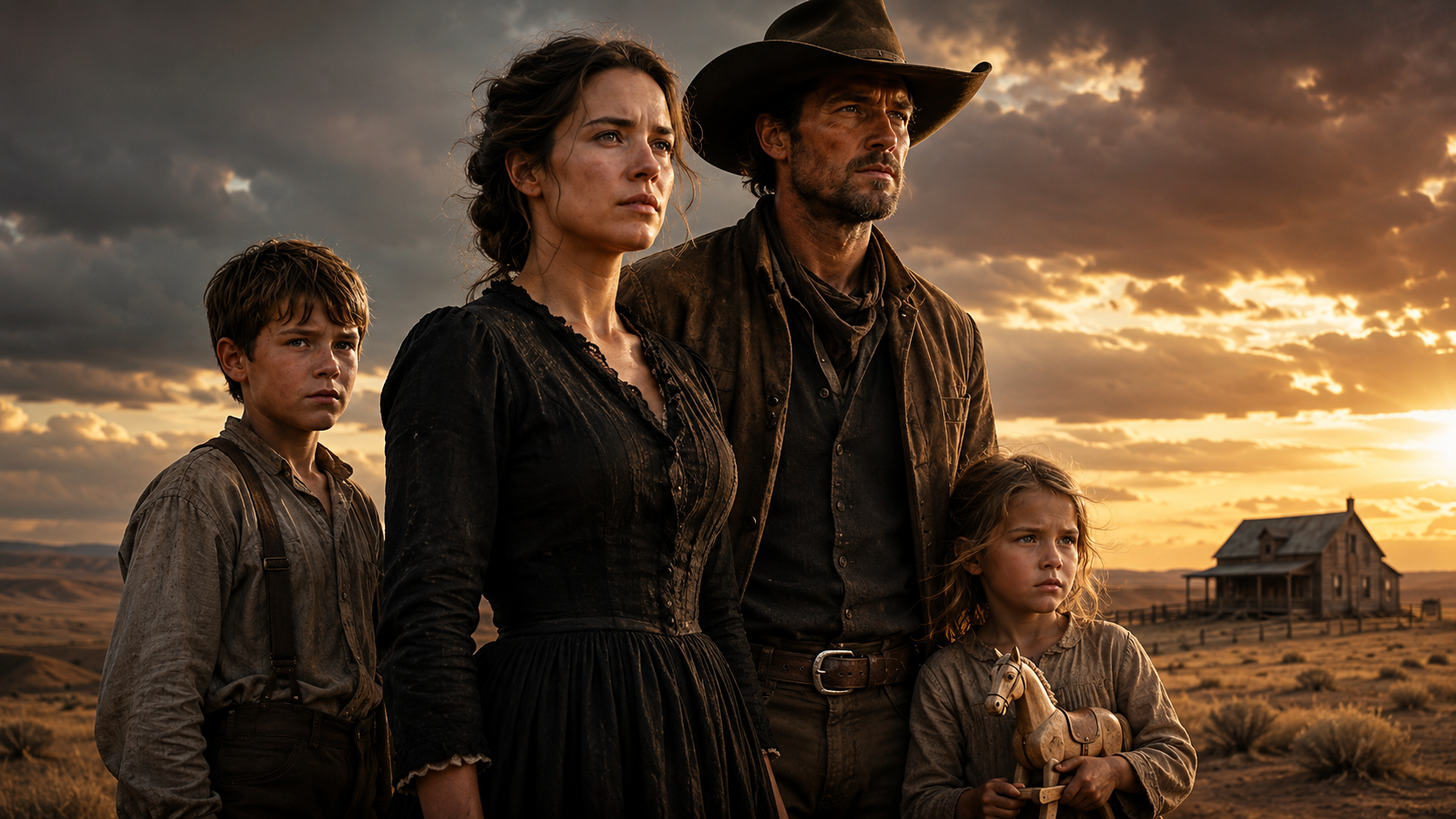
The man holding the reins was broad-shouldered, rain dripping from the brim of his hat. He had the kind of face that looked carved by weather and responsibility. Beside him sat two children. A boy of about twelve watched her with suspicion sharpened into a weapon. A smaller girl, no more than six, stared from beneath a knitted hood, one hand clutching a wooden horse.
“I’m not begging,” Nora said before he could ask.
“I didn’t say you were.”
“I’m waiting.”
“For what?”
She looked down the empty road, then back at him. “For the world to become kinder.”
The corner of his mouth moved, almost a smile, though his eyes remained tired. “That may be a long wait.”
“I’ve had practice.”
The man climbed down from the wagon. “Elias Ward.”
“Nora Bell.”
“Mrs. Bell?”
“For now.”
He understood more than she meant to give away. His gaze moved to the black dress, then to the carpetbag, then to her pale hands curled around the dead watch.
“You have somewhere to stay tonight?” he asked.
Nora’s pride rose, thin and useless. “I have possibilities.”
“Possibilities don’t keep the rain off.”
“No,” she admitted. “But sometimes they’re all a person owns.”
The smaller child whispered, “Papa, she’s shaking.”
The boy snapped, “Lottie, hush.”
Elias turned his head. “Caleb.”
The boy looked away, angry at being corrected and angrier, somehow, at Nora for existing.
Elias faced her again. “My ranch is five miles east. I can offer a roof, supper, and a dry blanket. Nothing more than that unless you ask for it.”
“I can’t pay.”
“I didn’t name a price.”
“Men always do,” Nora said.
For the first time, something hard passed through his expression. Not anger at her. Recognition.
“Some men,” he said. “Not all.”
She should have refused. She should have kept walking until the town ended and the darkness swallowed her with all the other women nobody remembered. But the little girl was still looking at her, and there was something in Elias Ward’s silence that felt less like charity and more like a door being held open.
Nora stepped toward the wagon.
Caleb shifted aside with obvious reluctance.
“I don’t want her sitting near Lottie,” he muttered.
Nora stopped.
Elias’s voice turned quiet. “You will speak with manners in my wagon.”
“She’s a stranger.”
“So was your sister the day she was born. You loved her anyway.”
Caleb’s face hardened, but he said nothing more.
Nora climbed in. Her wet skirt dragged against the wood. Lottie leaned close enough that Nora could see the child’s lashes were clumped with rain.
“Are you cold?” Lottie whispered.
“Yes.”
“I was cold after Mama died.”
The words struck the wagon like a bell.
Elias closed his eyes for half a breath, then took the reins. “Lottie.”
But Nora answered before he could apologize for the child.
“I was cold after my husband died,” she said.
The little girl considered this with solemn understanding. Then she slid the wooden horse into Nora’s lap.
“He doesn’t make you warm,” Lottie said, “but he listens.”
Nora stared at the toy until the road blurred.
For five miles, the rain kept talking where people could not.
The Ward ranch stood beneath a ridge of black pine and pale stone, a lonely house with a sagging porch, a barn leaning into the weather, and acres of land stretching into night. It was not beautiful in the polished way rich men preferred. It was scarred, stubborn, alive.
Inside, the kitchen smelled of smoke, beans, and old grief.
Elias gave Nora a blanket and pointed her toward the stove. Lottie remained close, as though the space beside Nora had become safer than any other place in the room. Caleb sat at the far end of the table and watched every bite Nora took as if she had stolen it from his dead mother’s plate.
After supper, Elias sent the children to bed. Lottie obeyed only after Nora promised to return the wooden horse in the morning. Caleb paused at the doorway.
“She won’t stay,” he said.
Nora looked at him. “You don’t know that.”
“I know people leave.”
There was no childishness in his voice. Only evidence.
Elias flinched as if struck, but the boy was already gone.
The house settled into quiet.
Nora stood near the stove with the blanket around her shoulders. “Your son hates me.”
“My son hates losing,” Elias said. “He’s had too much practice.”
“And you?”
“I hate asking what I’m about to ask.”
That made her turn.
Elias stood across the room, hat in his hands, looking suddenly less like the man who had pulled her from the rain and more like a man standing at the edge of his own ruin.
“There is a man named Gideon Voss,” he said. “He owns the mill, the bank note on my land, half the cattle in the county, and most of the cowards who call themselves officials. He wants this ranch because there’s spring water beneath the north pasture and a rail spur coming within ten miles by winter.”
Nora listened.
“My wife, Anne, died two years ago. Since then, Voss has been telling the court I can’t keep a family claim without a proper household. My father’s deed was written old-fashioned and foolish. It says the ranch must remain a family home, not merely a business holding. Voss bought my debt, found a judge willing to smile at him, and now he means to take everything.”
Nora tightened the blanket around herself. “What does that have to do with me?”
Elias did not look away.
“My children need a woman who won’t be frightened out of this house. I need a wife the court cannot ignore. You need shelter and a name that no coachman can throw into the mud.”
The silence that followed was so complete Nora could hear rain dripping into a bucket by the back door.
“You’re asking me to marry you,” she said.
“I’m asking you to consider a bargain.”
“A bargain is what people call desperation when they want it to sound respectable.”
“Yes,” Elias said. “Sometimes it is.”
Nora almost laughed. She almost cried. That morning, she had buried Daniel Bell in a grave so poor there was no stone. By night, a stranger was offering her a home, a war, and two wounded children.
“Do you want a wife,” she asked, “or a witness?”
“I want someone who will stand beside me when Voss comes to finish what he started.”
“And when he offers me money to leave?”
“He will.”
“And when people say I sold myself for a roof?”
“They will.”
“And when your son looks at me like I am a thief?”
Elias’s jaw tightened. “He already does.”
Nora looked toward the dark hallway where the children slept.
She had spent most of her life being told what she was worth. Too plain for gentleness. Too poor for respect. Too large for admiration. Too honest for comfort. Too late for happiness.
Now a ruined rancher was asking her to name her own terms.
“If I marry you,” she said, “I will not be furniture in your house. I will not be a nurse with a ring. I will not be thanked in private and hidden in public. I will sit at your table. I will speak in your court. I will correct your children when they are cruel and comfort them when they are afraid. If your enemy insults me, I will answer him myself.”
Elias studied her for a long moment.
Then he nodded once.
“That,” he said, “is the first honest proposal I’ve heard tonight.”
Nora held his gaze. “Then here is my answer. I will not marry you because I need saving. I will marry you because I am tired of being treated like something a rich man can step over.”
Elias’s expression changed.
For a moment, he looked as if he had expected gratitude and found fire instead.
The next morning, they married in the county office while mud still clung to Nora’s boots.
The clerk smirked when he read her name. “Mrs. Bell yesterday. Mrs. Ward today. Fast weather in this county.”
Elias stepped forward, but Nora placed a hand on his arm.
She looked at the clerk. “Sir, if speed troubles you, you should complain to the rain. It brought me here quicker than comfort would have.”
The clerk’s smirk faded.
He stamped the paper.
When they stepped outside, Gideon Voss was waiting beside a polished black carriage.
He was not the kind of rich man who wore wealth loudly. He wore it cleanly. Fine gloves. Silver hair. A dark coat without a speck of mud. Men like him did not need to shout. Other people shouted for them.
“Elias,” Voss said. “You disappoint me.”
“That has never cost me sleep.”
Voss turned to Nora. His gaze traveled over her dress, her old carpetbag, her worn shoes. “And this is the miracle bride?”
Nora smiled faintly. “No miracle, Mr. Voss. Just a woman with dry ink on a legal certificate.”
“How practical.”
“Practical women survive.”
“Not always.”
Elias moved, but Nora spoke first.
“Was that a threat?”
Voss’s smile remained smooth. “An observation.”
“Then observe carefully,” Nora said. “I am not for sale, not for shame, not for fear, and not for whatever number you were preparing to offer.”
A flicker crossed his face.
There it was.
The number.
The plan.
The assumption that every poor woman had a price if the purse was heavy enough.
Voss leaned closer. “Everyone is for sale, Mrs. Ward.”
Nora stepped down from the boardwalk into the mud so they stood nearly eye to eye.
“No,” she said. “Some people are simply waiting for someone foolish enough to make an offer.”
For the first time, Gideon Voss had no immediate reply.
Elias helped her into the wagon. As they rode away, Caleb stared at her from the back seat with something different from hatred.
Not trust.
Not yet.
But curiosity had entered where contempt had been.
Life at the ranch did not turn tender because of a wedding certificate.
Caleb refused her cooking for three days until hunger defeated his anger. Lottie followed her everywhere and woke screaming twice a night. Elias worked from dawn until his hands cracked and bled, then came inside with apologies trapped behind his teeth.
Nora did not try to become Anne Ward. She dusted the portrait on the mantel. She placed fresh flowers beneath it when she found wild asters near the creek. She asked Lottie to tell stories about her mother and listened when the child could speak. She did not force Caleb to call her anything but Mrs. Ward, and when he spat the name like a curse, she answered as if he had spoken kindly.
On the sixth evening, Caleb threw down his fork.
“She made biscuits wrong.”
Nora looked at the biscuit in question. “It rose.”
“Mama’s were better.”
“I believe you.”
“She knew how we liked everything.”
“She had more time to learn.”
“You’ll never be her.”
“No,” Nora said. “And if I tried, you would hate me for lying.”
The boy’s face went red.
Elias started to speak, but Nora lifted one hand.
“Your mother has a place in this house,” she continued. “I am not here to steal it. I am here because the living still need supper, clean shirts, and someone stubborn enough to keep enemies off the porch.”
Caleb’s eyes filled, but he refused to blink.
“I don’t want to like you,” he said.
Nora nodded. “Then don’t. Eat anyway.”
After a long moment, he picked up the biscuit.
Two days later, Gideon Voss came to the ranch.
He arrived with two riders, a lawyer, and a smile polished thin as glass. Elias met him in the yard. Nora stepped onto the porch with Lottie behind her skirt and Caleb at the barn door holding a pitchfork he did not know how to use.
“Mrs. Ward,” Voss said. “I’ve come with mercy.”
“Strange,” Nora replied. “It looks like paperwork.”
His lawyer opened a leather case.
Voss continued. “Five thousand dollars. More money than a woman in your position could earn in twenty lifetimes. Take it, leave by sundown, and I will see that no unpleasant rumors follow you.”
Elias went still.
Nora descended the porch steps.
“Unpleasant rumors,” she repeated.
“About your first husband. About the sudden convenience of your second. About why a woman alone in the world finds marriage so quickly when land is at stake.”
The yard seemed to hold its breath.
Nora thought of the coachman. The clerk. The women who had looked through her as if poverty were contagious. She thought of all the rooms where she had made herself smaller to be allowed a chair.
Then she thought of Lottie’s wooden horse in her apron pocket, Caleb eating a biscuit he claimed to hate, and Elias standing beside her as if she were not a burden but a line he would not let another man cross.
“Mr. Voss,” Nora said, “you have mistaken me for a woman who wants comfort more than dignity.”
“Dignity does not buy bread.”
“No,” she said. “But neither does cowardice, not for long.”
His smile thinned.
“You will regret refusing me.”
“I have regretted many things,” Nora said. “Speaking clearly has never been one of them.”
The lawyer shifted. One of the riders looked away.
Voss lowered his voice. “I can ruin you.”
Nora took one step closer. “Then you had better begin. Because I am already standing in the place you wanted empty.”
For a moment, nobody moved.
Then Caleb came from the barn and stood beside her.
He did not look at Nora. He looked at Voss.
“She’s not leaving,” he said.
The words were rough. Small. Trembling.
But they were the first gift the boy had given her.
Voss saw it too.
That was why his face changed.
A house could be bought. A judge could be bought. A debt could be bought. But a boy choosing someone in front of witnesses—that was a different kind of property line.
One money could not cross.
Voss left without another word.
That night, Elias found Nora on the porch, watching the moon rise over the north pasture.
“You should have taken the money,” he said quietly.
She glanced at him.
He leaned against the post. “Five thousand dollars is freedom.”
“No,” Nora said. “It is distance. Freedom is different.”
“And what is freedom, Mrs. Ward?”
She looked through the window. Lottie was asleep by the stove with the wooden horse under one arm. Caleb sat at the table pretending not to mend a tear in Nora’s shawl.
“Freedom,” Nora said, “is being poor in a place where no one can purchase your disappearance.”
Elias was silent for a long time.
Then he said, “I asked you for a bargain.”
“I know.”
“I think I received a blessing instead.”
Nora did not answer quickly.
The old Nora would have denied it. She would have made herself smaller under the warmth of praise. She would have handed the words back before anyone could decide she did not deserve them.
But that woman had been left in the rain outside Briar Creek.
This one looked at Elias Ward and let the truth stand.
“You received a wife,” she said.
His eyes softened.
Inside the house, Caleb looked up from the torn shawl and saw them through the window. He did not smile, not exactly.
But he kept sewing.
And for the first time since Nora Bell had buried one life and walked into another, the dead watch in her pocket no longer felt like an ending.
It felt like proof.
Time could stop.
And still, somehow, a woman could begin again.

