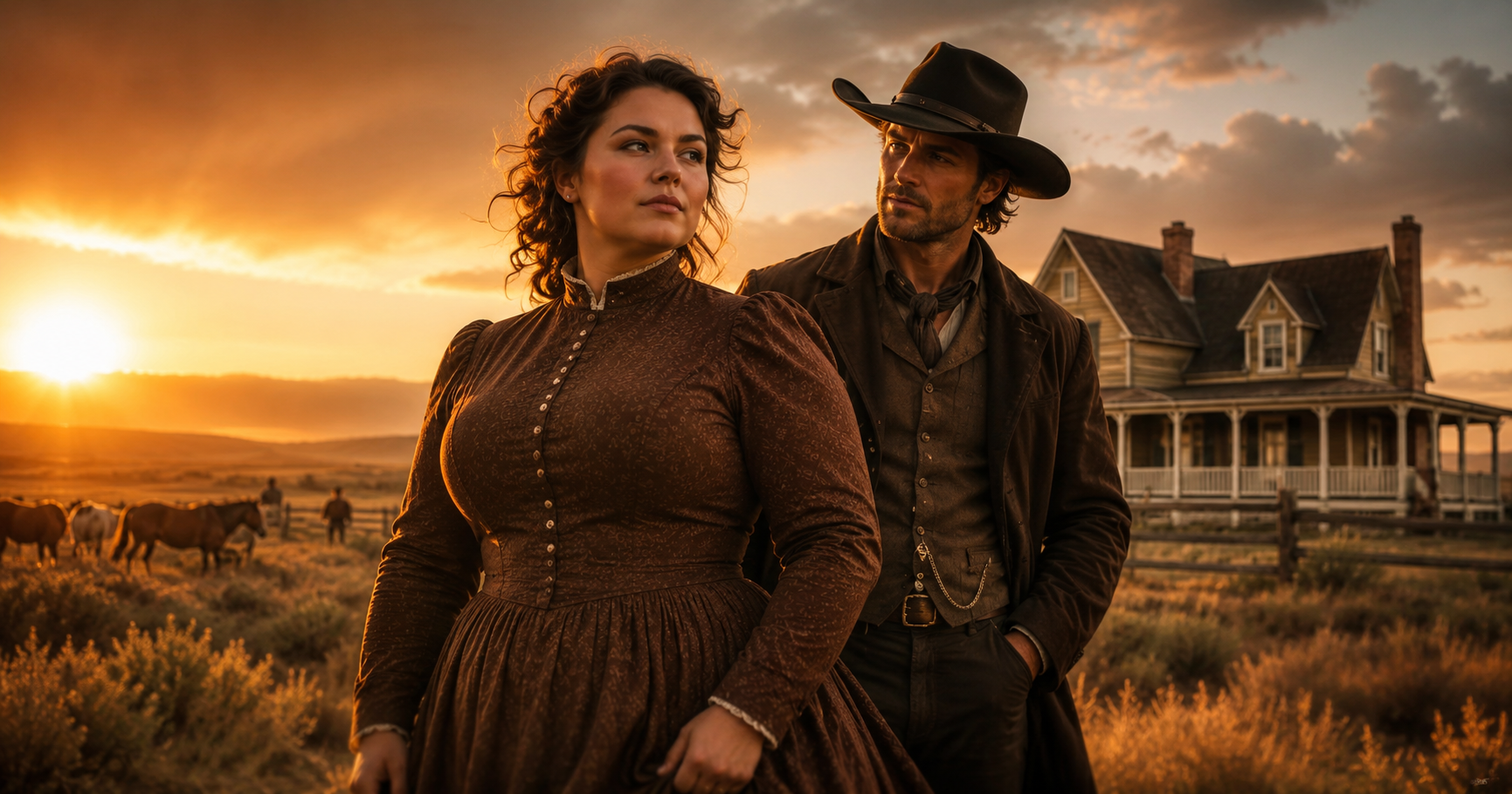
The Bride No One Chose

“Take the one nobody else will touch,” Gideon March said, his voice slick with contempt. “She eats too much, speaks too little, and costs more to keep than she will ever be worth.”

The parlor went still.

Evelyn Hart stood near the cold fireplace with her gloved hands folded in front of her stomach. She had trained herself not to react when men laughed. She had trained herself not to flinch when women pretended pity. She had trained herself not to answer when her father reduced her to weight, appetite, and inconvenience.

But that morning, something inside her did not bend.

It simply went silent.

There were three men in the room, all of them there to bargain for a bride. Not a wife, not a companion, not a woman with a mind or a pulse or a memory. A bride. A transaction wrapped in lace and shame.

The first man, a dry-goods merchant with damp hands, had looked at Evelyn once and turned away as if her body were an insult. The second, a widowed preacher, had asked whether she was obedient. The third had not asked anything at all.

He stood by the window, tall, sun-browned, broad through the shoulders, his dark coat carrying dust from the road. His name was Rowan Blackwell, cattle king of the northern plains, owner of Blackwell Range, a thousand miles of grass and weather and danger. Men said he could buy a bank before breakfast and break a horse before noon. Women said he had not smiled since his wife died.

Evelyn had expected him to laugh with the others.

He did not.

Gideon leaned back in his chair and waved one careless hand toward his daughter. “She is no beauty, Mr. Blackwell, but she can read, count, sew, and keep a kitchen from burning. If you want useful, she may do. If you want pretty, you came to the wrong house.”

The merchant coughed into his hand. The preacher looked at the carpet.

Rowan Blackwell looked at Evelyn.

Not at her waist. Not at her cheeks. Not at the places men usually measured first and understood least.

He looked at her eyes.

“How much did you ask for the younger one?” he said.

Gideon’s smile returned at once. “For Marian? Two hundred dollars. She is delicate, charming, agreeable—”

“I did not ask for her virtues.”

Gideon blinked.

Rowan turned from the window. “How much?”

“Two hundred.”

“And for Miss Evelyn?”

Gideon laughed. “For Evelyn? I would take fifty and thank Providence.”

The insult struck the room harder than a slap.

Evelyn kept her face still.

Rowan reached inside his coat, removed a leather billfold, and placed six hundred dollars on the table.

Gideon stopped laughing.

The merchant’s mouth opened. The preacher stared. From the hallway, Evelyn heard her younger sister draw a sharp breath.

Rowan’s voice was low and even. “I will pay triple. Not for ownership. Not for obedience. For her father’s agreement that she leaves this house today with everything that belongs to her, and no man follows to drag her back.”

Gideon’s face darkened. “You speak as if I am selling livestock.”

“No,” Rowan said. “You spoke that way.”

The room shifted around Evelyn. Air moved differently. Light seemed to grow sharper at the edges.

Her father looked at the money, then at Rowan. Greed wrestled pride across his face. Greed won.

“She is yours,” Gideon said.

Evelyn’s hands curled inside her gloves.

Rowan’s gaze did not leave Gideon. “She is not mine. She will be my wife if she chooses to step into my carriage.”

For the first time that morning, everyone looked at Evelyn as though her answer mattered.

She felt her sister watching from the hallway. Sweet, pretty Marian, dressed in pale blue, frightened and hopeful and guilty all at once. Marian had never been cruel, only sheltered. Their father had raised one daughter like a porcelain figure and the other like a debt.

Evelyn looked at the money on the table. Six hundred dollars. More than her father had ever spent on her comfort in all her twenty-six years. More than enough to purchase silence, signatures, and escape.

Then she looked at Rowan Blackwell.

“Why?” she asked.

One word. Barely more than breath.

Rowan answered without ornament. “Because you were the only person in this house who looked like she had survived it.”

That was the first kind thing he gave her.

Not praise. Not flattery. Recognition.

Evelyn went upstairs and packed a trunk.

She took three dresses, two books, her mother’s silver thimble, a ledger she had kept hidden beneath loose floorboards, and a small wooden box of letters tied with green ribbon. She did not take the mirror. She had spent too many years learning to hate what it showed her.

When she came down, Gideon was counting the money.

He did not rise. “Do not expect to come crawling back.”

Evelyn paused at the door.

For years she had imagined grand speeches. She had imagined accusing him of every cruelty, every dinner where he watched her plate, every party where he introduced Marian as his daughter and Evelyn as “the older girl,” every time he said no man would want her unless hunger, debt, or desperation made him blind.

But freedom did not need a speech.

“No,” she said softly. “I will not.”

Outside, the morning was bright enough to hurt.

Rowan helped her into the carriage, then placed her trunk beside the driver’s bench himself. He did not touch her waist. He did not crowd her. He offered a hand and waited for her to decide whether to take it.

She did.

They rode in silence until the town road became open country.

At last Evelyn said, “How far is your ranch?”

“Three days if the weather holds.”

“You have children?”

“Two. A girl of ten and a boy of seven.”

“And they need a mother?”

His jaw tightened. “They need a house that does not feel like a grave.”

Evelyn turned to him. “That is not the same thing.”

“No,” Rowan said. “It is not.”

She studied his profile. He was not handsome in the polished way of city men. His face had been built by weather, loss, and command. There were lines at the corners of his eyes, a scar near his chin, and a stillness that warned the world not to come too close.

“What do you expect of me?” she asked.

“Honesty. Order. Help with the children if they allow it. Accounts if you are willing. The ranch books have been neglected since my wife died.”

“And as your wife?”

The question tasted of humiliation, but she made herself ask it.

Rowan looked at the reins. “Nothing you do not choose.”

She stared at him.

He continued, “This arrangement gives you a legal place in my household and gives my children a woman under the roof who is not passing through for wages. But your door is yours. Your body is yours. Your future is not something I purchased from Gideon March.”

Evelyn turned toward the window so he would not see her eyes fill.

“Men say many things on the road,” she whispered.

“I know.”

“And change them once the door is locked.”

“I know that too.”

“Then why should I believe you?”

Rowan guided the horses around a rut. “You should not believe me yet. Watch me.”

So she did.

That first night they stopped at a way station with peeling white paint and a stable that smelled of hay and rain. Rowan asked for two rooms. The keeper raised an eyebrow. Rowan stared until the man lowered it.

At supper, Evelyn noticed things.

Rowan thanked the girl who brought coffee. He paid the stable boy extra for rubbing down the horses. He did not drink whiskey though it was offered. When a drunk at the next table muttered something ugly about “fat brides and rich fools,” Rowan set down his fork and looked at him once.

The drunk found urgent business outside.

Evelyn slept badly in a clean bed, afraid that comfort was a trick.

On the second day, the road grew meaner. The carriage wheels jolted over stones. Wind worried dust into her hair. At noon, Rowan stopped near a creek and unpacked bread, cheese, apples, and cold ham.

Evelyn waited for him to comment on how much she ate.

He did not.

Instead he said, “There is more if you want it.”

She looked at him sharply.

He did not seem to understand what he had done.

That made it worse.

For years, meals had been battles. Her father counted biscuits. Her aunt sighed over butter. At parties, women watched her plate with soft smiles and sharp eyes. Evelyn had learned to eat before entering rooms, to refuse sweets she wanted, to hide hunger like a crime.

Rowan broke an apple with his knife and handed her half.

“You work hard?” he asked.

“I kept my father’s household.”

“That is not an answer.”

“It is the only one most people require.”

“I am not most people.”

“No,” Evelyn said. “Most people ask less and assume more.”

Something like amusement moved through his face. “And you?”

“I assume nothing. It saves disappointment.”

“That sounds lonely.”

“It is safer than hope.”

Rowan did not argue. She liked him better for that.

They camped the second night beneath cottonwoods, the sky bruised purple above the plains. Rowan built a fire, rolled his blanket on the far side of it, and gave Evelyn the covered wagon for privacy. Over beans and coffee, he told her about Blackwell Range.

There were cattle spread across three valleys, horses in the east pasture, two wells, one schoolhouse twelve miles away, and a house built too large for the silence that had entered it. His daughter, Tessa, read everything she could get her hands on and trusted almost no one. His son, Milo, had not spoken above a whisper since his mother’s burial.

“What was her name?” Evelyn asked.

“Adelaide.”

The name left his mouth carefully.

“She was loved,” Evelyn said.

Rowan stared into the fire. “Yes.”

“Then your children will not thank me for standing where she stood.”

“No.”

“And you?”

He looked up.

“Will you resent me for not being her?”

The fire cracked between them.

Finally he said, “No woman on earth could be Adelaide. I would not insult you by asking.”

Evelyn lowered her eyes.

That was the second kind thing he gave her.

A place not stolen from a dead woman.

On the third evening, Blackwell Range appeared beneath a vast red sky.

The house stood on a rise above the valley, square-shouldered and weathered, with a long porch, tall windows, barns beyond, and corrals full of restless horses. It was not elegant. It was alive. Smoke rose from the chimney. Dogs barked. Somewhere a gate slammed.

Before Rowan could help Evelyn down, the front door opened.

A thin girl with dark braids stepped onto the porch. Her chin was high, her eyes too old.

Behind her stood a small boy clutching a wooden horse.

“Tessa,” Rowan said. “Milo. This is Evelyn Hart.”

“March,” Evelyn corrected softly, then stopped.

No. Not anymore.

“This is Evelyn Blackwell,” Rowan said.

The girl’s face hardened. “She is not our mother.”

“No,” Evelyn said before Rowan could answer. “I am not.”

Tessa blinked, surprised by agreement.

Evelyn climbed down carefully, smoothing her skirt. “I have no wish to replace a woman I never knew. That would be foolish and rude. But I am hungry, tired, and very interested in knowing whether this house has a kitchen.”

Milo hid farther behind the door.

Tessa crossed her arms. “Of course it has a kitchen.”

“Then you are already better informed than I am. Will you show me?”

“I do not take orders from you.”

“That is fortunate,” Evelyn said. “I have not given one.”

Rowan’s mouth twitched.

Tessa stared at Evelyn, uncertain whether she had been challenged or respected.

At last the girl turned sharply. “This way.”

The kitchen told Evelyn more than any welcome could have.

Dishes stacked in the sink. Flour spilled near the pantry. A pot burned black at the bottom. Clean laundry folded on one chair, dirty laundry heaped under another. The room had not been ruined by laziness. It had been abandoned by joy.

Evelyn took off her gloves.

“Tessa, where is the flour kept?”

The girl hesitated. “Blue jar.”

“Salt?”

“Small tin by the stove.”

“Coffee?”

“Top shelf. Papa forgets and puts it with the beans.”

“I heard that,” Rowan said from the doorway.

“You were meant to,” Tessa replied.

Evelyn smiled before she could stop herself.

Milo watched from behind his wooden horse.

She crouched, slowly so as not to startle him. “Hello, Milo. I am told you are a man who keeps his words carefully. I respect careful men. I talk only when necessary myself, though your sister may doubt that after tonight.”

Milo did not answer.

But he did not run.

They ate fried potatoes, beans, and bread toasted hard over the stove. It was not a fine meal, but it was warm. Rowan looked at the table as though he had forgotten what it meant for four people to sit together under lamplight.

After supper, Evelyn washed dishes while Tessa dried them badly and with open resentment.

“You are doing that wrong,” Tessa said.

“Very likely.”

“Mama dried glasses first.”

“Then tomorrow you may teach me.”

The towel stilled in Tessa’s hands.

People who expected arguments were often disarmed by being believed.

That night, Evelyn stood alone in her new room. It had a narrow bed, a washstand, a hooked rug, and curtains faded by sun. Her trunk waited at the foot of the bed. On the dresser sat a small vase with one wildflower in it.

Rowan had not mentioned it.

That was the third kind thing he gave her.

Not a declaration. A quiet attempt.

The first weeks were brutal.

Evelyn rose before dawn and slept after midnight. She sorted the pantry, scrubbed floors, mended shirts, aired mattresses, cleaned ash from corners, organized invoices, and found unpaid bills tucked into a tobacco tin. She learned which hens bit, which pump handle stuck, which hired hand lied about feed, and which creditor had been charging Rowan twice for the same deliveries.

The ranch was rich in cattle and poor in attention.

Evelyn gave it attention.

She turned ledgers into columns, columns into truth, and truth into money saved. When she showed Rowan the first corrected account, he read it twice.

“You found all this?”

“I found what was there.”

“I have been cheated.”

“Yes.”

“For how long?”

“At least eight months.”

His face darkened.

Evelyn closed the ledger. “Anger is expensive if spent before planning.”

He looked at her.

“Then plan,” he said.

So she did.

By the end of the month, the dishonest supplier was gone, the pantry costs had dropped, and the ranch hands had learned that Mrs. Blackwell knew the difference between fair wages and padded invoices.

Respect came slowly.

Suspicion came faster.

The neighboring women arrived with pies and curiosity. They looked at Evelyn’s body, her dress, her ring, her face, and then at one another.

One of them, Mrs. Bellweather, smiled with sugar on her teeth. “It must be quite a change, dear, from town life to ranch life. So much movement. So many stairs.”

Evelyn placed the pie on the table. “Yes. Fortunately, I have legs.”

Tessa choked on a laugh.

Another woman said, “Mr. Blackwell has always been generous.”

“How lucky for him,” Evelyn replied, “that I have always been useful.”

After that, the visits became shorter.

Tessa began appearing in the kitchen without being asked. She corrected Evelyn’s recipes, then asked questions about books, then lingered after supper with a mending basket in her lap and grief she did not know how to put down.

“She smelled like lavender,” Tessa said one evening, so suddenly Evelyn nearly pricked her finger.

“Your mother?”

Tessa nodded.

“Would you like lavender in the linen chest?”

The girl’s face tightened. “Do not pretend you care.”

Evelyn set down the needle. “I am not pretending. But I am also not asking you to love me for it.”

Tessa looked at her with wet, furious eyes. “Everyone says I must be grateful.”

“That is a heavy thing to demand from a child.”

“I am not a child.”

“No,” Evelyn said gently. “You are a girl who had to stand up too soon.”

Tessa covered her face and cried without sound.

Evelyn did not touch her. Not at first. She simply sat nearby and threaded the needle again.

After a while, Tessa leaned against her shoulder.

Milo’s trust was quieter.

He followed Evelyn from room to room, carrying his wooden horse. She spoke to him as she worked, never demanding words. She told him why dough must rest, why socks should be darned before the holes widened, why angry dogs should not be stared down, why grief sometimes sat in the throat like a stone.

One morning, she found him in the barn beside a calf rejected by its mother.

The calf shivered in the straw.

Milo looked at Evelyn, eyes wide with fear.

“We will warm her,” Evelyn said.

Milo touched the calf’s wet nose.

“She is unwanted,” Evelyn said softly. “That does not mean she is worthless.”

Milo’s lips trembled.

Together they rubbed the calf with old towels. Evelyn fetched warm milk. Milo held the bottle with both hands. The calf drank greedily, bumping his fingers.

Milo smiled.

Not much. Just enough to change the world.

Three days later, while Evelyn kneaded bread, he climbed onto a stool beside her and whispered, “Her name is Button.”

Evelyn’s hands froze in the dough.

She did not turn too quickly. She did not cry out. She did not call the others.

She only said, “Button is a fine name.”

From the doorway, Rowan heard.

His face broke.

Not loudly. Not dramatically. His grief simply rose, filled his eyes, and made him look suddenly less like a cattle king and more like a father who had been praying in silence for months.

That night, he found Evelyn on the porch.

The stars were sharp above the black fields.

“He spoke,” Rowan said.

“Yes.”

“How did you know not to push?”

Evelyn wrapped her shawl tighter. “Because silence is sometimes the last room a wounded person owns.”

He stood beside her, not touching.

“I thought money could solve the worst of it,” he admitted. “A housekeeper. A tutor. New clothes. Better meals.”

“Money can mend many things.”

“But not that.”

“No.”

Wind moved across the grass.

Rowan said, “Your father was a fool.”

Evelyn laughed once, without humor. “Many people have been foolish about me.”

“I was not speaking of your appearance.”

“I know.”

“You deserved better.”

She looked out at the dark pasture. “Deserving and receiving are distant cousins.”

“Not always.”

She turned then.

Rowan was watching her with an expression she had not seen from a man before. Not hunger. Not pity. Not calculation.

Wonder, perhaps.

It frightened her more than cruelty.

“Do not look at me like that,” she said.

“How am I looking at you?”

“As if I am something rare.”

“You are.”

“No. I am practical. Stubborn. Too large for fashion and too plain for songs. I am good with accounts, children, bread, and emergencies. That is not rare. That is merely unnoticed.”

Rowan stepped closer, stopping before closeness became pressure. “Then the world has been criminally careless.”

Evelyn’s throat tightened.

The fourth kind thing he gave her was not a sentence.

It was patience.

Summer changed the ranch.

The garden returned first. Tessa showed Evelyn where Adelaide had planted tomatoes, beans, squash, and herbs. They worked side by side in soil warm from sun. Sometimes Tessa told stories. Sometimes she cried. Sometimes she laughed and then looked guilty for it.

“Laughing does not bury her deeper,” Evelyn told her.

Tessa wiped her nose on her sleeve. “It feels like betrayal.”

“It is proof she left warmth behind.”

Milo’s calf grew strong and ridiculous. Button followed him like a dog, and Milo began speaking in small pieces. One word became three. Three became sentences. Sentences became questions.

Rowan listened to each one as though receiving gold.

Evelyn became known in the valley as the woman who had saved Blackwell Range from quiet ruin. Men who once smirked at Rowan’s bargain now removed their hats when she entered the mercantile. Women who once whispered asked for her recipes, her advice, her help reading contracts.

Gideon March heard of it, of course.

Men like Gideon always heard when money moved.

He arrived in September with a lawyer, a false smile, and Marian in a carriage behind him. He stepped onto Blackwell land as though dignity could be worn like a coat.

Evelyn saw him from the porch.

For a moment, the old fear returned. Her stomach tightened. Her hands went cold. She was a girl again in a dining room, being told to eat less, speak less, want less.

Then Tessa came to stand at her left.

Milo came to stand at her right.

Rowan stepped out behind her.

The fear did not vanish.

But it found no empty place to grow.

“Daughter,” Gideon called warmly.

Evelyn descended the porch steps. “Mr. March.”

His smile faltered. “Surely we are not strangers.”

“No,” she said. “Strangers are often kinder.”

The lawyer cleared his throat. Gideon’s eyes sharpened. “I have come because certain matters were handled hastily. Your marriage contract, your inheritance from your mother, the disposition of family assets—”

“My mother’s inheritance?” Evelyn said.

He waved a hand. “Small legal complications.”

“There were no complications when you told me she left nothing.”

Gideon’s face tightened.

Rowan’s voice came from behind her. “Choose your next lie carefully.”

The lawyer opened his case with trembling fingers.

Evelyn listened as the truth unfolded. Her mother had left money in trust for both daughters. Gideon had hidden Evelyn’s portion, claiming expenses, guardianship rights, and household debts. But marriage had changed her legal standing. Rowan’s attorney had been making inquiries quietly for weeks.

Evelyn turned to Rowan.

He did not look triumphant. Only steady.

“You knew?”

“I suspected. Your mother’s letters mentioned a trust.”

“You read them?”

“No. You left one open on the desk. I saw the word trust and asked permission from no one but the law.”

Gideon snapped, “This is family business.”

Evelyn faced him fully. “No. Family business was when a mother tried to protect her daughter and a father stole from her.”

Marian stepped down from the carriage, pale and shaking. “Papa?”

Gideon swung toward her. “Get back inside.”

Marian did not move.

Evelyn saw then that her sister’s cage had only been prettier.

The lawyer produced papers. The trust existed. The amount was considerable. Enough to make Evelyn independent. Enough to expose Gideon. Enough to free Marian too, if she dared.

Gideon’s voice dropped. “Evelyn, do not make a spectacle.”

She almost smiled.

For years, her existence had been treated as one.

“No,” she said. “I think I will make an ending.”

The legal fight lasted months, but Gideon lost. Men who had once dined at his table found reasons to avoid him. Creditors circled. Marian came to stay at Blackwell Range “for a visit” and never returned to her father’s house.

Evelyn used part of her inheritance to expand the schoolhouse, hire a proper teacher, and establish a fund for women who needed wages, passage, or lawyers more than pity. She did not name it after herself. She named it after her mother.

By winter, snow folded the range in white.

One evening, after the children had gone to bed and Marian was reading by the kitchen stove, Evelyn found Rowan in the barn, checking a mare heavy with foal.

“You will freeze,” he said.

“I brought your coat.”

“You are wearing it.”

“Yes. It is very warm.”

He smiled then, fully.

It changed his face so much she forgot what she had come to say.

For months, their marriage had been a structure built of respect. Separate rooms. Shared work. Glances that lasted too long and ended too soon. Words careful with hope.

Evelyn stood beside the stall door. “You once told me this arrangement had to be nothing more unless I chose otherwise.”

Rowan went still.

“I remember,” he said.

“I am choosing otherwise.”

The mare shifted in the straw.

Rowan’s voice was rough. “Evelyn.”

“I do not want gratitude from you. Or duty. Or loneliness dressed as affection.”

“You have none of those.”

“What do I have?”

He crossed the space slowly, giving her every chance to retreat.

“My admiration,” he said. “My trust. My desire, though I have fought to keep it from burdening you. My heart, if you want a damaged thing.”

Evelyn breathed out.

“All hearts are damaged things.”

He lifted his hand, stopped, and waited.

She stepped into his touch.

His palm came to her cheek as if she were precious, not fragile. There was a difference. Fragile things were handled with fear. Precious things were held with reverence.

When he kissed her, it was not the claiming kiss she had once feared from marriage. It was a question, and then an answer, and then a door opening in a house she had thought would never be hers.

Spring came early the next year.

The foal was born strong. The garden doubled. Tessa began writing stories and pretending they were only school exercises. Milo spoke so much that Rowan sometimes laughed and asked him to breathe between sentences. Marian learned accounts from Evelyn and discovered she had a sharper head for business than any man in her father’s circle.

And Evelyn?

She grew larger in every way that mattered.

Not smaller. Never smaller.

She took up space at the table, in the ledgers, in town meetings, in her husband’s arms, in the lives of children who had once feared loving her would betray the dead. She stopped apologizing for hunger, for intelligence, for laughter, for the breadth of her body and the force of her will.

Years later, people still told the story of the day Rowan Blackwell paid triple for the bride no one wanted.

They told it badly, most of them.

They made it sound like he had rescued her.

Evelyn knew the truth.

Rowan had opened a door.

She had walked through it.

And after that, she had built the future herself.

Содержание

1

Create a cinematic 15-second western romance drama trailer, no subtitles, no captions, no text on screen. A wealthy cattle rancher stands in a dusty parlor while a cruel father mocks his eldest daughter as unwanted. The rancher throws a stack of money on the table and says firmly, “I am not buying her. I am paying you to let her leave.” The humiliated woman looks up, shocked but proud. Cut to a carriage racing across golden plains, wind in her hair. She asks, “Why me?” He answers, “Because you looked like you had survived.” End with the ranch house at sunset, two wary children on the porch, emotional orchestral music, warm cinematic lighting, realistic period costumes, intense close-ups, no written words anywhere.

2

Create a 15-second dramatic trailer in a gritty frontier style, no subtitles, no captions, no on-screen text. Start with a close-up of a father sneering in a dark parlor: “Take the one nobody wants.” Cut to the full-figured bride standing silent, wounded but dignified. A powerful cattle king steps forward and says, “She is worth more than every insult in this room.” Quick cuts: money hitting the table, the bride stepping into a carriage, storm clouds over open plains, a lonely ranch kitchen, two grieving children staring at her. Dialogue continues: the girl says, “You are not my mother.” The bride replies gently, “No. But I can still keep this house warm.” End on the rancher watching her with respect, dramatic violin and low drums, no text or logos.

3

Create a 15-second emotional western family trailer, no subtitles, no captions, no text on screen. Open with a silent, large-bodied woman packing a small trunk while her father counts money downstairs. Her voice whispers, “I will not come back.” Cut to a rugged cattle king helping her into a carriage without touching her waist, respectful and restrained. He says, “Your door will be yours. Your future is yours.” Rapid montage: dusty road, campfire conversation, a little boy refusing to speak, the woman kneeling beside him with a newborn calf. She whispers, “Unwanted does not mean worthless.” The boy finally says, “Her name is Button.” End with the rancher’s eyes filling with tears, golden sunrise over the range, intimate cinematic realism, no written elements.

4

Create a 15-second high-emotion historical romance trailer, no subtitles, no captions, no on-screen text. Begin with a cold wealthy father humiliating his daughter in front of suitors: “No man will ever choose her.” A stern cattle king turns slowly and says, “Then I choose the woman all of you were too blind to see.” Cut fast: shocked faces, a wedding ring, a carriage leaving town, the bride scrubbing a neglected ranch kitchen, a rebellious daughter saying, “You cannot replace her.” The bride answers, “I came to help you remember her, not erase her.” Final shots: the father returning with a lawyer, the bride standing strong beside her new family, the rancher saying, “This is your home now.” Epic orchestral swell, cinematic western lighting, no text, no signs, no subtitles.