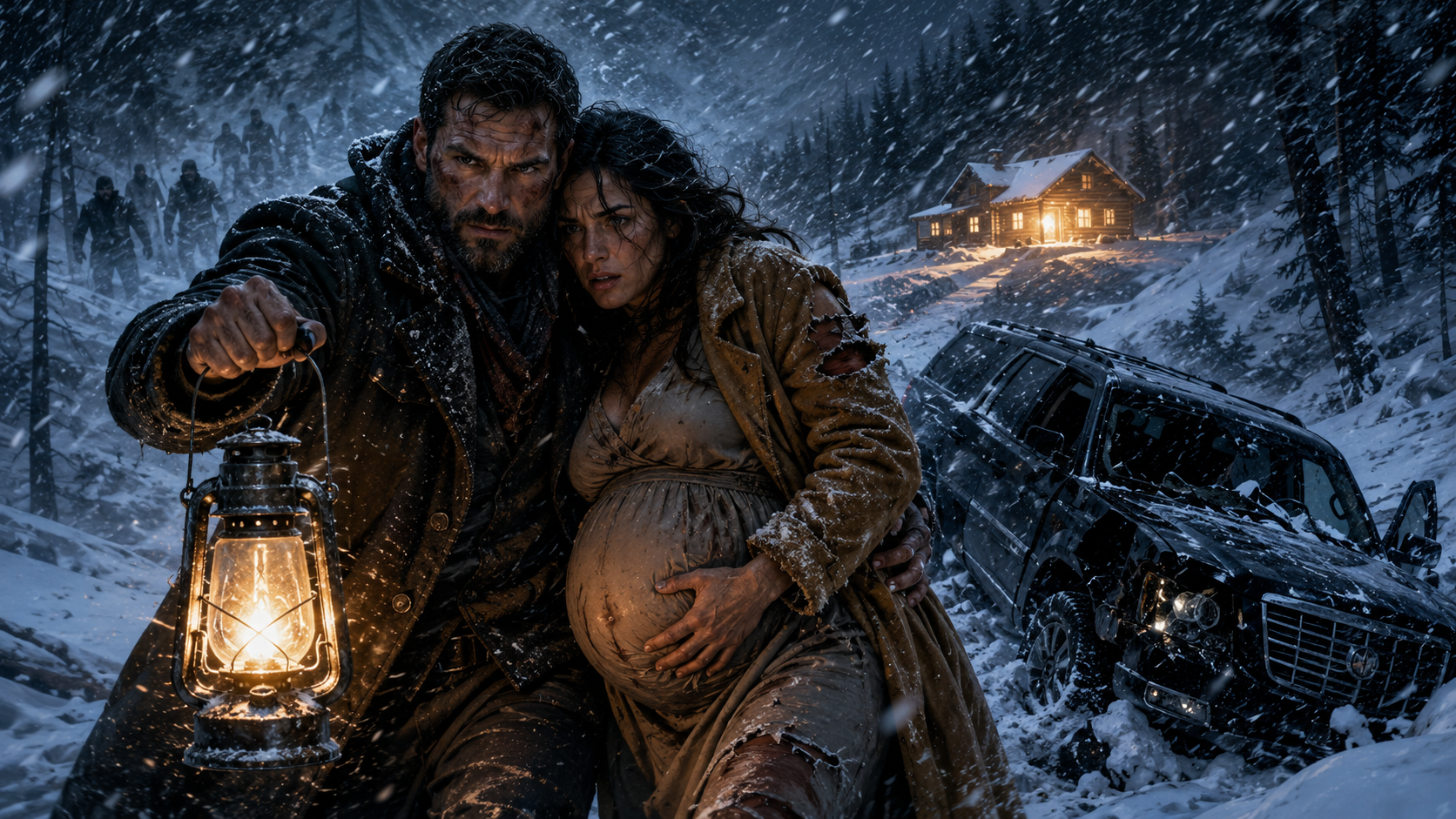
“Too Wide for a Harland Bride,” They Whispered—Until the Mountain Man Found Her Giving Birth Alone, and Her Baby’s First Cry Exposed the Men Who Wanted Him Gone

The first scream reached Ronan Kade through the storm like something the mountain itself had torn loose.

He had been repairing the latch on the west window of his cabin when he heard it. At first, he thought it was the wind twisting through the pines. Winter storms in the Bitterroot Range had voices. They moaned in gullies, howled under eaves, and snapped through branches like old bones. Ronan had learned not to answer every sound the dark made.

Then the scream came again.

Human.

Female.

Terrified.

Ronan stopped moving.

The storm slammed against the cabin walls. Snow hissed across the roof. The fire behind him spat sparks into the black iron grate. For three years, he had lived above Ironfall Pass because people down in town asked too many questions and believed too many lies. Up here, the trees knew how to keep secrets. The rocks did not stare. The wind did not whisper that he had lost his ranch, his family, and his mind all in the same year.

But tonight, someone was out there.

And she was calling.

Ronan grabbed his coat, his rifle, and the emergency lantern from the hook beside the door. When he stepped outside, the cold hit him hard enough to steal the first breath from his chest. Snow blew sideways. The ridge trail had already vanished under white. Beyond the yard, nothing existed but dark trees and moving shadow.

The scream came a third time.

Lower now.

Weaker.

Ronan turned toward it and began climbing down the old logging path.

He found the wreck less than half a mile below the cabin, where the road curled beside a ravine and dropped toward Black Alder Creek. A black luxury SUV had slammed nose-first into a pine. One headlight still burned, tilted toward the sky. Steam crawled from the crumpled hood. The driver’s door hung open.

At first, he saw blood on the snow.

Then he saw her.

She lay against the rear tire, wrapped in a torn camel-colored coat that looked expensive and useless. Her hair was dark, wet, tangled against her cheeks. One hand gripped the lower curve of her swollen belly, the other clutched a leather document case to her chest as if it were a child too.

She saw his lantern and tried to crawl backward.

“No,” Ronan called, raising his free hand. “I’m not here to hurt you.”

Her eyes flashed in the light, wild with pain and fear.

“That’s what they said.”

The words were thin, barely there.

Ronan knelt several feet away, slow enough not to startle her. He had been an Army medic before the mountains took him back. He knew shock when he saw it. He knew panic. He knew a body fighting to stay conscious while pain dragged it under.

“My name is Ronan Kade,” he said. “My cabin is up the ridge. I heard you scream.”

Her face twisted.

Another contraction took her.

She bit down on the sleeve of her coat to keep from crying out. Ronan looked away just enough to give her dignity, but not enough to miss what mattered. Her dress was soaked. Her breathing was wrong. She had been out here too long.

When the contraction passed, her head fell back against the tire.

“Hospital,” she whispered.

“Road’s gone,” Ronan said. “The lower bridge washed out this morning. My radio’s been dead since sunset.”

Her eyes closed.

“No. No, please. Not here.”

Ronan moved closer.

“What’s your name?”

For a moment, he thought she would not answer.

Then she whispered, “Elena.”

“Elena what?”

Her fingers tightened around the document case.

“Elena Marlowe.”

Ronan knew that name.

Not because of her.

Because of the name she had married.

He had seen it in headlines, printed beneath photographs of marble hotels, private aircraft, charity galas, and men with teeth too white to belong in honest mouths.

Elena Marlowe Harland.

The widow of Jasper Harland.

The woman the newspapers had called unstable.

The woman the Harland family had said was “resting privately” after her husband’s death.

Ronan’s jaw tightened.

“Your husband was Jasper Harland.”

She opened her eyes.

“Was,” she said. “He died twenty-two days ago.”

“I heard.”

Everyone had heard. Jasper Harland, heir to Harland Ridge Holdings, killed in a helicopter crash outside Aspen. Tragic accident. Family devastated. Pregnant widow absent from memorial. No comment.

The kind of silence rich families bought by the acre.

Elena looked past Ronan toward the road, as if expecting headlights to appear through the snow.

“They know I ran.”

“Who?”

Her lips trembled.

“Malcolm.”

“Jasper’s brother?”

She nodded, then gasped as another pain seized her.

Ronan slid his rifle strap higher on his shoulder and moved in beside her.

“Can you stand?”

“I don’t know.”

“You have to try.”

“They’ll come.”

“Then we should not be here when they do.”

At that, something like anger broke through her fear.

“You don’t understand. They don’t stop. Men like Malcolm Harland don’t lose things. They erase them.”

Ronan looked at the shredded rear tire of the SUV. It had not blown from the crash. The sidewall had been punctured cleanly. Shot, most likely, before she left the road.

“I understand more than you think,” he said.

She studied him then, really studied him. The beard. The scar along his temple. The old wool coat. The rifle. The shoulders built by weather and work instead of gyms and tailors.

“You live up here alone?”

“Yes.”

“By choice?”

“Most days.”

A laugh broke from her, too sharp to be happy. Then her face crumpled in pain again.

Ronan reached for her arm.

“Elena, I need to get you inside.”

Her grip tightened around the document case.

“No matter what happens, this stays with me.”

“Fine.”

“If I pass out—”

“You won’t.”

“If I do, take the case. Not the baby. Not me. The case.”

Ronan looked at her.

“Elena.”

She glared at him through tears.

“Promise me.”

“No.”

Her expression faltered.

“No?”

“I’m not choosing paper over a woman and her child.”

“You don’t know what’s in it.”

“I know what’s in front of me.”

For one long second, she looked as if she had forgotten what kindness sounded like when it was not trying to buy something.

Then her strength went out of her.

Ronan carried her up the mountain.

She was not light. He would have hated himself if he had thought it mattered. Her body was warm and shaking against him, her breath ragged in his ear. More than once, she whispered that she was sorry. Sorry for being heavy. Sorry for slowing him down. Sorry for the blood on his coat. Sorry for the storm, as if she had caused that too.

By the time the cabin lights came into view, Ronan was breathing hard.

Elena heard it and tried to push away from him.

“I can walk.”

“You can’t.”

“I’m too much.”

Ronan stopped at the porch and looked down at her.

“You are a woman in labor in a blizzard after a car crash. You are not a burden. You are a miracle with terrible timing.”

Her mouth opened.

No answer came.

He carried her inside.

The cabin was small but warm. One room downstairs, a loft above, a narrow kitchen, a stone hearth, a bed against the far wall that Ronan had not shared with anyone in years. He laid Elena there and moved quickly. Towels. Boiled water. Lanterns. Medical kit. Clean sheets. The storm buried the windows in darkness.

Elena clutched the document case as he checked her pulse.

“You were a medic,” she said.

“Army.”

“You know what you’re doing?”

“Enough to know we are not getting to a hospital tonight.”

Her eyes widened.

“No.”

“Elena.”

“No. I can’t have him here.”

“Him?”

Her hand moved over her belly with fierce tenderness.

“Theodore. Theo.”

Ronan paused.

“You named him already.”

“Jasper did.” Her voice broke. “He said every child deserves a name before the world starts arguing over them.”

Ronan softened despite himself.

“What does Malcolm want?”

She stared at the ceiling.

“The Harland trust.”

“That’s a lot of trouble for a trust he probably already has lawyers circling.”

“He controls part of it. Not all.” Her breath trembled. “If Theo is born alive, Jasper’s shares pass to him. Malcolm becomes temporary guardian only if I’m declared unfit. If Theo is not born alive, Malcolm controls the voting block outright.”

Ronan went still.

Outside, thunder rolled over the ridge.

Inside, the fire popped.

Elena’s eyes filled, but the tears did not fall.

“They told everyone grief made me delusional. They locked me in the west guest house. Took my phone. Sent doctors who asked questions like they already knew the answers. Then Malcolm told the staff the baby might not be Jasper’s.”

Ronan said nothing.

Elena turned her face away.

“I was a pastry chef at one of their resorts. That’s how I met Jasper. I wasn’t an heiress. I wasn’t thin enough for their parties. I didn’t know the rules. His mother called me a sweet mistake. Malcolm’s wife once said I looked like someone had invited the dessert table to dinner.”

Ronan felt something old and dark move in his chest.

“Elena.”

She gave a small, ashamed laugh.

“Everyone said I was too wide to wear the Harland name. Too plain. Too soft. Too hungry. Too loud when I laughed. Too much of everything a Harland wife was not supposed to be.”

“He married you.”

“Yes.”

“Then he knew exactly what he wanted.”

That made her look at him.

“They never forgave him for that.”

Another contraction hit before Ronan could answer. This one bent her body like a bow. She cried out, fingers digging into the sheet.

Ronan had seen enough births in field hospitals to know when time had run out.

No ambulance.

No doctor.

No road.

The child was coming.

“Elena,” he said, voice steady. “Listen to me. Theo is coming now.”

Panic swallowed her face.

“No. No, not here. Not like this.”

“Yes, here.”

“I can’t.”

“You can.”

“I’m too tired.”

“I know.”

“I’m scared.”

“I know that too.”

“No, you don’t.” She grabbed his wrist with sudden force. “I’m not strong. Jasper was strong. I just ran because he told me to run.”

Ronan leaned closer.

“You drove through a mountain storm with men behind you. You crashed, crawled out, guarded evidence, and kept your son alive with nothing but pain and stubbornness. Do not insult yourself by calling that anything less than strength.”

Her mouth trembled.

“I don’t want to die looking like this.”

The words came so softly he almost missed them.

Then he understood. The cruelty had gone deeper than the chase. Deeper than fear. Even here, with life pressing toward the world and death stalking the road below, some part of Elena still stood in gilded rooms under glittering chandeliers while polished women measured her waist with their eyes and powerful men laughed when they thought she could not hear.

Ronan took her hand.

“Elena Marlowe Harland, your body is not a mistake. It carried your son through a world that wanted him erased. It brought you up this mountain alive. It is not your shame. It is your weapon. Use it.”

She stared at him.

Then, through the tears, she gave one broken laugh.

“You always talk like a preacher with a rifle?”

“Only during emergencies.”

Another contraction rose.

This time, when Ronan told her to breathe, she listened.

The cabin became its own world. Storm outside. Fire inside. Pain, command, courage. Elena cursed once, apologized three times, then threatened to throw a lamp at Ronan if he told anyone she had cried.

“I have survived worse threats,” he said.

“You look like a man who invites worse threats.”

“I try to avoid women in labor when possible.”

She almost smiled.

Then the labor turned hard.

Time narrowed.

The fire sank low. The wind shook the shutters. Elena’s voice weakened. Ronan’s hands stayed steady because hands had no right to panic when someone else’s life depended on them.

He had watched soldiers bleed into dust.

He had watched his father’s land disappear beneath legal papers and poisoned water.

He had buried his mother on a spring morning while Harland lawyers called her grief “unrelated stress.”

He had thought he was finished wanting strangers to live.

Then Elena looked at him with eyes gone glassy and whispered, “I’m done.”

“No,” he said.

“I can’t.”

“You can.”

“I have nothing left.”

“You have one cry left in you,” Ronan said. “Make it louder than every person who tried to make your son disappear.”

Something changed in her face.

Disappear.

That word found the place where fear became fury.

Elena gripped his forearm, lifted her head, and fought.

Minutes later, Theo entered the world silent.

For one terrible second, the cabin forgot to breathe.

Elena saw Ronan’s face.

“No,” she whispered. “Please. Please, no.”

Ronan cleared the baby’s airway, rubbed the tiny chest, bent close, listening. The child was small, slick, frighteningly still.

“Come on, Theo,” he muttered. “You did not cross a mountain just to stop at my doorstep.”

Nothing.

Elena made a sound Ronan knew would follow him into dreams.

He rubbed harder.

“Breathe.”

The baby coughed once.

Then again.

Then a thin, furious cry tore through the cabin.

Elena collapsed back with a sob that sounded like prayer and disbelief in the same breath.

Ronan wrapped the child quickly and placed him against her chest.

“You have a son,” he said.

Elena touched Theo’s cheek with trembling fingers.

“Hi, my brave boy,” she whispered. “Hi. I knew you’d come.”

Theo cried again, angry at cold, angry at light, angry at a world that had tried to decide his fate before he could draw breath.

Ronan turned away to give them a moment.

That was when he saw the mark.

Just above the baby’s left collarbone, dark against fragile skin, was a small birthmark shaped like a broken crescent.

Elena saw Ronan notice.

Her entire body went rigid.

“You saw it.”

“It’s only a mark.”

“No.” Her voice changed. “It’s the Harland mark. Jasper had it. His father had it. His grandfather too.”

Ronan looked from her to the baby.

“Then Theo proves he is Jasper’s son.”

“Yes.”

Before Ronan could answer, static cracked from the old radio on the shelf.

Both adults froze.

The radio had been dead for two days.

A man’s voice came through, faint but clear.

“Ridge unit to base. We heard a baby.”

Elena stopped breathing.

Another voice answered.

Polished.

Cold.

Familiar even through static.

“Breathing?”

Elena’s eyes filled with terror.

“Malcolm,” she whispered.

The first voice replied, “Sounds like it.”

Silence.

Then Malcolm Harland said, “Then don’t come down until that changes.”

The cabin seemed to lose all heat.

Theo whimpered against his mother.

Ronan crossed the room and turned the volume down, but not off. Beside the radio, the emergency recorder he kept wired to the signal box blinked red.

Recording.

Elena saw the light.

“Did it catch him?”

Ronan looked toward the black window.

“Yes.”

Outside, somewhere between the pines, a branch snapped.

Men were coming.

Elena clutched Theo closer.

“You should leave us.”

Ronan picked up his rifle.

“Not happening.”

“They’ll kill you.”

“They can try.”

“You don’t understand. Malcolm owns judges. Banks. Sheriffs. Papers. Men like him don’t have friends. They have investments.”

Ronan checked the rifle chamber.

“He doesn’t own this cabin.”

“Ronan.”

“And he doesn’t own this mountain.”

The first shadow moved between the trees.

Then another.

Three men stepped out of the storm in dark jackets with no badges. One carried a shotgun. One kept his hand near his hip. The third lifted both hands as if he had come to borrow sugar.

Ronan stepped onto the porch before they reached the yard.

The cold slapped his face.

“That’s far enough.”

The men stopped.

The one in front smiled.

“Mr. Kade. We’re here to help Mrs. Harland.”

“You took a strange road for helpers.”

“She is under medical distress. Her family is concerned.”

“Her family just ordered you over my radio not to come down until her baby stopped breathing.”

The smile vanished.

Inside the cabin, Theo cried again.

The man with the shotgun looked toward the window.

Ronan fired into the snow at his feet.

The shot cracked through the trees. The man stumbled backward, losing his grip on the weapon. The other two froze.

“Next warning will be less generous,” Ronan said.

For several seconds, only the wind moved.

Then a new voice came from behind them.

“Well,” Malcolm Harland called, emerging from the pines in a charcoal overcoat far too fine for the mountain, “that is an uncivilized way to greet worried relatives.”

He was handsome in the way rich men often were handsome: expensive haircut, calm smile, soft hands, dead eyes. He looked made for boardrooms and private clubs, not snowfields and armed men.

Ronan kept the rifle trained on him.

“You’re trespassing.”

Malcolm glanced at the cabin.

“Elena,” he called gently. “Enough of this. You are ill. You’ve frightened yourself.”

No answer.

Malcolm sighed as if disappointed by a child.

“Mr. Kade, my sister-in-law suffered a traumatic loss. She has stolen confidential company materials and invented a fantasy that my family wishes her harm. I assume you are intelligent enough to see she is not well.”

Ronan’s eyes narrowed.

“Her tire was shot.”

“A terrible accident on a dangerous road.”

“You followed her.”

“To protect her.”

“You asked if the baby was breathing.”

“Out of concern.”

“And then you said not to come down until that changed.”

For the first time, Malcolm’s expression cracked.

Only for a second.

But Ronan saw it.

So did the men.

So did Elena through the small gap in the curtain.

“You recorded it,” Malcolm said softly.

Ronan did not answer.

Malcolm’s gaze sharpened.

“I know who you are, Ronan Kade. Former medic. Disgraced rancher’s son. Man who accused Harland Ridge of poisoning Black Alder Creek and lost everything proving nothing. People in Ironfall think you’re unstable.”

Something old twisted behind Ronan’s ribs.

So Malcolm knew.

That meant Elena’s flight was only one piece of the same rotten machine that had crushed his family years ago.

Malcolm smiled.

“A grieving widow, a hermit with a history of delusions, and a newborn who cannot testify. Do you think that frightens me?”

Ronan stepped down from the porch.

“No. But the truth usually frightens men who live off lies.”

Malcolm’s eyes flicked to the roof antenna.

Ronan saw the calculation.

Then Malcolm lifted one gloved hand.

Not much.

Just enough.

One of his men moved.

Before Ronan could fire, Elena did.

The shot came from inside the cabin and shattered the lantern hanging beside the porch, spraying glass and darkness between Ronan and the attackers. The men ducked. Ronan moved with the shadow, fired once into the tree beside them, and drove them back.

Elena appeared in the doorway.

She was pale as snow, wrapped in a blanket, Theo pressed to her chest. Ronan’s old revolver shook in her hand, but the barrel pointed straight at Malcolm.

Her voice was weak.

Her words were not.

“Tell your mother,” she said, “that Theodore cried. The whole mountain heard him.”

Malcolm went white.

Not angry.

Afraid.

Ronan saw it.

Elena saw it too.

A second truth opened beneath the first.

Malcolm had chased her.

Malcolm had sent men.

Malcolm had given the order.

But someone else’s shadow stood behind him.

“Go,” Ronan said.

Malcolm backed away first. His men followed, dragging their pride through the snow.

“This is not finished,” Malcolm called.

Ronan did not lower the rifle until the storm swallowed them.

Behind him, Elena’s knees buckled.

He caught her before she hit the floor.

For three days, the mountain kept them sealed away.

Snow buried the road. The lower bridge was gone. The radio coughed in and out. The satellite phone found signal only long enough to promise hope and then betray it.

Ronan tended Elena’s fever, kept Theo warm, watched the tree line, and checked the recording every hour.

It remained.

Malcolm’s voice, clear enough to damn him.

Breathing?

Then don’t come down until that changes.

And beneath it, Theo’s cry.

Thin.

Furious.

Alive.

Elena listened once.

Only once.

Afterward, she sat by the fire with Theo asleep against her and stared into the flames.

“They wanted silence,” she said. “That’s what this has always been. Silence from Jasper. Silence from me. Silence from my son.”

Ronan placed another log on the fire.

“Theo appears to object.”

For the first time since he had found her in the snow, Elena smiled.

“He gets that from me.”

“I noticed.”

Then the smile faded.

“I didn’t speak up soon enough.”

“You survived.”

“That isn’t the same thing.”

“No,” Ronan said. “But surviving is often the first language courage learns.”

She looked at him then.

Not at his scars. Not at the rifle near his knee. Not at the mountain-man legend people in town had built around him.

At him.

“You had to learn that language too.”

Ronan looked away.

The fire snapped.

“My family owned land along Black Alder Creek,” he said at last. “Harland Ridge wanted mineral rights. My father refused. Then the cattle started dying. Neighbors got sick. Water tests came back wrong, then clean, then wrong again. Harland lawyers called it natural runoff from old mines.”

“Was it?”

“No. It was waste from their upper extraction site.”

Elena’s face softened.

“What happened?”

“My father gathered proof. Drove toward Denver with it. His truck went off Silver Tooth Pass. Brakes failed.”

She closed her eyes.

“I’m sorry.”

“I came back from the Army for the funeral. Tried to reopen the case. Harland buried me under lawsuits. By the end, the ranch was gone, my mother was gone, and Ironfall had decided I was a drunk with a conspiracy.”

“Were you?”

“A drunk?” Ronan’s mouth twisted. “For a while.”

“And now?”

“Now I’m a man who stays sober because ghosts are loud enough without whiskey.”

Elena absorbed that quietly.

Then she nodded toward the leather case.

“Jasper believed you.”

Ronan looked up.

“What?”

“There’s a letter inside. He said if I made it to the mountains, I should find Ronan Kade. He said you were the only man in Montana who already knew what his family could do.”

Ronan stared at the case.

For years, he had thought himself buried by the Harlands.

Now a dead Harland had reached from the grave and placed a newborn in his arms.

Elena opened the case.

Inside were contracts, medical reports, internal emails, hidden payment records, property transfers, and a black flash drive taped beneath Jasper Harland’s business card.

Ronan read until the words blurred.

Harland Ridge had known.

They had altered water reports. Paid doctors. Buried claims. Bought silence. A private contractor tied to Harland security had been near Silver Tooth Pass the night Ronan’s father died.

At the bottom of Jasper’s handwritten letter, one sentence had been underlined twice:

If Elena reaches you, protect her first and expose us second. My family built a throne out of other people’s graves. My wife and child are the only clean things left with my name.

Ronan folded the letter slowly.

Elena watched him.

“Are you all right?”

“No.”

“I’m sorry.”

“Stop apologizing for other people’s sins.”

Her eyes filled.

“I don’t know how.”

“Then learn here.”

The words came rougher than he meant.

But she did not flinch.

She nodded.

That was how trust began between them.

Not gently.

Truthfully.

On the fourth morning, the storm broke.

The world outside looked innocent, all white branches and blue light, as if no men had come through the trees with murder in their mouths. Ronan saddled his mare, packed the documents into oilskin bags, and prepared to ride to Ironfall.

Elena stood in the doorway with Theo wrapped against her chest.

“You’re going alone?”

“You gave birth three days ago after a car crash and a manhunt. Yes.”

“I’m coming.”

“No.”

Her chin lifted.

“I didn’t ask.”

“You can barely stand.”

“I can sit.”

“You need rest.”

“My son needs a future.”

“He needs a living mother too.”

The words struck where he had not meant to hit.

Elena’s face hardened.

“I know what my body looks like to people. Soft. Too large. Too slow. Too much. I know the Harlands thought I was built for kitchens, not courtrooms. But I carried Theo while they hunted us. I brought him into this world on your bed while hired men waited outside to erase him. Do not make their mistake by deciding what I can endure.”

Ronan looked at her for a long time.

Then he nodded.

“All right.”

Surprise flickered across her face.

“That’s it?”

“You made your case.”

“I expected more arguing.”

“I’m stubborn, not stupid.”

That earned him a tired smile.

It changed the cabin.

Just a little.

They reached Ironfall near noon.

The town looked at them before it spoke. Wooden storefronts. A white courthouse. A diner with fogged windows. A feed store, a bakery, a church bell frozen silent above Main Street.

People saw Ronan first and stiffened.

Then they saw Elena.

Then the baby.

Whispers moved like wind.

“That’s Jasper Harland’s widow.”

“I heard she ran from treatment.”

“Is that the baby?”

“Why is she with Kade?”

Elena heard every word. Ronan saw her shoulders begin to fold inward, old shame trying to make her body smaller.

He stepped closer, not touching her.

Just near enough.

She straightened.

Sheriff Nolan Price came out of the courthouse before they reached the steps. He was broad, red-faced, and careful in the way paid men are careful.

“Ronan,” the sheriff said. “That rifle necessary?”

“Today? Yes.”

Nolan looked at Elena.

“Mrs. Harland, your family has been worried sick.”

Elena laughed softly.

“I’m sure.”

“We should get you somewhere private.”

“No,” Ronan said.

Nolan’s eyes flicked to him.

“This is family business.”

“Attempted murder isn’t.”

Elena drew a breath.

“My brother-in-law ordered men to kill my newborn son. We have a recording.”

For one second, the sheriff looked truly alarmed.

Then his face closed.

“Recordings can be misunderstood.”

Ronan gave a humorless smile.

“There it is.”

Before Nolan could reach for his radio, a black SUV pulled up beside the courthouse.

Malcolm stepped out.

Behind him came a woman in a cream wool coat, silver hair pinned beneath a hat, pearls at her throat, black gloves clasped as if she had arrived for a memorial portrait.

Elena went still.

Ronan did not need to ask who she was.

Celeste Harland did not enter a place.

She took ownership of it.

“Elena,” Celeste said.

The single word was soft.

Elena flinched anyway.

Celeste’s eyes lowered to the baby.

For half a second, something moved there.

Not love.

Not relief.

Calculation.

Then she smiled and held out her arms.

“My grandson.”

Elena stepped back.

“No.”

The town watched.

Celeste’s face trembled with wounded dignity.

“Darling, you are exhausted. You have suffered a terrible ordeal. Give me Jasper’s child.”

“You don’t get to say his name like you loved him.”

A murmur passed through the street.

Malcolm moved forward.

“This has gone far enough.”

Ronan shifted the rifle.

Malcolm stopped.

Elena’s voice shook, but it carried.

“Jasper left evidence of fraud, poisoned water, forged medical claims, and murder. Malcolm chased me because Theo’s birth threatened the trust. But Malcolm wasn’t the person Jasper feared most.”

Celeste’s eyes sharpened.

Elena looked directly at her.

“He feared you.”

The street went silent.

Celeste’s expression changed so subtly that most people missed it.

Ronan did not.

“You poor girl,” Celeste said. “You never understood my son. Jasper was sentimental. Easily led by pity. You mistook kindness for devotion and pregnancy for power.”

Elena’s cheeks flushed.

The old wound opened.

Everyone saw it.

Celeste saw it too and pressed harder.

“Do you know what Jasper told me after he married you? He said you made him feel human. As if humanity ever preserved a family. You were a pleasant rebellion, Elena. A warm kitchen after too many cold dining rooms. But you were never built to carry the Harland name.”

Tears filled Elena’s eyes.

For a moment, Ronan thought she might break.

Then Theo woke and cried.

The sound rose into the cold morning.

Every head turned.

Elena looked down at her son.

When she looked back up, shame was still there.

But it was no longer driving.

“No,” she said. “I was not built to carry your name. I was built to carry mine.”

Celeste’s mouth tightened.

“And what name is that?”

“Elena Marlowe,” she said. “Daughter of a baker who taught me feeding people was more honorable than owning them. Wife of a man brave enough to turn against his own blood. Mother of the child you tried to silence. That is enough.”

Ronan felt the shift before violence.

Malcolm’s hand dipped inside his coat.

Ronan moved, but Sheriff Nolan stepped between them and drew his gun.

He was not aiming at Malcolm.

He was aiming at Ronan.

“Set the rifle down,” Nolan said.

Malcolm smiled.

There it was.

The trap.

Ronan’s reputation. Elena’s supposed instability. A sheriff already bought. A town uncertain. Celeste standing in the center of it all, wearing grief like a crown.

Then the diner door opened.

Ada Finch, seventy-three years old and dangerous in the way only a woman who knows everyone’s secrets can be dangerous, stepped out holding a phone.

“Sheriff,” she called, “you may want to know my granddaughter in Billings is watching this live.”

Nolan froze.

Ada lifted the phone higher.

“Actually, about twelve thousand people are.”

Malcolm’s face drained.

Ada shrugged.

“I figured if wealthy people were going to threaten a woman with a newborn in front of my diner, the public deserved the show.”

A laugh broke from someone.

Then another.

The sheriff lowered his weapon slightly.

Not because he had become honest.

Because cameras make cowards recalculate.

Ronan used the moment.

He pulled the emergency recorder from his coat and pressed play.

Static filled Main Street.

Then Theo’s newborn cry came through.

Small.

Angry.

Alive.

After it came Malcolm’s voice.

Breathing?

Then don’t come down until that changes.

The town changed.

No one spoke.

Celeste closed her eyes briefly.

Malcolm lunged for the recorder. Ronan caught his wrist and twisted him to his knees in the mud. The sheriff raised his gun again, but this time three townsmen stepped between them.

“No,” Ada snapped. “Not today, Nolan.”

Elena stood on the courthouse steps, Theo crying against her chest, and looked at Celeste.

“Did you know?”

Celeste said nothing.

“Did you order it?”

Still nothing.

Then Theo’s blanket slipped from one shoulder.

The crescent birthmark showed.

Celeste’s composure cracked.

Not with love.

With hatred.

“That mark should have died with Jasper,” she said.

The words were quiet.

But Ada’s phone caught them.

So did half the town.

And that was the beginning of the end of the Harland dynasty.

Not the money.

Not the buildings.

The lie.

Within forty-eight hours, state investigators arrived. Then federal ones. Sheriff Nolan resigned before he could be removed. Malcolm’s men, unwilling to go down for a family that would abandon them, began talking.

Malcolm claimed he only wanted to scare Elena.

The recording said otherwise.

Celeste claimed grief made her speak cruelly.

The livestream said otherwise.

Jasper’s flash drive said worse.

There were hidden payments. Altered water reports. Forged medical evaluations meant to declare Elena unfit. Draft petitions questioning the unborn child’s paternity before Jasper had even died. Security invoices dated the night Elena’s tires were shot. Emails between Malcolm and Celeste discussing “the contingency” if “the infant survives delivery.”

But the greatest shock came three weeks later in a Denver courtroom.

Elena sat at the plaintiff’s table wearing a navy dress that did not fit the way it had before pregnancy, because bodies that survive do not obey rich people’s timelines. That morning, in Ronan’s cabin, she had almost refused to wear it.

“I look enormous,” she had whispered.

Ronan, packing evidence into a metal case, stopped.

“You look like a woman who survived.”

“That is not what people see.”

“Then people need better eyes.”

She had stared at him.

“You really mean that.”

“Yes.”

“I don’t know how to believe it yet.”

“Borrow my belief until yours grows back.”

So she wore the dress.

When Celeste Harland entered in black silk with cameras flashing behind her, Elena did not fold inward.

She took up her space.

The hearing was supposed to decide emergency protection for Theo and temporary control of Jasper’s shares. Celeste’s attorneys arrived ready to argue that Elena was unstable, Ronan was violent, and the recordings were unreliable.

They did not expect Jasper’s final will.

No one did.

Not even Elena.

Jasper’s personal attorney, a small gray-haired man named Henry Voss, approached the bench with shaking hands and asked to enter a sealed document into the record.

Celeste went pale.

Elena turned to Ronan.

“What is this?”

Ronan shook his head.

The judge opened the document.

The courtroom held its breath.

Henry Voss spoke softly.

“Six weeks before his death, Jasper Harland amended his estate plan. He transferred controlling voting authority of his personal shares not to his mother, not to his brother, not to the Harland board, and not to any male heir.”

Celeste stood.

“This is absurd.”

The judge looked over her glasses.

“Sit down, Mrs. Harland.”

Henry continued.

“He transferred authority to his wife, Elena Marlowe Harland, effective immediately upon his death. Any child born of the marriage is the financial beneficiary of the trust, but Mrs. Harland holds voting control as trustee until that child reaches adulthood.”

Elena could not breathe.

Henry turned to her.

“Jasper left a letter.”

The judge permitted it.

Henry read.

Elena, if they have made you believe our child is the only reason you matter, forgive me. I should have killed that lie while I was alive. Theo is our future, but you were my choice before he existed. I did not marry you because you carried my heir. I married you because you loved me without asking what my name could buy you. Do not let them use our son to erase you. You are not a vessel for Harland blood. You are the bravest person I have ever known.

Elena covered her mouth.

Ronan looked away, giving her the only privacy he could inside a room full of strangers.

Celeste whispered, “No.”

Henry’s voice trembled but did not stop.

If I am gone, take the shares, take the evidence, and take our child somewhere he can learn kindness before power. If Ronan Kade stands beside you, trust him. My family destroyed his, and I was too cowardly for too long to repair it. He owes me nothing. I owe him justice.

The courtroom blurred before Elena’s eyes.

She had run through mountains believing Theo’s first breath was the only thing standing between her and helplessness.

But Jasper had not left her helpless.

He had chosen her before the birth.

Before the chase.

Before the blood.

Before the cry.

Malcolm had tried to destroy Theo for power Elena already legally held.

Celeste had hunted a newborn because she could not bear a world where the “wrong woman” controlled the family name.

The twist was not that Theo was valuable.

The twist was that Elena had been valuable all along.

When the judge granted Elena temporary control and federal protection, Celeste made no sound. Malcolm stared at the table as if it might open and swallow him. Reporters crowded the hallway after the hearing.

Elena ignored them all.

Outside the courthouse, she found Ronan standing apart from the crowd with Theo in his arms.

He held the baby awkwardly but carefully, as if Theo were both breakable and sacred.

Elena walked toward them.

For a moment, she saw everything she had survived: the wrecked SUV, the cabin bed, the storm, Malcolm’s voice, Celeste’s cold eyes, Jasper’s letter, Ronan’s steady hands.

Then she started crying.

Ronan’s face tightened.

“Are you hurt?”

“No.”

“Is it fever?”

“No.”

“Do I need to threaten someone?”

She laughed through tears.

“No.”

He relaxed a fraction.

“Then what is it?”

Elena reached for Theo, then stopped and touched Ronan’s sleeve instead.

“I thought I was running to save his inheritance.”

Ronan waited.

“But Jasper left me something too.”

“The company?”

“No.” She looked down, then back up. “Permission to stop begging people to believe I was worth choosing.”

Ronan’s expression softened.

“You never needed permission.”

“I know,” she whispered. “But sometimes a lie is easier to escape when someone who loved you leaves a door open.”

The cases lasted more than a year.

Malcolm pleaded guilty after two of his hired men testified. Celeste fought longer, with better lawyers and colder patience, but Jasper’s documents were too thorough and her own words too public. The charges held. Conspiracy. Attempted murder. Fraud. Obstruction. Crimes tied to Black Alder Creek.

The Harland name did not vanish.

Elena did not want it to.

She changed what it meant.

Under federal oversight and with an independent board, Harland Ridge Holdings paid restitution to families along Black Alder Creek. Contaminated land was cleaned. Medical funds were created. Old claims were reopened. Ronan’s father’s death was formally corrected from accident to suspected homicide connected to corporate misconduct, though the man who had tampered with the brakes had died years before.

No courtroom could give Ronan his parents back.

But truth, late as it was, gave their graves a cleaner silence.

Elena offered to return the old Kade ranchland to Ronan.

He refused at first.

“It’s yours now,” he said.

“It was never theirs to take.”

“I don’t need charity.”

“It isn’t charity. It’s restitution.”

“I have a cabin.”

“You have a wound shaped like a ranch.”

That shut him up.

Two months later, Ronan signed the papers with hands that shook only once.

The land returned to the Kade name.

Elena stood beside him at the county office with Theo on her hip. The clerk, who had once avoided Ronan’s eyes, now called him Mr. Kade.

Ronan pretended not to care.

Elena knew he did.

Life after terror did not become simple.

It became possible.

Elena moved into a small house near Ronan’s cabin while the legal storms settled. Not into his cabin. Not at first. She was still grieving Jasper. Ronan understood that. He never pushed. Never stood too close. Never mistook rescue for ownership.

That made her trust him more.

He came by most mornings to split wood, repair a hinge, check the generator, or bring groceries from town. She accused him of inventing chores.

He accused her of making coffee strong enough to dissolve nails.

She accused him of having the emotional range of a locked barn.

He said locked barns were useful in winter.

Theo grew.

He became round-cheeked, loud, and personally offended by naps. Ronan carved him a cradle, then a rocking horse, then wooden blocks with letters burned into them. Elena watched the big mountain man sit on the floor while Theo slapped blocks against his knee and babbled as if explaining corporate law.

“You know,” Elena said one evening, “he thinks you’re funny.”

“That’s because he has taste.”

“He also eats his socks.”

“Still better taste than most people.”

Elena smiled.

Then the smile faded into something tender.

“Jasper would have liked seeing him loved like this.”

Ronan looked at her carefully.

“Do you want to talk about him?”

She had expected men to become uncomfortable when a dead husband entered the room. Ronan never did. He made space for Jasper the way he made space for weather: without pretending it was not there.

“Yes,” she said.

So she talked.

She told Ronan about the first cake Jasper ordered from her kitchen, pretending it was for a meeting when he only wanted an excuse to see her again. She told him how Jasper loosened his tie the second Celeste left a room. How he laughed at terrible jokes. How he cried the night a magazine called Elena “the billionaire’s oversized mistake.”

Ronan listened.

Not with jealousy.

With honor.

In time, Elena asked about his parents.

Ronan told her slowly. His father’s stubbornness. His mother’s garden. The creek before poison. The day the bank took the house. The years he spent believing no one would ever say the truth aloud.

Elena listened too.

That was how love came.

Not like lightning.

They had both had enough of things that struck suddenly and left smoke.

Love came like spring in high country: late, careful, stubborn, almost impossible to believe until green pushed through snow.

One night, almost two years after the storm, Elena stood in Ronan’s doorway with Theo asleep against her shoulder. Rain tapped softly on the roof. The cabin smelled of cedar, coffee, and the stew Ronan had nearly ruined before she saved it.

“I’m scared,” she said.

Ronan set down the dish towel.

“Of what?”

“Of wanting a life with you.”

His face went very still.

Elena looked down at Theo.

“I loved Jasper.”

“I know.”

“I still do, in a way.”

“I know.”

“That doesn’t feel fair to you.”

Ronan crossed the room slowly and stopped with enough space between them for her to choose.

“Elena, love isn’t land. You don’t have to empty one house before building another.”

Tears rose in her eyes.

“I’m not the woman I was before all this.”

“Good.”

She laughed weakly.

“That was not romantic.”

“I didn’t love that woman.”

Her breath caught.

Ronan’s voice softened.

“I respected her. I carried her. I watched her survive. But the woman standing here now? The one who took a company apart and rebuilt it with a baby on her hip? The one who cries when she’s angry and makes lawyers sweat? The one who still thinks her body is something to apologize for even after it carried life through hell?” He shook his head. “That is the woman I love.”

Elena cried then.

Theo woke and began crying too, offended at being left out.

Ronan looked at him.

“Your timing needs work, boy.”

Elena laughed so hard she cried harder.

Ronan kissed her forehead first.

Then waited.

She lifted her face.

Their first real kiss was not desperate. Desperation had belonged to the storm. This was steadier. Warmer. A promise made by people old enough in sorrow to know that promises cost something.

Theo grabbed Ronan’s beard and screamed.

Elena pulled back, laughing.

“He objects.”

“He’ll adjust.”

“He runs the household.”

“I’ve noticed.”

They married the following autumn in a meadow above Black Alder Creek.

No chandeliers. No champagne towers. No society photographers calling Elena brave while secretly measuring her dress size. She wore ivory lace and boots. Her body was softer than fashion magazines preferred, stronger than gossip could understand, and entirely her own.

Ada Finch baked pies.

The town came.

Federal agents did not, which Elena considered a blessing.

Theo, two years old and solemn in suspenders, carried the rings in a wooden bowl Ronan had carved. Halfway down the aisle, he sat in the grass and refused to continue until someone gave him a cookie.

“He negotiates like a Harland,” Ada said.

“No,” Elena replied. “Like a Marlowe.”

Ronan stood beneath an aspen tree, clean-shaven for the first time in years and visibly less comfortable than he had been facing armed men in a blizzard.

When Elena reached him, she whispered, “You look terrified.”

“I am.”

“Still want to marry me?”

“More than I want my next breath.”

“That sounds dangerous.”

“You usually are.”

She smiled.

During the vows, Ronan promised not to save her from every battle, but to stand where she could see him while she fought. Elena promised not to make him guess what her silence meant, and to remind him that home was not weakness.

When the preacher asked if anyone objected, Theo shouted, “Cookie!”

The meadow erupted in laughter.

Ronan looked down at him.

“Overruled.”

Years passed.

Black Alder Creek ran clear again.

The old Kade ranch became a working place once more, though Elena insisted on adding a commercial kitchen bigger than Ronan thought any kitchen had a right to be. She opened a bakery and refuge for women traveling through the mountains with no money, no safety, and no one waiting for them.

The sign above the door read: First Cry House.

Inside, every woman received warm food, a bed, legal contacts, medical care, and no questions she was not ready to answer.

Elena funded it with Harland money.

She considered that poetic.

Theo grew into a sturdy boy with Jasper’s crescent mark, Elena’s smile, and Ronan’s habit of standing with his feet planted like a tree. When he was six, he asked why he had two fathers.

Elena’s hands stilled over bread dough.

Ronan looked up from repairing a chair.

The question had been coming. They had prepared for it and still were not ready.

Ronan set the chair aside.

“Because love gave you one father who brought you into the world,” he said, “and another who was lucky enough to help raise you.”

Theo considered this.

“Was Daddy Jasper brave?”

Elena’s eyes filled.

“Yes,” she said. “Very.”

“Are you brave?” Theo asked Ronan.

Ronan thought about the storm, the courtroom, the years before truth.

“Sometimes.”

Theo looked at Elena.

“Is Mom brave?”

Ronan answered before she could.

“Always.”

Theo nodded as if this confirmed something obvious.

“I’ll be brave like Mom, smart like Daddy Jasper, and grumpy like you.”

Elena laughed until she had to sit down.

Ronan sighed.

“That seems fair.”

On Theo’s tenth birthday, Elena took him to the courthouse archive and showed him part of Jasper’s letter.

Not all.

Enough.

Then Ronan took him to the ridge above the old wreck site. The SUV was long gone. The road had been repaired. Wildflowers grew where blood had once darkened the snowmelt.

Theo stood quietly beside him.

“This is where I was born?”

“No,” Ronan said. “You were born in my cabin.”

“But this is where Mom almost died?”

“Yes.”

“And you found her because she screamed?”

Ronan looked across the pines.

“Yes.”

Theo was quiet for a long time.

Then he said, “Good thing she was loud.”

Ronan smiled.

“The best thing.”

Years later, when the story became local legend, people told it dramatically.

They said a mountain man found a billionaire’s curvy widow giving birth alone in a storm.

They said the baby’s first cry exposed the men who wanted him gone.

They said the Harland empire fell because one newborn refused to stay silent.

All of that was true.

But Elena knew the deeper truth.

The cry did not create Theo’s worth.

It revealed the ugliness of those who denied it.

The inheritance did not create Elena’s strength.

It gave the world paperwork for what had already been true.

And Ronan had not saved her because she was helpless.

He had answered because she called.

On the twenty-fifth anniversary of the storm, Elena woke before dawn and found Ronan’s side of the bed empty.

She found him outside near the old barn, standing beside a wooden sign he had mounted facing the ridge. His hair had gone silver at the temples. His shoulders were still broad. His hands were still rough. He still looked like a man the mountain had made and mercy had softened.

“What are you doing?” she asked.

He stepped aside.

The sign was carved from pine, the letters burned deep and careful.

Here, a woman refused silence.
Here, a child took his first breath.
Here, a lonely man learned that home can arrive screaming.

Elena read it twice.

Then her eyes blurred.

“You made this?”

“Took four tries.”

“You spelled everything right?”

“Don’t ruin the moment.”

She laughed and cried at the same time.

Ronan shifted, still uneasy with tears after all these years.

“I thought about mentioning the inheritance,” he said. “Or the trial. Or Celeste.”

“No.” Elena touched the carved words. “This is better.”

“You sure?”

She turned to him.

“The money was never the miracle.”

He looked toward the house, where grown Theo had arrived the night before with his wife and baby daughter, where light was beginning to glow in the kitchen, where the family they had built was waking into another ordinary, impossible day.

“What was?” Ronan asked.

Elena slipped her hand into his.

“That someone heard me,” she said. “And came.”

Ronan’s eyes shone.

“I would come again.”

“I know.”

From the house, Theo shouted, “Mom! Dad! The baby’s crying and Ada says breakfast is burning!”

Ronan sighed.

“Some traditions never die.”

Elena smiled toward the sunrise.

The mountains that had once carried her scream now carried her family’s laughter. The road that had almost ended her life had become the path home. The body she once believed took up too much room had held a child, survived a dynasty, built a refuge, loved two good men in different ways, and grown old without asking permission.

She leaned into Ronan’s side.

“Come on, mountain man,” she said. “Let’s go save breakfast.”

He kissed her temple.

“I already saved what mattered.”

“No,” Elena said, squeezing his hand. “You helped me save it myself.”

Together, they walked back toward the house, toward the crying baby, the burning toast, the clear creek, the loud family, and the life that had begun with one scream in the trees and one furious first breath that refused to be silenced.

“Too Wide for a Harland Bride,” They Whispered—Until the Mountain Man Found Her Giving Birth Alone, and Her Baby’s First Cry Exposed the Men Who Wanted Him Gone
At Eighteen, She Was Traded to a Widowed Rancher With Three Children… But by Summer, the Whole County Learned What He Had Really Paid For