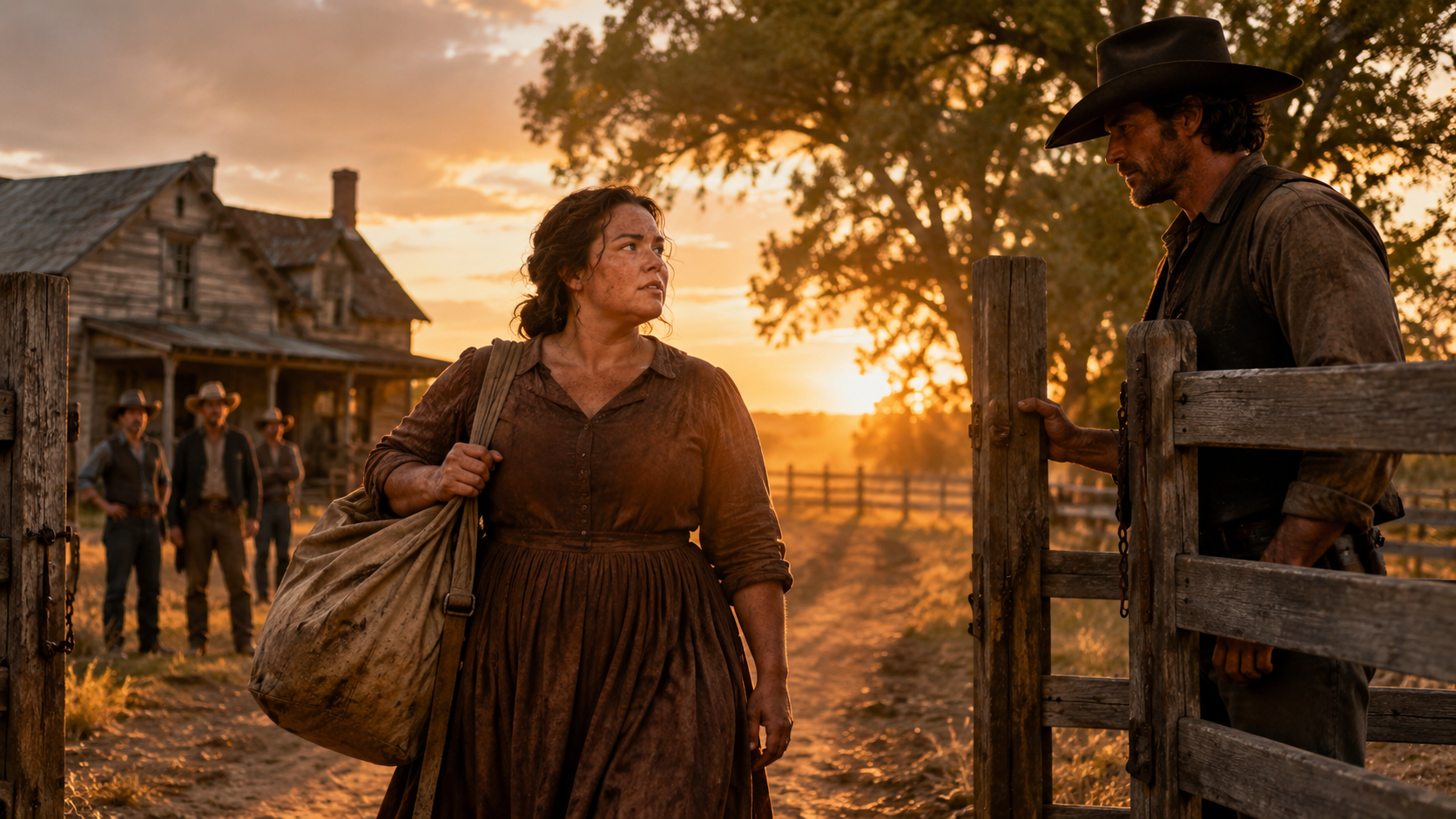
“They’ll never take her,” someone said from the shade of the livery stable.
“Take her?” another man laughed. “They’d need two wagons just to get her up the hill.”
Elsie Rowan heard every word.
She kept walking.
The road outside Hollow Bend shimmered with late-summer heat, and dust clung to the hem of her brown dress until it looked as if the earth itself had grabbed hold of her and tried to keep her back. Her boots were split at the sides. Her hands were raw from carrying a canvas bundle tied with rope. In that bundle were all the things Asa Crowe had not managed to steal: her mother’s recipe book, her father’s pocket watch that no longer ticked, a cracked blue teacup, and three letters she had never dared to read in daylight.
Behind her, the town watched.
It always watched.
Hollow Bend had watched when Asa Crowe rode to her father’s farm with a paper full of numbers and lies. It had watched when he told her the land was no longer hers. It had watched when he gave her one hour to leave the only home she had ever known. It had watched when she stepped off the porch with her bundle against her chest and a bruise blooming near her cheekbone from the doorframe she had been pushed through.
And when she passed the church wagon on the bridge, the preacher’s wife had looked down at her, lifted one gloved hand to her mouth, and whispered something to the woman beside her.
Neither of them offered a seat.
So Elsie walked.
At the edge of town, a boy from the livery called after her, “Black Creek Ranch is nine miles, Miss Rowan.”
“I know.”
“They don’t hire women out there.”
“They eat, don’t they?”
The boy did not answer.
A group of men near the feed store laughed, but the laugh sounded weaker than before. Elsie did not look back. Looking back was for people who expected someone to come after them.
No one came.
The sun rose higher. The road climbed through dry grass and sage. Twice she stopped to rest beneath thin trees that gave more shadow than comfort. Once a wagon passed her, and the driver looked away before she could lift her hand.
By the time the black fences of Black Creek Ranch appeared across the valley, Elsie’s mouth tasted of iron and dust. The house stood beyond a long lane lined with cottonwoods, its white paint weathered silver by wind and years. Behind it stretched barns, corrals, smokehouses, hay sheds, and a kitchen garden gone wild with neglect. It was not a grand place. It was something harder to build than grandeur.
It was a place that had survived grief.
A man at the gate saw her first. He was older, thin as a fence rail, with a gray mustache and eyes that missed little.
“You lost, ma’am?”
“No.”
“You looking for somebody?”
“Yes.”
“Who?”
“Mr. Gideon Hale.”
The man’s expression changed.
Not warm.
Not cold.
Careful.
“And what business do you have with Mr. Hale?”
“I want work.”
His gaze dropped to the bundle in her arms, then to her dusty boots, then quickly back to her face. That quickness told Elsie he had been taught manners late but had learned them well enough.
“What kind of work?”
“Kitchen work.”
The man scratched his chin. “Name?”
“Elsie Rowan.”
His eyes sharpened.
“Rowan?”
“My father was Thomas Rowan.”
“From the south ridge farm?”
“Yes.”
The old man breathed out through his nose. “Asa Crowe’s been busy, then.”
“He has.”
“And you walked here?”
“I didn’t fly.”
A sound came from somewhere behind the barn. A laugh, quickly swallowed.
The old man turned his head. “Caleb, if you’ve got enough air to snicker, you’ve got enough air to clean the tack room.”
A young ranch hand stepped into sight, red-faced and ashamed.
Elsie looked at him.
“Say it,” she said.
The young man blinked. “Ma’am?”
“Whatever you were laughing about. Say it where I can hear.”
His ears turned redder. “I didn’t mean anything.”
“That is rarely true.”
The old man covered a smile with the back of his hand.
Caleb lowered his eyes. “I just wondered if kitchen work would be too much.”
Elsie shifted the bundle higher against her chest.
“I buried my father in frozen ground with a shovel that had a cracked handle. I carried water for two years after our well rope broke. I cooked for men who thought hunger made them kings and grief made me their servant. A stove will not frighten me.”
The young man swallowed.
“No, ma’am.”
“What is your name?”
“Caleb Morris.”
“Then, Caleb Morris, when you wonder about a woman, start with what she has lived through before you measure what she looks like.”
The old man laughed then, full and loud.
“Mercy,” he said. “Black Creek needed that sentence ten years ago.”
Before Elsie could answer, the porch door opened.
Gideon Hale stepped out.
She knew him by silence before she knew him by sight. Every man near the yard straightened. Even the horses seemed to lower their heads. He was tall, lean, and broad through the shoulders, with black hair touched by early gray at the temples. His shirt sleeves were rolled to the elbows. He wore no fine coat, no polished boots, no gold watch chain. Nothing about him shouted wealth.
But authority rested on him like a weathered coat.
His face was not old, but sorrow had carved patient lines around his mouth. His eyes were a clear, cold blue, the kind of blue that made a person think of winter rivers and honest steel.
He came to the gate and stopped.
He looked at her face first.
Not at her size.
Not at the dust.
Not at the bruise.
Her face.
“Miss Rowan.”
“Mr. Hale.”
“Silas here says you’re asking for kitchen work.”
“If Silas heard me, then Silas is correct.”
The old man grinned. “She’s correct about other things too.”
Gideon did not look away from Elsie.
“Have you cooked for ranch hands before?”
“My father hired five men before the drought. Three after. One after that. Then none. I cooked anyway.”
“For who?”
“For my father. For myself. For neighbors too proud to ask and too hungry not to eat.”
Gideon’s jaw moved once.
“You walked from Hollow Bend?”
“Yes.”
“In this heat?”
“Yes.”
“With that bruise?”
Elsie’s fingers tightened on the bundle.
“The bruise didn’t ask permission to come with me.”
A flicker moved through his eyes. Anger, maybe. Not the kind that made noise. The kind that decided where it would stand.
“Water,” he said.
Silas was already moving.
Gideon opened the gate.
“Come in.”
Elsie did not move.
“I was not invited past the gate.”
“You are now.”
“On what terms?”
That earned the slightest lift of his brow.
“Work terms.”
“Then I’ll come in.”
She stepped onto Black Creek land, and something in her chest shifted. Not relief. Relief was too soft a word. It was more like the first breath after being held underwater by a hand you could not fight.
Silas returned with a dipper. Elsie drank slowly, though every part of her wanted to gulp. Her mother had taught her never to let desperation eat all her manners. When she finished, she handed the dipper back with both hands.
“Thank you.”
Gideon studied her.
“My wife ran this kitchen before she died,” he said. “She ran half the ranch too, though I was foolish enough at the time to believe I did. Since then, we’ve had six cooks. One left before breakfast. One burned beans so badly the pot still smells haunted. One cried whenever Silas spoke. One tried to make pudding with salt. One stole bacon and blamed coyotes. The last one married a stage driver and left us three recipes, all of them wrong.”
Silas sighed. “The pudding with salt was a dark week.”
Gideon continued, “I need a cook. But I do not hire a person because the town has been cruel to them.”
“I did not come selling cruelty.”
“No. You came asking for work.”
“Yes.”
His gaze moved toward the house.
“The pantry has flour, onions, potatoes, carrots, dried peaches, beans, eggs if the hens have kept their promises, and a ham shoulder. Twelve men eat in one hour. Feed them well, and you sleep in the cook’s room tonight. Tomorrow we speak wages. If the meal fails, I’ll drive you back to town myself and pay for a hotel room.”
Elsie looked at the house, then at the men pretending not to listen.
“So either way, I do not sleep on the road.”
“Either way.”
“And if they complain?”
Gideon glanced at the ranch hands.
“They may complain honestly. They may not be cruel.”
Elsie nodded once.
“Then we understand each other.”
She started toward the porch, then paused.
“Mr. Hale?”
“Yes?”
“I won’t need an hour.”
Silas chuckled.
Gideon tilted his head. “How long?”
“Forty minutes.”
The yard went quiet.
Gideon looked at her for one long breath.
“Forty, then.”
Elsie entered the kitchen and closed the door behind her.
The room was large, square, and tired. Copper pans hung dull above the stove. Flour sacks leaned open in the pantry. A long pine table stood in the middle, scarred by knives, mugs, elbows, and years of men sitting where a woman’s laughter used to be. Dust lay in the corners. The stove had a weak fire, more memory than flame.
Elsie set her bundle on a clean shelf.
Then she washed her hands.
The first rule of cooking, her mother used to say, was that panic had no place near flour. Panic made hard biscuits, sour faces, and foolish choices.
Elsie did not panic.
She fed the stove until the fire drew bright. She cut ham fat into a skillet and let it render. She peeled potatoes in fast, even strokes, boiled them, mashed them with milk and salt, then folded in fried onion until the smell filled the room like a promise. She rolled biscuit dough with a wine bottle because the rolling pin was missing. She made carrot gravy, sliced ham thin, stewed dried peaches with sugar and cream, and set coffee to boil strong enough to wake a judge from the grave.
At thirty-eight minutes, she opened the kitchen door.
“Supper.”
The men came in ready to judge.
They sat slowly. Gideon took the chair at the head of the table. Silas sat to his right. Caleb sat near the middle, looking at his plate as if it might accuse him first.
Elsie served without speaking.
Golden biscuits. Ham with crisp edges. Potatoes smooth and rich. Gravy dark with onion. Sweet peaches shining in cream.
No one spoke for the first minute.
Then Silas closed his eyes.
Caleb took a bite of biscuit and froze.
Another hand whispered, “Lord.”
Gideon ate three bites before he set down his fork.
Elsie stood near the stove, hands folded in her apron.
He looked at her.
“Do you cook like this every day?”
“No, sir.”
The men looked up.
Elsie said, “Some days I have better ingredients.”
Silas laughed so hard he coughed into his coffee.
Gideon’s mouth almost changed shape. Not quite a smile. But the possibility of one came into the room and stayed.
“We’ll discuss wages in the morning,” he said.
Elsie untied the apron and hung it on a peg slowly.
Like a woman who meant to use it again.
That night, she slept in a narrow room off the pantry. It held a bed, a washstand, one chair, and a window that looked toward the cottonwoods. More importantly, it had a door with a bolt.
Elsie stood for a long time staring at that bolt.
Safety, she had learned, was not a feeling.
It was a thing you could touch.
Before dawn, she was awake. By four-thirty, coffee boiled. By five, biscuits were in the oven. By five-thirty, Gideon entered the kitchen with his hat in his hand and shadows under his eyes.
“You sleep?”
“Some.”
“Room all right?”
“It has a door that closes.”
He looked at her over his coffee cup.
“That matters.”
“Yes.”
He sat at the table.
“Wages,” he said. “Eighteen dollars a month, board included.”
“Fourteen.”
He frowned. “I said eighteen.”
“I heard you.”
“Then why bargain down?”
“Because I came for work, not pity.”
His gaze sharpened.
“Miss Rowan, pity does not taste like those biscuits.”
“Neither does charity.”
For a moment, the kitchen was still.
Then Gideon nodded.
“Sixteen.”
“Fifteen.”
“Seventeen.”
“That is the wrong direction.”
“It is my direction.”
She nearly smiled despite herself.
“Fine. Seventeen. But I buy my own thread, soap, and writing paper.”
“You drive a hard bargain.”
“I have been driven hard. There is a difference.”
Silas entered just in time to hear that and muttered, “Black Creek has found itself a queen with a skillet.”
Elsie poured him coffee.
“Queens do not wash pans.”
“No,” Silas said, accepting the cup. “But the sensible ones know who does.”
By midmorning, the men had gone out, and Elsie was elbow-deep in dishes when someone knocked at the back door.
She did not open it.
A closed door was a question, her father used to say. A woman did not have to answer every question.
“Who is it?”
“Mrs. Adelaide Finch,” came a tight voice. “From the church committee.”
Elsie dried her hands slowly.
“What can I do for you, Mrs. Finch?”
“You may open the door, dear.”
“The door is doing well as it is.”
A silence.
“I came out of concern.”
“That must have been a long ride.”
“Miss Rowan, people are talking.”
“People often do when they have finished their own work too early.”
“You are an unmarried woman living under a widower’s roof.”
“I am a cook working in a kitchen.”
“That is not how it appears.”
“The truth has never needed help from appearances.”
Mrs. Finch’s voice hardened.
“Asa Crowe has filed a moral complaint against this ranch.”
Elsie’s fingers closed around the dish towel.
“What kind of complaint?”
“That Mr. Hale is sheltering a woman of questionable character.”
The words hit like dirt thrown into clean water.
Elsie breathed once.
“Mrs. Finch?”
“Yes?”
“You passed me yesterday on the bridge.”
No answer.
“Your wagon had an empty seat.”
“We were on church business.”
“You had room for mercy and chose not to carry it. Now you bring Asa Crowe’s gossip to my door and call it concern.”
“That is an ugly accusation.”
“No, ma’am. It is an accurate memory.”
Boots sounded on the porch.
Gideon’s voice came low and cold.
“Mrs. Finch.”
“Mr. Hale, I only came to warn—”
“Are you calling on my cook?”
“I am calling on decency.”
“Miss Rowan,” Gideon said, “do you want that door open?”
“No, sir.”
“Then it stays shut.”
Mrs. Finch inhaled sharply.
“The town will not approve of this arrangement.”
Gideon’s reply was quiet, but iron lived inside every word.
“The town did not sit beside my wife while fever took her breath. The town did not bring broth. The town did not wash sheets. The town did not hear her ask whether spring would come before she died. So the town may keep its approval for someone who needs it.”
For a moment, no one spoke.
Then the porch boards creaked as Mrs. Finch retreated.
Elsie waited until the wagon rolled away before she opened the door.
Gideon stood outside, hat in hand.
“You all right?”
“I’m angry.”
“That was not my question.”
“It is my answer.”
His eyes moved once to the mark on her cheek.
“Crowe works fast.”
“He has never believed in earning slowly what he can steal quickly.”
“He wants the complaint to poison trade. Labor. Credit. Reputation. By the time it fails, damage will have already eaten.”
Elsie understood.
“He wants your ranch weakened.”
“He wants Black Creek water.”
“And now I am the match he means to strike.”
Gideon put his hat back on.
“You are not leaving.”
“I did not ask.”
“You were thinking it.”
“I was considering whether removing the match might spare the barn.”
“If I let Asa Crowe choose who works in my kitchen, I deserve to lose every acre I own.”
She looked at him then, truly looked.
He was not merely kind. Pride stood in him, yes. Land. Name. House. Memory. But beneath that was something rarer.
Anger on behalf of someone else.
“All right,” she said. “I’ll stay.”
“Good.”
“But if trouble comes to your men—”
“My men are grown. They can decide before supper whether they are cowards.”
That evening, a boy delivered a letter.
Elsie opened it alone on the porch step.
Miss Rowan,
Your father’s outstanding debt remains unpaid. Deliver the Rowan recipe chest and all papers hidden inside it by Friday sunset, or my complaint against Black Creek Ranch will proceed. You know what your father signed. You know what the law will say.
A. Crowe
Elsie read it twice.
Then she folded it and put it in her pocket.
She served supper without a word. Beef stew. Corn cakes. Pickled beans. The men ate quietly, watching her the way people watch a darkening sky.
After dishes, she knocked on Gideon’s study door.
“Come in.”
He sat behind a desk covered in ledgers. Lamplight made his face look older.
Elsie placed the letter in front of him.
He read it once.
Then again.
“Recipe chest?”
“My mother’s.”
“What is in it?”
“Recipes.”
His eyes lifted.
“And?”
“Letters. Land records. A map of old wells. Maybe proof. Maybe nothing.”
“Where is it?”
“I won’t tell you.”
His expression changed.
“Because you distrust me?”
“Because if you do not know, no one can force you to say.”
For a long moment, only the lamp hissed.
Then Gideon leaned back.
“That is either wisdom or an insult.”
“It can be both.”
This time, the smile reached the corner of his mouth.
“Crowe forged your father’s debt?”
“Yes.”
“Can you prove it?”
“Not alone.”
“Then you are not alone.”
Elsie looked down at the letter.
“He took my farm. He used my father’s sickness against him. He made the town laugh while I walked with everything I owned in my arms. You may stand with me, Mr. Hale, but you will not stand in front of me.”
Gideon was silent for a long time.
Then he nodded once.
“Beside you, then.”
Help arrived the next morning wearing black lace gloves and an expression sharp enough to cut rope.
The carriage stopped in front of the kitchen door, and a small woman climbed down without waiting for assistance. She carried a leather case under one arm and a cane in the other, though she seemed more likely to strike the earth with it than lean on it.
Gideon stepped onto the porch.
“Mrs. Marietta Quill.”
The old woman ignored him and looked straight at Elsie.
“Thomas Rowan’s daughter.”
“Yes, ma’am.”
“Your mother once told me I had the warmth of a locked pantry.”
Elsie blinked.
“She said that?”
“In my own parlor.” Marietta sniffed. “I disliked her for five years. Then I realized she had been generous. I was worse than a locked pantry. At least a pantry contains something useful.”
Silas, standing behind Gideon, whispered, “I’ve missed her.”
Marietta opened her leather case and removed a stack of papers.
“Asa Crowe threatened your father outside my grain office nine years ago. I wrote down every word because I enjoyed collecting ugly truths about ugly men. I had the statement witnessed. I did nothing with it because I was comfortable, rich, and cowardly.”
Elsie’s throat tightened.
“Why bring it now?”
“Because Adelaide Finch came into my store yesterday and said she had passed you on the bridge and had not stopped. She said it as gossip. I heard it as judgment.”
Marietta placed the papers on the kitchen table.
“One sworn statement from me. One copy of the note Crowe claims your father signed. One confession from Peter Lyle, former clerk, admitting he copied your father’s mark after the stroke ruined his writing hand.”
Elsie sat down because her knees forgot their duty.
“Peter confessed?”
“He did. Apparently shame ages poorly when fed in secret.”
Gideon picked up the papers, reading with a face that hardened line by line.
Marietta looked at Elsie.
“Your mother and my sister worked together before both of them died. They knew Crowe was buying old water claims under false names. They suspected he meant to control every well, creek, and cattle route in the county.”
Elsie’s fingers went cold.
“My mother never told me.”
“She was protecting you.”
“She died with secrets.”
“She died with courage. There is a difference.”
The kitchen seemed to tilt around Elsie. Her mother’s recipe chest was no longer just a box of paper and memory. It was a locked room in the past, and Asa Crowe was already reaching for the key.
By noon the next day, Crowe came to Black Creek.
He arrived in a polished black buggy with two hired men behind him. He wore a cream-colored coat too clean for the road and a hat with a silver band. Asa Crowe had always dressed like a gentleman, which was how he fooled people who thought wickedness came in rags.
He expected Elsie hidden inside.
He expected Gideon angry and alone.
He expected the ranch hands nervous.
Instead, he found Elsie standing at the gate in a clean blue dress, her father’s broken watch pinned at her waist. Gideon stood beside her. Silas leaned near the fence. Caleb stood pale but steady. Marietta Quill sat on the porch with her lawyer and a cup of coffee she had criticized twice and refilled three times.
Crowe slowed his buggy.
“Miss Rowan,” he said. “I came for what is owed.”
“No,” Elsie replied. “You came early.”
His smile tightened.
Gideon said, “The debt note is forged.”
Crowe laughed.
“You have proof?”
Marietta rose from her chair.
“More than you will enjoy.”
Crowe saw her then.
Really saw her.
His confidence cracked.
“Marietta.”
“Asa.”
“You are interfering in private business.”
“I am correcting public rot.”
His jaw clenched.
“That woman owes me.”
Elsie stepped forward.
The hired men shifted.
“My father owed you nothing,” she said. “My mother owed you no fear. I owe you no silence.”
Crowe’s face flushed.
“You think cooking for a lonely rancher makes you respectable?”
Gideon moved slightly, but Elsie lifted one hand.
Not to stop him.
To claim the next words.
“Respectable?” she said. “You never wanted respectability. You wanted obedience dressed as law. You wanted my father ashamed, my mother erased, and me frightened enough to hand you the last thing in our house that you had not stolen. But my mother did not hide the recipe chest because it was valuable. She hid it because you believed women’s work was too small to matter. That is why you will lose, Mr. Crowe. You never knew where women kept the truth.”
For the first time, Asa Crowe had no answer.
Marietta’s lawyer cleared his throat.
“Mr. Crowe, sworn documents naming you in forgery and fraud will leave for the territorial court by sundown. If you wish to add intimidation in front of witnesses, please continue.”
Crowe looked from face to face.
There was no fear waiting for him.
Only people.
Together.
“This is not finished,” he said.
Elsie answered, “No. But you are.”
He turned his buggy sharply and drove away slowly because speed would have looked too much like defeat.
For one breath, Elsie stood still.
Then she turned to Gideon.
“Mr. Hale, breakfast is getting cold.”
She walked back to the kitchen and shook only after the door closed behind her.
But Asa Crowe was not a man who stopped when law stood in his path. He simply looked for a darker road.
Near sunset, Sheriff Jonah Vale rode to Black Creek alone. He stopped at the gate and removed his hat. He was a tired man with honest eyes and a weak mouth, and Elsie had learned weak men in public office could harm more people than cruel men in alleys.
“I came about the complaint,” he said.
Gideon’s voice cooled.
“You know it’s false.”
“Knowing and proving are different.”
Marietta stepped forward.
“Jonah Vale, do you remember the note Asa Crowe holds against your brother’s farm?”
The sheriff went pale.
“I do.”
“I purchased it yesterday. Your brother’s farm is clear if you tear that complaint and remember who that badge is meant to serve.”
The sheriff closed his eyes.
When he opened them, he pulled a folded complaint from his coat, tore it in half, then tore it again.
The pieces fell into the dust.
“I should have done this sooner,” he said.
“Yes,” Elsie replied. “You should have.”
Shame moved across his face.
“Your father once fed my family when my first child was born sick.”
Elsie reached into her pocket and removed her father’s broken watch.
“Then carry this until tomorrow. Feel how time stops when good men wait too long.”
The sheriff accepted it with both hands.
Then he looked toward the western ridge.
“Crowe is riding toward your old smokehouse.”
Elsie went still.
The recipe chest.
Gideon turned. “He found it?”
“I believe so. Two men with him. Tools in the wagon.”
Fear rose in Elsie hot and fast.
Beneath it came something stronger.
“No,” she said.
Gideon looked at her.
“No,” she repeated. “He does not get my mother’s box.”
Within minutes, six riders left Black Creek.
Elsie rode a chestnut mare Gideon warned had a wicked temper. The mare tested her once by sidestepping hard near the gate. Elsie leaned close and patted her neck.
“I walked nine miles in August with every fool in town watching,” she murmured. “You will have to do better than that.”
The mare settled.
They took the creek trail and came upon the Rowan smokehouse from behind the cedars.
Asa Crowe was on his knees inside, prying at the brick beneath the old curing hooks.
Elsie dismounted before Gideon could help.
“Take your hands off my mother’s floor.”
Crowe froze.
Slowly, he turned.
His coat was off. Sweat darkened his collar. Without witnesses he controlled, he looked smaller and meaner.
“Miss Rowan,” he said. “This property remains under lien.”
“The lien is forged.”
“You cannot prove—”
“We can,” Gideon said behind her. “Peter Lyle’s confession names you. Marietta Quill’s records show payment transfers. Sheriff Vale is riding here with deputies.”
Crowe’s hand twitched toward a pry bar.
Silas stepped forward with a coil of rope in his hand, not as a weapon but as a warning.
“Don’t make us drag dignity into this,” Silas said.
Crowe looked at Elsie.
Not Gideon.
Not Silas.
Her.
“You think you won?”
“No,” Elsie said. “I think my father is still dead. I think my mother died hiding proof because men like you taught the county to fear paper more than sin. I think families lost land because people with voices stayed quiet. Winning is too small a word for what should have been justice from the beginning.”
For the first time in years, Asa Crowe had nothing clever to say.
Sheriff Vale arrived with two deputies twenty minutes later. Crowe was arrested for forgery, fraud, intimidation, and trespass. His hired men surrendered without argument.
Elsie did not watch him leave.
She knelt inside the smokehouse and lifted the loosened bricks one by one. Beneath them sat a cedar chest wrapped in oilcloth.
Her mother’s chest.
Her hands trembled as she opened it.
Inside lay recipes written in three generations of women’s hands.
Molasses cake.
Pepper biscuits.
Chicken stew for fever days.
Wedding ham.
Funeral bread.
And beneath the recipes, tied with blue thread, were letters, copied deeds, well maps, payment lists, and a ledger of every false claim Asa Crowe had made across the county.
Gideon knelt beside her.
“There’s enough here to bury him.”
Elsie touched the papers.
“No,” she said softly. “Enough to unbury everyone else.”
The discovery cracked Hollow Bend open.
By Monday, Widow Clara Pike came from the north road with a statement about the pasture Crowe had taken after her husband died.
By Wednesday, a miner’s son arrived carrying a note with a forged signature.
By Friday, men and women who had whispered for years began walking through Black Creek’s gate.
Gideon’s dining room became a courthouse without a judge. Marietta’s lawyer took testimony at the long pine table. Sheriff Vale carried statements to town and returned with more. Silas kept coffee hot. Caleb carried wood, water, and apology in equal measure.
And Elsie cooked.
She cooked stew for widows who cried into their sleeves. She cooked biscuits for boys who had inherited debts that were never real. She cooked pies for women who had been called difficult because they remembered numbers better than men expected. She cooked coffee strong enough to keep Marietta Quill awake through depositions, though Marietta insisted sleep was an indulgence invented by lazy bones.
For four weeks, Black Creek Ranch smelled of flour, ink, justice, and fear slowly leaving people’s bodies.
Gideon guarded the kitchen doorway from those who thought grief gave them the right to crowd a woman. He carried water without being asked. He split wood before dawn. He said little.
But sometimes, when Elsie looked up from kneading dough, she found him standing near the door with his hat in his hands, watching her as if the sight of her had become part of the house he had not known he was missing.
The trial lasted six days.
Asa Crowe wore a dark suit and the calm expression of a man who had escaped consequences so many times he mistook luck for innocence.
Then Peter Lyle testified.
Then Marietta Quill testified.
Then Sheriff Vale placed Thomas Rowan’s broken watch on the judge’s bench and admitted, under oath, that he had delayed because he was afraid.
Finally, Elsie read her mother’s last letter aloud.
My sweet girl,
If you find this, then I have trusted silence too long, but never because I doubted you. I hid these papers where men would not look, among recipes, because men like Asa Crowe think kitchens are small places. Remember this: a kitchen is where hunger comes to be humbled. A table is where truth can sit down. Feed people if you can. Face them when you must. And never let any person convince you that taking up space is the same as taking what is not yours.
Elsie’s voice broke only once.
When the verdict came, it was not mercy.
Asa Crowe was sentenced to prison. His holdings were frozen. Fraudulent deeds were overturned. Water claims were returned. Families who had lost land began the long, imperfect work of claiming pieces of their lives again.
The Rowan farm was restored by court order.
Black Creek’s water rights were protected.
And Hollow Bend, which had spent years bowing politely before a thief, had to learn the awkward art of standing upright.
Autumn came gold and sharp.
One evening after the first frost silvered the fence rails, Gideon asked Elsie to walk with him beneath the cottonwoods.
She wore a blue shawl. He carried his hat in both hands.
“Miss Rowan,” he said.
“Mr. Hale.”
“I have been trying to say something for a month.”
“I know.”
He looked startled.
“You know?”
“You stand in the kitchen doorway like a man hoping bread will rise faster if he looks sorry enough.”
A laugh escaped him, low and surprised. It was the first full laugh she had heard from him.
Then he grew quiet.
“I hired you because I needed a cook,” he said. “But I opened my gate because you stood there tired, bruised, and proud enough to make shame look small. Since then, I have watched you feed the hungry, face the cruel, forgive slowly, speak plainly, and build a place where half this county found courage it had misplaced.”
Elsie looked toward the creek.
Gideon continued, “I loved my wife. I will always honor her. For years I thought honoring her meant leaving the house empty exactly as she left it. Then you walked into my kitchen and filled it with coffee, biscuits, argument, truth, and life.”
Her eyes burned.
He did not reach for her.
“I am asking whether, one day, when you are ready and not before, you might consider marrying me.”
Elsie closed one hand around the fence rail.
“Gideon.”
It was the first time she had used his given name.
He heard it. She knew he did.
“I will not say yes tonight.”
“I know.”
“I will take the winter. I will watch how you speak when cattle are thin and snow is mean. I will watch how you treat tired men, frightened women, stubborn horses, and bad news. I will watch whether kindness in you is a visitor or a resident.”
He nodded.
“Fair.”
“And in spring,” she said, “when the cottonwoods green, I will give you my answer.”
Gideon put his hat back on.
“I can wait for spring.”
Elsie looked at him and let herself smile.
“I believe your answer will be worth waiting for.”
Winter came hard.
Snow buried the fence lines. The men ate in the kitchen on the coldest nights. Marietta visited at Christmas with a goose and three opinions about stuffing, all of which Elsie listened to before making the stuffing her mother’s way. Marietta ate four helpings and pretended not to enjoy any of them.
Caleb Morris became the first to apologize properly.
He came to the kitchen one morning with his hat crushed in both hands.
“Miss Rowan,” he said, “I judged you before I knew you.”
“Yes.”
“I laughed because I was foolish.”
“Yes.”
“I’m sorry.”
Elsie handed him a tray of biscuits.
“Take these to Silas before they cool.”
He blinked.
“That’s all?”
“No. After that, scrub the pantry shelves.”
He smiled.
“Yes, ma’am.”
By February, the old Rowan farm had become a refuge for three families waiting on court papers. Elsie leased the pasture to Black Creek for one dollar a year and kept the smokehouse for herself. She told Widow Pike that a house once stolen should be lived in loudly.
In April, Mrs. Adelaide Finch came to the ranch.
She stood on the porch with a basket in her hands and shame written plainly across her face.
“Miss Rowan,” she said.
“Mrs. Finch.”
“I should have stopped the wagon on the bridge.”
“Yes,” Elsie said. “You should have.”
The woman’s eyes filled.
“I have spoken of mercy all my life. That day, I discovered I preferred mercy when it did not inconvenience me.”
Elsie let the truth sit between them.
Then she said, “You are here now.”
“That does not erase it.”
“No. But it begins something else.”
Mrs. Finch left flour, dried apples, and coffee in the basket. Elsie used the apples in pies the next day and sent one to the church with no note.
On the first Sunday in May, the cottonwoods opened their green leaves to the sun.
Elsie found Gideon by the porch rail.
She wore a clean blue dress. Her father’s broken watch, repaired at last, hung from a chain at her waist. Her mother’s recipe book rested on the kitchen table inside, open to a page titled Spring Bread.
Gideon saw her face and went very still.
“Mr. Hale,” she said.
His voice was quiet.
“Miss Rowan.”
“My answer is yes.”
They married in June in the front room of the Black Creek house.
Marietta Quill stood beside Elsie. Silas stood beside Gideon. Caleb wore a new shirt and ate enough cake to worry everyone. Widow Pike cried openly. Sheriff Vale came without his badge polished, because Elsie had told him shine was no substitute for courage.
It was not the grandest wedding the county had ever seen.
There were no chandeliers. No silk train. No orchestra. No polished carriage waiting outside.
There was only a ranch house full of people who had once looked away and now chose to see clearly.
They saw a strong woman in a blue dress standing beside a lonely cowboy who was lonely no longer.
They saw a repaired watch, a cedar recipe chest, and a kitchen door that opened to anyone hungry, frightened, ashamed, or brave enough to ask for help.
They saw Elsie Rowan Hale for what she had been all along.
Not a woman rescued.
Not a woman pitied.
Not a woman given a place.
A woman who had walked through heat, humiliation, grief, and fear with her mother’s recipes in her arms and her father’s courage in her bones, then built a home large enough for justice to sit down and eat.
For the rest of her long life, people in Hollow Bend told the story of the day Elsie Rowan came to Black Creek Ranch with dust on her dress and fire in her eyes.
Some told it as a love story.
Some told it as a courtroom story.
Some told it as the downfall of Asa Crowe.
But Gideon, when asked, always told it plainly.
“She came looking for work,” he would say from the head of the long pine table while Elsie laughed near the stove. “And the rest of us finally learned what work was.”
Then Elsie would set down biscuits hot enough to soften any hard heart, and the old cedar chest in the corner would catch the lamplight, shining not like treasure, but like truth finally brought home.

