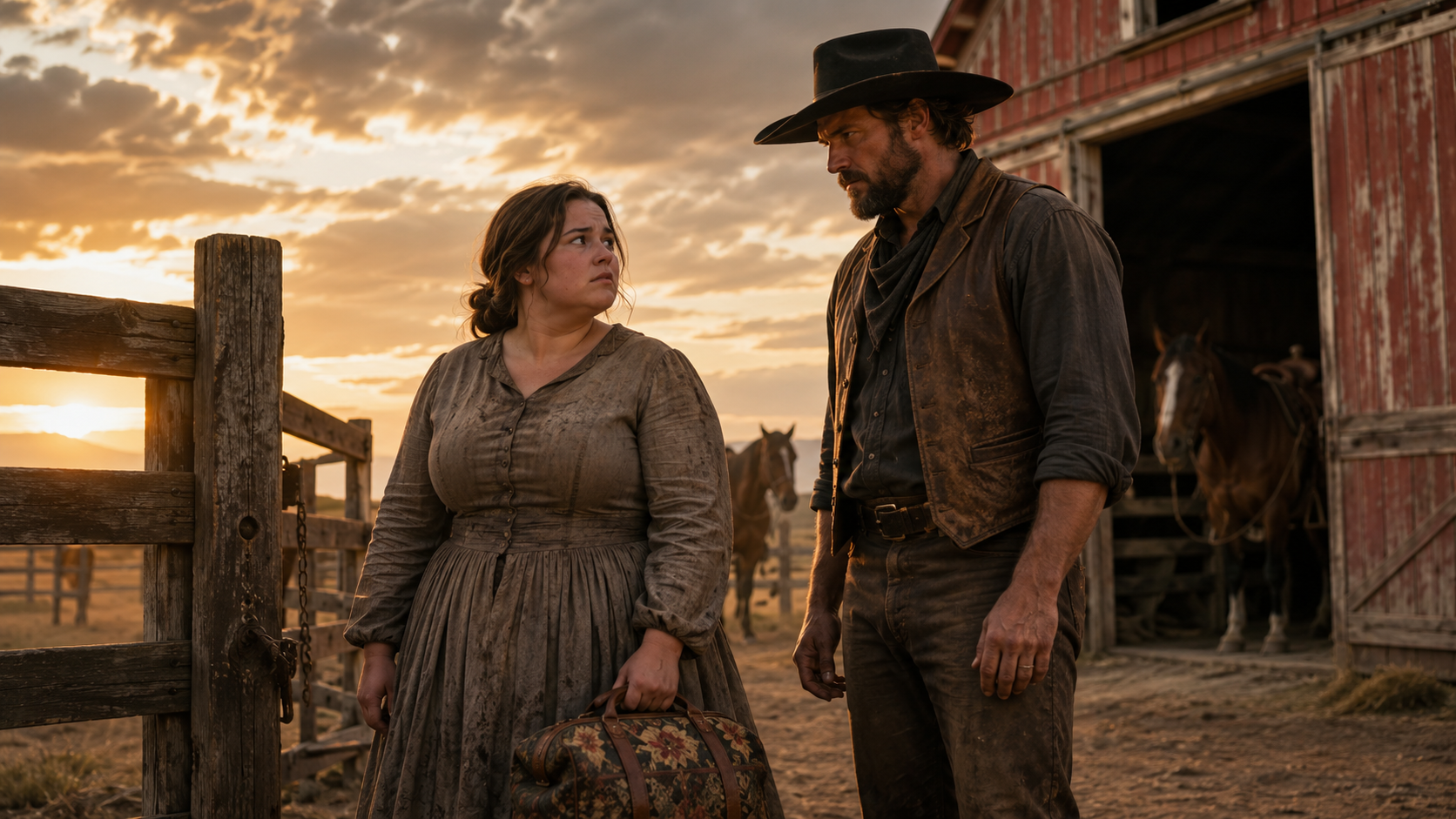
“Send the Big Girl to My Stable,” the Rancher Said… They Sent Her as a Cruel Joke, But He Refused to Hand Her Back

When Mara Ellison stepped down from the back of the supply wagon, every window on Mercy Row seemed to blink open at once.

The town of Dry Hollow was small enough to hear a kettle whistle three houses away and mean enough to turn that sound into gossip by supper. Dust sat on the porch rails. Flies circled the trough outside the livery. The church bell leaned crooked in its tower as if even God had grown tired of standing straight in that place.

Mara held her carpetbag with both hands and tried not to breathe too loudly.

That was one of the first things she had learned after her mother died: be quiet. Do not take the last biscuit. Do not ask why the other girls get ribbons while you get chores. Do not sit where chairs complain. Do not laugh too freely, because laughter from a woman shaped like you makes people look twice.

She had learned all of it from Mrs. Octavia Pruitt, who ran the boardinghouse with a Bible in the parlor and a ledger in her apron pocket. Mrs. Pruitt believed every girl owed the world rent simply for existing, and Mara, being larger than most, owed double.

“Stand up straight,” Mrs. Pruitt hissed from the porch of the boardinghouse. “You look like a sack of meal about to split.”

The girls behind her giggled.

There were four of them: Lottie Price with her yellow curls, Pearl Ames with her sharp little chin, Ruthie Vale with her pretty gloves, and Nell Ward, who laughed whenever the others did because she was afraid not to. They had been standing there since sunrise, waiting for Mara to return from delivering mended sheets to the hotel.

Mara knew that waiting look.

Something had been planned.

Mrs. Pruitt descended the porch steps, her black dress swishing around her ankles. She carried a folded paper between two fingers.

“Mara,” she said, falsely sweet, “you’ve been asked for.”

Mara’s fingers tightened around her carpetbag. “Asked for?”

Lottie covered her smile with one hand.

Mrs. Pruitt unfolded the paper with the solemn pride of a judge reading a sentence. “Mr. Gideon Ash of Broken Spur Ranch sent word that he needs help in his stable.”

The girls burst into bright, delighted laughter.

Mara did not understand at first. Broken Spur Ranch lay five miles beyond the north ridge, past the creek bed and the old burned mill. Gideon Ash owned it. Everyone knew that. Everyone also knew he was the last man a decent woman approached without a reason and the first man a foolish one feared.

They called him Ash the Hammer because he had once broken a man’s wrist against a saloon bar for striking a horse. They said he slept with a rifle across his lap. They said his father had been worse than a wolf and his son had inherited the teeth. They said his ranch hands never lasted and that animals obeyed him because they recognized another beast.

Mara had never seen him up close.

She had seen him once from the mercantile doorway, a tall man in a black hat loading grain sacks into a wagon, his face hidden beneath the brim, his shoulders broad enough to look carved from timber. People had stepped aside for him without being asked. Even the sheriff had nodded first.

Mrs. Pruitt’s mouth thinned with satisfaction. “He told the stable boy, ‘Send me someone strong. Send the big girl if she wants wages.’”

Pearl laughed so hard she nearly dropped her parasol.

“The big girl,” Ruthie repeated, sweet as poison.

Mara’s face burned.

“I have laundry to finish,” Mara said.

“You have an opportunity,” Mrs. Pruitt corrected. “Unless you believe yourself too fine for honest work.”

The girls giggled again.

Mara looked from one face to another and understood the shape of the trap. Gideon Ash had not asked for her by name. Maybe he had asked for a worker. Maybe he had not asked for anyone at all. It did not matter. Mrs. Pruitt was sending Mara because it amused them to imagine her walking into that man’s yard, frightened and sweating, only to be shouted back to town.

“Will he pay?” Mara asked.

The question silenced them for one breath.

Mrs. Pruitt’s smile sharpened. “If you manage not to offend him.”

Mara swallowed. “And if I don’t go?”

“Then you can collect your things from the attic before dark.”

There it was.

The door beneath the joke.

Mara had lived at Pruitt House for nearly two years, working in exchange for half her board and owing the other half no matter how many floors she scrubbed. She had no family left. Her mother had died in spring rain, coughing blood into a handkerchief she kept trying to hide. Her father had left before Mara could remember the sound of his boots. There was no aunt, no cousin, no husband, no savings.

Only the attic cot and the girls’ laughter below it.

So Mara took the folded paper, though she could not read Mrs. Pruitt’s cramped handwriting well enough to know what it truly said.

“When should I go?”

“Now,” Mrs. Pruitt said. “Best get there before he changes his mind.”

Lottie stepped forward and pressed an old bonnet into Mara’s hands. It was faded brown with one crushed side. “Wear this. The sun is cruel to delicate things.”

Another burst of laughter.

Mara did not answer. She tied the bonnet under her chin, picked up her carpetbag though she did not need it for stable work, and started north.

She heard them behind her.

“Ask him if he keeps a stall big enough!”

“Maybe he wants a mule, not a maid!”

“Careful, Mara. If he feeds you, he’ll never get rid of you.”

Mara kept walking.

The road out of Dry Hollow climbed in long pale curves through sagebrush and brittle grass. Every step lifted dust around her skirts. The sun rose higher, burning the back of her neck. By the second mile, sweat ran beneath her collar. By the third, her thighs ached. By the fourth, she had begun to wonder whether Mrs. Pruitt had invented the entire message and sent her toward humiliation for sport.

Then Broken Spur Ranch appeared beyond a line of wind-bent cottonwoods.

It was not the ruin she expected.

The house was old, yes, with weathered boards and a porch that sagged on one end, but the fences were mended. The water troughs were full. A vegetable patch grew beside the kitchen. The barn stood wide and red against the low hills, one door hanging crooked, the other open like a dark mouth.

A man was working near the corral, driving a post into the ground with slow, punishing swings of a sledgehammer.

Mara stopped at the gate.

The man did not look up.

She could turn around. She could walk back and say no one answered. She could sleep behind the church if Mrs. Pruitt meant what she said. She could pretend she still had choices.

The hammer fell again.

Mara lifted the latch.

It squealed.

The man turned.

Gideon Ash was not handsome in the way shop windows made men handsome. His face was too severe, his nose once broken, his jaw dark with stubble. A scar cut through his left eyebrow, pale against sun-browned skin. His eyes were gray, cold at first glance, but not empty.

They moved over Mara once.

Not the way men in town looked at her.

Not measuring. Not mocking. Not licking cruelty from the corners of their mouths.

He looked at her the way a man looks at a storm cloud and decides whether it carries rain or lightning.

“Who sent you?” he asked.

His voice was low. Rough. Unwelcoming.

Mara gripped the paper. “Mrs. Pruitt. From the boardinghouse.”

Something changed in his expression.

Not surprise.

Recognition.

“Of course,” he muttered.

Mara’s stomach dropped.

He knew.

One look and he knew she had been sent as a joke.

“I can work,” she said quickly. “I know I don’t look like—”

“I didn’t ask what you look like.”

The words struck the yard clean.

Mara stopped.

Gideon leaned the sledgehammer against the post. “I asked who sent you.”

She stared at him.

He was angry. That much was plain. But the anger did not seem aimed at her, and that unsettled her more than contempt would have.

“They thought it would be funny,” she admitted.

His jaw tightened.

“For you,” he asked, “or for me?”

Mara had no answer.

The wind dragged dust between them. Somewhere in the barn, a horse stamped hard enough to rattle boards.

Gideon looked past her toward the road to town. Then he opened the gate wider.

“Stable’s through there,” he said. “Broom hangs on the right. Forks are on the wall. Don’t go near the roan mare in the back stall unless I’m with you. She bites first and regrets nothing.”

Mara blinked. “You’re letting me work?”

“I’m letting you decide whether they get the laugh they wanted.” He picked up the sledgehammer. “And one more thing.”

“Yes, sir?”

His eyes narrowed slightly at the word.

“Don’t ‘sir’ me like you’re begging not to be hit. My name is Gideon. If you work here, you work standing up. You don’t fold yourself smaller to make fools comfortable.”

Mara’s throat tightened.

No one had ever accused her of making herself smaller.

Everyone else accused her of being too much.

Too wide for the aisle. Too heavy for the stairs. Too hungry. Too slow. Too visible. Too plain to be proud and too large to be pitied prettily.

She stepped into the yard.

The stable smelled of hay, leather, dust, and old neglect. Saddles lay slumped over rails. Harness straps tangled like dead snakes. Feed sacks had been chewed open by mice. The center aisle was clotted with straw, mud, and forgotten tools. Sunlight poured through cracks in the boards, turning every drifting speck into gold.

Mara stood in the doorway and looked at the work.

Then she took off the ridiculous bonnet.

She hung it on a nail, found the broom, and began.

At first, every sound made her flinch: Gideon’s hammer outside, the roan mare’s kick, the creak of rafters, the sudden snort of a gelding watching from his stall. Dust rose into her face and made her cough until her eyes watered. Her palms softened, then burned, then split. Sweat ran down her spine. Hay clung to her sleeves.

But work had one mercy that people did not.

Work did not laugh.

Work asked only to be done.

Mara cleared the aisle. She stacked usable wood near the wall and carried rotten boards to a burn pile. She sorted tools by purpose because her mother had once told her that order was what a tired soul could give the world when it had nothing else. She untangled harness, shook out blankets, swept old grain from the corners, scrubbed the troughs, and opened both doors to pull air through the stale heat.

Once, near noon, she paused to press her aching hand against her side and saw Gideon standing outside the stable door.

She straightened at once.

He said nothing.

Then he set a tin cup and a bucket of fresh water on a crate.

“Drink,” he said.

“I’m not finished.”

“I didn’t say retire. I said drink.”

She drank.

The water was cold enough to hurt her teeth.

It tasted like kindness, and that nearly made her cry.

By sunset, the stable no longer looked abandoned. It looked tired but breathing. The floor was clear. The tack wall made sense. The feed sacks were sealed in bins. The horses could look out without cobwebs hanging over their eyes.

Mara stood in the doorway, her arms trembling.

Gideon entered with a lantern.

The light made his scar sharper and his eyes less hard. He walked the aisle slowly, inspecting the pegs, the bins, the swept corners, the fresh straw.

Mara braced herself.

At Pruitt House, finished work only meant someone had found the next thing to criticize.

Gideon ran two fingers along the top rail of a stall, looked at them, and said, “Clean.”

Mara’s breath caught.

“I tried to—”

“You did.”

Two words.

Only two.

But they landed inside her like bread in an empty stomach.

She turned away quickly, pretending to coil a rope.

Gideon noticed anyway.

“You not used to hearing that?”

Mara gave a small laugh. It broke in the middle. “No.”

He was quiet for a long time.

“Come back tomorrow,” he said.

She turned. “You mean it?”

“I don’t decorate lies.”

“What about Mrs. Pruitt? She’ll expect—”

“She doesn’t run my ranch.”

Mara looked toward the road. The hills had turned purple. The first stars trembled above the ridge. She should have been afraid to walk back alone.

But for the first time in many months, she was more afraid of where she was returning than where she had been.

When Mara entered the boardinghouse kitchen that night, the girls fell silent.

Then Lottie began to clap slowly.

“Well,” she said, “the beast didn’t eat her.”

Pearl leaned back in her chair. “Maybe he hired her to scare away wolves.”

Ruthie smiled over her teacup. “Or maybe he likes his help sturdy.”

Mara kept walking.

That was new.

Usually she stopped. Usually she blushed. Usually she tried to offer them the apology they wanted without knowing what she had done wrong.

Tonight, her feet hurt too badly and her hands burned too fiercely to perform shame for anyone.

Mrs. Pruitt appeared at the foot of the attic stairs. “Where is the money?”

“He pays at week’s end.”

“Convenient.”

“He asked me back tomorrow.”

The kitchen changed.

Lottie’s smile faltered first.

Ruthie’s teacup paused halfway to her mouth.

Mrs. Pruitt’s eyes narrowed. “Did he?”

“Yes.”

“And what did you do for him?”

Mara met her gaze.

“I worked.”

The word sounded plain.

It also sounded like a door closing.

Mara climbed to the attic, lay down on her narrow cot, and stared into the dark while her body throbbed. Below, the girls whispered. Someone laughed once, then went quiet.

She closed her eyes.

Clean.

You did.

She held the words in her hands until sleep came.

The days that followed did not become easy. Nothing at Broken Spur was easy.

Gideon expected work to begin before sunrise and did not appear to understand the meaning of “almost finished.” He pointed with his chin more often than his hand. He spoke little, praised less, and never asked Mara to do anything he had not already done himself.

But he was fair.

If she lifted wrong, he showed her how to turn her shoulder. If she dropped a bucket, he waited until she picked it up. If she was too proud to admit a sack was too heavy, he took one end without comment and said, “Weight shared is not weakness.”

On the second morning, a pair of leather gloves waited on the fence post.

Mara stared at them.

Gideon passed with a coil of rope over his shoulder. “Your palms are torn.”

“I didn’t complain.”

“I didn’t accuse you.”

On the third morning, a plate of eggs and biscuits sat on the porch rail.

“I already ate,” Mara lied.

Her stomach growled so loudly that a horse lifted its head.

Gideon looked at her. “Your belly has more honor than your mouth.”

To her own surprise, Mara laughed.

It came out rusty.

Gideon looked startled by the sound, then looked away as if he had not heard it.

On the fourth day, the roan mare kicked the back wall so hard dust fell from the rafters.

Mara dropped the brush she was holding.

Gideon moved fast, but not toward Mara. He went to the mare’s stall, his voice low and steady.

“Easy, Juniper. Nobody’s taking anything from you.”

The mare’s ears flattened. Foam marked the bit scars near her mouth though she wore no bit now.

Mara watched from the aisle.

“She thinks hands mean pain,” Mara said softly.

Gideon glanced back.

“She was beaten before I bought her.”

Mara looked at the mare. The animal’s sides heaved. Her eyes rolled white, not with wickedness but with memory.

“So were you,” Mara said.

The stable went silent.

The moment the words left her mouth, she wished she could snatch them back.

Gideon’s face closed like a slammed shutter.

“I’m sorry,” Mara whispered. “That was not my place.”

“No,” he said.

Just that.

Then he turned back to the mare.

For the rest of the morning, he barely spoke.

Mara worked with a stone in her stomach. She had ruined it. Of course she had. People like her were always one wrong word away from losing shelter.

Near noon, she carried a feed sack into the storage room and found Gideon standing there, staring at a cracked shelf.

“My father believed fear made good workers,” he said.

Mara stopped.

He did not look at her.

“He was wrong. Fear makes quiet workers. Not good ones.”

The sack slipped slightly in Mara’s arms.

Gideon took it from her and set it on the floor.

“He broke horses, men, furniture, promises. Anything that resisted him.” His mouth tightened. “My mother used to say there was a tender man buried somewhere under the rage. She spent her life digging and found nothing but more stone.”

Mara said nothing.

“My father died in that yard,” Gideon continued. “Heart gave out while he was screaming at a boy for spilling nails. Town buried him and decided the son must be the same devil wearing newer boots.”

“Are you?” Mara asked.

His eyes cut to hers.

It was a reckless question. A foolish one.

But Mara was tired of fearing questions more than answers.

Gideon held her gaze.

“No,” he said at last. “But some days I hear him in my own voice, and that scares me worse than any gossip.”

Mara looked at the repaired shelf, the straight nails, the patient work.

“Maybe people keep looking at the hammer,” she said. “They miss what you mend.”

He stared at her as if she had spoken in a language he once knew and had almost forgotten.

Then he picked up the feed sack.

“Back to work,” he said.

But his voice was gentler.

On Friday, the joke came riding out from town.

Mara was at the pump rinsing buckets when she heard laughter on the road. She did not need to turn. She knew the sound the way a dog knows thunder.

Lottie, Pearl, Ruthie, and Nell stood at the gate in bright dresses, pretending they had come for a walk. Lottie held a parasol. Pearl carried a paper packet of sweets. Ruthie wore a ribbon Mara had once admired in the mercantile window.

“Well, well,” Lottie called. “So this is where you’ve been hiding.”

“I’m working,” Mara said.

The words came out smaller than she wanted.

Pearl leaned against the gate. “Working? Is that what he calls it?”

The others laughed.

Mara’s face burned.

Ruthie’s gaze traveled over Mara’s dusty dress, damp collar, and gloved hands. “You know what people are saying, don’t you? They say Mr. Ash took pity on you because no one else would.”

Pearl giggled. “Or maybe he likes them big enough to block the wind.”

Mara turned back to the bucket.

Water sloshed over her boots because her hands were shaking.

Then the stable door slammed.

Gideon crossed the yard.

The girls’ laughter thinned.

Lottie straightened and smiled too brightly. “Good afternoon, Mr. Ash. We were only checking on our dear friend.”

“She is busy.”

“We can see that.”

Gideon stopped at the gate. He did not raise his voice.

That made the air colder.

“Leave.”

Pearl blinked. “No need to be rude.”

“You came to my land to mock a woman doing honest work. Rude was where you started. I am offering you the chance to leave before you reach stupid.”

Nell went pale.

Lottie lifted her chin. “You don’t frighten me.”

Gideon leaned one hand on the gate. “Then your education has been neglected.”

The smile slipped from Lottie’s face.

The girls left.

Mara kept her back turned until their footsteps faded. She expected Gideon to tell her to toughen up, to say that tears were useless, to remind her that the world was cruel and she had better grow hide.

Instead, he stood beside her at the pump.

“You hurt?”

She shook her head.

Her eyes betrayed her.

“I hate that I care,” she whispered.

“About what they say?”

“About what everyone says.”

The pump handle creaked in the wind.

Gideon looked down the road. “I used to think not caring made a man strong.”

Mara wiped her cheek with her sleeve. “Doesn’t it?”

“No.” He glanced at her. “Sometimes it only makes him empty.”

“What makes a person strong, then?”

He thought about it.

“Staying kind without handing cruel people the knife.”

That evening, when Mara returned to Pruitt House, her attic bed had been stripped bare.

Her blanket lay folded in the hall. Her carpetbag sat beside it. The little tin box that held her mother’s thimble was balanced on top like an insult.

Mrs. Pruitt waited beneath the lamp.

“You are no longer welcome here.”

Mara’s mouth went dry. “Because I work for him?”

“Because you have become a source of talk.”

“The talk came from your girls.”

“My girls know how to behave.”

Mara looked past her.

Lottie stood in the parlor doorway with Mara’s blue hair ribbon looped around one finger.

Mara’s chest tightened. “Give that back.”

Lottie glanced down. “This?”

“It was my mother’s.”

“Then your mother had plain taste.”

Something inside Mara changed.

Not loudly.

Not like a door bursting open.

More like a rope, pulled thread by thread for years, finally snapping.

She walked forward.

Lottie’s smile vanished as Mara took the ribbon from her hand.

No grabbing. No shouting.

Just taking back what was hers.

Mara turned to Mrs. Pruitt. “I will pay what I owe when Mr. Ash pays me. Not a penny more. Not a prayer less.”

Mrs. Pruitt’s mouth opened.

Mara picked up her carpetbag.

For once, she left before anyone dismissed her.

The road to Broken Spur was darker than she expected. The moon hid behind clouds. Coyotes called beyond the creek bed. Every shrub looked like something crouched. Her feet blistered. Her stomach was empty. Twice she stopped and nearly turned back, not because she wanted Pruitt House, but because misery was familiar and freedom had no lamp.

Then she saw one.

A lantern burned at the Broken Spur gate.

Gideon stood beside it with a rifle in one hand.

He lowered the gun when he saw her.

“Mara?”

She tried to answer but could not.

His eyes moved to the carpetbag.

Understanding entered his face.

“She threw you out.”

Mara nodded.

For one terrible moment, she waited for him to sigh, to tell her that was not his concern, to say he had only hired her for stable work and could not invite scandal under his roof.

Instead, Gideon opened the gate.

“There’s a room off the kitchen,” he said. “Used to be my mother’s sewing room. Bed is small. Roof is honest.”

Mara stared. “I cannot stay in your house. People will talk.”

“People already talk.”

“I don’t want to damage your name.”

A humorless smile touched his mouth. “Mara, my name was dragged through mud before you set foot on this road.”

“That doesn’t make it right.”

“No,” he said. “It doesn’t.”

The simplicity of that answer nearly undid her.

He carried her carpetbag inside.

The room off the kitchen smelled faintly of cedar and lavender. A narrow bed stood beneath a small window. A washstand held a cracked pitcher. On the wall hung a framed piece of embroidery: Mercy is not weakness.

Mara touched the stitches.

“My mother made that,” Gideon said from the doorway.

“She believed it?”

“She tried to.”

Mara looked at him.

He nodded toward the door. “There’s a bolt inside.”

“I trust you.”

The words surprised them both.

Gideon’s throat moved. “You shouldn’t trust easy.”

“I don’t,” Mara said. “That is why it matters.”

He looked away first.

“Good night, Mara.”

“Good night, Gideon.”

It was the first time she had used his name without fear.

He paused as if the sound had touched a bruise.

Then he left.

Mara slept better than she had in years.

Not because the bed was soft.

It wasn’t.

Because no one laughed beneath her floor.

The next weeks made a life out of routine.

Mara rose early, tied her hair back with her mother’s blue ribbon, and worked until the sun turned the hills white. She cleaned stalls, mended blankets, washed tack, learned which horse liked apples and which one pretended to bite for sport. Gideon taught her how to judge hay, how to read a hoof crack, how to stand near a nervous animal without crowding it.

At night, they sat at opposite ends of the kitchen table.

At first, Gideon cleaned tack or repaired harness while Mara darned her stockings. Then one evening she noticed his account ledger lying open and frowned.

“These numbers don’t match,” she said.

Gideon looked up. “They do.”

“They don’t.”

“My books are fine.”

“Your handwriting looks like a spider drowned in ink, but that is not the issue.”

His mouth twitched.

Mara turned the ledger toward him. “You sold thirty head to Silas Creed in April.”

“I did.”

“The payment here is for twenty-four.”

“Creed said six came in light.”

“Were they light?”

“No.”

“Then he cheated you.”

Gideon leaned over the page. His shoulder came close enough that Mara smelled soap, leather, and smoke.

She pointed to another line. “Again in May. And here, with feed delivery. You paid for twelve sacks and received nine.”

His expression hardened.

“Creed handles half the ranch trade in this county,” he said.

“Then he is either careless with many men’s money or careful with stealing yours.”

Gideon stared at the ledger.

Mara felt suddenly foolish. “I only meant—”

“You can read figures?”

“My mother taught me. She kept books for a milliner before she married.”

“Mrs. Pruitt knew?”

“She said numbers make women proud.”

“Numbers make thieves nervous,” Gideon said.

The next morning, he placed three more ledgers on the kitchen table.

“Look through these.”

Mara blinked. “What about the stable?”

“It will wait.”

“Horses don’t usually agree to that.”

“I’ll handle them.”

She looked down at the books, then back at him. “You trust me with your accounts?”

“I trust what you notice.”

That trust became its own kind of wage.

For three days, Mara worked through the ledgers. She found missing cattle, false weights, inflated feed bills, and a pattern that led again and again to Silas Creed, the wealthiest trader in Dry Hollow and Ruthie Vale’s uncle.

Silas owned the feed store, the auction pens, and two-thirds of the sheriff’s courage.

On the fourth night, Mara made a list.

Gideon read it in silence.

When he finished, he put both hands on the table and bowed his head.

“How much?” she asked.

“Enough to break me by winter if it continues.”

Mara’s heart squeezed. “Can you prove it?”

“With your list, maybe.”

“Then we take it to the sheriff.”

Gideon laughed once. “Sheriff Hobb eats dinner at Creed’s table every Sunday.”

“Then we take it to the church elders.”

“Creed paid for the new bell.”

Mara looked at him. “Then who is left?”

Gideon’s gaze lifted to hers.

“Town meeting is Saturday.”

Saturday arrived hot and bright.

Mara wore her cleanest dress, the brown one with a mended cuff. She tied her mother’s ribbon at the back of her neck. Gideon hitched the wagon without speaking much. He had shaved. The scar through his eyebrow looked sharper for it.

“You do not have to come,” he said as she climbed onto the seat.

“Yes, I do.”

“They will talk.”

“They have had enough practice.”

His eyes moved over her face. “If it turns ugly, you leave.”

“If it turns ugly, I speak louder.”

For a moment, he almost smiled.

Dry Hollow’s meeting hall was packed when they arrived. Fans fluttered. Boots scraped. The smell of dust, sweat, and perfume filled the room. Mrs. Pruitt sat in front with the boardinghouse girls arranged around her like flowers in a vase. Lottie saw Mara first and whispered something that made Pearl turn.

Ruthie Vale’s smile vanished when she saw the ledgers in Mara’s arms.

Silas Creed stood near the front, a round man in a cream waistcoat, his silver watch chain shining across his belly. Sheriff Hobb leaned beside him, laughing too loudly.

The laughter stopped when Gideon entered.

Silas spread his hands. “Well now. Broken Spur honors us.”

Gideon walked to the front.

Mara followed.

A murmur moved through the hall.

Mrs. Pruitt’s eyes narrowed at Mara’s dress, her ribbon, her lifted chin.

Gideon placed the ledgers on the table.

“I’m here about theft.”

Sheriff Hobb straightened. “Careful with accusations.”

“I am careful with evidence.”

Silas chuckled. “Evidence? From you?”

“No,” Gideon said. “From her.”

Every face turned to Mara.

For one awful second, her body remembered every insult at once. Big girl. Mule. Beast. Too much. Not enough. She felt her hands dampen around the papers.

Then Gideon’s voice came quietly beside her.

“Stand up.”

Not a command to make her smaller.

A reminder.

Mara lifted the first page.

“The March cattle sale from Broken Spur to Mr. Creed recorded thirty head delivered,” she said. “Payment was issued for twenty-four. The auction ledger shows all thirty resold two days later.”

Silas’s smile faded.

Mara turned the page. “In April, Mr. Ash paid for twelve sacks of feed. Delivery receipt shows nine. The store ledger, which Mr. Creed’s clerk left unsigned but dated, shows the missing three charged again to Porter Ranch.”

The room stirred.

Silas’s face reddened. “Where did you get store ledgers?”

“From your clerk,” Mara said. “He came to Broken Spur last night because he is tired of being blamed for numbers he did not alter.”

Sheriff Hobb looked at Silas.

Silas pointed at Mara. “This is ridiculous. Since when do we let stable girls accuse businessmen?”

Mara’s pulse hammered.

“Since businessmen forgot stable girls can count.”

A sound passed through the room.

Not laughter.

Something better.

Attention.

Mrs. Pruitt stood. “This girl is ungrateful, dishonest, and easily led. I took her in out of charity.”

Mara looked at her.

The old fear rose.

Then it met something stronger.

“You took my labor,” Mara said. “You took my rent. You took my mother’s thimble until I paid for soup you said was charity. But you did not take me in. You kept me down.”

Mrs. Pruitt gasped.

Lottie stared at the floor.

Nell began to cry silently.

Silas slammed a hand on the table. “Enough! Are we truly listening to a woman Gideon Ash keeps in his house?”

The hall went dead still.

There it was.

The dirtiest weapon, polished and ready.

Mara felt the words strike, but before shame could close around her, Gideon stepped forward.

“I keep her employed,” he said. “I keep her paid. I keep her safe from people who mistake cruelty for respectability. If that stains my name, then my name was too clean for this town.”

Silas sneered. “Touching.”

Gideon leaned closer. “But not as touching as your signature on every false weight slip.”

Mara laid the slips out one by one.

The clerk stood from the back of the hall, pale and shaking. “It’s true.”

Silas turned on him. “Sit down.”

The young man swallowed. “No.”

That one word changed the room.

Others began speaking. A rancher from the east ridge shouted that his feed deliveries had been short too. A widow stood and said Creed had taken two calves for debt she never owed. A blacksmith produced a receipt. A farmer demanded the sheriff look at the papers.

Sheriff Hobb, seeing courage become fashionable, cleared his throat and reached for the ledgers.

Silas Creed was not arrested that day.

Power rarely falls in one clean blow.

But by sunset, he was no longer untouchable.

By Monday, three ranchers had pulled their business from his store. By Wednesday, the county judge sent for records. By Friday, Sheriff Hobb remembered where his spine had been stored and opened an inquiry.

And by the next market day, everyone in Dry Hollow knew that the big girl from Pruitt House had found the numbers that broke Silas Creed’s smile.

The change did not make the town kind.

Towns do not become kind overnight.

But people began nodding to Mara. Some awkwardly. Some with guilt. Some because they wanted Gideon’s business. She accepted none of it too quickly.

Mrs. Pruitt avoided her on the street.

Lottie crossed to the other side once, then stopped, turned back, and muttered, “I shouldn’t have said those things.”

Mara looked at her for a long moment.

“No,” she said. “You shouldn’t have.”

Lottie waited.

Mara did not offer comfort for guilt that was not hers to carry.

At Broken Spur, life continued.

The stable stayed clean. The roan mare Juniper began allowing Mara to stand near her stall. Then to touch her neck. Then, one golden evening, to brush her mane.

Gideon watched from the doorway.

“She likes you,” he said.

“She trusts slowly.”

“Smart horse.”

Mara smiled.

He stepped into the stable, holding an envelope.

“What is that?”

“Your wages.”

“It is not Saturday.”

“This is not wages for stable work.”

Mara opened the envelope and stared at the bills inside.

“Gideon, this is too much.”

“No. It is late.”

“For what?”

“Bookkeeping. Investigation. Saving my ranch from a thief.”

“I was helping.”

“You were working.”

She looked up. “You keep making those sound like the same thing.”

“They are.”

Her fingers tightened around the envelope.

No one had ever paid her for what her mind could do.

Gideon shifted, suddenly less certain than he looked when facing angry men. “There is something else.”

Mara waited.

“I want to offer you a position.”

“I have one.”

“A real one.”

She lifted an eyebrow. “The manure has felt very real.”

He nearly smiled. “Ranch bookkeeper. Stable manager if you want it. Room included. Wage written down. Your choice to leave whenever you please.”

The last sentence mattered most.

Mara heard it.

“You would put that in writing?”

“I already did.”

He handed her a folded paper.

The handwriting was still terrible.

But the words were clear.

Mara read them twice because the first time blurred.

Her name. Her wage. Her duties. Her room. Her freedom.

She looked at Gideon. “Why?”

He seemed almost offended by the question. “Because you are good at the work.”

“That is all?”

“No.”

The stable quieted around them.

Gideon looked toward Juniper’s stall, then back at Mara.

“Because when they sent you here to shame you, I saw a woman walk through my gate carrying more courage than this town has shown in ten years. Because you look at broken things without calling them worthless. Because you make this place feel less like something I inherited and more like something I might deserve.”

Mara could not speak.

He took one slow breath.

“And because when you leave a room, I notice the emptiness.”

Her heart moved strangely in her chest, frightened and bright.

“Gideon…”

“I am not asking for more than you wish to give,” he said quickly. “The job stands regardless. Your room stands regardless. Your safety stands regardless.”

Mara looked at the contract in her hand.

Then at the man who had first seen her humiliation and refused to join it.

People would still talk. Of course they would. Dry Hollow could turn a sunrise into scandal if the colors were too bold.

But Mara had spent too many years living as an apology.

She was tired.

Not of work.

Of shrinking.

She folded the contract carefully.

“I will take the job,” she said.

Gideon nodded, though something vulnerable flickered through his eyes.

“And,” Mara added, “when I decide what else I want, I will tell you plainly.”

A slow warmth entered his face.

“I would expect nothing less.”

From the back stall, Juniper snorted as if approving the arrangement.

Mara laughed.

This time the sound filled the stable without asking permission.

Months later, people would tell the story differently depending on who was telling it.

Mrs. Pruitt claimed she had always known Mara possessed unusual gifts and had merely arranged a chance for her to prove herself.

Lottie said the whole thing had been a misunderstanding.

Sheriff Hobb said justice had been his priority from the beginning.

Silas Creed said very little after the judge finished with him.

But the ranch hands who came to work at Broken Spur told the story best.

They said Gideon Ash had once stood at his gate like a storm cloud and found a woman sent there as a joke.

They said the town expected him to frighten her, mock her, send her back smaller than she came.

Instead, he opened the gate.

Instead, she cleaned the stable.

Instead, she found the theft.

Instead, she stayed.

And if anyone in Dry Hollow was foolish enough to call Mara Ellison “the big girl” with cruelty in their mouth, Gideon did not have to raise a fist or even his voice.

Mara handled it herself.

She would look at them with calm eyes and say, “Yes. Big enough to survive you.”

Then she would walk on, her blue ribbon bright in her hair, her ledger under one arm, the dust of Broken Spur rising behind her like a crown.


“Send the Big Girl to My Stable,” the Rancher Said… They Sent Her as a Cruel Joke, But He Refused to Hand Her Back
At 60, I found love again 9 years after losing my husband – At the wedding, my late husband’s brother shouted: “I’m against it!