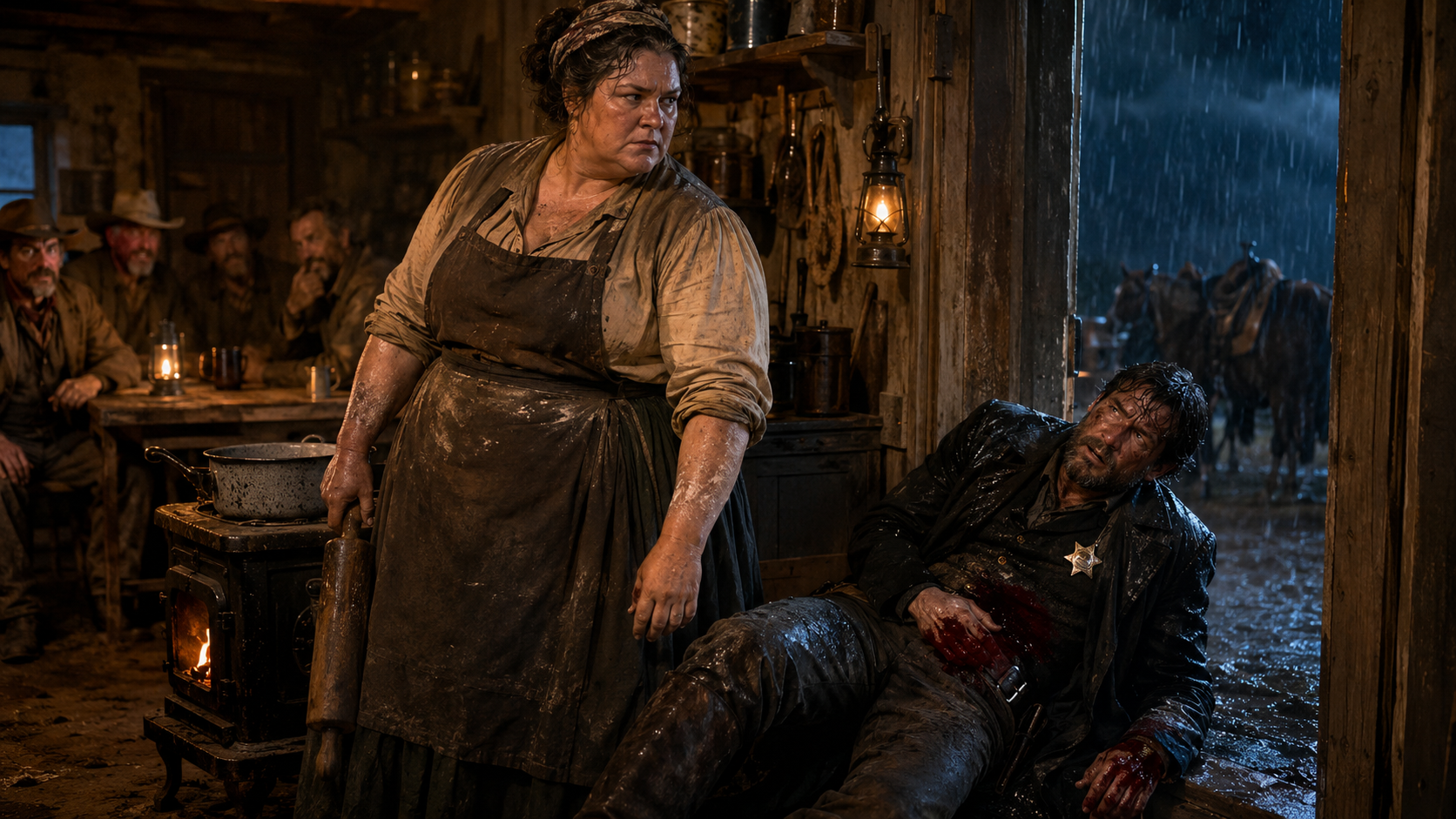
“Don’t save supper for a dead man.”
The words came from the far end of the room, where three cattle drivers sat with their boots on the chairs and their cruelty laid out as plainly as their cards. One of them laughed into his tin cup. Another wiped bean gravy from his mustache and glanced toward the door, where a man in a torn black coat lay half across the threshold, leaking blood onto the plank floor.
The storm had carried him in.
Or maybe it had only finished what the bullets started.
Wind screamed outside the Broken Spur way station, rattling the shutters and blowing dust through every crack in the walls. Rain came down hard enough to turn the yard into black soup. The horses in the lean-to stamped and cried, and the old stove glowed red in the middle of the room, fighting the cold with the stubborn pride of a thing too small for the work demanded of it.
Behind the counter stood Beatrice Callow.
Most people called her Bea when they wanted food. They called her Big Bea when they thought she could not hear. They called her worse when they were drunk, and sometimes when they were not.
She was a broad, heavyset woman with powerful arms, dark hair pinned badly under a kerchief, and a face that had learned not to ask the world for softness. Flour dust marked her sleeves. A burn scar crossed the back of one hand. Her apron was patched at the pocket and tied tight around a body men enjoyed judging until they tasted what came from her skillet.
She looked at the bleeding stranger.
He was not dead.
Not yet.
His hat had fallen near the door. Rainwater ran from his hair into his beard. His right hand was clamped around a leather satchel. His left sleeve was dark with blood from shoulder to wrist. A badge glinted beneath his torn coat, dull and muddy, but still visible.
Deputy U.S. Marshal.
The cattle driver laughed again.
“Bea, don’t you dare waste that stew. Man’s already halfway to the grave.”
Beatrice set down the ladle.
The room quieted.
Even cruel men knew when a cook had gone still in a dangerous way.
She came around the counter slowly, wiping her hands on her apron. She stepped over the stranger’s muddy boot, bent with a grunt, and pressed two fingers beneath his jaw.
A pulse.
Weak.
Angry.
Alive.
The stranger’s eyes opened a slit. Gray eyes, sharp even through fever and pain.
“Water,” he rasped.
One of the men at the table snorted. “Hear that? Corpse has manners.”
Beatrice looked over her shoulder.
“You three paid for supper?”
The driver who had spoken lifted his bowl. “Sure did.”
“Then eat it and keep your graveside sermons to yourselves.”
His grin faded.
Beatrice slid her arms under the marshal’s shoulders. He was taller than she expected and heavier than any wounded man had a right to be. Pain cut across his face as she dragged him away from the door. His boots left streaks of blood and mud on the boards.
“Satchel,” he gasped.
“You’re bleeding through your coat.”
“Satchel.”
“Lord save me from stubborn men.”
She reached back, grabbed the leather bag, and shoved it under her arm. Then she hauled him behind the counter and into the little room that served as her pantry, bedroom, and office depending on the hour.
He nearly passed out when she lowered him onto the cot.
“Name,” she said.
His mouth twitched. “You first.”
She narrowed her eyes. “You are not in a position to bargain.”
“Neither are you if those men outside decide to rob you.”
“They know better.”
His gaze dragged to the shotgun hanging above the flour barrel.
“I believe you,” he whispered.
“Name.”
“Rowan Vale.”
“Marshal Vale?”
“Was, last I checked.”
“I’m Beatrice Callow. If you die on my cot, I will be deeply inconvenienced.”
Something like a laugh broke in his chest and turned into a cough.
“Sorry,” he said.
“You’re not sorry yet.”
She cut away his coat.
The bullet had gone through the meat of his upper arm, ugly but clean. Another graze burned across his ribs. His fever worried her more than the wounds. He had ridden too long in the storm. He was shaking under her hands, not from fear, but from the body’s fury at being ignored.
“You were ambushed,” she said.
His jaw tightened.
“Two men. Maybe three.”
“Names?”
“Rusk brothers.”
At that, Beatrice’s hand stopped.
Rowan noticed.
“You know them?”
“I know the name.”
Everybody in that country knew the Rusk brothers. Elias and Boone Rusk had been robbing payroll wagons, burning stage offices, and leaving witnesses face-down in gullies for six years. Some said they had friends in every sheriff’s office from Abilene to Santa Fe. Some said they had never been caught because dead men could not testify.
Beatrice poured whiskey over the wound.
Rowan swore hard enough to make the horses outside answer.
“There,” she said. “Still alive.”
“I need to ride tonight.”
“You need to sleep.”
“They took a witness.”
“And you’ll rescue him by fainting off your horse?”
Rowan tried to sit. She pushed him down with one hand.
His eyes flashed.
Hers did not move.
For a moment, marshal and cook measured each other in the dim lamplight.
Then Rowan sank back onto the cot.
“You always this bossy?”
“You always this foolish?”
“Only when bleeding.”
“Then try bleeding quieter.”
Outside, the cattle drivers had grown louder. One of them started singing. Another knocked over a chair. Beatrice heard the floorboards creak near the pantry door.
“Bea,” called the cruel one, “the dead man done eating yet?”
She took the shotgun from the wall.
The door opened two inches.
Beatrice aimed at it.
The door stopped.
“Go sit down, Mr. Harlan.”
There was a pause.
“You wouldn’t shoot a paying customer.”
“No. But I might shoot a thief, and if your hand is on my pantry latch one more second, I’ll decide that’s what you are.”
The latch released.
Bootsteps retreated.
Rowan watched her with a strange expression.
“What?” she asked.
“I was thinking I picked the right floor to bleed on.”
“You didn’t pick. You fell.”
“Best fall I’ve ever taken.”
She should not have smiled.
She did anyway.
For two days, the storm trapped them at the Broken Spur.
Beatrice fed travelers, mended Rowan’s bandages, boiled coffee black enough to insult the devil, and listened to the wind scrape at the walls like fingernails. Rowan drifted in and out of fever. Sometimes he muttered names. Sometimes he reached for a revolver that was no longer there. Once, in the dark before dawn, he woke with his hand locked around her wrist.
“Don’t move,” he whispered.
Beatrice froze.
His eyes were open, but he was not seeing the pantry.
“They’re above the wash,” he said. “Two rifles. One by the cedar.”
“Marshal.”
“Tell Alden to run.”
“Rowan.”
At the sound of his name, his face changed. He came back from whatever blood-soaked memory had him.
He let go at once.
“I’m sorry.”
She rubbed her wrist. “Who’s Alden?”
His eyes closed.
“My deputy.”
“Dead?”
Rowan turned his face toward the wall.
That was answer enough.
She sat on the stool beside the cot. The little lamp threw gold light over the crates, the hanging herbs, the sacks of beans, the jars of peaches she had put up herself because no one made preserves properly within fifty miles.
“My father used to talk in his sleep,” she said.
Rowan did not look at her, but she knew he was listening.
“He would come home from the mines with coal dust in his ears and fear in his coat. My mother said he carried other men’s ghosts because he was too kind to set them down.”
“What happened to him?”
“Explosion.”
Rowan opened his eyes.
“Mine?”
“Railroad powder house. They said he was careless.”
“You don’t believe that.”
“I was twelve. A child believes what adults tell her until grief gets old enough to start asking questions.”
She stood too quickly, as if the words had embarrassed her.
“Eat.”
He looked at the bowl she set before him.
“What is it?”
“Stew.”
“What kind?”
“The kind that keeps ungrateful marshals alive.”
He ate.
After the first spoonful, he stopped and looked at the bowl.
Beatrice braced for a joke. Men always had a joke ready for a woman shaped like her. Something about how much she must taste while cooking. Something about how no man would go hungry in her bed. Something small and mean and tired.
Instead, Rowan said, “That is the best thing I’ve tasted in three months.”
She stared at him.
He looked embarrassed. “Too much?”
“No,” she said softly. “Just unexpected.”
“Good food shouldn’t be unexpected.”
“Kind words often are.”
Neither of them spoke for a while.
On the third morning, the road cleared enough for wagons.
Rowan could stand, though Beatrice told him he looked like boiled laundry. He insisted on leaving. She insisted he was an idiot. Their argument lasted twenty minutes and ended with him sitting at her kitchen table, pale and furious, while she packed supplies into a canvas bag.
“You cannot ride alone,” she said.
“I can.”
“You nearly fell walking to the water barrel.”
“That barrel moved.”
“It did not.”
“It might have.”
She tied the bag shut with unnecessary force.
“There is a town called Bitter Creek two days west,” she said. “I have an appointment there. The Grand Heron Hotel needs a head cook. I was already leaving this place.”
Rowan frowned. “You’re applying at the Grand Heron?”
“Yes.”
“That’s a fine hotel.”
“I know what it is.”
“I didn’t mean—”
“Yes, you did.”
He fell quiet.
Beatrice looked down at her hands. Strong hands. Scarred hands. Hands that could bone a fish, load a shotgun, knead six loaves of bread, and hold a dying man’s head above water. Still, the world looked at them and saw only what it wanted to mock.
“They’ll laugh when I walk in,” she said.
Rowan’s voice was low. “Then make them swallow the laugh with their first bite.”
She glanced at him.
He was serious.
That made it worse somehow.
“People like you always say brave things to people like me.”
“People like me?”
“Men with badges. Men with names that open doors. Men who can walk into a room without first apologizing for the amount of space they occupy.”
Rowan took that in.
Then he nodded once.
“You’re right.”
She had not expected that.
“I have opened doors,” he said. “Some I deserved. Some I didn’t. But I know this: no door stays respectable if cowards guard it.”
Beatrice’s throat tightened.
“Are you trying to be poetic?”
“I’m trying not to faint.”
That time, she laughed.
By noon, they were on the road.
Her wagon was painted green once, though dust and weather had chewed most of the color away. The mule, Queen Esther, had a mean temper and one white ear. Beatrice drove with her shoulders squared and her eyes forward. Rowan rode beside her on a borrowed horse, wrapped in a spare blanket, pretending the pain did not tear through him every time the trail dipped.
The country opened around them in raw, merciless beauty. Red hills. Black ravines. Grass bending under the wind. Far mountains like the backs of sleeping beasts. At night, they camped beneath a shelf of stone while coyotes sang to the moon.
Beatrice cooked bacon, corn cakes, and beans with dried peppers.
Rowan watched the firelight catch in her hair.
“You said your father died in a powder house,” he said.
Her hand paused over the skillet.
“I did.”
“What was his name?”
“Arthur Callow.”
Rowan went very still.
Beatrice noticed.
“What?”
He looked at her slowly. “Arthur Callow worked for the Midland Spur Railroad?”
“Yes.”
“Twenty years ago?”
“Near enough.”
Rowan set down his cup.
“What are you not saying?” she asked.
He took too long to answer.
“Arthur Callow’s name was in a file I saw in Denver. It was an old inquiry. Missing payroll. Sabotage. Laborers blamed. Case closed after the explosion killed the man who was supposed to testify.”
Beatrice could not feel the skillet handle.
“They said my father caused it.”
“That may not be true.”
Her laugh was short and hard. “May not?”
“I don’t know enough yet.”
“But you know something.”
“I know the Rusk brothers were tied to railroad thefts before they became famous for murder.”
The fire popped.
Beatrice looked away into the dark.
For years, she had carried her father’s death like a sealed jar. The label was written by other people: careless, clumsy, drunk, guilty. She had hated those words. She had swallowed them anyway because she was a girl, then a poor woman, then a large woman, then a working woman, and the world did not pause to listen when any of those people said, Wait. You have this wrong.
“What happened to the file?” she asked.
“Parts vanished. Witnesses vanished. Men got rich.”
“And now the Rusk brothers are riding west.”
“Yes.”
“Toward Bitter Creek?”
Rowan looked at her.
“Yes.”
She sat very still.
Then she turned the bacon before it burned.
“Eat,” she said.
“Beatrice—”
“Eat. If trouble is waiting in Bitter Creek, I would prefer you face it with food in your stomach.”
“You believe me?”
“I don’t know yet. But I believe my father was better than the story they buried him under.”
The Grand Heron Hotel stood at the center of Bitter Creek like a white wedding cake dropped into mud.
It had three stories, brass lamps, red carpets, and guests who used their napkins as if the cloth had personally offended them. Beatrice stopped the wagon across the street and stared at the building.
Her hands trembled on the reins.
Rowan saw.
“Drive on,” he said quietly.
“They will look at me.”
“Yes.”
“They will judge me.”
“Yes.”
She turned sharply.
“That is supposed to help?”
“No. It is supposed to be the truth. They’ll look. They’ll judge. Then you’ll cook.”
A muscle moved in her cheek.
“You make cooking sound like war.”
“Isn’t it?”
She almost smiled.
The hotel clerk looked Beatrice over as if she had tracked mud onto his soul.
His name was Percival Sneed. He had a waxed mustache, narrow shoulders, and the soft hands of a man who enjoyed giving orders he could not survive receiving. His gaze paused at Beatrice’s hips, her apron, her worn boots, then moved dismissively to Rowan.
“Applicants use the side entrance,” Sneed said.
“Good,” Beatrice replied. “I prefer useful doors.”
Sneed blinked.
Rowan covered his mouth.
The hotel owner, Mr. Ambrose Wycliff, was waiting in the dining room with two investors, a judge, and a woman in pearls who looked as though no plate had ever satisfied her. Wycliff’s suit was black, his beard silver, and his smile polished thin.
“Miss Callow,” he said. “Your letter was confident.”
“So am I, on good days.”
The pearl-wearing woman raised an eyebrow.
Wycliff looked at Rowan. “And your companion?”
“Deputy U.S. Marshal Rowan Vale,” Rowan said.
Sneed, standing behind them, went pale for half a second.
Beatrice saw it.
So did Rowan.
Wycliff folded his hands.
“The trial meal will be served at four. You will prepare three courses. You may use the kitchen, though my staff will observe. We value refinement here.”
Beatrice looked at the white tablecloths, the crystal glasses, the hungry judgment in every face.
“I value flavor,” she said. “Refinement can come along if it behaves.”
The kitchen staff laughed before they could stop themselves.
At four o’clock, Beatrice cooked.
Not the way she cooked at the Broken Spur, with one eye on the stove and one hand near the shotgun. Not campfire food. Not survival food.
This was the food her father had taught her to taste with memory. The food her mother had stretched from nothing during lean winters. The food Beatrice had built from every insult, every closed door, every lonely mile of road, every night she had fed people who mocked her and watched them go silent over their bowls.
She made roasted onion soup with bone broth, thyme, black pepper, and a splash of sherry.
She made beef rubbed with coffee and salt, seared hard in iron, then finished with a dark sauce of molasses, vinegar, and pan smoke.
She made cornmeal pudding with peaches, cream, and burnt sugar that cracked under the spoon.
The kitchen changed while she worked.
At first, the hotel cooks watched with suspicion. Then curiosity. Then hunger.
A young scullery girl whispered, “How do you know when the sauce is ready?”
Beatrice handed her a spoon.
“Taste.”
The girl tasted and closed her eyes.
“When it tells the truth,” Beatrice said.
Outside in the dining room, the laughter stopped first.
Then the conversation stopped.
Then came the sound every cook in the world understands: spoons returning too quickly to bowls.
When the final plate went out, Beatrice stood alone in the kitchen, her hands braced on the table.
Rowan came near.
“You did it,” he said.
She shook her head. “They haven’t said anything.”
“They don’t need to.”
“Yes, they do. Men like that always need words to convince themselves their own mouths aren’t smarter than they are.”
The kitchen door opened.
Ambrose Wycliff entered.
His expression gave away nothing.
Beatrice straightened.
Wycliff looked at her for a long moment.
Then he said, “Miss Callow, I have eaten in St. Louis, New Orleans, San Francisco, and once in Paris.”
Beatrice lifted her chin.
“Good for you.”
A cough of laughter escaped someone near the stove.
Wycliff’s mouth twitched.
“And yet,” he continued, “I believe the finest meal I have been served in ten years was cooked in my kitchen today by a woman I nearly underestimated before she lifted a knife.”
Beatrice’s breath caught.
“I would like you to run the Grand Heron kitchen,” he said. “If you are willing.”
For one terrifying second, she could not speak.
Then she said, “I want my own staff.”
“Reasonable.”
“I choose suppliers.”
“Within budget.”
“I decide the menu.”
“With discussion.”
“No.”
Wycliff studied her.
Then he laughed once, not mockingly, but with surrender.
“Very well. You decide the menu.”
Beatrice nodded.
Only after he left did she sit down.
Rowan knelt in front of her.
“Bea?”
She covered her face.
“I thought I would feel proud,” she whispered.
“You don’t?”
“I feel tired.”
He smiled gently. “Pride can arrive after a nap.”
She laughed into her hands, then cried before she could stop herself. Rowan did not tell her not to. He simply sat beside her on the kitchen floor until the storm inside her passed.
That night, while the hotel celebrated its new cook, Rowan searched for Percival Sneed.
The clerk had vanished.
So had a guest ledger, two envelopes from the telegraph desk, and the old stable key.
Rowan found Beatrice in the pantry, labeling jars.
“Sneed ran,” he said.
She did not look surprised.
“He knew your name,” Rowan added. “Not from the register. From somewhere else.”
Beatrice slowly set down the jar.
“My father kept a tin box,” she said. “Red lid. Brass clasp. My mother saved it after he died. I keep it in my wagon with spices.”
Rowan’s eyes sharpened.
“What is inside?”
“Cinnamon sticks. Dried orange peel. Old recipe cards. Nothing important.”
“Show me.”
They went to the stable with a lantern and Wycliff’s master key.
The wagon stood where Beatrice had left it, but the canvas flap had been cut.
Her crates had been opened. Flour spilled across the floorboards like pale dust. A sack of beans had been stabbed and left bleeding into the straw.
Beatrice climbed inside without a word.
The red tin was still there, tucked beneath a loose board near the stove box.
Her hands shook as she opened it.
Cinnamon. Orange peel. A folded recipe for her mother’s winter bread.
Rowan touched the bottom.
“May I?”
She nodded.
He pressed along the inner seam until something clicked.
A false bottom lifted.
Beatrice stopped breathing.
Inside lay oilcloth.
Inside the oilcloth lay papers.
Names.
Dates.
Payroll figures.
Railroad shipments.
Witness statements.
Bribe records.
And one letter written in Arthur Callow’s hand.
Beatrice knew the handwriting before she read a word.
My dear Clara, if this reaches you, take Bea and leave. I have found the men stealing payroll and blaming Chinese crews and Irish loaders. They plan to destroy the powder house and call it accident. The Rusk boys carry guns for them, but they are not the root. The money leads to Bitter Creek. Tell my daughter I did not drink. Tell her I did not run. Tell her I tried to come home clean.
Beatrice sat down hard on the wagon floor.
For twenty years, her father had been called careless.
For twenty years, her mother had lowered her eyes when men said it.
For twenty years, Beatrice had carried shame that was never hers.
Rowan read the final page and his face darkened.
“What?” she asked.
He looked toward the stable door.
“Percival Sneed’s father was Midland Spur’s regional paymaster.”
Beatrice closed the tin.
A strange calm settled over her.
“Then Mr. Sneed knows what is in this box.”
“Yes.”
“And the Rusk brothers are coming for it.”
“Yes.”
She stood.
Rowan reached for her. “You should leave town.”
She stared at him.
“Do not finish that thought.”
“Beatrice—”
“No.”
“They are killers.”
“So were the men who buried my father under a lie. I have been living with them at my table for twenty years. No more.”
“You are not trained for this.”
Her laugh was sharp.
“I am a cook. I work with fire, knives, boiling fat, drunk men, starving men, proud men, and idiots who think a kitchen is a soft place. Do not tell me I am untrained for danger.”
Rowan’s mouth closed.
She stepped closer.
“You can help me, Marshal. Or you can stand aside. But you will not put me away like a dish too fine for rough hands.”
He looked at her for a long moment.
Then he nodded.
Together, they made a trap.
Wycliff moved guests to the east wing. Rowan placed two trusted deputies in the laundry, one in the alley, and one behind the kitchen stairs. Beatrice spread the rumor herself, loudly complaining to the scullery girl that the red tin was hidden in the pantry because she did not trust hotel locks.
By midnight, Bitter Creek was silent under a lid of cold stars.
Beatrice stood in the Grand Heron kitchen, rolling biscuit dough.
A lantern burned on the worktable.
A shotgun rested beneath it.
The back door opened.
Elias Rusk entered first, tall and rawboned, with a pistol in his hand and a scar pulling one corner of his mouth into a permanent sneer.
Boone Rusk came behind him, wider, younger, meaner.
Percival Sneed followed last, sweating through his collar.
Beatrice did not look up.
“Kitchens closed,” she said.
Elias grinned. “We ain’t hungry.”
“That explains your poor judgment.”
Sneed’s voice shook. “Where is the tin?”
Beatrice dusted flour from her hands.
“Good evening to you too, Mr. Sneed.”
Boone lifted his pistol.
“Don’t be smart.”
“I tried being stupid once. Didn’t suit me.”
Elias stepped closer.
“You know, woman, folks said not to waste supper on that marshal. Should’ve listened.”
From the pantry shadow, Rowan spoke.
“She rarely listens to fools.”
Elias spun.
Rowan stood with his revolver drawn.
The kitchen erupted.
Boone fired first. The shot shattered jars above the sink. Deputies burst from the laundry. Sneed screamed and threw his lantern. Flame splashed across the flour sacks and climbed toward the curtains.
Beatrice moved before fear could catch her.
She grabbed the heavy iron skillet from the stove and swung it into Boone’s wrist. His pistol clattered across the floor. He roared. Rowan struck him across the jaw and drove him into the table.
Elias lunged for Beatrice.
His knife flashed.
He caught her by the apron and dragged her back against him, blade at her throat.
The whole room stopped.
Fire crackled behind them.
Rowan aimed, but his hand froze.
Elias smiled into Beatrice’s hair.
“Drop it, Marshal.”
Beatrice could feel the knife. Could smell whiskey on Elias’s breath. Could hear her own heart like a fist against a locked door.
Rowan’s eyes met hers.
He was afraid.
Not for himself.
For her.
That gave Beatrice courage enough to be angry.
“You killed my father,” she said.
Elias laughed softly.
“Lady, I killed lots of fathers.”
The words went through her like ice.
Then they turned to steel.
“My father fed men who had nothing,” she whispered. “He believed even hungry wolves could remember they were men.”
“What’s that got to do with me?”
Beatrice shifted her weight.
“Nothing,” she said. “You forgot too much.”
She drove her heel into his knee.
Elias cursed and jerked. The knife lifted from her throat for half a breath.
Half a breath was enough.
Rowan fired.
The bullet struck Elias in the shoulder. Beatrice dropped. Deputies tackled Boone. Sneed tried to run through the pantry and found Wycliff waiting with a fireplace poker.
The staff formed a bucket line before anyone gave the order. Cooks, maids, porters, bellboys, and guests in nightclothes passed water hand to hand until the flames hissed and died.
When it was over, the kitchen was blackened, the flour ruined, Boone Rusk unconscious, Elias Rusk bleeding and chained, and Percival Sneed sobbing into his own hands.
Beatrice stood in the middle of the wreckage with soot on her face.
Rowan came to her.
“Are you hurt?”
She touched the shallow cut at her throat.
“Not enough to stop breakfast.”
He stared at her.
Then he laughed once, breathless and broken with relief.
She held up the red tin.
“My father comes first.”
The trial lasted eleven days.
People came from three counties to fill the courtroom. Men who had built clean reputations on dirty money suddenly found themselves named in Arthur Callow’s careful records. Old lies cracked open. Dead workers were remembered properly. Families who had been blamed for thefts and sabotage stood together in the back of the room and listened as truth, late and limping, finally arrived.
Elias and Boone Rusk were convicted for murder, robbery, and the killing of Arthur Callow.
Percival Sneed turned witness to save his neck and lost his future anyway.
Beatrice sat through every hour.
She did not cry when the verdict came.
She cried later in the Grand Heron kitchen, holding the red tin against her chest while the morning bread rose on the table beside her.
“My father wasn’t careless,” she said.
Rowan stood close, not touching until she leaned into him.
“No,” he said. “He was brave.”
She closed her eyes.
“I spent so long being ashamed.”
“Of him?”
“Of what they made us carry.”
Rowan’s voice roughened.
“Then put it down.”
She did.
Not all at once. Grief never leaves like a guest who remembers his hat. It lingers. It sits in corners. It asks for one more cup of coffee.
But it changed shape.
Beatrice became the most talked-about cook in the territory. Travelers came for her coffee-rubbed beef, her peach pudding, her winter bread, her pepper stew, her Sunday chicken, and the biscuits she claimed could fix bad marriages if served hot enough.
Some people still laughed when they saw her.
Then they ate.
Afterward, they spoke more carefully.
Rowan stayed in Bitter Creek. His wounds healed. His badge remained. But something in him softened—not weakened, only unknotted. He had spent years chasing killers across hard country, believing justice was something you hunted down with a gun. Beatrice taught him that justice could also be a table where truth was served hot and no one was allowed to leave hungry for dignity.
Their friendship became the town’s favorite subject.
Beatrice ignored the gossip.
Rowan tried to ignore it and failed badly.
One evening, after closing, he found her alone in the kitchen, rolling dough by lamplight. The scar at her throat had faded to a pale line. Flour dusted her cheek. Her sleeves were pushed to her elbows.
“You should sleep,” he said.
“You should stop giving orders in my kitchen.”
“I’m a marshal.”
“Not in here.”
He smiled.
She cut biscuits with the rim of a glass.
“I’ve been thinking,” she said.
“That sounds dangerous.”
“It is.”
He leaned against the counter.
She did not look at him.
“I think we should marry.”
Rowan straightened so fast he nearly knocked over a bowl.
“What?”
She finally looked up, annoyed.
“Must I repeat every important thing?”
“No. I just—Beatrice—are you asking me?”
“I am informing you of a sensible plan. You may participate by saying yes.”
He laughed, then stopped when he saw her face.
She was nervous.
Beatrice Callow, who had faced killers in a burning kitchen, was afraid of this.
Rowan crossed the room slowly.
“Yes,” he said.
Her eyes shone.
“You haven’t heard the terms.”
“I accept them.”
“You don’t know what they are.”
“You’ll tell me for the rest of my life.”
She tried not to smile and failed.
“I take up space,” she said quietly.
He took her flour-covered hands.
“Good. Take mine too.”
She looked down at their hands.
“I am stubborn.”
“I noticed.”
“I will feed strays.”
“I was one.”
“I will argue when you are wrong.”
“Then I’ll be well-corrected.”
Her voice dropped.
“And I will not be made small.”
Rowan cupped her face with both hands.
“Beatrice Callow, you found me dying on a dirty floor and dragged me back into the world. You can fill every room I ever stand in.”
She kissed him first.
The biscuits burned.
Neither of them cared.
They married in the Grand Heron dining room in early autumn, beneath garlands of wildflowers and lantern light. Wycliff cried and denied it. The scullery girl served as Beatrice’s attendant. Half the town came, including people who had once mocked her and now looked ashamed enough to be forgiven someday, though not too quickly.
Beatrice wore a blue dress made by her own hands because no dressmaker in Bitter Creek understood that a woman could be large and beautiful without needing either fact corrected.
Rowan wore his badge.
During the vows, he promised to come home alive whenever possible and honest always.
She promised to feed him, argue with him, and never let silence become a wall between them.
When the preacher pronounced them married, the kitchen staff cheered loudest.
Years passed.
Bitter Creek grew. The Grand Heron became famous. Beatrice trained women no one else would hire—widows, immigrants, farm girls, former saloon singers, freedmen’s sons, quiet boys with quick hands, loud girls with sharper tongues. She cared only whether they worked clean, tasted often, and respected the fire.
“A kitchen,” she liked to say, “doesn’t care what fools call you. It cares whether you burn the gravy.”
Rowan became known as the marshal who could end a fight before the first shot. He still carried a gun. He still used it when he had to. But he learned from Beatrice that not every danger needed a bullet. Some needed bread. Some needed listening. Some needed a woman with a skillet and no patience for nonsense.
On their twenty-fifth anniversary, they sat on the porch of the house they had built above town. Bitter Creek glowed below them, no longer a mud hole with ambition, but a living place full of lamps, voices, horses, children, church bells, supper smoke, and memory.
Beatrice’s hair had silver in it now. Rowan’s beard had gone almost white. Her body was still broad and strong. Her laugh still filled the air like a door thrown open.
“Do you ever think of that first night?” she asked.
“The night you threatened to shoot a paying customer?”
“The night I saved your life.”
“You charged me for stew.”
“You lived, didn’t you?”
He took her hand.
“I did.”
She leaned against him.
“They said not to waste supper on a dead man,” she murmured.
Rowan kissed her knuckles.
“Good thing you never listened.”
Below them, the town carried on.
Some lives are saved by doctors. Some by badges. Some by courts, bullets, letters, or the truth finally dragged into daylight.
And some are saved by a heavyset cook standing over a stove in a storm, refusing to let the world decide who is already dead.