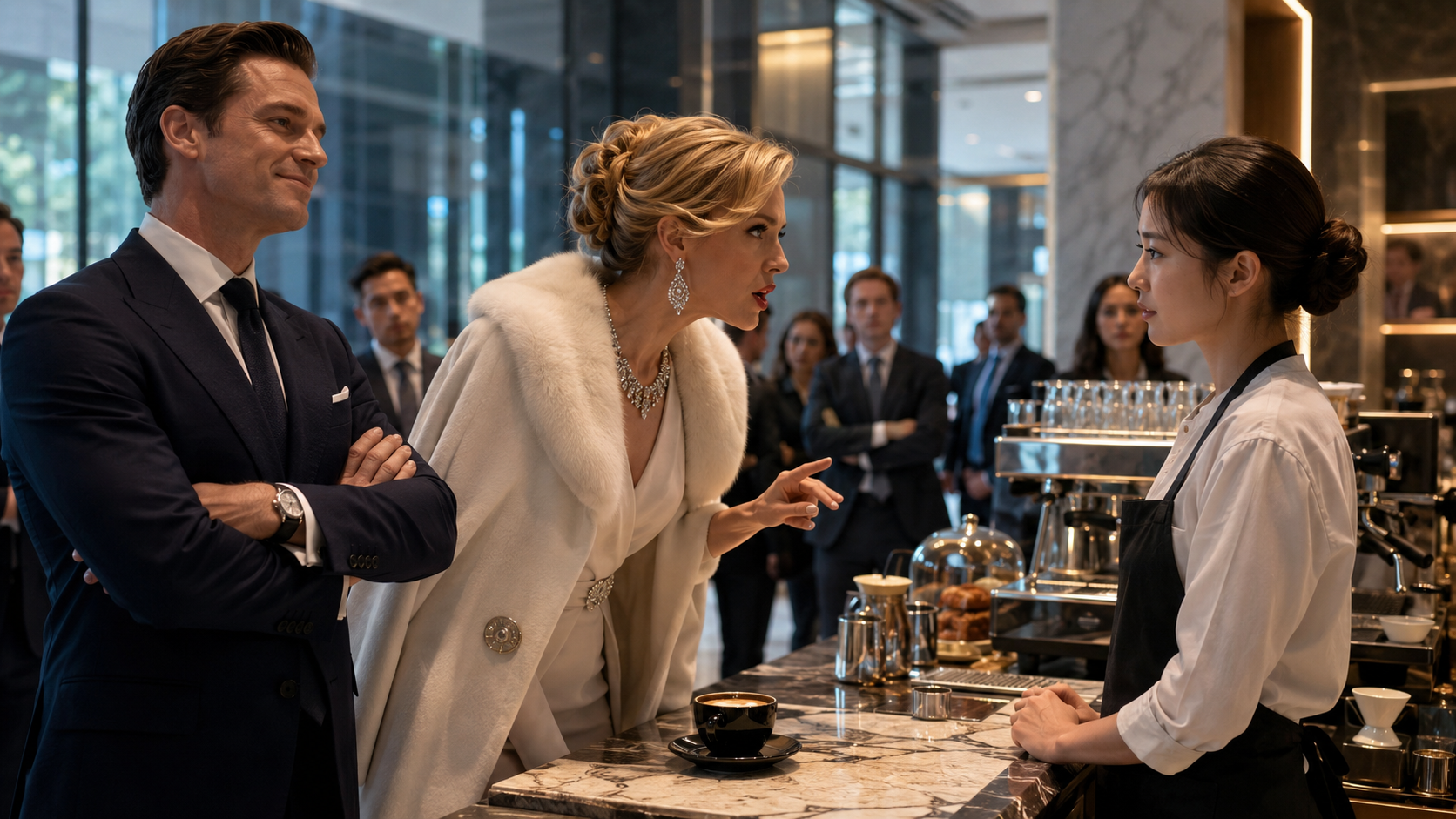
The first thing Celeste Arden learned behind the café counter was that people showed their real faces when they believed no one important was watching.
Not when cameras were pointed at them.
Not when executives sat across from them in glass conference rooms.
Not when human resources passed out glossy cards with words like respect, integrity, excellence printed in tasteful gray lettering.
People were easiest to read when they ordered coffee.
At 7:18 on a rainy Tuesday morning, Celeste stood beneath the warm lights of the Meridian Tower café wearing a black apron, a name tag that said CLAIRE, and a cap pulled low enough to hide the sharp cheekbones that had once appeared on the cover of Fortune & Empire.
No one looked closely at a barista.
That was the point.
“Double espresso, no sugar,” said a man in a charcoal coat, already turning away before he finished speaking.
“Good morning,” Celeste said.
He did not hear her. Or he decided not to.
A junior analyst with wet hair apologized three times for asking whether the almond croissants were fresh. A marketing director snapped her fingers for napkins without looking up from her phone. One of the security guards called every café employee by name and waited patiently while Celeste learned the register.
By 9:00, Celeste had written eleven notes in the small black notebook she kept beside the extra stir sticks.
She had spent three weeks doing this.
Three weeks arriving before dawn through the service entrance of the tower she owned.
Three weeks steaming milk, wiping counters, emptying trash, taking orders, cleaning tables, remaking drinks, and watching the people of Arden Meridian Holdings behave as though the lobby café were not part of the company at all, but some invisible machine that produced caffeine and politeness on demand.
The board thought she was in Zurich.
Her senior executives thought she was reviewing expansion contracts remotely.
Only three people knew the truth: her assistant, her security chief, and Malcolm Wren, the seventy-two-year-old board chairman who had warned her this experiment would either save the company or ruin her faith in it.
Celeste had replied, “Those are not opposite outcomes.”
Now she locked the portafilter into place and listened to the hiss of the espresso machine. The café smelled of roasted beans, butter, rain-soaked coats, and expensive perfume.
At 10:42, the air changed.
Celeste noticed because the young cashier beside her, Miles, straightened too quickly and knocked over a stack of lids.
“Oh no,” he whispered.
Celeste followed his gaze.
Damon Voss had entered the café.
Even in a building filled with people who wanted to look powerful, Damon stood out. He was tall, polished, beautifully dressed, and moved with the relaxed confidence of a man who had never once wondered whether a room would make space for him.
He was Arden Meridian’s Chief Strategy Officer.
He was also the board’s favorite candidate to become company president.
Celeste had hired him six years ago.
Back then, Damon had seemed brilliant, hungry, disciplined, and just humble enough to be trusted. He had rescued two failing divisions, negotiated a brutal merger without losing a major client, and charmed investors who usually needed three martinis to become cheerful.
Numbers loved him.
People, Celeste was beginning to suspect, survived him.
A woman walked beside him, one hand looped through his arm.
She was not an employee. Celeste knew because she had personally reviewed the badge scans every morning since beginning her undercover inspection.
Her name was Bianca Rowe.
Influencer, private-events consultant, charity gala regular, and, according to the company rumor mill, Damon’s girlfriend, though Damon was still technically married to a woman named Elise who lived in London and avoided newspapers with impressive skill.
Bianca wore white wool, diamond studs, and the expression of someone permanently disappointed by the world’s failure to become a mirror.
She stopped in front of the counter and looked at Celeste.
Not at her face.
At her apron.
Then her mouth curved.
“How sweet,” Bianca said. “You people have matching uniforms.”
Miles’s face turned pink.
Celeste smiled professionally. “Good morning. What can I get started for you?”
Bianca glanced at Damon. “Does she always sound rehearsed?”
Damon looked amused, not embarrassed.
“Bianca likes precision,” he said.
“I like competence,” Bianca corrected. Then she looked back at Celeste. “Cappuccino. Dry. Extra hot. No foam touching the lid. Cinnamon, but not from one of those dusty little shakers. And smile while you serve me. It makes the experience feel less depressing.”
The café quieted.
Not completely. People in corporate towers were experts at pretending they had not heard things. But the sound changed. Keyboards softened. Cups paused. Conversations lowered into careful murmurs.
Miles stared at the screen.
Celeste tapped the order in. “One dry extra-hot cappuccino with cinnamon.”
Bianca tilted her head. “And?”
Celeste looked at her.
Bianca touched her own cheek with one manicured finger. “Smile. I asked nicely.”
Damon chuckled under his breath.
That was the first note Celeste made without writing anything down.
Damon was not merely tolerating Bianca.
He was enjoying the room’s discomfort.
Celeste gave Bianca a calm, small smile. “Your drink will be ready shortly.”
Bianca’s eyes narrowed. She had wanted obedience, not composure.
Celeste turned to the machine.
Her hands were steady.
They had signed acquisitions under hostile conditions. They had opened factories in three countries. They had held her father’s hand in a hospital room while the doctors said there was nothing more to do.
They could make a cappuccino for a cruel woman.
While Celeste worked, Bianca drifted toward the pastry display.
“Are those gluten-free?” she asked.
Miles cleared his throat. “The lemon squares are, yes.”
Bianca lifted one brow. “I wasn’t speaking to you.”
Miles went silent.
Celeste placed Bianca’s cappuccino on the counter. “Here you are.”
Bianca picked it up, sniffed it, and grimaced.
“This is wrong.”
Celeste kept her voice even. “What would you like adjusted?”
“It tastes like resentment.”
Someone near the pickup area coughed into their sleeve.
Damon smiled at his phone.
Celeste said, “I can remake it.”
“You can do more than remake it.” Bianca leaned closer. Her perfume was sharp and floral. “You can try caring. This tower is filled with people doing real work. The least you can do is make coffee correctly.”
The words landed harder than they should have, because they were not just Bianca’s words.
They belonged to the culture Celeste had come downstairs to inspect.
Bianca had simply said them out loud.
Behind Celeste, Miles whispered, “I can make it, Claire.”
“No,” Celeste said softly. “I’ve got it.”
Bianca smiled with satisfaction.
Damon finally looked up. “Don’t take it personally,” he told Celeste. “She has high standards.”
Celeste looked at him.
Six years ago, Damon had sat in her office and told her his leadership philosophy was simple: raise the bar, protect the people trying to reach it.
Now he stood beside a woman humiliating a barista for sport and called it standards.
“I understand,” Celeste said.
And she did.
Better than he knew.
She remade the drink. This time Bianca watched every movement as if supervising a servant in an old movie.
“Where did you work before this?” Bianca asked.
“Several places.”
“That explains the vagueness.” Bianca turned to Damon. “Do they train them here?”
Damon slipped his phone into his pocket. “The café is outsourced.”
It was not.
Celeste had brought the café in-house two years ago after discovering that contracted staff had been underpaid by a previous vendor.
Damon should have known that. He had signed the transition memo.
But people who considered workers beneath them rarely remembered systems that protected those workers.
Celeste placed the second cappuccino down.
Bianca took one sip.
A long silence followed.
Then she said, “Better.”
Miles breathed again.
Bianca turned away, then paused and looked back at Celeste. “There. See? You improved when corrected. That’s the attitude you should lead with.”
Damon put a hand at Bianca’s waist and guided her toward the elevators.
As they left, Celeste saw a custodian near the lobby column watching them.
His name was Arthur Bell.
Sixty-one years old. Night-shift supervisor on paper, though his badge still listed him as general maintenance. Former operations foreman at a rail depot. Three commendations. Two denied promotion applications. One HR note describing him as “reliable but not leadership-facing.”
He had been one of the reasons Celeste came downstairs.
Arthur met Celeste’s eyes for one brief second.
He did not know who she was.
But he knew what had happened.
Later, during the lull before lunch, Miles leaned close while restocking straws.
“I’m sorry,” he said.
“For what?”
“For not saying anything.”
Celeste wiped the counter. “Why didn’t you?”
He swallowed. “Because he’s Damon Voss.”
“And?”
“And I’m on a temporary contract.”
There it was.
The simplest explanation for most corporate silence.
Not cowardice.
Math.
A person measured their rent, their insurance, their student debt, their probationary status, their sick mother, their child’s school fees, and decided dignity was expensive.
Celeste wrote in her notebook.
Fear travels downward faster than policy travels upward.
At 6:30 that evening, Celeste stood in her real office on the forty-seventh floor.
The room faced the river. Rain scratched silver lines down the glass. Far below, the café had closed, its lights dimmed except for the glow above the espresso machine.
Her black apron lay folded on the conference table beside her laptop.
Malcolm Wren watched the surveillance clips in silence.
He had been her father’s closest friend, then her harshest critic, then the closest thing she had to family after the funeral. He wore the same navy suits every day and had never once pretended age made him gentle.
The screen froze on Bianca pointing at her own cheek.
Smile.
Malcolm removed his glasses.
“Well,” he said. “She is unpleasant.”
“Bianca isn’t the problem.”
“No. Damon is.”
Celeste looked at the paused image. Damon stood behind Bianca, laughing.
“Partly.”
Malcolm gave her a narrow look. “You are about to make this more complicated than the board will enjoy.”
“The board enjoys simple stories because simple stories rarely accuse them.”
He sighed. “Celeste.”
She turned.
He softened, but only slightly. “Damon has strong support. His division is up seventeen percent year over year.”
“So was Victor Harlan’s before we discovered he had turned Procurement into a fear factory.”
“That was different.”
“Was it?”
Malcolm said nothing.
Victor Harlan had been gone for eight years, but his shadow remained inside the company like smoke behind wallpaper. He had increased margins, crushed complaints, and made talented people resign quietly. By the time Celeste removed him, two lawsuits were pending and one young manager had suffered a panic attack in a stairwell after a meeting that Victor later described as “direct feedback.”
Celeste had promised herself never to be seduced by performance that required human damage as fuel.
“Damon is not Victor,” Malcolm said.
“No,” Celeste replied. “Damon still has time to become him.”
Malcolm’s eyes moved back to the screen.
“You are thinking of canceling the appointment.”
“I am thinking of finding out whether the appointment should ever have been considered.”
“The vote is Friday.”
“Then Friday will be useful.”
The next morning, Damon returned to the café alone.
He ordered an Americano and took a call while Celeste made it.
“Yes, Friday,” he said into the phone. “No, Malcolm is being cagey, but it’s obvious. They wouldn’t call full senior leadership unless they were announcing structure.”
A pause.
He laughed.
“Celeste trusts results. She always has.”
Celeste poured hot water over espresso.
Damon continued, “The culture language is for annual reports. Investors want execution.”
Celeste placed the cup on the counter.
Damon barely glanced at her. “Thanks, Claire.”
It was the first time he used her fake name.
He had read the tag only because he wanted something from the room and there was no one else to acknowledge him.
At noon, Bianca came back without Damon.
She entered with two women from the legal department and one young assistant Celeste recognized from Investor Relations. The assistant, Nora, carried a tablet hugged to her chest as though it were a shield.
Bianca ordered a lavender honey latte, a drink the café did not serve.
“We have lavender tea and honey,” Celeste said. “I can make you a latte using both, but the flavor will be delicate.”
Bianca smiled at the women beside her. “Look at that. She has initiative today.”
Nora looked down.
Celeste made the drink.
While waiting, Bianca moved to the merchandise shelf and picked up a ceramic travel mug.
“Thirty-two dollars?” she said. “For this?”
“It’s handmade by a local studio,” Miles said carefully.
Bianca turned the mug in her hand. “Then the local studio is optimistic.”
She put it back carelessly. It knocked against another mug. The shelf wobbled.
Miles stepped forward, but Bianca’s sleeve caught the display.
Several boxes of tea slid off.
A mug fell.
It hit the marble floor and broke into three clean pieces.
The café stopped breathing.
Bianca looked at the broken mug, then at Celeste.
“Oh,” she said lightly. “You’ll need a broom.”
No apology.
No embarrassment.
Just the assumption that consequences were for whoever stood nearest in an apron.
Nora whispered, “Bianca, maybe we should—”
Bianca cut her a look. “Maybe you should not coach me in public.”
Nora went pale.
Celeste came around the counter with a broom and dustpan.
Miles reached for the broken pieces, but she shook her head once.
Not because she wanted him silent.
Because she wanted to see who else would speak.
No one did.
The women from legal became fascinated by their phones. Nora’s eyes filled with shame. Two directors at a nearby table kept pretending to discuss a presentation.
Arthur Bell, the custodian, stepped out from beside the service corridor.
“Ma’am,” he said.
Bianca turned slowly.
Arthur held his mop handle loosely. He did not sound angry. That made his voice carry farther.
“You broke it. You could at least say you’re sorry.”
The entire lobby seemed to tilt.
Bianca blinked. “Excuse me?”
Arthur nodded at the mug. “That belongs to somebody’s work. Somebody made it. Somebody stocked it. Somebody will have to report it. It costs you nothing to be decent.”
Bianca stared at him with genuine disbelief, as if a chair had begun speaking.
“I don’t take etiquette lessons from janitors.”
Arthur did not flinch.
“That’s all right,” he said. “Lessons only help people still willing to learn.”
No one moved.
Bianca’s face flushed red beneath her makeup.
Celeste crouched, swept up the broken ceramic, and placed the pieces in the bin.
When she stood, she looked at Arthur.
Only once.
But he understood.
He had not defended her because she was important.
He had defended a person because she was being degraded.
That difference mattered.
That night, Celeste watched the footage three times.
Not Bianca breaking the mug.
Not Arthur speaking.
Damon had not been present for that one.
But Celeste studied the people who had been present: legal directors, managers, assistants, vendors, interns, security, café staff.
She created two columns in her notebook.
What happened.
What everyone did next.
The second column was always more useful.
On Thursday evening, Celeste stayed in the café after closing. Miles had gone home. The manager was counting tills in the back office. Rain had stopped, leaving the windows black and reflective.
Arthur pushed a cart past the pastry case.
“You’re here late,” he said.
“So are you.”
He chuckled. “Floors have terrible manners. They get dirty even when I ask them not to.”
Celeste smiled.
It was the first genuine smile she had given in the café all week.
Arthur leaned the mop against the wall. “You done after tomorrow?”
Celeste paused.
“What makes you ask that?”
He shrugged. “You look like someone who is finishing a report.”
Celeste studied him.
Most people saw what uniforms told them to see. Arthur saw posture, timing, attention. He had been watching her watch everyone else.
“You think I’m writing a report?”
“I think you’re not here for the paycheck,” Arthur said. “No offense.”
“None taken.”
“You make coffee fine. But you look at people like you’re measuring weight on beams.”
Celeste laughed softly. “That is oddly specific.”
“I used to inspect rail platforms. If one beam lies, the whole structure pays later.”
There it was again.
Leadership without a title.
Celeste folded the rag in her hands. “Why are you still listed as general maintenance?”
Arthur’s expression changed.
Not anger.
Weariness.
“Because that’s what my badge says.”
“I read that you applied for operations supervisor twice.”
His eyes sharpened. “You read that?”
Celeste did not answer.
Arthur looked toward the closed glass doors. “First time, they said I needed updated certification. I got it. Second time, they said they wanted someone with a more executive communication style.”
He gave a small smile.
It was not bitter enough to protect him.
“That means they wanted someone who looked like he belonged upstairs,” he said.
Celeste felt something cold settle behind her ribs.
“Who told you that?”
Arthur lifted one shoulder. “People who probably forgot by lunch.”
Celeste did not forget.
That was the problem.
No company collapsed because of one Bianca Rowe.
Bianca was only loud.
The real danger was quieter.
It lived in promotion criteria that praised polish over courage. It lived in managers who dismissed reports because the offender was close to power. It lived in executives who used “not leadership-facing” to mean “not like us.”
Bianca had not created the sickness.
Damon had not created all of it either.
They had simply revealed where it had been allowed to grow.
At 10:55 Friday morning, the forty-seventh-floor boardroom filled with people who believed they had been invited to witness Damon Voss’s promotion.
The room was built for power: a long stone table, leather chairs, hidden screens, soundproof glass, the river shining far below like polished steel. Senior leaders sat in careful order. Board members occupied the front. Department heads stood along the walls. A few junior employees had been invited and looked terrified by the carpet.
Miles stood near the back in a clean shirt, holding a tablet so tightly his knuckles showed.
Nora from Investor Relations sat two rows behind legal, her face tense.
Arthur Bell had been escorted to a front-row seat by Celeste’s assistant, which caused several executives to whisper and then pretend they had not.
Damon arrived at 10:58.
Navy suit.
Silver watch.
Perfect hair.
He looked prepared to accept destiny.
Bianca was not permitted inside the boardroom because she did not work for the company, but she waited in the executive lobby beyond the frosted glass doors, wearing a cream coat and the delighted expression of someone expecting champagne.
Damon shook Malcolm’s hand.
Malcolm gave him nothing.
At exactly 11:00, the side service door opened.
Not the main boardroom doors.
The service door.
A woman stepped in wearing black trousers, a white shirt, and the same black café apron she had worn downstairs.
For half a second, the room misunderstood her.
Then recognition traveled across the table unevenly.
First irritation from people who thought catering had interrupted.
Then confusion from those who had ordered from her.
Then horror from those who knew the woman in the annual report photograph, the woman whose signature sat beneath half their stock grants, the woman who owned fifty-three percent of Arden Meridian Holdings and had built Meridian Tower from the bones of a bankrupt shipping warehouse.
Damon’s expression changed in stages.
Annoyance.
Amusement.
Confusion.
Then knowledge.
Celeste Arden walked to the head of the table.
The black apron remained tied at her waist.
Malcolm stood.
“Before today’s leadership discussion begins,” he said, “there is an introduction that apparently needs to be made. This is Celeste Arden, founder, majority owner, and chief executive officer of Arden Meridian Holdings.”
No one breathed loudly.
Celeste set her notebook on the table.
“For twenty-two days,” she said, “I worked downstairs in the lobby café under the name Claire. I made coffee, cleaned counters, restocked shelves, carried trash, apologized for delays I did not cause, and watched employees at every level interact with people they believed had no power over them.”
She picked up the remote.
The screens lit.
The first clip showed Bianca at the counter.
Smile while you serve me.
The sentence sounded smaller in the boardroom and uglier because it had nowhere to hide.
The second clip showed Damon laughing.
The third showed Bianca criticizing Miles.
The fourth showed Bianca breaking the mug and ordering Celeste to clean it.
The fifth showed Arthur stepping forward.
You broke it. You could at least say you’re sorry.
Then Bianca’s voice.
I don’t take etiquette lessons from janitors.
Arthur’s answer followed, quiet and devastating.
Lessons only help people still willing to learn.
Someone near the wall whispered, “Oh God.”
Celeste let the room sit inside its own memory.
Then the footage changed.
Damon in the café, speaking into his phone.
Culture language is for annual reports. Investors want execution.
Damon’s face hardened.
Celeste paused the video on him.
Not Bianca.
Damon.
She turned back to the room.
“I did not go downstairs to catch one rude visitor,” Celeste said. “That would be childish. Rude visitors come and go. What matters is who feels safe being cruel, who feels forced to be silent, and who benefits when silence becomes normal.”
No one looked comfortable now.
Good.
Comfort had protected too much.
“Arden Meridian is entering the largest expansion in its history,” Celeste continued. “The next company president will have authority over thousands of employees, contractors, vendors, and support staff. That person cannot merely deliver results. That person must understand that every result has a human cost if leadership is careless.”
Damon stood slowly.
“Celeste,” he said, voice controlled, “with respect, I think context is important.”
“It is,” Celeste said. “That is why everyone is here.”
“I did not mistreat anyone.”
“You watched someone else do it and smiled.”
His jaw tightened. “Bianca is not an employee.”
“No,” Celeste said. “She was a guest whose behavior you endorsed through silence.”
“That’s not fair.”
“Fairness is not what powerful people call it only after consequences arrive.”
The room went very still.
Damon’s face reddened.
Celeste opened her notebook.
“For three weeks, I documented who greeted café staff by name, who ignored them, who apologized after mistakes, who created mistakes to watch others fix them, who thanked cleaning staff, who stepped around spills, who reported problems, who buried them, and who treated proximity to power as permission.”
Her eyes moved across the executives.
Several looked away.
“Damon Voss will not become president of Arden Meridian Holdings.”
The silence cracked.
Damon gripped the back of his chair.
“You’re ending my promotion because my girlfriend was rude to a barista?”
“No,” Celeste said. “You ended your promotion because you believed cruelty was harmless when it landed on someone you considered replaceable.”
Beyond the frosted doors, Bianca saw movement and stepped closer.
Celeste looked toward the security director. “Ms. Rowe is to be escorted from the building. Her visitor privileges are revoked.”
The boardroom door opened.
Bianca’s voice floated in from the lobby. “What is happening?”
The security director answered with professional calm. “Ma’am, please come with me.”
“But Damon—”
“Now, ma’am.”
Inside the boardroom, Damon looked toward the door.
Celeste watched him.
Even now, he looked more offended by Bianca’s embarrassment than by what she had done.
That told Celeste enough.
“Effective immediately,” she continued, “Mr. Voss is relieved of strategic leadership duties pending a formal conduct review by the ethics committee and outside counsel. His future with this company will be determined after that review.”
Damon sat down.
The presidential posture left him.
Celeste turned a page.
“Now,” she said, “we will discuss what matters more than punishment.”
A ripple moved through the room.
Celeste looked toward Nora.
“Nora Kim.”
Nora froze. “Yes?”
“You apologized to café staff after Ms. Rowe’s behavior, although no one above you did. You also filed two incident summaries last quarter that your manager dismissed as ‘too minor to escalate.’ They were not minor. If you accept, you will move into the Client Integrity rotation next month.”
Nora’s eyes widened. “I accept.”
Celeste looked toward Miles.
“Miles Carter.”
Miles nearly dropped the tablet.
“Yes, ma’am?”
“You realized who I was during my second week downstairs.”
Heads turned toward him.
Miles went scarlet. “I didn’t tell anyone.”
“I know. You panicked for two days, then decided to treat me normally again.”
A small, nervous laugh moved through the room.
Miles swallowed. “I didn’t know what I was supposed to do.”
“Exactly,” Celeste said. “You were new, temporary, and afraid. You still tried to support coworkers without turning it into a performance. That matters. Your contract will be converted to full-time status, if you want it, and you will be offered a place in the junior operations mentorship program.”
Miles stared at her.
Then he nodded quickly. “Yes. Thank you.”
Celeste’s gaze shifted to Arthur.
The room seemed to brace itself.
“Arthur Bell has worked in this building for nine years. Before that, he supervised rail maintenance crews larger than some of our departments. Twice, he applied for advancement. Twice, he was denied for reasons that sound neutral in forms and shameful when spoken aloud.”
The Facilities Director lowered his eyes.
Celeste did not let him hide.
“Mr. Bell was told he lacked an executive communication style. Yet in the footage you just watched, the clearest leadership came from the man this company decided did not sound like a leader.”
Arthur looked down at his hands.
Celeste’s voice softened.
“Arthur, Arden Meridian would like to offer you the role of Deputy Director of Workplace Operations, with a six-month executive training track, retroactive salary adjustment to the start of this quarter, and authority to help redesign advancement pathways for support staff.”
Arthur did not answer at once.
Every person in the boardroom waited.
Then he lifted his head.
“I’ll accept,” he said. “On one condition.”
Malcolm’s eyebrows rose.
Celeste nodded. “Name it.”
“The pathway can’t be just for me,” Arthur said. “There are receptionists, café workers, guards, cleaners, mailroom people, assistants. Some of them have been ready for years. They don’t need a thank-you speech. They need a door that opens from their side too.”
For the first time that morning, Celeste smiled fully.
“Agreed.”
That was the part no one expected.
Not that the barista was the billionaire owner.
Not that Damon lost the presidency.
Not that Bianca was escorted out of the tower.
The real surprise was that Celeste did not stop at exposure.
Exposure was easy.
Repair was harder.
Celeste faced the room again.
“Beginning next month, Arden Meridian will establish advancement tracks for café services, security, reception, facilities, administrative support, and building operations. Not symbolic seminars. Real eligibility. Real pay review. Real mentorship. If we trust people to keep this company functioning, we can stop pretending they become invisible when leadership opportunities appear.”
Some board members exchanged uncomfortable looks.
Malcolm looked almost pleased.
Celeste continued, “A third-party culture audit begins Monday. Anyone frightened by that should spend the weekend asking why.”
No one laughed.
They knew she was not joking.
The meeting ended at 12:16.
People did not leave the way they normally left board meetings. There was no rush of calendar checks and polished irritation. They moved carefully, as if the floor had shifted and they were learning where to place their feet.
A few stopped to shake Arthur’s hand.
Two apologized to Nora.
Miles stood near the door looking stunned until Arthur touched his shoulder and said, “Come on, son. The tower’s still standing.”
Damon remained seated until the room had nearly emptied.
Then he approached Celeste.
His face had been arranged into humility, but it did not fit him yet.
“Celeste,” he said quietly. “I made a mistake.”
“Yes.”
“I should have stopped Bianca.”
“Yes.”
“I can learn from this.”
Celeste studied him.
Perhaps he could.
People sometimes changed.
But change was not a receipt they handed over to cancel consequences.
“I hope you do,” she said.
Relief flickered across his face.
“But not from the president’s office.”
The relief vanished.
Damon nodded once because there was nothing profitable left to say.
After he left, Malcolm came to stand beside Celeste.
“You know some directors will say you went too far.”
Celeste untied the apron and folded it carefully.
“They’ll call me by Monday.”
“To complain?”
“To confess what they ignored.”
Malcolm chuckled. “You always preferred earthquakes to renovations.”
“No,” Celeste said, looking at the empty chairs. “I prefer foundations that don’t lie.”
By 3:00, everyone in Meridian Tower knew.
Office towers were terrible at keeping secrets, especially righteous ones.
When Celeste walked into the lobby café that afternoon without the apron, conversations stopped. The silence was different from the silence after Bianca’s cruelty.
Not fear.
Not worship.
Recognition.
Miles stood behind the counter, trying to make a cappuccino while three analysts stared at him as if he had survived a public trial.
Arthur spoke with the café manager near the pickup station. Nora sat by the window with a coffee she had forgotten to drink.
Celeste walked to the counter.
Miles froze. “Ms. Arden.”
“Celeste is fine when I’m ordering coffee.”
He blinked. “You’re ordering?”
“I still drink coffee.”
That broke the tension.
A few people laughed.
Miles smiled, shaky but real. “What can I get you?”
“Flat white. Oat milk. One pump vanilla. Not too hot.”
He winced. “That feels like a test.”
“It is coffee, Miles.”
“Right. Coffee.”
He made it perfectly.
When he set the cup down, Celeste took a sip.
“Excellent,” she said.
Miles exhaled as though released from a locked room.
Arthur came beside her.
“Back where it started,” he said.
Celeste looked around the lobby.
A director picked up a napkin he had dropped instead of leaving it on the floor. A vice president thanked the security guard by name. A young analyst held the elevator for a cleaner pushing a cart. Small things. Almost nothing.
But culture rarely changed in lightning.
It changed in the moment someone noticed what they had trained themselves to ignore.
“It hasn’t started yet,” Celeste said.
Arthur nodded. “Fair.”
Three weeks later, Damon resigned before the review concluded. The official statement said he was leaving to pursue new opportunities. Celeste did not object. Public humiliation was not justice. Accountability was enough.
Bianca posted a long complaint online about jealous corporate women and the death of elegance. It was discussed for one afternoon, mocked by strangers for one evening, and forgotten by breakfast.
Nora became one of the sharpest voices in the Client Integrity team. Her first major proposal created a reporting structure that made it harder for managers to bury complaints by calling them personality conflicts.
Miles entered the mentorship program and eventually became café operations coordinator. Six months later, when a vendor mocked a delivery driver’s accent, Miles spoke up. His voice shook, but he spoke.
Arthur Bell became Deputy Director of Workplace Operations, then Director two years later. On his first week in the role, he removed the phrase executive communication style from every internal promotion rubric.
In its place, he wrote three lines.
Notices what others ignore.
Protects dignity when it costs something.
Leaves people larger than he found them.
Celeste kept the black apron in her office.
Not framed.
Not spotlighted.
Folded neatly inside a glass case beneath no plaque and no explanation.
Visitors often assumed it was an artifact from the company’s early days, some charming symbol of entrepreneurial humility.
Celeste rarely corrected them.
Most people did not ask.
But sometimes, late at night, when Meridian Tower quieted and the river reflected the city lights like broken gold, she would look at the apron and remember Bianca’s voice.
Smile while you serve me.
She would remember Damon laughing.
She would remember the room that watched.
She would remember Arthur stepping forward with a mop in his hand and more leadership than anyone in a tailored suit.
And she would remind herself of the lesson that no quarterly report, no leadership retreat, and no polished speech could replace.
Respect that depends on status is not respect.
It is strategy.
And sooner or later, when the apron comes off and the name tag changes, strategy stops protecting what character has already revealed.

