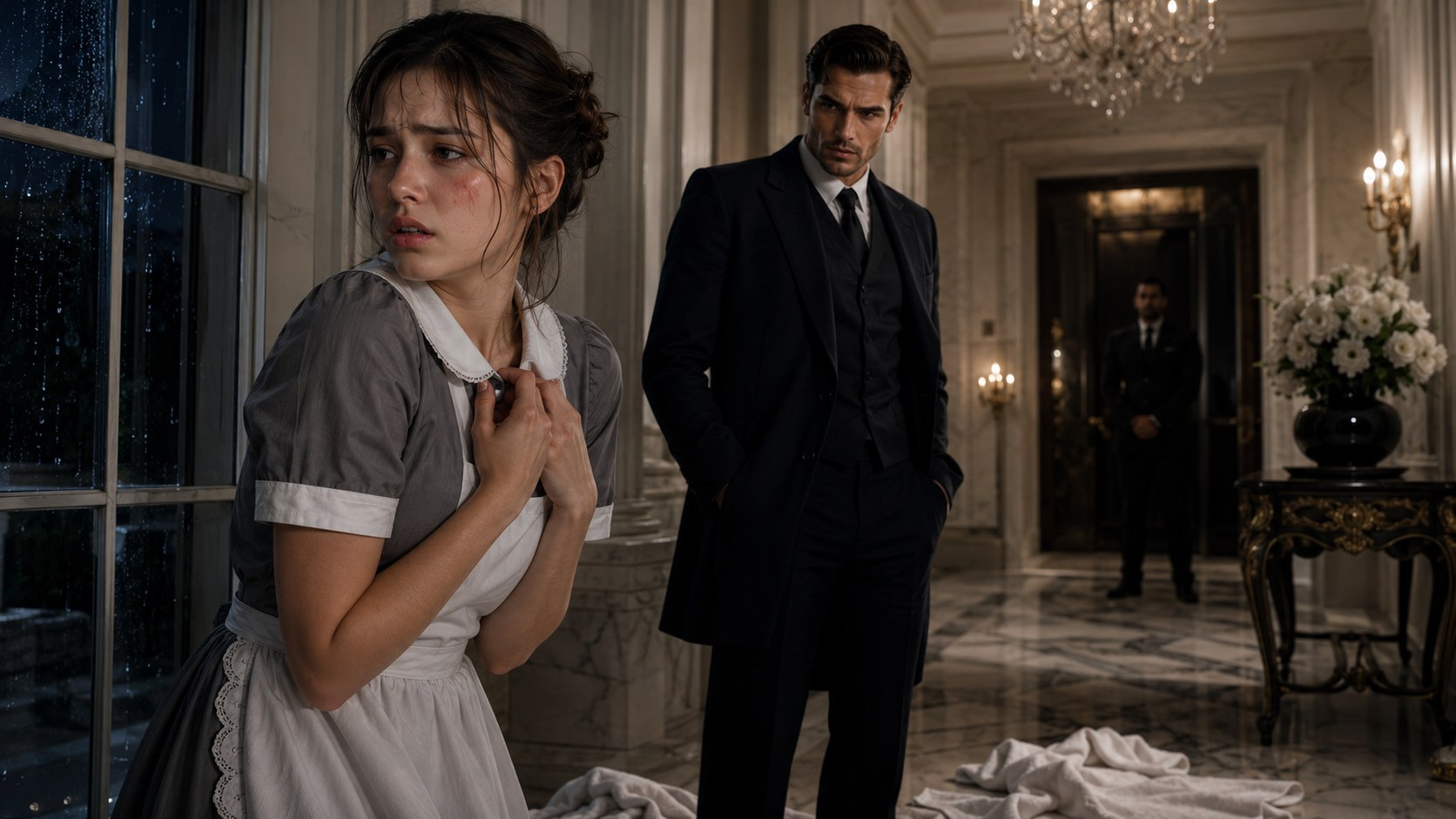
The Maid Behind the Locked Door

No one in the house was supposed to hear the maid cry.

That was the first rule of the Serrano estate, though nobody had written it down. The rules that mattered in that house were never written. They lived in glances, in lowered voices, in doors that closed before questions could be asked.

The mansion stood on a hill above the city, all black iron gates, white stone, and windows tall enough to reflect the sky like cold mirrors. People in the neighborhood called it the Cathedral because it looked too grand for sin. People who knew better called it the Cage.

Lina Vale worked there six days a week.

She arrived before sunrise, tied her brown hair low at her neck, put on the gray uniform with pearl buttons, and disappeared into the work that wealthy people noticed only when it wasn’t done. She polished the silver railings. She changed the lilies before they browned. She memorized which rooms smelled of cigars, which of perfume, which of fear.

She was twenty-four, quiet, and easy to overlook.

That made her useful.

At least, that was what Mrs. Vale, her grandmother, had always said.

“People show their real faces to the furniture and the help,” her grandmother used to tell her. “If they forget you’re human, listen carefully. That’s when truth walks barefoot.”

Lina had learned to listen.

She listened to the cooks whispering that the Serrano family had once owned half the docks and most of the police who patrolled them. She listened to the drivers say that Enzo Serrano smiled only when someone was about to lose something. She listened to the junior guards joke about old debts, quiet payments, and men who vanished after private dinners.

But mostly, Lina listened to Matteo Voss.

Matteo was not family, though he behaved as if the mansion had been built around his bones. He was Enzo Serrano’s chief of security, a square-shouldered man with pale eyes and a polished cruelty that never needed to shout. He could frighten a room by adjusting his cuffs. He could make servants tremble by saying their names softly.

He had noticed Lina on her third day.

That was when her trouble began.

At first, it was small.

“Miss Vale,” he would say, appearing in a doorway where he had no reason to be. “You missed a corner.”

She would look down at the marble floor she had just scrubbed. There would be no missed corner.

“Yes, sir,” she would answer anyway.

Then it became, “You’re slow.”

Then, “You’re careless.”

Then, “Girls like you should be grateful for work in a house like this.”

Lina had heard men like him all her life. Men who believed kindness was weakness and silence was permission. She did what she had always done. She made herself smaller. She avoided empty corridors. She kept her eyes down. She counted steps between rooms. She learned which doors did not lock and which staircases had cameras.

Then, one rainy Thursday evening, Matteo said her brother’s name.

She was carrying fresh towels past the west gallery when his voice slid out from the shadows.

“How is little Jonah?”

Lina stopped.

The towels shifted in her arms.

Matteo leaned against the wall beside a portrait of some long-dead Serrano ancestor, his hands in his pockets, his smile almost kind.

“That is your brother, isn’t it?” he asked. “Twelve years old. Asthma. Scholarship boy at St. Bartholomew’s. Very bright. Very fragile.”

Lina’s throat closed.

“Please don’t talk about him.”

Matteo pushed away from the wall.

“You’re in no position to tell me what to do.”

She stepped back. “I’ve done my work. I’m going to the laundry room.”

“You’ll go where I send you.”

“I’m not staying here.”

The smile left his face.

It happened quickly after that.

His hand closed around her wrist. The towels dropped. She tried to pull free, but he twisted her arm behind her back and shoved her toward the narrow service hall that led to the locked wine room. Lina stumbled, caught herself on the wall, and felt the sting of marble against her cheek when she fell.

For one stunned second, there was no sound but the rain striking the high windows.

Then Matteo crouched beside her.

“Listen carefully,” he said. “You saw nothing in this house. You heard nothing. You remember nothing. If you become a problem, your brother becomes one too.”

Lina pressed a hand to her face. Her cheek burned. Her wrist throbbed.

“I don’t know what you think I heard.”

His eyes sharpened.

“That answer tells me you heard enough.”

She did not cry until he left.

Even then, she tried not to make a sound.

She crawled behind the laundry carts and stayed there with one hand over her mouth, breathing through the pain, telling herself the way she always did: survive the next minute. Then survive the next.

But the west gallery had one thing Matteo had forgotten.

It had a private elevator.

And the elevator had opened just before Lina fell.

Julian Cross had arrived at the Serrano estate without warning.

He had never liked warning powerful men before he entered their rooms. Warning gave liars time to clean their hands.

At thirty-six, Julian was one of the richest men in the country, though wealth was the least dangerous thing about him. His company owned hotels, shipping warehouses, security software, and three private banks that old families used when they wanted their money to travel without questions. He did not raise his voice. He did not threaten twice. He had the kind of calm that made guilty men confess too early.

He had come to see Enzo Serrano about a missing ledger.

The ledger was supposed to contain names, payments, shell companies, and enough evidence to pull a dozen important people into daylight. Julian had been hunting it for two years because his father’s name was rumored to be inside it.

His father had died in a car accident when Julian was nineteen.

Julian had never believed in accidents that benefited criminals.

Enzo Serrano claimed he did not have the ledger.

Julian believed him.

That was the problem.

Because if Enzo did not have it, someone inside his house did.

Julian stepped out of the private elevator with two men behind him and heard the fall before he saw the girl.

A body hitting marble had a sound people pretended not to recognize.

His gaze moved down the corridor.

A maid lay on the floor near the laundry entrance. A man crouched beside her, speaking too low to hear. Then the man stood and walked away with the satisfied stiffness of someone who thought fear had done its work.

Julian did not move for several seconds.

The maid pushed herself up on one trembling arm. Her hair had fallen loose from its pins. One cheek was already reddening. Her gray uniform was wrinkled at the shoulder where someone had grabbed it.

She looked toward the elevator.

Their eyes met.

Julian saw the exact moment she decided not to ask for help.

That was what angered him.

Not only the bruise. Not only the threat. Not only the man walking away.

It was the way she swallowed her pain because life had taught her help came with a price.

“Mr. Cross?” his assistant murmured behind him.

Julian’s voice was quiet.

“Find out who touched her.”

His assistant, Mara, followed his stare. Her face changed.

“Yes, sir.”

Julian crossed the gallery.

The maid tried to stand too quickly and nearly fell again. He stopped three steps away so he would not tower over her.

“Don’t get up yet,” he said.

“I’m fine.”

“No.”

She blinked at him, startled by the firmness of the word.

“You’re not,” Julian said. “But you may decide how much help you accept.”

Her fingers tightened around the fallen towel.

“I can’t be seen talking to you.”

“You already have been.”

Fear moved across her face so quickly most men would have missed it.

Julian did not.

“What’s your name?” he asked.

She hesitated.

“Lina.”

“Lina what?”

“Vale.”

“Who hurt you, Lina Vale?”

Her eyes shifted toward the hall Matteo had taken.

“I slipped.”

Julian looked at the marble floor. Dry. Polished. Empty.

“No, you didn’t.”

Her mouth pressed into a line.

He respected that silence more than he liked it.

Behind him, the doors to the grand salon opened. Enzo Serrano emerged in a dark suit, silver hair combed back, smile ready before his eyes found the scene.

“Julian,” Enzo said smoothly. “You should have told me you were coming.”

“I prefer arriving while the truth is still unpacked.”

Enzo’s smile thinned.

Then he noticed Lina on the floor.

His expression changed, but not with concern. Irritation. Calculation. A host displeased by an untidy stain.

“What happened here?” Enzo asked.

Lina tried again to rise.

Julian held out one hand, palm open, not touching.

She stared at it.

Everyone in that house knew Julian Cross’s hand. It signed purchases that swallowed companies. It approved investigations that ruined reputations. It had shaken hands with presidents and refused the hands of men who later went to prison.

Lina took it anyway.

His grip was warm and steady. He helped her stand slowly.

Enzo watched.

“Miss Vale is unwell,” Julian said.

“She is staff,” Enzo replied. “My housekeeper will handle it.”

“No.”

One word.

The gallery went still.

Enzo’s eyes hardened. “Excuse me?”

Julian turned his head toward Mara.

“Bring her to me.”

Lina went cold.

Every servant in the gallery heard it. So did the guards. So did Enzo.

Bring her to me.

In a house like this, words could be a rope.

Lina pulled her hand away.

“I didn’t do anything.”

Julian looked back at her, and something in his expression shifted. Not softness exactly. Understanding.

“I wasn’t talking about you.”

The silence changed shape.

Julian turned toward the hall where Matteo had vanished.

“I meant whoever put his hands on you.”

Enzo’s face became very still.

“Be careful, Julian.”

“I am.”

“That man is my security chief.”

“Then your house is less secure than you think.”

Enzo stepped closer. “You do not give orders in my home.”

Julian’s gaze did not move from his.

“No. I give consequences.”

For the first time since Lina had started working at the estate, Enzo Serrano looked uncertain.

It lasted only a second.

Then he smiled again.

“Matteo,” he called.

The name traveled down the corridor.

A moment later, Matteo Voss returned.

He saw Julian first, then Enzo, then Lina standing with one hand pressed to her wrist.

His eyes narrowed.

“Sir?”

Enzo spoke lightly. “Mr. Cross has a question.”

Julian studied Matteo the way a surgeon might study a wound before cutting.

“Did you touch her?”

Matteo’s face showed nothing. “She fell.”

“That is not what I asked.”

“She’s clumsy.”

Lina looked down.

Julian saw it. The reflexive shrinking. The old training.

He hated old training.

Mara returned from the elevator with a tablet in her hand. She did not interrupt. She simply stood beside Julian and waited.

Julian kept his eyes on Matteo.

“Again,” he said. “Did you touch her?”

Matteo laughed once.

Not because anything was funny.

Because men like him laughed when they wanted witnesses to choose sides.

“With respect, Mr. Cross, you don’t understand how staff behave in houses like this. They exaggerate. They steal. They listen. Sometimes they need correction.”

Lina flinched.

That was his mistake.

Julian did not look at Lina. He did not need to.

He looked at Mara.

“Show me.”

Mara tapped the tablet.

The screen displayed a frozen image from the west gallery camera. Matteo’s hand on Lina’s wrist. Her body turned away. Towels falling.

Matteo’s smile disappeared.

Enzo’s eyes cut toward him.

“You said that camera was down,” Enzo murmured.

Lina heard it.

So did Julian.

There it was.

Not shock that Matteo had hurt her. Not concern that a maid had been threatened.

Irritation that the lie had failed.

Julian took the tablet from Mara.

“Camera wasn’t down,” he said. “Your internal feed was. Mine wasn’t.”

Enzo’s gaze sharpened.

“You put surveillance in my house?”

“I put protection on my elevator entrance after three men connected to your organization tried to search one of my vehicles last month.”

“That is a serious accusation.”

“I make serious accusations when I can prove them.”

Matteo looked at Enzo. “Boss—”

Enzo raised one hand.

The word died.

Julian stepped closer to Matteo.

“Miss Vale,” he said without turning, “did this man threaten your brother?”

Lina’s heart pounded so hard she could barely hear the rain.

Every instinct told her to say no.

No kept Jonah safe.

No kept her employed.

No kept her invisible.

But invisibility had not saved her. It had only made men comfortable hurting her where no one was supposed to look.

She lifted her chin.

“Yes.”

Matteo’s head snapped toward her.

Julian’s voice remained calm.

“With what?”

Lina swallowed. “He knew his school. His illness. He said if I became a problem, my brother would become one too.”

Mara’s jaw tightened.

Enzo sighed, almost bored. “Matteo, you disappoint me.”

Lina stared at him.

Disappoint.

As if a threat against a child were poor manners at dinner.

Matteo’s face changed. “I did it for the house.”

“No,” Julian said. “You did it because fear made you feel tall.”

Matteo stepped forward.

Julian’s guards moved before he finished the step.

Two men in black suits caught Matteo by both arms and pushed him back against the wall. Not violently. Efficiently. The kind of restraint that left no room for performance.

Enzo’s guards reached for their jackets.

Julian did not look away from Enzo.

“Tell your men to think carefully.”

The room held its breath.

Enzo smiled again, but this time there was no warmth pretending to be charm.

“My house. My staff. My discipline.”

“Your house,” Julian agreed. “My evidence. Federal interest.”

The words landed like a dropped blade.

Enzo’s smile vanished.

Julian lifted the tablet slightly.

“Assault. Threats against a minor. Tampering with internal cameras. And that is only what happened in one corridor while I was standing nearby.”

Matteo went pale.

Enzo looked at him properly now, not as an employee, but as a liability.

Lina had seen that look before.

Men in power did not always punish cruelty.

They punished inconvenience.

“Take him downstairs,” Enzo said.

Matteo’s eyes widened. “Mr. Serrano—”

“Quiet.”

The guards started to move him.

Julian spoke.

“No.”

Enzo turned.

Julian’s voice was colder now.

“He doesn’t go downstairs. He goes with my people.”

“That man works for me.”

“He threatened a woman under my protection.”

Lina turned sharply.

Under my protection.

The words were dangerous. They sounded like ownership if spoken by the wrong man.

Julian noticed her reaction.

“To be clear,” he said, still looking at Enzo, “protection she did not request, does not owe payment for, and may refuse at any time.”

Lina stared at him.

Enzo laughed softly. “You always were theatrical.”

“And you always mistook restraint for weakness.”

For a moment, the two men looked at each other across the marble gallery, and Lina understood something.

This was not only about her.

She had become the lit match in a room already full of gas.

Matteo struggled. “She’s lying. Check her room. Check her bag. She’s the one who took it.”

Lina froze.

Julian’s eyes narrowed.

“Took what?”

Enzo’s expression changed before he could hide it.

Matteo realized he had spoken too much.

Julian saw everything.

“What did she take?” he asked.

No one answered.

Then a voice came from the edge of the gallery.

“She didn’t take anything.”

Everyone turned.

The speaker was Mrs. Doria, the oldest housekeeper in the mansion. She had worked for the Serranos for twenty-three years and moved through the estate like a ghost with keys. Her silver hair was pulled into its usual severe knot. Her black dress was spotless. Her face was calm.

But her hands trembled.

Enzo’s expression darkened. “Doria.”

She did not look at him.

She looked at Lina.

“I’m sorry, child.”

Lina could not speak.

Mrs. Doria reached into the pocket of her apron and removed a small brass key.

Enzo’s voice dropped.

“Think very carefully.”

“I have,” she said. “For years.”

The rain battered the windows.

Mrs. Doria held the key out to Julian.

“Wine room. North wall. Third cabinet from the left. There is a false back.”

Enzo moved.

Julian’s guards moved faster.

The entire gallery shifted into controlled chaos. Enzo’s men shouted. Julian’s men blocked doors. Mara called someone and spoke in clipped legal language. Lina stood in the middle of it all, dizzy, her wrist aching, her cheek burning, while the house that had swallowed secrets for decades began to choke on one.

Julian did not take the key at first.

He looked at Lina.

“You don’t have to stay for this.”

She almost laughed.

Where would she go? Back to the staff room? Back to the bus stop in the rain? Back to Jonah and pretend monsters stayed behind gates?

“No,” she said. “I want to see.”

Something like respect moved across his face.

He took the key.

They went to the wine room.

Lina had cleaned outside that door every Tuesday and Friday. She had never been allowed inside. It smelled of old wood, expensive dust, and the bitter sweetness of bottles that cost more than her monthly rent.

Mrs. Doria pointed to the cabinet.

Julian opened it.

Rows of wine slept in velvet-dark shelves.

He pressed along the back panel. Nothing happened.

Mrs. Doria stepped forward and pushed a small carved rose near the hinge.

A click.

The false back loosened.

Behind it sat a black leather ledger wrapped in oilcloth.

Enzo Serrano said nothing.

But his silence was not empty.

It was fear with its mouth closed.

Julian lifted the ledger carefully.

His fingers tightened only once when he opened it.

Lina saw names. Dates. Numbers. Initials. A photograph tucked between pages. Old paper. New ink.

Mara looked over his shoulder and went still.

“Julian,” she said softly.

He had already seen it.

Near the middle of the ledger was an entry dated seventeen years earlier.

Cross, Adrian. Payment approved. Vehicle arranged. Problem contained.

The room seemed to tilt.

For one second, Julian Cross was no longer a billionaire, no longer a man feared in boardrooms and back rooms alike. He was a son staring at proof that grief had been manufactured.

Then he closed the ledger.

The sound was soft.

Final.

Enzo spoke at last.

“You don’t understand what that book will do.”

Julian turned.

“It will tell the truth.”

“It will start a war.”

“No,” Julian said. “It will end one you thought you had already won.”

Enzo’s eyes moved to Lina.

And she knew before he spoke that he would try to make her small again.

“This began with a maid who forgot her place.”

Julian stepped between them.

“No. This began with powerful men believing places belonged to them.”

Enzo smiled faintly. “Careful. You sound sentimental.”

“I’m not sentimental.”

Julian looked at Matteo, still held by the guards near the door.

“I’m precise.”

Matteo tried one last time.

“She heard us talking about the ledger. I only scared her because she was going to run to him.”

Lina’s eyes widened.

That was the missing piece.

She had been changing flowers outside the study two nights ago when voices rose behind the door. She had heard Matteo say something about “the Cross entry” and Enzo answer, “Keep the girl away from guests. She has ears.”

She had not understood.

They had thought she had.

Her ignorance had nearly gotten Jonah threatened.

Her silence had nearly protected them.

Julian turned to her.

“Is that true? Did you hear them?”

Lina looked at Enzo, then Matteo, then the ledger in Julian’s hand.

For years, she had survived by making herself harmless.

But harmless people still got hurt.

“Yes,” she said. “I heard your name. I heard them say the ledger. I didn’t know what it meant.”

Enzo’s voice softened.

It was the most frightening sound she had heard all night.

“Miss Vale, you are tired. Injured. Confused. Think about your brother before you attach yourself to a dangerous man’s accusations.”

Julian’s jaw tightened.

Lina lifted one hand.

Not to Julian.

To stop him.

She looked at Enzo Serrano herself.

“My brother is exactly why I’m not confused anymore.”

For the first time, Enzo looked at her as if she were not furniture.

It gave her courage.

“You built a house where everyone is afraid to tell the truth,” she said. “Then you acted surprised when lies started living here.”

Mrs. Doria covered her mouth.

Mara smiled, just barely.

Julian’s eyes never left Lina’s face.

Enzo’s voice turned sharp. “You think he will save you?”

Lina shook her head.

“No. I think I just saved myself.”

The police arrived eighteen minutes later.

Not local patrol officers who might owe favors. Federal agents in dark coats, led by a woman with calm eyes and a sealed warrant. Julian had not come to the estate unprepared. He had come waiting for one honest opening.

Matteo Voss was taken first.

He did not look powerful in handcuffs.

He looked ordinary.

That disturbed Lina more than she expected. Monsters, she thought, should look like monsters. But most of them looked like men who knew which rooms had no witnesses.

Enzo Serrano was not arrested that night.

Men like him were rarely taken in the first wave. They had lawyers, layers, and people willing to burn themselves to keep the top floor untouched.

But the ledger left the mansion in federal custody.

So did the camera footage.

So did Mrs. Doria’s statement.

So did Lina’s.

By midnight, the Serrano estate no longer felt like a cathedral.

It felt like a crime scene.

Lina sat in the back of Julian’s car with a blanket around her shoulders, staring at the mansion through rain-streaked glass.

Julian stood outside speaking with the federal agent. His coat was soaked at the shoulders. He did not seem to notice.

Mara sat beside Lina.

“You should let a doctor look at your wrist.”

“I need to get home to Jonah.”

“We already sent a car to your apartment. Your grandmother and brother are safe. Your neighbor Mrs. Patel is with them.”

Lina turned.

“You went to my home?”

Mara’s expression remained gentle.

“We called first. Your grandmother answered. She yelled at us for three minutes before accepting help.”

Despite everything, Lina almost smiled.

“That sounds like her.”

Mara looked toward Julian.

“He told them not to enter unless invited.”

Lina absorbed that.

Small things mattered.

Men who wanted control ignored doors.

Men who understood fear waited outside them.

Julian returned a few minutes later and opened the car door himself.

“May I sit?”

Lina looked at the empty seat across from her.

“You’re asking?”

“Yes.”

She nodded.

He got in.

For a while, neither of them spoke.

The rain softened against the roof.

Finally, Lina said, “You knew the ledger might be here.”

“Yes.”

“You used me?”

“No.”

She studied him carefully.

“Did you follow me?”

“No.”

“Did you know Matteo was threatening me?”

“Not until tonight.”

“But you were ready.”

Julian looked out at the gates.

“I am always ready in houses owned by men like Enzo Serrano.”

“That must be exhausting.”

“It is.”

The honesty surprised her.

She pulled the blanket closer.

“He said I attached myself to a dangerous man.”

Julian’s mouth tightened.

“He wasn’t entirely wrong.”

Lina looked at him.

Most men would have denied it.

Julian did not.

“I am dangerous to people who use money and fear as weapons,” he said. “I have also been careless in the past about how my power affects people standing near me. You should know both things before deciding whether to trust anything I offer.”

“What are you offering?”

“A doctor tonight. Legal support tomorrow. Security for your family until Matteo and Serrano’s men no longer pose a risk. A choice in every step.”

“And the price?”

“No price.”

“There’s always a price.”

“Yes,” Julian said. “But sometimes the person paying it is the one who owes the debt.”

Lina did not understand.

He looked down at his hands.

“My father died because men in that house decided his life was a business problem. You helped expose that truth.”

“I didn’t do it for you.”

“I know.”

“I didn’t even know what I had heard.”

“You still told the truth when lying would have been safer.”

Lina looked away.

“Safe never lasts.”

“No,” Julian said. “But neither does fear when enough people stop feeding it.”

The next week moved like a storm breaking apart over water.

Matteo Voss was charged with assault, intimidation, evidence tampering, and conspiracy tied to the ledger. His lawyer tried to paint him as loyal staff who had “overreacted during a stressful security breach.” The camera footage ruined that story before it could breathe.

Enzo Serrano retreated behind lawyers and locked gates, but the gates no longer kept the world out. Reporters gathered at the foot of the hill. Former employees began calling federal hotlines. Old names resurfaced. Old cases reopened. Men who had once dined under Enzo’s chandeliers suddenly forgot his number.

Lina did not return to the mansion.

Julian made sure her wages continued for thirty days through a legal victims’ fund, not through Serrano payroll. Mara arranged an attorney who spoke to Lina like she had a mind, not just a problem. A doctor wrapped her wrist, examined the bruise on her cheek, and documented everything. Jonah’s school changed pickup procedures. A quiet security team watched their apartment building from a respectful distance.

Her grandmother approved of none of it until she met Julian.

Mrs. Vale was seventy-one, five feet tall, and capable of making billionaires feel underdressed.

She opened the apartment door with a wooden spoon in one hand and suspicion in both eyes.

“So you’re the rich man.”

Julian stood in the hallway holding nothing. No flowers. No gifts. Smart.

“Yes, ma’am.”

“My granddaughter says you ask before entering.”

“I try to.”

“Try harder.”

“Yes, ma’am.”

Lina, standing behind her grandmother, pressed her lips together to keep from smiling.

Jonah peered from the kitchen doorway, inhaler in his sweater pocket, eyes wide behind round glasses.

Julian crouched slightly, not all the way, but enough to lower the height difference.

“Hello, Jonah.”

Jonah looked at Lina.

She nodded.

“Hi,” he said.

Julian did not extend a hand. “Your sister told me you like astronomy.”

Jonah’s eyes lit despite himself. “That’s not true.”

Lina frowned. “It’s not?”

“I like astrophysics. Astronomy is looking. Astrophysics is why.”

Mrs. Vale snorted. “He does this to everyone.”

Julian’s mouth curved.

“My mistake,” he said seriously. “Astrophysics, then.”

Jonah studied him.

Then he asked, “Do billionaires know about black holes?”

“Some behave like them.”

Jonah laughed.

Lina watched Julian’s face at the sound. It changed him. Not much. Enough.

Later, after Jonah returned to his homework and Mrs. Vale pretended not to listen from the kitchen, Lina walked Julian to the hall.

“Thank you,” she said.

His expression closed slightly, as if gratitude made him uncomfortable.

“You don’t owe me that.”

“I know. I’m saying it anyway.”

He nodded.

The hall light flickered once overhead. The building was old, stubborn, and always either too hot or too cold. Julian looked out of place in it, but not disgusted. That mattered too.

“Enzo’s lawyers may try to question your credibility,” he said. “They’ll look for anything they can twist.”

“I assumed.”

“They may bring up your family finances. Your brother’s medical bills. Your employment history.”

“They’ll say I wanted money.”

“Yes.”

“Did you?”

He paused.

“Did I what?”

“Think I wanted money?”

“No.”

“Why not?”

Julian’s eyes met hers.

“Because when you were hurt on that floor, you apologized for bleeding on the marble.”

Lina looked down.

She had forgotten that.

He had not.

“I hated that,” he said quietly.

She believed him.

That was dangerous.

Believing powerful men was how many women got trapped. But Julian did not ask her to believe blindly. He kept handing her facts, choices, names, documents. He let proof stand where charm would have been easier.

Over the next month, Lina learned that freedom did not arrive dramatically. It arrived in forms, signatures, therapy appointments, changed locks, court dates, and nights when Jonah slept without checking the window.

It arrived when Mrs. Vale stopped putting a chair under the doorknob.

It arrived when Lina walked past a man in a dark suit and did not flinch.

It arrived when she looked in the mirror and saw the bruise fading, then gone, and realized she was still angry.

Not afraid.

Angry.

Anger, she discovered, had cleaner edges.

Mara offered her a job first.

Not Julian.

That was important.

“The Cross Foundation needs a residential coordinator for women leaving coercive employment situations,” Mara said over coffee. “It involves housing logistics, appointments, transportation, crisis intake. You know the gaps because you’ve lived inside them. The pay is good. Training included. You would report to me, not Julian.”

Lina stared at her.

“You’re offering me charity with a desk?”

Mara laughed. “I’m offering you work with a salary and an annoying amount of paperwork.”

“I don’t have a degree.”

“You have competence. We can train the rest.”

Lina thought of the Serrano estate. The locked wine room. The women who had probably walked those halls before her and said nothing because rent was due, children needed medicine, and men like Matteo understood the mathematics of fear.

“When do I start?” she asked.

The trial did not happen quickly.

Real consequences rarely did.

But hearings began. Deals were offered. Names were traded. Enzo Serrano’s empire started to collapse not with a gunshot, but with accountants, subpoenas, and frightened men saving themselves in alphabetical order.

Matteo tried to claim he had acted alone.

Then the ledger produced payment records.

Enzo tried to claim he had never ordered violence.

Then Mrs. Doria testified about the locked room.

A former driver testified.

Then a former cook.

Then a woman who had been a maid before Lina, who had vanished from the estate after refusing Matteo’s attention.

Her name was Celia Wren.

She stood in court with shaking hands and told the truth anyway.

Lina sat behind her.

When Celia finished, she turned, searching the room like someone coming up from underwater.

Lina held her gaze and nodded once.

Celia began to cry.

Not loudly.

No one in that house had been allowed to cry loudly.

Julian sat on the opposite side of the aisle, surrounded by attorneys. He did not look at Lina often. He had learned that people watched them and invented meanings. He kept distance where distance protected her.

But after the hearing, in the courthouse corridor, he approached only when she was standing alone.

“You did well,” he said.

“I only sat there.”

“Sometimes that is the hard part.”

She leaned against the wall, suddenly tired.

“Do you ever stop measuring every room?”

He looked at her.

“No.”

“Me neither.”

Outside, cameras waited behind barricades. Questions rose and broke like waves whenever a lawyer stepped through the doors.

Lina took a breath.

Julian noticed.

“There’s a side exit.”

“I know.”

“Do you want it?”

She looked toward the front doors.

For months, she had been hidden. Behind carts, behind silence, behind other people’s decisions. The thought of cameras terrified her.

But fear was not always an instruction.

Sometimes it was only weather.

“No,” she said. “I want the front.”

Julian studied her for a moment.

Then he stepped aside.

Not in front of her.

Not behind her.

Beside her, but with enough space that no photograph could turn protection into possession.

Lina walked out through the courthouse doors.

The questions hit immediately.

“Miss Vale, did you know about the ledger?”

“Were you paid by Julian Cross?”

“Are you afraid of Enzo Serrano?”

She stopped at the microphone.

Her lawyer started to guide her away, but Lina lifted a hand.

The reporters quieted by degrees.

She looked into the cameras.

“My name is Lina Vale,” she said. “I worked in a house where people believed silence belonged to them. It did not. What happened to me has happened to many workers in many houses, offices, kitchens, hotels, and private rooms. Not all cages have bars. Some have paychecks. Some have threats. Some have powerful men calling cruelty discipline.”

The crowd stilled.

Lina’s voice shook once.

She continued anyway.

“I am not here because a billionaire saved me. I am here because women before me kept records, opened doors, remembered names, and finally spoke. I am here because my brother deserves a world where fear does not get to make family decisions. And I am here because the truth does not become less true just because the person saying it wears a uniform.”

She stepped back.

For once, no one shouted.

That night, Julian came to the foundation office after everyone else had gone home.

Lina was at her desk, surrounded by intake forms and cold tea. She looked up when he stopped at the doorway.

“You’re working late,” he said.

“So are you.”

“I own the building. That makes it less impressive.”

She smiled despite herself.

He held up a paper bag. “Your grandmother sent food.”

“My grandmother sent you?”

“She said you forget to eat when angry.”

“She’s not wrong.”

He placed the bag on the table near the door.

Still waiting for invitation.

Lina closed the file in front of her.

“You can come in.”

He did.

For a while they ate dumplings from paper containers under fluorescent lights while the city moved beyond the windows.

No mansion. No marble. No guards in the room.

Just rain, food, and two people learning what silence could feel like when it was not forced.

Finally, Lina said, “I used to think being invisible kept me safe.”

Julian looked at her.

“Did it?”

“No. It kept other people comfortable.”

He nodded slowly.

“I used to think power meant never needing anyone.”

“And?”

“It meant never knowing who stayed because they wanted to.”

Lina looked down at her tea.

“Is that why you ask permission for everything now?”

His mouth curved faintly.

“I ask because I have been the kind of man who assumed too much. I am trying not to remain him.”

That answer stayed with her.

Not because it was perfect.

Because it was unfinished.

Perfect men were usually selling something. Unfinished ones might still choose.

Months later, Enzo Serrano accepted a plea agreement that did not feel like enough to the public and felt like a miracle to the people who had once feared saying his name. Matteo Voss received a sentence long enough for Jonah to grow taller than Lina. The ledger became evidence in cases across three states. Julian’s father’s death was officially reopened, then reclassified.

Not an accident.

Lina attended Adrian Cross’s memorial service in spring.

Julian did not ask her to come. Mara did.

The service was small, private, held in a garden behind a museum Adrian had loved. Julian spoke only once.

“My father taught me that justice without tenderness becomes revenge,” he said. “For a long time, I remembered only the justice part.”

His eyes found Lina’s for half a second.

Then moved on.

Afterward, they walked together beneath trees bright with new leaves.

“Do you feel better?” Lina asked.

Julian considered.

“No.”

She appreciated the truth.

“But I feel less haunted,” he said.

“That’s something.”

“Yes.”

Jonah ran ahead with Mara’s niece, both of them arguing about whether time travel would create a paradox. Mrs. Vale sat on a bench nearby, pretending not to enjoy the expensive garden.

Lina watched her brother laugh.

That sound had become her favorite proof.

Julian stood beside her.

Not too close.

Never too close unless she chose it.

“Lina,” he said.

She turned.

For once, he looked uncertain.

It suited him better than control.

“I would like to take you to dinner,” he said. “Not as gratitude. Not as protection. Not as strategy.”

Her heart moved strangely.

“As what?”

“As a man asking a woman who owes him nothing.”

The answer should have been simple.

Yes or no.

But Lina had learned that freedom lived in the space before answering. The space where no one rushed you. The space where wanting could be examined without fear.

She looked at Julian Cross: dangerous, careful, wounded, powerful, trying.

Then she smiled.

“One dinner,” she said. “Somewhere without marble.”

His expression changed.

Not victory.

Relief.

“I know a place.”

“No private rooms.”

“Agreed.”

“No guards at the table.”

“Nearby?”

“Across the street.”

He nodded. “Across the street.”

“And if you try to order for me, I’m leaving.”

For the first time since she had met him, Julian laughed fully.

It startled birds from the trees.

Lina decided she liked the sound.

Years later, people would tell the story incorrectly.

They would say a shy maid was hurt inside a mafia boss’s mansion, and a furious billionaire ordered, “Bring her to me.”

They would make Julian the storm.

They would make Lina the girl rescued from it.

They would be wrong.

The truth was sharper and better.

A maid who had been trained to disappear finally refused.

An old housekeeper opened a locked room.

A ledger spoke for the dead.

A billionaire learned the difference between saving and standing beside.

And a girl who once apologized for bleeding on marble walked through courthouse cameras, foundation doors, spring gardens, and the rest of her life with her head raised.

Lina Vale was never invisible again.