When the Marble Steps Remembered

When the Marble Steps Remembered

“Celia?” he answered at once, his voice alert before she had even spoken. “What happened?”

The sound of her brother’s voice broke something in her more completely than the messages ever had.

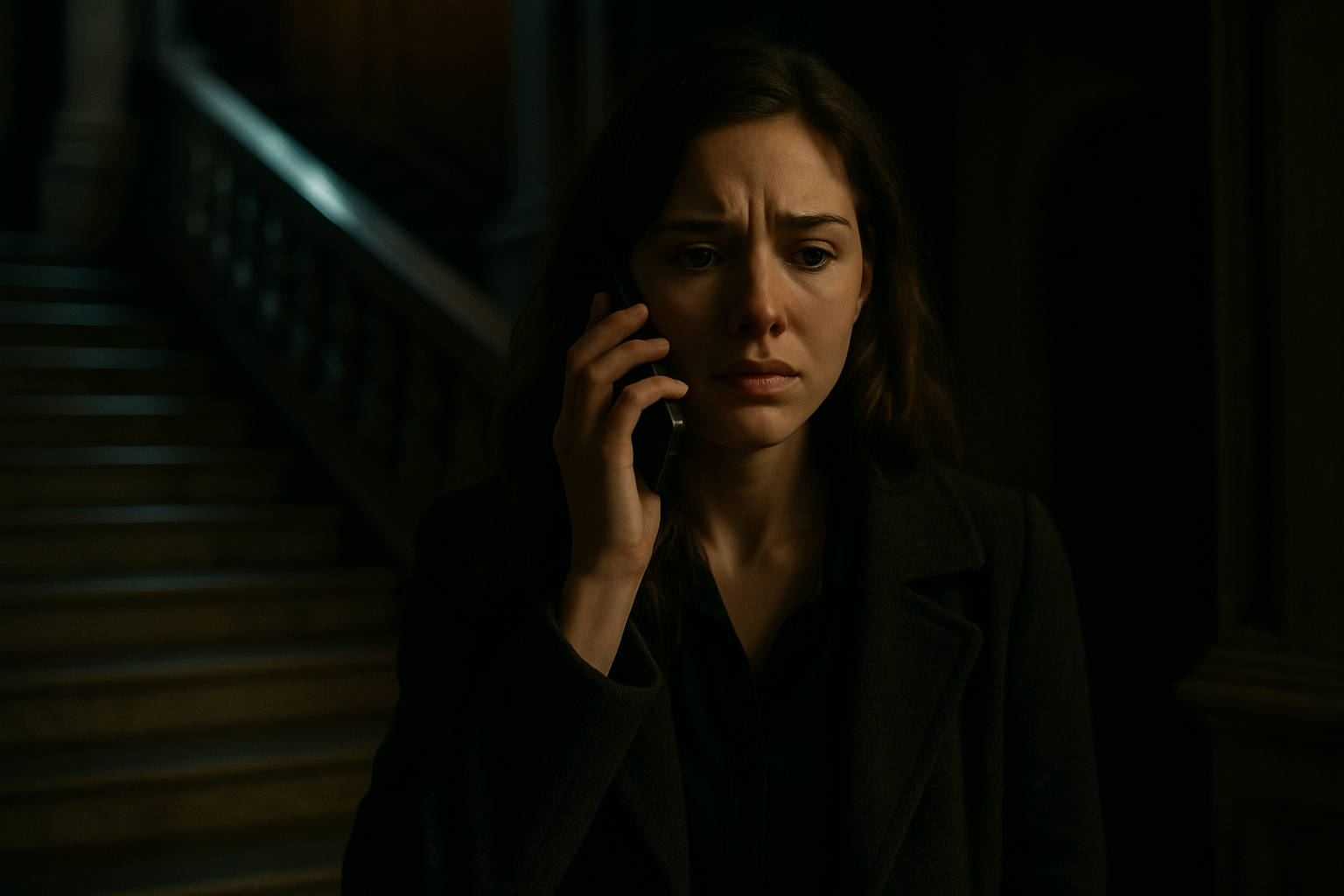
For several seconds, Celeste Marlowe could not speak. She stood in the shadowed hallway of the house that had once felt like proof she had been chosen, loved, secured. Now it seemed to breathe around her like a beautiful animal with teeth. Her hand trembled around the phone. The screenshots waited on the screen, cold and damning, every word between her husband and another woman a needle pushed beneath the skin.

She pressed her fist against her mouth and tried to draw air into her lungs.

“I need you,” she whispered.

That was all.

An hour later, she was in Adrian Vale’s office, seated in the deep leather chair opposite his desk, a folder of printed screenshots balanced on her lap. Beside her, a mug of tea sat untouched, steam fading into the late-night quiet. Rain tapped the tall windows behind Adrian, blurring the city lights into streaks of gold and white.

Adrian read every page.

He did not interrupt her with questions. He did not swear, though Celeste knew his temper well enough to recognize the stillness that came before it. He did not offer soft little phrases meant to soothe the wound while ignoring the knife still buried inside it.

He simply read.

Page after page.

Message after message.

Dinner reservations. Hotel confirmations. Cruel jokes. Plans made in the language of entitlement. References to Celeste’s pregnancy as though it were an inconvenience, a legal obstacle, a temporary problem to be managed.

When Adrian finished, he squared the pages into a precise stack on his desk and looked at his sister.

“Are you safe in that house tonight?”

Celeste blinked.

She had expected fury. She had expected a legal lecture, perhaps even the first outlines of war. She had not expected that question, so simple and so terrifying that it stripped away every excuse she had been using to stay upright.

“I think so,” she said.

Adrian’s eyes sharpened. “That is not an answer.”

She swallowed. “He’s cruel.”

Her palm moved instinctively over the curve of her stomach.

“He’s not violent.”

Adrian’s jaw tightened. In the yellow pool of his desk lamp, his face looked carved rather than born.

“Cruelty,” he said quietly, “is violence that hasn’t chosen its method yet.”

The words settled between them.

Celeste looked down at herself—at the swollen belly beneath her wool coat, at the daughter who shifted inside her as if responding to the tension in the room. She had spent years telling herself Dorian Blackwell’s coldness was stress, ambition, fatigue, brilliance. The price of loving a man who built towers and negotiated with billionaires before breakfast. The price of standing beside someone powerful.

“What do I do?” she asked.

Adrian leaned back, not with hesitation but with calculation. He was not merely her brother in that moment. He was the litigator who could make a witness confess with silence, the strategist who saw ten moves past a man who thought money made him untouchable.

“You go home,” he said. “You smile. You act tired, trusting, a little overwhelmed. You let him believe he is still smarter than you.”

Celeste stared at him. “You want me to pretend?”

“I want you to survive long enough for me to build a case so tight he won’t be able to buy a breath inside it.”

“Adrian, I’m pregnant.”

“That is exactly why we do this carefully.” His voice softened, though his eyes remained hard. “Dorian thinks you’re alone. He thinks you’re ashamed. He thinks pregnancy has made you fragile. Let him believe it. Weak men make arrogant mistakes when they are certain no one is watching.”

For the next four weeks, Celeste lived inside a performance so convincing that there were moments she frightened herself.

She made dinner while Dorian lied about late meetings. She asked if he wanted coffee while he texted Serena Vey beneath the dining table, his expression lit by the secret glow of his phone. She let him kiss her cheek in public. She let him rest his hand on her stomach at a children’s hospital benefit while cameras flashed and donors praised his devotion to family.

“Such a beautiful couple,” one woman had said.

Celeste had smiled so perfectly her cheeks ached.

Every smile cost her something.

Every laugh felt like swallowing glass.

Every time Dorian touched her, she had to remind herself not to flinch.

At night, after he fell asleep or left the house under the excuse of another investor dinner, Celeste moved through his office like a ghost. She uploaded documents to the secure folder Adrian had created for her. Bank statements. Property records. Insurance notices. Tax correspondence. Emails Dorian had carelessly left open on his desktop, trusting that his wife was too exhausted, too devoted, or too foolish to read them.

There were receipts from restaurants where he had allegedly met contractors but had reserved tables for two under Serena’s name. Credit card charges for jewelry that had never reached Celeste. Spa weekends disguised as client retreats. Hotel suites booked during evenings when he claimed to be across town reviewing architectural plans.

Celeste photographed everything.

Her hands shook at first. Then they stopped shaking.

Adrian moved faster than Dorian expected because Adrian was not only a divorce attorney. He was a trial lawyer with the instincts of a hunter and the patience of a surgeon. He understood money the way a physician understands blood: where it should flow, where it had pooled, where a wound had been hidden beneath silk.

He brought in a forensic accountant with silver hair and a voice like dry paper. He hired a private investigator who knew how to follow a luxury car without being seen. He consulted a former government investigator who specialized in buried assets and false corporate structures.

Together, they traced Dorian’s transfers from joint accounts into shell companies. They uncovered a penthouse in Westhaven leased through a faceless limited company. They found payments to Serena’s boutique design studio disguised as staging expenses for properties she had never staged. They discovered invoices that led nowhere, consulting fees paid to ghosts, and development funds quietly siphoned into accounts that should never have existed.

And then they found something larger.

Dorian had not merely stolen from Celeste.

He had been stealing from people far more dangerous than his pregnant wife.

For months, he had been draining funds from Ashbourne Capital, the private investment firm backing his largest mixed-use development in Northbridge County. Ashbourne Capital belonged to Lavinia Ashbourne, a billionaire widow whose name appeared in gold lettering on hospital wings and museum galleries, but whose lawyers were rumored to move like wolves through the courts.

Adrian did not tell Celeste everything at once.

He knew she was carrying enough fear already. Fear for herself. Fear for the baby. Fear of the man sleeping beside her each night with secrets in his phone and contempt under his skin.

But one evening, when she sat across from him again, pale with exhaustion and one hand braced beneath her belly, he told her the only thing she needed to hear.

“We have him.”

Celeste wanted to believe that meant the worst was over.

It did not.

It meant the worst was preparing to enter the room.

Dorian served her divorce papers on a rainy Thursday evening in late October.

He did it in the living room, beneath a framed photograph from their wedding day. In the picture, Celeste was laughing at something he had whispered into her ear. Her veil lifted in the wind. Dorian’s hand rested at the small of her back. The woman in the photograph still believed whispers were promises.

The woman on the sofa knew better.

“I won’t drag this out,” Dorian said.

He poured himself bourbon from the crystal decanter with the steady hand of a man presenting a business proposal, not dismantling a marriage. The amber liquid caught the firelight as it fell into the glass.

“The marriage hasn’t worked for years. We both know that.”

Celeste lowered herself slowly onto the sofa. Her back throbbed. Her ankles were swollen. Her daughter pressed sharply beneath her ribs, as if startled by the tone in the room.

“We’re having a baby in two months,” Celeste said.

Dorian took a measured sip. “I’ll meet my legal obligations.”

She looked at him. “Legal obligations?”

He sighed, as though she had disappointed him by being sentimental. As though her body were not carrying his child. As though the nursery upstairs, half-painted in soft ivory, had nothing to do with him.

“Celia, don’t make this harder than it needs to be.”

“Does Serena know you’re saying that?”

His eyes flickered.

There it was.

Not guilt.

Calculation.

“I didn’t want you to find out this way,” he said.

“You mean before I signed?”

Dorian’s glass paused near his mouth.

“I mean before we had a civil conversation.”

A month earlier, those words might have wounded her. They might have sent her scrambling to prove she was reasonable, lovable, easy to keep. Now, her fear cooled into something steadier.

She had spent years mistaking his composure for strength.

Now she understood it was only rehearsal.

Dorian placed a folder on the coffee table. The gesture was smooth, almost elegant.

“The settlement is generous,” he said. “You keep the house. I’ll cover medical bills through delivery. After that, we’ll arrange child support according to state guidelines.”

Celeste looked at the folder but did not touch it.

“The house has two mortgages and a balloon payment due in March.”

His smile tightened. “You’ve been busy.”

“No,” she said. “I’ve been married.”

Before he could answer, the doorbell rang.

The sound moved through the house with a clean, bright finality.

Dorian frowned. “Are you expecting someone?”

“Yes.”

For the first time that evening, uncertainty crossed his face.

He set down his glass and went to the door.

When he opened it, Adrian Vale stood on the threshold with rain beading on his dark overcoat and a process server beside him.

Adrian stepped inside without raising his voice, without hurry, without apology. Water glistened on his shoulders. His expression was calm enough to make the room feel smaller.

He looked at Dorian the way he looked at hostile witnesses—without hatred, without impatience, and without the slightest intention of mercy.

“Dorian Blackwell,” the process server said, extending the documents. “You’ve been served.”

Dorian took the papers automatically. His eyes moved over the first page.

“What the hell is this?”

“The end of your strategy,” Adrian said.

Dorian looked from Adrian to Celeste. “You called him?”

Celeste remained seated, one hand resting on her belly.

She did not answer.

She did not need to.

Adrian removed his gloves with deliberate care, finger by finger, as though time itself belonged to him.

“My sister is filing for divorce on grounds of adultery, dissipation of marital assets, financial misconduct, and breach of fiduciary duty,” he said. “We have already obtained an emergency injunction freezing your personal accounts, several corporate accounts, and the entities you used to move marital funds beyond reach.”

Dorian gave a single laugh.

Sharp.

False.

“You can’t freeze corporate assets in a domestic case.”

“No,” Adrian said. “But a judge can freeze assets connected to fraud. And Lavinia Ashbourne’s counsel was extremely interested in the ledgers I delivered this morning.”

The color drained from Dorian’s face.

Celeste watched it happen with a strange, almost distant clarity. For years, she had thought power was loud. She had thought power wore tailored suits, commanded rooms, signed checks, and made others wait.

In Adrian’s hands, power was a stamped document.

A quiet sentence.

A door closing before the other man realized he was trapped.

“You had no right,” Dorian said.

“I had probable cause,” Adrian replied. “There is a difference.”

Dorian turned to Celeste then, and for the first time that night, the polished husband vanished entirely.

What remained was smaller.

Uglier.

More honest.

“You stupid little girl,” he said. “You have no idea what you just did.”

Adrian took one step forward.

The room seemed to hold its breath.

“Speak to her like that again,” he said, his voice low and even, “and your next conversation will be with courthouse security while I file for a protective order.”

Dorian’s nostrils flared. “This is my house.”

“Not tonight.”

Adrian placed another document on the entry table.

“Temporary exclusive use has been granted to Celeste because of your documented financial misconduct, harassment, and unstable behavior during late-stage pregnancy. Pack a bag. You have twenty minutes.”

Dorian looked at Celeste as if waiting for her to undo it.

Perhaps some part of him still believed she would apologize for defending herself. Perhaps he thought she would soften, plead, smooth things over the way she once had after every insult disguised as honesty and every betrayal disguised as necessity.

But Celeste did not move.

She did not speak.

She simply sat beneath the wedding photograph, one hand over her unborn daughter, and watched the man who had underestimated her lose the first thing he thought no one could take from him.

Control.

Dorian left with one suitcase, two watches, and a phone full of messages he believed he had deleted.

The ambulance reached Inova Fairfax Hospital in under eleven minutes.

Nathan counted every one of them.

He sat strapped against the bench inside the ambulance, one hand braced near Evelyn’s shoulder because the paramedic would not let him touch her while they worked. There was blood at her hairline, blood on the cuff of her coat, blood where there should not have been blood. The medic called numbers into a radio in a voice too controlled to be reassuring.

Thirty-four weeks pregnant.

Fall down courthouse steps.

Possible placental abruption.

Maternal hypotension.

Fetal heart tones difficult to establish.

Difficult to establish.

Nathan would remember those three words long after he forgot the color of the ambulance walls. He would remember how they entered him like ice water poured directly into the chambers of his heart.

Evelyn drifted in and out. Once, her eyes opened, unfocused and full of terror.

“Baby?” she breathed.

The paramedic leaned over her. “We’re almost there, ma’am.”

“No.” Evelyn’s fingers twitched against the straps. “Is she—”

Nathan broke the rule and caught her hand.

“She is fighting,” he said, because he could not say she was fine, because the truth had become a room none of them could see into yet. “And so are you.”

Evelyn’s mouth trembled. Her grip tightened with the last of her strength.

“Don’t let him decide,” she whispered.

Nathan’s blood went still.

“Who?”

But Evelyn’s eyes rolled closed again. The monitor screamed its thin mechanical warning, and the medic swore softly under his breath.

At the emergency entrance, the world became movement.

Doors flew open. Cold air rushed in. White lights. Rolling wheels. A woman in blue scrubs asking gestational age. Another calling for obstetrics and trauma. Someone cut Evelyn’s coat up the sleeve. Someone else shouted for an ultrasound. Nathan followed until a nurse planted both hands on his chest.

“Sir, you have to wait here.”

“I’m her brother.”

“You still have to wait here.”

“She doesn’t want her husband making medical decisions,” Nathan said. “It’s in her file. Her attorney filed a medical directive. My name is Nathan Beaumont.”

The nurse’s expression changed by a fraction. Not softness. Recognition of danger.

“Do you have documentation?”

“My office does. I can have it sent in sixty seconds.”

“Send it.”

Nathan already had his phone out. His hands, which had held courtroom binders steady through hostile hearings and billion-dollar disputes, shook so badly he mistyped his own password twice.

Behind the swinging doors, Evelyn disappeared.

The doors kept moving after she was gone.

Nathan stood there, staring at them, with blood on the cuff of his shirt and courthouse dust on his knees.

Then Grant arrived.

He came through the ambulance entrance pale and breathing hard, his tie loosened, one side of his coat hanging open. He looked less like a husband than a man who had run after the consequences of his own life and still expected them to stop when he commanded.

“Where is she?” Grant demanded.

Nathan turned slowly.

For a moment neither man spoke. The fluorescent lights made Grant look older, emptied out. There had been a time when Nathan had let him stand at family tables, pour wine beside his mother’s silver candlesticks, call Evelyn sweetheart in a voice that seemed gentle if no one listened closely enough.

Now Nathan saw him as he was: a man who had used charm the way other men used knives.

“You don’t get to go back there,” Nathan said.

“She is my wife.”

“She is my client. She is my sister. And if the directive she signed is on file, I am her medical proxy.”

Grant’s eyes sharpened. “She was coerced.”

Nathan gave a laugh so low it barely sounded human. “Choose your next lie carefully. There are deputies ten feet away.”

Grant looked past him toward the trauma doors. “My child is in there.”

Nathan stepped into his line of sight.

“Your child is in there because your mistress pushed her mother down courthouse steps.”

Grant flinched, but only for a moment. “Marissa was upset.”

“Marissa committed assault in front of witnesses.”

“It was an accident.”

Nathan moved closer. “If you say that again, I will forget we are in a hospital.”

A sheriff’s deputy entered through the same doors then, followed by another. Nathan recognized the first one from the courthouse steps. His uniform was damp at the collar from the cold outside, and his mouth was pressed into a grim line.

“Mr. Beaumont,” the deputy said. “We’ll need a statement when you’re able.”

“Is Marissa Vale in custody?”

“She’s being transported for booking.”

Grant’s head snapped toward him. “Booking?”

The deputy looked at him without warmth. “Ms. Vale was seen shoving a pregnant woman down a flight of stone steps, Mr. Mercer.”

“She didn’t mean—”

“Mr. Mercer,” Nathan said softly.

Grant stopped.

The deputy’s gaze moved between them, registering everything and promising to remember it later.

“I’ll wait outside the family area,” the deputy said. “Doctors first. Statement after.”

Doctors first.

It became the only law Nathan could obey.

He sent the medical directive. He called his assistant and told her to get Judge Halperin’s clerk on the phone, to notify Evelyn’s family counsel, to preserve every scrap of footage from the courthouse, every 911 call, every cell phone video. His voice sounded composed. He could hear it and almost admire the impersonation.

Then he called his mother.

Margaret Beaumont answered on the second ring.

“Nathan?”

For one merciful second, he was nine years old again, standing at the bottom of a staircase after dropping a glass, waiting for someone older to tell him accidents could be fixed.

“It’s Evelyn,” he said.

There was silence.

“What happened?”

He looked down at the blood drying brown across his cuff.

“She fell.”

His mother inhaled sharply. “The baby?”

“We don’t know yet.”

“I’m coming.”

“Mom—”

“I am coming,” Margaret said, and hung up.

Grant hovered near the wall, making calls no one answered. His lawyer arrived twenty minutes later, coat buttoned wrong, forehead shining. Paul Wexler took one look at Nathan and seemed to understand that the case had changed shape while he drove. It was no longer divorce litigation. It was no longer financial misconduct tucked under civil pleadings and urgent motions.

Blood made everything simpler.

Blood made people choose sides.

A nurse came out at 1:07 p.m.

“Nathan Beaumont?”

He was on his feet before she finished saying his name.

“I’m Dr. Sanjani,” she said, though she wore no white coat, only scrubs and an expression trained to remain steady in rooms where families might shatter. “Ms. Mercer has regained consciousness briefly. She confirmed you as her medical decision-maker. We have the directive.”

Grant pushed away from the wall. “I’m her husband.”

Dr. Sanjani looked at him. “And she has explicitly requested that you not be involved in her care decisions at this time.”

“She’s injured. She doesn’t know what she’s saying.”

Nathan’s voice cut through the air. “Stop.”

But the doctor did not need him. “Mr. Mercer, your wife is alert enough to state her preference. It is documented.”

Grant’s jaw worked. “What about the baby?”

Dr. Sanjani turned back to Nathan. “We are concerned about placental abruption. The fetal tracing is unstable. There’s also maternal trauma—possible rib fractures, head injury, and internal bleeding. We need to proceed with an emergency cesarean section.”

Nathan felt the room recede.

“Will they live?”

Dr. Sanjani’s expression softened, which frightened him more than severity would have.

“We are moving quickly because that gives both of them the best chance.”

The pen she handed him was blue.

Nathan stared at it for a second as if it were an instrument from a foreign country. Consent. Surgery. Blood products. Anesthesia. Neonatal intervention. Each page had neat little lines where a person was meant to place certainty.

There was none.

There was only his sister’s whispered plea.

Don’t let him decide.

Nathan signed.

Grant made a sound behind him.

“You have no right.”

Nathan turned with the pen still in his hand. “I have every right she gave me when she finally understood who you were.”

Grant’s face changed then. The grief he had been performing drained away, and something uglier looked out through the cracks.

“If anything happens to my daughter because of this—”

Nathan stepped close enough that Paul Wexler grabbed Grant’s sleeve.

“Finish that sentence,” Nathan said.

Wexler murmured, “Grant. Don’t.”

For once, Grant listened.

The doors opened again, and through the gap Nathan saw Evelyn for half a second as they rolled her past toward surgery. Her face was ashen. Her hair was matted dark near the temple. A clear mask covered her mouth and nose.

Her eyes found him.

He did not know whether she could see him clearly. Still, he lifted his hand.

“I’m here,” he said.

The doors closed.

And Nathan was left with the men who had reasons to fear a woman surviving.

The next hour belonged to machines.

Nathan had spent his professional life making time obey calendars. Filing deadlines. Hearing dates. Market openings. Contract expirations. He understood time as a thing divided into billable parts, negotiated in conference rooms, measured by people who charged for precision.

Hospital time had no respect for him.

It stretched and collapsed. Ten minutes lasted an entire childhood. Forty minutes vanished while he stared at the same scuff mark on the floor. Somewhere a child cried. Somewhere a vending machine hummed. Somewhere behind walls, surgeons worked with gloved hands inside his sister’s body while a baby who had not yet seen the world was forced to fight for her place in it.

Margaret arrived in black wool and pearls, her hair pinned too perfectly, her face held together by will. When she saw Nathan, she did not ask for composure. She crossed the waiting room and took his face in both hands.

“My girl?” she whispered.

“In surgery.”

Margaret closed her eyes. The tremor passed through her fingers into his jaw.

Grant rose as if she might come to him. “Margaret—”

She turned.

The temperature of the room seemed to drop.

“You,” she said.

It was not loud. It did not need to be.

Grant stopped moving.

Margaret Beaumont had built philanthropy boards, ruined predatory executives with polite questions, and survived a husband who died too early without ever allowing grief to make her less formidable. She had accepted Grant Mercer into her family because Evelyn loved him. Now that love had been revealed as evidence of Evelyn’s goodness, not Grant’s worth.

“You will not speak to me,” Margaret said. “You will not stand near my son. You will not use the word family in my presence. If my daughter dies, there will not be a locked door in this country strong enough to make you feel safe.”

Paul Wexler went pale.

Grant swallowed. “I didn’t push her.”

“No,” Margaret said. “You only brought the hand that did.”

She sat beside Nathan after that and took his bloody hand in hers.

No one said anything for a long time.

At 2:36 p.m., a neonatal nurse emerged.

Nathan stood.

Margaret stood.

Grant stood too, but no one looked at him.

“Baby girl delivered at 2:31,” the nurse said. “She’s alive.”

The sound that came out of Margaret was half sob, half prayer.

Nathan gripped the back of the chair.

Alive.

The word did not fix the world, but it put a floor beneath it.

“She needed respiratory support,” the nurse continued. “She’s premature and had some distress, but the NICU team is with her now. She’s small, but she’s fighting.”

Nathan’s throat closed.

“Can we see her?”

“Soon. We need to stabilize her first.”

“And Evelyn?” Margaret asked.

The nurse’s face grew more careful.

“Dr. Sanjani will come speak with you.”

Alive became not enough.

Nathan heard himself ask, “Is my sister alive?”

“Yes,” the nurse said quickly. “She is alive. But there were complications.”

Complications.

Another clean hospital word for terror.

Dr. Sanjani arrived twelve minutes later with a surgical cap still on her head and fatigue around her eyes.

“Evelyn survived the delivery,” she said.

Margaret’s knees weakened. Nathan caught her elbow.

The doctor continued. “She had a significant placental abruption and internal bleeding from the fall. We controlled the hemorrhage. She required transfusions. There are two cracked ribs, a concussion, extensive bruising, and a laceration at her scalp that has been closed. She is being transferred to recovery, then likely the ICU for monitoring.”

Nathan nodded because his body remembered how even when his mind did not.

“Will she wake up?”

“We expect her to, yes. She was under general anesthesia. Given the concussion and blood loss, it may take time.”

“Can she have more children?” Grant asked.

The question landed wrong.

Not with grief. With calculation. With ownership.

Dr. Sanjani looked at him, then at Nathan, clearly measuring what she was allowed to say.

Nathan’s voice was sharp. “He is not entitled to her medical details.”

Grant’s face darkened. “I’m the father of her child.”

“You are not her proxy,” Dr. Sanjani said evenly. “Mr. Beaumont is correct.”

Grant looked as if he might argue, but Paul Wexler touched his arm again.

It was astonishing, Nathan thought, how often Grant needed to be stopped from making himself worse.

Dr. Sanjani led Nathan and Margaret down the hall to a smaller consultation room where Grant could not follow. There, she explained what she had not said in the waiting area. Evelyn had nearly bled out. The placenta had separated too quickly. The baby had been deprived of oxygen for a dangerous stretch, though not long enough yet to predict the outcome. The next twenty-four hours mattered. The next forty-eight mattered more.

“There may be no long-term effects,” the doctor said. “There may be some. We won’t know immediately.”

Margaret listened without blinking, but Nathan felt her nails press crescents into his palm.

“Can Evelyn see her?” Nathan asked.

“When she is awake and stable.”

“And if Grant tries to access the NICU?”

“We can restrict visitors with proper legal documentation.”

“You’ll have it,” Nathan said.

Dr. Sanjani studied him. “I believe you.”

By late afternoon, the courthouse video had already found its way into the hands of the county prosecutor.

Not the press. Not yet.

Nathan made sure of that.

He wanted legal containment before public spectacle. He wanted Marissa processed before she could transform herself online into a sobbing victim in silk. He wanted Grant’s phone subpoenaed, his messages preserved, his assets frozen harder than they already were. Rage sharpened him into efficiency. Grief would come later. Fear would come at night. For now, there were forms to file and orders to obtain, and Nathan knew how to build a wall out of paper strong enough to stop a man.

By 5:00 p.m., an emergency protective order was in place barring Marissa Vale from contact with Evelyn, the child, Nathan, and Margaret.

By 5:40, Nathan’s associate had filed for a temporary order restricting Grant’s access to Evelyn’s medical information and the infant’s location pending a custody hearing.

By 6:15, the first reporter called.

Nathan did not answer.

In the NICU, the baby lay beneath blue-white light, impossibly small under a web of tubes and wires.

Nathan saw her through the glass before he was allowed inside. She had Evelyn’s mouth. That was the first thing he noticed, and it nearly undid him. A tiny bow of a mouth, stubborn even in sleep, moving now and then as if practicing protests for a life that had already demanded too much of her.

Margaret pressed her hand to the window.

“Oh,” she whispered. “Oh, Evelyn.”

The nurse beside them spoke gently. “She’s doing better than she was when she arrived. Still critical, but stable.”

Stable.

Nathan had never loved a word so fiercely.

“What is her name?” the nurse asked.

Nathan looked at Margaret.

Margaret looked at the child.

“Evelyn hadn’t told us,” she said. “She kept saying she wanted to meet her first.”

The nurse nodded. “Then Baby Girl Mercer for now.”

Nathan’s head turned.

“No,” he said.

The nurse blinked.

Margaret wiped her eyes and straightened.

Nathan’s voice was quiet but absolute. “Not Mercer.”

“Legally, we have to use the mother’s registered surname until paperwork—”

“Then use her mother’s legal name.”

The nurse checked the chart. “Evelyn Mercer.”

Nathan felt the old anger rise again, but Margaret placed a hand on his arm.

“Not tonight,” she said softly. “We will fix what can be fixed when both our girls are breathing without machines.”

Both our girls.

Nathan looked back through the glass.

The baby’s chest rose and fell with help from a machine that made soft, disciplined sounds. Each breath looked like a negotiation. Each breath looked like defiance.

Behind him, in the corridor, Grant’s voice rose.

“I have a right to see my daughter.”

The NICU nurse’s expression tightened. Nathan turned before Margaret could.

Grant stood at the security desk, arguing with a charge nurse who had the weary authority of a woman who had refused stronger men than him before breakfast. Paul Wexler was gone. Without counsel, Grant looked more openly desperate, and desperation had stripped him of refinement. His hair was disordered. His eyes were red. His phone was clutched in one hand like a weapon that had stopped working.

“She is a patient in this unit,” the charge nurse said. “Access is restricted.”

“I’m her father.”

“You are not on the approved list at this time.”

Grant saw Nathan.

“You did this,” he said.

Nathan walked toward him. “Yes.”

“She’s my blood.”

“She is Evelyn’s child.”

Grant let out a bitter laugh. “You people always thought you could buy everything. Judges. Doctors. Names.”

Nathan stopped two feet away. “Careful.”

“No, you be careful.” Grant lowered his voice, but the threat in it made the nurse reach toward the phone. “Evelyn is weak. She’s emotional. You’ve been manipulating her since this started. When she wakes up, she’ll understand that child needs her father.”

Nathan stared at him, and for the first time all day, something cold settled over the rage.

Grant was not frightened enough.

That was the danger. Not his power, not his money, not his lies. Those had begun to crumble. The danger was that some private chamber inside Grant remained untouched by consequence. He still believed the world could be rearranged if he simply insisted loudly enough.

Nathan leaned closer.

“When Evelyn wakes up,” he said, “she will hear that her daughter is alive. Then she will hear that Marissa is in custody. Then she will hear that you tried to force your way into the NICU while she was unconscious. I want you to think very carefully about how that will sound in court.”

Grant’s nostrils flared.

“You’re enjoying this.”

Nathan’s voice dropped. “My sister is in an ICU because of you. My niece is breathing through a tube because of you. There is nothing in me capable of enjoyment today.”

Security arrived before Grant could answer.

He did not leave gracefully. Men like Grant rarely did when the room refused to bend. He threatened litigation. He demanded names. He promised careers would end. But the hospital corridor did not care who he had once taken to dinner or whose campaign he had funded. Two guards escorted him to the elevator while Nathan watched.

As the doors closed, Grant’s eyes found his.

For one second, all the masks were gone.

Hatred looked back.

Nathan did not look away.

Evelyn woke near midnight.

Not fully. Not gently. She rose out of anesthesia like someone surfacing through dark water, choking on pain she did not yet understand. Machines surrounded her. A line ran into her arm. Another into her hand. Her mouth was dry, her throat raw from intubation, and every breath pulled fire through her ribs.

Nathan was in the chair beside her bed.

He had refused to leave the ICU room after the nurse allowed him in. Margaret had been persuaded to sleep for twenty minutes in a family lounge and had done no such thing. She sat now beneath a thin hospital blanket, rosary wrapped around fingers that had not touched prayer beads in years.

Evelyn’s eyes opened.

Nathan stood so fast the chair scraped the floor.

“Evy.”

Her gaze moved slowly, trying to assemble the world. Ceiling. Monitor. Brother. Mother. Pain.

Then memory struck.

Her hand jerked toward her stomach.

The sound she made was not quite a word.

Nathan caught her hand carefully, avoiding the IV.

“She’s alive,” he said immediately. “Evelyn, listen to me. She’s alive.”

Tears spilled sideways into her hair.

Margaret was at her other side then, bending over her, kissing her forehead with a broken tenderness. “She’s alive, darling. She’s beautiful. She’s tiny and furious and alive.”

Evelyn tried to speak. Her voice came out ragged. “Hurt?”

Nathan swallowed.

“She’s in the NICU. She needs help breathing right now, but the doctors say she’s fighting.”

Evelyn closed her eyes. The tears kept coming.

“Marissa?”

“In custody,” Nathan said.

Her eyes opened again.

“Grant?”

“Not allowed near you.”

A faint tremor passed through her face. Relief first. Then fear. Then something like shame.

“I fell.”

“No,” Nathan said.

She looked at him.

He leaned closer so she could see that this mattered, that she must not carry even one ounce of blame that belonged elsewhere.

“You were pushed.”

Evelyn stared at him, breathing shallowly against the pain.

Then she whispered, “The steps.”

Nathan knew what she meant. The courthouse. The stone. The cold. The terrible angle of the sky as she went down. He wondered if memory had already sealed itself inside her body, if years from now she would feel it in winter, in old buildings, at the sound of heels striking marble.

“Yes,” he said. “But there were witnesses. Cameras. She won’t rewrite it.”

Evelyn’s mouth trembled.

“She always rewrote everything.”

Nathan smoothed a strand of hair from her bruised forehead. “Not this.”

A nurse came in to check her vitals. Evelyn endured the attention with the dazed obedience of the badly injured, but her eyes kept moving toward Nathan, asking questions she did not have the strength to form.

When the nurse left, Evelyn forced one word through her raw throat.

“Name.”

Margaret leaned closer. “The baby?”

Evelyn nodded.

Nathan said, “They have her listed temporarily.”

Pain flickered across Evelyn’s face. “Mercer?”

No one answered fast enough.

Her tears changed. Not fear this time. Fury.

“No.”

“Evy, we can handle it later.”

“No.” Her voice was barely air, but the will inside it filled the room. “Not his name.”

Nathan bent over her hand. “Then tell me what you want.”

Evelyn closed her eyes. For a moment he thought she had slipped under again. Then her fingers tightened weakly around his.

“Clara,” she whispered.

Margaret covered her mouth.

Evelyn opened her eyes. “Clara Beaumont.”

Nathan felt something inside his chest give way.

Their grandmother’s name. Their mother’s maiden name restored through her daughter. A name Grant had not purchased, not touched, not earned.

Margaret began to cry silently.

Nathan bowed his head over Evelyn’s hand.

“I’ll make it happen,” he said.

Evelyn’s gaze searched his face with exhausted urgency. “Promise.”

“I promise.”

She seemed to rest then, but only for a breath.

“Is she alone?”

“No,” Nathan said. “There are nurses with her constantly.”

Evelyn looked toward the door as if she could will herself out of the bed, across the hall, through walls and machines, into the plastic-warmed world where her daughter lay beneath lights.

“Tell her,” Evelyn whispered.

“What?”

Her lips parted. The effort cost her. Nathan leaned close enough to hear.

“Tell her I’m coming.”

Nathan’s throat burned.

“I will.”

“And Nathan?”

“Yes?”

Her eyes fixed on his, clearer now despite the drugs, despite the injury, despite the terrible long day that had tried to take everything from her.

“Don’t let him touch her.”

Nathan straightened.

Outside the room, the ICU hummed softly. Beyond the hospital walls, November pressed its cold hands against the glass. Somewhere, Grant Mercer was learning the limits of locked doors. Somewhere, Marissa Vale was sitting beneath fluorescent lights with mascara dried on her cheeks, discovering that regret was not the same thing as innocence.

And in the NICU, Clara Beaumont took another assisted breath.

Nathan looked at his sister, battered and pale and alive beneath the thin hospital blanket, and made the kind of vow that did not require witnesses because it had already become law inside him.

“He won’t,” he said.

Evelyn closed her eyes.

For the first time since the marble steps had risen up to meet her, she slept.

Nathan rode in the ambulance beside her.

One of the paramedics tried, for exactly three seconds, to tell him that family members usually followed in their own vehicles. Nathan turned his head slowly and looked at the man, his suit jacket darkening at the cuffs with Evelyn’s blood, his face so white and still it seemed carved from the same courthouse stone that had nearly killed her.

The objection withered.

“Fine,” the paramedic said, and slammed the doors.

The ambulance tore away from the courthouse with its siren screaming through Fairfax, cutting across traffic, scattering noon-hour commuters who would later tell each other they had seen the aftermath of something terrible without knowing they had only witnessed its shadow. Inside, everything was motion: gloved hands, clipped instructions, the metallic rattle of equipment, oxygen hissing through a mask, the monitor shrieking and settling and shrieking again.

Evelyn lay strapped to the stretcher, her face ghost-pale beneath streaks of blood and rain. Her hair, always so carefully pinned or brushed smooth, clung damply to her temple. One arm had been secured against her body. The other rested at her side, fingers curled faintly, as though somewhere deep beneath shock and pain she was still trying to protect the child inside her.

Nathan kept his hand wrapped around those fingers.

“Stay with me,” he said, though he knew she could not answer. “Evelyn, stay with me. You do not get to leave me here with all your unfinished arguments.”

The paramedic closest to him glanced up, perhaps at the oddness of the sentence, perhaps at the restraint in Nathan’s voice. But Nathan was not speaking for anyone else. He was anchoring himself to the only thing he still had the power to do.

Talk.

He had spent his adult life making language into a weapon. He had bent juries with it, cornered liars with it, drawn confessions out of silence and truth out of rot. But now his words had no edge. They were only a thread cast into darkness.

“Her pressure’s dropping,” one paramedic said.

“Baby’s heart rate?”

“Decelerating.”

“Call ahead. Tell them severe trauma, third-trimester pregnancy, possible abruption.”

Nathan heard the word and understood enough to feel the floor vanish under him.

Abruption.

The placenta tearing away.

The child losing oxygen.

Evelyn bleeding where no hand could reach her until steel opened her body.

He looked down at his sister, at the lashes resting against her cheeks, at the faint bruise already blooming along one side of her jaw. Only minutes ago she had been standing in front of the courthouse, holding his arm, frightened but upright, speaking of divorce and safety and June.

June.

The name came into his mind like a candle in a sealed room.

When they reached the hospital, the ambulance bay doors flew open before the vehicle fully stopped. A trauma team was already waiting. Surgeons, obstetricians, anesthesiologists, NICU nurses—an entire storm of trained urgency—closed around Evelyn with the terrifying precision of people who knew that compassion could not be allowed to slow their hands.

“Thirty-two weeks,” someone called.

“Fall down multiple stone steps.”

“Blunt abdominal trauma.”

“Hypotensive.”

“Fetal distress.”

“Possible placental abruption.”

“Two large-bore IVs. Type and cross. Get blood ready.”

Nathan moved with the stretcher until a nurse put both hands on his chest.

“Sir, you have to stop here.”

“She’s my sister.”

“I know. But you have to stop here.”

The doors ahead of him opened and swallowed Evelyn whole.

For one awful second, Nathan saw a slice of the room beyond: white lights, blue gowns, stainless steel, a chaos so ordered it felt inhuman. Then the doors closed, and he was left outside in a hallway that smelled of antiseptic and coffee and rain-soaked wool.

He stood there in his bloodstained suit, motionless.

For the first time in his adult life, Nathan Reed had no argument to make.

Law could not cross that threshold.

Money could not bargain with hemorrhage.

Reputation could not intimidate a heart monitor into finding its rhythm and keeping it.

He had built his career on the belief that there was always a pressure point, always a statute, always a witness, always a door one could force open if one knew where to lean.

Now there was only waiting.

And waiting was barbaric.

A nurse tried to guide him to a chair. He did not sit. Another offered him a paper cup of water. He did not drink. Someone asked if there was family to call.

That, at least, he could do.

His hands were steady when he took out his phone. It was a lawyer’s steadiness, a brother’s refusal to shatter while he was still needed.

Their mother answered on the second ring from Richmond, her voice warm with ordinary concern.

“Nathan? Is everything all right?”

He closed his eyes.

“No,” he said. “Come to Fairfax. Evelyn is hurt. The baby is coming now.”

There was a silence on the other end, not empty but collapsing.

“How hurt?”

“Badly.”

“Is she—”

“She’s alive. She’s in surgery.”

Their mother made a sound he had never heard from her, not even when their father died. A thin, wounded intake of breath, as if grief had hooked itself under her ribs.

“I’m leaving now,” she said.

“Don’t drive too fast.”

“Nathan.”

“I mean it. I can’t lose you on the way here too.”

Another pause. Then, softer, “I’m coming.”

He ended the call and stood beneath the fluorescent lights, staring at the closed surgical doors until the grain of the paint blurred.

Then he made the second call.

District Attorney Caroline Shaw answered with the clipped alertness of a woman who had already learned that certain phone calls arrived carrying blood.

“Nathan,” she said. “I’m already hearing about a fall at the courthouse.”

“It wasn’t a fall.”

Silence hardened the line.

“My sister was pushed down the front steps by Grant Mercer’s mistress. There are cameras. There are witnesses. Evelyn is in surgery. The baby may not survive.”

Caroline’s voice changed. It lost all trace of professional distance and became something colder, sharper.

“I’ll send detectives.”

“I want Marissa Vale arrested.”

“If the footage supports it, she will be.”

“It will.”

“You know I can’t take your word for—”

“Caroline.”

That stopped her.

He was not raising his voice. He did not need to. There was something far more dangerous in him now than rage.

“I watched my pregnant sister bleed on courthouse stone.”

Another silence.

“I’ll send detectives,” Caroline said again, quieter this time.

“And Grant Mercer needs to be treated as more than a bystander.”

“That is a serious accusation.”

“I know what serious sounds like, Caroline.”

“I’m listening.”

“He has been moving assets, hiding money, and discussing ways to reduce his obligations if Evelyn loses the baby.”

The words tasted like poison.

“If Evelyn loses the baby.”

Not if the baby dies.

Not if his daughter dies.

If Evelyn loses the baby—as though a child were a misplaced ring, a legal inconvenience, a number in a column.

Caroline exhaled slowly. “Do you have proof he encouraged violence?”

“Not yet,” Nathan said. “But I will.”

“Nathan.”

“I know.”

“Do not obtain evidence illegally.”

“Then move fast enough that I don’t have to.”

For once, Caroline Shaw did not rebuke him.

“I’ll get Romero assigned,” she said. “And I’ll have someone pull courthouse surveillance immediately.”

“Good.”

“Nathan?”

“What?”

“I’m sorry.”

He looked at his sister’s blood drying beneath his fingernails.

“Be useful instead.”

Then he hung up.

Inside the operating room, Evelyn was dying by inches.

The fall had done what Marissa Vale’s hands alone could not have managed: it had turned marble and gravity into accomplices. Evelyn’s ribs had cracked against the courthouse steps. Her clavicle had broken beneath the force of impact. A concussion clouded the brain that had once remembered birthdays, recipes, arguments, and every cruel thing Grant Mercer had said after midnight when he thought no one would ever hear of it.

But the worst damage was hidden.

The placenta had partially torn from the uterine wall. Blood pooled where it should not. Oxygen faltered. The baby’s heart, small and furious and frightened, dipped on the monitor while the obstetric surgeon called for instruments and the anesthesiologist watched Evelyn’s blood pressure slide downward with merciless speed.

“Prep for emergency C-section.”

“She’s unstable.”

“The baby’s not tolerating this.”

“We don’t have time.”

They cut through her body to save the life inside it.

At 1:47 p.m., Evelyn Mercer’s daughter was delivered into a room filled not with celebration but alarms.

She did not cry.

For a moment—one suspended, breathless, unbearable moment—there was only the wet hush of surgical movement and the flat urgency of machines.

Then the NICU team took her.

She weighed four pounds and two ounces.

Tiny.

Too early.

Not gone.

Silent, but not surrendered.

A nurse wrapped her in sterile warmth while another slipped a tube between impossibly delicate lips. Two fingers pressed against her chest, compressing a heart that had not yet learned the world could be so cruel. Someone adjusted oxygen. Someone called out numbers. Someone murmured, again and again, “Come on, little one. Come on. Come on.”

It was not a prayer, not exactly.

It was command.

Invitation.

Defiance.

The baby’s chest rose because a machine insisted. Her limbs trembled faintly. Her skin was flushed, translucent, furious with the effort of being alive.

Then, at last, sound broke from her.

Thin.

Reedy.

Almost offended.

It was not the triumphant cry people imagined when they spoke about birth. It was not a movie moment, not a swelling of music, not a mother weeping and a father laughing as the world became new.

It was fragile and uncertain.

But it was a cry.

It was breath.

It was life, offended by death’s presumption, insisting on itself.

Ten minutes later, Evelyn’s heart stopped.

The bleeding had not slowed. It came and came, a red tide no surgeon could politely reason with. Her pressure crashed. The room shifted from urgency into war.

“Massive transfusion protocol.”

“More suction.”

“Clamp.”

“We need control now.”

Her uterus, the place that had held June, had become the thing killing her.

There are choices medicine makes that are not choices at all. There are doors that close because the alternative is a grave.

The surgeons performed an emergency hysterectomy to save Evelyn’s life.

Her heart faltered once more. Stopped.

Returned.

Nathan knew none of this as it happened.

He knew only the hallway.

The closed doors.

The scuffed floor.

The clock that moved with obscene indifference.

At some point, a security guard brought him a plastic bag for his ruined suit jacket. Nathan ignored it. At some point, an orderly wiped a small smear of blood from the wall near where he stood; Nathan watched the red vanish and felt something inside him harden permanently. At some point, Caroline texted: Detectives en route. Courthouse secured.

He did not answer.

Then the surgical doors opened.

A man in blue scrubs stepped out, mask tugged down beneath his chin. He looked exhausted in the way only surgeons looked exhausted—body tired, eyes still terribly awake. His badge read: Dr. Adrian Cole.

“Nathan Reed?”

Nathan stepped forward.

“Yes.”

Dr. Cole’s expression did not soften with false hope. Nathan appreciated that, even as he hated him for everything he was about to say.

“Your sister is alive.”

Nathan closed his eyes.

For a moment, all of him went silent.

Alive.

The word entered him like air after drowning.

“She is in critical condition,” Dr. Cole continued. “She sustained multiple traumatic injuries—fractured ribs, a broken clavicle, concussion, significant internal bleeding. The most immediate crisis was a severe placental abruption. We delivered the baby by emergency C-section.”

Nathan’s throat tightened.

“The baby?”

“In the NICU. She’s ventilated. Premature, but alive. Oxygen deprivation is a concern. The next forty-eight hours are going to be important.”

Nathan nodded once, but his mind snagged on every word.

Premature.

Ventilated.

Oxygen deprivation.

Forty-eight hours.

Dr. Cole went on, and Nathan braced himself before he knew why.

“We also had to perform an emergency hysterectomy to control your sister’s hemorrhage.”

The hallway seemed to tilt.

“She will not be able to carry another pregnancy.”

For a second, Nathan was not in the hospital. He was in his office months earlier, watching Evelyn sit across from him with one hand on her belly, her expression equal parts wonder and fear.

I don’t know if I’ll ever do this again, she had said. But I want this one. I want her to have a quiet life.

A quiet life.

Nathan swallowed hard. His voice, when it came, sounded scraped raw.

“Does she know?”

“No. She’s sedated. We’ll speak with her when she’s conscious and stable.”

Stable. Another word that sounded like a promise and wasn’t.

“Can I see her?” Nathan asked.

“Your sister is being transferred to the ICU. It will take some time before visitors can go in.”

“No,” Nathan said, then corrected himself because grief had muddled him. “The baby. My niece. Can I see my niece?”

Dr. Cole studied him for a moment, as though measuring what kind of man stood before him.

Then he nodded to a nurse nearby.

“Take him to the NICU.”

The nurse led Nathan through secured doors that required a badge, then a code, then a gentle warning about washing his hands. He scrubbed until the blood was gone from his skin but not from beneath memory. He followed her into a dimly lit room where machines hummed softly, where every sound seemed calibrated not to disturb the fragile citizens inside.

The babies were impossibly small.

Each rested in an incubator or bassinet surrounded by technology too large for them, wires and tubes and monitors forming mechanical halos around lives still negotiating their place in the world. The room smelled faintly of plastic, warmth, and something sterile enough to be holy.

“There,” the nurse whispered.

Evelyn’s daughter lay inside an incubator under gentle light. Her chest rose and fell in rhythm with the ventilator. A tiny cap covered her head. Transparent tape held tubes in place against skin so delicate Nathan felt afraid to look too hard at it.

Her hand rested near her cheek.

Her entire hand was no bigger than his thumb.

Nathan stopped walking.

He had cross-examined murderers without flinching. He had stood in rooms full of grieving families and maintained control because control was his profession, his armor, his offering. But this—this scrap of a child, this fierce little almost, this daughter of his battered sister—undid him in a way no verdict ever had.

The nurse checked the chart, then looked at the card taped to the incubator.

“What is her name?” she asked gently.

Nathan looked too.

Baby Girl Mercer.

The words struck him with unexpected violence.

Mercer.

Grant’s name attached to her like a stain before she had even opened her eyes.

He thought of Evelyn again, months earlier, sitting curled in his office chair after a deposition had gone badly. She had not cried then. Evelyn had been doing less crying by that point, as though tears were a resource she had learned to ration.

“I like June,” she had said, one hand moving in slow circles over her stomach. “It sounds like light returning.”

Nathan had teased her then. Gently.

“June Reed Mercer? That is a lot of names for someone who currently weighs less than a cantaloupe.”

Evelyn had smiled, and for one second she had looked like the girl who used to run barefoot down their mother’s porch steps in summer.

“She’ll grow into them,” she had said.

Now Nathan stood before the incubator and forced his voice to remain steady.

“June,” he said. “Her name is June Reed Mercer.”

The nurse wrote it carefully.

Not Baby Girl Mercer.

June.

A person. A light. A claim.

Nathan placed one finger against the plastic wall of the incubator. He wanted to touch her, but he was afraid of bringing the world too close.

“I’m your uncle Nathan,” he whispered. “Your mom is busy being stubborn, so I’m going to be stubborn for both of you until she wakes up.”

June’s eyelids fluttered, though the nurse told him it was reflex.

Nathan chose not to believe her.

Across town, the courthouse steps had been washed, but not clean.

Blood can leave stone before it leaves people. Already, a maintenance worker had rinsed the marble under orders from someone who wanted government property restored to its usual dignity. But the witnesses remained. So did the cameras. So did the memory of a scream echoing off columns built to suggest justice was immovable.

Marissa Vale was arrested before the afternoon rain had stopped.

At first, she performed innocence with the conviction of a woman who had survived for years by confusing drama with truth. She cried. She trembled. She pressed her manicured fingers to her mouth. She said Evelyn had stepped backward. She said Nathan had frightened her. She said she had only reached out.

Then she said pregnancy made women clumsy.

The detective standing nearest her went utterly still.

Marissa seemed to hear her own words then, to recognize how monstrous they sounded released into the air. Her crying sharpened into panic.

“That’s not what I meant. I mean she was emotional. She was unstable. Everyone knows she’s unstable.”

Detective Luis Romero, who had arrived from the district attorney’s office with a face made for patience and eyes made for evidence, said nothing. He simply looked toward the front of the courthouse, where uniformed officers were already collecting statements.

Grant Mercer stood near one of the columns, speaking into his phone in a low, tight voice.

Not sobbing.

Not demanding news from the hospital.

Not trying to follow his wife.

Speaking.

Calculating.

Romero watched him for a moment before approaching.

“Mr. Mercer?”

Grant ended the call too quickly.

“Yes?”

“I’m Detective Luis Romero. I need to ask what you saw.”

Grant’s eyes flicked toward Marissa.

Marissa looked back at him with desperate faith. It was almost pitiful, that look. She had mistaken secrecy for intimacy. She had believed shared wrongdoing made a bond. She had trusted the man who had taught her every day, by example, that people were only useful until they became expensive.

Grant inhaled, then arranged his face into grief.

“I saw her shove my wife,” he said.

Marissa’s mouth fell open.

For a heartbeat, she only stared.

“What?”

Grant lowered his eyes in a performance so swift it might have impressed Nathan in a courtroom.

“I tried to stop her.”

“You liar,” Marissa screamed.

Several heads turned.

Grant flinched—not from guilt, but from exposure.

Marissa lunged toward him, and officers caught her by the arms before she could move more than a step.

“You told me to confront her,” she cried. “You said if she lost the baby, everything would be easier.”

The plaza went quiet.

It was the kind of quiet that did not come from absence of sound, but from collective recognition. Even the rain seemed to thin.

Detective Romero’s gaze sharpened.

“Mr. Mercer?”

Grant’s grief vanished. In its place came irritation, cold and reflexive.

“She’s hysterical.”

Marissa laughed once, a broken, ugly sound.

“Hysterical? You said nature could take care of it. You said she was fragile. You said the baby was a chain around your neck.”

“Stop talking,” Grant said.

But she was past obedience now.

“He said he couldn’t let Evelyn trap him. He said if she wasn’t pregnant, this would all be simple. He said—”

“Enough,” Grant snapped.

Romero’s voice cut through both of them.

“Ms. Vale, you’re under arrest.”

“For what?” she shrieked, though she knew. Everyone knew.

Officers turned her around. Her designer coat, pale camel wool now damp at the hem, bunched awkwardly as her wrists were cuffed behind her back. She looked suddenly younger and older at once, stripped of glamour by fluorescent inevitability.

Grant stepped away from her as if betrayal were contagious.

That was the second false twist.

For a moment, to the bystanders, it may have looked like Marissa Vale was simply trying to drag Grant down with her. A panicked woman blaming the man who had discarded her. A mistress, cornered and humiliated, inventing cruelty to wound him back.

But when Nathan heard the account later, sitting in a hospital corridor under lights that made every face look already dead, he did not hear hysteria.

He heard the first honest thing Marissa had said all day.

At county lockup, Marissa’s world was reduced to inventory.

Her coat was bagged as evidence.

Her earrings were removed.

Her bracelet was listed.

Her phone was taken.

Her shoelaces were confiscated.

The woman who had once judged restaurants by their wine lists and apartments by their skyline views sat on a metal bench beneath fluorescent lights that made every imperfection visible. Mascara had dried beneath her eyes in dark, uneven tracks. Her hands shook so badly she had to clasp them between her knees.

“I want to call Grant,” she said.

No one cared.

Eventually, she was allowed a phone.

The first call went to voicemail.

“Grant,” she whispered, turning her shoulder toward the wall as though privacy still existed. “Grant, you need to fix this. Tell them. Tell them I didn’t mean—tell them what happened. Please. Please call me back.”

She hung up and waited ten minutes.

Then twenty.

Then she called again.

This time, the line went straight to a disconnected number.

For a while, she kept the receiver pressed to her ear, listening to the dead tone as though it might change its mind.

By evening, Marissa understood.

Grant had not merely abandoned her.

He had prepared to abandon her.

Somewhere before the shove, before the courthouse, before Evelyn’s body struck marble, Grant Mercer had already created distance. A severed line. An exit. A way to make Marissa into the whole story if the story turned ugly enough.

And it had.

While Marissa sat under lights designed to erase delusion, Grant was not grieving at the hospital.

He was in the Tysons Corner office of Alan Breck, a criminal defense attorney whose carpets were thick, whose whiskey was expensive, and whose clientele tended to describe consequences as misunderstandings.

Breck sat behind a wide desk of dark wood, reading Grant with the flat, professional interest of a man who had heard every version of rich panic.

“My wife is medically incapacitated,” Grant said. “My daughter is premature and in intensive care. I am her biological father. I need emergency custody and authority over medical decisions.”

Breck did not immediately answer.

He had defended enough wealthy men to recognize the strange calm that sometimes followed moral disaster. Poor men often came in frantic. Guilty men often came in angry. But men like Grant Mercer sometimes arrived serene, already rearranging the facts in their heads until guilt became strategy.

“You’re worried about your child?” Breck asked.

“I’m worried about control,” Grant said.

Breck’s eyebrows lifted a fraction.

Grant corrected himself smoothly. “Control of the situation.”

“Those are not the same thing.”

“They are tonight.”

Breck leaned back. “There is an asset freeze.”

“I know.”

“A judge froze marital assets because your brother-in-law persuaded the court you were dissipating funds.”

“My brother-in-law persuades people of many things.”

“And now,” Breck continued, “your wife has been nearly killed on courthouse steps by your mistress in front of witnesses.”

“My former mistress.”

The attorney’s expression remained unchanged.

Grant’s jaw tightened. “And I didn’t touch anyone.”

“That distinction may not protect you.”

“It has protected better men than me.”

“Not from Nathan Reed.”

For the first time, Grant’s composure showed a hairline crack.

“Nathan is emotional right now,” he said. “Emotional men overreach.”

It was the most expensive mistake Grant had ever made.

He believed Nathan’s love for Evelyn would make him reckless. He believed grief would blind him, rage would hurry him, and fury would tempt him into one procedural error after another. Grant had always mistaken restraint for weakness because he possessed neither.

In truth, Nathan’s love did not make him reckless.

It made him exact.

At 2:00 a.m., while Grant slept briefly in a hotel suite paid for by one of the last credit cards not yet frozen, Nathan sat in Caroline Shaw’s office with an encrypted drive beside his elbow and a yellow legal pad covered in notes so precise they looked almost surgical.

The district attorney’s office at that hour had lost its daytime authority and become something stranger: a warren of half-lit rooms, stale coffee, humming printers, and exhausted people still awake because harm did not keep business hours. Caroline Shaw stood by the window for a moment, looking down at the dark shape of the city, then turned back to him.

She had removed her blazer. Her sleeves were rolled to her elbows. Her hair, usually pinned cleanly at the nape of her neck, had loosened around her face.

“Tell me you didn’t hack anything,” she said.

Nathan looked at her.

“I didn’t hack anything.”

“I need more than your tone of offended dignity.”

“These are cloud backups produced under subpoena in the civil case. We subpoenaed Grant’s devices and accounts two weeks ago. His attorney fought the scope and lost. The court ordered production. My forensic consultant preserved metadata and chain of custody. Everything I have touched, I have touched legally.”

Caroline studied him. “And everything you want me to touch?”

“You can obtain by warrant.”

“Based on?”

“The courthouse assault. Marissa Vale’s spontaneous statement in front of witnesses. Grant’s relationship to both victim and attacker. The existing financial fraud evidence. His attempted asset transfers. His motive to avoid spousal and child support.”

“You’re building my affidavit for me?”

“I’m saving you time.”

“You’re not the prosecutor here.”

“No,” Nathan said. “I’m the brother.”

For once, Caroline did not correct him.

She sat across from him and reached for the legal pad.

“What material are we talking about?”

Nathan slid a printed transcript across the desk.

Caroline looked down.

At first, she read with the professional detachment of someone accustomed to ugliness in black ink. Then her face changed. Not dramatically. Caroline Shaw was not a woman of theatrical reactions. But a stillness came over her, the kind that signaled a door had opened in her mind and something unforgivable had walked through it.

Nathan watched her read the first line.

Then the second.

Then the third.

Outside the office, a printer started somewhere down the hall, chattering into the hour before dawn.

Caroline lifted her eyes.

“Nathan,” she said slowly, “where did this come from?”

“The subpoenaed backups.”

“Who is speaking?”

“Grant,” Nathan said. “And Marissa.”

Caroline looked back at the transcript.

Her mouth tightened.

Nathan did not move.

He had memorized the words already. They had carved themselves into him. He could hear Grant’s voice in every line, relaxed and contemptuous, speaking of Evelyn not as a wife, not as the mother of his child, but as a problem to be solved by pressure, humiliation, and, if fortune cooperated, biology.

Caroline read on.

The room seemed to shrink around them.

At last, she set the transcript down with care, as if it were contaminated.

“I’m calling Romero,” she said.

Nathan leaned back, exhaustion finally showing at the edges of him.

“Good.”

“And Nathan?”

He looked at her.

“Do not go near Grant Mercer tonight.”

A faint, humorless smile touched his mouth.

“I’m not going near him.”

Caroline did not relax.

“Promise me.”

Nathan’s eyes dropped to the transcript between them.

Then he thought of Evelyn in the ICU, unconscious and emptied of blood and future children.

He thought of June inside her incubator, chest rising because a machine insisted.

He thought of Marissa on a metal bench, finally discovering the price of being useful to Grant Mercer.

And he thought of Grant sleeping in a hotel bed, still believing control was possible.

“I promise,” Nathan said.

But the promise did not comfort either of them.

Pain was simply the language her body spoke before any other sense could return.

The first thing she understood was emptiness.

Not silence—there were machines clicking and sighing around her, voices soft as folded cloth beyond a curtain, the faint squeak of rubber soles on polished hospital floors. Not darkness—light seeped red through her closed lids, thin and merciless. Not fear, though fear came soon after.

It was the hollow beneath her ribs, the altered weight of herself.

Her hand moved before she could think. Fingers dragged over the sheet, stiff and swollen from IV tape, searching the rise of her stomach.

Flat.

Not flat the way it had once been before morning sickness and prenatal vitamins and secret hopes she had been afraid to say out loud. Flat in a way that felt stolen.

Her eyes flew open.

A sound tore out of her, raw and small, more animal than word.

A nurse appeared at once. “Mrs. Mercer. Evelyn. You’re in the hospital. You’re safe.”

Safe.

The word landed with such grotesque wrongness that Evelyn tried to sit up. Pain detonated across her abdomen, her hip, her skull. White light burst behind her eyes.

“Don’t move,” the nurse said, pressing gentle hands to her shoulders. “Please. You’ve had surgery.”

“My baby.” Evelyn barely recognized her own voice. It scraped from her throat as if it had been buried. “Where is my baby?”

The nurse’s face changed.

In that fraction of hesitation Evelyn died a hundred deaths.

Then the nurse leaned closer. “She’s alive.”

She.

The pronoun entered Evelyn like a match struck in a sealed room.

“She’s alive?” Evelyn whispered.

“Yes.” The nurse’s eyes glistened, but her voice remained steady. “She was delivered by emergency C-section. She’s in the NICU. She’s very premature, and she’s very sick, but she’s alive.”

Evelyn closed her eyes. Tears leaked from the corners and slid into her hair.

A daughter.

She had not allowed herself to say daughter, not after the ultrasound tech smiled and asked if she wanted to know, not after she’d driven home with both hands on the wheel and whispered the answer to herself in traffic. A daughter had felt too precious to name while Grant still moved through her life like a man with keys to every locked door.

“What happened?” Evelyn asked.

The nurse glanced toward the room entrance.

Evelyn followed her gaze.

Nathan was standing there.

He looked as if days had been carved out of him. His shirt was wrinkled beneath his jacket. His jaw was dark with sleepless stubble. There were shadows under his eyes deep enough to hold secrets. But when Evelyn saw him, something in his face broke open.

“Evie,” he said.

No one had called her that in years except him.

The nurse stepped back, giving them a privacy that was not privacy at all. The machines continued their faithful counting. Somewhere down the hall, an infant monitor chimed, and Evelyn flinched toward the sound.

Nathan crossed the room and took her hand with such care that she understood before he spoke how close she had come to leaving the world.

“Tell me,” she said.

His throat moved.

“Nathan.”

“You fell at the courthouse,” he said.

Memory did not return whole. It came in shards.

Marble stairs.

Marissa’s perfume, sweet and sharp.

A hand gripping her sleeve.

The glitter of a bracelet.

Her own body twisting sideways.

The impossible moment of flight.

Then Grant’s face above her—not terrified, not grief-stricken. Calculating.

Evelyn began to shake.

Nathan squeezed her fingers. “Marissa was arrested at the scene. Grant is trying to turn it into an accident. He filed an emergency petition for custody and access to funds.”

For a moment, Evelyn only stared at him.

Even after everything, some part of the old marriage tried to protect itself. The mind could survive cruelty by pretending there were limits to it. Surely he would steal. Surely he would lie. Surely he would humiliate her in court. But he would not stand over the blood of his wife and child and think of accounts.

Except he had.

She had seen his eyes.

“Custody,” she repeated.

“He won’t get it.”

The certainty in Nathan’s voice was not comfort. It was a weapon laid across the foot of her bed.

Evelyn tried to inhale deeply and couldn’t. Pain caught her halfway. “He did this.”

Nathan’s gaze sharpened, but he said nothing too quickly.

“He did,” Evelyn whispered. “He didn’t push me. Marissa did. But he sent her there. I know he did. She kept saying the same things he said. The same phrases. Like she had rehearsed them. ‘You don’t get to ruin him.’ ‘You don’t get to trap him with a baby.’”

Nathan’s eyes closed for half a second.

When he opened them, the grief was gone. What remained was colder.

“We have messages,” he said. “Between them.”

Evelyn’s grip tightened around his hand. “How bad?”

“Bad enough.”

“Nathan.”

He looked at her then, and she understood he had been deciding what truth she could bear.

“Grant told Marissa stress affects pregnancies,” he said quietly. “He told her to remind you that you were not safe just because you were pregnant. When she asked what if something happened, he wrote that everything would become simpler.”

Evelyn turned her face toward the ceiling.

The light above her blurred.

Everything would become simpler.

Her daughter was in a glass box breathing through a machine because Grant Mercer wanted arithmetic to improve.

For years, Evelyn had called him many things in the privacy of her mind. Cruel. Charming. Hungry. Faithless. Dangerous. But she had still imagined that somewhere inside him lived a human border, a last locked room into which even his ambition could not enter.

There was no room.

Only appetite.

“I want to see her,” Evelyn said.

Nathan’s expression softened in agony. “The doctors said—”

“I want to see my daughter.”

“You will. I promise. But you’re recovering from major surgery and a head injury. They’re watching for swelling. Your blood pressure is unstable.”

“I don’t care.”

“I do.”

That stopped her.

Not because she agreed. Because of the way he said it. Like a man bracing a door against a storm with his own body.

Evelyn turned her head toward him. “Is she alone?”

“No.” His voice gentled. “I’ve been with her. As much as they’ll allow. Aunt Lydia came. She sat outside the NICU knitting something too small for any baby on earth and threatened three residents until one brought her coffee. Caroline’s been here and at the courthouse. Rosalind Beaumont sent a pediatric specialist without being asked.”

Evelyn blinked. “Rosalind?”

“She’s furious,” Nathan said. “Which, in her case, is more useful than sympathy.”

A faint sound escaped Evelyn. It might have been a laugh if she’d had the strength for one.

Then she closed her eyes again.

“What did I name her?” she whispered.

Nathan went still.

“You didn’t,” he said.

Evelyn’s lashes trembled.

“I kept telling myself there would be time,” she said. “After the deposition. After the divorce. After I was somewhere he couldn’t poison everything I loved.”

“There is time,” Nathan said.

Evelyn turned her face toward him. “Grace.”

Nathan’s breath caught.

It had been their mother’s middle name.

“Grace,” he repeated.

“Grace Eleanor Reed.”

He looked at her carefully. “Not Mercer?”

“No.”

The answer came with no hesitation. No bitterness either. Something better than bitterness. Judgment.

Nathan bowed his head over her hand, and for a moment Evelyn felt the tremor he had been hiding from everyone else.

“Grace Eleanor Reed,” he said.

The baby did not know her name.

In the NICU, inside a clear isolette beneath blue-white lights, she existed in the fragile country between machines and miracles. She was impossibly small. Her skin was translucent, flushed dark in places from bruising. A ventilator tube was taped to her mouth. Wires bloomed from her chest like cruel little vines. One hand, no larger than a folded moth, rested near her cheek.

Nathan had seen battlefields in courtrooms. He had watched families devour estates, widows learn about hidden second lives, sons testify against fathers and fathers sell sons for reduced sentences. He had thought himself acquainted with the varieties of human damage.

Nothing prepared him for the sight of Grace.

Or for the rage that came when he looked at her and saw numbers.

That was what Grant had seen. Not fingers. Not breath. Not a mouth too small to cry around the tube. Numbers. Obligations. Leverage. Access.

Nathan stood outside the glass, hands clasped before him because if he unclasped them he was afraid of what they might do.

A nurse named Priya adjusted something inside the isolette with practiced gentleness. “She had a stable hour,” she said.

Nathan had learned quickly that in the NICU, hope came measured in minutes.

“A stable hour is good?” he asked.

Priya looked up. “A stable hour is good.”

So he accepted the hour as if it were a kingdom.

When the doctors finally allowed Evelyn to be wheeled down two days later, the entire corridor seemed to change around her. Nurses slowed. Conversations dropped. Even people who did not know the story sensed some gravity arriving in the chair—the pale woman with a bandage at her temple, one arm wrapped protectively over her abdomen, her face sharpened by pain and impossible determination.

Nathan walked beside her. Aunt Lydia walked on the other side, carrying a blanket she had knitted in pale yellow with stitches so uneven they looked like a nervous system.

“I don’t know why I brought this,” Lydia said, her voice wobbling with indignation at herself. “She can’t use it. It’s absurd.”

“She’ll use it later,” Evelyn said.

Lydia’s mouth closed.

Later.

That was the religion of the NICU. Later she would breathe on her own. Later she would gain weight. Later she would wear clothes that did not look like costumes for dolls. Later Evelyn would hold her without wires. Later would be paid for in vigilance.

They stopped outside the isolette.

For several seconds, Evelyn did not speak.

Her face changed so completely that Nathan looked away, not from discomfort, but from reverence. Whatever happened next in courts or interviews or headlines, this was the center of it. A mother meeting the life dragged from her body too soon and loving her without permission from prognosis.

“She’s real,” Evelyn whispered.

Priya came around the side. “Would you like to touch her?”

Evelyn’s eyes flew to the nurse. “Can I?”

“We can help you do containment touch. It’s calming for premature infants. No stroking yet. Just still hands.”

Evelyn nodded as if accepting an oath.

Priya opened the portholes. Nathan helped steady Evelyn as she leaned forward. Her hands trembled badly until they passed through the openings and rested, one around Grace’s tiny feet, one curved near her head.

Evelyn stopped trembling.

“Oh,” she breathed.

Grace did not open her eyes. She did not suddenly improve because love had entered the room; hospitals were not fairy tales. The ventilator continued. The monitor lines continued their jagged green testimony. But her tiny fingers flexed once against the air, and Evelyn made a sound that emptied everyone around her.

“My Grace,” she whispered. “I’m here.”

Aunt Lydia turned sharply away and blew her nose into a tissue with the force of a trumpet.

Nathan looked through the glass reflection and saw Caroline standing at the NICU entrance.

She had not crossed into the room. She wore the same navy suit from court, now creased from too many hours in too many chairs. Her hair was pinned back, but strands had escaped at her temples. She held a folder against her chest.

Nathan stepped toward her.

“Grant?” he asked.

“Processed,” Caroline said. “Bail hearing tomorrow. Breck is already signaling withdrawal unless Grant waives conflict and pays a mountain in advance.”

“Of course he is.”

“Marissa gave a statement.”

Nathan’s attention sharpened.

“All of it?”

“Enough to bury him alive if it holds.” Caroline glanced past him toward Evelyn and Grace. Her voice dropped. “She says Grant began working on her weeks ago. Not ordering directly at first. Just feeding her grievances. Telling her Evelyn would take the house, the money, the family name. Telling her the pregnancy changed everything. He showed her articles about stress-related miscarriage.”

Nathan’s face hardened.

“He told her which courthouse entrance Evelyn would use,” Caroline continued. “He texted her when you and Evelyn left the conference room. He told her security cameras on the east stairwell had been malfunctioning since renovations.”

“They were?”

“Yes.” Caroline’s mouth tightened. “Conveniently.”

Nathan looked toward the corridor as if Grant might still be standing there, adjusting his cuffs.

“Did he have someone inside?” he asked.

“We’re looking.”

“That’s not an answer.”

“It’s the only one I have right now.”

Nathan exhaled through his nose.

Caroline shifted the folder in her arms. “There’s something else.”

He knew by her face that the day had found another knife.

“What?”

“Marissa claims Grant told her not to worry if things got messy because ‘Helen owes me one.’”

Nathan’s eyes narrowed. “Helen who?”

“She says she assumed it meant a courthouse administrator or clerk. But given this morning, I need to ask—does Grant know Judge Garvey?”

Nathan’s first instinct was refusal. Judge Helen Garvey had cut through Grant’s petition like a scalpel through silk. She had looked disgusted by him. But instinct was not evidence, and Nathan did not believe in protecting assumptions just because they were comforting.

“I don’t know,” he said. “But Grant collects favors the way other men collect cuff links.”

Caroline nodded. “Romero is pulling courthouse maintenance logs, staff assignments, camera reports, and visitor records. If someone helped create a blind spot, I want them.”

“Good.”

“Also, Rosalind Beaumont’s counsel filed the civil seizure motions. The injunction is broad. Grant’s accounts are freezing faster than he can lie about them.”

“Did we get the Cyprus transfers?”

“Some. Not all.”

Nathan looked at her.

Caroline’s expression told him the story had not ended with the obvious villain in cuffs.

“There’s a receiving entity we can’t identify,” she said. “Blackridge Holdings. Layered through three jurisdictions. It received two million from a Beaumont development account and then made a payment to a company that provides private security.”

Nathan’s gaze slid back toward the NICU, toward Evelyn’s bowed head over the isolette.

“Private security for what?”

“We don’t know yet.”

“When was the payment?”

Caroline hesitated. “The day before the deposition.”

The hospital air seemed to grow colder.

Nathan said nothing for a long moment.

Then, softly, “Grant didn’t trust Marissa to do the job alone.”

“That’s one possibility.”

“What’s the other?”

Caroline’s face was grim. “That Marissa was only the loud part of a larger plan.”

Behind the glass, Evelyn lifted her face. For the first time since waking, she was smiling—not broadly, not happily, but with wonder fierce enough to survive terror. Grace’s foot had shifted beneath her hand.

Nathan forced his own expression to remain calm until Evelyn looked away again.

“Do not tell her that yet,” he said.

“I wasn’t planning to.”

“And Caroline?”

“Yes?”

“Find out who Blackridge paid.”

Her answer was immediate. “Already doing it.”

Grant Mercer’s bail hearing drew cameras.

By then the story had escaped the courthouse and hospital walls. It moved through the city in murmurs first, then headlines, then the voracious language of public appetite. Wealthy developer arrested. Pregnant wife attacked at courthouse. Premature infant fighting for life. Mistress cooperating. Frozen assets. Beaumont money missing.

Men like Grant spent their lives manufacturing image, and it was remarkable how quickly an image rotted once sealed evidence entered the air.

He appeared in court wearing a jail-issued jumpsuit because no one had brought him a suit in time. That, more than the charges, seemed to enrage him. His hair was no longer perfect. His jaw was rough. His eyes, always so skilled at softness, had gone flat and venomous.

Nathan watched from the second row.

He did not sit at counsel table. He was there as Evelyn’s proxy, as Grace’s temporary guardian, as witness, as brother. Caroline stood for the Commonwealth. Breck was gone. In his place stood a criminal defense attorney named Victor Hale, a man with silver hair, rimless glasses, and the careful expression of someone who had already demanded payment before entering an appearance.

“Your Honor,” Hale said, “Mr. Mercer is a respected businessman with deep community ties. These accusations are inflammatory and largely dependent on the testimony of a woman currently facing severe charges herself. He is not a flight risk.”

Caroline rose.

“Your Honor, Mr. Mercer had access to multiple hidden accounts, international transfer mechanisms, and falsified corporate entities. He attempted to use his critically injured wife’s medical incapacity to gain custody of a premature infant and access frozen funds within hours of the attack. The Commonwealth considers him an extreme flight risk and a danger to witnesses.”

Grant turned his head toward Nathan.

There it was again—that old hatred dressed in disbelief.

How dare you survive my plans.

How dare she.

How dare the baby.

The judge denied bail.

Grant’s composure cracked just slightly. A pulse jumped in his cheek. His hands closed into fists on the table. But he said nothing until the deputies moved to escort him out.

Then he leaned toward Nathan as he passed.

“You think she’ll thank you?” Grant murmured. “You think Evelyn wants you running her life?”

Nathan did not move.

Grant smiled. “You always wanted to be the man she needed.”

The words were ugly, chosen not for truth but for infection. Grant had always been gifted at finding a person’s hidden bruise and pressing it with a clean thumb.

Nathan met his eyes.

“She needed a brother,” he said. “That was enough.”

Something in Grant’s smile faltered.

Nathan stepped closer, lowering his voice so only Grant could hear.

“And if you ever say her name like you still own it, I will forget every civilized lesson I’ve ever learned in a courtroom.”

The deputy pulled Grant onward.

This time, Grant did not shout.

That evening, Evelyn insisted on hearing everything.

Nathan had tried to protect her with summaries. Caroline had recommended waiting. Aunt Lydia had declared that men had been deciding what women could bear since the invention of bad furniture and that Evelyn would decide for herself.

So Nathan sat beside Evelyn’s hospital bed with the folder across his knees and told her.

Not all at once. Not brutally. But truthfully.

He told her about the messages. About Marissa’s statement. About Grant’s custody petition. About the Beaumont ledgers. About the bail hearing.

Evelyn listened without interrupting, one hand resting against the incision beneath her blanket, the other curled around the yellow knitted blanket Lydia had left behind.

When Nathan finished, she looked toward the dark hospital window. Her reflection looked ghostly in the glass: bruised temple, hollow cheeks, eyes too large for her face.

“He was going to stand beside her isolette,” she said, “and pretend to love her.”

Nathan said nothing.

“He would have held her hand in front of doctors. Asked careful questions. Used the right words. Everyone would have said how tragic it was. Poor Grant. His wife unstable, his mistress violent, his daughter fragile.”

Her voice thinned, but did not break.

“He would have made Grace into a key.”

“Yes,” Nathan said.

Evelyn closed her eyes.

The room hummed around them. IV pump. Air vent. Distant cart wheels. The huge machinery of keeping people alive.

“I married him because he made the world feel manageable,” she said after a while. “Isn’t that ridiculous?”

“No.”

“He was so certain. About restaurants, investments, people, weather. He could walk into a room and decide where everyone belonged. After Mom died, after Dad followed her so quickly, I was so tired of uncertainty. Grant made everything sound like a plan.”

Nathan remembered.

He remembered Evelyn at twenty-six, bright with grief she refused to show, standing in their parents’ kitchen while casseroles crowded every surface and distant relatives asked what would happen to the house. Grant had been there, impossibly polished, his hand at the small of her back. Nathan had disliked him instantly and told himself it was because no man would ever be good enough for his sister.

He had not understood then that some men did not love vulnerable women.

They audited them for entry points.

“He didn’t begin with cruelty,” Evelyn said. “That would have been easier. He began with answers. Then the answers became rules. Then the rules became consequences.”

Nathan’s jaw tightened.

“I should have—”

“Don’t,” she said.

He looked at her.

“Don’t finish that sentence unless it ends with ‘trusted you sooner,’ and even then I don’t want to hear it tonight.”

A faint, tired smile touched his mouth.

Evelyn turned her head on the pillow. “I knew you hated him.”

“I hated him politely.”

“You were terrible at polite.”

“I was excellent. I only called him a predatory mannequin once, and not to his face.”

Her laugh hurt. She winced, then laughed again more carefully, tears gathering at the edges of it.

The laughter faded.

“Nathan,” she said, “if I don’t make it—”

“No.”

“You don’t get to say no to the premise.”

“I do. I just did.”

“Nathan.”

He looked away.

She reached for his hand. This time, she was the one who squeezed.

“If I don’t make it,” she said, “Grace stays with you. Not Grant. Not any Mercer cousin who appears smelling money. You.”

“You’re going to make it.”

“Promise me.”

He swallowed.

“You and Lydia,” she continued. “And maybe Rosalind can frighten schools into being excellent when the time comes.”

Despite himself, Nathan smiled.

“Promise me,” Evelyn said again.

He looked at his sister, at the bruises along her arm, the monitors tracking the stubborn fact of her life, the eyes that had changed since the stairwell. Softer in some ways, harder in others. A woman stripped of illusion and still choosing commands.

“I promise,” he said.

Her body relaxed slightly.

“And if I do make it,” she added, “you are still not naming her law school.”

“That seems unfair.”

“I’m serious.”

“So am I. Reed v. Mercer has a nice ring.”

“Nathan.”

“All right.”

A nurse entered to check her vitals, and the conversation dissolved into blood pressure cuffs and medication adjustments. But later, when the lights dimmed and Evelyn drifted into exhausted sleep, Nathan remained in the chair.

He watched the monitors.

He watched the door.

Sometime after midnight, his phone buzzed.

Caroline.

He stepped into the hall before answering. “What do you have?”

Her voice was low and tight. “Blackridge paid a subcontractor called Voss Medical Transport.”

Nathan frowned. “Ambulances?”

“Not exactly. Private patient movement, secure transfers, executive medical logistics. They have contracts with hospitals, prisons, wealthy families moving elderly relatives quietly. That kind of thing.”

“Why would Grant pay them?”

“That’s what I asked.”

Nathan’s grip tightened on the phone.

Caroline continued, “The payment was marked as a retainer for emergency neonatal transfer services.”

For a second, the corridor seemed to tilt.

“Natal transfer,” Nathan repeated.

“Yes.”

“He was planning to move the baby.”

“Or wanted the option.”

Nathan looked through the rectangular window in Evelyn’s door. She was sleeping, unaware that even now Grant’s plans were still crawling out from under stones.

“Where would they take her?”

“I don’t know yet. But the retainer included after-hours availability, privacy protocols, and a destination field that was left blank.”

Nathan’s voice went cold. “Can a father authorize transport if the mother is incapacitated?”

“If he has legal custody or medical decision-making authority.”

“The emergency petition.”

“Yes.”

Grant had not simply wanted access to money.

He had wanted possession.

Nathan closed his eyes for one instant and saw Grant standing in family court, lowering his eyes at the word daughter.

The gesture had not been grief.

It had been anticipation.

“Put a guard on the NICU,” Nathan said.

“Already requested. Hospital security is being notified, but Nathan—”

“What?”

“Romero called Voss. Their night dispatcher says a transport team was placed on standby Saturday morning.”

Saturday.

Before Evelyn woke.

Before Grace had a name.

Before Grant’s custody petition failed.

Nathan turned toward the elevator bank. At the far end of the hallway, beyond the nurses’ station, two orderlies pushed a linen cart past a bank of vending machines.

One of them glanced up.

Only for a second.

Long enough.

Nathan’s entire body went still.

The man wore scrubs beneath an unzipped hospital transport jacket. Blue cap. Surgical mask under his chin. Nothing remarkable except that when his eyes met Nathan’s, they did not slide away with the mild curiosity of hospital staff.

They measured him.

Then the man turned the cart sharply toward the service corridor.

Nathan lowered the phone.

“Caroline,” he said, already moving, “send security to the NICU. Now.”

“What’s happening?”

“I don’t know.”

But he did know one thing.

Grant Mercer was in a cell.

His plans were not.

Mercy would have been a childhood without oxygen alarms.

Mercy would have been Evelyn learning lullabies instead of saturation numbers, milk schedules instead of legal terminology, how to fold tiny socks instead of how to answer a prosecutor without shaking.

Still, when the judge finished speaking and the bailiff placed a hand on Grant’s arm, Evelyn felt no triumph. Only the strange, hollow quiet that follows a storm when the roof is gone but the sky has finally stopped breaking.

Grant turned then.

Not fully. Not bravely. Only enough that his eyes passed over the courtroom and found her for the first time that day.

There had been years when Evelyn would have searched his face for regret. Years when she would have made herself smaller to fit inside whatever mood he offered her. Years when she would have believed that if he looked wounded, she had caused the wound.

Now she saw him plainly.

A man who had mistaken ownership for love.

A man who had thought money could purchase silence, charm could launder cruelty, and a woman’s body was simply another asset to be managed.

His mouth moved as if he meant to say something.

Nathan shifted in front of Evelyn before a sound could leave Grant’s lips.

The bailiff guided Grant away.

The door closed behind him with a clean, final click.

Evelyn did not cry until she was in the parking garage.

Reporters waited beyond the main exit, shouting her name into the cold afternoon. Nathan had anticipated them. He led her through a service corridor, past vending machines and a janitor’s cart, through a side door into concrete silence.

Only when the elevator doors shut did Evelyn’s knees weaken.

Nathan caught her by both arms.

“I’m all right,” she said automatically.

“No,” he answered. “You’re standing. There’s a difference.”

That broke something in her. She pressed her forehead against his shoulder and began to sob—not elegantly, not quietly, but with the rough sound of someone whose body had carried terror too long and had finally found a place to set it down.

Nathan held her in the dim elevator while the numbers descended.

Neither of them spoke.

There were no words broad enough for justice that arrived late, or survival that came scarred, or a verdict that could punish a crime but not reverse it.

When they reached the garage, Nathan helped her into the passenger seat and waited beside the open door until she could breathe again.

Then he said, “June’s nurse sent a video.”

Evelyn wiped her face with trembling hands. “Show me.”

On the screen, June lay awake in her incubator, no longer under the blue glow of treatment lights. Her cheeks had filled out by the smallest, most miraculous degree. Her eyes, still unfocused and dark, blinked slowly at the world as if unimpressed by all its noise. One foot kicked free from her blanket.

Angela’s voice floated from behind the camera. “Somebody heard her mother was in court and decided to object to the proceedings.”

June opened her mouth in a tiny silent cry.

Evelyn laughed through fresh tears.

“There she is,” Nathan said softly.

“Yes,” Evelyn whispered. “There she is.”

The world outside the hospital kept trying to turn Grant’s conviction into spectacle.

News vans lingered near the entrance for days. Commentators replayed the courthouse footage until Nathan’s attorneys threatened injunctions. Former colleagues of Grant’s released statements expressing shock. A few attempted to imply that no one could have known.

Rosalind Beaumont did not pretend.

She issued one statement through her company’s legal office.

Grant Mercer exploited trust, manipulated financial systems, and harmed people whose lives mattered more than any investment. Beaumont Holdings will cooperate fully in restitution and recovery proceedings.

Then, privately, she came to the hospital.

Evelyn almost refused to see her. She was exhausted by powerful people with careful language. But Rosalind arrived without cameras, without aides, without perfume strong enough to announce money before conscience. She wore a navy coat and stood just inside the family waiting room, hands clasped around a leather purse she never opened.

Nathan stayed by the door.

Rosalind looked older than she had at the charity dinners where Grant once moved through rooms like a man born to be admired. The sharp polish remained, but grief had put its thumbprint beneath her eyes.

“I won’t take much of your time,” Rosalind said.

Evelyn sat in an armchair near the window, one hand resting protectively over the abdomen that no longer held June but still ached as if memory had weight.

“I don’t have much to give,” Evelyn replied.

“I know.” Rosalind swallowed. “I wanted to tell you in person that we have recovered enough records to establish a restitution fund. Your attorneys will receive the formal details. Medical expenses, long-term care, security, anything June needs. It will not repair what happened.”

“No,” Evelyn said. “It won’t.”

Rosalind accepted the answer without flinching. “But it should exist.”

Evelyn looked past her to the NICU doors. “Grant used to speak about you as if you were a mountain he intended to climb.”

“He spoke that way about everyone,” Rosalind said. “People were terrain to him.”

Nathan’s jaw tightened.

Rosalind turned to him. “Your accountants found things my people should have caught sooner.”

“Yes,” Nathan said.

There was no cruelty in it. Only fact.

Rosalind nodded once, as if she deserved the blade and had decided not to step aside. “I am changing those systems. That is not your burden, Mrs. Mercer. But I wanted you to know.”

Evelyn winced at the name.

Rosalind noticed.

For a moment, no one spoke.

Then Rosalind said quietly, “Whatever you choose to call yourself after this, I hope it belongs only to you.”

It was the first thing she had said that did not sound drafted by lawyers.

Evelyn looked at her then. Really looked.

“Thank you,” she said, not because gratitude was simple, but because the sentence had reached a place the money could not.

Rosalind left soon after.

Nathan watched her go. “Do you believe her?”

Evelyn leaned back, suddenly tired down to the marrow. “I believe she understands consequences when they arrive at her own door.”

“That’s not the same as goodness.”

“No,” Evelyn said. “But sometimes it’s where people begin when goodness won’t come naturally.”

Nathan glanced at her, a faint smile touching his mouth. “You sound annoyingly wise.”

“I’m heavily medicated.”

“That explains it.”

She closed her eyes and rested her head against the chair.

Beyond the glass, the NICU hummed with fragile life.

June continued to fight.

The word fighting had become so common that Evelyn began to dislike it. Everyone called June a fighter, as if an infant had chosen battle, as if bravery were the same as being forced too early into pain. Evelyn knew better. June was not fighting because she was heroic. She was living because she had been born with no other task.

Some days were victories measured in drops.

One more milliliter of milk.

One gram gained.

One hour without an alarm.

One less tube.

Other days folded backward. June forgot to breathe and turned dusky beneath the monitors while Evelyn stood frozen until Angela’s calm hands brought color back into the tiny face. An infection scare placed her back under stricter watch. A feeding intolerance made her belly swell and stole two days of progress. Evelyn learned the cruel arithmetic of the NICU: hope could rise for a week and fall in a minute.

Nathan learned it too.

He learned to scrub his hands to the elbow without being told. He learned the names of June’s medications. He learned which chair had the least offensive squeak and which vending machine stole quarters. He brought Evelyn soup, clean socks, phone chargers, legal documents, silence.

Once, at three in the morning, Evelyn woke in the family sleep room to find him sitting on the floor with a stack of printed articles about premature infant development spread around him like a detective’s case file.

“You’re not a neonatologist,” she murmured from the narrow bed.

“No,” he said, highlighting something. “But if one of them uses the phrase ‘possible outcomes’ one more time, I’d like to understand whether I should panic or merely frown.”

“You frown either way.”

“I have range.”

She smiled into the pillow.

He looked up. The harsh fluorescent light made his face look drawn and younger somehow, stripped of all the courtroom armor. “Go back to sleep.”

“You should too.”

“I will.”

“You’re lying.”

“Obviously.”

Evelyn watched him for a moment. “Nathan.”

“Hm?”

“I don’t know how to be a mother like this.”

He set the highlighter down.

The machines outside the room beeped faintly through the wall.

“I don’t know how to do any of this,” she said. “I thought I would have months. I thought I would buy a crib and complain about swollen ankles and pack a hospital bag with too many socks. I thought I would be ready.”

Nathan rose from the floor and came to sit at the edge of the bed. “No one is ready.”

“I wasn’t even awake when she was born.”

His expression softened.

“I didn’t hear her cry,” Evelyn whispered. “I didn’t hold her. I didn’t tell her I was glad she was here. What if some part of her knows that?”

Nathan took her hand. “Then some part of her also knows you came back.”

Evelyn stared at him.

“You came back,” he repeated. “From blood loss, surgery, infection risk, grief, fear—all of it. You came back to her. That counts.”

Her eyes filled.

“And for the record,” Nathan added, “the crib is already assembled.”

Evelyn blinked. “What?”

He cleared his throat. “I may have assembled it badly.”

“You assembled a crib?”

“I hired no fewer than three professionals after my first attempt created what I can only describe as a decorative ladder.”

She laughed, then pressed a hand to her incision when it pulled.

Nathan looked offended. “The instructions were hostile.”

“I’m sure they were.”

“And multilingual in a judgmental way.”

For the first time in weeks, Evelyn laughed until she had to breathe carefully through the pain.

It did not fix anything.

But it made a little room.

As June grew, Evelyn changed in quieter ways.

Her hair, which had begun falling out in soft handfuls after the trauma and surgery, was cut to her shoulders by a volunteer stylist who came to the hospital on Tuesdays. Evelyn looked at herself afterward and saw someone unfamiliar but not ruined.

Her body became a place she had to renegotiate.

The scar across her abdomen healed into a raised pink line. The hysterectomy left behind a grief that arrived unpredictably: in the baby aisle when she saw maternity clothes, in elevator reflections when her hand moved by instinct to a belly no longer rounded, in the soft congratulations offered by strangers who did not know June had come through violence.

Some mornings Evelyn hated her body for failing.

Other mornings she placed her palm over the scar and tried to thank it.

You got her here.

You got us both here.

Therapy helped, though not elegantly. Evelyn spent several sessions saying very little. Then one day, when asked what she remembered most, she described the marble beneath her hands as she fell—the coldness, the hard shine, the way each step seemed to rise toward her like an accusation.

“I hear them sometimes,” she admitted. “In dreams. Not the people. Not Marissa. The steps.”

“What do they say?” the therapist asked.

Evelyn had almost laughed at the strangeness of the question.

But then she answered.

“They say I should have known.”

The therapist waited.

Evelyn’s throat tightened. “They say I should have left him sooner.”

“Do you believe that?”

She looked toward the window where sunlight lay across the floor in a clean square.

“I don’t know what I believe,” she said. “I know what I’m trying to believe.”

“What is that?”

“That surviving late is still surviving.”

The therapist wrote nothing down for a moment.

Then she said, “That seems like a good place to begin.”

Grant wrote letters.

The first arrived six weeks after sentencing, forwarded through his attorney in a cream envelope that looked absurdly elegant stamped with the prison mail code.

Nathan found it first.

He entered the NICU family lounge holding the envelope between two fingers as if it carried disease.

“You don’t have to read it,” he said.

Evelyn was pumping milk at the corner table beneath a faded poster about hand hygiene. Nothing in her life felt private anymore, not grief, not recovery, not the small mechanical indignities of motherhood.

She looked at the envelope.

Her name appeared in Grant’s handwriting.

Evelyn Mercer.

The name looked like a chain pretending to be ink.

“What does he want?” she asked.

Nathan’s face hardened. “Control.”

“Did you read it?”

“No. It’s yours.”

She almost told him to destroy it.

Instead she finished pumping, labeled the tiny bottles with June’s name and the time, washed her hands, and sat down.

“Stay,” she told Nathan.

He did.

She opened the envelope.

Grant had written three pages.

He did not apologize.

He wrote about betrayal. About Nathan poisoning her against him. About Marissa being unstable. About prosecutors twisting words. About how prison gave a man time to see who had truly loved him and who had only loved his success. He said he forgave Evelyn for allowing anger to cloud her judgment. He said June would one day need her father’s side of the story.

Near the end, he wrote:

I will not give up my rights to my daughter. Whatever you have been told, I am still her father.

Evelyn read the sentence twice.

The room became very still.

Nathan reached for the letter. “Evelyn.”

She folded it carefully, placed it back in the envelope, and handed it to him.

“Give it to the attorneys.”

His eyes searched her face. “Are you all right?”

“No.”

“Do you want me to—”

“I want you to tell them to move forward with everything.”

He nodded slowly.

The petition had already been prepared. Termination of Grant’s parental rights. Sole custody. Protective orders. Name change. Every legal severing the law would allow.

Grant’s conviction should have made the outcome obvious.

But obvious things still required paperwork, hearings, signatures, rooms where Evelyn would have to sit beneath fluorescent lights while strangers discussed her daughter’s safety in procedural language.

“He won’t get near her,” Nathan said.

Evelyn looked through the lounge window toward the NICU, where June slept beneath a blanket Nathan had bought because it had tiny lemons on it and he had declared all babies needed “aggressively cheerful fruit.”

“I know,” she said.

But knowing was not the same as peace.

The day June graduated from the incubator to an open crib, Angela cried.

She pretended she did not.

“I have allergies,” she said, adjusting June’s blanket with suspicious intensity.

“To babies?” Nathan asked.

“To difficult families.”

Evelyn stood beside the crib with both hands over her mouth.

June wore a white onesie with sleeves rolled twice and a hat too large for her head. Her oxygen support had been reduced to a nasal cannula. Her cheeks were rounder now, her fingers less like twigs. She still looked impossibly small, but no longer unreal. She looked like a person making demands.

Angela lifted her gently. “Ready?”

Evelyn sat in the rocking chair and opened her arms.

June came to her with a soft grunt.

No wires tangled between them this time except the thin oxygen tubing and monitor leads. Evelyn could see more of her daughter’s face. Could trace the delicate curve of her ear. Could count lashes.

Nathan took a picture.

“Don’t post that anywhere,” Evelyn said without looking up.

“I’m not Grant.”

The words landed, then softened.

Evelyn looked at him.

Nathan lowered the phone. “Sorry.”

“No,” she said. “It’s all right.”

Because it was true.

That was the strange thing about truth after violence: sometimes it hurt and healed at the same time.

June opened her eyes.

Evelyn smiled down at her. “Hello, my brave girl.”

June yawned, unimpressed by sentiment.

Nathan leaned over the crib. “She has my skepticism.”

“She has none of your qualities.”

“She has my hairline.”

“She has hair.”

“Exactly. An improvement.”

Angela laughed and wiped her cheek with the back of her wrist.

Weeks later, after one hundred and twelve days in the NICU, June came home.

The discharge process took six hours and felt like both liberation and an elaborate test designed to prove Evelyn was unqualified. Nurses reviewed medications, feeding plans, oxygen instructions, emergency signs, follow-up appointments, developmental risks, safe sleep, adjusted age, infection precautions. Nathan took notes with the solemn intensity of a man preparing for cross-examination.

Evelyn buckled June into the car seat with hands that shook.

“She’s too small for the world,” she whispered.

Angela knelt beside her. “The world will have to adjust.”

Evelyn looked at the nurse who had seen her at her most frightened, who had placed June against her chest for the first time, who had translated alarms into hope and setbacks into survivable facts.

“How do I thank you?” Evelyn asked.

Angela’s eyes softened. “Send pictures. Not too many. Just enough to prove you’re all right.”

Evelyn hugged her carefully.

Then Nathan carried the car seat as if it contained a crown jewel, a bomb, and his entire remaining faith in humanity.

At the hospital doors, Evelyn stopped.

For months, the outside world had existed as weather glimpsed through windows. Now it rushed toward her with sunlight, exhaust, voices, movement. No monitors. No nurses. No Angela within shouting distance.

Panic brushed cold fingers along her spine.

Nathan noticed. “We can take a minute.”

June made a small irritated sound from the car seat.

Evelyn looked down.

Her daughter’s eyes were closed, her mouth pursed as if she had already judged the air quality and found it lacking.

A laugh escaped Evelyn.

“All right,” she whispered. “You’re right. No dramatic pauses.”

They went home.

Home was not the house she had shared with Grant.

Nathan had arranged for its sale through attorneys while Evelyn was still in recovery. She never returned for her clothes, her books, or the framed wedding photographs that had once lined the upstairs hallway. Movers packed what she requested and donated the rest.

Instead, she and June moved into a sunlit apartment with wide windows, warm floors, and no staircase inside.

Nathan lived three floors below.

He claimed this was for convenience.

Evelyn claimed he was pathologically unable to mind his own business.

Both were true.

The nursery was pale yellow. The crib had been professionally assembled and then, at Nathan’s insistence, inspected twice. On the wall above it hung no family portraits, no curated display of wealth, no carefully staged image meant to prove anything to guests.

Only three framed prints: a moon, a lemon tree, and a small blue bird in flight.

June slept badly.

So did Evelyn.

Nights became a landscape of feeding alarms, oxygen checks, medication syringes, and the fierce parental terror of silence. Evelyn learned to wake before June cried. She learned the difference between a hungry sound, a tired sound, and the particular offended squeak June made when her sock came loose.

Sometimes, in the blue hour before dawn, Evelyn sat by the window with June against her chest and watched the city lift itself slowly out of darkness.

“You don’t know this yet,” she would whisper, “but people are going to tell you stories about how you came into the world.”

June would sleep, warm and stubborn against her.

“They’ll say you were early. They’ll say you were tiny. They’ll say you fought.” Evelyn kissed the fine hair at her temple. “But I’ll tell you the better story. I’ll tell you that you were wanted. I’ll tell you that before you ever opened your eyes, people were waiting to love you.”

Some nights she could say it without crying.

Some nights she could not.

Grant’s second letter arrived the same week the hearing date was set.

This time Evelyn did not open it.

She gave it to Nathan, who gave it to the attorneys, who filed it with the others.

The hearing would take place at the same courthouse.

Of course it would.

When Evelyn read the notice, the paper blurred in her hands.

Nathan saw the address and cursed so violently June startled in her bassinet.

“Sorry,” he told the baby immediately. “That was an adult legal term.”

Evelyn sat on the sofa, staring at the official seal.

“We can request accommodations,” Nathan said. “Remote appearance. Separate entrance. Security escort. Anything.”

Evelyn nodded, but the marble steps had already risen in her mind.

White stone.

Cold beneath her palms.

The sound of her body striking edge after edge.

Blood.

Voices.

Nathan shouting her name.

“I can’t go back there,” she said.

“Then you won’t.”

But even as he said it, they both knew the truth was more complicated.

Grant had taken many things from her. Sleep. Safety. The uncomplicated joy of pregnancy. The future children she had imagined without naming. Her trust in rooms where men smiled and meant harm.

He had taken the courthouse steps too.

He had turned stone into nightmare.

For three days Evelyn tried to accept Nathan’s plan. Remote testimony. Attorneys present in her place. Medical letters. Protective petitions. Everything lawful, reasonable, safe.

On the fourth day, she took June for a walk.

It was late spring. Trees along the avenue had begun to green at the edges, tentative as first attempts at forgiveness. June lay bundled in her stroller, small hands tucked beneath a blanket, a portable monitor clipped discreetly near her feet.

Evelyn walked slowly. Her body still tired easily. Her scar pulled in damp weather. But her legs held.

At the corner, a little boy tripped on the curb and began to cry. His mother crouched, kissed both scraped palms, and told him, “You fell. Now we get up.”

The words followed Evelyn for half a block.

You fell.

Now we get up.

That evening, after June’s feeding, Evelyn found Nathan in her kitchen sterilizing bottles with the grim focus of a man defusing explosives.

“I’m going to the hearing,” she said.

He nearly dropped a bottle. “No.”

“Yes.”

“No.”

“You’re not my attorney in this conversation.”

“I’m your brother in every conversation.”

She leaned against the counter. “I know you want to protect me.”

“I have made that abundantly clear through both words and hovering.”

“I love you for it.”

“That sounds like the beginning of a sentence I’ll hate.”

“I need to walk into that courthouse.”

Nathan set the bottle down carefully.

Evelyn continued before fear could steal the words. “Not because Grant deserves to see me. Not because the court needs my suffering performed in person. Because I need to know that place isn’t stronger than I am.”

His face changed.

The protest remained in him; she could see it. Nathan had built himself into a wall after the fall, and walls did not enjoy being asked to open gates.

“What if it hurts you?” he asked.

“It will.”

“What if you panic?”

“I might.”

“What if—”

“Then you’ll be there.”

He looked down.

The kitchen was quiet except for the soft hiss of steam.

Evelyn stepped closer. “You told me standing wasn’t the same as being all right.”

His mouth tightened.

“I’m not pretending I’m all right,” she said. “I’m saying I want to stand there anyway.”

Nathan covered his eyes with one hand.

For a moment, he looked so tired that Evelyn remembered he had fallen too, in his own way. He had watched his sister disappear down marble steps. He had held blood under his hands. He had waited outside operating rooms. He had learned the NICU not as a parent, but as someone who loved both mother and child and could not bargain with God for either.

When he lowered his hand, his eyes were bright.

“I hate this plan,” he said.

“I know.”

“I will be unbearable about security.”

“I assumed.”

“I’m calling ahead. Private entrance. Officers. Medical team nearby. If I don’t like the air pressure, we leave.”

“The air pressure?”

“I’m expanding my criteria.”

Evelyn smiled.

Nathan pointed at her. “And you do not climb those steps unless you decide in that moment. Not for symbolism. Not for pride. Not for any imaginary audience. Do you understand?”

Her smile faded into something steadier.

“Yes,” she said. “I understand.”

The morning of the hearing arrived silver and cold.

Evelyn dressed before June woke. She chose a navy dress with long sleeves, low shoes, and the gold necklace engraved with her daughter’s name. Her hands trembled only once, when fastening the clasp.

June watched from her bassinet with solemn dark eyes.

“You look judgmental,” Evelyn told her.

June blinked.

“Your uncle says that’s genetic.”

Nathan arrived at seven with coffee, three security confirmations, two backup plans, and a tie Evelyn was certain he had chosen because it looked combative.

He stopped when he saw her.

“What?” she asked.

“Nothing.”

“What?”

He shook his head. “You look like yourself.”

Evelyn absorbed that quietly.

For a long time, mirrors had shown her only evidence: bruises fading, scars healing, bones sharper from hospital months, eyes shadowed by nights of listening for breath. But perhaps he was right. Perhaps the self did not return all at once. Perhaps it came back in fragments—a laugh in a NICU chair, a signature on a petition, a mother standing in a kitchen saying yes, I am afraid, and yes, I am going.

They left June with Angela, who had become less a former nurse than an unofficial aunt with strict opinions about handwashing.

“Bring back good news,” Angela said, settling June against her shoulder.

Nathan kissed the baby’s hat. “If anyone attempts nonsense, your mother will vaporize them legally and I will assist.”

Evelyn touched June’s cheek.

Her daughter’s skin was warm. Real. Here.

“For you,” Evelyn whispered.

Then she went downstairs.

The car ride to the courthouse passed in pieces.

A red light.

Nathan’s hand flexing on his knee.

The smell of coffee she could not drink.

A cyclist cutting through traffic.

Her own pulse in her ears.

When the courthouse came into view, Evelyn’s body knew before her mind could prepare.

Her breath shortened.

Her palms went cold.

The building rose ahead, pale and severe, its columns catching the morning light. People moved in and out through the front entrance as if stone were only stone, as if thirty marble steps could not hold the echo of a body falling.

Nathan’s driver slowed near the side entrance.

“We can go around,” Nathan said immediately.

Evelyn looked at the side door.

Safe. Sensible. Open.

Then she looked at the front steps.

For a moment, she was back there.

Marissa’s face twisted with fury.

Grant’s voice in memory, smooth as poison.

Pain gripping her abdomen.

Nathan shouting.

The world turning sideways.

The marble rising.

Evelyn closed her eyes.

In the darkness behind her lids, she saw June beneath NICU lights. June’s hand curled against her heartbeat. June in a lemon blanket. June coming home too small for the world and making the world adjust.

She opened her eyes.

“Stop here,” she said.

Nathan went still. “Evelyn.”

“I’m not climbing all of them.”

“You don’t have to climb any of them.”

“I know.”

The car stopped at the curb.

Security officers moved into position. The morning wind lifted Evelyn’s hair as Nathan opened her door and offered his hand.

She took it.

Her feet touched pavement.

For several seconds, she did not move.

The courthouse steps waited ahead, bright and cold and crowded with ghosts.

Nathan stood beside her, not pulling, not speaking, his presence solid as a vow.

Evelyn inhaled once.

Then again.

On the first step, nothing happened.

Stone met her shoe. Her knees shook, but they held.

On the second, her breath caught.

On the third, Nathan’s hand tightened around hers.

“Still with me?” he asked quietly.

Evelyn looked up at the doors.

At the place where fear had been waiting for her.

At the place where her life had broken open and, impossibly, continued.

“Yes,” she said.

And the marble, silent beneath her feet, remembered.

On the civil side, Grant’s empire did not crumble with drama.

It collapsed with the cold, brutal efficiency of men in suits carrying court orders.

There were no raised voices in the marble lobbies of Beaumont Capital. No desperate speeches. No last-minute miracle from a loyal associate willing to risk prison for him. Just locks changed before sunrise, servers imaged and seized, accounts frozen, development interests stripped from his name and transferred with signatures he was no longer powerful enough to delay.

Grant Mercer had spent years building rooms where other people waited for his permission to enter.

Now doors closed in his face.

Beaumont Capital seized his development holdings first—the waterfront project he had bragged about at charity dinners, the mixed-use towers he had promised would “reshape” entire neighborhoods, the shell companies whose names sounded respectable only until federal auditors peeled them apart. One by one, the architecture of his wealth was exposed for what it had been: fraud dressed in limestone, betrayal hidden beneath polished floors.

Federal authorities claimed accounts tied to wire fraud, insurance manipulation, and concealed marital assets. Investigators found transfers routed through three states, two offshore structures, and one charity Grant had once praised from a gala podium while Evelyn sat beside him in silk and diamonds, unaware that his hand on the small of her back was not affection.

It was ownership.

By the time the civil proceedings were finished, there was little left for him to own.

Evelyn received the remaining marital estate, full custody of June, and a restitution order Grant would likely spend the rest of his life failing to satisfy. The judge read the decision in a voice so ordinary it almost made Evelyn dizzy. After everything—the fall, the blood, the NICU alarms, the tapes, the testimony, the long nights with Nathan going over documents while June slept in a bassinet nearby—the final unraveling of Grant Mercer’s life came down to clauses, numbers, and the soft scrape of paper across a bench.

Nathan sat beside her during the hearing, one hand folded over the other, his jaw set in that particular way that made even seasoned attorneys avoid looking directly at him.

When the judge finished, Nathan exhaled through his nose.

Evelyn did not cry.

She had cried in hospital bathrooms with stitches pulling under her ribs. She had cried over breast milk that would not come and over June’s tiny fingers wrapped around tubes. She had cried the first time she remembered the exact sound her body had made when it struck the courthouse steps.

But in that courtroom, when the last legal thread tying her future to Grant Mercer was cut, Evelyn felt only stillness.

Not peace.

Not yet.

Just stillness.

Like the air after a storm when the trees were broken, the roads flooded, the roof half-gone—but the wind had finally stopped screaming.

Outside the courthouse, reporters waited behind a line of metal barricades.

Evelyn paused at the top of the steps.

For half a second, her body remembered another staircase. Another fall. Another bright morning turning violent beneath her.

Nathan noticed immediately.

“Evie,” he said softly.

She lifted her chin.

“I’m all right.”

“You don’t have to be.”

“I know.”

That had been one of the hardest things to learn. That she did not have to be all right to keep going. That strength was not the absence of trembling. Sometimes it was simply taking the next step with someone close enough to catch you if your knees forgot their purpose.

Nathan offered his arm.

Evelyn took it.

Together, they walked down the courthouse steps.

Every camera shutter sounded like an insect wing. Every shouted question blurred into noise.

“Mrs. Mercer, do you have a statement?”

“Evelyn, how do you feel about the ruling?”

“Do you believe justice was served?”

She did not stop.

She did not give them a quote they could carve into spectacle.

At the bottom of the steps, she turned once—not toward the reporters, but toward the building behind her. Its pale columns rose into the washed blue sky, indifferent and grand. Marble held light strangely. It made everything appear clean, even when terrible things had happened on it.

Evelyn looked at the steps and thought: You did not keep me.

Then she got into the car.

The McLean house sold three months later.

She did not walk through it one last time.

The realtor offered gently, almost reverently, as if the house were a body that deserved a viewing.

“Sometimes people need closure,” the woman said.

Evelyn looked through the windshield at the brick facade, the black shutters, the circular drive where delivery vans had once brought floral arrangements too large for any table. In the upstairs window, she could see a white curtain moving faintly behind the glass. The nursery window. The room Grant had stood in with his hands in his pockets, pretending to discuss paint colors while already calculating how her death would change the balance sheet.

“No,” Evelyn said. “I don’t need anything from that house.”

And she meant it.

She did not want the chandelier imported from Italy, whose thousands of crystals had once scattered light over dinner parties full of men who called Grant visionary and women who envied Evelyn’s life from across linen-draped tables.

She did not want the wedding photograph over the staircase, the one where Grant’s smile looked warm if you did not know how to read possession in the angle of his hand.

She did not want the nursery he had pretended to plan. The pale green walls. The unopened boxes. The white crib assembled under a ceiling painted with clouds, as though tenderness could be purchased and installed.

She did not want the kitchen where the truth had first appeared on an iPad screen while her tea went cold beside her hand.

She did not want the bed where she had lain awake beside him, feeling distance grow between them like a wall she could not yet see.

She did not want the locked office. The wine cellar. The formal dining room. The guest bath with the silver-framed mirror in which she had once practiced smiling before a fundraiser because Grant had told her she looked tired.

She wanted none of it.

There was only one thing she kept.

A carved wooden rocking horse.

Her father had made it years before Grant, before boardrooms and trial exhibits, before grief became something with a case number. It had been stored in a corner of the attic, wrapped in a moving blanket and forgotten by everyone except Evelyn.

The horse was small and sturdy, with a mane carved in careful grooves and a slightly crooked smile. Her father had made it when Evelyn was nineteen, after he had begun speaking wistfully about grandchildren he might never meet. He had sanded the wood by hand until it felt soft as cloth. Under one runner, in tiny uneven letters, he had carved:

For the child who will be loved before they arrive.

Nathan carried it out himself.

He came down the front steps with the rocking horse held carefully against his chest, his expensive suit jacket dusted with attic grit, his face unreadable.

Evelyn stood beside the moving truck and reached for it.

Nathan hesitated. “I can put it in the back.”

“No,” she said. “I’ll hold it.”

He handed it to her.

For a moment, the weight of it broke something open in her. Not painfully. Not like before. This was a different breaking, a seam loosening after being stitched too tight.

She pressed her palm against the carved mane and thought of her father’s hands. Broad, warm, patient. Hands that had fixed loose cabinet hinges, held hers across hospital beds, brushed tears from her cheeks after her first real heartbreak and told her that anyone who made love feel like fear did not deserve to be called home.

He had never met Grant.

Evelyn was grateful for that now.

She placed the rocking horse in the passenger seat of her car and buckled it in without explanation.

Nathan watched her do it and said nothing.

That was one of his gifts. For a man who could dismantle an opposing witness with one eyebrow, Nathan knew when silence was the only kindness large enough for the moment.

The house closed before the leaves changed.

Evelyn signed the papers in a plain conference room with fluorescent lights and a bowl of peppermints no one touched. When it was done, the realtor slid a folder toward her and said, “Congratulations.”

The word startled her.

Congratulations belonged to weddings, babies, promotions, ribbon cuttings. Not escape. Not survival. Not selling the place where you had once mistaken luxury for safety.

But Evelyn accepted the folder.

“Thank you,” she said.

Then she walked out without looking back.

She bought a low, sunlit house near Cape Charles on Virginia’s Eastern Shore, where the Chesapeake Bay changed color with the weather and the horizon seemed to breathe.

It was nothing like McLean.

That was the first thing Evelyn loved about it.

The house sat at the end of a quiet road lined with wax myrtle and loblolly pine. It had weathered cedar shingles, a blue front door, wide doorways, and a porch that caught the afternoon light in long golden bars. There was no gate. No intercom. No sweeping staircase designed to impress visitors before they had even removed their coats.

Inside, the rooms were simple and bright. The kitchen opened into the living room. The floors creaked honestly. The windows did not require motorized shades or security codes. In the back, a small garden had gone wild under the previous owner’s neglect—lavender tangled with crabgrass, tomatoes reseeding themselves stubbornly along the fence, rosemary grown woody and defiant.

Evelyn loved that too.

The nursery faced east.

That decided it.

In the mornings, the first light spilled over the crib in pale ribbons, touching the walls before it touched anything else. Evelyn painted the room herself, slowly, over the course of a week, taking breaks when her ribs ached or her shoulder stiffened. She chose a soft cream color, warm but not sweet, and hung sheer curtains that moved whenever the bay wind came through the open window.

Nathan arrived one Saturday with a drill, a toolbox, and a level he seemed to distrust personally.

“I can hire someone,” Evelyn said from the doorway, June asleep against her chest in a wrap.

Nathan looked offended. “I know how to hang shelves.”

“You once paid a man to assemble a floor lamp.”

“That floor lamp had emotional problems.”

“It had three parts.”

“And yet it leaned like a drunk senator.”

He hung the shelves anyway.

They leaned slightly to the left.

Evelyn did not fix them.

Neighbors came by with casseroles and muffins and jars of homemade pickles. They did not ask for headlines. They did not lean in with hungry sympathy. They knew, of course. Everyone knew something. Evelyn had been in enough papers for strangers to recognize the shape of her tragedy even when they pretended not to.

But Cape Charles had its own manners.

Mrs. Bell from two houses down brought chicken and dumplings in a blue ceramic dish and said, “You keep the dish as long as you need.”

A retired teacher named Alma dropped off a stack of children’s books and told Evelyn that babies liked rhythm more than plot, which Evelyn found strangely comforting.

Mr. Hendricks, who lived across the road and repaired boats in a shed that smelled of varnish and salt, left a basket of tomatoes on the porch with a note that read: Too many. Help.

No one mentioned Grant.

No one said, “I saw you on television.”

No one asked what it felt like to fall.

For the first time in months, Evelyn was allowed to be more than what had happened to her.

She became the woman with the baby who liked morning walks.

The woman learning to garden.

The woman whose brother visited often and parked badly.

The woman who bought too many peaches at the farm stand because June liked to mash them between her fingers and laugh.

The woman who sometimes stood at the edge of the bay at dusk, one hand resting over the scar beneath her blouse, watching the water darken from blue to pewter to black.

Healing did not arrive the way Evelyn expected.

For a long time after Grant’s sentencing, she had believed it would come dramatically, like justice had. She thought healing would feel like a verdict. A door slamming. A gavel strike. A final word spoken by someone with authority to make the past obey.

She imagined waking one morning whole.

Instead, healing came in pieces so ordinary they might have been missed by anyone not watching carefully.

June breathing through the night without an alarm.

Evelyn walking to the mailbox without pain.

The first morning she forgot to be afraid before opening her phone.

The first time she heard footsteps behind her in a parking lot and did not freeze.

The first time she laughed before remembering that laughter was allowed.

The first time she looked at her scar in the bathroom mirror and did not feel only what had been taken.

It was still there, of course.

A pale, uneven line low across her body. A mark where doctors had cut life out of danger. A reminder of blood, urgency, and the impossible smallness of June’s first cry.

For months, Evelyn had hated it.

Then one night, after June’s bath, as the baby lay kicking on a towel and grabbing at her own toes, Evelyn caught sight of herself in the mirror. Damp hair. Tired eyes. Soft stomach. Scar.

June squealed.

Evelyn looked down.

Her daughter was smiling up at her with two new teeth and absolute trust.

Something shifted then.

Not healed. Not erased.

Shifted.

Evelyn touched the scar gently and thought, This is where she came through.

After that, she did not love the mark. Not exactly.

But she stopped treating it like a wound that owed her an apology.

One year after the fall, June took her first steps on a braided rug in the living room.

The afternoon was heavy with late summer heat. Outside, clouds gathered over the bay in great blue-gray towers, promising rain before evening. The windows stood open, and the curtains lifted and fell with the damp breeze. Somewhere beyond the yard, a gull cried like it had been personally betrayed.

June was still small for her age.

Her doctors said this with charts, percentiles, and careful voices, as if Evelyn had not already learned every ounce of her daughter by heart. June had spent months in therapy. Months with specialists. Months teaching every adult around her that fragile was not the same thing as weak.

She had a stubborn chin, dark curls that refused every clip Evelyn bought, and a habit of staring solemnly at strangers until they earned her approval. She loved peaches, bathwater, Nathan’s watch, and one particular stuffed crab from the aquarium gift shop that had become so worn one claw had started to sag.

Nathan sat cross-legged on the living room floor, suit sleeves rolled up, tie loosened, the stuffed crab in one hand like evidence in a deposition.

“Come on, Junebug,” he coaxed. “Three steps and I’ll give you the crab.”

Evelyn stood near the sofa, hands half-lifted, terrified and laughing. “Do not bribe my child.”

Nathan did not look away from June. “I am motivating my client.”

“She’s not your client.”

“She’s my most important client.”

“She cannot retain counsel. She eats lint.”

“Many powerful people do.”

June stood between them, wobbling on uncertain legs, one hand still touching the edge of the coffee table. Her mouth opened in fierce concentration. A curl stuck to her cheek. Her little knees trembled.

Evelyn stopped breathing.

Nathan held out the crab. “That’s it. Eyes on the prize.”

June released the table.

For one suspended second, nothing happened.

Then she took one step.

Nathan gasped as if watching a Supreme Court verdict swing in his favor.

June took another.

Evelyn’s hands flew to her mouth.

A third step followed, crooked and triumphant, and then June collapsed forward with a squeal straight into Nathan’s arms.

He caught her like she was made of light.

“Objection withdrawn,” he declared, lifting her high. “The witness walks.”

June shrieked with delight and grabbed his nose with both hands.

Nathan winced. “Strong grip. Very aggressive cross-examination.”

Evelyn laughed so hard tears came to her eyes.

Not the brittle laughter she had used in the early months when people said kind things and she did not know how to answer. Not the polite laughter of survival. This laughter rose from somewhere deeper, somewhere she had thought buried beneath hospital corridors and legal filings and the echo of Grant’s voice saying her name like a signature on property.

She laughed until she had to sit down.

Nathan lowered June into his lap and looked over at her, his expression softening.

“You okay?”

Evelyn wiped her cheeks. “Yes.”

“You’re crying.”

“I know.”

“Good crying?”

She looked at June, who was now attempting to put the stuffed crab’s entire claw into her mouth.

“Yes,” Evelyn said. “Good crying.”

Nathan studied her for a moment longer, then nodded as if accepting testimony.

“Dangerous development.”

“What is?”

“You being happy. I may not know how to handle it.”

“You’ll adapt.”

“I’m an old man.”

“You’re forty-one.”

“With the emotional range of a retired judge.”

“That’s generous.”

He smiled.

June crawled from his lap to Evelyn’s feet, moving with determined little grunts. When she reached her mother, she planted both palms on Evelyn’s knees and lifted her arms.

Evelyn picked her up carefully, mindful of the old ache that sometimes still woke in her ribs when the weather changed. June settled against her as if she had always belonged exactly there, cheek pressed to Evelyn’s chest, one damp fist tangled in the fabric of her shirt.

For a moment, the room became very quiet.

Rain began outside, soft at first, tapping on the porch roof and whispering through the garden. The bay wind moved through the open windows, carrying the smell of salt, grass, and late summer storm.

Evelyn held her daughter against the scar that had once felt like the end of everything.

Nathan leaned back on his hands. “What are you thinking?”

Evelyn looked down at June’s dark curls.

“That I used to believe justice meant they lost.”

Nathan’s face changed. The humor left it gently, not abruptly. “They did lose.”

“Yes,” Evelyn said. “They did.”

Grant Mercer had lost almost everything he had worshipped.

His money. His reputation. His name spoken with envy. His place in rooms where power gathered. His freedom.

He had become a number in a federal system, processed, classified, moved through corridors where no one cared what suit he used to wear. The first photograph of him in prison khakis had circulated online for three days before the world found something newer to devour. His appeals crawled forward and failed in pieces. His attorneys filed motions with decreasing confidence. His letters to Evelyn, unopened and returned through counsel, became less frequent.

Eventually, they stopped.

Marissa Vale became a cautionary name whispered in articles about scandal and greed. Former friends denied knowing her well. Boards removed her from archived gala pages. Her old interviews about ambition and “disrupting the development landscape” were replayed with cruel commentary until even public fascination tired of her.

Their punishment mattered.

Evelyn never pretended it did not.

Actions had to have consequences. Harm had to be named. Crimes had to be answered. There were nights, especially early on, when knowing Grant was locked behind steel was the only reason she could sleep.

But punishment was not the whole of justice.

If she let Grant and Marissa remain the center of the story, then some part of what they wanted would still be true. They had tried to make her life orbit theirs. Her body, her pregnancy, her death, her daughter’s future—all of it had been reduced in their minds to leverage, inheritance, liability, opportunity.

They had tried to turn her pregnancy into a financial event.

They had tried to make June a number in a calculation.

They had tried to push Evelyn out of her own life and replace her with paperwork, insurance claims, condolences, and a mistress waiting in another city for a wife to disappear.

But Evelyn Mercer did not vanish at the bottom of those courthouse stairs.

She rose.

Slowly.

Painfully.

Imperfectly.

Not as the woman she had been before, because that woman no longer existed. The old Evelyn had believed polish meant protection. She had mistaken silence for grace, endurance for love, appearances for shelter. That version of her had died in pieces long before the fall.

The woman who remained was different.

Scarred.

Clear-eyed.

Less willing to be admired and more determined to be known.

She had built a new architecture from ruins. Different beams. Stronger joints. Rooms where truth could enter without knocking. Rooms where fear did not get the master bedroom. Rooms where her daughter could wake with sunlight on her face and never learn to confuse control with devotion.

Nathan was quiet for a long time.

Then he said, “So what’s the whole justice?”

Evelyn shifted June higher on her hip. Her daughter had begun to grow sleepy, the excitement of walking draining from her all at once. Her lashes fluttered against her cheeks. One hand rested over Evelyn’s heart.

Evelyn looked around the room.

At the crooked shelves Nathan had hung.

At the rocking horse her father had carved, now standing near the window, its wooden runners glowing honey-gold in the rainy light.

At the basket of toys overturned on the floor.

At the stack of medical bills, mostly paid now, tucked under a cookbook on the kitchen counter.

At the pair of tiny shoes abandoned beside the rug.

At the rain beading on the windows and the lavender bending in the garden.

At her brother, who still frightened opposing counsel but now kept baby wipes in the side pocket of his leather briefcase.

“This is,” she said.

Nathan followed her gaze, and for once, he had no argument.

Outside, the rain strengthened, blurring the bay beyond the glass. The house did not impress anyone from a society page. It held no chandelier, no locked office, no imported marble, no secret accounts humming beneath a marriage like buried wires. There was no second phone hidden in a drawer. No woman waiting for tragedy to clear a path. No husband rehearsing grief before the crime was finished.

It held a mother.

A child.

An uncle who pretended not to cry during animated movies and failed every time.

It held neighbors who left tomatoes on the porch, sunlight across nursery walls, and a carved horse made by a grandfather June would know through stories.

It held ordinary mornings.

That was the miracle Evelyn had almost missed.

The next morning, June woke with the light.

She always did.

A small sound came first over the monitor—not crying, not quite babbling, but a bright, questioning hum as if she had opened her eyes and found the world worth discussing. Evelyn stirred before the second sound, already attuned to the rhythm of her daughter’s waking.

For a moment, she lay still.

The room was pale blue with dawn. Rain had passed in the night, leaving the air washed clean. Somewhere outside, water dripped from the eaves. A bird called from the cedar near the porch.

Evelyn placed a hand over her own heart.

There had been a time when waking meant inventorying danger.

Where was Grant?

What had he said last night?

What had she missed?

What did her body hurt from?

What did she need to pretend not to know?

Now waking meant June.

Her warmth. Her hunger. Her furious little opinions. Her life unfolding one dawn at a time.

Evelyn rose, pulled on a robe, and walked down the hall to the nursery.

The eastern window glowed.

June stood in her crib, gripping the rail with both hands, curls wild from sleep. When she saw Evelyn, her whole face opened.

“Mama,” she said.

The word was still new enough to stop time.

Evelyn crossed the room and lifted her daughter into her arms. June smelled of sleep, cotton, and the faint lavender soap Alma had given them. She tucked her face into Evelyn’s neck with a sigh of complete satisfaction, as if this—being held, being answered—was the natural order of the universe.

Evelyn closed her eyes.

And there it was again.

The NICU.

The clear plastic walls of an incubator.

The tiny weight of June placed against her chest for the first time, wires trailing, alarms murmuring, nurses moving softly around them. Evelyn had been weak then, stitched together, hollowed by terror and blood loss. She had looked down at her daughter’s impossibly small body and felt a love so fierce it frightened her more than death had.

She had made a promise then.

Not grandly. Not aloud for anyone else.

Just a whisper against June’s fragile head.

I’m here.

At the time, it had meant: I did not leave you.

Then it meant: I will fight.

Then: I will testify.

Then: I will heal.

Then: I will make a home where you are not a secret, not an asset, not evidence, not an heir to someone else’s cruelty.

Now, standing in the nursery with morning light spilling over them both, Evelyn understood that the promise had never been a single moment.

It was a life.

She had kept it in courtrooms.

She had kept it in hospital rooms.

She had kept it while signing papers that ended a marriage and began a future.

She had kept it on nights when June cried for hours and Evelyn cried too.

She had kept it by staying.

By rising.

By choosing again and again not to let the worst thing become the only thing.

June lifted her head and patted Evelyn’s cheek with one soft hand.

Evelyn smiled.

“I’m here,” she whispered.

June answered with a sleepy, satisfied sound and rested against her again.

Beyond the window, the Chesapeake Bay caught the first full light of morning and turned silver.

And this time, nothing waited in the shadows to take it away.

When the Marble Steps Remembered
There was a little puppy sitting in a tube “crying” from loneliness