The Heiress They Declared Dead

The Heiress They Declared Dead

Nobody bent to pick up the crayon.

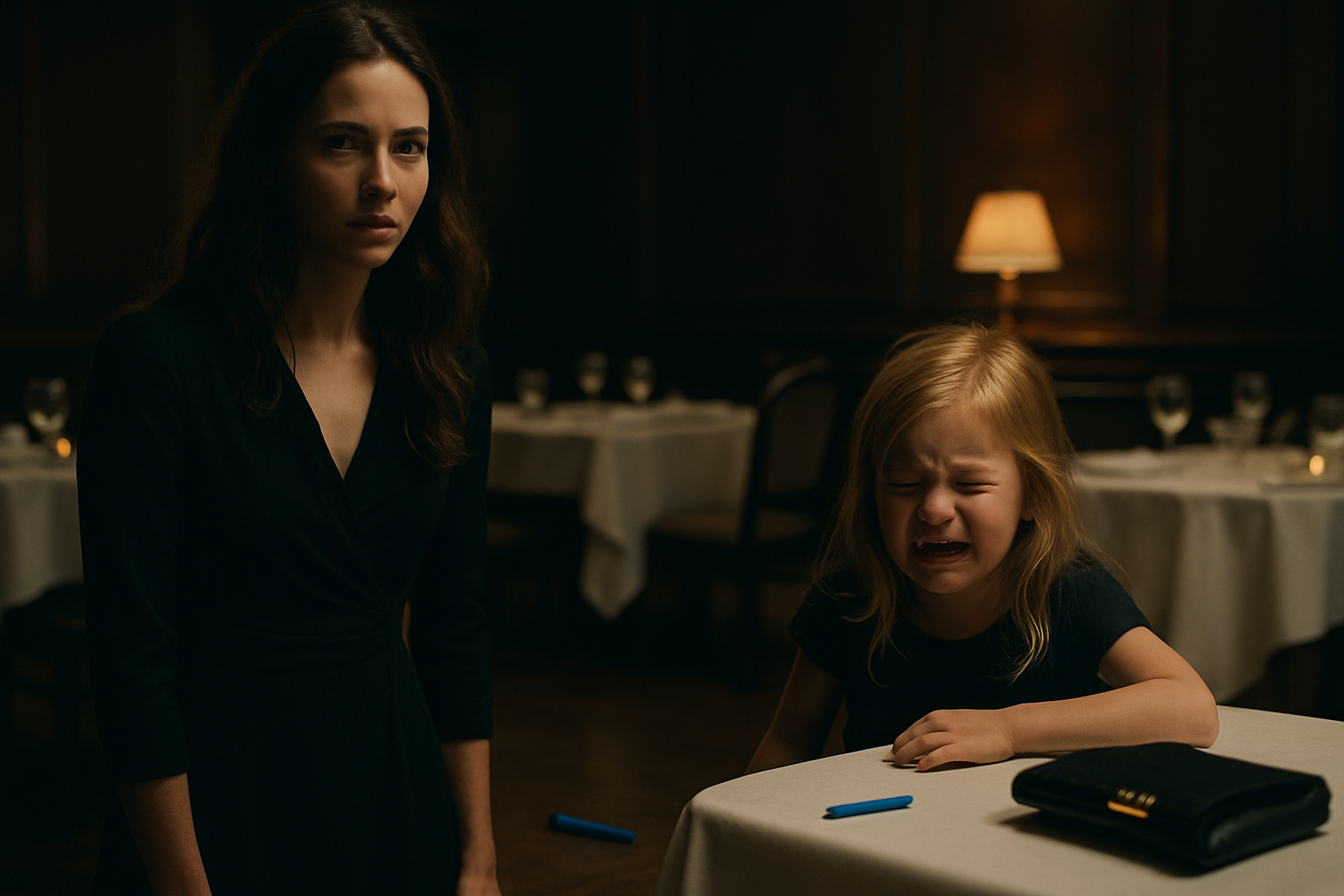
For three long seconds, the private dining room at The Gilded Stag seemed to exist outside of time, sealed inside a glittering bubble of shock. The only sounds were Mira’s small, broken sobs and the faint, velvety spill of jazz drifting from the hidden speakers above the paneled walls. The blue crayon had slipped from the child’s trembling fingers, rolled across the polished floor, tapped once against the leg of a white-draped table, and come to rest beside Governor Seraphina Calder’s black satin clutch.

Elara Voss stood near the center of the room with one cheek burning bright, her lower lip split, and the imprint of her mother’s fingers blooming scarlet around her upper arm.

At the head of the table, Cornelius Voss looked as if the marble floor had vanished beneath his imported shoes.

His sixtieth birthday dinner had not merely been planned. It had been engineered. Every detail had been arranged with the ruthless precision of a military campaign: the most exclusive steakhouse in Ashbourne, a private room with a minimum so obscene that ordinary families could have lived on it for years, orchids flown in from across the ocean, crystal stemware set at exact angles, a seven-tier bourbon chocolate cake crowned with gold leaf, and a guest list carefully selected to remind the city that the Voss family still belonged among the untouchable.

Judges. Lobbyists. Bankers. Old-money widows. New-money predators. Two cabinet hopefuls. One senator.

And now, in the middle of that perfect room, the governor of Bellwether herself stood between the tables, accusing Cornelius Voss’s wife of assault and praising the daughter the family had spent seven years pretending no longer existed.

Vivienne Voss found her voice first.

Of course she did.

Women like Vivienne did not believe silence was dignified. They believed it belonged to maids, servants, clerks, girls who cried in bathrooms, daughters who disappointed them.

“Governor Calder,” Vivienne said, forcing a laugh that scraped through the room like a knife across china, “I think there has been a terrible misunderstanding. Elara has always been… theatrical. She appears where she is not invited, she twists stories to suit herself, and frankly, she has had struggles you could not possibly understand.”

Elara reached for a linen napkin from the edge of the nearest table and pressed it carefully to her lip.

She did not argue.

Once, she would have. Once, she would have pleaded, explained, shaken with the desperate need to be believed. She would have dragged facts into a room that had already chosen a lie. She would have thought truth needed to raise its voice in order to survive.

She knew better now.

Governor Calder looked at Vivienne as if the woman were a wine stain spreading across expensive silk.

“I understand more than you imagine,” the governor said. Her voice was calm, but it carried to every corner of the room. “I understand that your daughter walked into my office two years ago with evidence of a bid-rigging scheme designed to steal hundreds of millions from Bellwether taxpayers. I understand that she risked her career, her safety, and the stability of her child’s life in order to expose it. And I understand that tonight, in front of witnesses, you raised your hand against the woman who helped save this state from one of the largest infrastructure fraud cases in its history.”

A sound passed through the room.

Not quite a gasp. Not quite a whisper.

It was the noise powerful people made when they suddenly realized the ground beneath their feet might not be as solid as they had assumed.

Men who had spent the first half hour of dinner discussing golf memberships, highway contracts, and quiet federal favors now stared at Elara as though she had become dangerous to stand near. Women who had smiled beside Vivienne at museum galas and hospital fundraisers began leaning subtly away from her, careful not to let their shoulders touch, careful not to be photographed too close.

Across the table, Celeste Voss’s red lips parted.

“That’s not possible.”

Elara finally turned toward her younger sister.

“Hello to you too, Celeste.”

Celeste’s eyes flashed, bright and cold beneath the chandelier light. “Don’t act like this is normal. You disappear for seven years, sweep in dressed like some grieving political widow, and suddenly the governor is making you sound like a hero?”

“She did not disappear,” Governor Calder said.

The room tightened around the words.

“Your family buried her.”

That sentence changed the temperature of the room.

Cornelius took one step forward. His face had gone pale beneath its careful tan. “Now wait just a minute.”

“No, Mr. Voss,” the governor said. “You have had seven years of minutes. Tonight, your daughter gets one.”

Elara lowered the napkin.

Blood still darkened the corner of her mouth, a small crimson mark against her composed face. Yet her expression remained almost serene. That calm frightened her family more than a scream ever could have.

They had expected the old Elara.

The girl who begged to be believed.

The young woman who cried outside locked doors while voices whispered on the other side.

The daughter who still believed someone at the Voss family table might love her enough to tell the truth.

But the old Elara had died long before her family paid to print the obituary.

Near the head of the table, Senator Gideon Thorne sat with one hand frozen around a glass of cabernet. He was an old Bellwether politician, silver-haired and smooth-faced, with the polished smile of a man who had survived three scandals by learning never to stand too close to the flames.

His son, Julian Thorne, looked worse than anyone else in the room.

“Elara,” Julian said again, as if her name were a key he could not make fit into the lock.

Mira turned her tear-streaked face toward her mother.

“Mommy,” she whispered, her little voice breaking, “why did Grandma hit you?”

The question landed harder than the slap.

Elara crossed the room before anyone could stop her. Governor Calder bent with quiet care, lifting Mira from her lap and placing the child safely into Elara’s arms. The little girl clung to her mother’s neck with both arms, burying her face in the dark satin of Elara’s gown.

“It’s okay, baby,” Elara whispered against her hair. “You are safe.”

Vivienne made the fatal mistake of speaking again.

“This child should not even be here.”

Elara lifted her head slowly.

For the first time that night, something sharp entered her eyes. Something bright. Something honed over years of humiliation, grief, hunger, fear, and survival.

“Say one more word about my daughter.”

The room stopped breathing.

Vivienne’s face tightened, her jaw working as though another insult were trapped behind her teeth. But even she heard the line beneath Elara’s voice. Even she understood it should not be crossed.

For years, Vivienne had mistaken her daughter’s kindness for weakness. She had mistaken Elara’s mercy for surrender. She had mistaken silence for defeat.

Now, in front of every person she had tried so desperately to impress, Vivienne realized too late that kindness had only ever been what Elara chose when she still believed mercy was deserved.

Governor Calder turned slightly toward the plainclothes officers stationed along the wall.

“Please make sure Mrs. Voss does not approach Ms. Voss or her child again tonight.”

One of the officers stepped closer to Vivienne.

Vivienne’s mouth opened in disbelief. “You cannot be serious.”

“I am very serious,” the governor said.

Cornelius wiped his forehead with a folded handkerchief, his practiced charm beginning to fracture beneath the pressure. “Governor, please. I am certain we can settle this quietly. This is my birthday dinner. My clients are here. Senator Thorne is here.”

“That is exactly why I came,” Elara said.

Every eye turned to her.

She shifted Mira higher on her hip and looked at her father.

For seven years, she had imagined this moment.

Sometimes, in the sleepless dark, she had imagined herself screaming until the chandeliers trembled. Sometimes she had pictured Cornelius falling to his knees, begging forgiveness before the same guests whose approval he valued more than blood. Sometimes she had imagined Celeste exposed, Vivienne humiliated, every lie dragged back to the mouth that created it.

But Elara had learned that revenge and justice were not the same creature.

Revenge wanted pain.

Justice wanted daylight.

“You told people I was dead,” Elara said.

A woman near the back table whispered, “Dead?”

Cornelius’s face drained of color.

“Elara.”

“No,” she said. “You don’t get to say my name like a warning. You signed the obituary.”

Julian Thorne turned sharply toward Cornelius. “What obituary?”

Elara reached into the small black clutch hanging from her wrist. With careful fingers, she withdrew a folded sheet of paper and placed it on the table beside the untouched birthday cake.

The paper was not new. Its edges had softened from years of handling, folding, unfolding, hiding, and bringing into the light again. The creases were deep. The ink had begun to fade. But the words remained clear enough to wound.

Governor Calder said nothing.

She already knew what it was.

Elara opened the page.

Despite themselves, several guests leaned forward.

At the top was the crest of the Ashbourne Chronicle.

ELARA MARIS VOSS, 29, PASSES AFTER LONG PRIVATE STRUGGLE.

Vivienne made a small choking sound.

Elara read only the first line aloud.

“The Voss family mourns the loss of their beloved daughter, Elara Maris Voss, who passed peacefully after years of battling personal hardship.”

Her voice did not shake.

That made it worse.

“I was twenty-nine,” Elara said. “I was living in Port Kellan. I was working as a forensic accountant for a federal subcontractor. I was pregnant with Mira. And I was very much alive.”

Senator Thorne slowly set down his wineglass.

Julian stared at the obituary as if the paper itself were burning.

“Celeste told me you had died,” he said.

Celeste snapped, “Because that is what my parents told everyone.”

“No,” Elara said softly. “You told him that because you were engaged to the man who had once promised to marry me.”

The room erupted in whispers.

Julian looked as though the slap had struck him next.

Celeste’s face hardened into something brittle and ugly. “That was ancient history.”

Elara tilted her head.

“You mean when you slept with him while I was at a hospital appointment?”

Julian closed his eyes.

Lily lifted her head from Claire’s shoulder, her small brow pinched in confusion. The room around her had changed in a way children could feel before they could name it. Grown-up voices had sharpened. Smiles had disappeared. The air, only moments ago thick with champagne, perfume, and the brittle music of old money congratulating itself, had gone cold.

She did not understand the obituary. She did not understand the word dead being spoken about her mother while her mother stood warm and breathing beside her. She did not understand why the beautiful woman in the ivory dress stared at them as if they were a stain, or why the older woman with diamonds at her throat looked as though she wanted to slap someone and faint at the same time.

Lily only knew that her mother’s arms had tightened.

Claire kissed her daughter’s temple.

“It’s all right,” she whispered, though nothing in that room was all right. “I’ve got you.”

Then Claire looked away from Ethan Marlowe as if he had finally become what he should have been years ago: irrelevant.

The gesture wounded him more than anger would have. Anger meant a person still mattered. Anger kept a thread alive between two people, however frayed. But Claire’s indifference was clean. Final. A door not slammed, but closed and locked from the inside.

Seven years earlier, Ethan Marlowe had been everything a woman like Claire Bennett had been taught to want and everything she had not yet learned to distrust.

He had a famous last name, one that opened rooms before he entered them. He had the polished charm of a man raised around campaign donors and private schools, a man who knew how to lean close when he listened, how to make a woman feel as though every word she spoke had interrupted the world in the best possible way. Back then, he had been a rising political aide with a future already being arranged around him by men who golfed together and women who lunched with purpose.

He had made Claire believe she was seen.

That had been the cruelest part.

Not the betrayal. Not even the abandonment. It was the memory of being seen by someone who, in the end, had only looked at her when it was convenient.

Ethan had loved her in private. Or perhaps he had loved the version of himself reflected in her eyes: brave, sensitive, capable of choosing something real over something strategic. In quiet corners, away from the gaze of Richmond society, he had touched her like she was sacred. He had told her things he said he had never told anyone else. He had promised her that politics did not own him. That his father did not own him. That someday, when the time was right, they would stop hiding.

But Ethan had always hesitated in public.

And Vanessa Bennett had known how to turn hesitation into opportunity.

Vanessa had never loved Ethan. Not really. Vanessa loved possession. She loved victory. She loved walking into a room and knowing another woman had been left outside it. Ethan, with his pedigree and pliable weakness, had been a prize she could display.

And Ethan had been too weak to understand the difference between being desired and being chosen.

When Claire became pregnant, the fragile illusion shattered quickly.

She had not told Ethan right away. She had needed a day to breathe, then another to imagine. She had sat on the edge of her bed with the pregnancy test on the nightstand and pressed both hands over her mouth, terrified and strangely full of wonder. She had been twenty-six, not a girl, but in that moment she had felt impossibly young.

A child.

Their child.

For a few hours, before fear found her, Claire allowed herself to imagine a life that might still be difficult but honest. Ethan would be frightened at first, of course. Anyone would be. But then he would take her hands, draw that deep breath he always took before pretending to be braver than he was, and they would decide together.

She had believed that.

Until Vanessa found out first.

It happened during a Sunday brunch at Diane and Charles Bennett’s house, one of those suffocating family events where the silver was antique, the flowers were professionally arranged, and every sentence carried a second meaning. Claire had left Diane’s tablet on the kitchen island after helping her mother pull up a seating chart for an upcoming charity luncheon. Vanessa, bored and predatory, had picked it up.

Claire’s messages had been synced.

Vanessa read enough.

She did not confront Claire at the table. That would have been too messy, too immediate. Vanessa preferred damage that ripened. By the end of that week, Diane was calling Claire selfish. Charles was calling her an embarrassment. Vanessa was calling Ethan every night in a voice soft enough to sound wounded and sharp enough to draw blood.

Ethan called no one.

Not Claire.

Not once.

For three days, she waited.

She watched her phone until the screen blurred. She reread the last message she had sent him. We need to talk. Please. It’s important.

The message remained unanswered.

On the fourth day, Diane stood in Claire’s bedroom doorway as if already inspecting it for resale.

“You will not drag this family through scandal,” Diane said.

Claire sat on the bed with a sweater folded in her lap. “I’m pregnant, Mom. I’m not committing a crime.”

Diane’s mouth tightened. “Do not be dramatic.”

That was Diane’s gift. She could take any wound and call it theater.

Charles had been worse. He had not yelled at first. He had stood by the fireplace in his study, fingers resting on the mantel, his voice low and measured.

“Do you understand what you’ve done?”

Claire had laughed once, because the alternative was sobbing. “What I’ve done? I’m having a baby.”

“You are unmarried.”

“I know.”

“With Ethan Marlowe.”

Claire said nothing.

Charles turned then, and she saw not a father, not a man worried for his daughter, but a businessman calculating exposure.

“Senator Marlowe’s people will deny everything if this becomes public,” he said. “And if they don’t, they’ll bury it in a way that makes you look unstable. You think you’re the first girl to mistake attention for commitment?”

The word girl had struck harder than she expected.

Claire had left Richmond with one suitcase and $1,800 from her savings account.

No trust fund. No goodbye dinner. No tearful reconciliation on the front steps of the house where she had grown up. Diane did not come to the door when Claire carried her suitcase down the stairs. Charles did not ask where she would go. Vanessa watched from the landing, arms folded, lips curved with the satisfaction of someone who had not merely won but rearranged reality so winning looked inevitable.

Three months later, Claire Bennett’s obituary ran in the Richmond Register.

Beloved daughter of Charles and Diane Bennett. Cherished sister of Vanessa Bennett. Lost too soon.

There were no details about the accident because there had been no accident. No funeral because there was no body. No grave because Claire was alive in a cramped apartment near Virginia Beach, vomiting every morning into a chipped toilet, pressing one hand to her stomach and the other to the wall to keep herself upright.

Diane had framed it as mercy.

“People will stop asking questions,” she had said in the last voicemail Claire ever saved. Her mother’s voice had been calm, breathy, almost kind. “You made your choices, Claire. Let us survive ours.”

Let us survive ours.

As if Claire’s existence were a storm they had endured.

Charles had used the obituary to protect business relationships. A dead daughter was tragic; a pregnant unmarried daughter abandoned by a Marlowe was inconvenient. Tragedy drew sympathy. Inconvenience drew whispers.

Vanessa had used it to inherit Claire’s place in the family story. She became the only Bennett daughter, the elegant survivor, the woman who wore grief like a tasteful black dress when it suited her and discarded it when it did not.

And Ethan had accepted it.

That, Claire later realized, had been the truth that freed her from him.

He had not investigated. He had not demanded proof. He had not driven to Virginia Beach or searched hospitals or called old friends or hired anyone to ask questions. He had accepted her death because believing Claire was dead was easier than admitting he had abandoned her while she carried his child.

But Claire had not died.

She had worked.

She had suffered.

She had built.

There were mornings when pregnancy made standing impossible, and she still got up because rent did not care about nausea. There were nights when Lily cried with the desperate rage of an infant who had no language for hunger or colic or the absence of a second pair of arms, and Claire walked the apartment floor until dawn, whispering numbers under her breath to stay awake.

One, two, three.

Debit, credit, balance.

Breathe.

She took contract work first. Bookkeeping for a dentist’s office. Payroll cleanup for a restaurant owner who paid in checks that sometimes cleared. Tax preparation during seasons that turned her eyes red and her back stiff. She studied after Lily fell asleep, earning certifications one exhausted hour at a time.

And slowly, quietly, she became dangerous.

Not in the way Charles understood danger. She had no private security, no board seat, no senator returning her calls. Claire’s danger was patience. Precision. Memory. She learned to read financial records the way other people read faces. She could spot a lie in a vendor ledger. She could hear panic in a reconciliation statement. She could trace money through layers of shell companies until the numbers, exhausted by their own disguises, began confessing.

She became the kind of forensic accountant corporations feared: invisible until it was already too late.

Then she found the fraud.

It began with a flood wall project in Hampton Roads.

The coastal defense program had been born after a brutal hurricane season left neighborhoods underwater, families sleeping in school gyms, elderly residents trapped on second floors, and small businesses ruined beneath brown floodwater. News cameras had shown children being carried through streets that had become rivers. Politicians promised change. Agencies moved quickly. Emergency funding flowed.

The state allocated $240 million to repair bridges, reinforce drainage systems, strengthen seawalls, and protect low-income communities from the next disaster.

On paper, it looked noble.

On paper, everything always did.

The contracts passed through agencies, private firms, emergency procurement waivers, subcontractors, consulting partnerships, minority vendor initiatives, infrastructure studies, compliance reports, and environmental reviews. Each layer added legitimacy. Each layer also added shadow.

One of those consulting partnerships belonged, quietly, to Bennett Development Group.

Not openly. Charles was too careful for that. The name did not sit in bold print on the first page of public filings. It appeared indirectly, through a limited liability entity connected to a management firm that billed another advisory group that subcontracted with a vendor whose registered address traced back to a suite Bennett Development had leased and “vacated” on paper two years earlier.

Most people would have missed it.

Claire did not.

She recognized the habits before she confirmed the names.

Her father had patterns. Inflated invoices rounded in familiar ways. Repeated vendor codes altered by a single digit. Emergency procurement waivers filed late but backdated cleanly. Administrative fees tucked beneath language no one wanted to question because the project itself was morally protected.

Flood walls. Bridges. Drainage systems.

Who wanted to be the person slowing down disaster relief?

A small consulting fee here. A site assessment there. A materials surcharge, an expedited labor premium, a compliance adjustment. Every theft dressed as urgency. Every false charge hidden beneath the suffering of people with the least power to challenge it.

If Claire had looked away, no one would have blamed her.

No one even knew she was still connected to Charles Bennett. Her name had been buried. Her existence had been erased from the family’s official history. She could have protected Lily, protected her job, protected the fragile peace she had built from exhaustion and stubbornness.

Instead, she made copies.

She made them carefully.

She backed up emails. She printed wire transfer records. She mapped shell companies by address, ownership structure, and payment sequence. She built timelines. She highlighted procurement exceptions and compared them to weather emergency declarations. She stayed up long after Lily fell asleep, the glow of her laptop turning the apartment walls blue while rain tapped the windows like a warning.

Then she walked into the governor’s office.

At first, Governor Evelyn Pierce had not known what to make of her.

Claire arrived in a navy suit that had been altered twice and still pulled slightly at the shoulder. Her hair was pinned neatly at the nape of her neck. Beneath one arm, she carried a battered folder thick with documents. In front of her, she pushed a stroller where three-year-old Lily slept with a stuffed rabbit tucked under her chin.

She did not look like a whistleblower.

She looked like a tired mother who had used her lunch break to run an errand she could not afford to postpone.

The receptionist tried to redirect her to constituent services. An aide suggested she send an email. Another asked if she had an appointment.

Claire had said, calmly, “No. But if the governor waits until I do, two hundred and forty million dollars may be gone.”

That sentence traveled faster than paperwork.

Governor Pierce met her in a small conference room twenty minutes later, expecting perhaps an exaggeration, perhaps a grievance, perhaps another citizen overwhelmed by bureaucracy. What she found instead was a quiet woman who asked for no pity and wasted no words.

Claire laid out bank transfers, shell companies, forged compliance reports, duplicate invoices, procurement emails, and internal memos with the terrifying calm of someone who had already lost enough to stop being afraid.

She did not mention, at first, that Charles Bennett was her father.

She let the documents speak.

The documents were eloquent.

Within six weeks, federal investigators were involved.

Within four months, $240 million in taxpayer funds was frozen before it could disappear into accounts designed never to be found.

Within a year, three executives were indicted, two procurement officers resigned, and a network of contractors began quietly offering deals in exchange for leniency.

Charles Bennett survived only because he had built his life around plausible deniability. He had kept his signature off the dirtiest documents. He had let subordinates send the emails, consultants sign the authorizations, vendors collect the money, and lawyers create enough distance for him to stand in public with clean hands.

But Claire knew better.

So did Governor Pierce.

And now, inside the glittering private dining room of Archer & Vale, everyone else was beginning to know it too.

Charles gripped the back of a chair so hard his knuckles blanched.

“This is slander,” he said.

His voice was loud enough, but not strong. There was a tremor beneath it, a hairline crack running through the polished surface of Charles Bennett.

Claire looked at him gently.

That gentleness was unbearable.

“No, Dad,” she said. “Slander is false.”

The word Dad struck the room oddly. Not because it was affectionate, but because it reminded everyone that beneath the scandal, beneath the money, beneath the political consequences gathering like storm clouds, there had once been a family. A father. A daughter. A house where a child had learned to walk and speak and trust.

Diane’s lips parted.

“You ungrateful girl,” she whispered.

Governor Pierce’s eyes cut toward her with the clean, lethal precision of a blade.

“Mrs. Bennett,” she said, “I would choose your next words very carefully.”

But Diane was unraveling.

Public humiliation had stripped her of the manners she wore like perfume. The room was full of people whose opinions mattered to her: donors, attorneys, society wives, men with foundations and women with committees, Senator Marlowe and his circle, Vanessa’s friends, Charles’s associates. They had seen the obituary. They had heard Claire speak. They had watched Charles falter.

Diane could survive cruelty. She could survive lies. What she could not survive was being exposed as ordinary in her cruelty.

“We gave you everything,” Diane said, her voice rising. “Schools, clothes, a name. We gave you a life most girls would have been grateful for. And you repay us by marching in here with that child and trying to destroy your father?”

Claire adjusted Lily on her hip. Her daughter was growing heavier, but Claire did not put her down.

“You gave me a name,” Claire said, “then printed it in an obituary while I was still breathing.”

Diane’s face twisted.

“Because you left.”

“You threw me out.”

“You shamed us.”

“I was pregnant.”

“You were unmarried.”

“I was your daughter.”

The words landed quietly.

They were not shouted. They did not need to be. They moved through the room with the force of something ancient and undeniable. A truth so simple that all the wealth in Richmond could not dress it into something else.

I was your daughter.

For a moment, something seemed to fracture—not in Diane, perhaps. Some people could not be broken open by truth because they had spent too many years hardening themselves against it. But around the room, faces changed.

A woman near the windows lowered her champagne glass.

One of Charles’s board members stared at the floor.

An older man who had laughed at Diane’s jokes earlier now looked at Claire as if seeing the outline of a ghost become human.

The story Diane had told for years began collapsing inside the minds of those who had repeated it without question. Claire had been troubled. Claire had run off. Claire had died tragically. Claire had made choices that could not be discussed.

But now Claire stood there, living proof that silence had been curated.

Vanessa crossed her arms, the diamond bracelet at her wrist flashing under the chandelier.

“Fine,” she said. “Let’s all feel sorry for Claire. She always did love being the victim.”

Claire’s smile was small.

“No, Vanessa,” she said. “You loved me being the victim. It gave you a role.”

Vanessa’s expression flickered. The perfect mask slipped just long enough for everyone to see the panic underneath, raw and ugly before she smoothed it away.

Ethan Marlowe stepped toward Claire.

He had gone pale. The confident ease he usually wore—the inherited ease of men who had rarely been denied space—had deserted him. For the first time that evening, he looked not like a senator’s son, not like a political heir, not like Vanessa’s polished companion, but like a man standing at the edge of a grave he had never bothered to inspect.

His voice was low.

“Is Lily mine?”

The room went silent again.

Even the waitstaff froze.

Lily looked from Ethan to Claire, sensing that she had become the center of something she did not understand. Her small fingers curled into the fabric of Claire’s sleeve.

Claire looked at Ethan fully then.

For years, she had imagined this moment in different forms. In the early days, she had imagined rage. She had imagined screaming at him on a sidewalk, throwing every unanswered message in his face. Later, she imagined coldness. Then, when Lily was a baby and Claire was too tired to hate anyone properly, she had imagined nothing at all.

Now, standing before him, she felt neither anger nor grief nor the old ache that had once kept her awake at three in the morning.

She felt free.

“No,” she said.

Ethan flinched.

He had no right to. Still, he did.

Across the room, Vanessa exhaled. It was soft, nearly soundless, but Claire caught it. Relief. Quick and instinctive. Vanessa hid it almost immediately, pressing her lips together, but it was too late.

Claire saw that too.

“You can relax, Vanessa,” she said. “You stole a coward, not a father.”

Someone near the bar coughed into their napkin. Whether from shock or a failed attempt to smother laughter, no one could tell.

Ethan’s face reddened.

“Claire,” he said, “I thought you were gone.”

“You thought what you wanted to think.”

“I would have helped you.”

“No,” Claire said. “You would have asked your father what help would cost you.”

Senator Marlowe stiffened.

The remark was not loud, but it was surgical. It cut through Ethan and reached the man behind him—the father whose shadow had shaped every weak decision Ethan had ever mistaken for strategy.

Senator Marlowe’s jaw tightened. He was an older version of his son, sharper and colder, with hair silvered at the temples and eyes accustomed to measuring damage. He understood, better than most, how quickly a private scandal could become public currency. He had come that night expecting a birthday dinner, perhaps a toast, perhaps even a useful alliance between the Marlowes and Bennetts.

Instead, he was watching the room fill with blood.

Governor Pierce’s husband, Daniel Pierce, had remained quiet through most of it.

He was not a politician by temperament. Where Evelyn Pierce commanded attention, Daniel absorbed it and softened its edges. He had been standing near the long dining table, observing with a grave expression, saying nothing because nothing he could have said would have improved the truth.

Then he noticed something on the carpet.

Lily’s crayon.

It had rolled beneath a chair during the first wave of raised voices. Purple wax, worn flat on one side from a child’s grip.

Daniel bent, picked it up, and crossed the room. He placed it carefully on the table beside Claire’s clutch, not making a performance of the gesture, not asking for thanks.

Somehow, that quiet act made the room feel human again.

Lily noticed.

Her lip trembled.

“Can we go home?” she whispered.

Claire’s expression softened at once. Whatever steel had held her upright in the face of Diane, Charles, Vanessa, and Ethan melted when she looked at her daughter.

“Soon, sweetheart,” she said. “Very soon.”

Charles saw the softness and mistook it for weakness.

He lunged toward it with the instincts of a man who had always known which bruise to press.

“Yes,” he said sharply. “Go home. That would be best for everyone.”

Claire looked at him.

“I am not finished.”

Charles froze.

The room seemed to contract around those five words.

Claire shifted Lily gently and reached into her clutch again. This time, she did not pull out an old newspaper clipping yellowed by time and cruelty. She withdrew a second envelope.

It was crisp. White. Heavy.

The letterhead at the top bore the seal of the Office of the Attorney General of Virginia.

Charles recognized it before anyone else did.

His face drained so quickly that Diane reached for his arm.

“Charles?” she whispered.

His knees seemed to loosen beneath him. For the first time all evening, the great Charles Bennett looked old.

Governor Pierce spoke before he could.

“Mr. Bennett,” she said, her voice clear enough to carry to every corner of the private dining room, “before your daughter arrived tonight, she provided my office with supplemental records related to the Hampton Roads emergency infrastructure investigation.”

Charles’s eyes did not leave the envelope.

Governor Pierce continued.

“Those records include correspondence that appears to connect Bennett Development Group directly to two shell vendors currently under federal review.”

Charles tried to speak.

No sound came out.

Claire crossed the small space between them and placed the envelope beside his untouched birthday plate.

The cake had not yet been cut. The candles, arranged in elegant gold holders, waited uselessly at the center of the table. A waiter stood near the service door holding a silver knife he no longer knew what to do with.

Claire’s hand lingered on the envelope for a single second.

“Happy birthday,” she said.

No one gasped this time.

Shock had moved beyond sound.

The room went dead quiet.

Diane looked from the envelope to her husband. “Charles?”

Vanessa’s face had gone pale beneath her careful makeup. “Dad?”

Senator Marlowe stood slowly, the legs of his chair scraping softly against the floor.

“Charles,” he said, each word measured, “tell me this is not what it sounds like.”

Charles’s mouth opened and closed.

For decades, he had built his life on the assumption that money could turn truth into a scheduling issue. Delay the meeting. Shift the blame. Retain the lawyer. Donate to the campaign. Restructure the company. Quiet the witness. Move the asset. Rewrite the record.

But this was different.

The governor was in the room.

The attorney general’s seal was on the table.

His dead daughter was alive, holding a child, and standing before witnesses.

The truth had not merely returned.

It had arrived documented.

“This is a family attack,” Charles said at last.

But his voice had lost authority. It sounded thin, almost petulant.

“She has always resented us.”

Claire nodded.

“I did resent you,” she said. “Then I outgrew it. This is evidence.”

The distinction seemed to disturb him more than hatred would have.

Hatred he understood. Hatred could be dismissed as emotional. Evidence could not.

Vanessa stepped forward, her composure finally splitting.

“This cannot happen tonight,” she said.

Her voice shook with outrage, but beneath it was terror. Not terror for her father. Not even terror for the stolen public money or the ruined communities or the people who might suffer when infrastructure failed because men like Charles had siphoned safety into profit.

No, Vanessa’s terror was social.

This was not the setting she had chosen. This was not the story she had arranged.

Her eyes darted toward Senator Marlowe, then Ethan, then the guests who had begun whispering behind raised hands.

“Ethan’s father is here,” she said. “We were going to announce—”

“Announce what?” Ethan asked.

His voice was flat, but Claire heard what lay beneath it. He already knew. Perhaps not the details, but the shape of it. Vanessa had orchestrated the evening too carefully. The guest list had not been random. The seating chart had not been accidental. Senator Marlowe’s presence at Charles Bennett’s birthday dinner had always meant something more than courtesy.

Vanessa turned toward Ethan.

For the first time all night, desperation cracked through her perfect posture. Her chin trembled before she lifted it. Her eyes shone, not with tears of remorse, but with the fury of a woman whose stage had been seized before her grand entrance.

“Our engagement,” she said.

Ethan stared at Vanessa as though he were seeing her for the first time, not as the woman in the red dress he had allowed himself to choose, but as someone standing in the wreckage of a lie and still trying to arrange the broken pieces into something flattering.

“You wanted to announce our engagement at your father’s birthday dinner,” he said slowly, each word sharpening as it left his mouth, “while your sister was secretly alive?”

Vanessa’s chin lifted, but her eyes flickered. “I didn’t know she was coming.”

“But you knew she was alive.”

The music from the quartet had stopped. No one had told them to stop playing, but some instinct for catastrophe had taken over, and now the ballroom was filled with the kind of silence that made every breath sound like testimony.

Vanessa said nothing.

That silence answered more cleanly than a confession.

Ethan took a step back from her. It was not dramatic. He did not fling his glass or curse or make a scene. He simply moved away as if proximity itself had become contaminating.

“My God,” he whispered.

Vanessa’s face hardened.

For a moment, Claire saw the old Vanessa—the girl who used tears as weapons when softness worked, and cruelty when softness failed. The sister who had learned early that beauty made people forgive her before she apologized. The daughter who had watched Diane long enough to master the art of making herself the victim in any room.

“Don’t you dare act innocent,” Vanessa snapped. “You believed it because it was convenient. You moved on because I was easier. You liked being told you were still a good man.”

A murmur passed through the guests.

Claire almost admired the precision of it.

Vanessa might have been selfish, vain, and cruel, but she was not stupid. Her words found the wound because she had helped make it.

Ethan’s face changed. Shame did not arrive all at once. It gathered slowly, dimming him from the inside. His gaze moved from Vanessa to Claire, then to Lily clinging to her mother’s skirt, cheeks wet and eyes wide.

“Claire,” Ethan said, voice low. “I am sorry.”

Claire looked at him.

Years ago, she would have wanted that apology like oxygen. She would have turned it over in her hands, inspected it for sincerity, pressed it against every bruise his betrayal had left. She would have needed him to understand what he had done, needed him to regret it loudly enough to make the past feel less lonely.

But time had changed the shape of need.

Her eyes stayed cool.

“I know.”

“I mean it.”

“I know that too.”

He swallowed. “Is there anything I can do?”

Claire looked down at Lily. Her daughter had stopped crying, but one hand was still tangled in the fabric of Claire’s dress, clutching so hard her knuckles had gone pale. Around them stood the people who had toasted Charles Bennett, admired Diane Bennett, envied Vanessa Bennett, and accepted Claire’s death because the living truth had been inconvenient.

“Yes,” Claire said. “Leave us alone.”

Ethan’s expression folded inward. For once, there was no argument left in him. No defense, no explanation, no noble gesture that could redeem the years. He accepted it because there was nothing else left to take.

Twelve minutes later, the first police officer arrived.

There were no sirens. No doors thrown open. No swarm of flashing lights reflected in the crystal chandeliers. The interruption came quietly through a side entrance, as though the law itself had dressed for the occasion and learned discretion.

One officer entered first, accompanied by one of Governor Pierce’s security officers. Then came another officer, and behind them a woman in a navy suit with a leather portfolio tucked under one arm. Claire recognized her immediately: Marisol Keene, a representative from the attorney general’s office.

She had been waiting in the building across the street for nearly an hour.

Claire had known there was a chance the confrontation would accelerate everything. She had hoped for it, in fact. Public lies had a way of forcing private crimes into the open faster than legal memos did.

Charles saw the officers, and in the space of one breath he seemed to age ten years.

His shoulders, which had always seemed designed for tailored tuxedos and handshakes, dropped as if someone had cut the invisible strings holding him upright. The color drained from his face. Even the expensive silver in his hair looked suddenly dull beneath the ballroom lights.

Diane whispered, “No. No, no, no.”

It was not a plea. It was denial dressed as prayer.

The first officer approached with professional calm. “Mr. Bennett, we need you to step outside with us for a conversation.”

Charles stiffened. “Absolutely not.”

“Sir—”

“I will not be questioned in the middle of my birthday dinner.”

“You’re welcome to call your attorney.”

That sentence frightened him more than handcuffs would have.

Claire saw it land.

Charles Bennett was a man who understood tone. For decades, he had lived inside the small differences between invitation and warning, negotiation and threat, delay and defeat. The officer’s sentence carried no uncertainty. It did not ask for cooperation. It merely allowed him one last piece of procedure before the machinery began moving without his permission.

The guests watched in stunned fascination as Charles reached for his phone with fingers that were not quite steady.

Diane grabbed his sleeve. “Charles.”

He did not look at her.

“Charles,” she said again, this time smaller.

Still, he did not look at her.

The woman from the attorney general’s office stood nearby, expression unreadable. Governor Pierce remained at Claire’s side, her face composed but not triumphant. Claire understood why. There was no joy in watching a powerful man cornered by the consequences of his own greed. There was only necessity.

At last, Charles was escorted from his own birthday dinner.

He walked past the orchids, their white petals arranged in expensive abundance along the edges of the room. He walked past the untouched cake, five tiers of sugar and gold leaf waiting beneath a spotlight. He walked past the framed slideshow of his achievements projected above the bar—groundbreakings, awards ceremonies, ribbon cuttings, charity galas.

Just as Charles passed beneath it, the slideshow changed.

A photograph from twenty years earlier appeared on the screen.

Charles stood smiling at a family beach house in the Outer Banks, one arm around Diane, the other lifted in a wave toward whoever had taken the picture. Vanessa was beside them in a sundress, flawless even then. Claire was sixteen, sunburned across the bridge of her nose, laughing with her head tipped back, wind whipping her hair across her face.

She looked unbearably young.

Unaware.

Still believing that family love was imperfect but real. Still believing obedience could earn safety. Still believing fathers protected daughters, mothers softened fathers, and sisters remained sisters even when rivalry made them cruel.

Claire watched the image until it changed again.

Then her daughter tugged at her.

“Mommy?”

Claire looked down.

Lily’s eyes followed the path Charles had taken. “Is Grandpa in trouble?”

The word Grandpa hit the room differently now. A title innocent enough to ache.

Claire bent and kissed Lily’s forehead. “Grandpa made choices.”

“Bad choices?”

“Yes, baby,” Claire said. “Bad choices.”

Across the ballroom, Diane sank into a chair.

Without Charles beside her, she looked altered. Less like a queen presiding over a social court, more like an aging woman abandoned in the middle of a room she no longer knew how to command. Her face was gray beneath the expensive makeup. The pearls at her throat seemed suddenly too heavy. Her hands gripped the arms of the chair as if the world had become unsteady.

For years, Diane Bennett had lived as though consequences were things hired people handled elsewhere. Bills were paid by assistants. Reputations were managed by publicists. Messes were cleaned before guests arrived.

Now the mess stood around her in tuxedos and gowns, whispering into phones.

Vanessa remained near the dessert table, alone in her bright red dress.

It had been chosen to announce joy. Desire. Victory.

Now it looked obscene against the ruin.

Senator Marlowe had already moved away from her. He was speaking to Ethan in a low, clipped voice. Whatever warmth he had shown the Bennett family earlier had evaporated. Political men knew how to leave a sinking ship without splashing.

Ethan’s gaze flickered once toward Claire, but he did not approach.

Good, she thought.

Some doors closed gently. Others had to be nailed shut.

Claire gathered Lily’s little purse from the chair where it had fallen. She picked up the crayon drawing from the table, smoothing one bent corner with her thumb. A blue house. A yellow sun. Three stick figures holding hands. She also took the dessert menu Lily had admired earlier, the one embossed with a winged horse in silver foil.

Lily had called it a magic pony.

Governor Pierce touched Claire’s arm gently, careful to avoid the nail marks Diane had left in her skin.

“You do not have to stay,” the governor said.

Claire nodded. “I know.”

“You were brave tonight.”

Claire looked toward the door where Charles had disappeared. “No,” she said. “I was prepared. There is a difference.”

The governor’s mouth curved faintly. “Sometimes preparation is what bravery looks like after enough pain.”

For the first time that night, Claire almost smiled.

Almost.

She shifted Lily higher on her hip and turned toward the exit.

Behind her, a chair scraped against the polished floor.

“Claire.”

Diane’s voice.

Every person still in the room looked at her.

Claire stopped, but she did not turn fully. “Yes?”

Diane was standing now. Barely. Her lips trembled. Her eyes shone—not with remorse, Claire knew better than to assume that, but with panic, humiliation, and the fury of a woman who had been publicly stripped of control.

Still, for one foolish second, Claire wondered.

The child inside her wondered.

That child had never completely stopped waiting outside locked doors. Never completely stopped hoping her mother might open one and say, I am sorry. I should have protected you. I chose wrong. You deserved better.

That child held her breath.

Diane’s lips parted.

“How could you do this to your father?”

There it was.

Not regret.

Not love.

Not even curiosity about the daughter she had helped erase.

Only outrage that the family’s shame had escaped into public view.

Claire’s face became very still.

Around them, no one moved.

Then Claire turned fully toward her mother, Lily warm and heavy in her arms.

“The same way you did it to your daughter,” Claire said. “In public.”

Diane recoiled as if struck.

Claire did not wait to see whether the wound landed deep enough to change anything.

She simply walked out.

Outside, Richmond waited cool and bright beneath the streetlights.

The night air touched Claire’s face like water. For one dizzy moment, the city seemed too real—the shine of the pavement, the hush of traffic, the flags shifting above the entrance, the black state SUV waiting at the curb.

A small cluster of reporters had gathered beyond the barricade, sensing blood without yet understanding the full shape of the scandal. Their cameras lifted when Governor Pierce emerged behind Claire. Questions rose in a scattered wave.

“Governor, can you comment—”

“Ms. Bennett, is it true—”

“Was your father taken into custody—”

Governor Pierce’s security team moved smoothly, creating a path without pushing. Claire kept Lily’s face turned toward her shoulder.

Lily was drowsy now, her little body sagging with the aftermath of fear. She rubbed one eye with the back of her hand.

“Mommy,” she murmured, “why did that lady say you saved the state?”

Claire paused with one hand on the SUV door.

For a second, she did not know how to explain corruption to a six-year-old. Theft was too small a word. Betrayal too heavy. Fraud too meaningless.

So she chose the truth with softer edges.

“Because some people were trying to steal money that belonged to families who needed safe roads and strong bridges.”

Lily blinked. “And you stopped them?”

“I helped.”

Her daughter considered this very seriously. “Like Wonder Woman?”

Claire smiled for the first time that night.

“With spreadsheets.”

Lily frowned. “That sounds boring.”

“It was very boring.”

A beat passed.

“Can we get pancakes?”

Claire looked over her shoulder at Governor Pierce, who had followed them out and clearly heard the question. The governor’s solemn expression cracked.

“I know a diner that makes excellent pancakes,” she said.

And so the woman who had just exposed one of Richmond’s most powerful families did not go home to champagne or victory speeches or a quiet room where she could collapse privately.

Instead, she ended up in a booth at a twenty-four-hour diner on Broad Street with the governor of Virginia, two security officers, a sleepy child, and a plate of chocolate chip pancakes shaped vaguely like Mickey Mouse.

No cameras were allowed inside.

No speeches were made.

The diner smelled like burnt coffee, butter, and raincoats drying near the door. Fluorescent lights hummed overhead. A waitress named Marcy recognized Governor Pierce, froze for half a second, then recovered with the professionalism of a woman who had served truck drivers, college students, police officers, and hungover bridesmaids at three in the morning.

“You all want coffee?” she asked.

“Desperately,” Governor Pierce said.

Claire sat in the booth with an ice pack pressed against her cheek. The skin beneath it throbbed where Diane’s hand had struck her. Lily sat beside her, half folded against Claire’s arm, dipping fries into syrup with solemn concentration.

Governor Pierce noticed and pretended not to.

The security officers sat at the counter, giving them space while scanning the door every few seconds.

For the first time all night, Claire felt the shaking begin.

It started in her hands.

Then moved into her ribs.

Then into her breath.

She set the ice pack down carefully before she dropped it.

Governor Pierce saw. Of course she did.

“It is over for tonight,” she said quietly.

Claire looked out the diner window. The city beyond the glass looked ordinary, which felt almost insulting. Cars passed. A man walked a dog. Somewhere down the block, laughter spilled from a bar as if the world had not split open.

“Not over,” Claire said.

“No,” Governor Pierce admitted. “But over for tonight.”

Claire closed her eyes.

For once, that was enough.

By morning, the story had exploded.

It moved through Richmond first, then Virginia, then national news. It took on headlines, subheadings, timelines, pundit panels, legal experts, and grainy photographs of Charles Bennett being escorted from the side entrance of the Jefferson Hotel.

RICHMOND DEVELOPER ESCORTED FROM BLACK-TIE DINNER AMID INFRASTRUCTURE FRAUD INVESTIGATION.

FAKE OBITUARY USED TO ERASE WHISTLEBLOWER DAUGHTER, SOURCES SAY.

GOVERNOR CREDITS FORENSIC ACCOUNTANT CLAIRE BENNETT WITH SAVING $240 MILLION IN PUBLIC FUNDS.

The headlines made Claire sound mythic.

They did not show her standing barefoot in her kitchen at six-thirty in the morning, making oatmeal while Lily searched for her purple hair clip and complained that her socks felt “wrong.”

They did not show her packing a lunchbox with apple slices, pretzels, and a note with a heart drawn at the bottom.

They did not show her carefully avoiding every television, every browser, every notification that flashed across her phone.

She drove Lily to first grade like it was any other Thursday.

But it was not any other Thursday.

At drop-off, Lily’s teacher hugged Claire longer than usual.

Not dramatically. Not enough for the children to notice. Just an extra second, a hand pressed between Claire’s shoulder blades.

“You let us know if you need anything,” the teacher whispered.

Claire nodded because words were too dangerous that early in the morning.

Near the cubbies, another parent leaned close and murmured, “You are amazing.”

Claire smiled automatically.

Then she went home and cried in the laundry room.

She cried between the dryer and a basket of unfolded towels, one hand clamped over her mouth because the plumber was supposed to arrive sometime between eight and noon and she did not want to explain herself to a stranger holding a wrench.

Admiration, she discovered, could be almost as exhausting as cruelty.

When a person had lived too long without safety, praise felt suspicious. Kindness had weight. Being seen after years of hiding was not freedom at first.

It was exposure.

The legal storm lasted eighteen months.

Charles Bennett was indicted on charges of conspiracy, fraud, and money laundering connected to shell vendors, inflated emergency contracts, and a network of consulting fees that had moved public money through companies with names so bland they seemed generated by a machine.

Commonwealth Bridge Solutions.

Atlantic Municipal Partners.

Piedmont Emergency Logistics.

Some existed only on paper. Others had offices with no employees. One had listed its headquarters as a storage unit outside Petersburg.

Two former associates agreed to testify.

They described meetings where Charles never wrote anything down. They explained how he approved structures verbally while keeping documents clean, how he used loyalty as both reward and threat, how everyone understood the Bennett name should never appear too close to the money.

But the most damaging evidence came from an old backup server Claire had recovered after noticing irregular archive gaps in project correspondence.

Buried beneath years of metadata and deleted folders was an email from Charles to a senior executive.

Keep the Bennett name three rooms away from the invoice trail.

That phrase became famous.

Late-night hosts repeated it. Editorial pages dissected it. Prosecutors enlarged it on courtroom screens. Forensic accounting students studied the case before the trial had even concluded.

Claire hated the phrase.

Not because it damaged Charles.

Because she could hear his voice in it.

Smooth. Clever. Certain he would never be caught.

Diane was not charged.

There was never enough evidence to prove she had known the financial mechanics, and ignorance, however cultivated, was not a crime.

But she lost nearly everything she valued.

Charity boards removed her quietly, with polished letters thanking her for years of service while making clear her service was no longer welcome. Friends stopped answering lunch invitations. Women who had once competed for seats at her table now crossed rooms to avoid being photographed near her.

The hospital gala replaced her name on a donor plaque after reporters discovered part of the pledged donation had never actually been paid.

That humiliation wounded Diane more deeply than any indictment could have.

She remained in the house for a while, surrounded by rooms designed to impress people who no longer visited. Then the house went on the market through a broker who described it as “a rare estate opportunity with legacy architectural details,” as though the right phrasing could bleach scandal from marble.

Vanessa tried to reinvent herself in Washington, D.C.

She changed her hair, softened her wardrobe, and took meetings with image consultants who spoke of “narrative rehabilitation” and “strategic philanthropic repositioning.” She appeared at one fundraiser for childhood literacy and one panel about women in leadership.

The photographs were not kind.

Neither was the internet.

The engagement to Ethan Marlowe ended before it began.

Senator Marlowe’s office released a statement two days after the scandal broke, saying his family had “no ongoing personal or professional association with the Bennett family.”

It was cold.

It was polished.

It was devastating.

Ethan wrote Claire three letters.

The first came six weeks after the dinner, handwritten on thick cream paper. Claire recognized his careful slant before she opened the envelope, and for several minutes she simply stood in the hallway holding it, listening to Lily sing to herself in the living room.

She read that one.

It was sincere. Painfully so.

He apologized for believing what had been easiest. For not searching harder. For confusing grief with permission. For allowing Vanessa and Diane to curate his memory of Claire until doubt became inconvenient.

Claire folded the letter and placed it in a drawer.

The second letter arrived four months later.

She skimmed it standing over the recycling bin. It contained more remorse, more explanation, and an offer to meet whenever she felt ready.

She did not feel ready.

More importantly, she did not feel interested.

The third letter arrived near Christmas.

Claire wrote RETURN TO SENDER across the envelope without opening it.

Not every apology deserved a room in the future.

Some belonged in the hallway, acknowledged but not invited in.

Claire continued working, but not quietly anymore.

Governor Pierce appointed her to lead a new state financial integrity task force based in Richmond. The position came with an annual salary of $210,000, a secured office suite two blocks from the Capitol, and authority no auditor in Virginia had previously held: the power to review emergency contracts before public money went out instead of after it disappeared.

Claire read the offer three times.

Then she asked for a meeting.

Governor Pierce expected salary negotiations, staffing questions, perhaps concerns about security. Claire had some of those, yes. But she came with a folder of notes, a yellow legal pad, and the expression of a woman who had spent too many years being underestimated to ever again enter a room unprepared.

“I’ll accept,” Claire said, “on one condition.”

Governor Pierce leaned back in her chair. “Only one?”

“For now.”

The governor smiled. “Let’s hear it.”

“The office provides a childcare stipend for every employee,” Claire said. “Senior auditors, junior analysts, administrative assistants, interns if they qualify. Everyone.”

Governor Pierce’s brows lifted slightly.

Claire continued before she could respond. “If you want talented people to do difficult public-interest work, you cannot build a department that only functions for employees with a spouse at home, inherited money, or parents nearby. Fraud hides in complexity. So does burnout. I want good people, and I want them able to stay.”

For a long moment, Governor Pierce studied her.

Then she nodded. “Agreed.”

Claire exhaled slowly.

“Anything else?” Governor Pierce asked.

As if she had misplaced a seating card or overcooked a roast.

Claire let the silence sit between them until Diane shifted beneath it.

“Handled things badly,” Claire repeated, her voice quiet enough to make Diane listen harder. “You mean when you let my father tell an entire city I was dead?”

Diane’s lips parted.

“Or when you watched him order me out of this restaurant while my daughter cried? Or when you slapped me in front of strangers because I had embarrassed you by surviving?”

A flush crept up Diane’s throat.

People were passing through the lobby now, elegant couples wrapped in winter coats, a waiter carrying a tray of champagne flutes toward another private room. The world did not stop for old wounds. Claire had learned that. The world kept moving, which was both cruelty and mercy.

Diane looked toward the dining room doors as if hoping no one important could hear.

There it was, even now.

The instinct.

Not regret first.

Reputation.

Claire saw it and felt something in her finally settle.

“I am not going to perform forgiveness for your comfort,” she said.

Diane flinched.

“I’m not asking you to perform anything.”

“Aren’t you?”

Her mother’s fingers tightened on the clasp of her purse. “I came here for dinner with a friend. I did not come to be attacked.”

Claire almost laughed, but there was no humor in it. “That is the difference between us. You can still call the truth an attack.”

Diane looked away. In the golden lobby light, the lines at the corners of her mouth seemed deeper than they had three years before. Claire remembered that mouth issuing instructions: stand straight, smile softer, don’t contradict your father, don’t make this hard, don’t shame us.

Once, Diane’s disapproval had felt like weather.

Now it felt like an old photograph left too long in the sun.

Faded. Recognizable. Powerless unless Claire chose to frame it again.

“I was afraid,” Diane said at last.

Claire watched her carefully.

“Of what?”

“Of losing everything.”

“You did lose everything.”

Diane’s eyes flashed. “You think I don’t know that?”

“No,” Claire said. “I think you know you lost the house. The invitations. The committee seats. The friends who were never friends. I don’t know if you understand what else you lost.”

Her mother swallowed, and for one brief second something unguarded moved across her face. Not elegance. Not control. Something rawer.

“My daughter,” Diane whispered.

Claire’s chest tightened despite herself.

She hated that. Hated that some part of her still responded to that word in Diane’s mouth. Daughter. A word that should have been a shelter and had so often been a leash.

“You lost me years before that dinner,” Claire said. “That night was just when everyone else found out.”

Diane blinked quickly, once, twice.

“I wrote to you.”

“You wrote to explain yourself.”

“I didn’t know how to do anything else.”

“That was always the problem.”

The door to the private dining room opened behind Claire, spilling warmth and laughter into the hallway. She turned just enough to see Lily slip through, her dark hair half fallen from the clips she had insisted made her look “like a junior senator but cooler.”

Lily stopped when she saw Diane.

The laughter from the room vanished behind the closing door.

Claire stepped slightly in front of her daughter without thinking.

Diane saw the movement. Pain crossed her face, but Claire did not apologize for it. A body remembered danger before the mind had time to be polite.

Lily looked from Claire to Diane.

“Is that her?” she asked softly.

Claire did not lie to her daughter. She never had, not when the truth could be made gentle enough to carry.

“Yes,” Claire said. “This is Diane.”

Not Grandma.

Not your grandmother.

Just Diane.

Diane noticed. Her face tightened.

“Hello, Lily,” she said.

Lily’s expression was not afraid now. Curious, maybe. Guarded. She had been five the last time she had seen Diane Bennett, small enough to be frightened by raised voices and adult hands. Now she was nine and beginning to understand that adults could be wrong in ways more complicated than breaking rules.

“You look like your mother,” Diane said.

Lily considered that. “People keep saying that.”

“It’s a compliment.”

“I know.”

Claire nearly smiled.

Diane’s eyes shone. “I’ve thought about you often.”

Lily tilted her head. “Why didn’t you say sorry then?”

The question landed with the clean force only a child could deliver.

Diane’s mouth opened and closed.

Claire felt the old instinct to rescue her mother from discomfort rise in her like a bad reflex. She crushed it.

“I should have,” Diane said finally.

Lily nodded, not forgiving, not condemning, simply recording.

“You made my mom bleed,” she said.

Diane closed her eyes.

“Yes.”

“And you let everybody be mean to her.”

“Yes.”

“And you said we weren’t family.”

Diane inhaled shakily. “I was wrong.”

Lily looked up at Claire, as if checking whether wrong was enough.

Claire said nothing.

Because it wasn’t.

Not yet.

Maybe not ever.

But it was more than Diane had managed before.

Governor Pierce emerged from the dining room then, pausing as soon as she saw the three of them. Her gaze moved from Claire to Lily to Diane, taking in the architecture of the moment with the precision that had made her both feared and trusted in public life.

“Claire,” she said, not intruding, only offering presence.

Diane stiffened. Old habits again. Recognition of rank. Adjustment of posture. The automatic calculation of how she appeared before power.

“Governor Pierce,” Diane said.

“Diane.”

The governor’s voice held no warmth, but it held discipline. She did not gloat. Claire loved her for that.

Lily slipped her hand into Claire’s.

“I came out because they’re arguing about whether cake with fruit counts as healthy,” Lily said, still watching Diane. “It does not.”

Governor Pierce’s mouth twitched. “A serious policy debate.”

“Exactly.”

Diane stared at Lily’s hand in Claire’s. There was a grief in her face now that seemed almost honest, and Claire hated that too, because honest grief did not erase dishonest years.

“I won’t keep you,” Diane said.

“No,” Claire replied. “You won’t.”

Diane drew herself together as if gathering loose threads. “May I write again?”

Claire did not answer immediately.

The old Claire would have said yes to soften the moment. The old Claire would have gone home and regretted it in the dark. The old Claire would have offered a door because she had been trained to believe closed doors were cruel.

The woman standing in Archer & Vale’s hallway had learned better.

“You may write,” Claire said. “I may not answer.”

Diane nodded once.

It was not what she wanted.

It was what Claire was willing to give.

“And Lily?” Diane asked.

Claire’s voice cooled. “Lily is not available for you to ease your conscience.”

Diane looked as if she had been struck, though no one had raised a hand.

Lily squeezed Claire’s fingers.

Diane looked at her granddaughter one last time.

“I am sorry,” she said.

Lily studied her. “Okay.”

Not I forgive you.

Not it’s fine.

Just okay.

A place to put the apology until it proved it deserved more.

Diane turned and walked back toward the entrance. A valet opened the door for her, and the winter air rushed in, sharp and clean. For one second, Claire saw her mother framed against the night: elegant, diminished, alone.

Then she was gone.

Claire stood still.

Governor Pierce waited.

Lily leaned into her side. “Are you okay?”

Claire looked down at her daughter, at the serious eyes and stubborn chin, at the child who had once sobbed in this same building and now stood as if no chandelier, no old money, no Bennett ghost could intimidate her.

“Yes,” Claire said, realizing as she spoke that it was true. “I am.”

Lily nodded. “Good. Because they saved us cake. I told them you needed extra because of emotional labor.”

Governor Pierce let out a laugh.

Claire pressed a hand to her forehead. “You cannot just say things you hear me say on the phone.”

“I used it correctly.”

“You did.”

“Then I stand by it.”

They returned to the room together.

For the first time in three years, Claire sat inside Archer & Vale after seeing her mother and did not feel as though the floor had opened beneath her.

She ate the cake.

It did have fruit.

It was not healthy.

It was perfect.

That night, after the dinner, Claire drove home through streets washed silver by rain. Lily fell asleep in the passenger seat halfway through a detailed explanation of why the foundation should adopt a therapy dog named Justice. Claire listened to her daughter’s breathing, soft and even, and felt the quiet fullness of a life no longer arranged around fear.

Their little brick house waited with its blue door shining beneath the porch light.

Inside, Claire helped Lily out of her coat, guided her upstairs half-asleep, and tucked her into bed. Lily opened one eye as Claire pulled the blanket to her chin.

“Do you hate Diane?” she murmured.

Claire sat on the edge of the mattress.

The room smelled faintly of lavender detergent and colored pencils. On the wall above Lily’s desk hung a framed photo of the two of them at the beach in Norfolk, hair whipped wild by the wind, both laughing with their mouths open. Claire had once disliked the picture because she thought she looked tired.

Now she loved it because she looked alive.

“I don’t know,” Claire said honestly.

Lily frowned sleepily. “Is that bad?”

“No. Feelings don’t have to be tidy.”

“Mine are never tidy.”

“I’ve noticed.”

Lily gave a small offended hum.

Claire brushed hair from her forehead. “I think I spent a long time wanting Diane to become someone who would protect me. And tonight I realized I don’t need to wait for that anymore.”

“Because you protect you.”

“Yes.”

“And me.”

“Always.”

Lily thought about that. “Can people be sorry and still not safe?”

Claire’s throat tightened.

“Yes,” she said. “They can.”

Lily nodded as if filing that away for later, then closed her eyes. “Then maybe she’s a sorry cactus.”

Claire stared at her.

“A what?”

“A sorry cactus. Like, sad, but still pokey.”

Claire laughed softly despite the ache behind her ribs. “That is disturbingly accurate.”

“I’m wise,” Lily whispered.

“You’re dramatic.”

“I can be both.”

Within seconds, she was asleep.

Claire remained beside her a moment longer, hand resting on the blanket, letting the steady rise and fall of Lily’s breathing anchor her.

Downstairs, the house was quiet. The kitchen still held the faint scent of morning coffee. Lily’s latest drawing hung crooked on the refrigerator: Claire in a cape, holding a briefcase in one hand and a stack of pancakes in the other. Above her head, in careful purple marker, Lily had written: MOM, DEFENDER OF DOCUMENTS.

Claire stood in front of it for a long time.

Then she turned out the lights.

For two weeks, life returned to its familiar rhythm.

Claire testified before a legislative committee about identity fraud and coercive family control. She reviewed grant applications for the Bennett Foundation. She helped Lily build a model of the Chesapeake Bay watershed using clay, blue paint, and an alarming quantity of glitter. She forgot, for whole stretches of hours, the look on Diane’s face in the restaurant lobby.

Then a package arrived.

It came on a Thursday afternoon during a hard rain.

Claire was working from home, reviewing a case file from a legal aid clinic in Danville. A young man had discovered his parents had taken out loans in his name before disowning him. The pattern was painfully familiar: the theft disguised as parental authority, the paperwork weaponized by people who knew exactly which systems trusted them.

The doorbell rang.

Claire glanced toward the front window. A courier stood on the porch holding a flat, waterproof envelope against his chest. He looked miserable in the rain.

She signed for it.

The return address was handwritten.

Diane Bennett.

Claire stood in the foyer with water dripping from the envelope onto the wood floor.

For a moment, she considered placing it unopened in the trash, the way she had with the letter. She even walked toward the kitchen.

Then she saw the words written beneath her name.

Personal documents enclosed.

Her pulse changed.

Not faster exactly.

Sharper.

She took the envelope into her office and locked the door, though Lily was still at school and no one else was home. Habit. Precaution. The body remembering that some truths entered a room like intruders.

Inside the waterproof mailer was an older manila folder, the kind Charles had used in his office for documents he considered too important for digital copies. The tab had yellowed with age.

On it, in Charles Bennett’s unmistakable handwriting, were three words:

CLAIRE — FINAL STATUS

Claire did not breathe for several seconds.

There was a note clipped to the front of the folder. Diane’s handwriting was smaller than Claire remembered, less confident.

Claire,

I found this in a storage box that was returned to me after the federal seizure. I do not know if Charles kept it intentionally or forgot it existed. I have read enough to understand that there are things I did not know and things I chose not to know.

You were right. “Handled badly” was not enough.

I am not sending this to excuse myself. I am sending it because it belongs to you.

Diane

Claire read the note twice.

Then she set it aside and opened the folder.

The first page was a copy of the obituary from the Richmond Ledger.

Claire Anne Bennett, beloved daughter of Charles and Diane Bennett…

The familiar sickness rose in her throat, but she forced herself to keep going.

Behind it was a stack of correspondence between Charles and a private attorney Claire did not recognize. Not his trial counsel. Not anyone who had appeared during the fraud investigation. The letters were dated years before the Archer & Vale dinner. Years before the fake obituary.

Years before Claire had understood that her exile had a paper trail.

She began reading.

At first, the language was dry enough to seem harmless.

Beneficiary designation.

Contingency clause.

Presumed estrangement.

Family trust protections.

Then she saw her grandmother’s name.

Eleanor Bennett.

Claire sat back slowly.

Her father’s mother had died when Claire was twenty-three, during the first bitter year after Claire had refused to end her pregnancy. Claire had not been invited to the funeral. Diane had called two days later, her voice clipped and cold, to say that Eleanor would have been “heartbroken by the choices you made.”

Claire had believed her.

Because that was what exile did. It left you dependent on messengers who benefited from your ignorance.

Now Claire held a copy of Eleanor Bennett’s trust amendment in her hands.

She read it once.

Then again.

The words blurred, sharpened, blurred again.

Upon my death, a protected distribution shall be made to my granddaughter, Claire Anne Bennett, independent of any parental administration or corporate control. Should Claire have living issue, biological or legally adopted, said issue shall be recognized within the Bennett family trust line…

Living issue.

Claire’s hand went cold.

Lily.

She turned the page.

There were letters from Eleanor’s attorney requesting updated contact information for Claire. There were notes in Charles’s handwriting beside them.

No response.

Unstable.

Estranged.

Do not contact directly.

Then another document.

An affidavit.

Claire recognized her father’s signature immediately.

I, Charles Whitmore Bennett, certify that my daughter, Claire Anne Bennett, has severed contact with the family, has rejected all association with the Bennett name, and has no known dependent child recognized by the family…

Claire’s vision narrowed.

No known dependent child recognized by the family.

Lily had been three months old when that affidavit was signed.

Claire remembered those months with brutal clarity: the apartment in Norfolk with the broken radiator, the secondhand crib, the nights she ate toast so she could afford formula, the way she used to stand in grocery aisles doing math with tears in her eyes. She had thought she was poor because she had chosen dignity over obedience.

All that time, her grandmother had left her money.

Protection.

A way out.

And Charles had buried it under paper.

Claire kept reading, each page another stone placed on the grave her family had tried to build around her.

There were internal Bennett Holdings memos. Handwritten instructions. Tax filings. Trust distribution schedules. A letter discussing “reallocation” of Claire’s share after “practical family severance.”

Then came the document that made Claire stand so quickly her chair struck the wall.

It was not a death certificate.

Not exactly.

It was worse in its own way.

A notarized statement, signed by Charles and witnessed by someone whose stamp Claire could barely read, claiming that Claire Bennett was “unreachable, presumed deceased for private family trust purposes following extended absence and lack of verified contact.”

Presumed deceased for private family trust purposes.

A legal ghosting dressed in formal language.

Not enough for a court burial.

Enough, apparently, for money to move.

Enough for Charles.

Enough for Diane, if she had chosen not to ask.

Claire pressed both hands flat on the desk.

The rain hammered the windows.

Her little house, her safe house, seemed suddenly full of old voices.

You always make things difficult.

You chose this life.

Don’t come crawling back.

She had not crawled.

She had been robbed.

There was more.

A distribution ledger showed transfers from Eleanor Bennett’s trust into accounts associated with Bennett Holdings, then into subsidiaries Claire recognized from the federal investigation. Some had been exposed. Some had not.

Beside one transfer, Charles had written:

C share absorbed. V allocation adjusted.

V.

Vanessa.

Claire sat down again, slowly this time.

Vanessa, with her diamond bracelets at Archer & Vale. Vanessa, smiling as Claire stood in the doorway with Lily’s small hand in hers. Vanessa, who had once told Claire that “some people just aren’t built for the family they’re born into.”

Had she known?

Claire turned another page.

An email printout answered her.

From: Vanessa Bennett
To: Charles Bennett
Subject: Trust questions

Daddy,

Mother says not to bring this up again, but if Grandmother’s attorney keeps asking about Claire, shouldn’t we just say she’s gone permanently? I don’t see why everyone has to keep pretending she might come back. She made her choice. If there’s a way to finalize it before the next distribution, we should.

Also, if the child exists, does that matter?

— V

Claire went completely still.

If the child exists.

Not Lily.

Not my niece.

The child.

There was a handwritten note beneath the printed email in Charles’s script.

Handled. Do not discuss in writing again.

Claire felt something inside her turn from grief to a cold, clean fury.

Not the wildfire kind that consumed everything and left ash.

The kind that became architecture.

The kind that built cases.

She reached for her phone and called Governor Pierce.

Even out of office, the governor answered on the second ring.

“Claire?”

Claire looked at the folder spread across her desk. “I need you to come over.”

The governor’s tone changed instantly. “Are you safe?”

“Yes.”

“Is Lily safe?”

“At school. She’s fine.”

“What happened?”

Claire lifted the top page with two fingers, as if it were contaminated.

“I think my father stole my inheritance by declaring me functionally dead before he declared me publicly dead,” she said. “And I think he used part of it to fund the fraud.”

There was silence on the line.

Then Governor Pierce said, “Don’t touch anything else. I’m on my way.”

Claire almost smiled despite everything. “I’ve already touched everything.”

“Of course you have.”

“I wore gloves for some of it.”

“Claire.”

“What?”

“This is not a spreadsheet.”

Claire looked at the obituary. At the affidavit. At Vanessa’s email. At her grandmother’s words acknowledging not only Claire, but any child Claire might have.

“No,” she said. “It’s a grave.”

The governor arrived forty minutes later with no entourage, no driver, no public armor. Just a raincoat, a leather satchel, and the expression she wore when something unjust had made the mistake of becoming documented.

She read in silence.

Claire watched her face harden page by page.

When the governor reached Vanessa’s email, she removed her glasses and set them carefully on the desk.

“Did your mother say where she found this?”

“In a storage box returned after the seizure.”

“Convenient.”

“Yes.”

“Do you believe her?”

Claire leaned back. “I believe she sent it because it frightened her.”

“That’s not the same thing.”

“No.”

Governor Pierce looked at the folder again. “This could reopen several financial trails.”

“I know.”

“It could also reopen probate and trust litigation.”

“I know.”

“It may implicate people who escaped the first investigation.”

Claire’s mouth tightened. “I know.”

The governor studied her. “And emotionally?”

Claire looked toward the hallway, where Lily’s rain boots sat crooked by the door.

“Emotionally,” she said, “I am trying not to think about how many nights I rocked Lily in a cold apartment while my father was moving money my grandmother left to protect us.”

Governor Pierce’s gaze softened. “Claire.”

“If I think about it too directly, I may put my fist through a wall.”

“I would advise against that.”

“I assumed.”

“Bad for the hand. Also the wall.”

Claire let out a breath that was almost a laugh.

The governor returned to the documents. “There’s a name here. The notary.”

“I saw.”

“And the attorney.”

“Yes.”

“We need a forensic trust attorney. Not just federal prosecutors. Someone who understands estate manipulation, private instruments, fiduciary misconduct.”

Claire nodded. “The foundation has contacts.”

“Do not use foundation resources for your personal matter.”

“I know that.”

“I’m saying it because you are already making a list.”

Claire was, in fact, already making a list.

Governor Pierce gave her a look.

Claire sighed. “Fine. I will make a separate list.”

“That is not the reassurance you think it is.”

Before Claire could answer, headlights swept across the front window.

Both women turned.

A car had pulled up to the curb outside the house. Not a delivery van. Not a neighbor. A dark sedan idling in the rain.

Claire stood.

Governor Pierce reached for her phone.

The sedan’s rear door opened.

For one wild second, Claire thought Diane had come.

But the woman who stepped out was younger, taller, wrapped in a cream coat that looked expensive even from across the lawn.

Vanessa Bennett stood beneath a black umbrella, staring at Claire’s blue front door.

Claire felt the air leave the room.

Governor Pierce’s eyes narrowed. “Were you expecting your sister?”

“No.”

Vanessa did not approach immediately. She stood at the curb like someone gathering courage or rehearsing a lie. Rain glittered around her in the porch light.

Then Claire’s phone buzzed on the desk.

A text message appeared from an unknown number.

Don’t trust Mother. She only sent you half.

Claire looked from the phone to the woman outside.

Another message arrived.

If you want the rest, come alone. And don’t tell Lily.

“You slapped me in front of my child,” Claire said.

The words did not come out loud. They did not need to. They landed between them with the force of a door being locked.

Diane Bennett stood in the hallway outside the dining room, one hand still pressed lightly against the wall as if the house itself might steady her. Behind them, the low murmur of voices continued—Lily laughing at something Governor Pierce had said, cutlery chiming softly against plates, the faint crackle of rain against the windows. Life, somehow, was continuing only a few feet away.

Claire did not look toward it.

She kept her eyes on her mother.

“You published my obituary while I was alive,” Claire continued. “You stood beside Charles and let him tell the world that I had died after a ‘long private struggle.’ You watched people mourn me for a tragedy you helped invent. You told anyone who asked that I was unstable because I refused to let you turn my life into a family inconvenience.”

Diane flinched at each sentence, but Claire did not soften. Not this time.

For years, Diane had relied on the fact that Claire would be the one to look away first. The daughter who had learned early that her mother’s disappointment could fill a room faster than smoke. The girl who apologized to end arguments she had not started. The young woman who had once mistaken survival for silence.

That woman was gone.

Diane swallowed. Her pearls rested at her throat, perfect and useless. “I know.”

Claire’s mouth tightened.

“No,” she said. “You remember. That is different from knowing.”

The hallway seemed to narrow around them.

Diane’s eyes filled, but Claire had learned not to trust tears simply because they arrived on time. Some tears were grief. Some were regret. Some were only self-pity escaping through the nearest exit, hoping to be mistaken for repentance.

“I was ashamed,” Diane whispered.

Claire’s chest gave one hard beat.

“Of me?”

Diane closed her eyes.

“At first,” she admitted.

The honesty was so sharp it almost felt like another slap.

“At first,” Diane said again, weaker now. “Yes. I was ashamed that you would not behave the way we expected you to. I was ashamed that you left. Ashamed that you were pregnant. Ashamed that people asked questions I did not know how to answer without admitting we had failed you.”

Claire said nothing.

Diane opened her eyes, and this time the tears in them had lost their performance. There was no graceful tilt of the chin, no wounded dignity. Only an older woman standing in a hallway, finally facing the shape of what she had chosen.

“Then I was ashamed of myself,” Diane said. “But by then, I had told the lie so many times I did not know how to walk back into the truth.”

Claire stared at her mother for a long moment.

There it was.

Not enough.

Not nearly enough.

It did not rebuild a childhood. It did not undo Lily’s confusion when she had been old enough to understand that a whole branch of her family had pretended her mother no longer existed. It did not erase the obituary, the whispered phone calls, the closed doors, the years Claire had spent carrying her own grief while everyone else had insisted she was the problem.

But it was the first honest sentence Diane Bennett had ever given her.

And because Claire had built a life out of refusing lies, she knew honesty when it finally appeared.

“I cannot give you the relationship you want,” Claire said.

Diane’s face crumpled.

Claire watched it happen. She felt the old instinct rise—the daughter’s reflex to comfort, to make less, to patch over damage so her mother would not have to sit inside the consequences. For half a second, her hand almost moved.

Then she thought of Lily.

She thought of her daughter watching her, learning from her, someday deciding what love was allowed to demand.

Claire kept her hands at her sides.

“I cannot bring you into Lily’s life just because you are lonely,” she said. “I cannot pretend the past was a misunderstanding. I cannot let you skip accountability and call it healing.”

Diane nodded slowly. Tears slipped down her face now, uncollected. “I understand.”

“I don’t think you do yet,” Claire said, not cruelly. “But maybe you can.”

Diane pressed her lips together.

Claire took a breath.

“But,” she said.

Diane looked up.

The word was small, but in that hallway it sounded like a door opening the width of a hand.

“You can write to me once a month,” Claire said. “Not to Lily. To me. No surprise visits. No gifts. No messages through other people. One letter. Once a month.”

Diane was very still.

“If you lie,” Claire continued, “if you blame, excuse, dramatize, manipulate, or try to make me responsible for your pain, I stop reading. If you tell the truth, maybe one day there will be a second step.”

Diane lifted a trembling hand to her mouth.

“Thank you,” she whispered.

Claire’s eyes did not move from hers.

“Do not thank me yet,” she said. “Truth will cost you more than pride ever did.”

Diane nodded again, and this time she did not ask for a hug.

That mattered.

Claire turned and walked back toward the dining room without embracing her mother, without offering absolution, without sealing the moment in some tidy gesture that would make everyone else more comfortable.

It was not cruelty.

It was a boundary.

And boundaries, Claire had learned, were not walls built to punish people. They were doors with locks, windows with latches, fences with gates that opened only when safety had been earned.

When she reentered the dining room, Lily looked up immediately.

Children always knew when weather had changed.

Claire gave her a small smile.

Lily studied her face for a second, then relaxed and returned to explaining to Governor Pierce why pancakes tasted better when they were shaped like animals, even if the animal was not identifiable.

Governor Pierce listened with the seriousness of a woman receiving classified information.

Claire sat down.

Under the table, Lily’s foot found hers.

Claire touched it back.

A year passed before Lily met Diane again.

Not because Diane asked perfectly. She did not. Her first letters were careful in the way old habits were careful—polished, defensive around the edges, full of phrases like I never meant and you must understand. Claire read them at the kitchen table after Lily went to bed, underlining nothing, responding to nothing.

The third letter was shorter.

The fourth contained no excuses.

The fifth began, I have been trying to remember the first lie I told myself about you.

Claire read that one twice.

Diane wrote about Charles, but not in the old way. Not as if he had hypnotized the whole family and left her blameless. She wrote, I liked the protection his cruelty gave me. When he was harsh, I could be soft by comparison without ever being brave. I let him be the villain so I would not have to be honest.

Claire folded that letter and sat with it for a long time.

There were months when no second step seemed possible. There were days when Claire found herself angry all over again, not with the clean rage that had carried her through the night at Archer & Vale, but with the tired, ordinary fury of remembering. Fury in the grocery aisle. Fury while packing Lily’s lunch. Fury while seeing an elderly woman help her daughter choose tomatoes and realizing she had never had a mother who knew how to stand beside her without measuring her.

Therapy helped.

So did work.

So did pancakes.

So did the blue-door house, which had slowly become less like a refuge and more like a home. The front garden had lavender now. Lily had claimed the smallest upstairs room as an art studio, though it was mostly filled with glitter, paper scraps, and drawings of horses with improbable wings. Claire had replaced the dining table with one large enough for guests, not because she wanted to host society dinners, but because she liked the idea of having room for people who arrived honestly.

Governor Pierce came sometimes, never empty-handed and never with ceremony. She brought files when there was work, soup when Claire was sick, and once an alarming ceramic frog that Lily had admired at a craft fair. The governor insisted it was “whimsical.” Claire insisted it looked like it knew state secrets.

They kept it on the porch.

Vanessa called twice that year.

The first call was stilted, both of them speaking as if across a frozen pond, unsure where the ice would crack. Vanessa was in Chicago. She had taken a job with a nonprofit legal clinic, though she said it quickly, as if she did not want credit for doing something decent. She asked about Lily. Claire answered carefully. Vanessa did not ask to visit.

The second call came near Christmas.

“I don’t know how to be your sister,” Vanessa said.

Claire had been standing at the sink, washing a mug Lily had painted with the words WORLD’S OKAYEST MOM because she thought it was hilarious.

Claire dried her hands slowly.

“I don’t know how to be yours either,” she said.

The silence that followed was not warm, exactly. But it was not empty.

“That’s fair,” Vanessa said.

It was.

Charles wrote once from federal prison.

Claire recognized the handwriting before she opened the envelope. Her body knew it before her mind did. The old slant of authority, the thick black ink, the way her name was written as if it belonged to him.

She did not read it.

She took it to the backyard, placed it unopened in the grill, and lit a match.

Lily watched from the porch.

“Bad mail?” she asked.

“Yes,” Claire said.

“Do we need marshmallows?”

Claire laughed so hard she had to sit down.

“No,” she said. “Not for that.”

The meeting with Diane happened in a public garden in Richmond on a Sunday afternoon in April. Claire chose the place because it had open paths, benches, families nearby, and no private corners that could turn into emotional traps. She chose the time because one hour before Lily’s piano lesson meant there would be a natural ending.

Diane arrived early.

That was new.

She wore a simple navy coat and low shoes inappropriate for no one. No pearls. No dramatic hat. No perfume announcing her arrival before she entered the garden. In her hands, she carried only a children’s book wrapped in plain brown paper.

Claire noticed that Diane did not rush forward.

She waited.

Lily stood beside Claire, taller now, her hair in two loose braids, her expression solemn in the way children became solemn when they knew adults were trying not to make something strange.

“That’s her?” Lily asked quietly.

“Yes,” Claire said. “That’s Diane.”

“Not Grandma?”

“Only if you decide that someday.”

Lily thought about that. “Okay.”

They walked together.

Diane’s eyes went first to Claire, then to Lily, and the grief that moved across her face was real enough that Claire felt it like a draft. Lily looked so much like Claire at that age—bright-eyed, wary, already observant enough to be dangerous.

“Hello, Lily,” Diane said.

“Hello,” Lily replied.

Diane knelt, not too close, and held out the book.

“I brought this for you,” she said. “But you do not have to take it.”

Lily glanced at Claire.

Claire nodded once.

Lily accepted the package and unwrapped it carefully. It was a copy of The Secret Garden, old-fashioned and illustrated, with a green cloth cover. Claire’s throat tightened despite herself. Diane had read that book to her once during a thunderstorm when Claire was seven, before everything between them had become so complicated that even tenderness came with conditions.

“I liked this story when I was young,” Diane said. “So did your mother.”

Lily ran her fingers over the cover. “Thank you.”

Diane drew a breath.

Then she said what Claire had required her to say—not the exact words, but the truth.

“I hurt your mother,” Diane told Lily. “I was wrong. I should have protected her. I should have told the truth. I did not. You do not have to forgive me because I am your grandmother.”

Lily looked at her carefully.

For a moment, a breeze moved through the garden and stirred the pale blossoms overhead. Somewhere nearby, a toddler shrieked with joy at a duck.

Then Lily asked, “Are you still mean?”

Claire nearly choked.

Diane blinked.

For one wild second, Claire thought her mother might stiffen, might retreat into offense, might make the question proof of disrespect.

Instead, Diane gave a shaky laugh that broke in the middle.

“I am trying not to be,” she said.

Lily considered this with grave seriousness.

“That’s good,” she said. “Mean people are exhausting.”

Diane’s face softened in a way Claire had never seen before—not polished, not performative, not arranged for admiration.

“Yes,” Diane said softly. “They are.”

They walked for forty-seven minutes.

Claire counted without meaning to.

Lily asked Diane if she liked dogs. Diane said she had always been afraid of large dogs but was trying to become less ridiculous about it. Lily informed her that fear was not ridiculous unless you made it everyone else’s problem. Diane accepted this correction with humility.

They sat by the fountain. Diane did not ask to hold Lily’s hand. She did not ask for photographs. She did not ask Claire if this meant she could come for holidays.

When Lily’s piano lesson approached, Claire stood.

Diane stood too.

“Thank you for meeting me,” Diane said.

Lily hugged the book to her chest. “Bye, Diane.”

Something flickered in Diane’s eyes at the name, but she did not correct it.

“Goodbye, Lily.”

It was not a movie ending.

Nobody ran into anyone’s arms. No music swelled. Claire did not suddenly become a daughter who needed her mother’s approval, and Diane did not transform overnight into someone safe. There was no magical healing, no clean erasure, no tearful reunion that made the years of damage seem necessary because it led to a pretty scene in a garden.

But the meeting ended without harm.

For Claire, that was enough.

Years later, people would still ask about the night at Archer & Vale.

They wanted the dramatic version.

They wanted the slap.

The governor rising from her chair.

The fake obituary unfolded beneath chandelier light.

The envelope sliding across the table.

Charles Bennett, red-faced and furious, escorted from his own birthday dinner while the cake melted untouched beneath golden candles.

They wanted to hear how the room went silent. How the donors stared. How the dynasty cracked in public. How the daughter everyone had been told was dead stood alive in a black dress and refused to disappear.

Claire understood why.

People loved the moment a lie was exposed.

Exposure had theater. It had villains and witnesses and consequences sharp enough to see. It gave people a clean place to point and say, There. That was when everything changed.

But that was not the real story.

The real story came after.

It came in mornings when nobody clapped.

It came when Claire woke before dawn to answer emails from state offices and still had to pack Lily’s lunch because the world did not pause for a woman’s resurrection. It came in courtrooms where lawyers said words like misappropriation and fraud while men in expensive suits tried to look surprised by crimes they had helped hide. It came in therapy offices where Claire learned that anger could be a compass but not a house.

It came in school drop-off lines, budget meetings, quiet kitchens, and grocery store aisles where she bought strawberries on sale and realized she no longer heard Charles’s voice telling her what kind of women looked for discounts.

It came when Lily had nightmares and Claire sat beside her bed, smoothing her hair until dawn, understanding that children inherited the weather around them even when no one explained the storm.

It came when Diane’s letters arrived on schedule, some better than others, and Claire read them only when she felt strong enough.

It came when Vanessa sent a postcard from Chicago with a picture of Lake Michigan and the words, I saw this and thought Lily would like the color of the water. There was no apology in it. There was also no demand. Claire kept it on the refrigerator for three weeks, then placed it in a drawer.

It came when Claire stopped organizing her life around the people who had rejected her and started building something they could no longer enter without permission.

The blue-door house changed as Lily grew.

The porch steps were repainted twice. The lavender spread stubbornly along the walk. The ceramic frog remained by the door, weathered and smug. A pencil mark chart on the pantry wall recorded Lily’s height in uneven increments, each line labeled with the date and whatever obsession she had at the time: horses, space, volcanoes, detective novels, lemon cake, civil engineering for reasons Claire never fully understood.

On Lily’s twelfth birthday, Claire hosted a small party in the backyard.

Not grand. Not impressive by Bennett standards.

Just bright paper lanterns strung between trees, a folding table covered in a yellow cloth, sandwiches cut into triangles, lemonade in glass pitchers, and a cake Lily had decorated herself with purple icing and a lopsided horse that looked, according to Governor Pierce, “like it had survived a minor diplomatic incident.”

Lily was delighted.

Governor Pierce came with a gift wrapped so badly that everyone knew her husband had done it. The paper sagged on one side and was held together with an unnecessary amount of tape.

“I was told this is charming,” the governor said.

“It is evidence,” Claire replied.

“Of affection?”

“Of incompetence.”

Lily tore it open and found a set of watercolor pencils so beautiful she gasped.

Diane came too.

She had been invited for one hour.

She arrived five minutes late, apologizing once, and did not overstay.

That restraint meant more to Claire than flowers would have.

Diane brought no dramatic gift, no heirloom jewelry, no attempt to purchase belonging. She gave Lily a small notebook with a pressed-flower cover and said, “For thoughts you do not want adults improving.”

Lily smiled at that.

“Adults do improve too many things,” she said.

“I am learning that,” Diane answered.

Claire watched them from beside the lemonade table, aware of the ache in her chest. Not pain exactly. Not peace exactly either. Something more complicated. The feeling of looking at a bridge still under repair and choosing, for now, not to cross it too quickly.

Vanessa did not come.

But a card arrived from Chicago two days before the party. It had Lily’s name printed neatly on the envelope.

Inside were three sentences.

Happy birthday, Lily. Your mother is the bravest person I have ever known. I hope twelve is kind to you.

There was no return address.

Lily read it twice, then handed it to Claire.

“Do I have to feel sad?” she asked.

“No,” Claire said.

“Do I have to feel happy?”

“No.”

Lily nodded, relieved. “Good. I feel curious.”

“That’s allowed.”

Charles, still in federal prison, sent nothing.

Claire did not know whether he had tried and failed, or whether pride had finally swallowed even the performance of fatherhood. Either way, the mailbox stayed quiet.

She was grateful.

As the sun went down on Lily’s birthday, the backyard glowed gold. Children chased one another through the grass. Someone knocked over a cup of lemonade. Governor Pierce argued with a twelve-year-old about whether dragons should be considered reptiles. Diane sat in a lawn chair with a paper plate balanced on her lap, listening more than she spoke.

Then Lily climbed onto a chair.

Claire turned sharply. “Lily—”

“I’m fine!” Lily announced, wobbling only a little. “I want to make a toast.”

The backyard quieted.

Lily lifted a plastic cup of lemonade. Her cheeks were flushed from running, and one braid had come almost entirely undone.

“To Mom,” she said, grinning. “For saving Virginia with boring math and for not letting mean people ruin pancakes.”

For one breath, nobody moved.

Then Governor Pierce burst out laughing.

The others followed.

Even Diane laughed, one hand pressed to her heart.

Claire laughed too, but her eyes burned so suddenly she had to look down.

Lily hopped off the chair and ran to her, colliding into her waist with all the careless force of being loved without fear.

Claire held her.

The moment passed into the ordinary noise of the party—cake being sliced, children bargaining for corner pieces, someone asking where the trash bags were. But Claire kept it folded inside her, another proof, another piece of evidence that the life she had fought for had become real enough to spill lemonade on.

Later, after the guests had gone and Lily had dragged her presents upstairs, the house settled into the soft disorder of celebration.

Dishes waited in the sink.

Birthday ribbons trailed across the living room floor.

A deflated balloon leaned in the corner as if exhausted by joy.

The refrigerator was covered with drawings of winged horses, crooked stars, and one picture of a woman in a cape holding a calculator. Lily had titled it MOM SAVES THE BUDGET UNIVERSE.

Claire stood in the kitchen doorway for a while, smiling at it.

Then she stepped out onto the porch.

Richmond hummed softly beyond the trees. The night was warm and damp, the air smelling of cut grass, melted birthday candles, and rain gathering somewhere west of the city. The porch light cast a golden circle over the boards. The ceramic frog watched from its post with official suspicion.

On the small metal table beside Claire sat an old folded paper.

She had taken it from the locked drawer in her bedroom that morning.

The fake obituary.

For years, she had kept it.

Not because she wanted the pain.

Not because she enjoyed touching the wound.

But because there had been a time when she needed proof. Proof that the cruelty had been real. Proof that she had not imagined the betrayal. Proof that the world had once been asked to accept her death, and that she had survived anyway.

Now she unfolded it one last time.

The paper had yellowed slightly at the creases. The ink was still sharp.

CLAIRE ELIZABETH BENNETT, 29, PASSES AFTER LONG PRIVATE STRUGGLE.

Below the headline was the photograph they had chosen—not her favorite, not one she would have approved, but one from a charity event where she had looked elegant, quiet, useful. A daughter suitable for mourning. A woman already arranged for public consumption.

Claire read the lie without shaking.

There was no roaring in her ears now. No nausea. No trembling hands.

Only recognition.

This had once been a weapon.

Then it had become evidence.

Now it was only paper.

She took the matchbox from her pocket.

The first match failed, breaking against the strip. Claire smiled faintly. Even fire, apparently, required persistence.

The second match flared.

She held it to the corner.

The obituary caught slowly at first, the flame licking along the edge as if considering the work. Then all at once it took, bright and hungry. Fire moved through the printed date, through the invented grief, through the false ending her family had written for her. It blackened the curve of her name. It swallowed the word passes. It turned private struggle into curling ash.

Claire lowered the burning paper into the metal bowl and watched until nothing remained but fragile gray flakes.

The porch door opened behind her.

Lily stepped out in pajamas, holding the forbidden flashlight she believed was still hidden beneath her pillow.

Claire did not turn immediately. “You know I know about that flashlight.”

Lily sighed. “I suspected.”

Claire looked over her shoulder.

Lily came to stand beside her, hair loose now, face sleepy and curious. She peered into the bowl.

“Was that important?” Lily asked.

Claire looked at the ash.

Then at her daughter.

Alive. Bright. Barefoot beneath the porch light. A girl who knew boundaries as naturally as breathing, who asked hard questions without apologizing, who believed pancakes were worth defending from mean people.

Claire smiled.

“It used to be.”

Lily leaned closer. “And now?”

Claire brushed one cool fleck of ash from the rim of the bowl.

“Now it’s just paper.”

Lily nodded, satisfied by the answer in the uncomplicated way of children who have never had to worship a family’s version of events.

“Good,” she said.

Then she leaned against Claire’s side.

Claire wrapped an arm around her daughter and held her there while the night breathed around them.

Inside the house, the dishes still waited. The ribbons still trailed across the floor. The calculator superhero still guarded the refrigerator. Tomorrow there would be work, school, bills, laundry, letters perhaps, decisions certainly. Healing had not made life simple. It had only made it honest.

Claire Bennett had not been saved by revenge.

Revenge had burned hot, but it could not have raised a child. It could not have balanced a budget, built a home, taught her how to sleep again, or shown Lily how to love without fear.

Claire had been saved by truth.

By work.

By her daughter’s hand in hers.

By the friends who stayed after the spectacle ended.

By the decision to stop begging people to admit she was alive.

The world had once read her obituary.

Now it would have to read her name on everything she built after it.

And this time, Claire wrote the ending herself.

The room went so still that even the rain seemed to hesitate against the glass.

Adrian Blackwell stood with the torn pieces of the ultrasound trembling between his fingers, his face drained of the cold arrogance that had ruled it only moments before. The strip of glossy black-and-white paper—creased, ripped, almost ruined by his own hand—fluttered like a wounded thing.

Across from him, Seraphina Vale sat on the edge of the examination table, one hand over the curve of her belly, the other gripping the paper sheet beneath her. She had not cried when he called her a liar. She had not begged when he told her to keep her “fake baby.” She had not even flinched when the sound of the ultrasound tearing cracked through the room.

But now, as the child inside her kicked hard enough for Adrian to see the movement beneath her dress, her composure broke in a way that made him feel smaller than any humiliation money could buy.

Not because she looked weak.

Because she looked finished with him.

Dr. Helena Greer stepped between them, her silver hair pinned severely at the nape of her neck, her expression carved from years of witnessing the damage powerful men caused when they mistook suspicion for intelligence.

“Mr. Blackwell,” she said, her voice quiet enough to cut, “that child is not imaginary.”

Adrian’s throat moved.

“I—”

“Do not speak,” Seraphina said.

Two words. Soft. Devastating.

He shut his mouth.

The monitor beside the table still glowed, the heartbeat filling the sterile room in rapid, undeniable rhythm.

Thump-thump. Thump-thump. Thump-thump.

A life.

His heir.

Their child.

Dr. Greer adjusted the machine, her gaze never leaving Adrian. “The pregnancy has been verified repeatedly. Bloodwork. Ultrasound. Fetal development. There is nothing fraudulent about it.”

Adrian looked at Seraphina, searching her face for the woman who used to look at him as if he were shelter instead of storm.

He found only silence.

Then the door opened.

Vivienne Blackwell entered first, chin lifted, diamonds at her throat, her perfume arriving before her smile. Behind her came Malcolm Graves, Adrian’s oldest legal advisor, carrying a leather folio beneath one arm. Two hospital administrators followed, pale and uneasy.

Vivienne paused when she saw the torn ultrasound in Adrian’s hand. Something flickered across her expression—satisfaction quickly buried.

“Oh,” she said. “How unfortunate.”

Seraphina’s hand tightened over her stomach.

Adrian saw it.

For the first time, truly saw it.

Not guilt. Not shame. Fear.

Not of him, exactly.

Of what had been arranged around him.

His mother’s voice continued, smooth as polished marble. “I warned you, Adrian. Women like her always become desperate when their lies begin to collapse.”

Dr. Greer turned sharply. “Mrs. Blackwell, you have no authority in this room.”

“I have every authority where my family is concerned.”

“No,” Seraphina said, rising carefully from the table. “You never had authority over me.”

Vivienne’s smile hardened.

Adrian looked between them, a cold unease crawling up the back of his neck. There had been moments in the past months—small inconsistencies, sudden absences, missing messages, Seraphina’s phone calls mysteriously unanswered, the house staff repeating things he had never said—that he had dismissed because it was easier to believe his mother was protective than malicious.

And because Seraphina had no one powerful enough to defend her.

That truth struck him hardest.

He had not asked for evidence.

He had asked for obedience.

Malcolm Graves cleared his throat. “Mr. Blackwell, Dr. Greer contacted my office this afternoon, as did a representative from Vale & Hawthorne Holdings.”

Vivienne went still.

Seraphina’s eyes flicked toward Malcolm.

Adrian frowned. “What does Vale & Hawthorne have to do with this?”

Malcolm opened the folio slowly. “Everything.”

Vivienne laughed once, too quickly. “This is absurd.”

“No,” Malcolm said. “It is overdue.”

He withdrew a stack of sealed documents, yellowed at the edges, each stamped with official marks. Birth records. Court filings. A coroner’s notice. A death certificate.

Adrian’s gaze caught on the name.

Seraphina Elise Hawthorne.

Declared deceased.

Age: six.

Cause: presumed death in the Northwick estate fire.

His blood went cold.

The name echoed through him. Hawthorne.

The Hawthorne fortune had been the ghost behind half the mergers in Europe, a dynasty whose only child had supposedly perished twenty years ago in a fire that ended an empire overnight. After that, the family holdings had been placed under trusteeship, then gradually absorbed, redirected, “managed” by distant relatives and corporate caretakers.

Adrian had studied the case in business school.

Everyone had.

The lost heiress. The child declared dead.

Seraphina did not look surprised.

She looked tired.

Malcolm continued, “Seraphina Vale was not born Seraphina Vale. She was registered under that name nine months after the fire by a private guardian in Geneva. The original records were sealed, then altered. Dr. Greer discovered inconsistencies in her genetic screening when processing prenatal care.”

Dr. Greer nodded. “Routine inherited-risk paneling raised markers linked to the Hawthorne maternal line. I requested consent for deeper comparison. Seraphina gave it.”

Adrian could barely breathe.

“And?” he asked.

Malcolm placed one final document on the counter.

“The comparison confirms Seraphina Vale is Seraphina Elise Hawthorne. The missing heiress. The legal beneficiary of the Hawthorne estate.”

Vivienne’s composure cracked.

Only for a second.

But Adrian saw it.

Seraphina saw it too.

“So,” Seraphina said quietly, “you knew.”

Vivienne’s eyes narrowed. “Be careful.”

“No,” Seraphina replied. “I was careful for too long.”

Adrian turned slowly toward his mother. “What does she mean?”

Vivienne lifted her chin. “She is manipulating you.”

“She asked you a question,” Dr. Greer said.

Vivienne’s glare sliced toward her. “You have already overstepped, Doctor.”

Malcolm’s voice remained calm. “Mrs. Blackwell, your name appears in correspondence with the original Hawthorne trustees. Several coded payments were routed through accounts connected to your charitable foundation. Those accounts also funded the investigator who produced the false report claiming Ms. Vale had been seen meeting with another man during the estimated conception period.”

Adrian’s ears rang.

The report.

The photographs.

The damning timestamps.

The envelope his mother had placed in his hand with tears in her eyes, whispering that she was only trying to protect him.

He turned to Vivienne. “You fabricated it.”

“I protected you,” she snapped.

“From my wife?”

“From a fortune hunter.”

Seraphina laughed then, once, without humor. “A fortune hunter?”

The air shifted.

She stepped down from the examination table, ignoring Dr. Greer’s soft protest, and stood in front of Vivienne with the exhausted dignity of someone who had been buried alive and had clawed herself back to daylight.

“You called me a nobody when I entered your house,” Seraphina said. “You told your friends I was a pretty mistake Adrian would grow bored of. You made sure every invitation arrived late, every dress was wrong, every servant believed I was temporary.”

Vivienne’s mouth tightened.

“You leaked my medical appointment to the press. You bribed the driver who said I visited a lover. You had my prenatal vitamins replaced. You told Adrian my father was a criminal when you knew I never knew my father at all.”

Adrian went white.

“What?” he said.

Seraphina did not look at him. She could not. If she did, the fragile restraint in her voice might break, and she refused to break in front of them again.

“And when I started asking about the Hawthorne name,” she continued, “you sent me a warning.”

Vivienne’s silence became confession.

Adrian took one step forward. “What warning?”

Seraphina reached into her handbag and withdrew a small envelope, worn soft from being opened and closed too many times. She handed it to Malcolm, who removed a single photograph.

A childhood photograph.

A little girl in a white dress standing beside a fountain.

On the back, written in red ink:

Dead girls should stay dead.

Adrian stared at it.

Then at his mother.

The woman who had raised him.

The woman whose grief he had trusted. Whose instincts he had obeyed. Whose judgment he had mistaken for love.

“What did you do?” he asked.

Vivienne’s nostrils flared. “I did what your father was too weak to do. The Hawthornes would have destroyed us. That estate, those shares—do you have any idea what your father risked when he tied our companies together? A child inheriting that much power would have destabilized everything.”

“A child?” Seraphina whispered. “I was six.”

“You were an asset,” Vivienne hissed. “One that disappeared.”

Adrian’s face twisted, not with rage yet, but with the horror that comes before rage—the moment the mind tries to reject what the soul has already accepted.

“You knew she survived.”

Vivienne said nothing.

“You knew,” Adrian repeated, voice dropping.

Malcolm closed the folio. “The evidence suggests Mrs. Blackwell became aware within a year of the fire. Rather than report it, she assisted in maintaining the concealment. When Ms. Vale married you, the risk of exposure increased.”

Seraphina’s gaze finally moved to Adrian.

“And when I became pregnant,” she said, “your mother realized the Hawthorne bloodline would be impossible to bury again.”

Adrian looked down at the torn ultrasound pieces in his hand.

His own cruelty stared back at him.

He had not protected his child.

He had nearly helped erase them.

Vivienne reached for him. “Adrian, listen to me.”

He stepped back.

That single movement shattered something in her face.

“Adrian.”

“No,” he said.

His voice was hoarse, but steady.

“No more.”

The rain broke harder against the window, a furious applause from the darkening sky.

Vivienne’s expression transformed. The elegance vanished, leaving only the steel beneath.

“You think she loves you?” she said. “She will take everything. The moment the courts recognize her, Vale & Hawthorne will rise again. She will own enough voting power to challenge Blackwell Global from the inside. She will take your name, your child, your company—”

“She can have it,” Adrian said.

The room froze.

Vivienne blinked. “What?”

Adrian did not look away from Seraphina.

“If that is what it takes to make right what was stolen from her, she can have it.”

For the first time since he entered the room, Seraphina’s mask shifted. Not softened. Not forgiven.

But shaken.

Adrian turned to Malcolm. “File everything. Tonight. Notify the board. Freeze any accounts tied to my mother’s foundation, her personal holdings, and all trusts that passed through the Hawthorne receivership. I want independent auditors in every office by morning.”

Vivienne let out a sharp breath. “You would ruin your own mother?”

“You ruined yourself.”

“I made you.”

Adrian’s face hardened. “No. You trained me to mistake power for truth. She”—his eyes flicked to Seraphina—“tried to teach me the difference.”

Vivienne slapped him.

The sound cracked through the room.

Adrian did not move.

Security appeared in the doorway, summoned silently by one of the administrators. Vivienne looked at them as if the world itself had committed treason.

“You cannot remove me from my son’s hospital.”

“This is not your hospital,” Dr. Greer said. “And he is not your weapon.”

Vivienne’s gaze burned over Seraphina. “This isn’t over.”

Seraphina lifted her chin.

“For you,” she said, “it is.”

Malcolm signaled to security. Vivienne resisted for one humiliating second, then remembered the audience and straightened her coat as if she were leaving by choice. But when she passed Seraphina, she leaned close enough for only her to hear.

“You should have died in that fire.”

Adrian heard it.

So did Malcolm.

So did Dr. Greer.

And Seraphina, who had spent her life feeling hunted by shadows she could not name, finally smiled.

“Maybe,” she said. “But I didn’t.”

Vivienne was escorted out.

The door closed.

And the silence that followed was not peaceful.

It was the silence after an explosion, when survivors stand among the wreckage and realize survival is not the same as safety.

Adrian turned toward Seraphina.

Every apology he had ever heard in boardrooms, scandals, lawsuits, and family dinners felt obscene now. Words were cheap. Words were what he had used to wound her. Words had called her a liar. Words had stripped her of dignity while their child listened from within her body.

Still, he had nothing else to offer first.

“Seraphina,” he said.

She looked away.

“Don’t.”

He nodded once, as if struck. “All right.”

“I don’t want your shock. I don’t want your guilt. I don’t want you to suddenly become gentle because a lawyer proved I was valuable.”

“That isn’t—”

Her eyes flashed.

He stopped.

She breathed through the tightening in her abdomen, and Dr. Greer came to her side at once.

“Sit down,” the doctor ordered.

“I’m fine.”

“You are not fine. You are eight months pregnant and have been subjected to severe emotional distress. Sit.”

Seraphina sat.

Adrian took one instinctive step toward her, then forced himself still.

Dr. Greer checked her pulse, then the monitor. The heartbeat remained strong, stubborn, alive.

Thump-thump. Thump-thump.

The sound nearly brought Adrian to his knees.

“I didn’t know,” he said quietly.

Seraphina closed her eyes. “You didn’t want to know.”

That was worse.

Because it was true.

He could have asked why she looked frightened when his mother entered a room. He could have questioned why the evidence against her appeared too neatly arranged. He could have remembered her hands trembling when she told him she was pregnant—not with calculation, but wonder.

Instead, he had seen betrayal because betrayal was easier than vulnerability.

“I will not ask you to forgive me,” he said.

“Good.”

“I will not ask to come home.”

Her jaw tightened.

“I will sign whatever you need. Protection. Custody. Medical authority. Security not connected to my family. Separate residence. Full access to any resources you choose, with no conditions.”

Seraphina opened her eyes slowly.

“And what do you want in exchange?”

“Nothing.”

She studied him, looking for the trap.

He deserved that.

“Nothing,” he repeated. “Not your trust. Not your name. Not the child’s last name. Nothing you are not willing to give.”

Something fragile and painful moved across her face, but she buried it quickly.

“The baby deserves a father who believes in them before the world forces him to.”

Adrian bowed his head.

“Yes.”

“And I deserved a husband who believed me before blood tests and attorneys.”

“Yes.”

“You broke something, Adrian.”

His voice nearly failed. “I know.”

“No,” she said. “You don’t. Not yet. But you will.”

He accepted that like a sentence.

Because it was one.

By morning, the news broke.

Not as gossip. Not as scandal fed through anonymous mouths. Malcolm Graves made certain of that. The statement was precise, devastating, and impossible to dismiss.

Seraphina Vale had been legally identified as Seraphina Elise Hawthorne, sole surviving heir to the Hawthorne estate, previously declared dead following the Northwick fire. A petition had been filed to reverse the death declaration. A criminal inquiry had been opened into fraudulent estate administration, witness tampering, financial concealment, medical interference, and threats made against the recovered heiress.

By noon, Vale & Hawthorne Holdings surged back into existence like a ship rising from black water.

By evening, Vivienne Blackwell’s charitable foundation was frozen.

By the next week, three trustees had fled the country.

They did not get far.

The world that had ignored a dead little girl suddenly could not stop saying her name.

Seraphina Elise Hawthorne.

The heiress they declared dead.

She watched it all from a private residence overlooking Lake Geneva, far from the Blackwell mansion and its polished halls of humiliation. Adrian had arranged the house but had not stepped inside without permission. The staff were chosen by Malcolm and Dr. Greer. Security reported to Seraphina alone.

For the first time in months, she slept with the door unlocked.

Not always peacefully.

But safely.

Adrian came every Tuesday and Friday at four.

At first, he remained in the garden.

He would stand beneath the chestnut trees in his dark coat, rain or shine, and wait for the housekeeper to tell him whether Seraphina would see him. Sometimes she did. Sometimes she did not.

On the days she refused, he left flowers—not roses, never the dramatic red roses he used to buy after arguments, but small arrangements of white lilies and lavender, the kind she had once said reminded her of mornings in places where no one expected anything from her.

He also left documents.

Signed custody protections.

Medical directives.

Transfers restoring Hawthorne property.

Copies of lawsuits filed against the people who had profited from her disappearance.

He never left notes asking for forgiveness.

That restraint, more than the flowers, unsettled her.

One Friday, three weeks after the clinic, Seraphina found him in the garden with his sleeves rolled up, helping the elderly groundskeeper repair a section of storm-damaged trellis.

She stood beneath the terrace awning, one hand resting on her belly.

“You’re terrible at that,” she called.

Adrian looked up.

For a moment, the sight of her stole the breath from him as brutally as it had the first night he saw her at the winter auction—before suspicion, before marriage, before the machinery of his family closed around them.

She wore a pale blue dress and no jewelry except her wedding ring on a chain around her neck.

Not on her finger.

But not gone.

“I’m aware,” he said.

The groundskeeper grunted. “He is learning.”

“He owns six construction firms.”

“And yet,” the old man said, “he cannot hold a nail.”

Seraphina almost smiled.

Almost.

Adrian saw it and looked down quickly, not daring to claim it.

She walked slowly into the garden. He stepped back at once, giving her space.

“I received the court notice,” she said. “The death certificate will be formally vacated next month.”

“I know.”

“The Hawthorne estate will be restored.”

“Yes.”

“You transferred the Northwick property into my sole name.”

“It was always yours.”

Her gaze moved over him. “You didn’t have to include the Blackwell shares acquired during the receivership.”

“Yes,” he said. “I did.”

“Your board is furious.”

“My board can survive disappointment.”

“And your mother?”

A shadow crossed his face. “Vivienne has been indicted.”

Seraphina absorbed that. The wind lifted a strand of hair across her cheek.

“Will you testify?”

“Yes.”

“Against her?”

“Yes.”

“Even if she says you betrayed your blood?”

Adrian’s voice lowered. “My blood is not an excuse for her crimes.”

The baby kicked then.

Hard.

Seraphina winced and pressed her palm to the side of her belly. Adrian’s eyes dropped involuntarily, and the longing on his face was so naked she nearly had to look away.

Nearly.

“Give me your hand,” she said.

He froze.

She held out hers impatiently. “Before they stop.”

Adrian wiped his palm on his trousers like a nervous schoolboy, then stepped closer. Slowly. Carefully. As if approaching a wild bird.

Seraphina took his hand and placed it against the curve of her stomach.

For one second, nothing happened.

Then—

A firm kick struck beneath his palm.

Adrian stopped breathing.

Another kick.

His face changed completely.

Not the public face. Not the billionaire. Not the man raised in glass towers and war rooms.

Just a father meeting his child through the body of the woman he had failed.

His eyes filled, but he did not let the tears fall.

“Hello,” he whispered.

Seraphina looked at him then, really looked.

The remorse in him was not theatrical. It did not demand comfort. It did not reach for her to soothe it. It simply existed, heavy and deserved.

The baby kicked again.

Adrian laughed once, broken and quiet.

“They’re strong,” he said.

“She,” Seraphina replied.

He looked up.

“She?”

Seraphina nodded. “Dr. Greer confirmed it. A girl.”

Something like awe moved through him. Then grief. Then fear.

“A daughter,” he said.

“Yes.”

The word settled between them.

Not heir.

Not asset.

Not proof.

Daughter.

Adrian gently withdrew his hand, though every part of him wanted to keep it there.

“What will you name her?” he asked.

Seraphina studied the lake beyond the trees.

“I was thinking of Elianora,” she said. “After my mother.”

Adrian nodded, throat tight. “It’s beautiful.”

“And Rose,” she added after a moment. “After yours.”

He stared at her.

Seraphina’s expression remained guarded. “Your mother is Vivienne. But Rose Blackwell raised you until she died, didn’t she?”

His grandmother.

The only warmth in his childhood.

The woman who taught him to read contracts and fairy tales with equal seriousness. The woman Vivienne erased from conversation because she had never been able to control the dead.

Adrian’s eyes lowered.

“She would have loved you,” he said.

Seraphina’s voice softened despite herself. “Then the baby should carry something from the part of your family that knew how.”

He could not speak.

So he bowed his head.

Elianora Rose Hawthorne.

When their daughter was born two weeks later, she arrived during a thunderstorm.

The labor was long, fierce, and frightening. Seraphina cursed Adrian with such creativity that Dr. Greer laughed behind her mask, and Adrian, who had negotiated billion-dollar collapses without sweating, nearly fainted twice before the final push.

Then the cry came.

Small. Furious. Alive.

Seraphina collapsed back against the pillows, trembling, hair damp against her temples, tears sliding silently into her hairline.

Dr. Greer placed the baby on her chest.

Elianora Rose Hawthorne opened her tiny mouth and protested existence with remarkable conviction.

Seraphina laughed and sobbed at once.

Adrian stood beside the bed, one hand covering his mouth, utterly undone.

“She’s here,” Seraphina whispered.

“Yes,” he said. “She is.”

The baby rooted against her mother, fists curled, cheeks flushed from battle.

Dr. Greer looked at Adrian. “Would you like to cut the cord?”

He looked to Seraphina.

Not the doctor.

Not instinct.

Permission.

Seraphina was silent for a long moment. Then she nodded.

His hand shook as he took the scissors.

Afterward, when mother and child were cleaned and settled, when the storm softened into rain and the hospital room glowed gold in the early morning, Adrian sat in the chair beside the bed holding his daughter for the first time.

Elianora was impossibly small against his chest.

He had held signed acquisitions worth nations.

None had ever terrified him like this.

“I will never let anyone make you feel unwanted,” he whispered to her. “Not for one second. Not even me.”

Seraphina heard him.

She did not answer.

But she did not ask him to leave.

Months passed.

The trials began.

Vivienne arrived at court in black silk, veiled like a grieving widow, though no one had died except the empire she built on lies. The press shouted questions. Cameras flashed. She walked past them all with the icy elegance of a woman still convinced the world was simply delayed in recognizing her innocence.

Then Seraphina entered.

No veil.

No hiding.

She wore white.

At her side walked Malcolm Graves. Behind her came Adrian, not touching her, not leading her, not claiming her. Simply present. A witness. A shield if asked. Nothing if not.

In the courtroom, the truth unfolded piece by piece.

The forged death filings.

The bribed official.

The altered adoption papers.

The trust accounts.

The threats.

The manipulated photographs used to accuse Seraphina of infidelity.

The medical tampering.

And finally, Adrian’s testimony.

Vivienne watched him from the defense table, her face unreadable.

“Mr. Blackwell,” the prosecutor asked, “when did you first become aware that evidence against your wife had been fabricated?”

Adrian looked at Seraphina before answering.

“The day I chose to believe it.”

A murmur moved through the courtroom.

The prosecutor paused. “Can you clarify?”

“Yes,” Adrian said. “The fabrication began before I saw the documents. But my guilt began when I accepted them without questioning the woman I had promised to trust.”

Vivienne’s mouth tightened.

“Did your mother influence your belief?”

“Yes.”

“Did she present herself as protecting you?”

“Yes.”

“And do you believe that was her motive?”

Adrian looked at Vivienne then.

“No.”

Vivienne’s eyes flashed.

“What do you believe motivated her?”

“Control,” Adrian said. “Greed. Fear of losing power to the woman her family had helped erase.”

When the verdict came, Vivienne did not cry.

Guilty.

Guilty.

Guilty.

The words landed one after another until even her posture seemed to bow beneath them.

As officers approached, she turned—not to Adrian, but to Seraphina.

“You think this makes you safe?” she said.

Seraphina, holding Elianora in her arms, looked at the woman who had tried to bury her twice.

“No,” she replied. “It makes me free.”

Vivienne was taken away.

And the doors closed behind her.

A year later, Northwick Estate bloomed again.

For decades, it had stood charred and abandoned on the hill, its surviving stone walls strangled by ivy, its gardens devoured by weeds. The world remembered it as a tragedy. Seraphina remembered it first as smoke, then as absence.

Now sunlight poured over restored terraces. The fountain where she had once been photographed as a child ran clear. Hawthorne roses climbed the west wall in pale pink clusters.

On the lawn, beneath a white canopy, the Hawthorne Foundation for Missing Children opened its doors.

Not a charity for reputation.

Not a tax shelter.

A promise.

Every child erased by paperwork, trafficking, war, greed, or neglect would have someone searching. Every false death certificate, every sealed file, every convenient disappearance would have a place where the powerful could not simply pay silence to remain silent.

Seraphina stood at the podium with Elianora on her hip.

Her daughter had Adrian’s dark eyes and Seraphina’s stubborn chin. She clutched a ribbon in one fist and attempted to eat it with deep seriousness.

The crowd laughed softly.

Seraphina smiled.

“I was once declared dead,” she said into the microphone. “A court accepted it. A company profited from it. A family concealed it. And the world moved on because a dead girl is easy to manage.”

The lawn went silent.

“But I was alive. I grew. I loved. I was frightened. I was lied to. I became a mother. And I learned that survival is not the end of a story. It is the place where truth begins demanding a future.”

Adrian stood near the back of the crowd.

He had not asked to stand beside her on the stage. She had not asked him to.

Their marriage remained legally intact, though transformed into something quieter, more difficult, and more honest. He lived in the east wing when invited and in Geneva when not. He attended therapy. He changed his company governance. He removed every structure Vivienne had used to turn wealth into a weapon.

He learned his daughter’s feeding schedule.

He learned that apologies were not events but habits.

He learned Seraphina took her tea with honey when she was sad and without when she was angry.

He learned not to reach for her hand unless she offered it.

Some evenings, she did.

Most evenings, not yet.

But on the morning of the foundation opening, as she prepared to leave Northwick’s nursery, Elianora had grabbed Adrian’s tie and refused to release him. Seraphina had watched him negotiate with a baby for three full minutes before saying, dryly, “You’re losing.”

“I am aware,” he had replied.

And she had laughed.

Not almost.

Fully.

It had startled them both.

Now, as Seraphina finished her speech, her eyes found him in the crowd.

“For every child the world has misplaced,” she said, voice steady, “we will look. For every name buried under lies, we will speak it. For every powerful person who believes the vulnerable can be erased, we will become the record they cannot destroy.”

Applause rose like weather.

Elianora startled, then decided applause was wonderful and clapped one small hand against Seraphina’s necklace.

The ribbon was cut.

The foundation opened.

And for the first time in twenty years, Northwick Estate was not a monument to death.

It was a house of return.

That evening, after the guests had gone and the staff cleared away the last glasses of champagne, Seraphina walked alone to the fountain with Elianora asleep against her shoulder.

Adrian found her there but stopped several feet away.

“May I?” he asked.

She nodded.

He came to stand beside her.

The water reflected the lavender dusk. For a while, neither spoke.

“She’ll grow up knowing everything,” Seraphina said.

Adrian looked at their daughter. “Yes.”

“Not the cruel details too early. But the truth. No ghosts in locked rooms. No family myths built on silence.”

“Yes.”

Seraphina glanced at him. “And if she asks about Vivienne?”

His face tightened. “We tell her that some people love power more than people. And that blood does not excuse harm.”

Seraphina nodded.

The fountain murmured.

Adrian reached into his coat and withdrew something small wrapped in silk.

“I found this in the recovered Hawthorne vault,” he said. “Malcolm said it belongs to you.”

Seraphina took the bundle carefully.

Inside lay a tiny gold locket, smoke-darkened at the edges but polished clean. Her fingers trembled as she opened it.

On one side was a portrait of her mother, Elianora Hawthorne, laughing at something beyond the frame.

On the other side was a curl of pale childhood hair.

Seraphina’s breath caught.

“I thought everything was gone,” she whispered.

“I know.”

Her eyes filled, and this time, when tears fell, they did not feel like defeat.

Adrian stood beside her, hands at his sides, fighting every instinct to comfort her without permission.

After a moment, Seraphina leaned into him.

Just slightly.

But enough.

He closed his eyes.

He did not put his arms around her until she shifted closer.

Then he held her and their sleeping daughter with a gentleness that felt like penance and prayer.

“I can’t go back to who I was,” she said against his coat.

“I don’t want you to.”

“I can’t love you the way I did before.”

“I know.”

She looked up at him. “That woman trusted too easily.”

Adrian’s voice broke softly. “She deserved to be proven right.”

Seraphina studied his face in the fading light.

“Maybe,” she said, “we don’t go back.”

He waited.

“Maybe we build forward.”

The words entered him slowly, like dawn entering a shuttered room.

“Only if you want that,” he said.

“I don’t know everything I want yet.”

“That’s all right.”

“But I know Elianora deserves a family that tells the truth.”

“Yes.”

“And I know I deserve a life no one else authors for me.”

“Yes.”

“And I know you have a very long way to go.”

A faint, aching smile touched his mouth. “I am aware.”

Elianora stirred between them, opened her eyes, considered both parents with solemn judgment, then yawned and went back to sleep.

Seraphina laughed quietly.

Adrian looked at the sound as if it were mercy.

Above them, the first stars appeared over Northwick.

Once, Seraphina had been a name crossed out of a ledger.

A child reduced to ash on paper.

A woman called liar by the man who should have sheltered her.

But paper burned.

Lies unraveled.

And life—stubborn, kicking, furious life—had answered from within her when no one else would.

Years later, people would tell the story many ways.

They would speak of the billionaire who tore the ultrasound and froze when his unborn daughter kicked back.

They would speak of the wife who was not a nobody but the lost Hawthorne heiress.

They would speak of the mother-in-law who tried to bury a bloodline and instead exposed her own crimes.

But those who truly knew Seraphina understood the heart of it was simpler.

She had not returned to reclaim a fortune.

She had returned to reclaim herself.

And on quiet mornings at Northwick, when sunlight spilled through the nursery windows and Elianora Rose Hawthorne’s laughter rang down halls once haunted by silence, Seraphina would sometimes touch the scarred gold locket at her throat and remember the girl everyone had declared dead.

Then she would lift her daughter into her arms, look toward the gardens where Adrian waited patiently beside the roses, and step into the life no one would ever steal from her again.