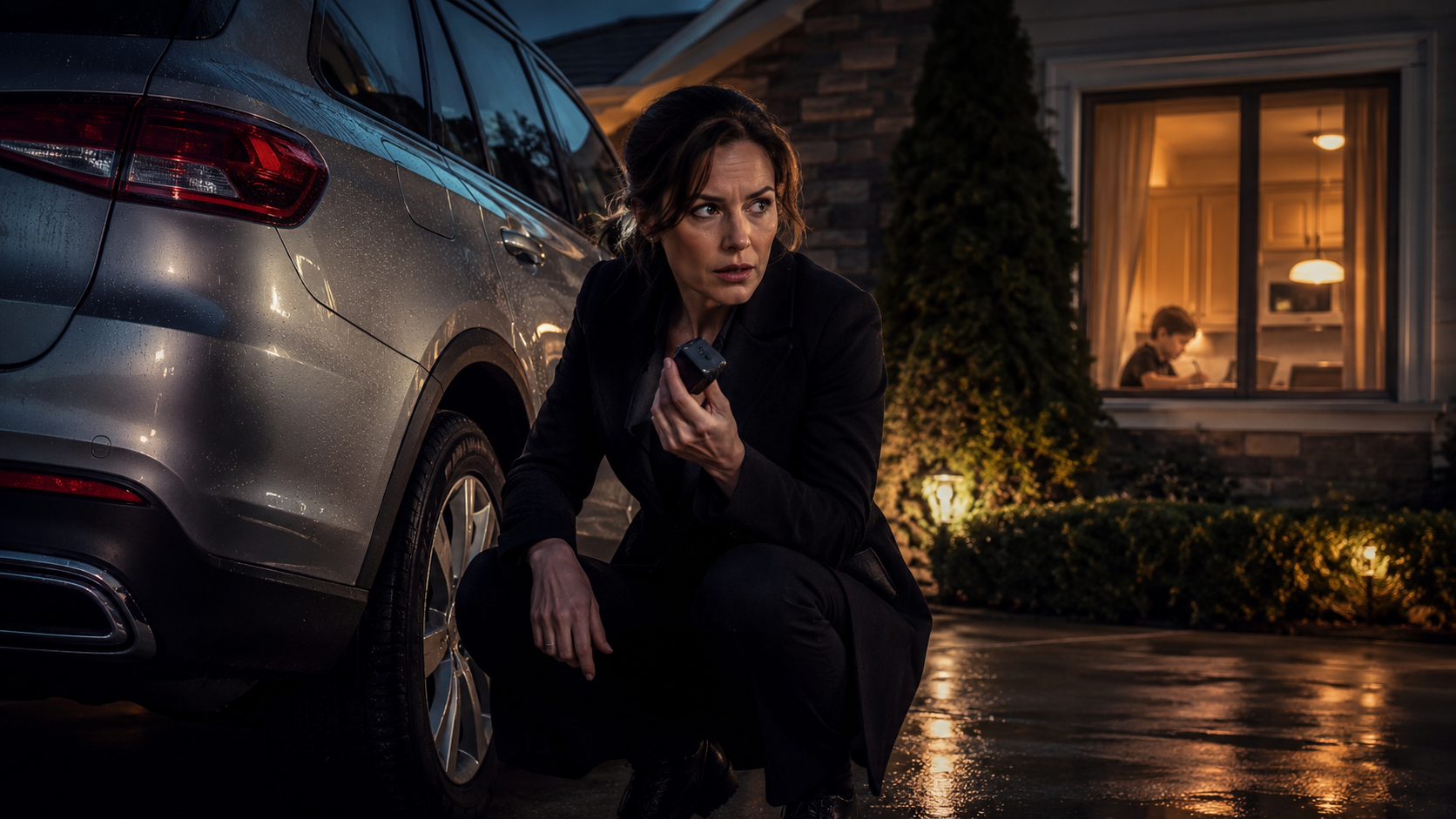
Nora Ellison found the tracker because of a sound.
Not a dramatic sound. Not the shriek of brakes, not the snap of a lock, not the kind of sound that announces danger in movies.
It was a faint plastic rattle beneath the rear bumper of her silver SUV as she turned into the driveway of the neat brick house her husband called their “forever home.”
The house sat at the end of a quiet street in Westhaven, Virginia, where the lawns were trimmed like carpet and every porch light turned on at dusk. It was the kind of neighborhood where people waved from behind expensive windows and pretended not to notice when one spouse stopped seeing friends, stopped working, stopped answering old phone calls.
Nora parked in the driveway, turned off the engine, and sat very still.
Inside, her nine-year-old daughter, Elsie, was probably at the kitchen table with her spelling list, swinging her legs under the chair while the soup cooled beside her. The laundry was folded. The dishwasher was humming. The roast chicken was in the oven because Graham liked dinner to smell warm when he came home.
Warm.
Orderly.
Safe.
That was the word he used most often.
Safe house. Safe choices. Safe routines. Safe wife.
Nora opened the driver’s door and crouched beside the rear bumper.
The rattle came again when she touched the plastic undercarriage panel. Something black and flat shifted in the narrow space above the wheel well.
Her stomach tightened before her mind had words.
She went into the garage, grabbed the small emergency toolkit Graham always mocked because “no one fixes anything themselves anymore,” and slid onto the cold concrete in her cream sweater and house shoes.
Three screws. One loosened panel. One magnetic mount.
Then the object dropped into her palm.
It was matte black, sealed, heavier than it looked. No branding. No consumer logo. Not the cheap kind suspicious boyfriends bought online and forgot to charge. This was hardened. Weatherproof. Low-profile. Built to last. Built to disappear.
Nora held it beneath the garage light and turned it once.
Her breath left her slowly.
A military-grade location beacon.
Long-life battery. Motion-triggered reporting. Cellular relay with encrypted fallback. Magnetic chassis mount. Roughly one-meter accuracy in urban zones.
She knew the architecture because twelve years earlier, before marriage softened her into someone easier to underestimate, Nora Ellison had helped design the detection suite that found devices like this.
Not the tracker itself.
The hunter.
A system that listened for ghosts. A system that identified hidden transmitters, mapped abnormal signal patterns, and traced unauthorized surveillance across buildings, vehicles, and personal devices. Corporations had paid millions for it. Investigators had borrowed it. Government contractors had wanted to own it.
And Nora had walked away from all of it after Graham Whitlock convinced her that being brilliant made her lonely.
“You don’t need that world anymore,” he had told her.
“You’re always tense when you work.”
“I just want peace for us.”
At first, it sounded like love.
Then it became advice.
Then it became a boundary.
Then it became the walls of a cage.
Nora closed her fingers around the tracker.
For five years, Graham had called her forgetful when she disagreed with him. Sensitive when she cried. Paranoid when she asked why he always knew where she had been. Ungrateful when she wanted to see old colleagues. Reckless when she said she missed work.
Now she knew.
He had not guessed.
He had watched.
The garage door was still open halfway, framing the quiet street like a stage set. Across the road, Mrs. Bell’s curtains twitched and fell still.
Nora stood and placed the tracker on the workbench.
Her phone was in her pocket.
Her first instinct was to call Graham.
Her second instinct was smarter.
She opened her contacts and searched a name she had not touched in almost six years.
Keira Park.
For a moment, Nora only stared at the screen.
Keira had been her closest friend in another life. The kind of friend who brought coffee at midnight and solved impossible problems with a dry erase marker in her teeth. The kind of friend who had warned Nora once, very gently, that Graham did not sound protective.
Nora had defended him then.
“He just worries,” she had said.
Keira had answered, “Control always introduces itself as concern.”
Nora had not called after that.
Not because Keira was wrong.
Because Nora was afraid she was right.
Her thumb pressed the call button.
Keira answered on the fifth ring.
“Nora?”
The surprise in her voice was sharp enough to cut.
Nora closed her eyes. “Hi, Kei.”
Silence.
Then Keira’s voice changed. Lower. Focused. “Are you safe?”
The question landed so quickly that Nora almost smiled.
Not hello. Not where have you been. Not why now.
Are you safe?
Nora looked toward the kitchen window. Elsie sat at the table inside, bent over her notebook, mouthing spelling words to herself.
“For the moment,” Nora said.
“What happened?”
Nora looked at the black device on the bench. “I found a tracker under my car.”
Keira did not speak for three seconds.
“What kind?”
“Not retail.”
Another pause.
“Nora.”
“I know.”
“Who put it there?”
Nora swallowed. “Graham.”
Keira exhaled through her nose. “Do not confront him.”
“I wasn’t planning to.”
“Good. Listen to me carefully. If he used something professional, the car is not the only place. Phone, laptop, home router, cameras, kid’s devices, maybe gifts. Assume anything with a battery can betray you.”
Nora’s fingers went cold.
Elsie’s tablet.
Her backpack.
The little purple watch Graham had bought her “in case of emergencies.”
Something in Nora hardened.
For years, she had felt herself getting smaller one compromise at a time. She had mistaken exhaustion for peace. She had mistaken obedience for maturity. But when her mind turned toward her daughter, the woman Graham had buried began digging upward.
“What do you need?” Keira asked.
Nora looked around the garage at the tidy shelves, the labeled bins, the snow shovel Graham insisted belonged on the third hook and nowhere else.
“A clean phone. Signal scanner. Faraday bags. Forensic camera. Fresh storage. And someone who remembers how to wake up an old ghost.”
Keira let out one short laugh, but there was no humor in it.
“I knew you were still in there.”
Nora picked up the tracker and slipped it into an old metal coffee tin lined with foil from the pantry.
“I’m not in there anymore,” she said. “I’m out.”
That evening, Graham came home at 6:48.
Nora knew because she had quietly reactivated the old side-door camera from the original home system, the one Graham thought had stopped working three years ago. He had replaced the visible interface with a subscription service he controlled, but he had never bothered to remove the original local unit.
He had forgotten what she used to do for a living.
Or worse, he had never believed she was still capable of doing it.
Graham stepped from his dark sedan, checked his phone, and glanced toward her SUV.
His expression changed.
Only a little.
But Nora saw it.
The tracker had stopped moving at 4:12 p.m. It now sat in a foil-lined tin behind a box of paint rollers. To whatever system Graham monitored, Nora’s vehicle was home.
Technically true.
Operationally useless.
Graham entered the kitchen with his charming husband smile, the one that made neighbors trust him and waiters laugh too loudly.
“There are my girls,” he said.
Elsie ran to him. “Dad, I got twenty out of twenty on spelling.”
“That’s my genius.” He kissed the top of her head. Then he looked at Nora. “Dinner smells incredible.”
“Chicken and rosemary,” Nora said.
“Perfect.”
He set his briefcase by the pantry, not the hall closet. His eyes drifted for half a second toward the garage door.
Nora stirred the soup.
“Everything all right?” he asked.
“Why wouldn’t it be?”
He smiled. “No reason.”
At dinner, he asked Elsie about school, laughed when she told him her teacher’s parrot had learned the fire drill sound, and complimented Nora twice. To anyone else, he would have looked like a devoted husband.
That was the cruelest part.
Graham was not a monster every hour of the day.
He could be gentle. He could be funny. He could remember how Nora took her coffee and hold her hand at church and cry during old movies. He could look at Elsie like she was the whole sky.
Then he could follow them without permission, measure their movements, and call it love.
After Elsie went upstairs to brush her teeth, Graham leaned against the counter while Nora rinsed plates.
“You went out today.”
Her hands did not pause. “I did.”
“Where?”
“Grocery store. Pharmacy. Picked up dry cleaning.”
“You didn’t mention the pharmacy.”
“I forgot.”
“For what?”
She turned off the faucet and looked at him. “Headache medicine.”
He tilted his head slightly. “You’ve been getting headaches again?”
“Only small ones.”
“You know I worry when you don’t tell me things.”
There it was.
The soft rope.
Nora dried her hands on a towel.
“I know.”
He stepped closer and brushed his knuckles along her cheek. “I just want to take care of you.”
She looked up at him and wondered how many times he had said that while checking a map of her location.
“That’s what you always say,” she replied.
His smile held.
But his eyes sharpened.
That night, Nora waited until Graham’s breathing deepened beside her.
At 1:09 a.m., she slipped from bed.
At 1:16, she retrieved the black duffel Keira had left beneath the hydrangea bushes while Graham was upstairs reading to Elsie.
At 1:23, Nora began the sweep.
She started with the SUV, photographing the mount and the cavity, recording the device inside the tin, documenting without destroying.
At 1:51, she found the second tracker.
It was inside Elsie’s purple watch.
Nora sat on the floor of her daughter’s room with the tiny device in her palm while Elsie slept under a blanket printed with moons and stars.
The room smelled like lavender spray and crayons.
On the bookshelf sat a clay turtle Elsie had made in art class. On the desk, a half-finished drawing showed their family standing under a giant sun. Graham had very broad shoulders in the drawing. Nora was smaller. Elsie had drawn herself in the middle, holding both their hands.
The tracker was hidden beneath the plastic battery plate.
“Emergency safety feature,” Graham had called it when he gave Elsie the watch.
Nora had trusted him.
For ten full seconds, she could not move.
Then she placed the watch carefully on the carpet and covered her mouth so the sound inside her chest would not wake her daughter.
Tracking Nora was abuse.
Tracking Elsie was unforgivable.
By dawn, she had found two more compromises.
A hidden remote access profile on her laptop.
A private administrator account on the home router.
Keira found the phone infection remotely once Nora moved the device into isolation. It was not crude spyware. It was expensive, quiet, built for people who could afford to ruin lives without leaving obvious fingerprints.
“Whoever set this up knows what they’re doing,” Keira said through the clean phone.
Nora stood in the pantry at 5:40 a.m., whispering beside sacks of flour and cereal boxes.
“Graham doesn’t.”
“No. Graham paid someone.”
Nora closed her eyes.
Of course he had.
Graham was controlling, not technical. He knew how to charm, pressure, and purchase. He did not know how to build.
“What do we do?” Keira asked.
Nora opened her eyes.
The first pink light of morning was spreading across the kitchen floor.
“We don’t remove everything.”
“No?”
“If we pull all of it, he knows.”
Keira was quiet for a second.
Then she said, “You want to feed him.”
“I want to learn his pattern.”
“That is dangerous.”
“So is staying blind.”
Nora made pancakes at 6:30.
When Graham came downstairs, she was sliding the last one onto Elsie’s plate.
He kissed her cheek. “You’re up early.”
“Couldn’t sleep.”
“You should take better care of yourself.”
Nora poured coffee into his favorite mug.
“I’m starting to agree.”
For the next thirteen days, Nora became the wife Graham believed he had trained.
She smiled more.
She answered quickly.
She volunteered small details.
She left her phone in predictable places and watched which cameras activated. She drove her SUV on ordinary errands while Keira shadowed the signal trail from a separate system. She texted harmless lies from the compromised phone and used the clean one only inside signal-blocking pouches.
If Nora typed, “Taking Elsie to dance,” Graham checked the location panel within three minutes.
If she said, “Stopping by the library,” he called with a question about dinner before she reached the parking lot.
If Elsie’s watch went offline for more than twenty minutes, Graham texted, Everything okay with bug?
Bug.
His nickname for their daughter.
Nora took screenshots.
Every time.
Patterns became evidence.
Evidence became a map.
And the map led somewhere colder than Nora expected.
The data from her home did not flow straight to Graham.
It went first to a private server registered under a company called Grey Harbor Consulting.
Nora knew the name.
Not because she had worked there.
Because six years earlier, Grey Harbor had tried to acquire one of the systems Nora helped build. They had wanted surveillance disguised as security. They had wanted tools that could predict when an employee might quit, when a spouse might leave, when a whistleblower might talk.
Nora had refused to sign off on the partnership.
She had called the proposal predatory.
Two months later, her career began to collapse.
Anonymous complaints about her “temperament.” Meetings she was no longer invited to. Graham appearing at her office with lunch and concern. Graham telling her she looked tired. Graham telling her she did not have to fight all the time.
Graham, who had met one of Grey Harbor’s executives at a fundraiser.
Keira found the payment trail on day sixteen.
“Nora,” she said, “he has been paying them for five years.”
Nora sat in a church parking lot with the clean phone pressed to her ear.
“How much?”
“Two thousand a month at first. Then thirty-five hundred. Last year it increased to five.”
Nora stared through the windshield at a stone angel near the cemetery gate.
“For what?”
Keira hesitated.
“Say it.”
“Domestic stability monitoring.”
Nora laughed once.
The sound did not feel like hers.
Keira continued carefully. “They generated monthly reports. Location summaries. Social contact risk. Emotional volatility scores. Financial independence indicators. Escape probability.”
Nora’s grip tightened.
“Escape probability?”
“Yes.”
“I’m his wife, Keira. Not a prisoner.”
“I know.”
“What about Elsie?”
Another hesitation.
Nora’s voice dropped. “What about my daughter?”
“There are child routine reports. School pickup times. Friend groups. Which parent she runs to first. Which parent she obeys faster. Notes about custody positioning.”
The car seemed to shrink around Nora.
Custody.
For years, Graham had been building a file.
Not just to control her.
To take Elsie if Nora ever tried to leave.
Keira spoke again. “There’s one more thing.”
Nora closed her eyes.
“The executive overseeing the account is Malcolm Sayer.”
The name opened a door in Nora’s memory.
Malcolm Sayer had been her former division director. Silver hair, calm hands, perfect suits, poison in a polite voice. He had once told Nora in a conference room that her concerns about surveillance misuse were “morally theatrical.”
He had also been the man who introduced Graham to several private security investors the year before Nora resigned.
Nora understood then.
Her marriage had not become a cage by accident.
Someone had sold Graham the bars.
That night, Graham came home with flowers.
White roses.
Nora hated white roses.
He knew that.
“I thought these would brighten the kitchen,” he said.
Elsie wrinkled her nose. “Mom likes yellow ones.”
Graham’s smile stayed in place. “Does she?”
Nora took the vase from him. “They’re fine.”
Later, after Elsie went upstairs, Graham poured himself a drink and stood in the doorway of the living room.
“You seem better lately,” he said.
Nora folded a blanket slowly. “Do I?”
“Calmer.”
“I’ve been trying.”
“I notice.”
He came behind her and placed his hands on her shoulders.
The old Nora would have gone still.
The new Nora noticed pressure, angle, distance to the door, reflection in the dark window.
“You know,” he said, “when you’re peaceful, this house works beautifully.”
Nora looked at his reflection.
“And when I’m not?”
His fingers tightened for one second.
“Then I worry something is influencing you.”
“Something?”
“Someone.”
Nora turned.
Graham’s face was soft. His voice was soft.
But his eyes were searching for cracks.
“Have you talked to anyone lately?” he asked.
“Like who?”
“I don’t know. Old friends. People from before.”
“Before what?”
He smiled faintly. “Before us.”
There it was.
The idea that her life began when he entered it.
Nora set the blanket down.
“I ran into a woman from Elsie’s school.”
“What woman?”
“Graham.”
“What?”
“Do you hear yourself?”
His expression shifted. Not anger yet. Offense first. He always chose offense before anger because offense made Nora apologize.
“I’m asking because I care.”
“No. You’re asking because you want inventory.”
Silence fell between them.
Graham set down his glass.
“Nora, don’t start this.”
“I’m not starting anything.”
“You get in these moods and then rewrite everything I do as control.”
She almost smiled.
He was still using old tools.
He did not know she had changed locks inside herself.
“I’m going to bed,” she said.
He stepped aside.
But as she walked past him, he whispered, “I know when something is off.”
Nora paused at the stairs and looked back.
“So do I.”
The trap formed three days later.
Grey Harbor sent Graham an alert that Nora had visited a women’s legal clinic.
She had not.
Keira created no fake evidence. They did not hack courts, forge records, or invent documents. Nora simply used the compromised system against itself. She drove the SUV near the clinic, left it in a public garage, took a ride to a coffee shop two blocks away, and let the tracker tell Graham an incomplete story.
He called in seven minutes.
“Where are you?”
Nora looked across the coffee shop at Keira, who sat with a laptop closed in front of her and a legal advocate beside her.
“At lunch.”
“With who?”
“Why?”
“Nora.”
“Graham.”
“What are you doing downtown?”
She stirred her tea. “You tell me.”
Silence.
Then he laughed once, softly. “What does that mean?”
“It means you always seem to know.”
He hung up.
Keira lifted her eyebrows.
Nora’s clean phone buzzed ten minutes later.
A message from the legal advocate’s investigator.
He took the bait.
Graham had left his office and driven straight to the clinic.
Not home.
Not to Nora.
To the place he thought she might be getting help.
By the time he arrived, Nora was not there.
But two witnesses watched him park illegally, storm inside, demand to know whether his wife had spoken to anyone, and threaten to sue the receptionist for “interfering in a private family matter.”
Graham was careful at home.
He was less careful when surprised.
That became the first public crack.
The second came the next morning.
Graham stood in the kitchen, pale with rage beneath a calm voice.
“I think we need to talk.”
Elsie was upstairs getting dressed.
Nora poured coffee. “About what?”
“About trust.”
“Interesting.”
His jaw moved.
“I went to the clinic yesterday because I was worried.”
“How did you know where to go?”
“You told me you were downtown.”
“I said I was at lunch.”
“You know what I mean.”
“No, Graham. I don’t.”
He stepped closer.
“You are my wife.”
“I am aware.”
“You don’t get to disappear.”
“I was gone for two hours.”
“You lied.”
“You tracked me.”
The words entered the room like a match falling into gasoline.
Graham froze.
Nora watched every part of him recalculate.
Confusion first.
Then denial.
Then tenderness.
“Nora,” he said softly, “what are you talking about?”
She took the purple watch from her robe pocket and placed it on the counter.
His eyes flickered.
Just once.
Enough.
Elsie’s watch sat between them like a tiny witness.
Graham’s voice lowered. “Why did you take apart our daughter’s watch?”
Nora placed the SUV tracker beside it.
Then a printed photo of the hidden router account.
Then the camera logs.
Then the Grey Harbor billing summaries.
Graham stared.
His face emptied.
For the first time in their marriage, he had no prepared expression.
Nora said, “You followed me.”
He did not answer.
“You followed our daughter.”
His eyes rose. “I protected her.”
“No.”
“You think the world is safe? You think I don’t see what can happen?”
“You paid strangers to score my obedience.”
“I paid professionals to help keep this family stable.”
“Stable means you in control.”
His face hardened.
“There it is. This is what happens when you talk to people who poison you against your own husband.”
Nora almost laughed.
“You still think this is about who I talked to.”
“It is.”
“No. It’s about what you did.”
He leaned forward, hands on the counter.
“You have no idea what I have done for you.”
“I know exactly what you have done.”
“You were falling apart before me.”
“I was successful before you.”
“You were alone.”
“I was free.”
That struck him.
His voice turned cold. “Freedom is a childish word people use when they don’t understand consequences.”
Nora gathered the papers back into a folder.
“Then understand this consequence.”
The doorbell rang.
Graham looked toward the hall.
Nora did not move.
He turned back slowly. “Who is that?”
“My attorney.”
His face changed.
The bell rang again.
“And a family court advocate,” Nora said. “And two officers here for a civil standby while Elsie and I leave.”
Graham’s mouth opened.
For one wild second, Nora saw the man behind the husband: not wounded, not frightened, but furious that the lock had opened from the inside.
“You won’t take my daughter,” he said.
Nora stepped closer, voice quiet enough that only he could hear.
“You put a tracker on her body. You lost the right to say my daughter like ownership.”
He reached for the folder.
Nora pulled it back.
“Don’t.”
His hand stopped.
Because the old Nora might have flinched.
This one did not.
Elsie came downstairs with her backpack, her hair half-brushed and her eyes worried.
“Mom?”
Nora turned, and her voice softened immediately.
“Hey, sweetheart. We’re going to stay with Aunt Keira for a little while.”
Graham moved toward Elsie. “Bug, come here.”
Elsie looked at him, then at Nora.
Something in her small face hesitated.
Children notice more than adults want to believe.
Nora held out her hand.
Elsie took it.
Graham saw that.
And that was the moment he understood the system had failed.
The weeks that followed did not feel victorious.
They felt exhausting.
Protective order hearings. Forensic reviews. Emergency custody motions. Interviews in rooms with beige walls. Graham’s attorney called the surveillance “misguided safety planning.” Malcolm Sayer’s representatives denied wrongdoing. Grey Harbor claimed all monitoring had been authorized by a “concerned spouse.”
Then Keira found the older contract.
The one Graham had signed electronically.
The one that stated he understood location tracking and device monitoring had to comply with applicable consent laws.
The one that used Nora’s forged initials.
That was the thread that unraveled everything.
Nora recognized the initials immediately. Too round. Too careful. Graham had practiced her signature, but not her impatience. Nora signed quickly, with a sharp upward slash at the end. Whoever forged the consent form had copied her name, not her hand.
A document examiner confirmed it.
Then another woman came forward.
Then three.
Then eight.
All connected to Grey Harbor.
Wives. Former partners. Employees. A city council aide. A physician whose ex-husband always knew which shelter she had called before she arrived. Each story different. Each pattern familiar.
Concern.
Safety.
Stability.
Control.
Malcolm Sayer resigned from two boards before the investigation became public. Grey Harbor closed its offices for “restructuring.” Graham’s company placed him on leave when the court filings surfaced.
But Nora did not feel satisfied watching his world shrink.
She felt tired.
One evening, weeks after she and Elsie moved into a small rented townhouse with yellow curtains in the kitchen, Elsie sat beside her on the floor assembling a puzzle.
“Did Dad love us?” Elsie asked.
Nora’s hand stopped over a blue puzzle piece.
She had prepared for many questions.
Not that one.
She looked at her daughter.
Elsie’s face was serious and too old for nine.
Nora chose the truth carefully.
“I think your dad loved the feeling of having us near him,” she said. “But real love does not need to trap people to keep them.”
Elsie looked down at the puzzle.
“Will he get better?”
“I don’t know.”
“Do we have to hate him?”
Nora’s throat tightened.
“No, baby. You don’t have to hate him. But you do get to be safe from him.”
Elsie nodded slowly.
Then she picked up another piece.
“This house feels louder,” she said.
Nora glanced around the tiny living room.
The dishwasher squeaked. Cars passed outside. A neighbor’s dog barked. The heater clicked like an old machine waking up.
“Louder bad?” Nora asked.
Elsie shook her head.
“Louder like… nobody is listening through the walls.”
Nora pulled her daughter close and held her until the puzzle blurred.
Three months later, Nora stood in a conference room downtown.
Not as Graham’s wife.
Not as a victim.
As the woman she had once been and the woman she had become.
Across the table sat attorneys, investigators, advocates, and two women from the state technology crimes unit. Keira leaned against the wall with her arms crossed, trying and failing to hide how proud she was.
Nora connected her laptop to the screen.
The first slide displayed a simple title:
Domestic Surveillance Patterns and Coercive Technology Abuse.
No drama. No revenge language. No personal photographs.
Just evidence.
Device types. Purchase channels. Consent fraud indicators. Router access patterns. Hidden account behaviors. Common escalation timelines. How abusers framed monitoring as care. How courts missed it. How schools could unknowingly reveal children’s routines. How women like Nora were told they were paranoid until the proof became too heavy to ignore.
When Nora finished, the room was silent.
Then one investigator said, “Could this be turned into a screening protocol?”
Nora looked at Keira.
Keira smiled.
Nora turned back.
“Yes,” she said. “That’s what I build.”
Not built.
Build.
Present tense.
Later that afternoon, Nora walked out into bright spring air.
Her phone buzzed.
A message from an unknown number.
You destroyed me.
She stared at the words.
For five years, a message like that would have made her shake.
Now she only felt the distance between who she had been and who she was becoming.
She typed nothing back.
Instead, she forwarded the message to her attorney, blocked the number, and kept walking.
At the curb, Elsie waited beside Keira, waving both hands.
“Mom! Guess what? I got the science fair team!”
Nora smiled so hard it hurt.
“That’s amazing.”
“They’re doing robots. I said you know about systems.”
Keira snorted. “Understatement of the century.”
Elsie slipped her hand into Nora’s.
“Can you help us make one that finds lost things?”
Nora looked down at her daughter.
A lost career.
A lost self.
A lost sense of safety.
Some things could be found.
Some things had to be rebuilt.
And some things, once discovered, could never be hidden again.
“Yes,” Nora said, squeezing Elsie’s hand. “I know exactly how to find what’s missing.”
Behind them, the courthouse doors opened and closed. Somewhere inside, Graham was still trying to explain himself in language that made cages sound like protection.
But Nora was already moving forward.
Not quietly.
Not harmlessly.
Not safely in the way he had meant.
Free.

