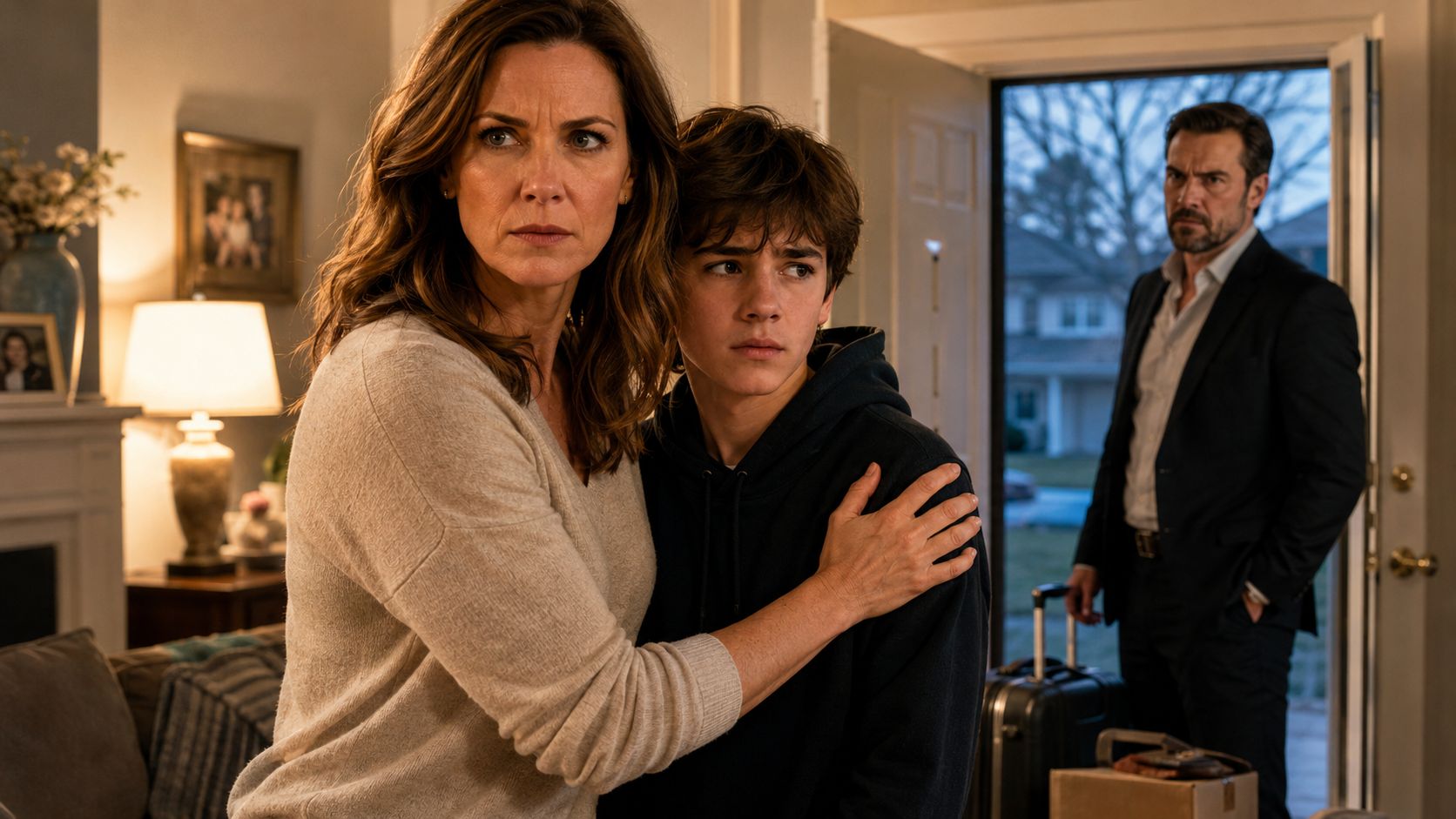
Her New Husband Told Her Son to Leave — So She Packed the Bags He Never Expected

The first thing Olivia Mercer noticed was how quiet her house became after Adrian slammed the front door.

Not peaceful quiet.

Not the soft evening kind that settles after dinner, when dishes are drying in the rack and a teenage boy is upstairs pretending not to listen to music too loudly.

This quiet had teeth.

It filled the hallway, pressed against the walls, slid beneath the staircase, and wrapped itself around her fifteen-year-old son, Caleb, who stood halfway down the steps with one hand clenched around the railing and the other holding his school hoodie against his chest like armor.

Adrian’s last words were still hanging in the air.

“When I come back tonight, I want his bags packed. I don’t care where he goes. Your sister. A boarding program. Foster care, if that’s what it takes. I am done living with him.”

Olivia had not answered him.

Not because she had no words.

Because if she had spoken in that moment, she might have said something she could never take back.

Now Adrian was gone, his tires scraping over the gravel drive, and Olivia stood in the living room staring at the door as if it had become a witness.

Caleb did not move.

He had grown tall in the last year, too tall for the old photographs on the mantel where he still had round cheeks and gaps between his teeth. He was almost six feet now, all elbows, long legs, dark curls, and the careful stillness of a boy who had learned not to take up too much room.

That stillness broke Olivia’s heart more than Adrian’s cruelty.

“Caleb,” she said softly.

He looked down at the step beneath his shoes.

“It’s okay,” he said.

No child should ever say those words after being thrown away.

Olivia turned toward him.

He swallowed hard. “I can go to Aunt Nora’s for a while.”

“No.”

His face twisted, not quite crying, not quite angry. “Mom, I don’t want you to lose everything because of me.”

She climbed the stairs slowly until she stood one step below him. Even then he was nearly eye level with her.

“You are not the reason I would lose anything.”

“He hates me.”

“That is his shame. Not yours.”

Caleb’s eyes shone. He blinked quickly and looked away, embarrassed by his own pain.

“He said foster care.”

“I heard him.”

“He said it like I was furniture he wanted removed.”

Olivia felt something inside her go dangerously calm.

For months, she had explained Adrian away.

He was stressed.

He was adjusting.

He had never raised a teenager before.

He did not mean to sound cold.

He liked order.

He needed quiet for work.

He was trying.

But trying did not look like contempt. Trying did not look like a grown man standing in the living room and demanding that a mother send her child away so his evenings could feel more convenient.

Caleb whispered, “If you have to choose—”

“I already chose.”

He looked at her then.

Olivia reached up and cupped his face, the way she had when he was small and feverish, when thunderstorms frightened him, when his father died and he had asked if heaven had visiting hours.

“I chose you the day they put you in my arms,” she said. “I chose you when you spilled cereal on the floor at two years old. I chose you when you cried through your first day of school. I chose you when your dad died and we had to learn how to breathe again. I chose you every morning after that. No husband, no house, no bank account, no dinner party, no quiet evening comes before you.”

Caleb’s mouth trembled.

“Mom…”

She pulled him into her arms.

He was not little anymore, but he folded into her like he had been holding himself together with string. His shoulders shook once, then again, and Olivia held him tighter.

Adrian had mistaken her softness for weakness.

That was his first mistake.

His second was believing she would ever choose him over her son.

After a few minutes, Olivia pulled back and wiped Caleb’s cheek with her thumb.

“Go upstairs,” she said. “Pack a small bag.”

His face fell.

“Mom—”

“For tonight only,” she said. “You’re going to Aunt Nora’s. I need you somewhere safe while I take care of this.”

He stared at her. “Take care of what?”

Olivia looked at the front door.

“Adrian told me to pack bags,” she said. “So I will.”

Two hours later, Caleb sat at Nora’s kitchen table with a bowl of tomato soup in front of him and a blanket around his shoulders.

Nora Mercer had never liked Adrian Vale.

She had been polite because Olivia had asked her to be. She had smiled at Thanksgiving when Adrian corrected Caleb’s posture at the table. She had stayed quiet at Christmas when Adrian joked that teenage boys were “walking grocery bills.” She had bitten her tongue at family dinners when Adrian spoke over Olivia and called it leadership.

But when Olivia told her what he had said, Nora did not try to be polite anymore.

She grabbed her keys so fast they nearly flew from her hand.

“Bring my nephew here,” she said. “And do it before I drive over there and make the evening news.”

Now Caleb was upstairs in Nora’s guest room, pretending he was fine. Olivia and Nora sat across from each other at the kitchen table, two mugs of untouched tea between them.

Nora leaned forward. “Tell me you’re leaving him.”

Olivia stared at the steam rising from her mug.

“No.”

Nora’s face changed. “Olivia.”

“I’m not leaving him,” Olivia said.

Nora opened her mouth.

Olivia looked up.

“He is leaving my house.”

Nora sat back.

Then, very slowly, she smiled.

“There she is.”

Olivia reached into her tote bag and pulled out a thick blue folder. She placed it on the table.

Inside were the deed, mortgage documents, tax records, insurance papers, bank statements, and the prenuptial agreement Adrian had insisted on because he thought he was protecting himself.

He had never understood that Olivia had more to protect.

The house on Bellweather Lane belonged to her.

She had bought it four years after her first husband, Daniel, died. She had used insurance money, savings, and every ounce of strength she had left after grief hollowed her out. It was not a mansion, but it was theirs. A pale blue house with white trim, a maple tree in the yard, a cracked stone path, and a garage Daniel had once dreamed of turning into a woodworking shop.

Caleb had learned to ride a bike in that driveway.

He had cried on that porch after his first school dance went badly.

He had built model airplanes in the kitchen while Olivia worked late at the dining table.

That house had held every broken and rebuilt version of their family.

Then Adrian moved in after the wedding and started acting like the house had been waiting for him all along.

At first, he had been charming. He brought flowers. He fixed loose cabinet handles. He called Caleb “champ” and asked about school. He said he admired how strong Olivia was.

But little things began to change.

He wanted Caleb’s gaming desk moved because it made the upstairs hallway look “cluttered.”

He complained that Caleb’s basketball shoes smelled.

He told Olivia that boys needed discipline, not comfort.

He said Caleb was old enough to stop needing his mother so much.

He laughed when Caleb showed Olivia a drawing, then said, “That’s nice, but you’ll need a real skill someday.”

Olivia had argued. Adrian had apologized. Then he had repeated himself in smaller, sharper ways.

And Olivia, exhausted from work, marriage, motherhood, and the fear of failing at all three, had tried to keep the peace.

She saw now that peace had been the wrong word.

It had been surrender.

Nora tapped the folder. “Do you have a lawyer?”

“I called Marisol Keene on the way here.”

Nora’s eyebrows rose. “The divorce attorney?”

Olivia nodded.

“She called me back in seven minutes.”

“Good.”

“She told me not to destroy anything, not to threaten him, not to let him inside if I feel unsafe, and to document everything.”

Nora took a sip of tea. “Marisol sounds like my kind of woman.”

Olivia stood.

Nora watched her carefully. “Are you sure you should go back alone?”

“I need to do this while he’s gone.”

“I can come.”

“No,” Olivia said. “Stay with Caleb.”

Nora’s expression softened.

Olivia looked toward the ceiling, where Caleb was probably lying awake in the guest room, staring at a wall that was not his, wondering whether he had ruined his mother’s life by existing.

“He needs one adult tonight who isn’t packing, calling lawyers, or changing locks,” Olivia said. “He needs soup and quiet and someone who will remind him he is wanted.”

Nora stood and hugged her.

“Then go,” she said. “And pack carefully.”

Olivia drove home through streets silvered by rain.

When she stepped inside, the house felt different. Not empty. Waiting.

She went upstairs first.

Not to Caleb’s room.

To the bedroom she had shared with Adrian.

His side of the closet was immaculate, every suit lined by color, every shirt spaced evenly, every pair of polished shoes angled just so. He liked order when it belonged to him. He called it standards. When Caleb left a hoodie on a chair, it was disrespect.

Olivia opened the closet doors.

Then she began.

She packed his suits into garment bags. His shoes into boxes. His watches into the leather case he kept on the dresser. His cufflinks, chargers, shaving set, cologne, expensive skin creams, gym clothes, belts, laptop stand, framed degrees, golf clubs, and the absurd imported pillow he claimed helped his posture.

She packed slowly and cleanly.

She did not tear.

She did not smash.

She did not throw.

Every item went into a box, bag, or suitcase.

Every box was labeled.

Every label was written in black marker, neat enough for a courtroom photograph.

Bedroom.

Bathroom.

Office.

Garage.

Kitchen.

Personal documents.

Electronics.

Adrian had told her to pack bags.

He had not specified whose.

By midnight, the hallway was lined with his life.

By one in the morning, she was in his office.

That was where she found the envelope.

It was tucked inside the bottom drawer of his desk, beneath old invoices and a folder labeled “Renovation Concepts.” Olivia almost ignored it. Then she saw her name through the thin paper.

Inside were copies of documents she had never signed.

A home equity loan application.

A financial projection for Adrian’s private real estate project.

A draft email to a lender referring to “our Bellweather property.”

Our.

Olivia read the pages twice, then a third time.

Adrian had listed the house as a future asset in a business expansion plan.

Not hers.

Theirs.

Her hands went cold.

The project was called Vale Urban Living. She had heard him mention it often enough. Luxury rentals. Investor meetings. A downtown building he wanted to buy and renovate. He always said he needed “one strong financial move” to secure the deal.

Now she understood what he had been waiting for.

A wife without resistance.

A house without a teenage boy in it.

A life arranged around him.

Olivia took photographs of every page and sent them to Marisol.

Then she packed the envelope into a separate folder.

Evidence.

At three in the morning, she slept on the couch for less than two hours.

At six, she called a locksmith.

At seven, she called a moving service and ordered a storage pod.

At eight, she spoke to Marisol again.

At nine, she called the non-emergency police line and asked what documentation she should have ready if her husband returned and attempted to enter a house solely in her name.

At ten, she drank coffee so strong it tasted like a warning.

By noon, Adrian’s belongings were outside under the covered side porch and in the storage pod at the end of the driveway.

Nothing was damaged.

Nothing was missing.

Nothing was hidden.

On top of the largest suitcase, Olivia placed a white envelope.

Inside was a note.

Adrian,

Your belongings are packed. The locks have been changed. Do not enter the house. Future communication must go through my attorney.

You told me to choose.

I did.

Olivia

She did not write more.

Men like Adrian fed on long explanations because explanations gave them places to argue.

A closed door was cleaner.

At 6:18 p.m., headlights swept across the front windows.

Olivia stood in the living room with her phone in her hand, recording.

Adrian’s black SUV stopped halfway up the driveway.

For several seconds, he did not get out.

Then the driver’s door opened.

He stepped onto the pavement in his tailored gray coat, his expression blank with confusion. He looked at the storage pod. Then the boxes. Then the suitcases.

His face changed.

Confusion became disbelief.

Disbelief became fury.

He snatched the envelope from the suitcase, ripped it open, and read.

His head lifted slowly.

“Olivia!”

She did not answer.

He marched to the front door and shoved his key into the lock.

It did not turn.

He tried again.

Harder.

The lock held.

He pounded on the door.

“Open the door.”

Olivia remained still.

He struck the door again. “Open this door right now.”

She pressed the intercom button.

“No.”

Adrian froze, then looked directly at the small camera beside the doorbell.

“What did you just say?”

“I said no.”

“This is my home.”

“No,” Olivia said. “It is not.”

“I live here.”

“You lived here.”

“You cannot throw your husband out like some tenant.”

“You told me to send my child away like unwanted furniture. You don’t get to lecture me about dignity.”

His jaw flexed.

“Let me in, Olivia.”

“No.”

His voice dropped. That was the voice he used when he wanted to sound controlled. Reasonable. Superior.

“You’re upset. I understand. I said something harsh. We can discuss it like adults.”

“You had your discussion. You gave me instructions.”

“I was angry.”

“You were honest.”

He looked toward the neighbor’s house and lowered his voice.

“You are humiliating me.”

“No,” Olivia said. “I am refusing you.”

His expression sharpened.

“You think this makes you strong? Throwing my things onto the porch?”

“They are packed properly. Nothing is damaged. You can take them tonight or arrange movers.”

“I’m not going anywhere.”

“Then I’ll call the police.”

He laughed once. “You wouldn’t.”

Olivia lifted her phone.

“I already have the number ready.”

Adrian stepped closer to the door, so close his face filled the camera.

“You are making a mistake.”

“No,” Olivia said. “I made the mistake when I kept forgiving the first warning signs.”

Something ugly flashed in his eyes.

“You always do this,” he snapped. “You turn Caleb into a shield. You let him run the house. He is fifteen, Olivia. Fifteen. Old enough to manipulate you. Old enough to know exactly how to keep you alone.”

Her hand tightened around the phone.

“He is a child.”

“He is almost a man.”

“He is my son.”

“He is the reason this marriage failed.”

“No,” Olivia said. “You are.”

Adrian stared at the door.

For a moment, neither of them spoke.

Then he said quietly, “You will regret choosing him.”

The sentence settled between them like smoke.

Olivia pressed call.

The police arrived twelve minutes later.

By then, Adrian had changed faces.

He stood beside the driveway looking wounded and exhausted, like a man who had been forced into public pain by an irrational woman. When the officer approached, Adrian sighed heavily and rubbed his forehead.

“Thank God you’re here,” he said. “My wife is having some kind of breakdown. She locked me out and put my belongings outside.”

Olivia opened the door only after the officer stood between them.

She handed him the deed, her identification, Marisol’s business card, and a short written summary.

The officer read everything without expression.

Adrian kept talking.

“We had a disagreement about parenting,” he said. “That’s all. Her son has behavioral issues, and I suggested we look into options. She twisted it.”

Olivia looked at him.

There it was.

The new story.

Not cruelty. Parenting.

Not rejection. Options.

Not a man demanding the removal of a child. A concerned husband trying to help.

The officer looked up. “Mrs. Mercer, is your son currently in the home?”

“No. He is with my sister.”

Adrian jumped in. “Because she removed him to manipulate the situation.”

Olivia took out her phone. “I have audio from the living room camera.”

Adrian’s face changed.

It was slight.

But Olivia saw it.

He had forgotten about the camera.

The same camera he had insisted they install after a package disappeared from the porch. The same camera he praised because “a smart home protects smart people.”

Olivia opened the file.

Adrian’s voice filled the porch.

“I don’t care where he goes. Your sister. A boarding program. Foster care, if that’s what it takes. I am done living with him.”

The officer’s mouth tightened.

Adrian said nothing.

Olivia stopped the recording.

The officer turned to him. “Sir, you need to leave the property tonight.”

Adrian stared. “You’re taking her side?”

“I’m explaining what happens next. She has asked you not to enter. The property appears to be in her name. You can arrange to collect your belongings peacefully, or you can create a trespassing issue.”

“This is absurd.”

“Sir.”

Adrian looked at Olivia then.

Not with love.

Not with regret.

With hatred.

“This isn’t over.”

Olivia met his eyes.

“I know.”

And she did.

Men like Adrian did not walk away from a locked door. They looked for windows.

The next morning, Olivia filed for divorce.

By noon, Adrian had already started telling people his version.

He told mutual friends Olivia had “spiraled” after a parenting argument.

He told coworkers Caleb was unstable.

He told his sister that he had tried to build a family, but Olivia refused to discipline her son.

By evening, Olivia received three messages from people who had never once asked Caleb how he was doing.

Maybe Adrian just needs space.

Teenagers can be difficult.

Marriage requires compromise.

Olivia read each message.

Then she blocked the numbers.

At Nora’s house, Caleb sat on the edge of the guest bed with his backpack at his feet.

“Is he coming back?” he asked.

Olivia sat beside him.

“No.”

Caleb nodded, but his eyes did not believe her yet.

“What if the court says he can?”

“Then we fight it.”

“What if people believe him?”

“Some might.”

He looked at her.

She hated that she could not give him an easier truth.

“But people believing a lie does not make it true,” she said. “And I am done living for the comfort of people who were never standing in the room with us.”

Caleb stared down at his hands.

“I heard him before,” he said.

Olivia went still.

“What do you mean?”

Caleb swallowed. “A few weeks ago. He was in the garage on the phone. I went to get my bike pump, and I heard him talking.”

“What did he say?”

Caleb’s fingers tightened.

“He said once I was out of the house, you’d be easier to convince. He said you were sentimental about the place because of Dad, but you’d get over it if he handled things right.”

Olivia felt the room tilt.

“What things?”

“I don’t know. Money, I think. A loan. Something about downtown apartments.”

Olivia closed her eyes.

The envelope.

The lender documents.

The plan.

Caleb’s voice dropped. “I didn’t tell you because I thought maybe I misunderstood. And because you were happy.”

Olivia turned toward him quickly.

“Caleb, look at me.”

He did.

“You never have to protect my happiness by carrying pain alone.”

His face crumpled.

“I thought if I said something, you’d think I wanted him gone.”

“Oh, sweetheart.”

“I did want him gone,” Caleb whispered. “But I didn’t want you sad.”

Olivia pulled him close.

“I was sad with him,” she said. “I was just calling it marriage.”

That was the moment Caleb finally cried.

Not quietly.

Not neatly.

He cried like a boy who had spent months folding himself smaller and smaller until there was nowhere left to fold.

Olivia held him and let him fall apart.

A week later, Caleb came home.

He paused in the doorway as if asking permission from the house itself.

The hallway looked different. Adrian’s framed city prints were gone. His steel umbrella stand was gone. His sharp black console table was gone.

In their place, there was space.

Caleb stepped inside carefully.

His shoes squeaked on the floor.

Olivia waited.

He looked toward the stairs. “Is my room still…”

“Your room is your room.”

He nodded.

Then, after a long moment, he dropped his backpack by the door.

Normally Olivia would have told him to put it away.

Instead, she let it sit there.

A backpack by the door had never been disrespect.

It had been proof that a child came home.

That night, Caleb played music in his room.

Not loudly.

Just enough for Olivia to hear the bass through the ceiling while she stood in the kitchen making pasta.

For months, the house had been managed like a hotel lobby. Quiet. Clean. Presentable. Dead.

Now there was music upstairs.

A spoon clattered in the sink.

The dryer buzzed.

Caleb shouted down, “Mom, do we still have parmesan?”

Olivia pressed both hands to the counter and cried.

Not because she was broken.

Because the house was breathing again.

The divorce turned ugly quickly.

Adrian hired an attorney who wrote emails like polished threats. He claimed Olivia had unlawfully removed him from the marital home. He requested temporary access to the property. He asked for reimbursement for household expenses. He accused Olivia of alienating him from the family and creating a hostile environment.

Then his attorney made the mistake of mentioning Caleb.

He suggested the court should consider whether Caleb’s “emotional volatility” had contributed to the breakdown of the marriage.

Marisol Keene smiled when she read that part.

It was not a warm smile.

It was the kind of smile a surgeon might give before picking up a scalpel.

“He should have left your son out of it,” Marisol said.

Olivia sat across from her in the office, hands folded in her lap.

“We have the recording,” Marisol continued. “We have the deed. We have the prenuptial agreement. We have the loan documents you found. We have the messages where he complained about Caleb. And now we have his attorney putting this theory in writing.”

She tapped the file.

“He thinks he is building a case against your son. He is building one against himself.”

The temporary hearing took place in a small courtroom that smelled faintly of paper, old carpet, and coffee.

Adrian arrived in a navy suit.

He looked tired, but carefully tired. The kind of tired meant to be seen. He had not shaved completely, leaving just enough shadow on his jaw to appear wounded rather than careless.

When he saw Olivia, his face softened.

It was almost impressive.

She remembered falling for that face once.

The tender eyes. The lowered voice. The way he made every apology sound like a confession and every confession sound like love.

Now she saw the performance beneath it.

His attorney argued first.

He described Adrian as a devoted husband pushed out of his home after a disagreement. He said Olivia acted impulsively. He said Adrian had contributed emotionally and financially to the household. He said no spouse should be locked out without due process.

Then Marisol stood.

She did not raise her voice.

She did not need to.

She played the recording.

The courtroom heard Adrian say foster care.

Adrian stared at the table.

His attorney shifted in his seat.

Then Marisol introduced the messages.

One read:

“You keep acting like Caleb is your partner. He is not. I am.”

Another:

“I did not marry a woman just to come second to a teenage boy.”

Another:

“You have three years until he leaves. I am your future, Olivia. Stop making me compete with your past.”

Olivia had cried the first time she reread those messages.

Now she listened without flinching.

The judge looked at Adrian over her glasses.

“Mr. Vale, did you suggest your wife place her minor child in foster care?”

Adrian cleared his throat.

“Your Honor, the statement was taken out of context.”

“What context makes that suggestion appropriate?”

Silence.

The judge continued. “Did you refer to the home as a financial asset in loan documents related to your private business?”

Adrian’s attorney stood. “Your Honor, those documents were preliminary and unsigned.”

“That was not my question.”

Adrian’s jaw tightened.

“They were projections.”

“Based on property you do not own?”

He said nothing.

The judge denied Adrian’s request to return to the house.

She granted Olivia temporary exclusive use.

She ordered all communication to go through attorneys.

Then she looked directly at Adrian.

“And I will be very clear. Do not contact the minor child. Do not involve him in this matter. Do not make public or private accusations about him in an attempt to pressure his mother.”

Adrian nodded stiffly.

Outside the courthouse, he caught up to Olivia near the steps.

“Olivia.”

Marisol immediately moved between them.

“Counsel only,” she said.

Adrian ignored her. His eyes stayed on Olivia.

“I loved you.”

Olivia studied him.

Maybe he believed it.

Maybe he loved the version of her who made room for him by making herself smaller. Maybe he loved being served dinner in a quiet house. Maybe he loved her grief because grief had made her careful, grateful, afraid of losing again.

But he had not loved the full truth of her.

Because the full truth included Caleb.

“No,” Olivia said. “You loved being chosen.”

Then she walked away.

Spring came slowly.

The maple tree in the front yard grew pale green buds. Rain washed salt from the driveway. The grass recovered in uneven patches where Adrian’s storage pod had sat.

Inside, the house changed.

Olivia turned Adrian’s office back into a room with windows.

She and Caleb painted it warm cream on a Saturday afternoon. Caleb got paint on his nose and denied it for twenty minutes while Olivia tried not to laugh.

They moved Daniel’s old workbench from the garage into the room.

Caleb spread his drawing tablets, model pieces, and tools across the surface.

“This can be yours,” Olivia said.

Caleb looked around like he did not trust the offer.

“For real?”

“For real.”

“What if I make it messy?”

“Then we clean it.”

“What if I’m loud?”

“Then I tell you to lower the volume like a normal mother.”

He smiled.

It was small.

But it stayed.

Nora came over with takeout and declared the room “the official headquarters of not being thrown away.” Caleb groaned and told her that was the worst name he had ever heard. Nora said it was a working title.

For the first time in months, laughter reached every corner of the house.

Adrian tried once more.

It happened on a Thursday evening in April.

Olivia was carrying groceries from the car when she saw him standing at the end of the driveway.

He looked different.

Less polished.

His hair was longer. His coat was wrinkled. His confidence had thinned.

She stopped near the porch.

“You’re not supposed to be here.”

He lifted both hands.

“I’m not here to fight.”

“Then leave.”

“I lost the downtown deal.”

Olivia said nothing.

“The lender backed out. Investors got nervous. My attorney says the divorce will take months.” He laughed bitterly. “Everything is falling apart.”

“That sounds like something to discuss with your lawyer.”

He looked toward the house.

“I made mistakes.”

“Yes.”

“I said things I shouldn’t have.”

“Yes.”

“I was under pressure.”

Olivia set the grocery bag down on the porch step.

“Adrian, do you know what pressure does?”

He frowned.

“It reveals what is already inside. It does not invent it.”

His face hardened, then softened again as if he remembered which mask worked better.

“I miss you.”

“You miss the house.”

“That’s not fair.”

“You miss access. You miss control. You miss the version of me that apologized when you were cruel.”

He looked away.

For a moment, she saw the anger beneath the embarrassment.

Then he said, “And Caleb? He just wins?”

Olivia almost laughed.

There it was.

After lawyers, court, humiliation, lost money, and ruined plans, he still thought a child having a home was a victory against him.

“Caleb was never playing your game,” she said. “Neither was I.”

Adrian’s mouth tightened.

“You’ll be alone.”

Olivia picked up the grocery bag.

“No,” she said. “I was alone with you.”

She went inside and locked the door.

That night, Caleb found her in the kitchen.

“Was that him?”

“Yes.”

“What did he want?”

“A second chance to become the same mistake.”

Caleb leaned against the counter.

“Did you ever think about giving it to him?”

Olivia looked at her son.

His curls were damp from a shower. His socks did not match. There was graphite on his wrist from sketching. He was fifteen, almost sixteen, still growing, still healing, still learning that love did not require him to disappear.

“No,” she said.

He nodded, but something in his face remained uncertain.

She walked to him.

“Caleb, listen to me. The right person will never ask me to love you less so he can feel loved more.”

His eyes filled.

He looked away and laughed under his breath, embarrassed again.

“You always say things like they belong in a movie.”

“Good. Then remember that line.”

“I will.”

Months passed.

The divorce finalized in August.

Olivia kept the house.

Adrian kept his debts, his pride, and whatever story he needed to tell himself in order to sleep at night.

He moved into a luxury apartment across town that, according to Nora, had “all the warmth of a dentist’s waiting room.” Olivia told Nora to stop checking his social media. Nora said she was not checking. She was monitoring enemy weather patterns.

Caleb started his junior year of high school.

On the first morning, he came downstairs wearing a dark green shirt, jeans, and the cautious expression of someone trying to look older than he felt.

Olivia held out a paper lunch bag.

He stared at it.

“Mom. I’m fifteen.”

“You still eat lunch.”

“I can buy lunch.”

“You hate the cafeteria pizza.”

He took the bag with exaggerated suffering.

Then he saw what she had written on it.

Not a note.

Not a speech.

Just his name.

Caleb.

He ran his thumb over the letters.

For reasons neither of them said aloud, the sight of his name on a bag made the kitchen go quiet.

Months ago, Adrian had ordered Olivia to pack Caleb’s bags.

Now here she was, packing one for him again.

Not to send him away.

To send him into the world fed, loved, and expected home.

Caleb cleared his throat.

“Thanks.”

“You’re welcome.”

He walked to the door, then stopped.

“Mom?”

“Yes?”

“I’m glad you chose me.”

Olivia smiled, though her eyes burned.

“I will always choose you.”

He nodded once and left for school.

The door closed behind him.

This time, the quiet that followed was peaceful.

It was the quiet of a house that knew exactly who belonged inside it.

And on the kitchen table, beside the divorce papers Olivia had not yet filed away, sat one final envelope from Marisol’s office.

Inside was the completed deed confirmation, the court order, and the last page of a marriage that had tried to turn a mother against her child.

Olivia placed the papers in the blue folder.

Then she went upstairs to the room Caleb had painted cream.

Sunlight poured across the workbench. Sketches covered the wall. A model airplane hung from the ceiling by fishing line, turning slowly in the air.

For the first time in a long time, Olivia did not feel like she was surviving the aftermath of someone else’s decision.

She felt like she had made her own.

Adrian had told her to pack bags.

So she had.

Just not the ones he expected.

Her New Husband Told Her Son to Leave — So She Packed the Bags He Never Expected
My husband demanded that we split our finances 50/50 because he got a pay rise. I agreed, but on one condition.