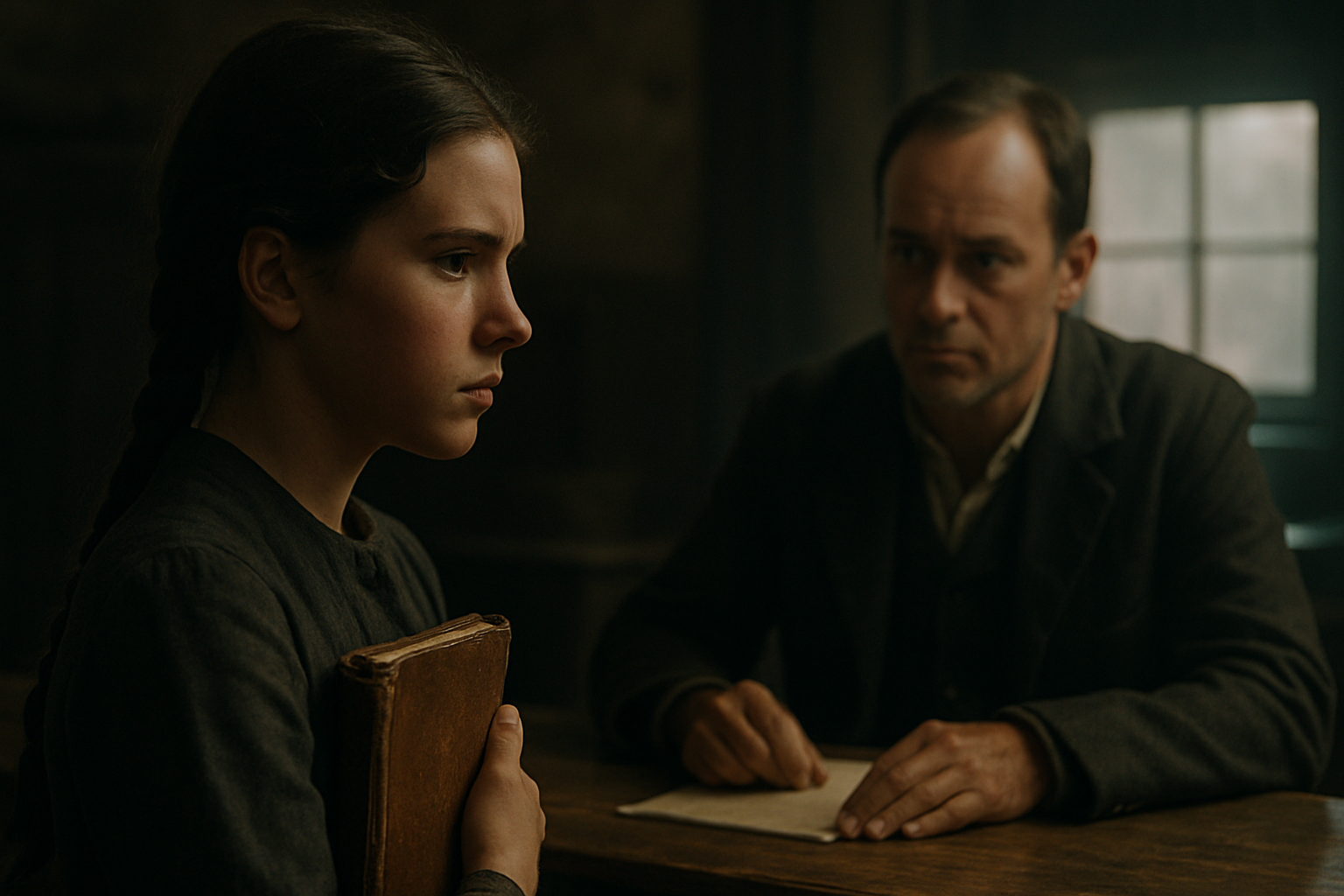
**Beneath Her Sod Roof, a Saga of Resilience and Redemption**
The sun peeked over the horizon as Hester Barnett headed determinedly toward the registry office, her dark hair tightly woven into a braid, her well-worn leather-bound journal tucked under her arm. The man seated behind the wooden counter hardly glanced her way as she approached.
“Name?”
“Hester A. Lane.”
“Age?”
“Eighteen,” she declared with unwavering confidence, though it was a flimsy truth.
He eyed her skeptically. “You look younger.”
“I hear that often.”
“Got the filing fee?”
With a swift, practiced motion, she slid the coins across the slick counter.
A quick inspection of the receipt—already inked and sealed—persuaded him, and with an indifferent shrug that signaled the end of his responsibility, he continued, “You know you need to live on the claim and improve it, right? Five years if you aim to prove it up.”
“I aim to,” she affirmed.
He chuckled softly, a hint of pity lacing his amusement. “Winter’s coming.”
“I noticed.”
By midday, she stood before the rise she had claimed as her own. Three miles south of Timber Valley, it overlooked the sprawling plains that stretched to the horizon. Other settlers had ignored it for its awkward slope and windy peak, unsuitable for traditional homes. But to Hester, it was exactly what her mother had advised her to seek: a south-facing hill for warmth, a natural channel for water, densely rooted sod, clay beneath the topsoil, willows by the creek, and wagon tracks distant enough for solitude.
To others, it seemed a fool’s choice.
To Hester, it was halfway built already.
The first to deride her ambition was Garrett Larkin. A widower with a fiery beard and three absent fingers, Garrett’s timber house had been battered eastward by two harsh winters. His belief that suffering bred wisdom had brought him from Dakota’s cold grip.
He arrived on horseback as Hester measured her land with string and stakes.
“Planning to fence that slope?” he asked with a hint of sarcasm.
“I’m planning to build.”
His gaze swept the landscape. “Build what?”
“A dugout.”
He laughed so heartily a crow took flight from a nearby tree.
“A dugout? Girl, those are for root vegetables and cowards ducking bullets.”
“It’ll be for me.”
He dismounted, kicked her stake with a boot, his voice turning serious. “Earth caves in. Roofs rot. Smoke suffocates. Water seeps. You’ll wake up buried, drowned, poisoned, or frozen. Maybe all four if fate is feeling efficient.”
Hester wound her string, unfazed. “Thanks for the tips.”
“Expecting company?”
“No.”
“Riches?”
“Enough.”
“Experience?”
Her eyes followed the hill’s slope. “Enough to see flat walls on flat land aren’t working too well for you.”
His cheerful demeanor clouded. The cost of his house was a bitter pill, and the entire town knew he burned wood like a locomotive. Pride didn’t take kindly to being challenged, least of all by a girl.
“You’re mouthy,” he said.
“I’m cold,” Hester replied. “There’s a distinction.”
The second critic was Wilhelm Becker, a German artisan whose hand had crafted the finest stone house in Timber Valley, only to watch moisture bead each morning like a regretful sweat.
Wilhelm reviewed Hester’s blueprints with disapproval.
“Underground retains dampness,” he warned. “Dampness invites illness. Illness leads to graves.”
“I’ll slope the floor to the door.”
“With what tool?”
“A level.”
“You own one?”
“I’ll rent one.”
“You understand pitch?”
“I know water moves downhill.”
His lips compressed into a stern line. “That isn’t carpentry.”
“No,” Hester conceded. “But it’s a decent start.”
The third and most painful objection came from Pastor Gideon Stowe, whose congregation met in his parlor—a convenience he called sacrifice. He wore a long, somber coat sent from Chicago and thought of civilization as something hung on a peg at the door.
Finding Hester slicing sod with a borrowed spade, he offered his concern softly.
“Miss Lane, this is unseemly.”
Leaning on the spade, palms blistered, she met his gaze. “No sir. It’s hard work.”
“It’s not the labor but the appearance I speak of. A girl alone in a pit. People will gossip.”
“They already do.”
“They might say you’ve forsaken decency.”
She surveyed the wide prairie, distant rooftops shivering under the sky, smoke dragged flat by the wind.
“Does decency keep a fire lit?”
His face softened, a prelude to a kindly cruelty.
“There are homes willing to take you in. Widow Winslow needs help. The Bronson offer may still stand if approached with humility. Divine protection often manifests through correct order.”
“My mother protected me with a journal and two hundred dollars.”
Pastor Stowe’s eyes flickered.
Brief. Almost insignificant.
But Hester noticed.
“You knew about the money?” she asked.
He recovered, “I know grief leads to imagining signs where only temptations lie.”
That chilled her more than any wind.
“What did Franklin tell you?”
His mouth set to a firm line. “He warned me you were headstrong, courting ruin.”
“And marrying Dorian Bronson would save me.”
“It would place you under protection.”
“Whose?”
“Miss Lane—”
“No,” she interrupted. “Whose protection? Divine or a man hungry for my claim?”
For the first time, Pastor Stowe’s temper flared.
“You’re sixteen. You don’t comprehend the perils of freedom.”
Hester drove the spade deeper into the earth.
“I understand the perils of dependence well enough.”
He departed, coat flapping behind like a tattered flag.
That evening, as the chill settled blue over the riverbend, Hester contemplated beside her half-dug wall of soil whether courage felt different from folly only after surviving it.
She rented tools: a spade, a mattock, a hand saw, a level, and a wagon for timber. She hired the Yarrow brothers, Jacob and Eli, hungry for work at fifteen and seventeen, unwise enough not to know pride earns less than silver. Fifty cents a day plus dinner if they brought their own tools was the agreement.
“You sure it won’t collapse on us?” Eli asked on the first day.
“No,” Hester replied honestly.
Jacob blinked. “That’s not very reassuring.”
“I’m sure enough to stand inside when it’s done.”
Eli grinned. “Well, if it collapses, we’ll be famous for a moment.”
For nineteen long days, they carved the hill.
Eight feet into the south-facing slope, then three feet down, crafting a space twelve feet wide, sixteen deep. High in front, lower toward the back. Hester halted progress often to check the grade. An inch drop over six feet, gentle enough for a chair to stand but effective enough for water to trickle out instead of pooling under a bed.
The boys griped.
Hester paid them still.
The sod rose in hefty blocks, roots interwoven tightly like coarse loaves. They sliced each brick three feet long, one foot wide, half a foot thick, stacking them grass side down for rooting. The front wall stood thick as a bank vault, narrowing toward the top. Behind the outer sod, Hester left an air gap and built an inner wall. Garrett Larkin passed by twice, shouting that she was building two bad walls instead of one good one.
Hester ignored him.
She had witnessed frost’s slow crawl up single walls. She understood the contrast between a packed earth cellar and a drafty shack. Though she didn’t know the term “dead air insulation,” she knew still air didn’t bite as moving air did.
For the roof, she spent more than she wished, yet less than advised. Six lodgepole beams, expensive to haul, set closely, willows woven over, canvas laid above, and then two sod layers, fourteen inches thick, sloped to shed meltwater.
When the last sod was secured, Eli lay flat in the doorway and groaned.
“If I ever see another sod brick, I’ll marry it just so I can leave it,” he declared.
Jacob tossed a clod at him.
Hester laughed for the first time since leaving Franklin’s place.
The stove cost her twenty-three dollars. Small, cast iron, scarred by its travels, purchased from a trader who warned of its temperament—smoking if wronged, singing if righted. Hester laid the chimney not straight up, as Garrett insisted, but angled through the hillside in a clay-lined tunnel before rising beyond the roofline. The first lighting resulted in smoke back-drafting into the room, making them all cough till their eyes watered.
Eli rushed out. “Your singing stove’s trying to kill us.”
Hester wiped her tears. “The angle’s wrong.”
Garrett, watching from horseback, cried, “Told you!”
Hester dismantled the pipe, repacked clay around its joint, narrowed the throat, and tried again.
This time, the draft set.
Smoke whisked clean through the tunnel, the clay surrounding the pipe warming slowly, retaining heat long after fire dimmed to coals.
Garrett ceased his laughter.
He never apologized.
Two salvaged windows cost twelve dollars, remnants of some long-forgotten brawl. She installed them deep within the front wall’s thickness, forming natural wells for light. The door, thick cottonwood plank, four inches, swung inward to prevent snowdrifts from trapping her. Leather hinges groaned. The latch stuck. The room smelled of damp earth, clay smoke, grass roots, ash, and hope.
On the fourth of December, Hester Lane moved into her hill with eleven dollars and thirty-two cents to her name.
That same afternoon, Levi Woodson arrived.
Levi taught when Timber Valley’s children gathered enough for lessons. At twenty-nine, from Illinois, he’d attended college just long enough to learn Latin didn’t prevent men from foolishness.
He removed his hat before entering.
That gesture alone endeared him to Hester.
Inside, he stood still, eyes tracing the walls, roof beams, chimney angle, window wells, and floor.
“Well,” he finally said.
Hester braced herself. “Go on.”
“You’ve constructed a thermal mass.”
She frowned. “I’ve built a place not to freeze.”
“Yes. That too.” He touched the back wall. “Six feet down, the earth tempers change slowly. It remains steady while air goes mad. Most homes here heat the sky through flimsy boards. Yours borrows patience from the ground.”
Hester stared at him.
No one had ever called anything she did patient before.
“My mother claimed potatoes sometimes knew more than carpenters,” she recalled.
Levi smiled. “Your mother sounds formidable.”
“She was.”
“Then she taught you well.”
The compliment hit a bruise inside Hester. She turned away, feigning busyness with the lamp.
“Will it hold?”
“If you manage air and moisture, yes. Crack the door in daylight. Keep the chimney clear. Watch for condensation. Don’t let pride keep you from asking for help.”
She glanced sidelong at him. “Does everyone here think I’m made of pride?”
“No,” Levi replied. “Some think you’re made of scandal. Some think you’re made of folly. I’m starting to think you’re made of arithmetic.”
She nearly laughed.
Nearly.
The first week taught her what theory couldn’t.
The dugout was darker than a house. Even with two windows, winter sunlight entered warily. Hester burned the lamp longer than planned, trading kerosene for sanity. At night, the walls seemed to breathe—not move, but exist with a closeness both soothing and unsettling.
She learned where to stack wood to dry instead of mold. She learned to crack the door an inch at noon, even when cold air crawled inside like a living thing. She found a small morning fire raised the room’s temperature to sixty-four, maintaining warmth long after flames died. She discovered that silence underground differed from silence above. Less empty. More attentive.
People came.
Mostly women.
Matilda Winslow brought bread, saying nothing about propriety. Mrs. Becker delivered pickled cabbage, eyeing the drainage with suspicion. Garrett’s sister, Ellen, came with her children, masking worry with curiosity.
“Is it lonely?” Ellen asked.
Hester looked around the single room. Bed in one corner. Table in another. Shelves cut into the wall. Stove. Trunk. Journal.
“Yes,” she said.
Ellen seemed startled by the honesty.
“But not as lonely as being unwanted in someone else’s house.”
Ellen glanced toward the door where her children prodded frozen grass with sticks.
“My husband says you’re making us all look foolish,” she said.
“I’m not trying to.”
“That might be worse.”
By mid-December, a cold front swept in.
Six below. Twelve below. Seventeen below at dawn, with a wind slicing through ordinary walls to chill bones in their sleep.
In Garrett Larkin’s timber house, the stove devoured wood every two hours. His youngest awoke crying as frost formed inside his window. In Wilhelm Becker’s stone house, walls sweated by day and froze by night. Pastor Stowe preached perseverance while his wife tucked blankets around parishioners’ knees.
In Hester’s dugout, the thermometer read fifty-eight at dawn.
She fed three sticks to the stove, brewed coffee, and watched the room climb to sixty-three.
On the third cold snap morning, Garrett called.
He didn’t dismount initially. Sat on his horse while Hester split kindling in her woolen sweater, her breath faint but untroubled.
“How much wood you burning?” he demanded.
“Six, maybe seven pounds daily.”
“That’s a lie.”
Hester swung the hatchet. The kindling split.
“It would be a peculiar lie.”
“My house burns forty.”
“I know.”
His face reddened against the windburn. “What’s that supposed to mean?”
“Your chimney smokes like a train.”
He eyed the thin gray tendril above her dugout.
“Let me see,” he said.
Hester rested the hatchet. “Ask nicely.”
Garrett’s eyes narrowed.
For a moment, she expected him to ride off. But cold had worn him down longer than pride had fortified him.
“May I see?” he muttered.
Hester opened the door.
Garrett ducked inside and halted.
The warmth didn’t blast like a stove’s heat. It enveloped. It radiated from walls, floor, and air. No draft crawled under the table. No frozen corners lurked behind the bed. It felt less like entering a room than stepping into a creature’s steady heartbeat.
Garrett removed one glove, pressing his palm to the back wall.
“Well, I’ll be damned,” he whispered.
Hester stood by the door, granting him the dignity of silence.
His gaze danced from the stove to beams to chimney.
“My grandfather had a bank barn in Ohio,” he admitted, “built into a hill. Cool in summer, warm in winter. I slept there with dogs when Pa got mean.” He swallowed. “I forgot.”
Hester’s anger softened despite herself.
“People forget what doesn’t look grand.”
Garrett chuckled without humor. “No. People forget what poor folks knew first.”
He left without conceding she was right. But after that, he stopped claiming she’d die.
That should’ve sufficed.
It wasn’t.
A week before Christmas, Dorian Bronson came calling.
Hester saw him through the window’s well, a tall silhouette cloaked in black, his stride deliberate, full of self-assuredness. At forty-seven, thick-waisted, clean-shaven but for a gray mustache, every inch of him reeked of a man used to others stepping aside.
She met him outside.
“No need to stand in the cold,” he said. “Invite me inside.”
“No.”
His smile tightened. “Still sharp.”
“Still disinterested.”
His gaze roamed the hill, the door, the chimney smoke. “You’ve made quite a scene of yourself.”
“I’ve made a home.”
“Homes have rooms. This is a burrow.”
“Then why’re you here?”
His eyes settled on her face. “Franklin is ready to forgive your outburst.”
Hester nearly laughed. “Is he?”
“Olivia’s nearing her time. The family needs help. Return, apologize, and we can discuss marriage once the child arrives.”
“There is no arrangement.”
“There could be.”
“I’d rather sleep in the snow.”
His expression shifted then. The charm drained, leaving something cold and hungry.
“You think this claim makes you safe,” he said.
Hester’s fingers clenched hidden in her gloves.
Bronson stepped closer. “A girl can’t prove land alone. Not really. Accidents happen. Papers get lost. Men testify. Ministers counsel. Clerks misremember. You’ve made people uneasy, Miss Lane. Uncomfortable people seek comfort.”
Then she understood the flicker in Pastor Stowe’s eyes.
“You and Franklin plotted this.”
Bronson’s smile widened. “Franklin has debts. Olivia has needs. I have means. You have a claim better placed than you realize.”
“What does that mean?”
His gaze drifted to the lower slopes where winter grass speared the snow.
“Ask your mother.”
“My mother’s dead.”
“Then perhaps ask why she filed before telling her husband.”
Hester’s heart raced.
Bronson tipped his hat. “The deep freeze comes after Christmas. Pride’s easier in mild weather. When ready for reason, send word.”
He walked away.
That night, Hester rifled through the journal again.
Nothing new surfaced. No second note. No map. No resolution. Just that first letter, the spent money now invested in walls and roof, and her mother’s careful warning.
Feeble men do damage while convincing themselves choice eludes them.
For the first time since building the dugout, Hester barred the door before dusk.
Christmas passed quietly.
Hester roasted a hen Ellen Larkin had traded for sewing. She read Luke, because her mother had, then Job because she felt less forgiving. She sang a hymn softly, stopping midway when her voice broke.
Approaching dusk, Levi Woodson came bearing a parcel.
“Merry Christmas,” he offered.
Inside, a small brass thermometer—better than her battered one.
“I thought your arithmetic deserved proper instruments.”
She turned it in her hand. “I’ve nothing for you.”
“You let me stand inside Cedar Valley’s most fascinating room. That is enough.”
She hesitated before recounting Bronson’s visit.
Levi’s face darkened.
“Bronson holds freight contracts,” he said. “Half the valley owes him.”
“Franklin too?”
“Likely.”
“He claimed my claim is better placed than I know.”
Levi peered toward the frozen creek. “Rumors suggest the railroad survey may come close within years. Land with water access could prove valuable.”
“My mother knew.”
“Sounds like she suspected.”
Hester folded her arms. “So they didn’t just wish marriage—they wanted me erased.”
Levi didn’t sugarcoat the truth. “Yes.”
Ironically, his honesty steadied her.
“What do I do?”
“Survive winter first,” he said. “Legal battles are for the living.”
Two days on, a trader visited.
Gideon Shaw had spent years trapping, hauling, trading, and fibbing across Dakota Territory, though his weather sense was truthful. He stopped by Hester’s dugout near sundown, his mule steaming, gaze on the western horizon.
“Big one coming,” he warned.
“How big?”
“Forty below if the devil’s counting. Wind hard enough to strip paint from a saint’s pride.”
“When?”
“Night after next, maybe sooner.”
Hester surveyed the horizon. It bore a strange metallic tint, bruised green-gray beneath the clouds.
“You telling everyone?”
“Told who’d listen. Most men hear weather warnings as slights.” He eyed her door. “You ought to go into town.”
“No.”
“Hester, I admire gumption, but I don’t worship it. This storm will kill.”
“If this can’t hold, others’ roofs won’t.”
He studied her.
Then nodded once.
“Keep your chimney clear. Bank snow against the door but don’t let it seal you in. Melt water early. And should you hear tapping in the walls, don’t panic. Frost moves earth like a fist.”
Her stomach tightened. “That happens?”
“Occasionally.”
“Reassuring.”
“Truth rarely is.”
After he left, Hester prepared.
Extra wood stacked near the entry. Barrels filled. Beans soaking. Chimney checked, door barred, roof bolstered. Chickens crated near the wall despite their protests. A rope tied from door to a willow stake should whiteout blind her. Cornbread cooked, wrapped, and stacked near the stove.
Then she sat with her mother’s journal, writing in its blank pages.
December 28. Thermometer outside shows 4 below at twilight. Inside 61 with a low fire. Wind southwest, rising. If I perish, let it be known the house didn’t fail for lack of care.
She studied the sentence.
Then struck out If I perish.
Rewrote:
When I survive, remember to widen chimney before next winter.
The blizzard hit at 2:00 a.m.
It roused her like cannonfire without the cannon.
The hill itself groaned.
Not the cabin. The hill.
Wind above roared so fiercely the dugout hunkered deeper, instinctively burrowing. The door rattled against its bar. Snow hissed through some slender gap. The chickens erupted in a clamor of alarm.
Hester lit the lamp despite her hands’ desire to tremble.
Inside: fifty-four.
Outside, through a cracked peephole: thirty-one below.
She fed the stove. Not too much. A raging fire could crack pipe or misdraw. Slow heat. Steady heat. Let the clay absorb. Let the walls learn again.
By dawn, the outside world vanished.
Sky gone. Creek gone. Road and settlement erased. Only white violence and the sound of something immense passing overhead.
Hester remained inside.
She read. Cooked. Slept in fragments. Hourly, she checked the chimney draw, a thread near the stove seam. It pulled inward. Good. She cracked the door, shoveling snow back before it sealed her. The cold bit her heavily, but she retreated into warmth with gratitude sharp as pain.
The first day passed.
Then the second.
By the second night, the outside thermometer became useless, crusted in ice. Snow banked against the entrance till only the inward-opening door saved her from being trapped. Wind whipped over the roof, but the sod held firm. Beams creaked, deep and slow, like old men coughing.
Hester touched each and whispered, “Hold.”
Around midnight, the stove smoked.
At first, faintly.
A gray tendril curled from the seam, flattening under the ceiling.
Hester stood instantly.
The draft thread hung limp.
“No,” she whispered.
She opened the stove. Smoke billowed out.
Chimney blocked.
For one frantic second, fear blanked her mind. Gideon’s warning echoed back. Keep your chimney clear. If blocked, smoke would fill the dugout. Carbon monoxide would send her to eternal sleep. Warm, safe, and dead.
She wrapped her face, grabbed the poker, opened the cleanout at the chimney base. Ash spilled out. No obstruction there.
The trouble lay above.
Outside.
Hester stared at the door.
To clear the chimney, she needed to confront the storm.
She tied the rope around her waist, grabbed the shovel, forced the door open. Snow collapsed inward. Wind struck like a hammer blow. She dropped to her knees, crawling since standing was impossible. The rope seared through her glove as she followed it to the willow, then angled up the slope where the chimney stood.
She saw nothing.
Not a foot ahead.
Her world shrank to rope, shovel, breath, pain.
Cold stabbed her skirt. Ice formed on lashes. Twice she lost the pipe and had to sweep until metal clanged beneath her glove.
Found it.
She dug.
Snow packed around the chimney, but not enough for a full block. Something else was wedged inside.
Hester thrust the poker down.
It struck fabric.
She twisted, yanked, pulled.
A wadded canvas came free, stiffened by ice, blackened at one edge.
Canvas.
Not snow.
Not accident.
Someone had sabotaged her chimney.
For a moment, the storm stepped aside for a hotter terror to flood in.
Dorian.
Franklin.
Pastor Stowe.
Someone meant to let her own home kill her and let the blizzard take the blame.
Her body wanted to freeze at the realization.
Then smoke puffed from the pipe, hot and alive.
Hester shoved the canvas in her coat, cleared the rim, crawled back down half-blind, falling more than entering through the doorway, slamming it shut, gasping on the floor as smoke cleared above and the stove resumed its draw.
She didn’t cry.
Her anger burned hot enough.
The third day dawned without light, the storm still raging, though weaker now, like a beast tiring. Hester hadn’t slept. She sat at the table, the frozen canvas beside her, her mother’s journal under her hands.
Who?
Her mind circled the question.
Who hated enough to quietly kill?
Dorian had motive. Franklin had debt. Pastor Stowe had reputation. Garrett had pride, but he’d witnessed the dugout’s success, and his meanness was loud, not hidden.
Late afternoon, the wind dropped suddenly.
Silence engulfed her.
She opened the door to a wall of snow.
It took her half an hour to dig enough to squeeze through. Outside, the cold was beyond counting. Lungs emptied. The prairie transformed into white dunes, fence posts buried, creek erased, houses reduced to smoking dots.
Hester climbed the hill, surveying Timber Valley.
A chimney silent.
Another followed.
Then movement near the road—three figures staggering, one falling, one rising, one carrying something bundled.
From the Foster place.
Even from a distance, Hester recognized Franklin’s gait.
For a long moment, she stood, canvas hidden in her coat, watching him struggle.
She could shut the door.
She could survive.
The thought was clean, cold.
Then Olivia collapsed.
Franklin tried lifting her, failing. The bundle under his arm moved weakly.
Hester cursed, grabbed the rope, descended the hill.
By the time she reached them, Franklin’s face was gray beneath the ice in his beard.
“Hester,” he croaked.
Olivia moaned. The bundle wasn’t the newborn she expected but little Jacob, Olivia’s fourteen-month-old nephew taken in after tragedy. His cheeks waxy, his cries threadbare.
“Where’s the baby?” Hester demanded, eyeing Olivia’s belly.
Guilt washed over Franklin so quickly she knew.
“Not yet,” he confessed. “Early labor. Pain last night. House split. Stove pipe torn. Couldn’t keep warmth.”
Hester looked toward the dugout.
Every step might kill them all.
Every delay might kill them faster.
“Hold the child under your coat,” she instructed. “Olivia, can you walk?”
Olivia’s fearful eyes found hers. Fear stripped away all pretense.
“I’m sorry,” Olivia whispered.
“Walk first. Confess later.”
They reached the dugout in parts.
Hester got Olivia to bed, Jacob near the stove, Franklin slumped against the wall. She stripped frozen layers, rubbed Jacob’s hands till he screamed properly, spooned hot coffee into Franklin because his tremors forbade him from holding a cup.
Olivia’s pains ebbed and broke like waves.
Hester had never delivered a baby. She’d seen calves, once a foal, and Mrs. Larkin’s youngest when Matilda arrived late and her mother did what needed doing. She remembered towels. Water. Clean hands. Calm assurances.
“You’ll be fine,” she told Olivia.
Olivia clutched her wrist. “Don’t let me die.”
Hester faced the woman who took her place at the hearth and threatened her into marriage like discarded furniture.
“I won’t.”
Franklin murmured from the wall.
When she turned, he stared at the frozen canvas by the door. It must have slipped from her coat.
His face shifted.
Not confusion.
Recognition.
Hester saw it.
“You know what that is.”
Olivia cried out as another contraction struck.
Franklin diverted his gaze.
Hester closed the distance in two steps, crouched before him.
“Who blocked my chimney?”
His mouth opened, closed.
“Who?” she pressed.
Olivia sobbed, “Franklin, confess.”
Hester turned slowly.
Olivia’s features crumpled.
“I didn’t know he’d act tonight,” she swore. “Before God, I swear.”
The room tilted.
Franklin hid his eyes with a trembling hand.
“Bronson told me it’d just smoke you out,” he whimpered. “Force you back to town. Said there’d be no harm.”
Hester stared.
The stove ticked softly.
Jacob whimpered in sleep.
Olivia moaned, and Hester stood between a birth, murder attempt, and the man who carved her a wooden horse when she was eight.
“You stuffed canvas in my chimney?”
Franklin’s voice cracked. “Bronson did. I showed where the pipe rose. Pastor claimed—”
“Pastor Stowe?”
“Said your claim was unnatural. A girl alone invited sin. Said restoring you to rightful protection might save your soul.” Franklin gulped. “Bronson promised my debts would vanish if you wed him. Once his, he’d manage the claim. The railroad—”
“The railroad,” Hester echoed.
“He procured the survey map.”
Olivia’s scream pierced.
The baby was coming.
For one awful second, Hester wanted every sordid detail exposed. Names, dates, promises, signatures. She wanted Franklin to feel the fear she’d faced crawling through the blizzard with death spewing from her stove.
But Olivia screamed again, blood staining the sheet.
Hester rose.
“This isn’t over,” she vowed.
Then she delivered Olivia’s child.
The baby emerged small, blue, and silent.
Hester’s world narrowed to the infant in her grasp. She rubbed its back. Nothing. Cleared its mouth. Nothing. Olivia sobbed, struggling to rise. Franklin whispered prayers bordering on bargains.
Hester cradled the infant near the stove, rubbed harder, heard her mother’s voice from deep memory reserved for crises.
Make the living know they’re wanted.
“Breathe,” Hester commanded. “You didn’t endure that storm to quit here.”
The infant coughed.
Once.
Twice.
Then filled the dugout with an indignant wail.
Olivia sank back, sobbing.
Franklin wept into his palms.
Hester wrapped the infant in her mother’s blue shawl, placing her on Olivia’s chest.
“It’s a girl,” she announced.
Olivia gazed at the infant, then at Hester.
“What should I name her?”
Hester almost said, Not my concern.
But the infant’s fist clutched the shawl’s edge tightly.
“Eliza,” Hester replied.
Olivia wept harder.
The storm ceased before dawn.
When the sky cleared, it revealed a frigid world gleaming, holy until tallying began.
Four dead in the broader valley. Two elderly siblings whose wood ran out. A young couple, found lifeless fifty yards from their door, lost in whiteout. An infant in a claim shack where the north wall fractured, leaving the stove powerless.
Garrett Larkin’s family endured by burning chairs and part of a bed frame. Wilhelm Becker’s youngest lost two frost-bitten toes. Pastor Stowe’s wife fainted in the cold parlor. Dorian Bronson’s freight barn collapsed, killing two mules and revealing illicit railroad stakes.
But Hester’s dugout remained.
Inside, with no roaring fire, the thermometer read fifty-six. With care, sixty-five.
Word traveled with thaw.
By noon, Garrett arrived with teams to carve paths. He found Franklin outside Hester’s dugout, guarded by his own shame while Olivia and the children slept inside.
Garrett comprehended the scene; the canvas, the blocked chimney tale Hester recounted flat as steel.
He faced Franklin.
“I oughta break your jaw.”
Franklin didn’t lift his head. “You ought.”
Garrett glanced at Hester. “Want me to?”
The absurdity nearly made Hester laugh.
“No.”
“Pity.”
Levi Woodson came next, bearing a notebook, his expression that of a man whose mind had transformed into a courtroom.
“Tell me all,” he requested.
Hester did.
She detailed Bronson’s visit, Pastor Stowe’s warning, Franklin’s confession, the canvas, the railroad survey, the debts. Olivia, weak but coherent, corroborated. Franklin signed a statement, hands trembling so badly Levi blotted the ink twice.
Then Hester showed Levi the dugout.
Not as a curiosity, but as evidence.
He measured wall thickness, roof pitch, chimney draw, interior temperature, exterior temperature, wood consumption, floor grade, condensation—or its absence. He queried, and Hester answered. Garrett listened, pretending indifference but failing.
“This,” Levi concluded, “isn’t luck.”
Hester was tired enough for honesty. “It felt like luck crawling to the chimney.”
“Luck survives mistakes,” he said. “You survived because you planned. That’s engineering.”
Garrett grunted. “Don’t inflate her head.”
Hester eyed him. “Too late. I reside in a hill. My head’s ample.”
He laughed.
Three days later, Pastor Stowe appeared in her doorway.
He seemed smaller without parishioners flanking him.
“I seek forgiveness,” he said.
She didn’t invite him in.
“Seek it from God.”
“I have.”
“What did He say?”
The pastor flinched.
Behind Hester, Olivia shifted, baby Eliza nestled against her shoulder. Franklin penned another confession, now naming Bronson’s full proposition.
Pastor Stowe saw and grasped his impending ruin.
“I believed I was restoring order,” he stammered.
“You aided a man in smoking me out during a blizzard.”
“I didn’t know Bronson would act amidst the storm.”
“You knew he’d act.”
Tears shone in eyes unworthy of them.
“Yes.”
Hester waited.
Outside, men repaired roofs, women boiled snow for washing, children hauled split wood. The town, honest under weather’s lash, had no energy for polite falsehoods.
“What do you want?” she inquired.
“To make amends.”
She thought of the lost infant, the young couple, Becker’s daughter, Garrett’s children sleeping atop broken frames, her mother’s letter, her chimney-sooted hands.
“You’ve a parlor larger than my home,” she said. “Open it to families until spring. Your woodpile goes first to homes with children. You’ll confess, not prettily, but truthfully. Never again recommend marriage for shelter when a girl can build her own.”
His face paled.
“It’ll end my ministry.”
“No,” Hester corrected. “It’ll reveal if you ever possessed one.”
He bowed his head.
Dorian Bronson attempted to leave Timber Valley before the road cleared.
Garrett Larkin halted him.
Garrett later claimed, “I just stood in a horse’s way.” Silas’s bruises suggested otherwise.
The territorial marshal arrested Silas on charges evolving from fraud to more intriguing accusations following Levi’s discovery of his railroad speculation correspondences. Franklin avoided jail, partially because Hester declined pressing charges, partially because Olivia’s testimony emphasized Bronson’s lead. But Franklin forfeited his claim settling debts, and for the first time, worked land he didn’t pretend to own.
In February, the Dakota Frontier Journal published Levi Woodson’s article:
A PRAIRIE HABITATION THAT HELD SIXTY-FIVE IN FORTY BELOW
It should’ve centered on Hester’s dwelling.
It became about Hester.
That irked her.
The article chronicled a sixteen-year-old homesteader crafting a low-cost earth-sheltered home using sod insulation, air gaps, drainage grading, and thermal mass concepts. It compared fuel consumption between her dugout and three traditional homes. It noted frame and stone shelters failed extreme cold, her dugout sustaining livable temperatures efficiently. It omitted her blizzard childbirth and attempted murder.
Hester preferred it so.
The community didn’t.
By March, three families sought her designs. By April, nine. By May, seventeen.
Hester charged five dollars per consultation, not greedily, but because free advice was too readily ignored. When paid, they listened.
“No,” she instructed Garrett, examining his half-dug hill. “Not there. Water’ll breach the wall.”
Garrett wiped sweat. “You always this bossy?”
“When paid.”
“I regret it all.”
“You’ll regret drowning more.”
Wilhelm Becker hired her to modify his stone house. She showed him to add an inner sod wall with vents managing moisture. He argued for hours, then followed her exactly. That winter, his walls ceased sweating.
Matilda Winslow turned her storage cellar into a warm boarding room for those unable to afford wood. Ellen Larkin insisted on window wells wide enough for morning sun. Levi translated Hester’s insights into plans newspapers and government agents grasped.
“Professors eastward would take pages to explain what you say in one sentence,” he mused one evening.
“What sentence?”
“Water flows downhill.”
She smiled. “They’re welcome to it.”
Olivia stayed through spring.
Initially, Hester wasn’t sure how to handle her. Forgiveness wasn’t a door opened once. It was like the dugout—dug slowly, fortified carefully, never safe if neglected.
Olivia wasn’t instantly sweet. Shame didn’t render her gentle overnight. But motherhood softened something fear had sharpened. She lab

