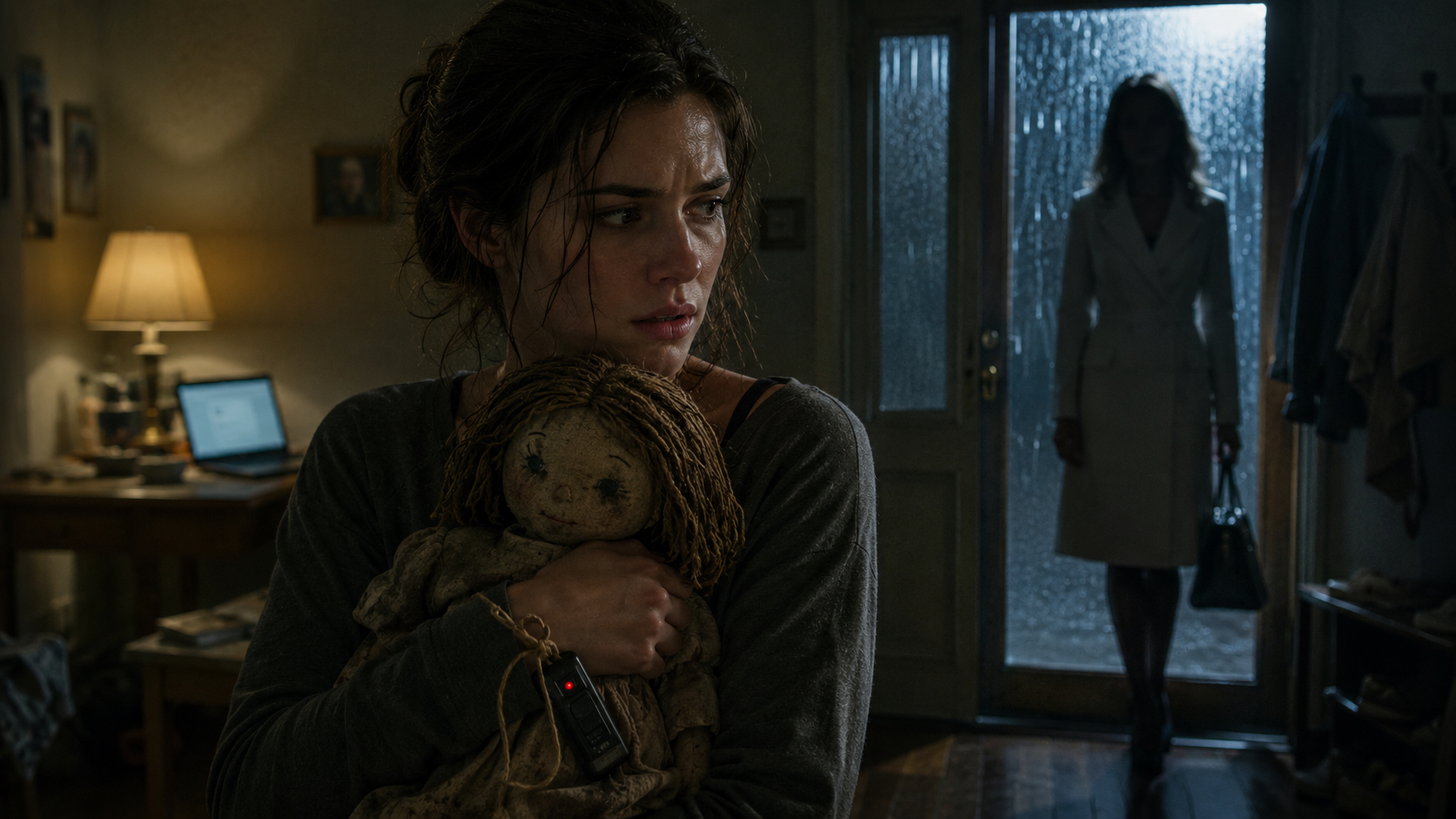
Mara Vance had learned not to expect anything from Nolan Pierce.
Not a birthday call.
Not child support.
Not even a guilty text at midnight after three drinks and a bad memory.
For almost four years, he had been a ghost with a handsome face, a man who had once promised forever and then traded forever for private planes, magazine parties, and a woman whose jewelry cost more than Mara’s entire yearly rent.
So when the package arrived on a rainy Tuesday afternoon, Mara almost threw it away.
It sat outside their apartment door in a dented cardboard box, soaked along one corner, with her daughter’s name written across the top in black marker.
For Lily. From Daddy.
Six-year-old Lily saw it before Mara could hide it.
“Daddy sent me something?” Lily whispered.
There was so much hope in her voice that Mara felt anger rise like heat behind her eyes.
Nolan did not get to do this.
He did not get to disappear for years, let Mara work double shifts and count coins at the laundromat, let Lily cry into her pillow after every missed birthday, and then suddenly send a gift as if love could be mailed in a wet cardboard box.
But Lily was already kneeling on the floor, her tiny fingers trembling with excitement.
“Can I open it, Mommy? Please?”
Mara stood frozen, one hand still on the doorknob.
She wanted to say no.
She wanted to carry the box downstairs and throw it into the building dumpster.
She wanted to protect her daughter from another disappointment wrapped in Nolan’s handwriting.
Instead, she swallowed.
“Okay,” she said softly. “But let me help.”
Inside was an old rag doll.
Not new. Not pretty. Not even clean.
The doll had yellow yarn hair, one blue button eye, one missing eye, and a faded green dress with brown stains along the hem. It smelled faintly of dust, rain, and something metallic.
Lily’s smile faltered.
“Oh,” she said.
Mara stared at it in disbelief.
This was what Nolan sent after four years?
A dirty doll that looked like it had been pulled from a trash bag?
There was no card. No apology. No money. No explanation. Only the doll and a tiny plastic recorder tied around its wrist with a fraying red ribbon.
Lily pressed the button.
A crackle filled the room.
Then Nolan’s voice came through.
Weak. Raspy. Terrified.
“Lilybug, listen to Daddy. Give Dolly to Mommy. Tell her to look inside. Don’t let the shining lady take it. Do you understand? Don’t let the shining lady—”
The message cut off.
Mara stopped breathing.
Lily looked up at her.
“Mommy,” she whispered, “why does Daddy sound scared?”
Mara took the doll from her daughter’s hands.
The apartment suddenly felt too quiet.
Outside, rain tapped against the window. A police siren wailed somewhere blocks away. In the kitchen, the refrigerator hummed like nothing had changed.
But everything had.
Mara turned the doll over slowly.
The stitching along its back was crooked. Fresh. Someone had cut it open and sewn it shut again by hand.
Her fingers shook as she took a small pair of scissors from the junk drawer.
“Lily, go to your room.”
“But—”
“Now, sweetheart.”
Lily obeyed, but she did not close the door all the way.
Mara sat at the kitchen table under the weak yellow light and opened the doll’s back seam.
A small bundle slid out.
Inside a square of plastic wrap were three things: a flash drive, a microSD card, and a folded photograph.
The photograph showed Nolan.
Mara nearly dropped it.
He was thinner than she remembered. Not polished, not smiling, not standing beside his glamorous new wife in some charity magazine.
He was sitting on the floor in a dark room, wrists bruised, face hollow, eyes wide with fear.
On the back of the photo, written in a shaky hand, were seven words.
Mara, I was wrong. She is not real.
Mara’s stomach twisted.
She looked toward Lily’s bedroom.
Her daughter was peeking through the crack in the door, clutching the doll’s detached red ribbon.
“Mommy?”
Mara forced her voice to stay steady.
“It’s okay, baby. Stay there.”
But it was not okay.
Because the “shining lady” could only mean one person.
Seraphina Cross.
Nolan’s new wife.
The woman he had left them for.
The woman the newspapers called an heiress. The woman with perfect blond hair, diamond earrings, charity galas, glass houses, and a smile so smooth it looked professionally installed.
The woman Nolan had chosen over his own child.
Mara plugged the flash drive into her old laptop.
At first, only a black screen appeared.
Then a video opened.
Nolan’s face filled the frame.
His lips were cracked. His beard was uneven. He kept glancing toward something beyond the camera.
“Mara,” he whispered. “I know I don’t deserve your help. I know that. But Lily does. If you’re seeing this, it means I got the doll out.”
Mara’s hand flew to her mouth.
Nolan swallowed hard.
“Seraphina Cross isn’t Seraphina Cross. She stole that name. She stole the money, the houses, the companies. She’s done it before. Different names. Different husbands. I found documents, passports, bank transfers. I was going to leave, but she found out.”
A sound came from somewhere behind him.
Nolan flinched.
“She has people everywhere. Don’t call my lawyer. Don’t trust the private security company. Don’t go to anyone she introduced me to. Find someone outside her circle.”
His eyes filled with shame.
“I’m sorry. For leaving. For believing her. For choosing a fantasy over my family. I know sorry means nothing now, but please—protect Lily. She already came to your apartment once. She knows about you.”
The video shook.
Footsteps.
Nolan leaned closer.
“Mara, if she comes for the doll, don’t open the door.”
The screen went black.
Three seconds later, someone knocked.
Mara froze.
Not on the video.
At her real apartment door.
Three slow knocks.
Lily whimpered from her room.
Mara closed the laptop and pulled the flash drive out so fast she almost broke it.
The knock came again.
“Mara Vance,” a woman called from the hallway.
The voice was soft.
Elegant.
Familiar from interviews and charity clips.
Mara moved quietly toward the peephole.
A woman stood outside in a white coat, dry despite the rain, hair pinned perfectly at the back of her head. Her diamond earrings glittered under the hallway light.
Seraphina Cross.
Nolan’s millionaire wife.
The woman who smiled from glossy magazine covers beside him while Lily asked why Daddy forgot her.
Seraphina leaned closer to the door.
“I know you’re awake, Mara.”
Mara stepped back.
Her pulse hammered so hard it hurt.
She slipped the flash drive into her bra, tucked the microSD card into the pocket of her jeans, and grabbed the heaviest thing within reach: a cast-iron pan from the stove.
Lily appeared in the hallway with the torn doll clutched to her chest.
“Mommy?”
Mara put a finger to her lips and pointed back to the bedroom.
The knock came again, sharper now.
“I only need the toy,” Seraphina said. “This does not have to become dramatic.”
Mara stayed silent.
Seraphina sighed.
“Mara, Nolan is unwell. He has been stealing things from my home, inventing stories, frightening people. If he sent your child something, it may contain private family documents. Give it to me, and I will make sure you are compensated.”
Mara almost laughed.
Compensated.
Four years of unpaid support. Four years of Lily waiting by windows. Four years of Mara sewing the same winter coat twice because a new one cost too much.
Now Seraphina stood outside her door offering money like mercy.
Mara leaned close to the door.
“Where is Nolan?”
A pause.
“At home.”
“Then put him on the phone.”
“It’s after midnight.”
“You came here after midnight.”
The silence changed.
It thickened.
When Seraphina spoke again, her voice had lost its softness.
“You have no idea what kind of trouble you are inviting into your life.”
Mara tightened her grip on the pan.
“No,” she said. “But I know what kind of trouble you are bringing to my door.”
Seraphina laughed once.
“Brave. Poverty makes some women very theatrical.”
Mara felt the insult hit the old bruises.
The cheap apartment.
The secondhand couch.
The overdue electricity bill magneted to the fridge.
The way Nolan’s absence had turned survival into a daily calculation.
But shame no longer had room in her.
Fear was using all the space.
“I’m calling the police,” Mara said.
“No, you’re not.”
Mara stopped.
Seraphina’s voice lowered.
“Because if you call the wrong officer, I will know in five minutes. If you send that drive to the wrong person, I will know in two. And if you think one locked door can keep me away from your little girl, Mara, you are not as clever as Nolan promised me you were.”
Mara’s blood went cold.
Behind her, Lily began to cry silently.
Seraphina tapped the door once with a fingernail.
“Give me the doll. I will deposit one hundred thousand dollars into an account for your daughter before morning.”
Mara said nothing.
“Two hundred thousand.”
Mara swallowed.
Three years ago, that amount of money would have solved everything.
Rent. Medical bills. Lily’s school. Food. Debt. A future.
And that was exactly why it disgusted her.
“You think every woman can be bought because Nolan could be,” Mara said.
Another pause.
Then Seraphina whispered, “When mothers disappear, children learn very quickly that toys cannot protect them.”
Mara’s hand shook.
The elevator bell dinged.
Seraphina’s heels clicked away down the corridor.
Mara waited until she heard the elevator doors close before she moved.
Then she ran to Lily, pulled her into her arms, and held her so tightly the child squeaked.
“Mommy, I’m scared.”
“I know,” Mara whispered. “I know, baby.”
Lily sniffled against her shirt.
“Daddy said Dolly had another secret.”
Mara pulled back.
“What?”
Lily reached into the pocket of her pajama pants and took out a tiny silver memory card.
“I was supposed to give it to you after the shining lady came,” she whispered. “But I forgot because she scared me.”
Mara stared at it.
Then she kissed Lily’s forehead.
“You didn’t forget. You kept it safe.”
The next hour passed like a storm inside the apartment.
Mara copied every file from the flash drive and memory card onto an old external hard drive. Then she uploaded encrypted copies to a cloud account Nolan didn’t know existed.
Before marriage, before motherhood, before debt and exhaustion had narrowed her life into shifts and rent dates, Mara had studied cybersecurity at community college. She had not finished the program, but she remembered enough.
Evidence was only evidence if it survived.
The memory card held more videos.
Some showed Nolan whispering from the same dark room.
Some showed scanned passports with different names but Seraphina’s face.
Others showed bank records, medical prescriptions, wire transfers, property deeds, and emails written under aliases.
The worst file was a video taken through a half-open door.
Seraphina stood in a garage beside a man Mara did not recognize.
Nolan’s voice was not in the clip. He must have hidden the camera.
Seraphina said, “Once the accounts are empty, we make him look unstable. The ex-wife already hates him. The child barely knows him. No one will fight too hard for a man who abandoned his family.”
Mara stepped away from the laptop.
Her legs felt weak.
Nolan had been selfish. Cruel. Vain. He had chosen luxury over Lily’s little hand reaching for him.
But he had not deserved this.
And Lily loved him.
That mattered.
Even when Mara hated that it mattered.
At 3:47 a.m., Mara called the only lawyer she trusted.
Avery Sloane had handled the custody case years earlier. She was blunt, underpaid, relentless, and immune to expensive smiles.
She answered on the seventh ring.
“Mara? Is Lily hurt?”
“No. But Nolan sent her a doll with evidence hidden inside. His wife just came to my door and threatened us.”
Avery did not ask if Mara was exaggerating.
Her voice became sharp and awake.
“Lock every door. Do not call local police yet. Send me copies of everything. Right now.”
By sunrise, Avery was in Mara’s kitchen wearing rain boots, a wool coat, and the expression of a woman who had already decided to ruin someone’s life legally.
With her came Rhys Calder, a former federal investigator who now worked private fraud cases.
Lily sat on the couch wrapped in a blanket, holding the rag doll against her chest.
Avery watched the first video in silence.
When Nolan’s gaunt face appeared, her jaw tightened.
“I always thought he was a fool,” she said.
Mara gave a bitter laugh. “He was.”
Rhys leaned closer to the screen.
“Maybe. But fools make useful targets.”
They spent two hours sorting the files.
Rhys found patterns quickly.
Seraphina Cross had not always been Seraphina Cross.
In older records, she was Nina Vale.
Before that, Claudia Stone.
Before that, Elise Arden.
Before that, someone named Maribel Reyes, who had disappeared from public records after marrying a wealthy widower in Texas.
Different cities. Different men. Different fortunes.
The pattern was ugly.
A lonely wealthy man.
A beautiful woman with a polished story.
A marriage.
Isolation.
Medication.
Money drained through shell companies.
Then scandal, disappearance, death, or institutionalization.
Nolan had not married a millionaire.
He had married a thief wearing a dead woman’s life.
Avery closed the laptop.
“You and Lily need to leave this apartment today.”
Mara looked around.
The peeling paint near the window.
The chipped mug in the sink.
The stack of laundry folded neatly on a chair.
The paper snowflakes Lily had taped to the wall.
It was not much.
But it was theirs.
It was the life Mara had built from nothing after Nolan destroyed the first one.
Now even that was unsafe.
“Where do we go?” Mara asked.
Avery stood.
“Somewhere Seraphina won’t think to look.”
By noon, Mara and Lily were in a quiet apartment under Avery’s cousin’s name.
Rhys arranged private security through someone he trusted. Avery contacted a federal prosecutor she had once clerked for, who brought in Special Agent Imani Ford from a financial crimes task force.
Agent Ford reviewed the evidence without blinking.
When the final video ended, she looked at Mara.
“Do you understand what your ex-husband sent you?”
Mara nodded. “Proof.”
Agent Ford’s expression hardened.
“More than proof. He sent you the map to a criminal network.”
The search for Nolan began with the smallest clue.
Not the passports.
Not the money transfers.
Not the forged medical records.
A sound.
In one of Nolan’s recordings, just before he stopped speaking, there was a faint noise in the background.
Rhys isolated it.
A ship horn.
Then bells.
Then a man shouting over a warehouse intercom.
Agent Ford’s team cross-checked property holdings connected to Seraphina’s aliases. One shell company owned an old storage facility near the river, close enough to the docks to hear ships and close enough to a chapel to hear bells every hour.
The raid happened before dawn.
Mara was not allowed to go.
She sat in the borrowed apartment with Lily asleep across her lap and the rag doll tucked between them. Avery paced near the window. Rhys stood by the door, phone in hand, silent as a guard dog.
At 5:58 a.m., Avery’s phone rang.
She answered.
Mara stood before Avery said a word.
Avery listened.
Then her face changed.
“They found him,” she said.
Mara’s knees almost gave out.
“Alive?”
Avery nodded.
“Barely. But alive.”
Nolan was found in a locked room beneath the storage facility office.
He was dehydrated, drugged, bruised, and too weak to stand. Beside him were sedatives, forged documents, restraints, and a suitcase half-packed with cash and passports.
Seraphina was gone.
She had escaped less than an hour before the raid.
That made the danger worse.
A predator in control was frightening.
A predator running out of time was worse.
Federal agents moved Mara and Lily again, this time to a secured hotel under witness protection procedures.
Lily cried when security had to inspect the doll.
Mara cried in the bathroom with the shower running so her daughter would not hear.
Three days later, Nolan woke in the hospital.
Mara did not want to see him.
Then Lily asked.
“Can I talk to Daddy?”
Mara sat beside her daughter for a long time before answering.
Part of her wanted to say no forever.
Another part remembered Nolan’s face in that video, and the way Lily still whispered “Daddy” as if the word had not yet broken in her mouth.
The hospital room smelled of antiseptic and machines.
Nolan looked nothing like the man from the magazine photos.
He was thin. Pale. Hollow-eyed. His wrists were bandaged. His hair had grown unevenly, and his mouth trembled when he saw Lily.
“Lilybug,” he whispered.
Lily held Mara’s hand tighter.
“Daddy?”
Nolan broke.
Not beautifully. Not nobly.
He cried like a man whose mistakes had finally learned how to speak in his child’s voice.
“I’m sorry,” he said. “I’m so sorry.”
Lily frowned.
“Mommy said Dolly helped find you.”
Nolan looked at the rag doll under Lily’s arm and nodded through tears.
“She did.”
Lily stepped closer.
“Why didn’t you come to my birthday?”
The room went silent.
Mara turned her face toward the window.
Nolan swallowed hard.
“Because I was selfish,” he said. “Because I cared about money and attention and being important. And I forgot that the most important person in my life was waiting for me.”
Lily stared at him.
“Me?”
Nolan’s voice cracked.
“Yes. You.”
Lily thought about that for a moment.
Then she said, “That was bad.”
Nolan closed his eyes.
“Yes,” he whispered. “It was.”
After Avery took Lily to the cafeteria, Mara stayed behind.
Nolan looked at her from the bed.
“I don’t deserve to ask you for anything.”
“No,” Mara said. “You don’t.”
He nodded.
That made her angrier than excuses would have.
She had expected him to defend himself. To blame Seraphina. To turn his suffering into a reason Mara should forget hers.
But he only looked destroyed.
“I sent the doll because Seraphina checked everything else,” he said. “Phones. Email. Lawyers. Bank accounts. She never thought I’d hide evidence inside a child’s toy.”
“Our child,” Mara said coldly.
His face twisted.
“I know.”
“No, Nolan. You don’t. You missed fevers. School forms. Rent notices. Her first lost tooth. Her preschool show. You missed nights when she asked me if she had done something wrong because Daddy didn’t call.”
Nolan covered his face with one hand.
Mara stepped closer.
“You don’t get to come back from a locked room and let that tragedy erase the one you created before it.”
“I know,” he whispered.
“Good.”
“I’ll pay everything. Back support. Current support. Whatever the court orders.”
“You will.”
“And if Lily never forgives me—”
“That belongs to her,” Mara said. “Not you.”
He nodded again.
Mara looked at him for a long moment.
Once, she had loved him.
Then she had hated him.
Then she had survived him.
Now he was something else.
Lily’s father.
A victim.
A witness.
A man who had done terrible harm and then, by some twisted path, helped expose something worse.
That did not make him good.
It made him necessary.
“Tell the truth,” Mara said.
Nolan looked at her.
“All of it. To the agents. To the court. To Lily when she is old enough. If you protect your pride one more time, I will walk away and never look back.”
Nolan nodded.
“I’ll tell the truth.”
And for once, he did.
Seraphina Cross was arrested thirteen days later at a private airstrip under another name.
She carried two passports, loose diamonds hidden inside a cosmetics case, and enough cash to disappear for years.
The media first treated it like a glamorous scandal.
An heiress accused of fraud.
A missing husband found alive.
A mysterious doll with hidden evidence.
Then the truth unfolded.
Seraphina Cross had never been Seraphina Cross.
The real woman connected to that name had vanished years earlier after entering a private recovery clinic. The woman who took over her identity had spent years building false lives, marrying men with money, hollowing out their accounts, and leaving them ruined, discredited, dead, or missing.
The trial became national news.
Mara wanted none of it.
But she testified because the doll had arrived at her door. Because Seraphina had threatened her child. Because Nolan had hidden the truth inside Lily’s toy. Because women like Seraphina counted on shame, fear, and silence to finish the work their lies began.
On the stand, Mara told the jury about the package.
The dirty doll.
The broken recording.
The flash drive.
The midnight knock.
The threat at the door.
Seraphina sat at the defense table in a black suit, beautiful and calm, performing innocence with the patience of a woman who had fooled richer people than a jury.
Her attorney suggested Mara had invented parts of the story because she hated Nolan for leaving her.
Mara looked directly at the jury.
“I did hate him,” she said. “He abandoned our daughter. But hate doesn’t create forged passports. Hate doesn’t create sedatives, shell companies, missing husbands, stolen identities, or a man locked under a warehouse.”
Several jurors looked toward Seraphina.
For the first time, her perfect expression shifted.
Nolan testified for two days.
He admitted he had left Mara and Lily because Seraphina made him feel powerful. He admitted he stopped paying child support because Seraphina told him Mara would use the money to control him. He admitted he ignored every warning because wealth had flattered him into stupidity.
Then he described the first time Seraphina drugged him.
The first missing day.
The drained accounts.
The locked room.
The recordings.
The doll.
The courtroom went silent when the prosecutor asked, “Why send the evidence to your daughter?”
Nolan looked toward Mara, then down at his hands.
“Because Seraphina controlled the adults,” he said. “She never thought a child’s love could carry anything dangerous.”
The strongest witness was not Nolan.
It was Mrs. Alvarez from the apartment across the hall, who had recorded part of Seraphina’s visit through her cracked door because, as she told the court, “A rich woman in diamonds at a poor mother’s door after midnight is not there to bring soup.”
The courtroom laughed softly.
Then the recording played.
Seraphina’s voice filled the room.
“When mothers disappear, children learn very quickly that toys cannot protect them.”
The laughter died.
That threat sealed what the records had already proven.
Seraphina Cross, born Nadia Rosales, was convicted of kidnapping, identity theft, financial fraud, conspiracy, unlawful imprisonment, witness intimidation, and crimes connected to several previous victims.
At sentencing, the judge said she had worn wealth like a costume and used marriage like a hunting license.
Seraphina did not cry.
She only looked offended that the room no longer believed her.
Mara sat in the back row beside Avery.
Nolan sat several rows away, thinner but recovering, eyes fixed on the floor.
Lily was not there.
Mara had made sure of that.
A child did not need to watch a monster be named to know the door was finally locked.
After the trial, Nolan was ordered to pay years of back child support and ongoing support. Some of the money came from recovered funds. Mara did not celebrate it. She put most of it into Lily’s education account and used the rest to move them into a safer apartment with sunlight in the kitchen and a small balcony where Lily planted marigolds in plastic pots.
The doll got a shelf in Lily’s bedroom.
Lily named her Poppy.
For months, Lily refused to sleep unless Poppy faced the door.
Nolan asked for visits.
Mara said no at first.
Then supervised video calls.
Then supervised meetings with a family therapist.
Then short visits in places with windows, counselors, and rules.
Lily was not simple with him.
Sometimes she ran into his arms.
Sometimes she sat beside Mara and refused to look at him.
Sometimes she asked questions that destroyed him more efficiently than any prosecutor ever had.
“Did you remember my birthday and not come?”
“Why did you buy the shiny lady flowers but not send Mommy money?”
“Did you love me less when you were rich?”
Nolan answered every question.
Sometimes badly.
But honestly.
One afternoon after therapy, Nolan found Mara waiting outside the office.
“She asked if I only loved her because she saved me,” he said.
Mara’s chest tightened.
“What did you say?”
“I told her I should have loved her properly before she saved anyone.”
Mara studied him.
For one second, she saw the young man she had married before ambition hollowed him out. Then she saw the man who left. Then the man who came back broken.
None erased the others.
“Good answer,” she said.
Nolan nodded.
“I’m trying.”
“I know.”
“It doesn’t fix it.”
“No,” Mara said. “It doesn’t.”
But trying mattered.
Not enough to restore love.
Enough to build something safer for Lily.
Years passed.
Reporters called Poppy “the doll that broke the heiress case.” Producers offered money. Podcasts wanted interviews. Documentary crews mailed letters.
Mara refused almost everything.
Lily’s face stayed private.
Her childhood did not belong to strangers just because a criminal had tried to destroy it.
When Lily turned nine, she asked why people cared so much about her old doll.
Mara sat beside her on the bed and told her the gentlest version of the truth.
“Poppy carried something important,” she said. “Something that helped stop a dangerous person.”
“Daddy put it there?”
“Yes.”
“Because he was scared?”
“Yes.”
Lily looked down at the doll.
“Was Daddy bad too?”
Mara closed her eyes for a moment.
Children deserved the truth, but truth had to be given in pieces small enough for their hands.
“Your dad made very bad choices,” Mara said. “Choices that hurt us. But making bad choices is not the same as being unable to change. What matters now is whether he keeps telling the truth and keeps showing up.”
Lily thought about that.
“Poppy showed up,” she said.
Mara smiled.
“Yes,” she whispered. “Poppy did.”
By the time Lily was twelve, Nolan had become a steady father.
Not perfect.
Not magically forgiven.
But present.
He lived modestly, went to therapy, paid support, showed up for school meetings, attended recitals, and never corrected Mara when she told the truth about the past.
Sometimes Lily trusted him.
Sometimes she did not.
Nolan learned to accept both.
One spring evening, Lily’s school held an art show.
Her drawing won second place.
It showed a little rag doll standing in front of a huge locked door, holding a tiny key in one cloth hand.
The title was:
Small Things Can Be Brave.
Mara cried in the hallway.
Nolan stood beside her, eyes wet.
“She gets that from you,” he said.
Mara shook her head.
“No,” she said. “She gets it from herself.”
For the first time in years, they stood together without anger filling all the space between them.
Not as husband and wife.
Not as enemies.
As two people connected by a child who had deserved better and was finally receiving it.
Later, Lily asked them both to take a picture with her and Poppy.
Mara hesitated.
Nolan did too.
Lily rolled her eyes.
“It’s just a picture.”
So they stood on either side of her.
Lily held Poppy in the middle.
The camera flashed.
No one pretended they were a perfect family.
That was why the photo was honest.
Years later, when Mara told the story, people always wanted the frightening parts.
The package.
The hidden recordings.
The woman at the door.
The false names.
The locked room.
The doll that carried evidence in its torn little body.
But Mara always said the scariest part happened before all of that.
“The scariest part,” she would say, “was how close I came to throwing the package away because of who sent it.”
Because sometimes the truth arrived filthy.
Sometimes rescue looked insulting at first.
Sometimes the person who hurt you became the person who needed saving, and saving him did not mean forgiving him.
It meant refusing to let a worse monster win.
Lily kept Poppy forever.
The doll sat on a bedroom shelf, then on a dorm room desk, then years later behind glass in the office where Lily worked as an attorney for children whose voices had been ignored.
When clients asked about it, Lily would smile.
“That’s Poppy,” she would say. “She taught my family that small things can carry big truths.”
And Mara, whenever she visited, would touch the glass gently.
She no longer felt rage when she looked at the doll.
She felt awe.
Because once, in the middle of the worst night of her life, a filthy toy had given her back control of a story she thought had ended in abandonment.
It exposed a predator.
It saved a father.
It protected a child.
And it taught Mara something she never forgot.
A mother’s first instinct may be to throw away anything that hurts her child.
But sometimes, before you throw it away, you have to look inside.

