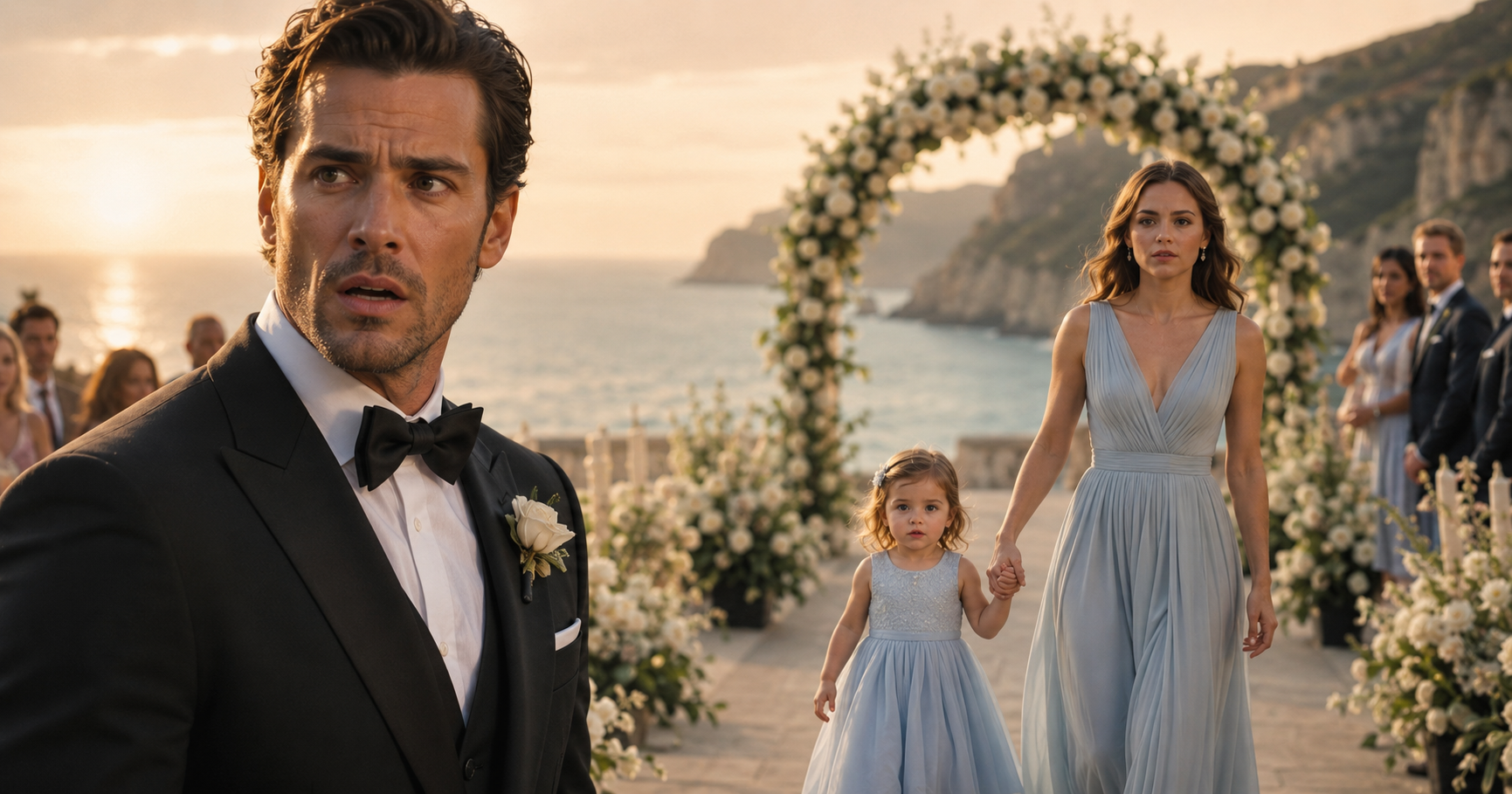
Adrian Vale had never feared a boardroom.
He had walked into rooms where men twice his age waited to tear him apart. He had sat across from ministers, rivals, prosecutors, investors, and enemies who smiled with polished teeth while hiding knives beneath contracts. He had built Vale Meridian from a half-ruined inheritance into a global empire with his name engraved across glass towers, private terminals, hospital wings, and charity foundations.
But one cream-colored envelope on his desk had managed to unsettle him more than any hostile takeover ever had.
The invitation lay beside his untouched coffee.
Vivienne Hart and Thomas Bell request the honor of your presence…
Adrian had known Vivienne since college. She had been one of the rare people who could enter his office without trembling, insult his tie, steal his espresso, and leave with a donation check for whatever charity had captured her heart that month. She had also been one of the few people who had refused to choose sides when Adrian’s marriage collapsed.
At the bottom of the invitation, written in Vivienne’s looping handwriting, was one extra sentence.
I invited Mara too. Be civil, or I’ll seat you with my grandmother and her bridge club.
Adrian stared at the name for a long time.
Mara.
Three years had passed since he had last seen Mara Ellis Vale standing in the doorway of their Pacific Heights house, one hand around the handle of a small suitcase, her wedding ring sitting on the marble console behind her like something already dead.
He still remembered what she had said.
“I’m tired of begging you to come home to a life you never wanted.”
He had told himself she was being dramatic. He had told himself she would cool down. He had told himself love could wait until after the merger, after the lawsuit, after the Singapore expansion, after every fire he believed only he could put out.
By the time he understood that she was gone, she had already changed her number, moved out of the city, and signed the divorce papers without asking for a single share of his fortune.
That had hurt him more than he admitted.
Not because of the money.
Because Mara had refused to profit from losing him.
Now, three years later, he was holding an invitation to a wedding where she would be standing under spring trees in a pretty dress, perhaps laughing with some man who knew how to answer messages, keep promises, and eat dinner before midnight.
Adrian told himself not to go.
Then he ordered his tuxedo pressed.
The wedding was held on the coast, at a white estate above the ocean where the grass rolled toward cliffs and the wind smelled like roses, salt, and money old enough to pretend it was modest. Guests drifted across the lawn in silk and linen. Champagne caught the sun in tall glasses. A string quartet played something delicate beneath a floral arch.
Adrian arrived late enough to avoid small talk and early enough to prove he was not hiding.
That was the first lie of the day.
He was absolutely hiding.
He stood near the stone terrace with a glass he had no intention of drinking, watching the guests gather for the ceremony. Several people greeted him. He nodded. He smiled when required. He endured congratulations for a hospital acquisition, a magazine cover, a speech at some summit he barely remembered giving.
All the while, his eyes kept searching the crowd.
He saw Vivienne first.
She looked radiant, nervous, and dangerous in the way brides became dangerous when they had planned an event for fourteen months and suspected someone might ruin it.
She spotted him and pointed two fingers at her eyes, then at him.
Behave.
Adrian almost smiled.
Then the smile died.
Mara had arrived.
For one suspended second, the entire wedding seemed to blur around her.
She was standing at the edge of the lawn in a pale blue dress that moved softly in the wind. Her dark hair was shorter than he remembered, pinned loosely at the back of her neck, with a few strands escaping around her face. She looked older. Not in a cruel way. In a real way. As if life had asked something of her and she had answered without applause.
Adrian’s hand tightened around his glass.
She was not alone.
A little girl stood beside her, one small hand wrapped in Mara’s fingers.
She could not have been more than two.
She wore a white cardigan over a yellow dress, with tiny shoes and a ribbon slipping loose from her curls. She was looking around the lawn with serious gray eyes, the kind of eyes that studied before they trusted.
Adrian forgot to breathe.
The child turned her head.
Sunlight touched her face.
And Adrian saw himself.
Not vaguely. Not in the flattering way strangers said babies looked like everyone.
He saw the sharp little line of concentration between her brows. He saw the dark lashes. He saw the same gray eyes that looked back at him from every mirror before dawn.
His glass slipped from his hand.
It hit the terrace stones and shattered.
Several guests turned.
Mara heard it too.
Her gaze moved across the lawn and found him.
For a moment, neither of them moved.
The little girl looked up at her mother. “Mama?”
Mara’s face changed. Just slightly. Enough for Adrian to understand that she had known this moment might come and had dreaded it anyway.
Vivienne, who had been adjusting her veil near the steps, followed Adrian’s stare. Her mouth parted.
“Oh,” she whispered.
Adrian crossed the lawn before anyone could stop him.
He did not know what his face looked like. He only knew guests were stepping aside. He only knew the music had stopped sounding like music. He only knew Mara was watching him come toward her with the calm of a woman who had survived the worst thing he could do and no longer feared the rest.
He stopped a few feet away.
The child leaned against Mara’s leg.
Adrian looked at her. Then at Mara.
His voice came out rough. “Who is she?”
Mara’s fingers tightened gently around the little girl’s hand.
“This is Elodie.”
The name struck him with absurd force. A beautiful name. A name chosen without him. A name he had never whispered into a sleeping room, never written on a birth certificate, never heard cried in the middle of the night.
“How old is she?” he asked.
Mara’s eyes did not leave his. “Two.”
The world tilted.
Two.
The math was cruel because it was simple.
Adrian looked down at the child again. Elodie stared back at him with solemn curiosity, not afraid exactly, but cautious. She had a tiny pearl button undone on her cardigan. Adrian wanted, insanely, to kneel and fix it.
“Mara,” he said, barely above a whisper. “Is she mine?”
A few nearby conversations died at once.
Mara’s jaw tightened.
“This is not the place.”
He almost laughed. Not because anything was funny, but because his life had split open in the middle of a wedding lawn and she was worried about manners.
“Is she mine?” he asked again.
Mara looked away first. Not because she was weak. Because she was tired.
“Yes.”
The word did not explode.
It did something worse.
It entered him quietly and changed the shape of everything.
Adrian took one step back.
Vivienne hurried toward them, lifting the front of her gown. “Mara. Adrian. There is a garden room inside. Use it. Now. Before my aunt starts pretending she can’t hear while moving closer.”
Mara gave her a look that was almost gratitude.
Adrian could not speak.
He followed them through French doors into a small room lined with books and old family portraits. The sounds of the wedding softened behind glass. Somewhere outside, a coordinator began whispering urgently. The ceremony would wait. Or it would not. Adrian could not make himself care.
Elodie toddled toward a low table where someone had left a silver bowl of wrapped candies. Mara stopped her with practiced ease.
“No, sweetheart. Those are not for us.”
Elodie sighed, offended by injustice.
Adrian watched the exchange like a starving man watching a window lit from inside.
Mara turned to him. “Say what you need to say.”
He looked at her.
The woman who had once fallen asleep with her cheek on his shoulder while he read contracts in bed. The woman who used to dance barefoot in his kitchen because she hated the silence of his house. The woman he had slowly turned into a ghost by treating love like an appointment he could move to next week.
“You had my child,” he said. “And you didn’t tell me.”
Mara’s expression did not break, but something hardened inside it.
“I tried.”
Adrian stared at her.
“You tried?”
“Yes, Adrian. I tried.”
“When?”
She gave a small, humorless breath. “When I found out. When I was scared. When I was still stupid enough to believe that somewhere beneath all that ambition there was a man who would want to know he was going to be a father.”
He flinched.
She saw it and did not apologize.
“I called your office,” she continued. “Twice. Your assistant said you were overseas. I left messages. No one called back. I sent a letter to the house before you sold it. I sent another one to your legal office because that was the only address I knew would still reach you.”
“I never received them.”
“I know that now.”
“You know?”
Mara looked toward the window, then back at him. “Because after Elodie was born, I sent one more thing. A birth announcement. Not because I wanted anything from you. Not money. Not pity. I just thought you should know there was a little girl in the world with your eyes.”
Adrian felt something cold move through his chest.
“I didn’t get it.”
“No,” Mara said quietly. “But someone did.”
The room seemed to narrow.
“What does that mean?”
“It means a man from your legal department came to see me when Elodie was six weeks old.”
Adrian went still.
“He brought papers,” Mara said. “A confidentiality agreement. A financial settlement. A warning disguised as courtesy. He said you had moved on. He said you did not wish to be contacted about private matters. He said if I cared about my daughter’s peace, I would keep her out of the press.”
Adrian’s face drained.
“I never sent anyone.”
“I believe you.”
The words should have comforted him.
They did not.
Because belief had come too late.
“Who?” he asked.
Mara’s eyes sharpened. “You don’t know?”
“No.”
She studied him, and he hated that she had to decide whether he was lying.
“Graham Pierce,” she said.
Adrian knew the name like a blade knew its handle.
Graham Pierce was Vale Meridian’s chief counsel. Efficient, loyal, discreet, and ruthless. He had been with Adrian for eight years. He had handled the divorce paperwork. He had overseen the sale of the Pacific Heights house. He had also been close to Adrian’s mother, Celeste, long before Adrian took control of the company.
Adrian’s hands curled.
Mara noticed. “Don’t perform outrage for me.”
He looked at her. “I’m not performing.”
“Good. Because I have already lived through the part where powerful men act shocked by the damage done in their name.”
The sentence landed exactly where she aimed it.
Elodie wandered back to Mara, holding a fallen rose petal she must have found near the door. She lifted it proudly.
“Flower.”
Mara’s face softened at once. “Yes, baby. Flower.”
Adrian stared at the child.
His daughter.
His daughter had a voice.
His daughter knew the word flower.
His daughter had spent two years growing teeth and curls and opinions while he bought companies, gave speeches, and convinced himself that grief was discipline.
He crouched slowly, keeping distance.
“Hello, Elodie,” he said.
The little girl looked at him with suspicion.
Mara said nothing.
Adrian swallowed. “I’m Adrian.”
Elodie considered this.
Then she pointed at his tie. “Shiny.”
A broken sound nearly escaped him.
“Yes,” he whispered. “Shiny.”
She stepped closer, then stopped, glancing back at Mara for permission. Mara’s face was unreadable, but she gave the smallest nod.
Elodie reached out and touched the silver tie.
Adrian stayed perfectly still.
Her fingers were warm and impossibly small.
Something inside him, something locked away for years behind work and pride and fear, opened with such force that his eyes burned.
“Can I hold her?” he asked.
Mara’s answer did not come quickly.
He deserved no quick answer.
For a long moment, she looked at him as if measuring not whether he wanted the child, but whether wanting was enough.
Then she bent and lifted Elodie into her arms.
“Only if she wants to.”
Adrian nodded.
Mara murmured to the little girl, “Do you want to say hello?”
Elodie looked at Adrian. Then at his tie. Then at the buttons on his jacket, which apparently interested her more than his emotional collapse.
She leaned forward.
Mara carefully placed her in Adrian’s arms.
The weight of her nearly destroyed him.
She was solid, warm, alive. Not an idea. Not an accusation. Not a secret. A child. His child. She smelled faintly of vanilla biscuits and clean cotton. Her hand pressed against his chest as if steadying herself, and Adrian had the wild thought that his heart might frighten her with how hard it was beating.
“Hi,” he said, and his voice broke.
Elodie blinked.
Then she smiled.
Not because she knew him.
Not because she forgave him.
Simply because she was a child and he was holding her carefully, and the world had not yet taught her how much adults could ruin.
Adrian closed his eyes.
“I’m sorry,” he whispered.
Mara looked away.
Outside, applause rose suddenly. The ceremony must have begun without them.
Life, Adrian thought, had a cruel talent for continuing.
The door opened.
Celeste Vale entered without knocking.
Adrian’s mother was dressed in dove-gray silk and diamonds that had once belonged to someone royal enough to be forgotten politely. She took in the scene in one glance: Mara near the window, Adrian holding the child, the wreckage of truth scattered between them.
Her face did not change.
That was how Adrian knew.
“You knew,” he said.
Celeste closed the door behind her. “Lower your voice.”
Mara laughed once, softly. It contained no amusement.
Adrian stood slowly, Elodie still in his arms. “You knew I had a daughter.”
Celeste’s gaze flicked to Elodie, then away, as if the child were an unfortunate stain on expensive fabric.
“I knew there was a claim.”
“A claim?” Adrian repeated.
Mara stepped forward. “Her name is Elodie.”
Celeste ignored her. “You were in the middle of the Karsen merger. The family was already dealing with enough scandal after the divorce. Graham handled it.”
Adrian stared at his mother, waiting for some sign of regret.
There was none.
“You kept my child from me.”
Celeste’s mouth tightened. “I protected you from manipulation.”
Mara’s eyes flashed. “I asked for nothing.”
“You existed,” Celeste said coolly. “That was enough.”
The room went silent.
Adrian felt Elodie shift in his arms. She had sensed the change in the air, even if she did not understand it. Her lower lip trembled.
At once, Mara reached for her. Adrian gave her back immediately, though every instinct in him rebelled. Elodie tucked her face into Mara’s shoulder.
Celeste looked at Adrian. “Be sensible. This can be contained.”
Adrian’s voice was low. “Contained.”
“Yes. We will arrange testing privately. If necessary, a trust. Visitation can be discussed after the press risk is assessed.”
Mara’s face went pale with fury.
Adrian turned toward his mother.
For thirty-eight years, he had mistaken Celeste’s coldness for strength. He had thought her discipline had saved him after his father died. He had believed every sacrifice she demanded was the price of survival.
Now, standing in a wedding library with his daughter frightened in his ex-wife’s arms, he finally saw the truth.
His mother had not protected the family.
She had preserved control.
“You will not speak about my daughter as if she is a liability,” he said.
Celeste’s expression sharpened. “Adrian.”
“No.”
One word. Quiet. Final.
Celeste seemed more startled by that than by shouting.
Adrian walked to the door and opened it. “Leave.”
Her eyes widened. “You are making a mistake.”
“I made the mistake three years ago when I let Mara walk out of my life believing she was alone.” His voice roughened. “You made it unforgivable.”
Celeste’s gaze moved from him to Mara.
“You think this ends well?” she asked. “Men like Adrian do not become fathers because a child appears at a wedding.”
Mara lifted her chin. “Maybe not. But girls like Elodie do not need grandmothers who treat love like a public relations problem.”
For the first time that day, Celeste had no answer.
She left.
The door clicked shut.
Adrian did not move for several seconds.
Mara exhaled slowly, as if she had been holding her breath for years.
“I didn’t come here to do this,” she said.
“I know.”
“I came because Vivienne begged me. Because she said it had been long enough. Because I thought I could stand on the same lawn as you and feel nothing.”
“And do you?”
Mara looked at him.
That was answer enough.
They missed the ceremony.
They stood in the library while vows were spoken outside, while guests laughed and cried, while Vivienne Hart became Vivienne Bell beneath a floral arch without the two most dramatic people she knew witnessing any of it.
Later, Vivienne found them.
She entered still holding her bouquet, her new husband behind her, both of them glowing with newly married confusion.
“I leave you alone for twenty minutes,” Vivienne said, “and somehow my wedding becomes a Vale family tribunal.”
Mara looked ashamed. “Viv, I’m sorry.”
Vivienne crossed the room and kissed her cheek. “Don’t you dare. I knew seating you two within fifty yards of each other was either going to heal something or summon demons.”
Thomas peered at Adrian. “Did we summon demons?”
Adrian looked toward the door Celeste had used. “One.”
Vivienne noticed Elodie, who had recovered enough to play with the ribbon from the bouquet.
“And this,” she said softly, “is the famous little miracle?”
Mara’s eyes filled unexpectedly. “This is Elodie.”
Vivienne crouched in her wedding gown. “Hello, Elodie. I’m Aunt Vivienne, and this entire party is technically mine, so if you want cake before dinner, I have authority.”
Elodie looked at Mara.
Mara sighed. “One bite.”
Vivienne grinned. “Excellent. I’m already her favorite.”
For the first time that day, Mara laughed.
Adrian felt the sound move through him like light entering a boarded room.
The reception began without disaster, though whispers traveled faster than champagne. Adrian noticed them all: the turned heads, the narrowed eyes, the phones held too casually. Normally he would have managed the optics before the first rumor formed.
This time he did not.
When dinner was announced, Mara planned to leave.
Adrian found her near the side entrance with Elodie on her hip and a small bag over one shoulder.
“You’re going,” he said.
“She’s tired.”
“Elodie or you?”
Mara gave him a tired smile. “Both.”
He wanted to ask for an hour. A day. A chance. A lifetime he had no right to request.
Instead, he said, “Let me walk you to the car.”
She hesitated.
Then nodded.
They moved down a lantern-lit path toward the gravel drive. The ocean was dark beyond the cliffs. Music drifted from the tent behind them.
Elodie had fallen asleep against Mara’s shoulder.
Adrian kept his hands in his pockets because he did not trust them not to reach for what was not his to hold.
“I want to be in her life,” he said.
Mara stopped walking.
“I know wanting is not enough,” he continued. “I know I don’t get to arrive after two years and call myself her father like it’s a title I earned. But I want to know her. I want to support her. I want to show up in whatever way you decide is safe for her.”
Mara looked at him under the lantern light.
“There was a time,” she said, “when I would have given anything to hear you say that.”
“I know.”
“No, Adrian. You don’t. You don’t know what it feels like to sit on a bathroom floor with a pregnancy test in your hand and no one to call because the one person who should have answered had already made you feel like a burden.”
His throat tightened.
“You don’t know what it feels like to give birth and wonder whether your daughter will someday ask why her father never came.”
“I want to know the answer now,” he said. “So when she asks, I can tell her the truth. That I failed before I knew she existed, and other people made sure I stayed ignorant, but ignorance doesn’t make me innocent.”
Mara’s face shifted.
Not forgiveness.
But something moved.
“I won’t let you hurt her,” she said.
“I won’t ask you to trust me quickly.”
“I may never trust you the way I did.”
“I know.”
“She has a routine. She has a home. She has people who love her. You cannot buy your way into that.”
“I won’t try.”
Mara looked down at Elodie sleeping against her.
“She likes picture books,” she said quietly. “Bananas cut in circles, not sticks. She hates green socks for reasons she refuses to explain. She says ‘moon’ whenever she sees any light in the sky, including streetlamps.”
Adrian smiled through the ache in his chest.
“She sounds decisive.”
“She is your daughter.”
The words nearly broke him again.
A black car pulled up.
Mara adjusted Elodie carefully, preparing to leave.
Adrian opened the door for her.
Before she got in, she paused.
“I’ll send you my lawyer’s contact,” she said. “We’ll do this properly.”
“Of course.”
“And Adrian?”
“Yes?”
Her eyes met his. “If you disappear once she starts loving you, I will never forgive you.”
He deserved that.
“I won’t disappear.”
Mara studied him for a long moment.
Then she got into the car.
Adrian watched until the taillights vanished beyond the trees.
When he returned to the reception, the room quieted.
His mother stood near the head table, speaking to Graham Pierce. Graham’s expression changed the moment he saw Adrian.
Good, Adrian thought.
Fear was appropriate.
He walked straight to them.
“Your employment ends tonight,” Adrian said to Graham.
Graham stiffened. “This is hardly the setting—”
“You accepted instructions to intercept personal communications concerning my child. You threatened the mother of my daughter using company resources. You will be investigated by outside counsel. If you attempt to contact Mara again, you will answer to more than a termination letter.”
Celeste hissed, “Adrian, stop making a spectacle.”
He turned to her.
“I am finished mistaking silence for dignity.”
The room had gone still enough to hear the band falter.
Adrian stepped onto the small platform where the best man had given a speech earlier. Vivienne stared at him with wide eyes, then slowly covered her face.
“Adrian,” she muttered. “This is still my wedding.”
He looked at her. “I’m sorry.”
“You’d better be elegant.”
He faced the guests.
“I apologize for interrupting the evening,” he said, voice carrying through the tent. “A private matter has become visible today because too many people believed secrecy was more important than decency. There is a little girl named Elodie. She is my daughter. She is not gossip, not leverage, not scandal, and not a subject for speculation. Anyone who treats her or her mother as anything less than family will lose access to mine.”
No one spoke.
Then Vivienne raised her glass.
“To Elodie,” she said.
Thomas lifted his. “To Elodie.”
Slowly, awkwardly, then with warmth, others followed.
Adrian looked at his mother.
Celeste did not raise her glass.
That was fine.
For the first time in his life, Adrian did not need her approval to know what was right.
Six weeks later, Adrian stood outside a small yellow house in Mill Valley with a paper bag in one hand and terror in the other.
Mara opened the door before he could knock twice.
She wore jeans, a cream sweater, and no makeup. Her hair was tied back messily. She looked more beautiful than she ever had at galas, perhaps because this version of her belonged entirely to herself.
“You’re early,” she said.
“Four minutes.”
“That is early.”
“I brought bananas.”
“How are they cut?”
He lifted the container inside the bag. “Circles.”
Mara tried not to smile. Failed.
Elodie appeared behind her, holding a stuffed rabbit by one ear. She stared at Adrian.
He crouched.
“Hello, Elodie.”
She looked at the bag. “Nana?”
“Yes. Nana.”
She came closer.
Not running. Not rushing.
But closer.
Mara leaned against the doorframe and watched.
Adrian had faced empires with less fear than he felt opening a container of sliced bananas for a two-year-old.
Elodie accepted one circle and ate it with grave approval.
Then she held out the rabbit.
“Bunny,” she said.
Adrian took the introduction seriously. “Hello, Bunny.”
Elodie smiled.
Behind her, Mara looked away too late to hide the tears in her eyes.
They did not become a family that day.
Life was not that kind.
Trust did not return because Adrian wanted it. Love did not erase paperwork, grief, missed birthdays, or nights when Mara had done alone what should have been shared. Some days were awkward. Some conversations hurt. There were lawyers, schedules, apologies, boundaries, and moments when Mara’s anger rose fresh and justified.
But Adrian came back the next Saturday.
And the next.
He learned how to buckle a car seat. He learned that Elodie liked ducks but did not trust geese. He learned that bedtime required two stories, one song, and a glass of water she would not drink but needed nearby for reasons known only to toddlers and ancient kings.
He learned Mara drank tea now instead of coffee because coffee had made her sick during pregnancy and the habit had stayed.
He learned that regret was useless unless it became action.
One evening, months later, they stood together in Mara’s kitchen while Elodie slept upstairs.
Rain tapped against the windows. A small lamp glowed over the sink. Adrian dried dishes while Mara washed, a domestic miracle so ordinary it felt sacred.
“I used to imagine this,” Mara said suddenly.
He looked at her.
“Not this exact kitchen,” she continued. “Not after everything. But something like this. You drying a plate. A child asleep upstairs. No phones on the table. No driver waiting. No emergency more important than being here.”
Adrian set the towel down.
“I’m sorry it took losing you to understand what you were offering.”
Mara’s eyes softened, but sadness remained. “You didn’t just lose me. You gave me away.”
“I know.”
Silence settled between them.
Then Mara handed him another plate.
He took it.
“Next Saturday,” she said, “Elodie has a music class at ten. If you come, do not wear a suit. The teacher makes parents sit on the floor.”
Adrian nodded solemnly. “I can sit on the floor.”
“You say that now.”
“I will prepare.”
Mara laughed.
It was small. It was not a promise.
But it was real.
A year after Vivienne’s wedding, Adrian received another cream-colored envelope.
This one was not an invitation.
It was a drawing.
Elodie had made it in purple crayon. Three figures stood beneath a large uneven moon. One had long hair. One was small. One was tall and had what appeared to be either a tie or a very thin beard.
On the back, Mara had written:
She says this is us. I told her families can be complicated. She said, “Still family.”
Adrian sat at his desk for a long time, holding the paper carefully.
Outside his office windows, the city moved in glass and steel. Deals waited. Calls waited. Men in expensive suits waited for decisions that once would have consumed him.
But Adrian Vale had finally learned the difference between what demanded his attention and what deserved his life.
He framed the drawing himself.
Not in the hallway where visitors could admire it.
Not in the conference room where it could become part of his legend.
He placed it on his desk, facing him.
A purple moon.
A woman he had loved badly.
A child he had almost lost before he ever knew her.
A family, complicated and unfinished.
Still family.

