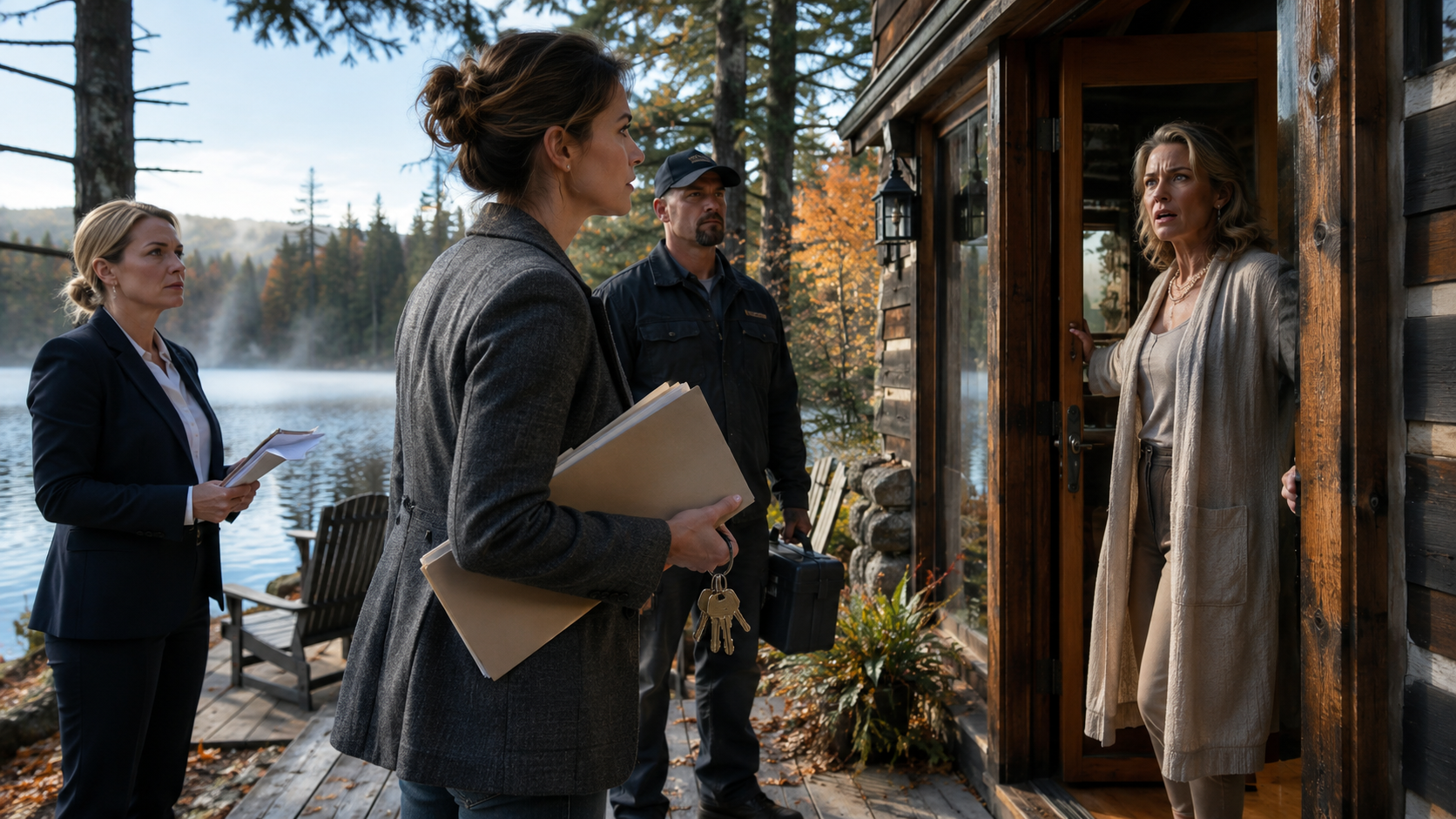
She Let Her Best Friend Use Her Lake Cabin for One Week. Eleven Months Later, She Came Back With a Lawyer, a Locksmith, and the Truth.

When Evelyn Mercer gave Tessa Rowe the spare key to her lake cabin, she thought she was offering her oldest friend a place to cry in private.

One week.

That was all Tessa had asked for.

“One week away from everything,” Tessa had whispered over the phone, her voice shaking in that familiar way that always made Evelyn forget every lesson she had ever learned about boundaries. “I just need silence. I need trees. I need water. I need to remember who I am.”

Evelyn had been standing in the break room of the hospital billing office where she worked, holding a vending machine coffee that tasted like burnt pennies. She had a stack of rejected insurance claims waiting on her desk, a headache pulsing behind her right eye, and exactly twelve minutes left of lunch.

Still, when Tessa cried, Evelyn’s first instinct was always to help.

“You can use the cabin,” Evelyn said.

There was a pause.

A small gasp.

“Evie, no. I couldn’t.”

“You can,” Evelyn said, softer now. “It’s empty this week. I wasn’t going up until next month anyway. Go. Sleep. Breathe. Leave the place exactly as it is, lock up when you go, and bring the key back next Sunday.”

“Next Sunday,” Tessa promised.

Evelyn believed her.

That was the mistake.

The cabin sat on the eastern side of Briar Lake, where the water turned copper at sunset and loons called across the fog before dawn. It was small, plain, and stubbornly old-fashioned: one bedroom downstairs, a sleeping loft upstairs, a green-painted kitchen, a stone fireplace, and a crooked screened porch that Evelyn had repaired twice with her own hands.

It was not a mansion.

It was not an investment property.

It was not a rental.

It was the first place in Evelyn’s life that had ever truly belonged to her.

She had bought it after twelve years of saying no to herself. No vacations. No new car. No pretty apartment with wide windows. No impulsive dinners, no expensive boots, no weekend trips with coworkers. She had lived in a gray one-bedroom apartment beside a laundromat and saved every extra dollar until the day the old cabin came on the market.

The realtor had apologized when she showed it.

“It needs work.”

Evelyn had looked at the sagging porch, the scratched floors, the smoke-stained mantel, the weeds growing around the dock, and felt something inside her settle.

“So do I,” she had said.

For four summers, she repaired it piece by piece. She sanded the kitchen cabinets. She replaced broken windowpanes. She learned how to patch screens, seal gaps, fix a leaky pipe, stack firewood, and make coffee on a stove that took ten minutes to decide whether it wanted to cooperate.

Her father had helped her with the dock before he died.

The last photograph she had of him showed him sitting on the cabin steps, laughing with a hammer in his hand, sawdust on his jeans.

After his funeral, Evelyn drove to the cabin alone and slept under a quilt that still smelled faintly of cedar. At sunrise, she walked down to the lake and promised herself she would never let anyone make her feel homeless inside her own life again.

Then Tessa called.

They had been friends since freshman year of college, back when Evelyn was shy and careful and Tessa entered every room as if it had been waiting for her. Tessa was magnetic. She could borrow a dress, lose it, apologize beautifully, and somehow make the owner comfort her. She could cancel plans at the last second and leave people worrying about her instead of being angry. She cried easily, laughed loudly, and collected wounded people the way some women collected candles.

Evelyn had been one of them.

Over the years, she had paid Tessa’s phone bill once, then twice, then stopped counting. She had driven across town at midnight after breakups. She had defended Tessa when other friends said she used people. She had told herself Tessa was simply dramatic, not dangerous.

The first week at the cabin passed quietly.

Tessa sent a photo of the lake with the message:
I can finally breathe.

Evelyn smiled.

On Sunday evening, no key appeared.

At nine, Evelyn texted:
Everything okay? Are you back?

Tessa replied at 11:48 p.m.
I’m so sorry. I had a panic spiral today. Could I stay until Wednesday? I swear I’ll be out then.

Evelyn stared at the message for a long time.

Then she typed:
Wednesday is fine. Please make sure the place is clean before you leave.

Wednesday became Friday.

Friday became the following Monday.

Monday became, “I just need until the end of the month.”

By the second month, Evelyn began to feel embarrassed for wanting her own cabin back.

Tessa always had a reason.

Her therapist said sudden displacement would be harmful.

Her mother was being cruel.

Her ex-boyfriend was harassing her.

Her nervous system was “finally learning safety.”

Evelyn tried to be patient. She told herself real friendship was not convenient. She told herself the cabin was empty most weekdays anyway. She told herself Tessa would leave soon.

Then she drove up one Saturday morning without warning and found the front door painted blue.

Not the careful, weathered green Evelyn had chosen after three weekends of sanding and priming.

Blue.

Bright, glossy, theatrical blue.

There were wind chimes on the porch. Her father’s old fishing creel had been moved from the wall and replaced with a circular mirror framed in shells. Inside, the furniture had been rearranged. Her books were stacked in boxes near the back door. Her coffee mugs were gone from the shelf and replaced with handmade clay cups Tessa called “intention vessels.”

Evelyn stood in the doorway, her overnight bag still on her shoulder.

Tessa emerged from the kitchen in a linen robe.

“Oh,” she said. “You should’ve told me you were coming.”

Evelyn blinked.

“Tessa. This is my cabin.”

Tessa smiled gently, as if Evelyn were a frightened child.

“I know. Of course. I just mean, I’m in a very delicate place right now. Surprise energy can be hard for me.”

“Surprise energy?”

“Evie.”

That tone. Soft, hurt, disappointed. The tone that always made Evelyn feel cruel before she had even spoken.

“I painted the door,” Tessa said. “I hope you’re not upset. The old color felt heavy.”

“My father helped me paint that door.”

Tessa’s face softened instantly.

“Oh, honey. I didn’t know.”

“You didn’t ask.”

Silence stretched between them.

Then Tessa touched Evelyn’s arm.

“I’m sorry. Truly. I thought I was bringing life into the space.”

“The space is my home.”

Tessa withdrew her hand.

For one second, Evelyn saw irritation flash behind her eyes.

Then it vanished.

“Of course,” Tessa said. “I never meant to make you feel that way.”

But Evelyn did feel that way.

She felt like a guest.

In her own cabin.

By the fourth month, Tessa was receiving packages there.

By the fifth, she had changed the bedroom curtains.

By the sixth, she had removed the guest book from the coffee table because, according to her, “the energy of strangers signing ownership over a place is very colonial.”

Evelyn did not know how to respond to that.

By the eighth month, an acquaintance sent Evelyn a screenshot.

Isn’t this your cabin?

Evelyn opened it at her desk between two billing disputes and felt the blood leave her face.

The image showed Tessa on the dock at sunrise, arms spread wide, wrapped in a cream shawl. Behind her, Evelyn’s lake glittered like something sacred.

The caption read:

Join me at The Blue Heron House for a three-day private renewal retreat. Limited spaces. Fire circle, lake meditation, grief release, sisterhood meals, and sacred rest. This home has held my transformation. Let it hold yours.

Evelyn read it twice.

Then again.

The price was listed at the bottom.

Seven hundred dollars per person.

Her hands began to tremble.

The cabin Tessa had begged to use for one week had become a business.

Evelyn called immediately.

Tessa did not answer.

Evelyn texted:
Are you charging people to stay at my cabin?

Three dots appeared.

Disappeared.

Appeared again.

Then Tessa replied:
Please don’t reduce healing work to money.

Evelyn laughed once, sharply, in the silent office.

She typed:
Are people paying you to stay at my cabin?

Tessa replied:
They are contributing to the container.

Evelyn stood up so fast her chair rolled backward into the filing cabinet.

Her supervisor asked if she was all right.

“No,” Evelyn said.

For once, the word came easily.

That night, she drove to her sister’s house with a folder of printed screenshots, months of texts, and a rage so heavy it felt calm.

Her sister, Claire, read everything at the kitchen table.

Claire was older by six years, blunt in the way Evelyn had always envied, and immune to Tessa’s charm because she had disliked her since 2009.

When Claire reached the message about “the container,” she put the papers down.

“I’m going with you tomorrow.”

“No.”

“Yes.”

“I don’t want a scene.”

Claire stared at her.

“Evelyn, she painted your door, moved your furniture, opened a business, and made you ask permission to enter your own cabin. The scene started months ago. You’re just late.”

Evelyn looked away.

Claire’s voice softened.

“Call a lawyer.”

“I don’t want to ruin her life.”

“She is living in yours.”

The lawyer’s name was Mara Ellison.

She worked out of a narrow brick office above a bakery downtown and wore black reading glasses on a chain around her neck. She was in her fifties, calm, precise, and had the unnerving habit of letting silence do half the questioning.

Evelyn told her everything from the beginning.

The phone call.

The one-week promise.

The delayed departure.

The painted door.

The packages.

The retreats.

The posts.

The way Tessa had started saying “our little lake home” when talking to mutual friends.

Mara listened without interrupting.

When Evelyn finished, Mara folded her hands.

“Did you sign a lease?”

“No.”

“Did you accept rent?”

“No.”

“Did you ever tell her she could live there indefinitely?”

“No. I told her one week. Then I gave extensions because she kept asking.”

“Do you have those messages?”

“Yes.”

“Did you authorize commercial use?”

“Absolutely not.”

“Did she change the locks?”

Evelyn hesitated.

“I don’t know.”

Mara’s expression did not change, but the air in the room shifted.

“You need to stop speaking to her directly.”

Evelyn swallowed.

“I’ve been trying to be kind.”

“I understand. But she is using your kindness as a paper trail against you. Every emotional exchange gives her a chance to reshape the story.”

“She keeps telling people I abandoned her.”

“Then we stop feeding the performance.”

Mara pulled a legal pad toward her.

“From now on, everything goes through me. We will revoke permission formally. We will document unauthorized commercial activity. We will notify the appropriate parties that the owner has not approved any paid retreats, rentals, events, or public use. We will schedule a lawful inspection. We will bring a locksmith only if permitted and necessary. And we will have witnesses.”

Evelyn stared at her.

“For months,” she whispered, “she made me feel insane for wanting it back.”

Mara’s face softened slightly.

“That is because you were arguing about feelings with someone who had already moved on to strategy.”

The formal notice went out two days later.

Certified mail.

Email.

Text through Mara’s office.

Hand delivery.

Tessa responded in eleven minutes.

Not to Mara.

To Evelyn.

I cannot believe you brought a lawyer into this.

Evelyn did not answer.

Another message arrived.

After everything I trusted you with, you’re choosing property over friendship?

Evelyn sent it to Mara.

Mara replied:
Do not respond.

Tessa texted again.

This cabin became meaningful because of me. You barely used it before I gave it purpose.

Evelyn’s thumb hovered over the screen.

She wanted to write, I used it to survive my father’s death.

She wanted to write, You gave it invoices and strangers.

She wanted to write, Get out.

Instead, she forwarded the message to Mara and placed the phone face down.

For the next week, Tessa unraveled in public.

She posted tearful videos from the porch, wrapped in Evelyn’s quilt, talking about betrayal without naming Evelyn.

She said some people offered shelter only to punish you for healing too beautifully.

She said women were often attacked when they created sanctuary outside systems of ownership.

She said money made people forget love.

The comments filled with sympathy.

Protect your peace.

No one can take your home if your spirit claimed it.

Some women build temples. Others get jealous.

Evelyn read them until her stomach hurt.

Then Claire took her phone away.

“You’re done watching theater.”

But the theater came looking for her.

Old college friends sent cautious messages.

Tessa says you’re evicting her?

She said you promised she could stay for a year.

Can’t you give her until spring?

Evelyn copied and pasted the same reply:

I allowed Tessa to use my cabin for one week. She has remained for eleven months, altered the property without permission, refused to leave, received mail there, and advertised paid retreats there without authorization. My attorney is handling it.

Most people stopped responding.

A few apologized.

One woman, Hannah, called and cried.

“I sent her a deposit,” Hannah admitted. “For a retreat next month.”

Evelyn closed her eyes.

“How much?”

“Three hundred.”

“Did she tell you she owned the cabin?”

“She said it was her home.”

Evelyn gripped the edge of her kitchen counter.

Her home.

Those two words became the stone in Evelyn’s chest.

Mara sent another notice.

This one went to Tessa and to every registered retreat participant whose contact information could be found. It stated clearly that no retreat, paid stay, lodging arrangement, ceremony, workshop, or commercial gathering had been authorized by the property owner.

Within hours, Tessa called Evelyn seventeen times.

Evelyn did not answer.

The voicemail arrived at 6:22 p.m.

Tessa’s voice was no longer soft.

“You humiliated me,” she said. “You reached out to women who trusted me. You damaged my work. Do you have any idea what you’ve done?”

Evelyn listened in the dark of her apartment.

Then Tessa’s voice cracked into tears.

“I thought you were my family.”

Evelyn almost deleted the voicemail.

Instead, she sent it to Mara.

Mara replied:
Good. Keep everything.

Three days later, Tessa changed the locks.

Evelyn discovered it when she drove up at dawn with Claire, intending only to photograph the exterior for the insurance company. Her key entered the front door halfway and stopped.

She tried again.

Nothing.

Claire stepped onto the porch beside her.

“Tell me she did not.”

Evelyn stared at the lock.

The lock her father had installed.

The lock that had opened for her through grief, exhaustion, rain, summer heat, and winter ice.

Changed.

For a moment, Evelyn could not breathe.

Then Tessa opened the door from inside.

She wore Evelyn’s old flannel shirt.

Evelyn knew it because there was a tiny paint stain near the cuff from the weekend she and her father fixed the dock railing.

Tessa looked at the key in Evelyn’s hand and smiled sadly.

“I had to protect my peace.”

Claire took one step forward.

Evelyn caught her sleeve.

“Tessa,” Evelyn said, her voice shaking, “you changed the locks on my cabin.”

“Our cabin has been under a lot of hostile energy.”

“It is not our cabin.”

Tessa’s eyes hardened.

“I receive mail here.”

“You were allowed to stay temporarily.”

“I have established residence.”

“You were a guest.”

“I was invited.”

“For one week.”

Tessa leaned against the doorframe.

“You know what your problem is, Evie? You give people things so you can feel generous, then you punish them when they actually need them.”

Evelyn felt the old reflex rise in her.

The apology.

The urge to explain.

The fear of being selfish.

But behind her, Claire said quietly, “Don’t you dare.”

Evelyn looked at Tessa.

Really looked.

Not at the friend from college.

Not at the crying woman on the phone.

Not at the person she had rescued so many times that rescue had begun to feel like love.

She looked at the woman standing inside her doorway, wearing her shirt, behind a lock she had no right to change.

“No,” Evelyn said. “My problem is that I kept calling theft a crisis because I didn’t want to admit my best friend was stealing from me.”

Tessa’s face changed.

Not sadness.

Not shock.

Anger.

Pure and bright.

“You’ll regret this.”

Evelyn nodded once.

“I already do.”

She left without another word.

But she did not leave defeated.

On the thirty-first day after formal notice, Evelyn returned to Briar Lake with Mara Ellison in the passenger seat.

Behind them came a locksmith named Dorian Price, a property inspector, a county deputy assigned for a civil standby, and Claire in her own car because she refused to miss what she called “the exorcism of entitlement.”

The morning was pale and bitter. Frost silvered the weeds along the road. The lake lay flat and dark between the trees.

Evelyn had imagined this drive many times over the past eleven months. In some versions, she cried. In others, she screamed. In one version, Tessa apologized and handed back the key.

In reality, Evelyn felt strangely quiet.

Mara reviewed the plan as they turned onto the private lane.

“You do not argue. You do not touch her belongings. You do not threaten. You do not enter alone. If she performs for the deputy, let her. If she cries, let her. If she accuses you, let her. We are here to document, inspect, and proceed lawfully.”

Evelyn nodded.

“And if she says it’s her home?”

Mara looked out at the trees.

“Then she can say it in front of witnesses.”

When the cabin came into view, Evelyn’s hands tightened on the steering wheel.

A new wooden sign hung beside the steps.

The Blue Heron House.

Below it, in painted letters:

A sanctuary for women who choose themselves.

Claire got out of her car and stared at the sign.

“She really put a brand on your porch.”

Mara gave her a warning look.

Claire raised both hands.

“I’m choosing silence.”

The deputy knocked first.

Tessa opened the door wearing a long gray cardigan, her hair loose over one shoulder. She looked past the deputy, past Mara, past the locksmith, and fixed her eyes on Evelyn.

“So this is what you’ve become.”

Evelyn stepped onto the porch.

“The owner.”

Tessa laughed softly.

“No. You’re a frightened woman hiding behind people with paperwork.”

Mara moved forward.

“Tessa Rowe?”

Tessa ignored her.

“Evie, look at me. Don’t do this. We can still fix this.”

“We tried fixing it for eleven months.”

“You mean I tried healing while you counted days.”

“I counted days because you promised seven.”

Tessa’s expression trembled. Tears filled her eyes almost instantly.

The deputy watched without expression.

“You’re going to throw me out in the cold?” Tessa whispered.

Evelyn looked past her into the cabin.

Her cabin.

The mantel had been draped with gauze. Her father’s photograph was gone. A shelf of labeled jars stood where her books used to be. The sofa was covered in white fabric. On the coffee table sat a stack of printed welcome packets for retreat guests.

Evelyn saw the title on top.

Returning to the Self: A Weekend at Blue Heron House.

Something inside her went very still.

“You charged strangers to sleep where my father died remembering he helped me build something,” Evelyn said.

Tessa’s tears stopped.

Only for a second.

But long enough.

Mara handed her a packet.

“Permission to occupy has been revoked. Multiple notices have been delivered. You have no lease, no rental agreement, and no ownership interest. We are here for inspection and documentation of unauthorized alterations and commercial use.”

Tessa crossed her arms.

“I live here.”

“That claim can be addressed through the proper process,” Mara said. “Today, the owner is exercising her rights with witnesses present.”

The deputy added, “We’re here to keep the peace.”

Tessa looked at him.

“This woman is weaponizing the law because she can’t stand that I turned a dead little cabin into something meaningful.”

Evelyn flinched.

Dead little cabin.

Claire inhaled sharply behind her.

Mara lifted one finger without turning around.

Claire stayed silent.

Evelyn stepped closer.

“My father’s hands are in that porch railing,” she said. “My savings are in those walls. My weekends are in that dock. My grief is in that bedroom. You did not make it meaningful. You made it useful to you.”

Tessa’s mouth tightened.

“You abandoned this place.”

“I worked to afford it.”

“You let it sit empty.”

“I let you stay because you said you were breaking.”

“I was.”

“No,” Evelyn said. “You were waiting for me to feel too guilty to say no.”

For once, Tessa had no immediate answer.

The inspection began.

Every room told on her.

The downstairs bedroom had been repainted cream. Evelyn’s quilt was stained with candle wax. Two floorboards near the fireplace were scorched. A closet had been cleared and filled with folding mats, incense, and boxes of journals labeled for retreat guests. The smoke detector in the hallway had been removed because, according to Tessa, “it kept interrupting ceremonies.”

The inspector photographed everything.

Mara took notes.

The deputy remained by the door.

The locksmith examined the changed lock and confirmed it had been replaced recently.

Evelyn walked through slowly, trying not to break.

In the kitchen, she found her father’s mug shoved into the back of a lower cabinet, cracked down one side.

She picked it up with both hands.

Tessa saw it and shrugged.

“It was chipped already.”

Evelyn closed her eyes.

A memory rose: her father sitting on the porch, drinking black coffee, saying, “You know what makes a place yours? Not the deed. The work. Every nail remembers who drove it.”

She opened her eyes.

“No,” she said. “It wasn’t.”

Upstairs in the loft, they found six sleeping pallets arranged close together. There were handwritten notes taped to the wall.

I release shame.

I claim abundance.

I deserve a home that holds me.

Claire muttered, “Apparently she claimed yours.”

Mara looked at her.

Claire pressed her lips together.

On a small desk by the loft window sat a folder.

Mara opened it carefully.

Inside were printed booking confirmations, deposit records, guest waivers, and a draft of a document titled Residential Contribution Agreement.

Mara’s face changed.

“What is that?” Evelyn asked.

Tessa moved quickly.

“That’s private.”

Mara did not hand it to her.

“This appears to be a document asking participants to pay monthly contributions for extended stays at this property.”

Tessa’s voice sharpened.

“It was an idea.”

“For property you do not own?”

“I was creating community.”

“You were preparing to sublet,” Mara said.

Tessa’s eyes snapped to Evelyn.

“You had everything. You had a job. You had savings. You had this place. I had nothing.”

Evelyn looked at her.

There it was.

Not apology.

Not confusion.

Not friendship.

Resentment.

The honest thing beneath all the soft words.

“I helped you because I thought you had nothing,” Evelyn said. “I didn’t understand that nothing was just what you planned to leave me with.”

The inspection continued for two hours.

By the time they returned to the porch, Tessa’s performance had collapsed into fury.

“You think this makes you strong?” she demanded. “You think standing here with a lawyer makes you better than me?”

“No,” Evelyn said. “It makes me finished.”

Mara turned to Tessa.

“You need to gather essential personal belongings for today. A full inventory and arrangement for remaining items will be handled through written communication.”

Tessa laughed.

“You can’t just change the locks.”

The deputy spoke calmly.

“Ma’am, you need to follow the instructions being given. This is a civil matter, and you’ve been advised.”

Tessa looked from face to face.

No one moved toward her.

No one comforted her.

No one asked Evelyn to be reasonable.

That seemed to frighten her more than anything.

For twenty minutes, Tessa packed with angry, dramatic movements. She took clothes, jewelry, a laptop, two bags of toiletries, three boxes of candles, and several bundles of sage. She tried to take the clay mugs from the kitchen.

Evelyn said, “Those are mine.”

Tessa scoffed.

“You hated them.”

“I hated that you replaced mine with them. But I bought the shelf. I bought the kitchen. I bought the cabin. Leave them.”

Tessa slammed the cabinet shut.

At the door, she paused.

She looked smaller with her bags in her hands.

For a moment, Evelyn almost saw the girl from college again, the one who had danced barefoot in the dorm hallway and shared cheap noodles during finals week.

Then Tessa said, “You’re going to be lonely here.”

Evelyn glanced at the lake.

The cold silver water.

The pines.

The porch her father had helped repair.

The cabin wounded but standing.

“No,” she said. “I was lonely when you were here.”

The locksmith changed the lock after Tessa left.

The sound of the drill echoed across the quiet lake.

Evelyn stood on the porch holding the new keys in her palm.

They looked ordinary.

Small.

Silver.

Almost disappointing, considering what they meant.

Claire came to stand beside her.

“You okay?”

Evelyn looked through the open doorway.

The cabin smelled of smoke, wax, perfume, and something sour beneath it all. Her furniture was wrong. Her walls were wrong. Her door was wrong. Her father’s mug was broken.

But the cabin was still there.

So was she.

“I don’t know,” Evelyn said.

Claire nodded.

“That’s allowed.”

For the next month, Evelyn worked every weekend.

She scrubbed wax from the floor. She washed curtains. She boxed Tessa’s remaining belongings with Mara’s instructions and photographed every item. She had the smoke detectors replaced, the wiring inspected, the scorched floor repaired, and the blue paint stripped from the front door.

Underneath, the old green remained in thin stubborn streaks.

Evelyn cried when she saw it.

Not because paint mattered.

Because something of hers had survived beneath what Tessa had put over it.

In the back of the closet, behind a stack of retreat mats, Claire found the old guest book.

The cover was bent.

A few pages had been torn.

But most of it remained.

Evelyn sat at the kitchen table and turned the pages slowly.

Friends who had visited years ago.

Her father’s blocky handwriting.

First night on the repaired dock. Evie did most of the work. Don’t let her tell you otherwise.

She laughed through tears.

Near the back, there was one entry in Tessa’s handwriting from the first week.

Thank you, Evie, for giving me seven days in a place that is yours in every beautiful way. I needed this more than I can say. I promise to leave it as gently as I found it.

Evelyn stared at the words.

Seven days.

Yours.

Promise.

Mara used a copy of that page later.

Tessa did not return quietly.

She posted one last video accusing unnamed people of using legal systems to destroy women-led healing spaces. But by then, too many people had heard enough of the truth.

Deposits had been refunded by force or embarrassment.

Mutual friends had gone silent.

Hannah posted a careful message saying she had unknowingly booked a retreat at a property the host did not own.

The story shifted.

Not all at once.

But enough.

One evening, Evelyn received a text from Tessa.

No apology.

No accountability.

Just one sentence.

I hope the cabin was worth losing me.

Evelyn sat on the porch at sunset, reading it twice.

The lake moved gently against the dock.

The repaired front door stood open behind her.

Inside, the house smelled of lemon oil, cedar, and coffee.

She thought about answering.

She thought about writing something sharp.

She thought about sending a photograph of the guest book, or the broken mug, or the new lock.

Instead, she blocked the number.

Then she made coffee in her father’s chipped backup mug, carried it down to the dock, and watched the last light burn across the water.

For the first time in almost a year, no one was performing grief on her porch.

No one was renaming her life.

No one was turning her kindness into a contract.

The cabin was quiet.

Not empty.

Quiet.

There was a difference.

In the spring, Evelyn repainted the front door herself.

Not the exact old green.

Something deeper.

Pine green, with a black iron handle and a lock that opened only for people she chose.

Claire helped plant lavender along the steps.

Mara sent the final paperwork in a thick envelope and included a note written on a small square of office stationery:

Never feel guilty for locking a door you paid to build.

Evelyn pinned it inside the pantry.

That summer, she invited people back to the cabin.

Carefully.

Her sister first.

Then Hannah, who brought a bottle of wine and apologized three more times than necessary.

Then two coworkers who asked before moving a chair.

No one stayed longer than agreed.

No one painted anything.

No one called it theirs.

On the anniversary of the day Tessa first called asking for one week, Evelyn drove up alone.

She arrived before sunset, unlocked the door, and stepped inside.

The cabin looked imperfect again.

Her kind of imperfect.

The floorboards creaked. The porch screen still needed patching. The old stove still clicked before lighting. The mantel held her father’s photograph. The guest book sat on the coffee table.

On the first blank page after the damaged section, Evelyn wrote:

I came back with a lawyer and a locksmith because I forgot, for a while, that kindness without boundaries becomes an invitation to people who do not love you.

Then she paused.

Added another line.

This cabin is not a sanctuary because someone named it one. It is a sanctuary because I learned how to protect it.

She closed the book.

Outside, the lake darkened.

A loon called once from somewhere beyond the reeds.

Evelyn locked the door behind her, walked down to the dock, and sat with her feet above the water.

For years, she had believed being good meant keeping doors open.

Now she knew better.

Some doors prove your heart by opening.

Others save your life by staying locked.

And this time, when the cabin settled behind her in the evening wind, Evelyn did not feel selfish.

She felt home.

She Let Her Best Friend Use Her Lake Cabin for One Week. Eleven Months Later, She Came Back With a Lawyer, a Locksmith, and the Truth.
A widow goes to her husband’s grave every week, and before leaving does something that has greatly surprised others