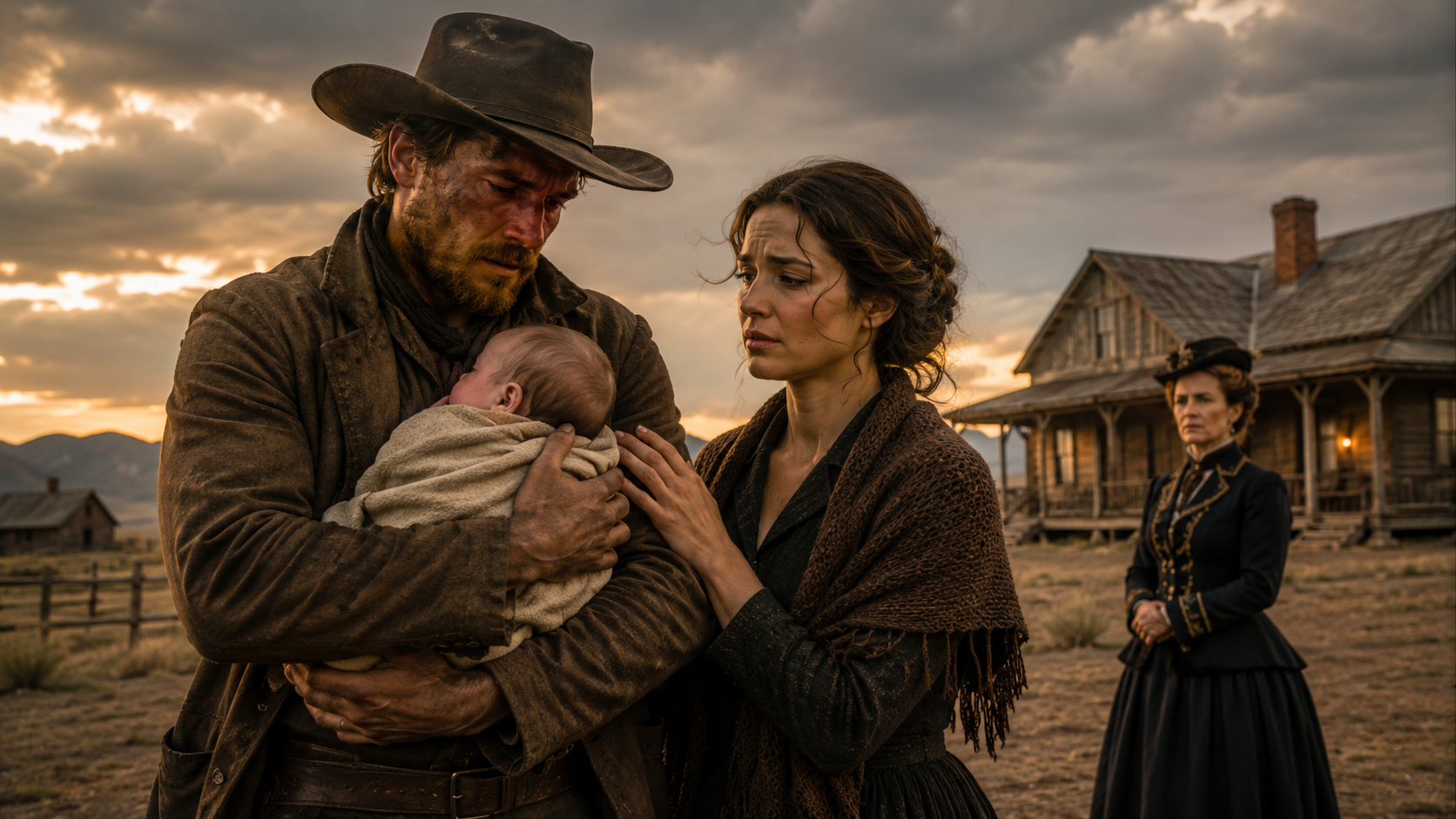
The first time Jonah Mercer heard the words, he was standing in the back room of Dr. Harlan’s office with his newborn daughter turning blue in his arms.
“Keep that cursed widow away from my child.”
The voice belonged to Mrs. Viola Trask, the richest woman in Coldwater Bend, the kind of woman who spoke softly because she had spent a lifetime teaching people to lean closer. She stood near the doorway with her gloved hands pressed to her chest, her black dress rustling like dry leaves. Behind her, two townswomen peered over her shoulders, hungry for disaster.
Jonah barely heard them.
All he could hear was the wet, weak rattle in his baby’s throat.
His daughter, little Mercy, was twelve days old and had already fought more battles than most grown men. Her mother had died before sunrise on the day Mercy was born. Fever, blood loss, and a hard birth had taken Clara Mercer from the world before she could kiss the child she had brought into it. Since then, the baby had refused bottle after bottle. Goat milk came back up. Thin porridge made her choke. Sugar water only quieted her long enough to frighten everyone.
Mercy was fading.
Jonah knew it every time he held her. She weighed less than a bundle of rags. Her cry had become a thin little scratch instead of a sound. Her mouth searched and searched, but nothing helped. She was starving with a house full of food around her.
Dr. Harlan stood beside the table, sleeves rolled, silver hair loose over his forehead. He had delivered half the children in the valley and buried too many of them. He looked at Mercy now with the grim patience of a man who knew truth was kinder than comfort.
“She needs a nursing woman,” he said.
Jonah stared at him.
“There isn’t one.”
“There is.”
The room went still.
Mrs. Trask’s lips tightened before Dr. Harlan even spoke the name.
“Eliza Wren.”
One of the women at the door gasped. Another whispered, “God preserve us.”
Jonah lifted his head slowly. He knew the name. Everyone knew it.
Eliza Wren lived beyond the abandoned mill, in a cabin where the cottonwoods grew too close and the road turned to clay after rain. She had been widowed twice before the age of twenty-eight. Her first husband had been killed beneath a falling beam at the sawmill. Her second had died of lung fever during a winter that buried three farms and half the cattle in the county. She had carried a child through that winter, but the baby had been born too early and lived only two days.
After that, people decided grief was not enough of an explanation.
A woman who survived too much must have invited it.
By spring, they were calling her cursed.
By summer, no one would take bread from her hands.
Now Dr. Harlan wanted Jonah to put his dying daughter against that woman’s breast.
“No,” Mrs. Trask said before Jonah could answer. “Absolutely not.”
Dr. Harlan did not look at her. “This is not your child, Viola.”
“No, but Clara was my cousin. I promised her I would look after this family if anything happened.”
Jonah’s jaw tightened. Clara had never mentioned such a promise.
Dr. Harlan’s eyes stayed on Jonah. “Eliza still has milk.”
Mrs. Trask made a sharp, disgusted sound. “Milk for a dead child.”
“That is enough,” the doctor said.
“It is not enough. A decent man would not let a woman like that touch his baby.”
Jonah looked down at Mercy. Her eyes were half-open, unfocused and dull. One tiny fist lay against his shirt, too tired even to curl. He had broken horses, fought wolves off calves, ridden through hail with a cracked rib, and once stitched his own forearm with fishing line. None of that had prepared him for the helplessness of watching his child starve.
“What happens if I refuse?” he asked.
Dr. Harlan’s face softened in a way that frightened him.
“Then you bury her before Sunday.”
Mrs. Trask crossed herself.
Jonah closed his eyes.
When he opened them, he was no longer listening to the town. He was listening to the faint, desperate breath of his daughter.
“Send for Eliza.”
No one moved.
Jonah raised his head. “Now.”
The boy who swept the doctor’s floor ran out the back door and took the road toward the mill.
Mrs. Trask stared at Jonah as if he had struck her. “You will regret this.”
“I regret a hundred things already,” he said. “One more won’t scare me.”
But that was not true.
He was terrified.
Eliza Wren arrived forty minutes later in a plain brown dress with rain on the hem and a gray shawl wrapped tight around her shoulders. She was not what Jonah expected.
He had imagined someone hard, perhaps. Bitter. A woman shaped by all the ugly things people said of her. Instead, she looked tired in a quiet, watchful way. She had broad hands, a soft face, and dark hair pinned badly at the back of her neck, as if she had done it while walking. Her eyes were hazel, but the kind of hazel that changed with light—green near the window, brown in shadow.