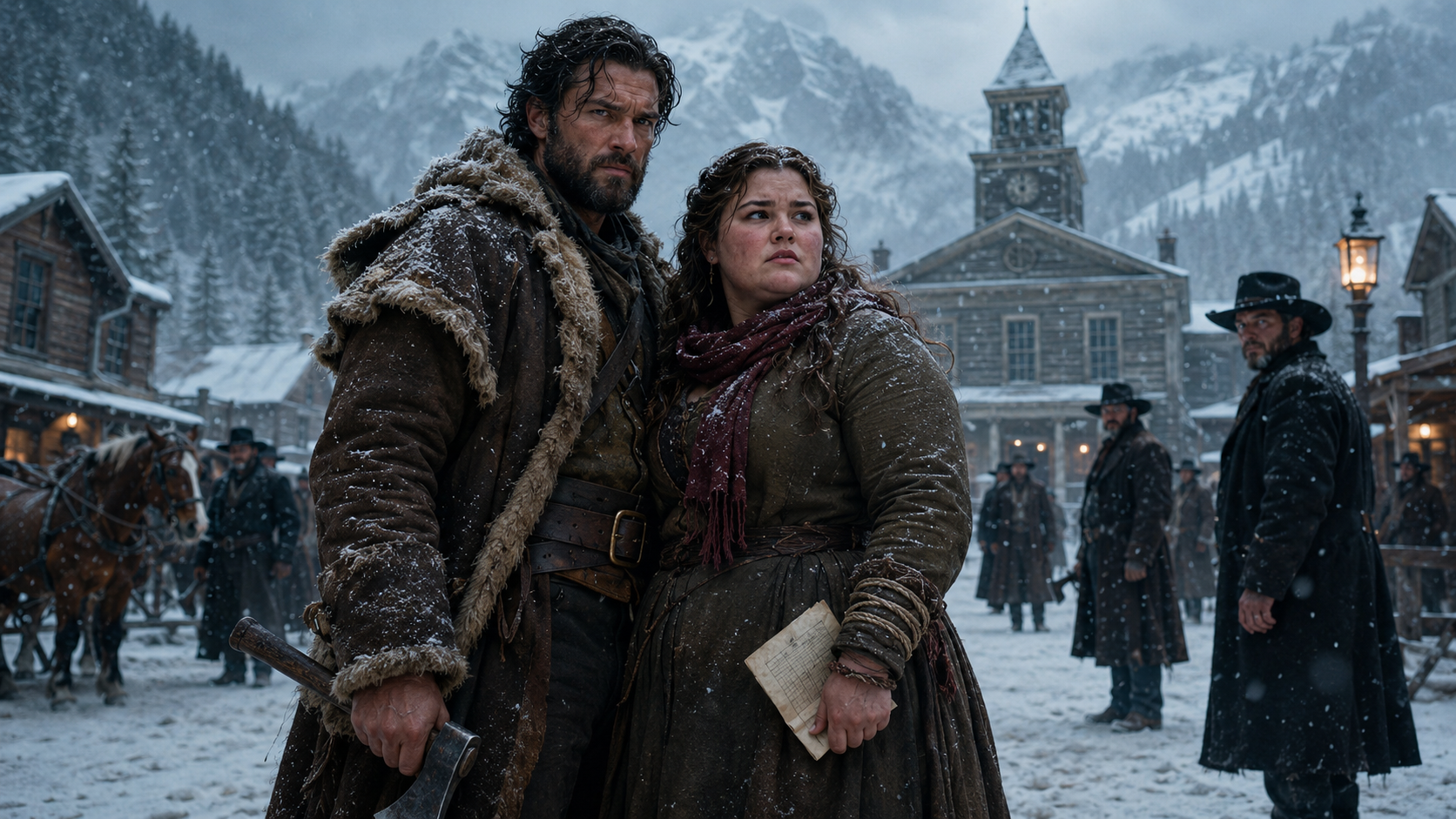
By the time Rowan Vale came down from Blackbriar Mountain, the whole town of Ash Hollow had already decided that Clara Wynn was guilty.
They had decided it before the ropes touched her wrists.
They had decided it before the mayor cleared his throat from the courthouse steps and spoke in that polished, sorrowful voice he used whenever he wanted cruelty to sound like duty.
They had decided it because Clara was easy to accuse.
She was the woman who worked in the back room of Trask’s Mercantile, the one who counted flour sacks and coal vouchers while customers pretended not to stare at the breadth of her hips, the softness of her face, the way she moved carefully through narrow aisles as if apologizing to shelves for existing.
She was the woman children repeated jokes about because their parents had spoken them first.
Too big for a husband.
Too plain for pity.
Too hungry-looking to trust around food.
And now, according to Mayor Silas Crowe, too dishonest to be left unpunished.
Clara stood tied to the hitching rail outside the courthouse with snow collecting in the folds of her coat. Her fingers had gone numb twenty minutes ago. Her cheeks burned from the cold and from the eyes watching her. Nobody met her gaze for long. That was the worst part. They wanted the spectacle, but not the responsibility of seeing a person inside it.
Mayor Crowe stood above her in a dark wool coat with silver buttons. Beside him, Mabel Trask clutched a handkerchief to her mouth as if grief had overcome her. Deputy Roland Pike leaned against the porch post with one hand resting near his pistol, smiling just enough for Clara to know he was enjoying himself.
“This town has survived hardship,” Mayor Crowe announced. “Fire, hunger, winter sickness, failed harvests. We survive because we trust one another. When that trust is stolen, justice must answer.”
A murmur moved through the crowd.
Clara tried to speak, but her jaw ached where Roland had struck her behind the mercantile before dragging her into the square.
“I didn’t steal anything,” she said.
Her voice came out smaller than she intended.
Roland laughed. “Hear that? Boxes vanish from the church pantry, and the woman caught holding relief goods says she didn’t steal.”
“I found the ledger,” Clara said, louder now. “That’s why you—”
Roland stepped closer.
She stopped.
His smile widened.
Mayor Crowe lifted a calming hand. “Miss Wynn is frightened. Fear often leads people into confused accusations.”
“I’m not confused.”
“No,” Mabel Trask said sharply. “You’re ungrateful. After all the work I gave you. After all the chances I offered. I saw you myself behind my store with the relief crates.”
Clara turned toward her. “Behind your store. Not behind the church pantry.”
Mabel’s mouth tightened.
“And the crates were already opened,” Clara said. “The seals were broken before I touched them.”
This time, the murmur was different.
Mayor Crowe heard it too. His expression shifted only slightly, but Clara saw the calculation pass through his eyes.
“Enough,” he said.
Then a voice came from the back of the crowd.
“Not enough.”
Everyone turned.
Rowan Vale stood at the edge of the square, broad-shouldered under a weathered buffalo coat, snow melting in his dark beard, a rifle slung across his back and an old hatchet hanging from his belt.
Ash Hollow knew him.
Or thought it did.
The children had been warned not to climb toward Blackbriar Pass because the mad mountain man lived there. The women whispered that he had killed a man years ago and escaped punishment because nobody dared climb after him. The men called him savage when he was absent and stepped aside when he came near.
Rowan did not look savage that morning.
He looked tired.
And angry in a way that made silence spread faster than fear.
Mayor Crowe forced a smile. “Mr. Vale. This is a town matter.”
Rowan walked forward until he stood between Clara and the courthouse steps.
“I can see that.”
Roland straightened. “You best keep walking.”
Rowan looked at the rope around Clara’s wrists, then at the snow on her shoulders, then at the crowd.
“What’s the charge?”
Mayor Crowe lifted his chin. “Theft of emergency supplies.”
“Proof?”
“Mabel Trask witnessed her.”
Rowan turned his eyes on Mabel. “You saw her take boxes from the church pantry?”
Mabel hesitated.
The whole town heard it.
“I saw her behind my store,” Mabel said. “With goods she had no right touching.”
“Were the boxes sealed?”
No answer.
Rowan looked past the mayor toward the courthouse, then toward the mercantile across the street.
“Open the door.”
Mayor Crowe frowned. “What door?”
“The pantry door. The mercantile cellar door. Any door that proves what you’re saying. Open it and let us see.”
The square went so still Clara could hear sleet ticking against the brim of Rowan’s hat.
Mayor Crowe’s smile vanished. “You do not come down from that mountain and command Ash Hollow.”
“No,” Rowan said. “I come down when Ash Hollow ties a woman outside in freezing weather and calls it law.”
Roland moved first.
His hand dropped toward his pistol.
Rowan caught his wrist before the gun cleared leather. He twisted once, hard and clean. Roland bent forward with a strangled curse, his pistol falling into the snow.
“Reach again,” Rowan said quietly, “and I’ll make that hand too expensive for you to keep.”
Several people gasped.
Mayor Crowe raised both hands. “There is no need for violence.”
“There was no need for rope,” Rowan said.
He drew the hatchet from his belt and cut Clara’s bonds in one stroke.
Pain rushed into her hands like fire. Her knees failed before pride could stop them. Rowan caught her under the arms and held her upright, steady but not possessive.
The crowd stared.
Clara hated that they stared more at the size of her body in his arms than at the marks on her wrists.
“Let her go,” Roland hissed, clutching his twisted hand.
Rowan did not look at him. “No.”
Mayor Crowe descended one step. “If you take her away, you interfere with justice.”
“If you follow without honest law,” Rowan said, “you trespass.”
“This is not over.”
Rowan turned his head slowly.
“No,” he said. “I doubt it is.”
Then he walked Clara out of Ash Hollow while the entire town watched and did nothing.
The climb up Blackbriar Pass was cruel.
The road narrowed between black pines bent beneath snow. Wind cut across the ridge in sudden blades. Clara tried to walk at first because she would rather have dropped dead in the road than be carried like a helpless bundle in front of him.
After the fourth stumble, Rowan stopped.
“You’re done.”
“I can walk.”
“You can fall. That’s not the same.”
“I’m heavy,” she muttered.
His eyes moved over her face, not her body. “You’re half frozen.”
“That’s not what people mean when they say it.”
“I’m not people.”
She did not know what to do with that.
He lifted her without ceremony. No grunt of disgust. No joke. No strained expression meant to remind her that she was a burden. He carried her as if carrying someone hurt was simply what strength was for.
His cabin appeared at dusk, tucked above a creek sealed under ice. It was rough, built from old pine and stone, but cared for. Wood stacked under a lean-to. Snow brushed away from the door. A line of traps hung clean and oiled beneath the eaves. Horseshoe chimes clinked in the wind.
Inside, warmth hit Clara so sharply she cried out.
Rowan set her by the fire and moved without wasted motion. Blanket. Kettle. Tin cup. Clean rag. Salve. A basin of warmed water.
He did not hover. He did not ask foolish questions. He worked like a man who understood that mercy could be quiet.
When he handed her broth, her fingers shook too badly to hold the cup.
He crouched in front of her. “May I?”
She swallowed and nodded.
His hands closed around hers, guiding the cup carefully. “Slow.”
The broth was salty, hot, and perfect. It burned all the way down. Clara closed her eyes because gratitude felt too much like weakness, and she had already been weak in front of too many people.
After a while, Rowan said, “Did Pike hurt you anywhere I can’t see?”
She stiffened.
He noticed at once and leaned back. “I’m asking for injury. Nothing else.”
“My jaw. My wrists.”
“Ribs?”
“No.”
“Head?”
“No.”
“Open your coat.”
Her eyes snapped to his.
The fire cracked loudly.
Rowan’s expression did not change, but something in his gaze softened.
“Not for that,” he said. “The lining. You kept pressing your arm against it the whole climb.”
Clara went cold in a way the fire could not fix.
He had seen.
Rowan sat back on his heels, giving her space. “I won’t touch you. I won’t take anything from you. But if whatever is hidden there is why they tied you to a rail, I need to know how much trouble followed us home.”
For a long moment, the only sound was wind against the shutters.
Then Clara unbuttoned her coat with stiff fingers. She reached into a torn seam and pulled out a folded ledger sheet, damp from melted snow and body heat.
Rowan did not reach for it.
She held it out.
“This is why they wanted me quiet.”
He took the page carefully. His eyes moved across the columns, initials, signatures, supply codes, dates, quantities. The room seemed to tighten around him.
“You understand it?” Clara asked.
“I understand enough.”
“Then you know it isn’t about peaches.”
“No.”
Her throat closed. “Are you going to give me back?”
His gaze lifted.
“To them,” she said. “If this is worse than theft. If it brings guns to your door. If you decide I’m not worth the trouble.”
Rowan folded the page once and set it between them on the table.
“Trouble has known my door for ten years.”
“That isn’t an answer.”
“It’s the truest one I’ve got tonight.”
He cleaned her wrists. The salve stung fiercely. She hissed, and his hand stopped until she nodded for him to continue. He bandaged her with strips torn from a clean shirt, then gave her the bed and laid his own blanket near the hearth.
He never asked whether she trusted him.
That was why she almost did.
When the lantern went out and the cabin settled into darkness, Clara stared at the fire’s last orange ribs.
“Why did you help me?” she whispered.
Rowan was silent so long she thought he had fallen asleep.
Then he said, “Because they liked hurting you.”
The answer followed her into fever.
For three days, sickness dragged Clara in and out of the world. She woke sweating, then shaking, then furious with shame because Rowan had to help her drink, eat, stand, and once cross the room when her legs turned useless beneath her.
He never mocked her.
He never pitied her loudly.
He looked away when she needed privacy and stepped near when she needed balance. Each kindness unsettled her more than cruelty ever had. Cruelty was familiar. Kindness made demands she did not know how to meet.
On the fourth morning, she found him outside splitting wood.
The sun made the snow almost painful to look at. Rowan swung the axe with controlled force, each strike clean through the heart of a log.
“I can work,” Clara said from the doorway.
He glanced over. “You can stand.”
“That is work compared to yesterday.”
His mouth twitched. “Start with coffee.”
“I don’t want charity.”
“Then don’t take any.”
“I’m in your cabin, wearing your socks and eating your food.”
“They’re terrible socks.”
“Rowan.”
He set the axe into a stump. “Can you count inventory?”
She blinked. “Yes.”
“Good. Pantry shelves are a disgrace. Count what’s there. Write it down. Then we’ll know whether supper depends on beans, luck, or a deer making poor choices.”
It was not pity.
It was a task.
Clara did it well.
By afternoon, she had counted flour, beans, dried apples, lamp oil, coffee, salt pork, cartridges, candles, bandages, spare blankets, fish hooks, and two jars of peaches she tried not to stare at. She organized everything by type, urgency, spoilage, and ration potential.
Rowan came in at dusk, looked at her pages, and raised one eyebrow.
“You always write like a county schoolmistress?”
“You always praise like a fence post?”
This time his almost-smile became real.
After that, a rhythm formed.
Rowan rose before dawn. Clara learned to bank the fire, mend canvas, stack kindling, boil coffee without ruining it, and make biscuits that gradually became less dangerous. He taught her to shoot because, as he put it, “Anyone who profits from your helplessness will be offended when you lose it.”
At first, the rifle frightened her. It bruised her shoulder and made her hands sweat. But she kept practicing.
Her body changed in ways she did not expect. She did not become a different woman. That was the miracle of it. Her hips remained wide. Her belly remained soft. Her cheeks remained round. But her legs grew steadier on snow-packed trails. Her arms strengthened from water buckets and firewood. Her back straightened without asking permission.
The shame did not vanish.
It loosened.
Like a bad stitch in a coat lining.
One evening, while she kneaded dough at the table, she found Rowan watching her.
“What?”
“You don’t fold yourself inward as much.”
She frowned. “I never did.”
“You did. Shoulders tucked. Arms crossed. Apologizing every time you moved through a room.”
Heat rose in her face. “People notice when I take up room.”
“Let them notice.”
“It isn’t that simple.”
“No,” he said. “It isn’t.”
Because he said it like a man who knew, she believed him.
That night, he told her about Miriam.
Not all of it. Rowan Vale did not spill memory like water from a broken pail. He gave it in pieces, each one rough and reluctant.
Miriam had been his younger sister. Ten years earlier, Ash Hollow had nearly burned when a summer fire came down through the west timber. Donations arrived after the evacuation: flour, medicine, blankets, cash, tools, roofing tin. Miriam worked in the town office and found numbers that did not match.
“She thought it was a mistake at first,” Rowan said, staring into the fire. “Then she found names of families who had supposedly signed for goods they never received.”
“Like the ledger page,” Clara said.
He nodded once.
“What happened?”
“She accused the wrong men.”
“Crowe?”
“He was deputy mayor then. Mabel Trask handled store distribution. Pike was young, but already mean enough to be useful.”
Clara’s hands tightened around her cup.
“They arrested her?” she asked.
“They called it protective custody. Said she was hysterical. Locked her in the jail overnight to calm down.”
“And in the morning?”
Rowan’s jaw shifted. “She was gone.”
Clara stopped breathing for a moment.
“Gone?”
“That was the word they used. Said she escaped. Said she stole relief money and ran before dawn. Two weeks later, I found her scarf by the gorge.”
“Did you find her?”
“No.”
“But you think—”
“I think she saw what you saw. I think she spoke before she understood how expensive truth can be.”
The fire popped.
Clara whispered, “And they blamed you too.”
“When I pushed too hard, a man ended up dead outside the saloon. They said I shot him.”
“Did you?”
“No.”
She believed him before the word finished leaving his mouth.
“Why stay?” she asked. “Why not leave Ash Hollow behind?”
Rowan looked toward the dark window, beyond which the mountain pressed close and black.
“Because this land was my father’s. Because Crowe wanted it. Timber, water rights, a clean route through the pass. Leaving would have meant handing him the mountain along with my sister.”
Clara thought of the hidden ledger page.
“So I’m not the first person they framed.”
“No,” Rowan said. “But you may be the first one holding a page they forgot to burn.”
The next morning, they found boot tracks near the frozen creek.
Rowan crouched over them, face unreadable. Clara stood behind him with the rifle gripped in both hands, trying to breathe the way he had taught her.
“How many?” she asked.
“Three. Maybe four.”
“From town?”
“Likely.”
“Do we run?”
He looked up toward the cabin.
“Not yet.”
By noon, the first shot cracked through the trees.
It struck the chopping block three feet from Clara.
Rowan shoved her behind the woodpile and fired once into the air.
“You’re on private land!”
Roland Pike’s voice came back from the pines. “Send the girl down, Vale!”
Clara’s stomach turned.
Rowan muttered something dark.
“How many?” she whispered.
“Enough to be stupid in groups.”
The next minutes dissolved into smoke, noise, splintering bark, and snow kicked up by bullets. Rowan did not shoot to kill. He shot branches above heads, snow near boots, tree trunks close enough to frighten fools into remembering they had mothers.
Clara stayed low until she saw a young man circling behind the cabin with a rag-stuffed bottle in his hand.
Fire.
He meant to burn them out.
Her hands shook as she raised the rifle. She aimed for the tree beside him and pulled the trigger.
The shot exploded bark close enough to shower his face with splinters. He dropped the bottle and fell backward with a shout.
“I don’t want to kill you!” Clara yelled, surprising herself. “But I am frightened, and I am improving very quickly!”
There was a silence.
From somewhere near the creek, Rowan called, “That may be the least comforting warning ever spoken.”
“Did it work?”
The young man scrambled away from the bottle. “It worked!”
By dusk, Roland Pike’s little attack had failed. Two men limped downhill supporting a third between them. Roland vanished before Rowan could cut him off. The broken fire bottle lay harmless in the snow, but the message was clear.
Ash Hollow would not let them keep the truth quietly.
Inside the cabin, Rowan cleaned a shallow cut on Clara’s temple where flying bark had caught her. His hands were careful, but his mouth was tight with anger.
“You should have stayed behind the woodpile.”
“He had fire.”
“I saw.”
“Then why are you angry?”
“Because you could have been shot.”
“So could you.”
“That’s different.”
Clara pulled away from his hand.
“Because you’re allowed to risk your life and I’m supposed to hide under the table until men finish deciding what happens to me?”
His eyes flashed. “Because I know what I’m doing.”
“And I’m learning.”
“This was not practice.”
“No,” she said, voice breaking. “It was my life. They tied me up. They lied about me. They would have watched me freeze and gone home for supper. I am tired of surviving by making myself smaller. I will not do it in your cabin too.”
Rowan said nothing.
Clara wiped her eyes angrily.
“I know I’m not Miriam.”
His expression changed.
“I know that is part of why you helped me,” she said. “I am sorry nobody saved her. I am sorry she vanished before anyone stood beside her. But I am here, Rowan. I am alive. And I need you to stop treating my survival like something that belongs only to you.”
The words hung between them.
Then Rowan sat back as if she had struck him harder than any bullet.
“You’re right,” he said.
Clara had been ready to argue. The apology left her defenseless.
“I don’t know how to stand close to someone,” he admitted. “I have spent ten years watching from a distance. Protecting a person beside me is harder.”
“I don’t need easy.”
“No,” he said softly. “I suppose you never did.”
The next morning, the young man Clara had frightened returned alone with a white flour sack tied to a branch.
His name was Noah Finch. He was nineteen, hungry, and terrified enough to look younger. Rowan made him leave his pistol on a stump before letting him come near. Clara recognized him as a delivery boy from Trask’s Mercantile.
“Pike lied,” Noah said, twisting his cap in both hands. “He said Vale had kidnapped you. Said he’d gone wild up here. Said if we didn’t help, he’d come down and murder people.”
Rowan folded his arms. “And now?”
Noah glanced at Clara. “She shot a tree instead of my head. Made me reconsider the story.”
Clara nearly laughed.
Noah told them Roland had been gathering men without the mayor’s public approval, though nobody truly believed Crowe knew nothing. He said Mabel Trask had locked her cellar and sent two wagons south after midnight. Then he said the thing that made Clara’s blood turn cold.
“There’s a town meeting tomorrow,” Noah said. “Mayor says it’s about public safety. Pike says they’ll declare both of you fugitives.”
Rowan looked at Clara.
Clara looked at the ledger page on the table.
Running would be easier.
There were settlements beyond the northern ridge. Rowan had hidden food caches, old trails, money wrapped in oilcloth, routes no town deputy could follow. They could vanish before dawn and let Ash Hollow choke on its own lies.
But lies, Clara had learned, did not stay where you left them.
They grew.
They became records.
Then warnings.
Then law.
She touched the bandage on her wrist.
“We go down.”
Rowan’s face hardened. “No.”
“Yes.”
“They’ll be waiting.”
“Good,” she said. “Then we won’t have to gather a crowd.”
“Clara.”
She lifted her chin.
“Open the door,” she said. “Let them see.”
His eyes searched hers.
This time, he did not tell her she was wrong.
Their plan was not heroic. Rowan said heroic plans got people buried. Their plan was ugly, practical, and built on three things: Noah’s guilt, Clara’s memory, and the fact that Mabel Trask trusted locks more than witnesses.
Noah went down first and told his mother everything. Mrs. Finch told Deacon Harlan. Deacon Harlan told his wife, who had long wondered why her family never received the coal vouchers Mayor Crowe claimed they signed for.
By dusk, doubt moved through Ash Hollow like water under thawing ice.
After dark, Rowan and Clara entered town through the old drainage ditch behind Trask’s Mercantile. Clara led him to the cellar door she had scrubbed a hundred times. Rowan broke the lock with one swing of his hatchet.
Inside were the missing supplies.
Not a few crates.
Not a mistake.
Rows and rows of stolen goods filled the cellar: flour sacks, canned meat, powdered milk, wool blankets, kerosene tins, insulin boxes packed in cold straw, bottles of medicine, envelopes of cash sealed with church stamps, and baby formula wrapped in brown paper.
There were records too.
Not only the page Clara had found.
Years of them.
Rowan stood in the lantern light, staring at a sheet dated ten years earlier.
Miriam Vale’s signature sat at the bottom.
Clara saw his face and knew.
“It’s forged,” she said.
“I know.”
His voice sounded scraped raw.
They packed what records they could carry. Noah brought Deacon Harlan and Mrs. Finch to witness the cellar before anyone could claim the evidence had been planted. By morning, half the town knew something was wrong.
That was why Roland Pike moved first.
The town meeting began at noon in the old mill hall. Clara waited in the alley across the street beneath Rowan’s spare coat, a wool hat pulled low over her brow. Her heart beat so hard she thought it might shake snow loose from the roof.
Rowan was supposed to enter from the back after Noah gave the signal. Clara would come through the front with the ledger copies and Deacon Harlan. They would force Mayor Crowe to answer in public before he could hide behind more official words.
But when the back door opened, Rowan did not appear.
Roland Pike did.
He had a pistol pressed to Rowan’s ribs.
Clara stopped breathing.
Rowan’s hands were tied. Blood marked the corner of his mouth. Roland shoved him onto the mill hall steps in full view of everyone inside, then shouted, “Found the mountain killer sneaking around with stolen papers!”
People spilled into the street.
Mayor Crowe appeared behind them, pale with fury. Mabel Trask stood at his side clutching her handbag so tightly the leather creaked.
Roland kicked Rowan to his knees.
For one terrible moment, Clara saw herself again: the square, the cold, the rope, the crowd.
Only now Rowan knelt where she had knelt.
And Roland held the knife.
“Here is your proof!” Roland shouted. “Vale broke into private property. He stole from Mrs. Trask. He’s been hiding that thieving woman in his cabin, and now he wants to turn this town against itself.”
Rowan’s eyes moved through the crowd until they found Clara in the alley.
Run, they said.
Clara stepped into the street.
“No.”
Every head turned.
Her legs wanted to shake. Her body wanted to fold inward and become small enough to slip between glances. Instead, she walked forward with the ledger pages held against her chest.
Roland’s face twisted.
“Well,” he sneered, “look who came waddling back.”
The insult struck the old bruise.
For one heartbeat, shame rose hot and familiar.
Then Clara looked at Rowan on his knees. At Noah standing pale beside his mother. At Deacon Harlan gripping his Bible like a shield. At the townspeople who had watched her suffer and now looked uncertain because uncertainty was easier than courage.
She lifted her chin.
“Yes,” she said clearly. “Look at me.”
The crowd quieted.
“Look at the woman you called greedy because it was easier than asking why relief food never reached your children. Look at the woman you called thief because Mabel Trask said so, because Mayor Crowe smiled, because Deputy Pike wore a badge and carried a gun. Look at me now and decide whether you will make the same mistake twice.”
Mayor Crowe stepped forward. “Miss Wynn is unstable.”
“I counted your supplies,” Clara said. “For months. I know the difference between missing inventory and hidden inventory. I know your handwriting. I know Mrs. Trask’s. I know Pike’s because he makes his sevens like snapped fence rails.”
A ripple moved through the crowd.
Clara held up the pages. “These are copies from the books in Mabel Trask’s cellar. The original ledgers are with Deacon Harlan and Mrs. Finch, who saw the stolen supplies themselves last night.”
Mabel’s face drained of color.
“That is a lie.”
“Then open your cellar,” Clara said.
Silence.
There it was again.
The sentence that had nearly gotten her killed.
Clara turned toward the crowd.
“Open the door and let us see.”
Someone shouted from the back. “Open it!”
Another voice joined. “Open the cellar!”
Mayor Crowe lifted both hands. “Everyone calm yourselves.”
But calm was no longer what moved through Ash Hollow.
Anger did.
Not wild anger. Not yet.
A colder kind.
The kind that came when people began adding up empty shelves, sick children, dead winters, missing medicine, and signatures they had never written.
Roland felt it too.
His pistol rose toward Rowan’s head.
“Enough,” he said. “One more word and I finish this.”
Clara raised the rifle hidden beneath Rowan’s coat.
She had never pointed it at a person and meant it until that moment.
“Drop it, Pike.”
His eyes widened, then narrowed. “You won’t shoot me.”
Clara’s hands were steady.
That surprised her most.
“You were right that I am scared,” she said. “I am scared of what happens when men like you decide who is allowed to be believed. I am scared of another woman freezing at that rail. I am scared of spending the rest of my life apologizing for surviving. But I am not scared enough to lower this rifle.”
Roland’s finger tightened.
Before he could fire, Noah Finch stepped between them.
Then Mrs. Finch.
Then Deacon Harlan.
Then a farmer whose wife had gone without insulin.
Then a schoolteacher whose students came hungry.
Then six more people.
Then ten.
Soon a wall of Ash Hollow citizens stood between Roland Pike and the man he wanted to execute.
Roland’s face darkened. “Move.”
Mrs. Finch’s voice was quiet but hard.
“No. We moved aside once. Look what it made us.”
Mayor Crowe seemed to shrink inside his fine coat. For the first time, he looked less like a leader than a man counting exits.
Mabel Trask tried to slip away.
Rowan, still bound, shifted one boot just enough to trip her as she passed.
She fell hard. Her handbag burst open across the snow.
Cash envelopes spilled out.
Church seals.
Relief stamps.
And a silver locket.
Rowan stared at it.
Clara lowered the rifle a fraction. “Rowan?”
He picked up the locket with bound hands.
His voice, when it came, was nearly unrecognizable.
“Where did you get this?”
Mabel scrambled backward. “I don’t know.”
Rowan stood slowly. The ropes around his wrists were half cut where he had been working them against a hidden blade.
“This was my sister’s.”
Mayor Crowe closed his eyes.
That was what broke him.
Not the ledgers.
Not the crowd.
Not even the stolen supplies.
The locket.
Because everyone in Ash Hollow knew Miriam Vale had supposedly run away with stolen relief money. Everyone knew Silas Crowe had sworn he never saw her after the night she vanished.
But Miriam’s locket had been inside Mabel Trask’s bag, wrapped in an envelope marked with Crowe’s handwriting.
Roland looked at the mayor.
“Silas?”
Mayor Crowe opened his mouth.
Nothing came out.
Clara understood before the confession began.
Miriam had not run.
She had found the same theft Clara found.
She had spoken.
And Ash Hollow had allowed silence to become a grave.
The county sheriff arrived two hours later, summoned by Deacon Harlan’s wife before dawn. By then, Trask’s cellar was open, the ledgers were spread across the mill hall tables, and half the town had found forged signatures written beside supplies they had never received.
Roland Pike was arrested after trying to flee.
Mabel Trask screamed until her voice gave out.
Mayor Crowe confessed quietly, not because he was noble, but because the evidence had finally grown heavier than his lies. He admitted Miriam had confronted him ten years earlier. He claimed her death had been an accident near the gorge, a struggle, a fall he never meant to cause.
Rowan listened without moving.
Clara stood beside him, close enough for her shoulder to touch his arm.
When Crowe finished, Rowan said only, “Show them where.”
The following spring, they found Miriam Vale beneath a cairn of stones near the river gorge.
Ash Hollow changed after that.
Not quickly.
Not cleanly.
Towns did not become honest overnight because guilty men were carried away. Shame had roots. Cowardice did too. But people began returning what they could. The church pantry reopened with three key holders instead of one. Relief ledgers were copied and read aloud at every meeting. Noah Finch became a deputy under the county sheriff. Mrs. Finch managed distribution and hired Clara to design the new inventory system.
Clara did not return to sleeping beside flour sacks in the mercantile.
She never again accepted wages promised “later.”
She lived on Blackbriar Pass.
At first, people whispered about that too.
Let them.
Clara had spent too much of her life being shaped by mouths that had never fed her.
She still had soft hips, a round face, and arms that filled her sleeves. She also had a steadier aim than half the men in town, a sharper head for numbers than any clerk Ash Hollow had ever hired, and a way of looking directly at liars that made them rethink their plans.
Rowan rebuilt the old smokehouse into a second cabin because, as he said, “People need doors of their own.”
Clara used it first for ledgers.
Then for storage.
Then for visitors who climbed the pass needing help Ash Hollow had once refused to give.
By autumn, Blackbriar became known less as the mountain where the killer lived and more as the place where no one asked what shape your shame had before offering coffee.
One evening, nearly a year after Clara had been tied to the courthouse rail, she and Rowan stood outside watching the first snow gather on the pines.
“Do you regret it?” he asked.
“Which part?”
“Staying.”
Clara looked down at the town lights flickering far below. Ash Hollow was still imperfect. So was she. So was Rowan. But imperfection no longer felt like a sentence.
She thought of the rope.
The crowd.
The ledger hidden against her heart.
She thought of Rowan walking into the square like a storm with a conscience.
She thought of herself raising a rifle and telling an entire town to look at her.
“No,” she said. “Not once.”
Rowan’s hand found hers, warm and scarred.
“Good,” he said. “Because I don’t either.”
The mountain wind moved around them, cold but no longer cruel. Below, Ash Hollow carried on, a little humbler, a little more careful with the truth. Above it, Clara Wynn stood without folding her shoulders inward, without apologizing for the space she filled, beside the man who had once demanded that a locked town open its door and let him see.
In the end, the lock that mattered had never been on a cellar.
It had been on fear.
And together, they had broken it.

