Sold for a Gambling Debt — Until a Widowed Mountain Man Made the Whole Valley Speak Her Name

The night Livia Hart learned her father had sold her, the wind was clawing at the cabin walls like something hungry.

She had been mending a torn sleeve beside the stove, trying to make her fingers move though they were stiff from cold and old bruises, when the horses came up the road.

Three of them.

Nobody rode that high after dark unless they carried trouble with them.

Her father, Bram Hart, heard the hoofbeats too. He lifted his head from the table, where a half-empty bottle leaned beside a stack of losing cards. His face changed at once. Drink made him cruel most nights, but fear made him almost sober.

“Get behind the curtain,” he hissed.

Livia did not ask why. In Bram’s house, questions were another way to earn pain.

She rose, gathered her mending, and slipped behind the faded quilt that hung between the kitchen and the main room. Through a tear in the cloth, she saw her father wipe his mouth with the back of his hand and stagger toward the door.

The knocking came before he reached it.

Not loud. Not frantic.

Three calm strikes, as if the man outside already owned whatever waited within.

Bram opened the door only a crack.

“Mr. Voss,” he said, and his voice sounded smaller than Livia had ever heard it. “I wasn’t expecting you tonight.”

“No debtor ever expects the man he owes,” replied a smooth voice.

The door opened wider.

Silas Voss stepped inside with snow on his shoulders and silver on his gloves. He owned the card rooms down in Mercy Creek, the freight contracts along the pass, half the lawmen by rumor, and all the frightened silence in the valley by fact.

Two men followed him in. Both wore pistols. Neither removed his hat.

Bram swallowed. “I’ll have the money after the spring drive.”

“You said that after the autumn cutting.”

“The mill cheated me.”

“You gambled away the mill payment.”

The words struck the room like stones dropped into a well.

Livia held her breath.

Voss walked to the stove, warmed his hands, and glanced around the poor cabin with an expression of polished disgust.

“Three hundred and eighty dollars,” he said. “Plus interest. Plus the cost of my patience.”

Bram’s mouth twitched. “I can work it off.”

“You?” Voss smiled faintly. “Bram, you have worked at being useless for twenty years. Why start changing now?”

One of the men laughed.

Bram’s face reddened, but he did not raise his voice. Not to Silas Voss. He saved that courage for his daughter.

“I need time,” Bram said.

“No,” Voss answered. “You need value.”

The silence after that became sharp.

Livia felt it before she understood it.

Voss turned his head slowly toward the hanging quilt.

“There are other kinds of payment,” he said.

Bram stared at the floor.

Livia’s fingers tightened around the sleeve in her lap until the needle bit into her skin.

“No,” Bram muttered.

But there was no horror in the word.

Only bargaining.

Voss removed one glove finger by finger. “There is a house in Abilene that pays for quiet girls with no mother and no brothers. They do not ask many questions if the paper is signed by a father.”

The room tilted.

Livia pressed a hand over her mouth.

Bram was silent for so long that hope, foolish and wounded, lifted its head inside her. Perhaps some small piece of him still remembered carrying her on his shoulders through summer grass. Perhaps he remembered her mother’s hands, or the way Livia used to sing while washing clothes by the creek.

Then he said, “She’s stubborn.”

Voss smiled.

“They all learn.”

“She’s not pretty like the ones they usually take.”

“They are not buying a bride.”

Livia shut her eyes.

The words did not merely frighten her. They erased her. Reduced her to a debt, a sum, a thing moved from one man’s hand to another.

“She’s bruised,” Bram said.

“They fade.”

“She runs her mouth when she’s desperate.”

“Then gag her.”

A log collapsed in the stove. Sparks flared. Livia flinched.

Bram reached for the bottle, drank, and wiped his lips again.

“How much of the debt?”

“All of it.”

Another silence.

This one had a grave inside it.

“When?” Bram asked.

“Before dawn tomorrow,” Voss said. “Wash her. Put her in something clean. I’ll send a wagon.”

Livia waited for the world to stop.

It did not.

Voss placed a folded note on the table.

“Sign this.”

Bram stared at it.

“You want the debt gone?” Voss asked.

Bram took the pen.

The scratching sound of his name on paper was smaller than a scream and worse than one.

Livia stood behind the quilt and felt something inside her go cold and clear.

Not broken.

Not yet.

Clear.

After Voss left, Bram drank himself into a heavy, open-mouthed sleep by the fire. The note remained on the table, weighted beneath the bottle. Snow whispered against the windows. The horses disappeared down the road.

Livia did not move for several minutes.

Then, quietly, she stepped out from behind the quilt.

Her father’s hand hung loose from the chair. The same hand that had once braided her hair badly after her mother died. The same hand that later learned the shape of belts, sticks, and fists.

She looked at him for a long time.

“You were supposed to keep my name,” she whispered.

Bram snored.

That was answer enough.

Livia turned away.

From the bedroom, she took her mother’s shawl, a pair of wool stockings, a cracked leather belt, and a small knife with a pearl-colored handle. From beneath a loose board near the stove, she pulled out a tin box no larger than a Bible.

Inside were the only things Bram had never managed to sell: her mother’s wedding ribbon, a pressed blue flower, a brass thimble, and a folded paper sealed with wax.

Livia had never read the paper. Her mother had given it to her the winter before she died and said, “When the world tries to tell you who you are, open this.”

Livia had been eight then.

Now she was twenty.

Her hands trembled as she tucked the paper into her bodice.

She wanted to take the note Voss had left. Proof. Evidence. Something.

But Bram’s arm shifted in his sleep.

Livia froze.

He mumbled, cursed softly, then sank back into the chair.

She left the note where it was. Proof would mean nothing if she was still here when dawn came.

At the back window, she paused.

Outside waited darkness, snow, wolves, and the ridge.

Inside waited a wagon.

She opened the window.

The cold hit like a thrown bucket of river water.

Livia climbed out.

She did not run toward town. Town had watched Bram drag her by the wrist through the mercantile. Town had seen bruises along her jaw and asked whether she had fallen. Town knew Silas Voss and lowered its eyes.

So she ran toward the mountains.

Toward Blackthorn Ridge.

Toward the one place Bram had warned her never to go.

Toward the cabin of Rowan Vale.

People in Mercy Creek spoke of Rowan as if he were half-man, half-storm. A widower. A trapper. A giant with a scar down one cheek and hands that could break a rifle stock. Children dared one another to creep near his land and touch the split-rail fence before racing away.

But Livia had seen him once at the feed store.

She had dropped a sack of flour because her wrist was swollen and weak. The men near the counter laughed. Rowan Vale had not laughed. He had picked up the flour, carried it to Bram’s wagon, and said only, “That wrist needs binding.”

Bram had sneered. “Mind your ridge, Vale.”

Rowan had looked at him then. Just looked.

Bram had gone quiet.

As Livia climbed through the snow that night, that memory became a lantern in her mind.

The creek led south. Rowan’s ridge rose beyond the old cedar grove. If she could reach it before dawn, before the wagon, before Voss’s men realized she had fled—

A dog barked behind her.

Livia stopped so sharply she nearly fell.

Another bark.

Then men shouting.

Bram had woken.

She stumbled forward, one hand pressed to her ribs, the other clutching her shawl at her throat. Snow filled her boots. Branches slapped her cheeks. The moon was hidden, and the forest seemed to shift around her, every tree becoming a man, every gust a hand.

A gunshot cracked behind her.

She dropped to her knees.

The shot had gone high, into the trees. A warning.

“Livia!” Bram’s voice roared through the storm. “You come back here!”

She crawled, then forced herself up.

No.

She had come back all her life. Back from the creek when he called. Back from the neighbor’s porch when he dragged her home. Back into the kitchen after each beating. Back into silence after every insult.

Not tonight.

The ridge steepened. Her breath tore at her throat. Her legs shook. Twice she fell and slid backward, clawing at frozen roots to stop herself.

The cold began to speak.

Rest.

Just for a moment.

Close your eyes.

Snow is soft.

She bit her lip until blood warmed her mouth and kept climbing.

Then, through the trees, she saw a light.

Small.

Amber.

Real.

A cabin window glowed above the slope.

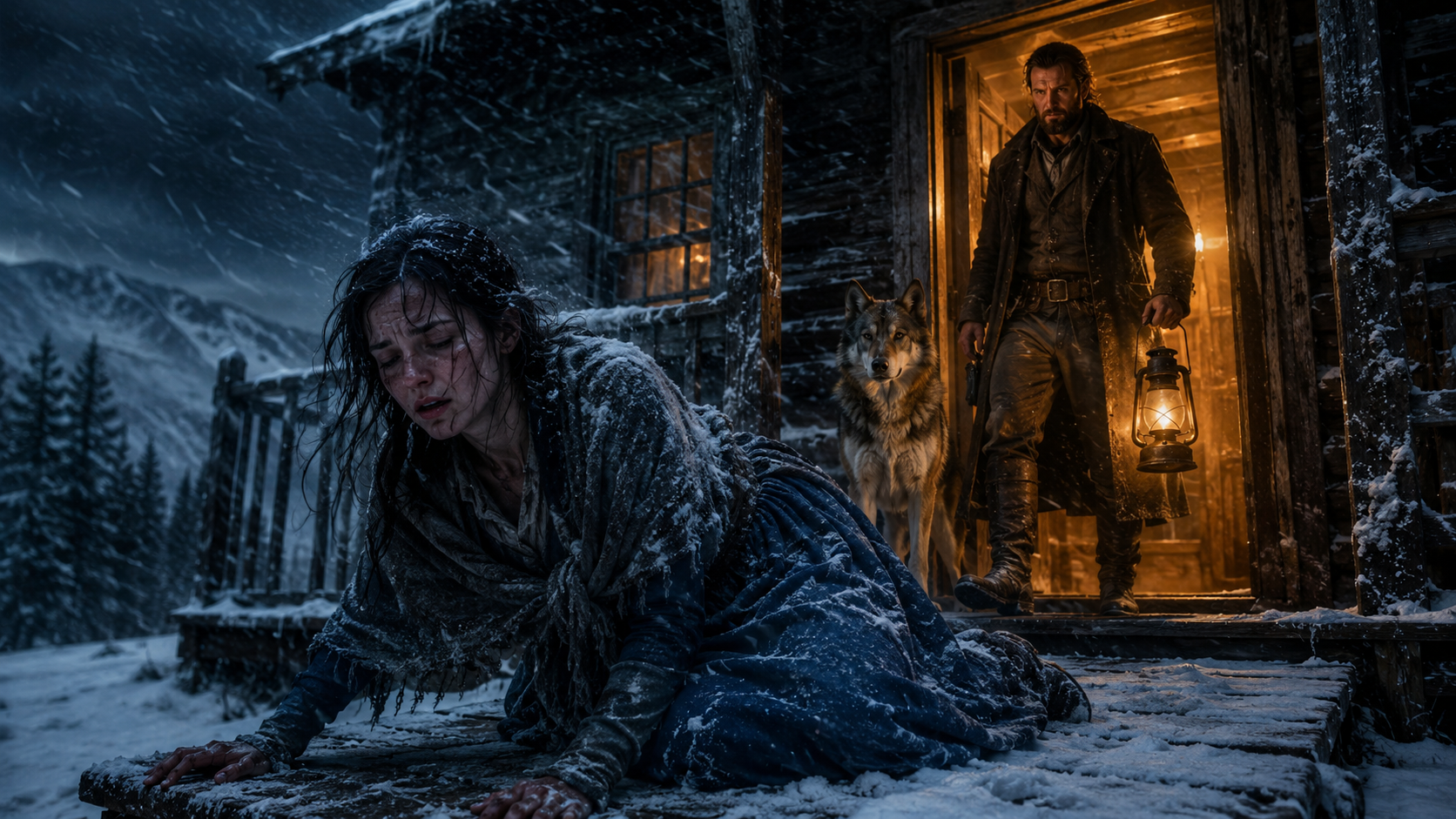
Livia tried to call out, but her voice broke. She dragged herself over the last rise, crossed a yard half-buried in drifts, and reached the porch on hands and knees.

Inside, a dog barked.

She lifted one numb hand and struck the door.

Once.

The door opened.

Warmth spilled over her.

Rowan Vale stood in the doorway, broad as an oak, a rifle in one hand, his gray eyes taking in her torn shawl, bloody mouth, frozen hair, and terror all at once.

Livia tried to stand.

Failed.

“Please,” she whispered. “Don’t let him sell me.”

Then the world went dark.

When Livia woke, men were shouting outside.

She did not know where she was at first. Smoke. Pine. Wool. Heat. A dog’s low growl. She lay on a bearskin near a hearth, buried under blankets, her boots removed, her feet burning with returning feeling.

The cabin door stood open.

Rowan Vale filled it.

Beyond him, morning had barely touched the snow. Three riders sat in the yard: Bram Hart, one of Voss’s men, and Sheriff Alden Pike.

Bram’s voice cracked with rage.

“She’s my daughter!”

Rowan’s answer was quiet. “Then you should have acted like a father before she froze on my porch.”

“She stole from me!”

“She ran from you.”

“She belongs to me!”

The dog beside Rowan snarled.

A pause followed.

When Rowan spoke again, his voice had changed. It had become colder than the ridge itself.

“Say that once more,” he said, “and choose your final words carefully.”

Livia could not see Bram’s face, but she heard his horse shift in the snow.

Sheriff Pike cleared his throat. “Vale, don’t make this ugly. The girl is wanted.”

“For what crime?”

“Theft.”

“What did she steal?”

Pike hesitated.

Rowan stepped onto the porch.

“What did she steal, Sheriff?”

Bram shouted, “My coat! My knife! My food!”

Rowan looked back into the cabin. His eyes flicked to the old army coat drying near the stove, the little knife on the table, the strip of jerky he had found in her pocket.

Then he looked at Bram again.

“She stole enough to survive the night.”

“She is mine to discipline.”

“No.”

The word was not loud.

It did not need to be.

Pike shifted his shotgun across his saddle. “The law says a father has rights.”

“The law also says a man cannot sell another human being to cover a gambling debt.”

Snow moved between them like smoke.

Bram went silent.

Livia’s stomach clenched.

Rowan had guessed.

Voss’s man spat to the side. “Careful, mountain man.”

Rowan raised his rifle, not quickly, not wildly, but with the calm of a man who had already decided what he would do if forced.

“I am being careful,” he said. “That is why you are still mounted.”

Sheriff Pike’s eyes narrowed. “You accusing someone?”

“I am asking why you rode through a blizzard to fetch a bruised woman before breakfast. I am asking why Silas Voss’s man is with you. I am asking why Bram Hart looks less like a father seeking a daughter and more like a debtor chasing collateral.”

Bram’s control snapped.

“She was worth three hundred and eighty dollars!” he shouted. “And now he’ll have my hide because of her!”

The words hung in the freezing air.

Even the horses seemed to still.

Inside the cabin, Livia shut her eyes.

There it was.

The truth, ugly and naked.

Rowan stepped down one stair.

Sheriff Pike cursed under his breath.

Voss’s man looked at Bram as if he had just dropped a lit lantern into dry hay.

Rowan said, “Leave.”

Pike tried to gather his authority. “This matter is not finished.”

“No,” Rowan said. “It is not.”

Bram pointed toward the cabin. “You can’t keep her forever!”

Rowan’s face did not move.

“I do not keep people,” he said. “That is the difference between us.”

The riders turned one by one.

Bram lingered longest, hatred twisting his mouth.

Through the blur of fever, Livia saw Rowan stand on the porch until the last hoofbeat faded into the trees.

Then he came inside, shut the door, and lowered the bar.

The cabin became very quiet.

He knelt several feet away from her, not close enough to trap her.

“You’re safe for now,” he said.

Livia wanted to believe him.

But safety was a language no one had ever taught her.

For three days, fever pulled her under and dragged her back.

Sometimes she was a child again, hiding beneath the table while Bram broke dishes after her mother’s funeral. Sometimes she was standing in the mercantile while women turned away from the bruise on her cheek. Sometimes Silas Voss was counting coins beside her bed and calling her payment.

Each time she cried out, Rowan’s voice reached her.

“You’re on the ridge.”

“No one is inside but me and the dog.”

“Drink this.”

“I won’t touch you unless you say yes.”

He kept his word.

When he changed the cloth around her ribs, he told her first. When he set broth beside her, he stepped back. When nightmares made her fight the blankets, he sat by the door instead of the bed, speaking to the hound until her eyes remembered the room.

The dog’s name was Bishop.

He was enormous, gray-muzzled, and deeply suspicious of everyone except Rowan. By the second day, he had decided Livia was under his protection and lay between her and the door like a furry judgment.

On the fourth morning, Livia woke clear-headed.

Sunlight lay pale across the floorboards. The storm had passed, leaving the world outside white and glittering. The cabin smelled of coffee, cedar, and rabbit stew.

Rowan stood at the table sharpening a knife.

Livia stiffened.

He noticed and immediately set it down.

“Sorry,” he said.

That startled her more than the knife.

Bram never apologized. He accused, denied, shouted, or laughed. Sorry was a word Livia had heard in church sermons and nowhere else.

“My coat?” she asked.

“Dry.”

“My knife?”

“On the shelf by the window.”

“My mother’s box?”

Rowan nodded toward the table. “There.”

The tin box sat untouched.

Livia dragged herself upright, wincing.

“You opened it?”

“No.”

“Why?”

“It was not mine.”

She stared at him.

The answer was too simple. Too strange.

Rowan poured coffee into a tin cup, then hesitated. “You want it?”

She nodded.

He set it on the floor halfway between them and returned to the stove.

That small act nearly made her cry.

He gave space like other men took air.

Days passed.

Then weeks.

Winter sealed Blackthorn Ridge from the valley. Snow buried the lower road. Ice formed along the creek. Bram could not climb to the cabin without freezing. Silas Voss could not send a wagon. Sheriff Pike could not pretend a paper had power where horses broke legs.

Livia healed slowly.

Her body learned first.

It learned that no one struck her when she dropped a cup. It learned that footsteps outside the door did not mean punishment. It learned that Rowan’s silence was not the same as Bram’s silence.

Bram’s silence had always been the breath before violence.

Rowan’s silence was simply a place where nothing was demanded.

He taught her practical things because pity embarrassed them both.

How to bank coals before bed. How to cut kindling without wasting strength. How to read animal tracks. How to tell weather by the color of cloud bellies over the ridge. How to load a rifle, then unload it safely.

“I don’t want to shoot anyone,” she said, stepping away from the weapon.

“Good,” Rowan replied.

“Then why teach me?”

“Because not wanting cruelty does not stop cruel men.”

She looked at the rifle on the table.

“My father always said women with weapons become wicked.”

“Your father said that because wicked men prefer unarmed women.”

She did not know what to do with that sentence, so she carried it silently for several days, turning it over like a smooth stone.

Rowan never asked for her story.

That made it easier to tell him pieces of it.

One evening, while mending Bishop’s torn sleeping mat, she said, “He was not always like that.”

Rowan, carving a peg by the fire, did not look up too quickly.

“Bram?”

She nodded.

“When my mother was alive, he laughed sometimes. Not much, but enough that I remember it. After she died, he started drinking. Then cards. Then blaming. First the weather. Then the mill. Then me.”

Rowan’s knife moved slowly through the wood.

“What was her name?”

“Celia.”

“A good name.”

Livia smiled faintly. “She used to say my name meant blue flower, though I don’t know if that’s true.”

“Does it matter?”

“I suppose not.”

“If she meant love by it, then it was true enough.”

Livia looked at him then.

The fire lit one side of his face and left the scarred side in shadow. He was not handsome in the polished way Silas Voss was handsome. Rowan looked carved by weather and loss. His hands were large, his beard streaked with iron, his shoulders heavy with work.

Above the mantel hung a small portrait of a woman in a dark dress.

Livia had noticed it the first day she could sit up.

“Was that your wife?” she asked.

Rowan’s knife stopped.

“Yes.”

“What was her name?”

“Elise.”

The name entered the room gently.

Livia lowered her eyes. “I’m sorry.”

“So am I.”

He set the carving aside.

“She died in childbirth,” he said after a long while. “The child too. Road washed out. Doctor could not come. I carried them both down in spring.”

The fire snapped.

“I thought grief was the worst thing a house could hold,” Rowan said. “Then you came to my door and reminded me some houses hold worse.”

Livia swallowed.

“I didn’t mean to bring trouble here.”

“You brought yourself.”

He said it as if that were enough.

For the first time in years, Livia wondered whether being alive might be something other than a burden someone else had to tolerate.

In March, the thaw began.

And with it came danger.

Snow loosened. The creek swelled. Roads opened. Smoke appeared again from cabins down in the valley. Men began riding between farms. News climbed the ridge slowly, carried by a peddler who stopped at Rowan’s fence with coffee, salt, and gossip.

Silas Voss was angry.

Bram Hart was drinking harder than ever.

Sheriff Pike had told anyone who asked that Rowan Vale was harboring a thief.

And a judge from the territorial circuit was expected in Mercy Creek by the end of the month.

Rowan listened to the peddler, paid him, and watched him go.

That evening, Livia found him cleaning his rifle by the window.

“They’ll come again,” she said.

“Yes.”

“Can we leave?”

“We can.”

She waited.

“But?”

“But if we leave, Voss keeps the valley. Pike keeps the badge. Bram finds someone else to sell, or beat, or blame.”

Livia folded her hands tightly.

“I don’t know how to fight men like that.”

Rowan looked at her.

“You already did.”

“I ran.”

“That was fighting.”

She turned toward the window. The valley below lay hidden beneath blue dusk.

“I have no proof,” she said. “Only what Bram shouted.”

“You have more than that.”

Livia looked back.

Rowan nodded toward the tin box on the shelf.

“Your mother’s paper.”

Her heart thudded.

“I never opened it.”

“Maybe now is when she meant you to.”

Livia took the box down with shaking hands.

The wax seal had cracked with age. She unfolded the paper carefully.

At first, the words blurred.

Her mother’s handwriting leaned across the page, delicate but firm.

My dearest Livia,

If you are reading this, then I am gone, and I fear I have left you with a man who does not know how to love anything he cannot own.

Forgive me.

There are truths I should have spoken sooner.

Your father is not Bram Hart.

Livia stopped breathing.

The cabin vanished around her.

Rowan rose but did not come closer.

She forced herself to continue.

Bram married me when I was already carrying you. He knew. He agreed to raise you because my family paid him to give us his name and silence. Your true father was Elias Wren, a surveyor from the eastern line. He died before you were born, thrown from a horse during a storm.

But he knew of you. He left papers. He left land rights. He left a recorded claim under your full name: Livia Celeste Wren.

Bram kept those papers hidden. I believe he meant to use them one day. I write this copy in case the originals disappear.

You are not his property.

You were never his shame.

You are my daughter, Elias’s daughter, and your own soul before God.

Make them say your name.

Your loving mother,

Celia Wren

Livia read the final line three times.

Make them say your name.

The paper trembled in her hands.

Rowan stood across the room, still as stone.

“He knew,” she whispered. “Bram knew I wasn’t his.”

Rowan’s jaw tightened.

“And he still—”

Her voice broke.

Everything shifted inside her. Not the pain. That remained. But the shape of it changed.

Bram had called her ungrateful blood, useless blood, cursed blood. He had beaten her for reminding him of her mother, then sold her as if fatherhood were a bill of ownership.

But he had never owned even the lie he used to hurt her.

“There may be records,” Rowan said. “Land office. Church register. County clerk.”

“Would they still exist?”

“If Voss has not burned them.”

“Why would Voss care?”

Rowan’s eyes darkened. “Land rights.”

The next morning, Rowan took down a metal strongbox from beneath a loose plank near his own bed.

Inside were letters, old receipts, military discharge papers, and a ribbon tied around a small bundle of legal documents.

“I know something about hidden records,” he said.

Livia did not ask until he handed her a folded deed.

Elise Vale had owned three hundred acres in the lower valley before she married Rowan. After her death, her cousin tried to claim Rowan had no right to remain on the ridge. Voss had funded the claim. Sheriff Pike had served the notice.

Rowan had fought for two years.

He had won.

“That is why Voss hates you,” Livia said.

“One reason.”

“He tried to take your home.”

“And failed.”

Rowan closed the strongbox.

“Men like Voss build power by making people feel alone. A widow with land. A trapper with grief. A girl with no family. Separate, each can be cornered. Together, the math changes.”

Livia looked at her mother’s letter on the table.

For years, she had believed her life was a locked room.

Now she saw a door.

Not open.

But real.

They spent the next week preparing.

Rowan rode to an old friend named Amos Bell, a retired clerk who lived beyond the northern ford and trusted Voss as much as he trusted rattlesnakes. Amos remembered Celia Wren. More importantly, he remembered Elias Wren’s survey claim.

“There was a packet,” Amos said, peering through spectacles at Livia across his kitchen table. “Filed under Wren. Mineral rights, timber rights, water access. Valuable land if the railroad spur ever came through.”

“And where is it now?” Rowan asked.

“County archive, if honest men kept it.” Amos snorted. “Which means we had better look before dishonest men hear us asking.”

They rode to the archive at dawn two days later.

Livia had not been in Mercy Creek since the night she fled. Every storefront seemed to stare. Every window held a memory. She wore a plain blue dress Rowan had bought from a widow near the ford, her mother’s shawl, and the pearl-handled knife hidden in her boot.

Rowan rode beside her, not ahead.

People stopped to watch.

Some whispered.

A boy outside the blacksmith shop said, “That’s Bram Hart’s girl.”

Livia heard Rowan inhale.

But before he could speak, she turned her horse and looked at the boy.

“My name is Livia Wren.”

The boy flushed and looked down.

Her heart pounded so hard she thought it might break her ribs.

But the sky did not fall.

At the county archive, the clerk claimed no Wren packet existed.

Amos Bell leaned both hands on the counter.

“Do not lie badly to a man who taught you filing,” he said.

The young clerk went pale.

Rowan said nothing.

Livia stood between them, feeling every eye in the room.

Finally, the clerk disappeared into the back.

He returned with a dust-coated ledger and a packet wrapped in oilcloth.

His hands shook.

“Sheriff Pike told me not to release this without his approval.”

Amos smiled without warmth. “Sheriff Pike cannot approve breakfast without Voss chewing it first.”

The packet contained copies of survey maps, a land claim, witness statements, and a birth acknowledgment signed by Elias Wren two months before his death.

At the bottom of one page was her name.

Livia Celeste Wren.

Not Hart.

Wren.

She touched the ink as if it might vanish.

Then the door opened behind them.

Sheriff Pike entered with Silas Voss at his side.

Bram followed, red-eyed and unshaven.

For one terrible moment, Livia was back in the cabin behind the quilt.

Then Bishop growled.

Rowan had brought the hound into town. The dog stood near the door, hackles rising, and the memory broke.

Voss looked from the packet to Livia.

“Those are private records,” he said.

Amos Bell barked a laugh. “Public filings become private only when thieves are embarrassed by them.”

Pike stepped forward. “Hand over the documents.”

Rowan moved one pace. Not between Livia and the men, but beside her.

It mattered.

He was not shielding property.

He was standing with a person.

“No,” Livia said.

Everyone looked at her.

The word had come out thin, but it had come out.

Voss smiled. “Miss Hart, you are confused.”

“My name is not Hart.”

Bram slammed his fist on the counter. “Your name is whatever I say it is!”

Livia flinched.

Then she saw Rowan’s hand curl at his side, saw the effort it took him not to move.

She breathed.

“My mother’s name was Celia Wren,” she said. “My father was Elias Wren. Bram Hart knew it. He hid it. Then he signed me away to settle a gambling debt.”

A murmur moved through the archive.

Voss’s expression hardened.

“Wild accusations from a runaway.”

Amos lifted the packet. “Not wild. Written.”

Pike grabbed for it.

Rowan caught his wrist.

The room went still.

“Careful, Sheriff,” Rowan said. “There is a circuit judge in town today.”

Pike’s eyes flicked.

That flicker told Livia everything.

Voss had not known the judge had arrived early.

Amos Bell smiled again.

“Oh,” he said, “did I forget to mention that?”

The hearing took place that afternoon in the church hall because the courthouse roof leaked and half the town wanted to watch.

By three o’clock, every bench was full. Farmers stood along the walls. Women gathered near the back with folded arms and tight mouths. Men who had lost money in Voss’s rooms avoided his eyes. Voss sat near the front in a black coat, calm as a funeral director.

Bram sat beside Sheriff Pike, sweating through his collar.

Livia sat at a table with Amos Bell.

Rowan sat behind her, Bishop at his feet.

Judge Miriam Calder presided from a plain wooden chair brought from the pastor’s study. She was a small woman with silver hair, sharp eyes, and a voice that made whispering feel illegal.

She read Celia’s letter first.

The room was silent.

Then Amos presented the land packet, the birth acknowledgment, and the archived claim.

The judge examined every page.

“Bram Hart,” she said at last, “did you know this woman was not your lawful daughter?”

Bram’s mouth opened.

Voss looked at him, and that look contained a threat.

Bram swallowed. “Celia was my wife.”

“That is not what I asked.”

Bram wiped his forehead.

“I raised her.”

“Did you know?”

He said nothing.

The judge leaned forward.

“Answer.”

“Yes,” Bram muttered.

The word moved through the hall like wind through dry leaves.

Livia gripped the edge of the table.

Judge Calder continued. “Did you conceal records belonging to Livia Celeste Wren?”

Bram’s face twisted. “Celia gave them to me.”

“Did you conceal them?”

“Yes.”

“Did you sign a document transferring custody or control of Miss Wren to Silas Voss in exchange for forgiveness of gambling debt?”

The hall seemed to stop breathing.

Bram looked at Voss again.

Voss did not move.

“No,” Bram said.

The church door opened.

A woman stepped inside.

She wore a dark green cloak and held a folded paper in one gloved hand.

Livia did not know her, but several men in the room did. Their faces changed.

“Mrs. Ansel,” Judge Calder said. “You have something to add?”

The woman walked to the front.

“My husband keeps Mr. Voss’s ledgers,” she said. “Kept them. Until this morning.”

Voss rose. “This is absurd.”

“Sit down,” said Judge Calder.

He did not.

Rowan stood behind Livia.

Voss sat.

Mrs. Ansel laid the paper before the judge.

“My husband is a coward,” she said, voice shaking. “But he is not a monster. He copied this before Mr. Voss locked the original away.”

Judge Calder unfolded the paper.

Livia knew before the judge spoke.

The note from Bram’s table.

The one signed while Livia hid behind the quilt.

The judge read silently.

Her face became stone.

Then she looked up.

“Bram Hart,” she said, “this document bears your signature.”

Bram stared at the floor.

Voss spoke quickly. “A debt agreement only.”

“It refers to Miss Wren as transferable settlement.”

The hall erupted.

Judge Calder struck the table with a Bible so hard dust jumped from its cover.

“Silence.”

Livia could not move.

She felt every gaze in the room, but this time something had changed. People were not looking at her bruise, her poverty, her shame.

They were looking at the men who had tried to make shame belong to her.

Judge Calder turned to Sheriff Pike.

“And you pursued this woman under color of law?”

Pike’s mouth tightened. “I acted on a complaint of theft.”

“From a man who had just sold her.”

“I didn’t know that.”

Bram laughed suddenly, a cracked, ugly sound. “You knew enough to come before dawn.”

Pike lunged from his chair. Two farmers grabbed him.

The hall broke into shouting.

Through it all, Livia sat still.

Then Judge Calder’s voice cut through.

“Miss Wren.”

Livia looked up.

The judge’s expression softened, not with pity, but with respect.

“Stand, please.”

Livia stood.

Her knees shook.

Judge Calder rose too.

“For the record,” she said clearly, “state your full legal name.”

Livia’s throat closed.

All her life, men had named her.

Bram’s girl.

Hart’s burden.

That poor thing.

Trouble.

Payment.

She felt Rowan behind her, steady as the mountain. She felt her mother’s letter folded against her heart. She heard Celia’s voice through years and snow and pain.

Make them say your name.

Livia lifted her chin.

“My name is Livia Celeste Wren.”

For a moment, no one spoke.

Then Judge Calder repeated it.

“Livia Celeste Wren.”

Amos Bell repeated it next.

“Livia Celeste Wren.”

Mrs. Ansel, crying now, whispered it.

“Livia Celeste Wren.”

A woman in the back said it louder.

Then another.

Then a farmer near the wall.

Soon the whole hall was speaking her name, not like gossip, not like judgment, but like the return of something stolen.

Livia Celeste Wren.

Livia Celeste Wren.

Livia Celeste Wren.

Bram covered his ears.

Voss stared straight ahead, his face pale with contained fury.

Rowan did not speak. He did not need to. When Livia turned, his eyes were wet.

Judge Calder ordered Bram Hart held for unlawful confinement, assault, fraud, and attempted sale of a person. She ordered Sheriff Pike relieved of his badge pending investigation. She ordered Silas Voss’s ledgers seized.

By sundown, Mercy Creek had changed.

Not completely. Places do not become clean in a day. Fear does not vanish because a judge says so. Men like Voss leave roots behind.

But something had cracked.

And cracks let in light.

That evening, Livia walked out of the church hall beneath a violet sky.

No one touched her.

No one called her Bram’s girl.

Rowan waited beside the horses.

“You did it,” he said.

She shook her head. “My mother did. Mrs. Ansel did. Amos did. You did.”

“You stood.”

She looked toward the jail, where Bram’s shouting carried faintly through the walls.

“I was afraid the whole time.”

“Standing afraid still counts.”

Bishop pushed his head under her hand.

Livia laughed softly, surprising herself.

“What happens now?” she asked.

Rowan glanced at the ridge.

“That is yours to decide.”

The answer frightened her more than any order.

Choice was a wide country, and she had never been taught how to walk through it.

In the months that followed, the Wren claim became the talk of three counties. The land Elias Wren had left her contained timber, water access, and a narrow pass the railroad men wanted badly. Silas Voss had known. Bram had known. That was why they had hidden her name.

Livia could have become rich quickly by selling everything.

She did not.

Instead, she hired Amos Bell to manage the legal mess and Mrs. Ansel to keep the books. She paid fair wages to men who had once avoided her eyes and better wages to widows no one else hired. She turned the old Wren land office into a shelter for women traveling through the pass with nowhere safe to sleep.

People said it was unwise.

People said she was inviting trouble.

People said many things.

Livia had spent twenty years being shaped by what people said. She was finished with that.

Bram was sentenced by summer.

Sheriff Pike lost his badge.

Silas Voss fled before trial, but not far enough. A freight agent recognized him two towns over after a poster described him as wanted for fraud, coercion, and unlawful trafficking. He was brought back in irons, no silver on his gloves, no smooth smile left.

The day they transported him through Mercy Creek, he saw Livia standing outside the shelter.

For a moment, old fear touched her spine.

Then Bishop growled beside her.

Rowan stood nearby, repairing a loose hinge, not as guard, not as owner, simply as a man who had chosen to remain.

Voss looked away first.

That night, Livia climbed Blackthorn Ridge alone.

Not because she had to flee.

Because she could go wherever she wished.

Rowan found her at the overlook, where the valley stretched below in green and gold.

“I thought you might be here,” he said.

She smiled. “You know all my hiding places now.”

“No,” he said. “Only the places where you breathe easier.”

They stood together while the sun lowered behind the peaks.

After a while, Livia said, “I used to think rescue meant someone carrying you away.”

Rowan rested his hands on the fence rail.

“And now?”

“Now I think rescue is someone opening a door and not deciding where you must go after.”

He nodded slowly.

“My wife would have liked you,” he said.

Livia looked at him. “Elise?”

“She was fierce about doors.”

The wind moved through the pines.

Livia reached into her pocket and unfolded the pressed blue flower from her mother’s box. It was fragile now, almost transparent.

“My mother said my name meant blue flower,” she said.

Rowan smiled faintly. “Then she was right.”

“Still?”

“Especially now.”

Below them, Mercy Creek glowed with lamplight.

A town that had once watched her suffer had been forced to speak her name.

But on the ridge, in the quiet, she spoke it herself.

“Livia Celeste Wren,” she said.

Not to prove it.

Not to fight.

Only to hear how it sounded when no one was taking it away.

Rowan did not interrupt.

Bishop leaned against her skirt.

The mountains listened.

And for the first time in her life, her name did not feel like something given.

It felt like something returned.

Sold for a Gambling Debt — Until a Widowed Mountain Man Made the Whole Valley Speak Her Name
A husband leaves his wife and child for a young mistress, and years later his daughter becomes his boss