The auctioneer would not look Mara Bellamy in the eyes.
That was the first thing she remembered afterward. Not the smell of wet wool in the courthouse hall, not the muddy boots scraping the floorboards, not the dozen men pretending they had only come to watch. She remembered the auctioneer’s eyes sliding past her as though shame were contagious.
“Lot number seven,” he called, his voice cracking only once. “Widow Mara Bellamy. Age twenty-seven. No living kin in the county. Household skills, sewing, accounts, basic reading. Widow of the late Edwin Bellamy.”
Someone near the back snorted. “And barren as a salted field.”
A few men laughed.
Mara kept her chin level.
Her black dress had been brushed until the seams shone. The hem was still damp from the walk through the rain. She had no gloves because Edwin’s creditors had taken the trunk where she kept them. They had taken the stove, the mule, the bedstead, the butter churn, and the little walnut desk that had belonged to her mother. Then they had found the old county marriage debt contract Edwin had signed years before, a cruel bit of legal rot that allowed a widow without property to be placed under “protective purchase” if a creditor pressed hard enough.
Protective.
That word had nearly made her laugh.
The men in Mercy Creek had spent three years calling her useless because she had never carried a child. Now they stood in a courthouse waiting to see if any of them could buy that uselessness cheaply enough to amuse themselves.
The auctioneer cleared his throat.
“Opening bid, twenty dollars.”
Silence.
Rain tapped the windows.
Mara could hear the clock above the judge’s empty chair. Tick. Tick. Tick. Every second seemed to peel another strip of skin from her pride.
“Ten dollars,” the auctioneer tried.
No one spoke.
“Five.”
A man coughed into his fist. Someone whispered, “Wouldn’t pay five for another man’s failure.”
Mara stared at the back wall until the courthouse blurred.
Then the doors opened.
Cold air rolled in first. After it came Silas Crowe.
Every man in the room seemed to shrink without moving.
Silas was not merely tall. He was built like the mountains had decided to walk on two legs. His shoulders filled the doorway. Rain darkened the brim of his hat and ran down the sides of his weathered coat. A scar cut from the corner of his left eyebrow to the cheekbone, pale against sun-browned skin. His beard was trimmed, but it did nothing to soften him. His hands were the hands of a man who could break a rail, mend a harness, or lift a calf out of a flood without needing help.
People called him the Giant of Black Lark Ranch.
They also called him cursed.
He had buried one wife, they said. Driven another mad, they said. Some even claimed women disappeared into his ranch house and came out as ghosts. The fact that no one could name those ghosts never troubled the town much. Mercy Creek preferred a good fear to an honest fact.
Silas removed his hat.
The auctioneer swallowed. “Mr. Crowe.”
Silas looked at Mara.
Not at her body. Not at the paper tied to her wrist. Not at the crowd waiting to see whether she would cry.
At her face.
“One dollar,” he said.
The room broke into noise.
The auctioneer blinked. “Sir?”
“One dollar,” Silas repeated. “For the contract. Not for the woman.”
A few men laughed louder now, delighted by the insult.
Mara’s cheeks burned. One dollar. She had expected humiliation, but not that precise a measurement.
The auctioneer looked around for another bid, almost pleading.
None came.
“Sold,” he said at last, and struck the table with his little wooden hammer. “To Silas Crowe of Black Lark Ranch.”
Mara stepped down from the platform without assistance. Her knees wanted to tremble, so she refused them permission. Silas approached, and close up he seemed even larger, even quieter.
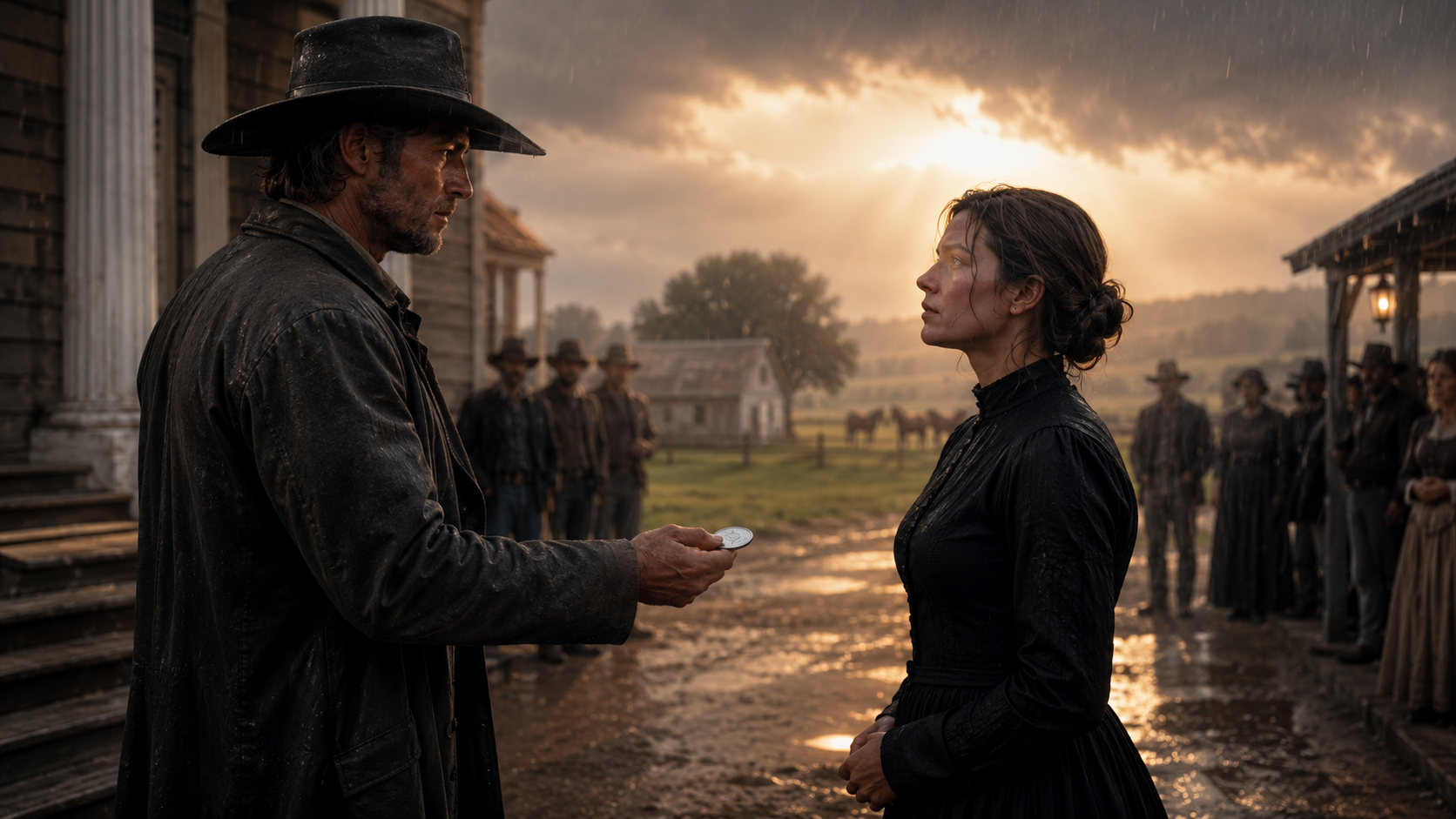
He held out his hand.
In his palm lay a single silver dollar.
“This belongs to you,” he said.
Mara looked from the coin to his face. “You paid it to the court.”
“I paid the court to end the bidding. I did not buy you.”
“That may be a distinction only you can afford.”
His expression did not change, but something in his eyes moved. Not pity. She could not have borne pity.
Respect, perhaps.
“Then keep the dollar,” he said. “You may need proof someday that the bargain was never you.”
She took the coin because refusing it would have looked like weakness.
Outside, rain fell in silver ropes. Silas brought a wagon around himself. No driver. No servant. Just the giant cowboy, holding the reins while the town watched from under awnings and courthouse eaves.
He helped her climb in without touching more than her sleeve.
As they rolled away, Mara heard a woman say, “Poor thing. Bought by a monster.”
Mara looked straight ahead.
Silas heard it too.
He said nothing.
Black Lark Ranch lay twelve miles west of Mercy Creek, where the land opened into long grass, red stone, and sky so wide it made a person feel exposed. The ranch house stood on a rise above Cotton Hollow, built from dark timber and pale limestone, broad-porched and severe. It looked less like a home than a decision no storm had ever managed to change.
Silas stopped the wagon before the porch.
“You’ll have your own room,” he said.
Mara turned toward him. “And your expectations?”
“My expectation is that you eat supper and sleep behind a locked door if that makes you feel safer.”
She studied him carefully. “Men rarely purchase women in public and then ask what makes them feel safe.”
“I told you. I purchased paper.”
“And if the paper says I am your wife?”
His mouth tightened. “Then the paper is wrong until you say otherwise.”
That answer unsettled her more than cruelty would have.
A plump woman with silver threads in her black hair came out onto the porch, wiping her hands on an apron. She had sharp eyes, kind cheeks, and the posture of someone who had survived enough to be impressed by very little.
“This is Mrs. Ortega,” Silas said. “She manages the kitchen and most of us when we’re foolish.”
Mrs. Ortega looked Mara over once, then smiled. “You must be frozen through. Come inside before the rain turns you into soup.”
Mara almost smiled back. Almost.
Inside, the house smelled of coffee, woodsmoke, leather, and loneliness. The rooms were clean but bare. Chairs lined walls as if waiting for guests who never came. The dining table could seat fourteen, but only one place was set.
Mara noticed everything.
Silas noticed that she noticed.
At supper, he sat across from her, not at the head of the table. Mrs. Ortega served beef stew, bread, and coffee so strong it seemed to have a temper.
Mara took one sip and coughed.
Mrs. Ortega’s mouth twitched.
Silas looked concerned. “Is it spoiled?”
“No,” Mara said, setting the cup down. “It is simply trying to kill me.”
For one second, silence held.
Then Mrs. Ortega laughed into her apron.
Silas stared at Mara as though she had performed a magic trick. The corner of his mouth moved, not quite a smile, but close enough to change his whole face.
After supper, he walked her to a room at the end of the hall. It held a bed, a washstand, a trunk, a small stove, and a window facing the cottonwoods.
“There’s a key on the inside,” he said.
Mara stepped in and turned back. “Why did you bid?”
Silas’s gaze dropped briefly to the floorboards.
“I needed a wife.”
“For an heir?”
“Yes.”
The honest answer struck harder than any polite lie.
Mara lifted her chin. “Then you chose poorly.”
“I know what people say.”
“People say it because it is true. Three years married. No child. Edwin made certain everyone knew whose fault it was.”
Silas’s eyes narrowed slightly. “Did a doctor tell you that?”
“My husband told me.”
“That is not the same thing.”
She had no answer to that.
Silas stepped back. “Sleep, Mrs. Bellamy.”
“Crowe, I suppose.”
“Only if you want the name.”
He left her standing in the doorway with a key in her hand and a silver dollar hidden in her fist.
The first weeks at Black Lark were not tender. They were stranger than that.
They were useful.
Mara rose before dawn because habit did not know she was supposed to be ruined. She found the pantry in confusion, the household accounts neglected, the linen supplies overcounted, the lamp oil overpriced, and three barrels of flour stored too close to damp stone. She discovered that a merchant in Mercy Creek had been charging Silas nearly double for coffee because Silas paid bills without reading them if the total looked plausible. She found two hired girls doing the work of five, not because Silas was cruel, but because no one had ever explained to him that fair wages did not matter if the work itself was unfairly divided.
On the sixth morning, she entered his office without knocking.
He looked up from a cattle ledger. “That room is private.”
“So is bankruptcy,” she said. “But if you keep managing household expenses like this, you will meet it publicly.”
He leaned back.
Most men would have shouted. Silas did not. He looked at the papers in her hand and then at her face.
“Come in.”
Mara laid her notes on his desk.
“You are being cheated by the coffee merchant, the lamp oil supplier, and possibly the man who sells you nails. The pantry roof leaks. The smokehouse door does not seal. Your cook is excellent, but she has been stretching poor supplies to hide waste. The laundry girls need a schedule. The north chimney needs cleaning before it burns your roof. Also, one of your ranch hands is stealing sugar.”
Silas picked up the first page. His eyebrows drew together.
“You found this in six days?”
“I was angry.”
He looked up.
“That helps me concentrate,” she added.
A sound came out of him then. Rough. Surprised. Rusty from disuse.
A laugh.
Mara looked away before he could see how much it startled her.
Silas read every page.
When he finished, he said, “The house is yours.”
“No.”
His brow lifted.
“The work is mine if I choose it. The responsibility may become mine. But do not hand me a house as if it is a basket of mending. Ownership is a different word.”
Silas studied her for a long moment.
“You care about words.”
“I care about what men hide inside them.”
After that, he stopped calling household matters “inside work.” He called them operations. When ranch hands smirked, he stared until they remembered something urgent elsewhere.
By Christmas, Black Lark no longer felt like a house holding its breath.
Curtains were washed. Floors shone. The pantry ran like a small army. Meals improved enough that men began finding reasons to linger near the kitchen door. Mrs. Ortega hummed when she baked. The hired girls laughed again. Even Silas changed in small ways. He wiped his boots before crossing Mara’s clean floors. He sent receipts to her desk without being asked. He stopped drinking coffee as though suffering were proof of manhood after Mara taught Mrs. Ortega to make a second pot that did not taste like boiled horseshoes.
Yet they slept in separate rooms.
The question of children remained between them like a locked gate.
One January night, snow came hard against the windows. Mara woke to the sound of movement in the yard and found Silas in the barn, brushing a restless mare by lantern light.
The horse trembled at every gust.
Silas murmured to her in a voice so low Mara could not hear the words, only the gentleness.
“You avoid the house after supper,” Mara said.
The brush paused.
Silas did not turn. “Do I?”
“Yes.”
“Maybe I prefer horses.”
“Horses do not ask why a man who needs an heir refuses to touch his wife.”
The mare shifted nervously. Silas laid one big hand along her neck until she quieted.
“I told you I would not force anything.”
“I believed you. That is not what I asked.”
His shoulders rose and fell once.
“Edwin told the town I was barren,” Mara said. “You told me a husband’s word is not a doctor’s verdict. Why?”
Silas finally looked at her.
Because I knew Edwin Bellamy.”
Mara went still.
Silas’s jaw hardened. “He came to Black Lark once, years ago, drunk enough to mistake boasting for conversation. He said a wife who could not give him sons was useful for blame. Then he laughed and said the doctor had told him after a fever in his youth that he would likely never father a child. He made me promise nothing. I promised nothing. But I remembered.”
The barn seemed to tilt around her.
Mara gripped the edge of a stall door. “You knew?”
“I knew there was a chance the shame was never yours.”
“And you said nothing?”
“It was not mine to throw into the street.”
“Not yours?” Her voice shook now. “My life was buried under that lie.”
“I know.”
“You know?” She stepped closer, anger hot enough to keep out the cold. “The town spat that word at me. Barren. Empty. Useless. Edwin let them. His creditors used it to price me. And you knew?”
Silas took the blow of her words without defense.
“Yes.”
“Why bid, then? Pity?”
“No.”
“Then why?”
His eyes were dark in the lantern light.
“Because when the auctioneer dropped the price to five dollars, every man in that room looked at you as if the world had permission to finish breaking you. I had spent years letting people believe lies about me because those lies kept greedy fathers from sending daughters to my door. I knew what it meant to stand inside a story you did not choose.”
Mara swallowed.
He continued quietly. “I paid one dollar because twenty sounded like purchase. One sounded like interruption.”
She wanted to stay angry. Some part of her did remain angry, and would for a long time. But beneath it something else moved.
Pain recognizing pain.
“People say you buried two wives,” she said.
Silas looked toward the storm-dark doors.
“Elise died of fever before our first anniversary. She was eighteen and frightened of everything, including me. I was too young and too clumsy to know how to comfort her. Marianne married me for land and hated every acre of it. She left with a cardsharp from Denver after seven months. Folks prefer saying I buried two wives. It makes me sound more interesting.”
“So only one died.”
“Only one.”
“And you let people call you a monster.”
“It kept certain people away.”
Mara studied him.
The giant of Black Lark. The cursed widower. The man who had carried a lie because correcting it would invite another kind of trouble.
“You are foolish,” she said.
A faint smile touched his mouth. “Mrs. Crowe, I have been called worse.”
“I have not decided to be Mrs. Crowe.”
“No.”
“But if I do decide…” She took a breath. “It will not be because you need an heir.”
Silas’s voice roughened. “Then why?”
“Because I am tired of being a grave for other people’s lies.”
The mare blew softly between them.
Silas stepped back, giving her room though she had moved toward him.
“If you ever come to me,” he said, “and change your mind afterward, you walk away. No apology. No explanation.”
Mara looked at the scar across his face, the careful distance in his body, the big hands that had gentled a frightened horse at midnight.
“If I come to you,” she said, “I will already know my mind.”
She came to him three nights later.
Their first tenderness was not like the songs. It had pauses in it. Questions. Awkward laughter. Silas asked before every touch, and Mara answered honestly. They were not suddenly healed. People did not become whole because a door opened between two bedrooms.
But something began.
A marriage, perhaps.
Not the paper kind.
The living kind.
In spring, Mara missed her courses.
For three weeks, she told no one. Hope was a dangerous animal. If fed too early, it could turn and bite.
But the signs gathered. Morning sickness. Heavy sleep. The strange bright ache beneath her ribs. Finally she sat across from Silas at the kitchen table while Mrs. Ortega kneaded bread nearby.
“I believe I am carrying a child,” Mara said.
Silas froze.
Mrs. Ortega’s hands stopped in the dough.
Mara tried to smile. “This is the part where a husband usually says something.”
Silas stood so fast the chair scraped backward.
“I’ll get Dr. Harlow.”
“Silas, he is thirty miles away.”
“I have fast horses.”
“It is early.”
“Elise died of fever.”
“I am not Elise.”
The words were firm but not cruel.
Silas stopped. His face had gone pale beneath the tan.
Mara reached across the table. “I need you happy, not haunted.”
He looked at her hand. Slowly, he covered it with his own.
“I am happy,” he said. “So happy I don’t know where to put it.”
Their first son, Elias, was born in November during a windstorm that rattled every window in Black Lark. Labor lasted eighteen hours. Silas, who could face a charging bull without flinching, spent half the night on his knees outside the bedroom door until Mara demanded he be brought in because his praying was louder than her groaning.
When the baby finally cried, Dr. Harlow laughed.
“A boy,” he said. “Strong as a church bell.”
Mara, exhausted and damp with sweat, looked at Silas. “There is your heir, Mr. Crowe.”
Silas came to the bedside.
But he did not look first at the child.
He looked at her.
“There is my wife,” he said. “Alive. That is the miracle.”
Mara wept then, not because she had given him a son, but because for the first time in her life a man valued her more than what her body could prove.
Mercy Creek did not allow happiness to pass untaxed.
The whispers began before Mara could comfortably walk to the porch.
“Too soon.”
“She must have been carrying before the auction.”
“Barren women do not bloom that fast unless they lied first.”
Silas wanted to settle the matter with his fists.
Mara forbade it.
“You cannot beat gossip dead,” she told him.
“I can make it limp.”
“You can make it louder.”
So Mara did something harder.
She went into town.
She carried Elias to church. She attended sewing circles. She brought broth to sick neighbors. She corrected the church accounts so politely that the treasurer thanked her before realizing she had uncovered two years of missing coins. She did not beg for kindness. She simply became too useful to dismiss.
Some women softened. Some did not.
The worst was Lavinia Pike, daughter of a railroad investor and once hopeful that Silas might marry her for her father’s money. At a spring picnic, Lavinia approached Mara while half the town listened.
“I admire your courage,” Lavinia said sweetly. “Most women bought at auction would hide themselves.”
Mara shifted Elias higher on her hip.
“I admire your confidence,” she replied. “Most women with manners that poor would try to speak less in public.”
The silence afterward was a thing of beauty.
Then Mrs. Ortega laughed so loudly she spilled lemonade on the mayor’s shoes.
By supper, half the town had repeated Mara’s answer.
That evening Silas looked at her across the porch and said, “You are a dangerous woman.”
“No,” Mara said. “Only properly rested.”
The second time Silas called her dangerous came two years later, when she saved Black Lark Ranch.
A dry summer burned the grass down to yellow wire. Cattle prices fell. A sickness moved through the southern herd and took forty-seven head in nine days. Silas worked from before dawn until after midnight, trying to hold disaster back with muscle and stubbornness.
Mara watched him become hollow-eyed.
One night she brought ledgers into his office and laid them open.
“You must sell part of the herd now.”
“No.”
“You will lose more if you wait.”
“I said no.”
“And I heard fear pretending to be judgment.”
His eyes flashed. “This ranch was standing before you came here.”
“It may not stand long after if you confuse pride with strategy.”
He slammed one hand on the desk hard enough to jump the ink bottle. “You think I don’t know cattle?”
“I think you know cattle so well you cannot bear to admit the land is telling you no.”
That struck.
Silas looked away.
Mara softened her voice. “Sell the weakest third before every desperate rancher tries to do the same. Keep the best breeding stock. Use the money for hay before the price doubles. The men will complain. Let them. Better a smaller herd alive in March than a grand herd dead in January.”
He resisted for four days.
Then he did exactly as she said.
That winter ruined three neighboring ranches.
Black Lark survived.
In April, Silas placed a folded deed beside Mara’s breakfast plate.
She opened it and stared.
“What is this?”
“Three hundred acres along Cotton Hollow.”
“In whose name?”
“Yours.”
Her fork slipped from her hand.
“Silas.”
“You saved this place. You manage the house. You read numbers clearer than any man I’ve hired. You advised the herd sale that kept us alive. Yet the law says everything here is mine because I am the husband. I can’t fix the law. I can fix that deed.”
Mara touched the paper with shaking fingers.
“People will say I bewitched you.”
“People say I killed two wives, you tricked me with a child, Elias was born too soon, and Mrs. Ortega uses too much cinnamon. People are unreliable.”
“You don’t understand what this means.”
“Yes, I do.”
“No,” she whispered. “You don’t. I have belonged to a father, then a husband, then creditors, then public opinion. I have never had land belong to me.”
Silas came around the table and knelt beside her chair, huge and humble.
“Then start with Cotton Hollow.”
Their second pregnancy came that summer.
Then came the surprise.
Twins.
Bennett and Amos were born during a thunderstorm. Bennett came into the world howling. Amos arrived silent until Dr. Harlow gave him one sharp tap, at which point he objected to existence with admirable fury. Mara laughed and cried at the same time. Silas walked into the hall afterward looking so pale Mrs. Ortega shoved him into a chair and ordered him to put his head between his knees.
“Three sons,” Dr. Harlow said. “That ought to satisfy any rancher alive.”
Silas, holding both twins badly while little Elias tried to climb his boot, looked at Mara.
“Only if it satisfies their mother.”
Mara thought three children would be the shape of their family.
Life had other arithmetic.
Two years later came Willa, with Mara’s gray eyes and Silas’s solemn stare. The town women brought pink quilts and foolish advice. Silas ignored most of it and carried his daughter around the ranch as though she were a visiting queen.
“Girls don’t need to inspect cattle,” an old hand joked.
Silas looked down at Willa asleep against his chest.
“Then cattle should behave without supervision.”
By their sixth anniversary, Black Lark was no longer spoken of merely as Silas Crowe’s ranch. People had begun saying “the Crowe place,” then “Mara Crowe’s office,” and finally, among merchants who had learned caution, “Do not cheat that woman unless you enjoy losing money in public.”
Mara turned Cotton Hollow into a horse program. Silas understood strength. Mara understood temperament. Together they bred horses that could work long days, carry nervous riders, learn fast, and keep their heads in storms. Buyers came from three territories. Men who had once laughed at the dollar widow now stood in her yard asking her price.
Mara gave it without apology.
Trouble came wearing a polished smile and a white hat.
His name was Roland Vane, owner of a rival spread east of Mercy Creek. He wanted Silas’s water rights. Silas refused to sell. Roland tried charm on Mara.
“You understand business,” he told her at the county fair. “A woman with influence over her husband could make him see reason.”
Mara looked at him over a glass of lemonade.
“Men who praise a woman’s influence usually hope she is vain enough to be useful.”
Roland’s smile cooled.
A month later, three of Mara’s best mares vanished.
Silas was away buying bulls in Kansas. The sheriff shrugged and said horses wandered. Mara knew better. She followed the tracks herself with Silas’s foreman, Abel Knox, and found the mares hidden in a canyon on Roland’s land, their brands altered so badly the wounds still bled.
Roland produced a bill of sale bearing Silas’s signature.
The signature was good.
Too good.
Mara studied it in the sheriff’s office and felt cold certainty settle inside her.
“This was copied from our bank papers,” she said.
Roland smiled. “Careful, Mrs. Crowe. Accusing a man of forgery is serious.”
“So is stealing from me.”
“From your husband,” Roland corrected.
The room went quiet.
Mara turned to the sheriff. “The mares were purchased with income from land deeded to me. Their records are signed by me. Their breeding contracts are signed by me. Mr. Vane has not stolen from my husband. He has stolen from me.”
The case went to court.
By then Mara was pregnant again.
She stood before twelve male jurors with her belly round beneath a dark blue dress while Roland’s attorney tried to turn theft into comedy.
“Gentlemen,” he said, pacing dramatically, “we are asked to believe that a woman, one acquired through a courthouse bargain, understands bloodlines, contracts, and branding marks better than an established rancher.”
Silas sat behind Mara, silent and furious enough to frighten the lamps.
Mara did not look back.
When she took the stand, the attorney asked, “Mrs. Crowe, are you truly asking this jury to believe you know more about horseflesh than Mr. Vane?”
“No,” Mara said. “I am asking them to read.”
A ripple moved through the courtroom.
She opened her ledger.
“These are the purchase records. These are the breeding notes. These are the veterinary descriptions of each mare, including old scars Mr. Vane’s men failed to cover with fresh brands. This is the bank document from which my husband’s signature was copied. You can see the same hesitation in the lower loop, because the forger copied not only the shape but the flaw.”
The attorney reddened. “You expect simple men to follow all that?”
“I expect honest men not to pretend confusion because the explanation comes from a woman.”
The jury found for Mara in less than an hour.
Roland Vane was fined, disgraced, and later charged after one of his own men confessed.
Outside the courthouse, in front of half the town, Silas took Mara’s hand.
“You saved us again,” he said.
“No,” she answered. “I saved what was mine.”
His smile was slow, proud, and bright enough to shame every whisper that had ever followed her.
Two months later, Mara delivered twin girls: Rose and Clara.
Six children filled the once-silent house.
Elias was serious and protective. Bennett was loud enough for three boys. Amos watched everything before speaking. Willa climbed fences faster than ranch hands could build them. Rose and Clara screamed if anyone dared separate them for longer than a minute.
Silas loved them with an intensity that bewildered those who had feared him. He still looked like a man who could bend iron, but Willa tied ribbons in his beard, the twins slept on his chest while he read cattle reports, and Elias once convinced him to attend a tea party with a wooden rifle as his guest.
Mara would pause in doorways and watch the giant cowboy softened by small hands.
Sometimes love arrived like lightning.
Sometimes it grew like grass after rain, quietly covering every scar in the ground.
The seventh child nearly cost them everything.
Mara was thirty-five when she realized she was carrying again. Eight years had passed since the courthouse. She had six healthy children, a thriving ranch, land in her own name, and a marriage that had become the spine of her life.
This time, when she told Silas, he did not smile.
He sat down heavily.
“Mara.”
“I know.”
“Dr. Harlow warned after the twins.”
“I know.”
“You nearly bled to death.”
“I know that too.”
His face looked older than it had that morning. “I cannot lose you.”
She crossed the room and took his face in her hands.
“You do not get to decide the future by fear.”
“No,” he said. “But I get to be afraid.”
“Yes.” She kissed his forehead. “You do.”
The pregnancy was hard from the start.
Mara tired easily. Her back ached. Dr. Harlow visited every two weeks and wore a cheerful expression that fooled no one. Silas reduced her work without asking. Mara fought him until she found Elias standing outside her office with tears in his eyes.
“Pa says you need rest,” he said. “But you won’t rest because you think resting means losing.”
Mara lowered the ledger she had been pretending to read.
“Did your father say that?”
“No,” Elias said. “I thought it myself.”
Behind him, Willa hugged a rag doll and nodded gravely. “If you die, Mama, I’ll be very angry.”
Mara laughed and cried at once.
After that, she rested.
The baby came during the first snow of November, eight years almost to the day after Elias’s birth. Labor began before dawn. By noon it had worsened. By evening Mara was feverish, exhausted, and losing strength.
Dr. Harlow tried to send Silas out.
“No,” Mara gasped. “He stays.”
So he stayed.
He held her hand while she cursed him, prayed with her when she trembled, and pressed his forehead to hers when she whispered, “I can’t.”
“You can,” he said, his voice breaking. “Not because I need another child. Not because of my name. Because you are Mara Crowe, and pain has never been the strongest thing in any room where you stood.”
The final push tore a scream from her.
Then a baby cried.
A girl.
Small, furious, alive.
Dr. Harlow moved quickly. Too quickly. Mrs. Ortega went pale. Silas saw blood on the sheets and fear in the doctor’s eyes.
Mara saw it too.
“Name her,” she whispered.
Silas shook his head. “You will name her when you are stronger.”
“Name her.”
He bent over her, terror stripping him bare.
“Mercy,” he said. “Her name is Mercy.”
Mara’s eyes filled.
“Good.”
Then she fainted.
For two days, Black Lark held its breath.
The children were kept quiet. Ranch hands removed their hats when passing the bedroom door. Mrs. Ortega prayed in Spanish and scolded God in English. Silas did not sleep. He sat beside Mara’s bed holding her hand, bargaining with heaven like a man trying to buy back the sun.
On the third morning, Mara opened her eyes.
“You look awful,” she whispered.
Silas made a sound that was half laugh, half sob.
“You scared ten years off my life.”
“Then we are closer in age now.”
He kissed her hand, her wrist, her forehead.
“No more children,” he said. “Seven is more than any man deserves. More than I deserve. I once thought legacy meant blood carrying my name. I was a fool.”
Mara watched him through tired eyes.
“What does it mean now?”
Silas looked toward the hallway, where six children were failing to whisper while waiting for news of the seventh.
“It means what we teach them. How we treat people. What we build that outlives our pride.”
Mara smiled faintly. “You have become wise, Mr. Crowe.”
“No,” he said. “I married well.”
Mercy lived.
Mara lived.
And the story of the barren widow who gave the giant cowboy seven children traveled faster than any horse Black Lark ever bred.
People told it badly, of course.
They said Silas bought Mara for one dollar and she repaid him with sons and daughters. They said motherhood proved she had value after all. They said the giant cowboy had known what he was doing when he chose her.
Mara hated that version.
So when a newspaper reporter came from Cheyenne in 1902 to write about the famous Crowe family, she told the truth.
“I was never worthless,” Mara said, sitting in her parlor while the young reporter tried to keep his pencil steady. “Not before children. Not before marriage. Not when men laughed at me in the courthouse. My value did not begin when my body became useful to someone else.”
The reporter blinked and wrote quickly.
“Then what did the dollar buy?” he asked.
Mara looked out the window.
Elias was helping Silas repair a gate. Bennett and Amos were arguing over a rope. Willa was riding too fast while Rose and Clara shouted encouragement from the fence. Mrs. Ortega rocked baby Mercy on the porch and threatened all of them with soup if they tracked mud into her kitchen.
“The dollar bought a pause,” Mara said. “That is all. A pause in cruelty. A chance to stand somewhere safe. Silas gave me that chance. I gave him one too. Everything after that, we had to build.”
“And the seven children?”
Mara smiled.
“They are not proof that I was valuable. They are proof that life can be generous when two people stop treating each other like bargains and start treating each other like souls.”
The reporter printed almost all of it.
By then, Silas had placed half the horse program in Mara’s name. Worker housing had expanded. A school fund had been created for the children of ranch hands. Mara taught bookkeeping, livestock records, and contract reading to women every other Saturday. Some came secretly at first, claiming they wanted Mrs. Ortega’s recipes. Within a year, their husbands stopped objecting because the women who attended stopped being easy to cheat.
Black Lark became more than a ranch.
It became a place where competence mattered more than birth, where girls learned numbers beside boys, where hired men were paid on time, where widows found work, where no one used the word barren as an insult twice.
Years later, when Silas’s beard had gone silver and Mara’s hair had softened white at the temples, they stood together on the hill above Cotton Hollow and watched their children scatter into lives neither could have imagined.
Elias took over cattle operations with calm authority. Bennett became a horse trader with too much charm and just enough honesty. Amos studied law after watching his mother face Roland Vane in court. Willa ran the horse program better than either parent had dared hope. Rose became a teacher. Clara trained as a nurse. Mercy, the child born from fear and named in desperation, became a writer who told the family story without polishing away its pain.
On Silas and Mara’s thirtieth anniversary, the children held a celebration at Black Lark. Lanterns hung from the cottonwoods. Music drifted across the yard. Grandchildren ran between boots and skirts. Mrs. Ortega declared the cake inferior to hers and then ate two pieces.
Elias stood to give a toast.
“Our parents began with one dollar,” he said, raising his glass. “But they taught us never to measure worth by price. They taught us partnership, courage, work, fairness, and the importance of listening when Mama says the numbers are wrong.”
Laughter rolled through the yard.
Silas leaned toward Mara. “He forgot stubbornness.”
“He inherited that from you.”
“From both of us, I think.”
Later, when the music softened and the children were busy with their own families, Silas and Mara walked to the barn where their life together had truly begun.
The old mare from that first winter was long gone, but Mara still remembered the smell of hay, the storm wind pressing against the walls, and the giant cowboy admitting he did not know how to be gentle.
“You once told me you saw a man calming a frightened horse at midnight,” Silas said.
“I did.”
“What do you see now?”
Mara looked at him.
The giant cowboy. The cursed widower. The man who had paid one dollar not to own her, but to stop the room from devouring her. The man who had learned that strength without tenderness was just another kind of fear.
“I see the best dollar I ever accepted,” she said.
Silas smiled. “That was supposed to be my line.”
“You bought the paper,” Mara said. “I bought the future.”
He took her hand, the same way he had outside the courthouse all those years ago. Only now there was no auctioneer, no crowd, no shame. Just two old fools standing in a barn where fear had become trust, and trust had deepened into love.
“Do you regret any of it?” he asked.
Mara leaned against him.
“The humiliation? Yes. The pain? Sometimes. The gossip? Often.” She looked up at him. “But you? Never.”
He bent and kissed her, still careful after all these years, still asking without words.
The silver dollar itself had disappeared long ago. Mara had spent it the week after their wedding on paper, ink, and a proper household ledger. Silas used to tease her for that until she reminded him that the first thing their marriage bought was accurate accounting.
But what came from that dollar remained everywhere.
In the house that no longer echoed.
In the ranch that outlived its founder.
In daughters who refused small lives.
In sons who learned fairness from a mother the world had priced at nothing.
In every woman who sat at Mara’s table and discovered that knowledge could be a key.
And in the quiet truth Silas and Mara proved together:
A person’s value is never decided by the cruelest room they have stood in.
Sometimes the world calls a woman barren because it cannot imagine what she is capable of growing.
Sometimes a lonely man thinks he needs an heir and instead finds a partner.
Sometimes one dollar becomes seven children, a home full of noise, a business built on respect, and a legacy large enough to shame every man who laughed when the bidding stopped.
Mara Bellamy had stood on a courthouse platform with a number tied to her wrist.
She left with a coin in her palm.
But she was never the bargain.
She was the fortune.

