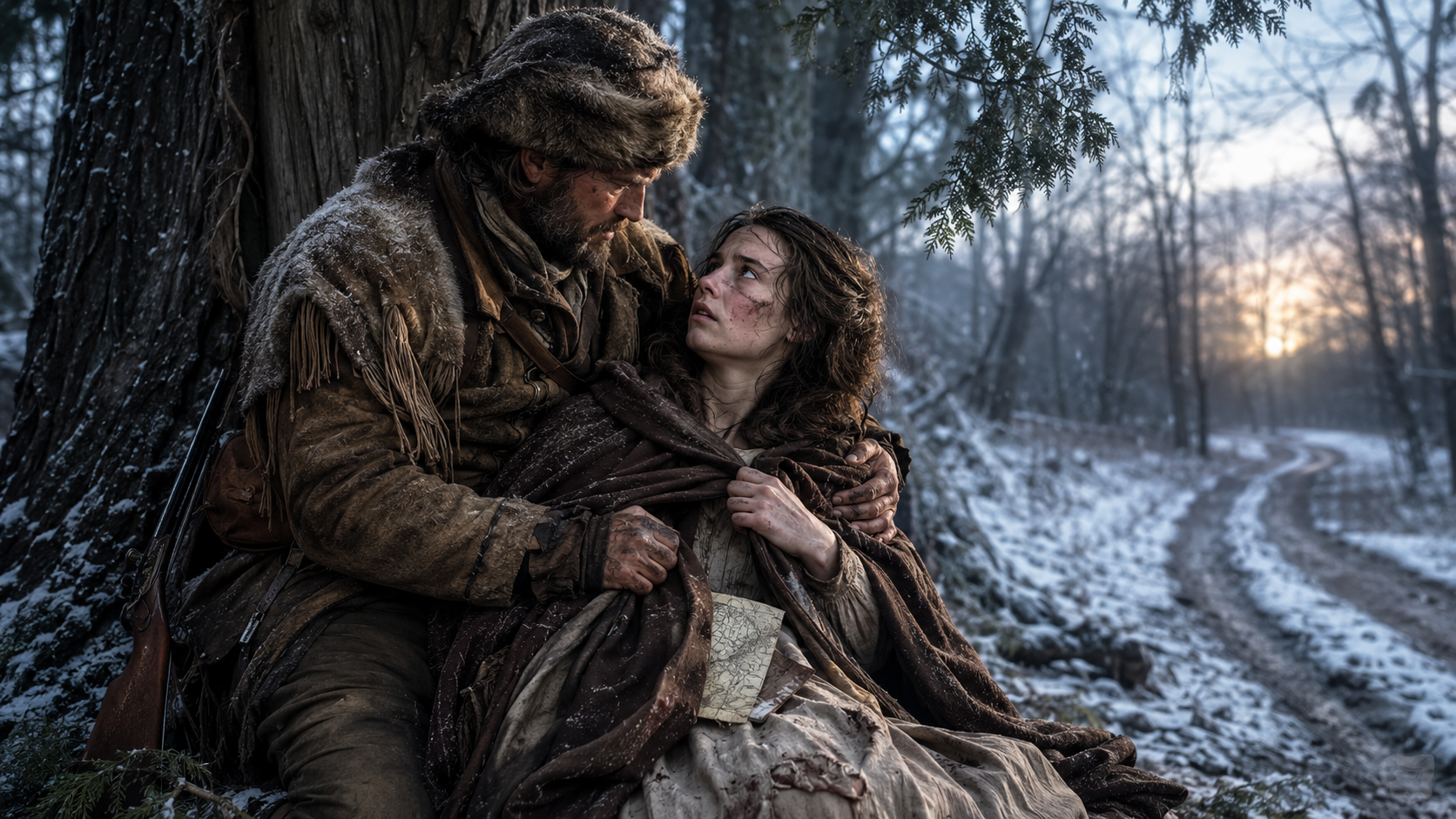
The Mountain Man Found Her Freezing by the Natchez Trace — Then the Map Sewn in Her Cloak Destroyed the Man Who Cast Her Out

“Suitable for him?”

The words slipped from Marian Bellamy’s mouth before she could fold them back behind her teeth.

Her father stopped cutting his ham.

Across the long breakfast table, Lucius Bellamy lifted his pale eyes with the slow patience of a man who had made obedience the weather inside his house. The morning light came through the tall windows behind him, turning the silver coffee service bright enough to hurt. Everything at Bellamy Oaks shone. The floors, the knives, the buckles on her father’s shoes, the brass on the mantel. It was a house polished so fiercely that a stranger might mistake shine for goodness.

Marian had stopped making that mistake years ago.

Everett Kane, seated beside her father, smiled over the rim of his cup.

He was not handsome, though he behaved as if the world owed him the word. He wore a gray coat too fine for breakfast and gloves he had removed only after making sure everyone noticed how clean they were. His money came from trade along the river, from warehouses, debts, transport contracts, and arrangements polite men discussed with lowered voices.

Her father had invited him to breakfast for one reason.

Marian was twenty-two, unmarried, and inconvenient.

Kane had offered to make her convenient.

Lucius set down his knife. “You asked a question.”

Marian’s hands tightened in her lap. “I asked whether I was suitable for Mr. Kane.”

A servant near the sideboard went very still.

Marian hated that she had noticed. She hated that everyone in the house had been trained to measure danger by the small changes in her father’s breathing.

Kane chuckled. “A woman with spirit is not unsuitable.”

“A woman with spirit,” Lucius said, “is often merely a woman indulged too long.”

Marian looked at the white tablecloth, then at the door, then back at her father. She was tall, broad-shouldered, and heavier than the ladies her father admired in other people’s parlors. He spoke of her body as if it were a debt he had been forced to carry. Too large, too slow, too stubborn, too fond of books, too inclined to question what men of property called order.

Her mother had once told her that a soul needed a room of its own.

Lucius had spent ten years making sure Marian’s soul had nowhere to sit.

“After breakfast,” he said, “you will remain in the front parlor until I send for you.”

Marian lowered her eyes. “Yes, Father.”

She remained in the parlor for eleven minutes.

Then she went to his study.

It was not the first time she had taken his keys.

Lonely daughters learned what servants already knew: which stairs complained, which locks stuck, which men believed themselves too feared to be robbed under their own roof. Lucius kept his iron safe for show. The papers he touched most often were in the second drawer of his desk, beneath a false bottom that lifted if one pressed the brass nail on the left corner.

Marian pressed it.

The drawer sighed open.

She found letters first. Then receipts. Then a ledger bound in cracked brown leather. She opened it because she already knew she would regret not opening it.

Names filled the pages.

Not names as a mother would speak them. Not names as God might hear them. Names reduced to ages, labor, scars, skills, prices, risks.

Josiah Reed, twenty-six. Stable hand. Reads? Watchful. Strong.

Marian stared at the question mark after “Reads” until the ink blurred.

Josiah rarely spoke to her. He worked in the stable, repaired harnesses, calmed horses with a quietness that made other people’s voices seem careless. Once, two winters before, she had seen him in the hayloft holding a torn newspaper close to the light. He had not held it like stolen property. He had held it like bread.

She had not told.

At the time, she had been foolish enough to call that mercy.

Now the ledger made the word feel thin.

She turned another page.

Nell Reed, seventeen. Field and kitchen. Compliant. Saleable.

Marian pressed her fist against her mouth.

Nell was Josiah’s sister. She had a laugh like a match struck in a dark room, quick and bright and immediately hidden. Marian had heard that laugh once behind the washhouse before the overseer came around the corner and swallowed it whole.

Beneath the ledger lay a folded letter.

Everett Kane’s handwriting slanted with expensive confidence.

The nine are to be ready before first light on Friday. Cutter will take them along the lower trace until the second creek, then south by the old stand. Avoid the chapel road. Questions have begun there. Payment on delivery. No delay.

Marian found the route sketch tucked inside.

For one breath, the room disappeared.

There was only paper.

A line of road. A creek. A crossing. A stand of black walnut trees. A mark for the patrol cabin. Nine small crosses that meant nine living souls would be chained and taken south before dawn Friday.

She thought of all the books she had hidden beneath her mattress. All the pamphlets she had read by candlelight. All the private disgust she had mistaken for courage.

The shame of it nearly bent her in half.

Then she saw another page.

A note in her father’s own hand: Reed woman, Amara. Manumission irregularity unresolved. Keep buried. Children not to be separated until sale necessary.

Amara Reed.

Josiah’s mother.

Marian had heard whispers that Amara had been sold when Josiah was a boy. Everyone had been told it. Josiah had been told it. Nell had grown up with it. Their mother had vanished into a sentence, and the sentence had become the truth because Lucius Bellamy had spoken it.

But this paper said otherwise.

This paper said a claim to freedom had existed.

This paper said her father had known.

Marian’s hands shook as she copied the map. She copied the note about Amara. She tore out two ledger pages, then three more, then forced herself to stop before the missing thickness became obvious.

At the bottom of her copied route, she wrote the only instruction she had ever seen in a letter passed through an old Quaker woman’s book years before.

Ask for Anna at Galloway Ridge.

She did not know whether Anna existed.

She did not know whether Galloway Ridge was still safe.

She did not know whether Josiah would trust the daughter of the man who claimed his life on paper.

She knew only that doing nothing had become a kind of death.

That night, rain came hard.

Lucius rode to Natchez to meet creditors. Everett Kane left after supper with promises to return before the week was out. Rafe Cutter, the overseer, drank in his cabin when weather turned mean. Bellamy Oaks settled into its usual silence, the silence visitors praised because they did not understand that terror could look very much like peace.

Marian put on her darkest cloak.

She sewed the copied map and the torn ledger pages into the lining with ugly, hurried stitches. Then she went to the stable.

Josiah was repairing a bridle by lantern light.

He looked up before she reached the door. The first thing she saw in his face was fear. Not for himself alone. Fear of what a white woman’s presence could become if anyone chose to make a story of it.

“Stop there,” he said.

Marian stopped.

Good, she thought. Learn quickly.

“I found something,” she whispered.

“Then take it back.”

“It concerns Nell.”

His expression changed by almost nothing. But almost nothing, in a man as guarded as Josiah, was enough.

“Say it and leave.”

Marian crossed no closer. She laid the folded paper on an overturned feed crate and stepped back.

“My father is selling nine people through Everett Kane before dawn Friday. Nell is one of them. You are too. I copied the route.”

Josiah did not move.

Rain ticked on the stable roof.

At last he came forward just far enough to look at the paper. His eyes passed over the lines once, then again. He picked up a bit of charcoal and drew a hard mark through one crossing.

“This creek is wrong.”

“You know the road?”

“I know every place a man can hide long enough to breathe, and every place he cannot.”

The answer had no drama in it. That made it worse.

He corrected three places on the map. A patrol road. A washed-out bridge. A low field where dogs could follow scent even after rain.

“Cutter drinks on rainy nights,” Josiah said. “But dogs don’t. If anyone runs, it must be before moonset. Split at the walnut stand. Children go with Mara Pike. Old Ben takes the east hollow. Nell—”

His voice stopped.

Marian looked at him.

“She is seventeen,” Marian said softly.

Josiah’s eyes cut to hers. “Your father’s book says that?”

“Yes.”

“His book makes her sound like a mule.”

“I know.”

“No.” His voice sharpened. “You read it. That is not knowing.”

The words struck where they deserved to.

Marian nodded. “You are right.”

That surprised him more than denial would have.

He folded the map and held it out.

“You take this.”

“I thought you needed it.”

“I have it now.”

“You memorized it?”

His gaze hardened. “Do not praise me for learning what I had to learn to stay alive.”

Her face burned. “Forgive me.”

“If you mean that, listen.” Josiah stepped back. “You do not speak to Nell. You do not come to the quarters. You do not cry at breakfast. You do not make yourself the center of what happens next. You brought paper. That is all. If this works, we carry ourselves. If it fails, we pay. Understand?”

Marian swallowed. “I understand.”

“No. But maybe you can obey.”

“Yes.”

“And if they ask you anything?”

“I will lie.”

“Can you?”

Marian thought of her father’s eyes. Everett Kane’s gloves. Rafe Cutter’s grin.

“Yes,” she said. “I have lived in this house all my life.”

Josiah studied her.

Then he nodded once.

“Go.”

She went.

But fear leaves tracks inside a house. Bessie, one of the kitchen women, noticed mud on Marian’s hem. She said nothing. But Cutter noticed Bessie noticing. By noon the next day, he was asking questions with a smile that meant someone would suffer if he became bored.

By Thursday afternoon, Josiah was dragged into the yard.

Everyone was made to watch.

The enslaved men, women, and children of Bellamy Oaks stood in two ragged lines beneath a sky the color of old iron. Marian watched from the upstairs balcony, her fingers locked around the rail. Her father had returned from Natchez in a black coat. Rafe Cutter stood beside Josiah with a strap in his hand.

“This man,” Lucius said, “has been suspected of conspiracy against lawful order.”

Lawful order.

Marian would remember that phrase all her life because her father spoke it in the same tone he used to request coffee.

Josiah knelt in the mud.

He did not look toward the balcony.

The first lash fell.

Something inside Marian, cracked for years, split open.

She ran.

Later, people would say Marian Bellamy came down the staircase like a storm given a woman’s body. Her hair fell from its pins. Her cheeks were white. The servants stepped out of her way. Her father turned with annoyance first, then surprise.

“Stop!” she screamed.

Cutter paused.

Lucius stared.

“It was me,” Marian said. Her chest hurt. Her voice shook, but it did not break. “I took the route. I copied it. I brought it to Josiah. He told me to leave. He wanted no part of it.”

The yard went silent.

For a moment, Lucius Bellamy looked at his daughter as if he had never truly seen her.

Then he smiled.

Not kindly.

With recognition.

He had spent his life finding the weakest place in every person and pressing until they bent. Now he had found hers.

“Take her inside,” he said.

No one moved.

His smile disappeared. “Now.”

Cutter seized Marian’s arm.

Josiah rose halfway from the mud before two men shoved him down.

“No,” Marian said, though she did not know whether she meant do not help me, do not waste yourself, or do not let this be the end.

Josiah looked at her once.

There was no romance in that look. No softness for songs. It was harder than that, and cleaner.

Protect the plan.

So Marian did.

That night, locked in her room, she heard wagons moving.

Not toward the lower trace.

Toward the east pasture.

Josiah had moved the escape forward.

Despite the whipping. Despite her mistake. Despite everything.

Marian went to her wardrobe, ripped open the cloak lining, and checked the papers still hidden there. Not all the ledger. Enough.

Enough to show double pledges on human lives.

Enough to show Everett Kane’s involvement.

Enough to show Amara Reed’s buried manumission claim.

Enough, perhaps, to wound her father in the only place men like him believed blood was real: money, reputation, ownership.

Near midnight, the door opened.

Rafe Cutter stood there with a candle. Behind him waited Everett Kane.

Kane wore his travel coat. His gloves were spotless.

“Your father has decided,” Kane said, “that Bellamy Oaks is not the best place for your recovery.”

“My recovery.”

“Women under strain often invent moral crusades. It is a recognized condition.”

Cutter grinned.

Marian understood.

She would be taken before dawn. To New Orleans, perhaps. To a marriage, perhaps. To a private room with locked windows and a physician paid to call rebellion illness. By the time anyone asked after her, her father would have a story ready.

A difficult daughter.

A nervous decline.

A shame handled quietly.

“No,” she said.

Kane sighed. “Large girls always mistake stubbornness for strength.”

For one clear second, Marian felt every insult ever placed on her body gather into a single blade.

She looked past Kane at the hallway.

“My mother was right,” she said.

Kane blinked. “About what?”

“That cruel men stand too close to doors because they cannot imagine being thrown through one.”

Then she hurled the candle at the curtains.

Flame climbed the fabric instantly.

Cutter cursed and lunged toward it. Kane shouted. Marian drove her shoulder into him with every ounce of strength her father had taught her to hate. Kane stumbled backward into the wall.

She was large.

She was strong.

For the first time in her life, the body they had mocked became the reason she survived.

Marian ran down the servants’ stairs, through the kitchen, across the yard, and into sleet.

Behind her, bells began clanging.

Dogs barked.

Men shouted.

She did not run toward town.

She ran for the Natchez Trace.

By dawn, she had lost one shoe in a flooded ditch, torn her palm on frozen bark, and wandered so far from the route that she no longer knew whether she was moving north, east, or straight toward death.

Still, she did not drop the cloak.

When her legs finally failed, she crawled beneath a cedar and curled around the papers sewn inside the lining.

That was where Silas Crowe found her.

People along the Trace called Silas a mountain man, though the hills there were not true mountains. He had earned the name because he had come down from the Cumberland country with a rifle, a mule, and a silence so complete that gossip had starved trying to feed on him.

Some said he had killed a man.

Some said he had once hunted runaways for money.

Some said he had lost a wife and buried the rest of himself with her.

Only one of those stories was true.

Silas had lost a wife.

Her name had been Anna Hale.

When Marian woke beneath his roof, the first thing she saw was a blue shawl hanging beside the hearth.

The second thing she saw was a Black woman sitting beside the bed with a shotgun across her lap.

Marian froze.

The woman was perhaps fifty, with silver at her temples and eyes that measured lies before they finished forming.

“Good,” the woman said. “You lived.”

Marian tried to sit up. Pain tore through her ankle.

“My cloak,” she whispered. “Where is it?”

“Safe.”

“Where?”

“Girl, safe is more than you had yesterday.”

Silas stood by the hearth, pouring coffee into a tin cup. He had a beard dark with rain, shoulders broad enough to block the firelight, and a face carved by weather rather than kindness. Yet when he brought the cup to Marian, he held it where she could take it without his fingers touching hers.

That small mercy nearly broke her.

“This is Mercy Galloway,” Silas said. “She decides whether you are worth believing.”

Marian looked at the shotgun. “And if she decides I am not?”

Mercy rested one hand on the barrel. “Then you will regret waking up.”

Silas said, “Tell it.”

So Marian told it.

Not beautifully. Not bravely. She stumbled, corrected herself, forgot the order of things, and began again. She confessed the map, the ledger, the route, Josiah, Nell, Amara Reed, Everett Kane, Rafe Cutter, the fire, the run through the sleet. She did not make herself noble. She did not ask them to admire her. When she reached the part where Josiah had been whipped because Cutter suspected something, her voice failed.

Mercy did not soften.

“Why should I believe a Bellamy?”

Marian closed her eyes.

“You should not,” she said. “You should believe the papers.”

Silas looked at Mercy.

Mercy looked at Silas.

Then Silas took the cloak from a peg, opened the lining with his knife, and laid the documents across the table.

Mercy read first.

Her face changed on the fourth page.

“Lord have mercy,” she whispered.

Silas leaned closer. “What?”

Mercy tapped one line. “Amara Reed.”

Marian’s breath caught. “Josiah’s mother.”

“You said they were told she was sold.”

“That is what my father said.”

Mercy’s mouth hardened. “This says there was a freedom claim.”

Silas read the line silently, then again aloud.

“Manumission irregularity unresolved. Keep buried.”

The cabin seemed to shrink around the fire.

“What does that mean?” Marian asked, though part of her already knew.

Mercy looked at her. “It means somebody tried to free that woman. Maybe a former owner. Maybe a will. Maybe a court paper. It means your father kept her anyway. It means her children may have a claim too, if dates and records hold.”

“That is proof,” Marian said.

Mercy’s eyes flashed. “No. It is paper. Proof is what powerful men agree not to ignore.”

The truth of that hurt worse than the cold.

Silas gathered the pages. “There is also Kane’s letter, payment terms, transport route.”

Mercy stood. “If Josiah moved them early, they will aim for the hollow church first. From there, west ridge. Then the farm.”

Marian looked from one to the other.

“You know the route.”

Silas’s jaw tightened.

Mercy answered instead.

“We are the route.”

The words moved through Marian like heat.

Silas looked toward the blue shawl by the hearth. “When your note says ask for Anna, it is asking for my dead wife.”

Marian went still.

“I did not know.”

“No,” Silas said. “You did not.”

“Then I failed.”

His eyes cut back to her. “Not yet.”

Mercy watched him carefully. “What are you thinking?”

Silas reached for his coat. “You ride to the hollow church. If Josiah’s group made it, move them before dark. If they did not, wait until moonrise. I will keep Bellamy busy.”

“How?”

Silas looked at Marian’s torn dress, swollen ankle, and fever-bright face.

“I am taking Miss Bellamy home.”

Marian recoiled. “No.”

Mercy lifted the shotgun a fraction. “Silas.”

“Not to surrender her,” he said. “To make them look at her.”

Marian shook her head. “I do not understand.”

“Your father thinks you ran with evidence. Cutter’s men are hunting the woods. If they hunt you, they are not hunting Josiah, Nell, or the children. But by noon they will remember the others. We need one more day.”

Mercy narrowed her eyes. “You mean to walk into Bellamy Oaks?”

“No.” Silas’s voice was flat. “I mean to walk into church.”

Marian stared at him.

“Tomorrow is Sunday,” he said. “Your father will be there. Kane too, unless he is already running. Creditors, sheriff, preacher, patrol men, neighbors. Everyone who enjoys pretending not to know what they know.”

Mercy gave a slow, humorless smile. “You always did favor ugly rooms.”

Silas looked at Marian. “Can you stand in front of them?”

Her body answered first.

No.

Her ankle throbbed. Her hands shook. Her father had made rooms feel like traps. Everett Kane could turn a woman’s truth into hysteria by smiling. Men had laughed at her body for years; women had pitied it with sharper cruelty. Every eye in the county would look at her, and her father would tell them what to see.

Then she thought of Nell walking through wet woods in the dark.

She thought of Josiah kneeling in the mud and protecting the plan.

She thought of her mother saying a soul needed a room.

Marian placed both feet on the floor.

Pain climbed her leg.

She stood anyway.

“Yes,” she said. “But not as bait.”

Silas’s eyes sharpened with respect. “As what?”

“As witness.”

Mercy lowered the shotgun.

“Good,” she said. “Then remember this. Witness is not theater. Witness is debt. Once you speak, you belong to what truth requires after.”

Marian nodded.

“I am ready.”

Mercy stepped closer and adjusted the blanket around her shoulders with surprising gentleness.

“No,” she said. “You are not. Ready is a luxury. Useful will have to do.”

Bellamy Chapel sat at the edge of town beneath three live oaks and a bell tower painted white every spring by men who were not allowed to worship inside the front doors.

On Sunday morning, every carriage in the county seemed to stand outside it.

Lucius Bellamy arrived in black.

Everett Kane arrived in gray.

Rafe Cutter stood near the rear with two patrol men, one cheek bandaged where flying glass from Marian’s room had marked him.

The story had already been arranged.

Marian Bellamy, overcome by nerves and improper reading, had suffered a violent episode, set fire to her room, fled into the weather, and endangered herself. Her father, dignified in sorrow, had organized a search. Mr. Kane, generous despite public embarrassment, had offered continued protection.

By noon, the county would pity Lucius.

By evening, they would forget Marian.

That was the plan.

Then the chapel doors opened.

Silas Crowe walked in first.

People turned because Silas was not a church man. He wore a dark coat brushed clean, boots still scarred by the Trace, and a rifle on his back because he had never believed holiness required helplessness.

Marian entered beside him.

The room inhaled.

She heard it. The tiny cruelty of surprise. The whispers beginning before anyone had chosen words. Mercy had given her a plain brown dress that fit because it had been chosen for a body, not against one. Her hair was braided simply. Her face was pale. Her ankle was bandaged beneath the hem.

She was not lovely in the way rooms rewarded.

She was present in a way they could not dismiss.

Lucius rose from the front pew.

“Marian,” he said, his voice tender enough to poison honey. “Thank God.”

She stopped in the aisle.

“Do not use God as a curtain, Father.”

The chapel fell silent.

The preacher stepped forward. “Miss Bellamy, perhaps this matter—”

“No,” Silas said.

One word.

Flat as a door closing.

The preacher stiffened. “Mr. Crowe, this is the Lord’s house.”

“Then it can survive the truth.”

Kane stood. “This is absurd. The girl is unwell.”

Marian turned to him. “I was well enough to marry when my father needed your money.”

A rustle moved through the pews.

Kane’s face darkened.

Lucius stepped into the aisle. “My daughter is distressed. Silas Crowe, you will explain why you have interfered in a family matter.”

Silas removed a folded packet from inside his coat.

“I found her freezing off the Trace,” he said. “Bleeding. Half dead. Carrying papers men in this room would kill to recover.”

Lucius’s eyes flicked to the packet.

It was quick.

Not quick enough.

A man in the second pew stood. Elias Pike, a river factor to whom Lucius owed more than he admitted.

“What papers?”

Silas handed the packet to Marian.

The weight was small.

The cost was not.

She unfolded the first page.

“My father planned to sell nine people south through Everett Kane,” she said. “He did so under concealed debt terms because he pledged some of the same people to more than one creditor.”

Pike went rigid. “What?”

Lucius’s face whitened around the mouth. “Silence.”

But Marian had learned from Josiah that panic wasted breath.

She read clearly.

Dates. Names. Amounts. Duplicate liens. Kane’s promise of payment on delivery. Cutter’s instructions to avoid the chapel road. The notation about Amara Reed’s buried claim.

The room began to change.

Not morally. Marian was no fool. Many of the people present cared little that families were to be torn apart. But they cared very much that Lucius Bellamy might have pledged the same “property” against different debts. They cared that Everett Kane might have profited from disputed claims. They cared that fraud, unlike cruelty, threatened men like themselves.

Silas watched the shift with cold satisfaction.

Lucius lunged for the papers.

Marian stepped back.

Silas moved between them.

“Touch her,” he said, “and you will do it in front of witnesses.”

Lucius’s eyes burned. “You think yourself righteous because you shelter hysterical women and thieves?”

“No,” Silas said. “I think myself finished listening.”

Kane pushed toward the side aisle. “Those documents are stolen.”

A voice spoke from the rear doorway.

“So were some people.”

Everyone turned.

Mercy Galloway stood in the open doors with mud on her skirt and victory in her eyes.

Beside her stood Josiah Reed.

For one moment, Marian could not breathe.

His face was bruised. One sleeve was torn. Exhaustion bent him but did not break him. Behind him stood Nell, Old Ben, Mara Pike, two children wrapped in shawls, and the others marked for the Friday sale.

Not everyone trapped at Bellamy Oaks.

Not everyone who deserved freedom.

But the nine who had been marked for transport.

The chapel erupted.

Cutter reached for his pistol.

Silas’s rifle came down before Cutter cleared leather.

“Do not,” Silas said.

Cutter froze.

Lucius stared at Josiah as if a chair had stood and accused him.

“You,” he said.

Josiah stepped forward.

“Yes.”

One word.

Calm.

Complete.

Nell clutched Mercy’s shawl around her shoulders. A little boy held Old Ben’s coat with both hands and tried not to tremble.

The preacher whispered, “This is disorder.”

Josiah heard him.

“No,” he said. “This is what order looks like when lies stop holding it together.”

The words struck Marian so hard that tears burned behind her eyes.

Lucius recovered first. Men like him often did.

“These people are my lawful property. I demand their seizure.”

Mercy laughed once. “Then explain Amara Reed.”

The name moved through the room like flame through dry paper.

Josiah’s face changed.

“What about my mother?”

Mercy looked at him, and for the first time that morning, her certainty softened.

“Your mother had a freedom claim filed before Bellamy moved her here. The record was buried. You and Nell may have inherited that claim.”

Josiah stood very still.

Hope entered him like a knife because hope, handed too suddenly, can wound.

“My mother was sold,” he said.

Silas’s voice was quiet. “Maybe. Maybe hidden. Maybe sent away under another name. Maybe worse. We do not know yet. But Bellamy knew there was a claim. He wrote it in his own book.”

Marian handed Josiah the page.

Their fingers did not touch.

He read the line.

For a moment, the chapel, the law, the rifles, the hatred, and the whispers all fell away from his face. He was a boy again, perhaps, coming in from work to find his mother gone. Then he was a man again, and grief became discipline.

He looked at Lucius.

“You knew.”

Lucius said nothing.

His silence answered.

Nell began to cry. Not loudly. Not like a child. Just one broken breath, then another, as if her body had understood before her mind that the theft of their mother had gone deeper than memory.

Everett Kane moved toward the side door.

Elias Pike blocked him.

“Not yet,” Pike said. “I have questions about my collateral.”

That was the ugly miracle of the morning: greed turning, briefly, against itself.

Marian hated that money moved men faster than justice. But Josiah had warned her. Use the weapons the world gives you. Do not mistake them for virtue.

The sheriff arrived twenty minutes later, summoned by a boy Silas had sent before entering the chapel. He did not arrest Lucius Bellamy. That would have been too clean a story for Mississippi in 1857. But under the eyes of creditors, neighbors, armed men, and documents too public to swallow, he agreed that disputed persons could not be transported until a magistrate reviewed the records.

It was a delay.

Only a delay.

But escape was often built from delays. From wrong turns, sick horses, storms, forged passes, locked doors opened for one hour and closed before dawn.

By nightfall, Josiah, Nell, Old Ben, Mara, and the children were gone again.

This time, no one in the chapel knew which direction.

Except Silas.

Except Mercy.

Except Marian.

And none of them spoke.

Lucius Bellamy did not fall in one grand blow.

Men like him rarely do.

He fell by rot made visible.

Within a week, creditors descended on Bellamy Oaks. Within two, Everett Kane swore he had always suspected irregularities in Lucius’s accounts. Within a month, the story reached newspapers far from Mississippi. Not the whole truth, because the whole truth would have endangered too many, but enough.

A planter’s daughter found freezing near the Trace.

Fraudulent ledgers.

Disputed freedom papers.

A woman declared mad by the men her documents exposed.

Northern editors loved that last part.

Southern neighbors did not love it, but they read it.

Lucius called Marian a liar. Then unwell. Then ungrateful. Then corrupted. But every accusation required him to say her name, and every time he said her name, someone remembered the papers.

By spring, Bellamy Oaks no longer shone.

Paint peeled from the columns. Creditors took the best horses. Rafe Cutter left for Louisiana after Silas found him near the stable one night and explained, without raising his voice, that the Natchez Trace was a poor place to be hunted by a man who knew every hollow of it.

No one saw Cutter in the county again.

Marian never returned to her father’s house.

For a time, she lived at Galloway Ridge, where Mercy taught her how to be useful without turning usefulness into vanity. Marian learned to copy letters in code. She learned which baskets carried medicine and which carried messages. She learned that guilt was not repair, and courage was not a feeling but a habit practiced when fear remained.

Months later, a letter came from Ohio.

It carried no names that would endanger anyone.

Only this:

The creek held. The children are well. N. laughs in her sleep now. J. asks whether the Amara record can still be found. Tell M. her map was wrong in three places, but useful in one.

Marian read the last sentence three times.

Then she laughed until she cried.

Silas found her on the porch with the letter in her lap.

“Good news?” he asked.

“The best insult I have ever received.”

He sat at the far end of the porch, leaving space between them as he always did.

Not coldness.

Respect.

For a while, they watched evening settle over the fields. Not cotton fields. Corn, beans, squash. Food for ordinary hunger. The difference mattered.

“Do you regret finding me?” Marian asked.

Silas looked at her as if the question had been built poorly.

“No.”

“You answered too quickly.”

“I had the winter to think on it.”

She smiled.

Her body had changed some with labor, grief, and healing, because all bodies change when life asks things of them. But it had not become the body her father once demanded. She no longer wished it would. It had carried evidence through ice. It had stood in a chapel. It had survived.

That was beauty enough.

“People still talk,” she said.

“People talk when the weather is dull.”

“They say you ruined yourself by helping me.”

Silas leaned back. “A man living alone with a mule and a dead wife’s shawl does not keep much for society to ruin.”

Marian looked toward the ridge.

“I do not want to be remembered as a romantic heroine.”

“Good.”

“I want to be useful.”

“Better.”

“I want my father to wake every morning and know I am still speaking.”

Silas’s mouth almost smiled.

“Best.”

She laughed softly, then grew quiet.

“Do you think Josiah will find what happened to Amara?”

Silas looked toward the darkening trees.

“I think he will try. I think Mercy will help him. And if that record still breathes somewhere, God pity the man who buried it.”

Marian folded the letter carefully.

The sunset threw gold across the porch boards. For a moment, she remembered Bellamy Oaks at dusk, how the windows had once shone like polished teeth. She had mistaken that shine for beauty when she was young.

Now she knew some houses glowed because they were burning quietly inside.

Her father had not lost everything.

Not yet.

But he had lost the thing men like him guarded most fiercely.

The right to define the story.

He could call Marian mad.

Others called her witness.

He could call Josiah property.

Somewhere north, Josiah was writing his own name.

He could call Nell saleable.

Somewhere free, Nell laughed in her sleep.

That was not justice complete. Marian knew better now than to confuse one rescue with redemption. The machinery of bondage still groaned across the South. Families were still divided. Men still profited. Women still vanished behind polite explanations. Children still learned fear before letters.

But nine people had reached the next station.

A ledger had become a weapon.

A woman left to freeze had lived long enough to speak.

And a mountain man who believed grief had finished him had carried her from the snow, not because she was helpless, and not because he was a savior, but because the work had placed her in his path and he still had two arms strong enough to lift.

Years later, when people asked Marian where her life truly began, they expected her to say it began in the chapel, when she named her father’s crimes before the county.

Sometimes, if the listener needed drama, she let them believe it.

But the truth was quieter.

Her life began beneath a cedar beside the Natchez Trace, half frozen, bleeding, ashamed of the body that had dragged her farther than fear wanted her to go.

It began when a stranger looked at that body and did not mock it, pity it, bargain for it, or try to own it.

He simply wrapped her in his coat and said, “Stay awake.”

So she did.

And once Marian Bellamy woke, the world that had tried to bury her never again knew peace.

The Mountain Man Found Her Freezing by the Natchez Trace — Then the Map Sewn in Her Cloak Destroyed the Man Who Cast Her Out
Internet users share photos of their cats that are too funny to hide from humanity