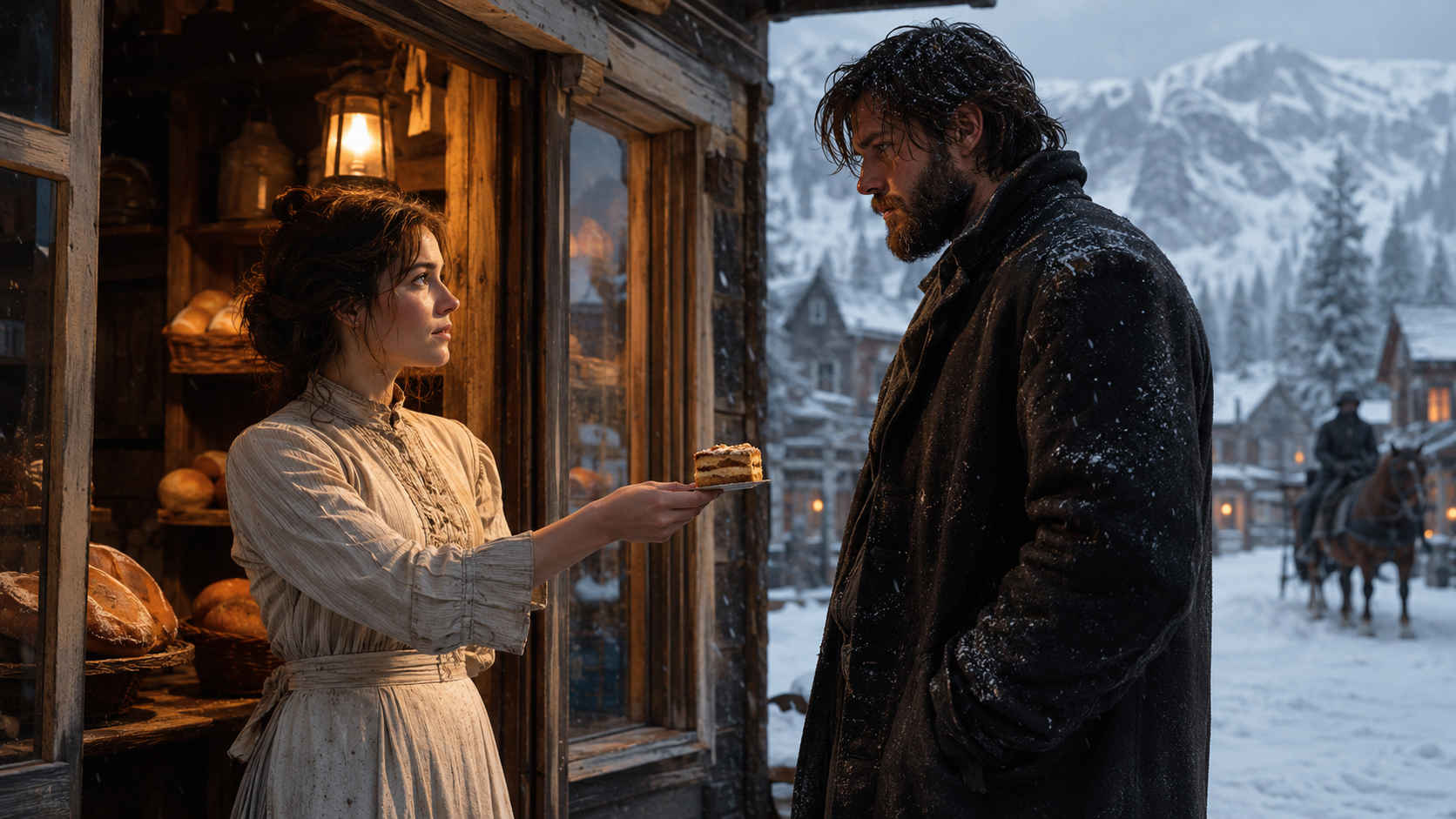
The Honeycake Dare

For six years, no one in Briar Hollow had seen Rowan Halloway eat anything sweet.

He bought salt pork when he came down from the ridge. Flour. Coffee. Nails. Kerosene. Once, in a winter so hard the river froze thick enough to hold a loaded wagon, he bought a bolt of wool the color of storm clouds and paid for it with three fox pelts so cleanly trapped the storekeeper held them up like church banners.

But honeycake, berry tarts, sugared rolls, apple dumplings, molasses bread — he never touched them.

Not at the harvest tables. Not at Christmas suppers. Not when old Mrs. Bell set a slice of spice cake in front of him and said it was a sin for a man to frown at cinnamon.

Rowan only looked at the plate, stood, and walked out into the snow.

After that, people stopped offering.

They said all kinds of things about him, because people will fill silence with whatever ugliness fits inside it.

They said Rowan had no heart left.

They said he had buried it somewhere up on Wolfthorn Ridge with his dead wife and the baby boy nobody spoke of loudly.

They said he had gone half-wild after the avalanche.

They said a man who lived alone that long either talked to ghosts or became one.

Lydia Marrow believed none of it.

Or rather, she believed only the part about the ghosts.

Everyone had them.

Some folks carried theirs quietly. Some drank because of them. Some married badly because of them. Some laughed too loudly at supper and cried into wash water before dawn.

Rowan carried his like a loaded rifle — always close, always dangerous, always pointed inward.

Lydia knew about that kind of carrying.

Her mother had died with flour on her apron and debt collectors at the door. Her father had spent the next four years gambling away grief one coin at a time, until the Marrow Bakehouse — the only warm, bright place Lydia had ever truly belonged — stood one bad signature away from being swallowed by Victor Cale.

Victor owned the freight depot, the hotel, two saloon shares, and enough men’s shame to make the whole town step aside when he crossed the street. He smiled like polished silver and had the patience of a wolf waiting for a calf to limp.

He wanted Lydia’s bakehouse.

He also wanted Lydia.

In his mind, there was not much difference.

The trouble began on a gray morning in late November, when Lydia opened the back door of the bakehouse and found a bundle wrapped in deer hide.

Two rabbits, cleaned and dressed.

Under them lay a small twist of blue thread.

Rowan Halloway used blue thread to mark his trade bundles. Everyone knew that. He never wrote notes. He never wasted words on paper if he could avoid speaking them with his mouth, and he avoided that too whenever possible.

Lydia stood in the alley, breath smoking in the cold, and stared at the rabbits.

“Stubborn man,” she murmured.

Then she smiled despite herself.

The day before, Rowan had found her on a ladder trying to patch a loose roof board while sleet needled sideways across the street.

“You’ll break your neck,” he had said from below.

Lydia, balancing a hammer between her teeth, had looked down at him. “Good morning to you too.”

He had held out one hand. “Come down.”

“I own this roof.”

“You won’t own the ground any less when you hit it.”

That had startled a laugh out of her.

Rowan had looked up sharply, as if laughter were a bird he had forgotten existed.

Then he climbed the ladder without asking permission, fixed the board in three minutes, checked the chimney brace, and climbed down before Lydia could decide whether to be grateful or insulted.

She had offered coffee.

He had refused.

She had offered bread.

He had refused that too.

So now, apparently, he had sent rabbits instead of accepting thanks.

Lydia carried them inside, cleaned the table, and stood for a long moment staring at her mother’s recipe book.

It was bound in cracked brown leather, swollen at the corners from years of steam and sugar and kitchen spills. Her mother, Evelyn Marrow, had written everything in it: recipes, debts paid, debts owed, weather notes, who liked more ginger in winter, who pretended not to like raisins but always bought currant bread when no one watched.

Lydia turned to the honeycake page.

The recipe had always been her favorite, though she rarely made it now. Honey was expensive. So was kindness. Both had to be rationed.

At the bottom of the page, in her mother’s slanted hand, was a note Lydia had read a hundred times without understanding.

For M.R., who said every sad man should be dared into sweetness.

Lydia had never known who M.R. was.

That morning, she made the honeycake anyway.

She warmed the honey until it loosened like amber in sunlight. She beat eggs until they shone. She grated nutmeg, shaved lemon peel, folded flour into the bowl, and poured the batter into her mother’s black iron pan.

By noon the whole bakehouse smelled like childhood.

By dusk, Lydia wrapped the cake in linen, tied it with string, and placed it on the back step where the rabbits had been.

She almost wrote a note.

Instead, she said aloud, “Fair trade.”

In the morning, the cake was gone.

Three days later, Rowan brought venison.

Not to the front door like a normal person.

To the back step before dawn, like some enormous wounded cat leaving offerings.

Lydia answered with bread.

He answered with trout.

She answered with plum preserves.

He answered with firewood stacked so neatly against the wall she knew he had spent too long doing it.

By the second week of December, the whole town had noticed.

Briar Hollow noticed everything.

At the general store, Mrs. Bell said, “A man does not bring split oak unless he means to stay warm near the woman he gives it to.”

At the church steps, young Mercy Vale whispered, “He looked at her window for ten whole seconds.”

At the livery, Jonas Pike said, “Halloway won’t court. He’s more likely to marry a pine tree.”

Lydia heard all of it and pretended she did not.

Rowan heard all of it and looked exactly the same, which was to say carved from winter and disapproval.

The first real conversation they had after the roof board happened because Lydia burned a batch of rolls.

Not badly. Just enough to curse.

She was standing in the back kitchen, holding a smoking tray, when Rowan appeared in the open doorway with a sack of coffee over one shoulder.

“You burned something,” he said.

Lydia turned. “Do you always announce disasters, or only mine?”

His gaze moved to the tray. “Those are rolls.”

“They were rolls.”

“Now?”

“Evidence.”

Something moved at the corner of his mouth. Not quite a smile. More like the memory of one testing whether it still fit.

Lydia noticed and felt an absurd little triumph.

She set the tray down. “Since you’re here, you may as well come in.”

He shifted his weight.

“You brought coffee,” she added.

“For trade.”

“And I brewed coffee. Also for trade.”

His eyes narrowed slightly. “You argue like a lawyer.”

“I bake like one too. Ruthless with measurements.”

He looked past her into the kitchen.

The room was warm. Golden. Flour dusted the worktable. A kettle hissed softly on the stove. Honey cooled in a crock near the window. It was the kind of room that asked a person to sit down and remember being human.

Rowan looked as if the room had struck him.

Lydia saw him begin to retreat.

So she did the one thing her mother had always done when fear tried to win.

She pushed.

“Rowan Halloway,” she said, folding her arms, “I dare you to drink one cup of coffee without running back to your mountain.”

His eyes came back to hers.

“No one dares me.”

“I just did.”

“That was foolish.”

“I’ve done worse before breakfast.”

He stared at her for so long that Lydia’s courage started to tremble around the edges.

Then he stepped inside.

They drank coffee at the worktable.

He did not take sugar.

She did not offer it.

For ten minutes, they said almost nothing. Yet the silence was not empty. It had shape. It rested between them like dough rising under cloth.

At last, Rowan looked toward the recipe book on the shelf.

“Your mother wrote that?”

Lydia followed his gaze. “Most of it.”

“She knew Maeve.”

The name dropped into the room like a coal from the fire.

Lydia stilled. “Maeve?”

His jaw tightened. “My wife.”

Lydia had heard the name only in whispers. Maeve Halloway. Dead six winters. Lost with her little son when snow broke loose above the north pass and buried half a cabin, a goat shed, and the road beneath it.

“My mother knew many people,” Lydia said carefully.

Rowan stood so abruptly his chair scraped the floor.

“I should go.”

“Rowan—”

But he was already at the door.

He paused only once, hand on the frame.

“Don’t make honeycake for me again.”

Then he left.

Lydia stood in the warm kitchen, feeling the chill he had carried out and left behind.

Two days later, Victor Cale came to collect what he called business.

He arrived after closing, when Lydia was sweeping flour from the front room and her father, Amos Marrow, sat at the corner table with his hands shaking from drink he claimed not to have taken.

Victor removed his gloves finger by finger.

“Miss Marrow,” he said smoothly. “You look tired.”

“Then don’t stay long.”

Amos flinched.

Victor smiled. “That sharp tongue will cost you one day.”

“It’s one of the few things I still own outright.”

“Are you certain?”

He laid a folded paper on the counter.

Lydia looked at it, and every warm thing in her went cold.

“What is that?”

“A note of debt. Signed by your father. Secured against this property.”

“My father does not own this bakehouse.”

Amos stared at the table.

Victor’s smile softened, which made it worse. “The county ledger says otherwise.”

“My mother left it to me.”

“Verbally, perhaps. Women often mistake wishes for documents.”

Lydia stepped closer. “Say that again.”

Victor’s eyes glittered. “Careful. Anger does not change ink.”

“How much?”

“Three hundred and eighty dollars, including interest.”

“That is theft dressed as arithmetic.”

“That is lending.”

“That is bloodletting.”

Victor leaned one elbow on the counter. “There are gentler ways to settle accounts.”

Amos whispered, “Lydia, listen to him.”

She did not look at her father.

Victor lowered his voice. “Marry me before Christmas Eve. I forgive the debt. The bakehouse stays open. Your father keeps his dignity. You gain protection.”

Lydia laughed once, short and sharp.

Victor’s smile faded.

“You think I’m joking?” he asked.

“I think you mistake a noose for a necklace.”

Amos covered his face.

Victor straightened. “You have twelve days.”

“Get out.”

“You will come around.”

“I said get out.”

He took up his gloves.

At the door, he glanced back. “Pride is a luxury, Miss Marrow. Women alone cannot afford much of it.”

After he left, Lydia turned to her father.

Amos looked smaller than the man who had once lifted her to reach the sugared buns cooling on the highest shelf. Smaller than grief. Smaller than the bottle hidden under his coat.

“How could you?” she asked.

His mouth trembled. “I thought I could win it back.”

“You never win.”

“I was trying—”

“No,” Lydia said, voice breaking. “You were trying to forget you ruined one day, and you ruined every day after it too.”

He reached for the bottle.

She walked away before she saw him drink.

The next morning, Rowan came to the back door with a brace of pheasants.

Lydia had not slept.

He noticed at once.

“Who hurt you?” he asked.

The question was so blunt it nearly undid her.

“No one.”

His eyes moved over her face. “Lydia.”

She hated the sound of her name in his mouth because it made her want to answer honestly.

“It’s nothing.”

“Nothing does not put shadows under both eyes.”

She wrapped the pheasants in paper though they did not need wrapping.

“This is my trouble.”

“I didn’t ask whose it was.”

“Then ask better questions.”

His face closed.

She heard herself and winced.

“I don’t need a mountain man fixing my roof, my door, my debts, and my life,” she said, though she already regretted every word. “I am not helpless.”

“No,” Rowan said quietly. “You are afraid.”

That was worse because it was true.

She turned away.

When she looked back, he was gone.

No bundle came the next day.

Or the next.

On the third morning, snow began before dawn.

By noon, the town had drawn itself inward. Shop doors closed early. Chimneys smoked hard. Horses stamped in their stalls and shook frost from their manes.

Near sunset, Mrs. Bell came into the bakehouse carrying eggs under her shawl.

“Rowan rode north,” she said.

Lydia kept cutting dough. “He lives north.”

“Not that north.”

The knife stopped.

Mrs. Bell’s voice gentled. “Jonas saw him take the pass toward the old Halloway place.”

Lydia looked toward the window.

Snow thickened against the glass.

“No one goes there in weather like this.”

“No one but a man trying to lose an argument with the dead.”

After Mrs. Bell left, Lydia opened her mother’s recipe book.

She did not know what she was searching for. Proof. Comfort. A miracle hidden between measurements.

Her fingers turned page after page until they reached the honeycake.

For M.R., who said every sad man should be dared into sweetness.

Lydia stared at the initials.

M.R.

Maeve Rowan?

No.

A smear of old honey had darkened the lower margin. Lydia rubbed at it gently with her thumb until another line emerged.

If Rowan ever forgets the way home, feed him honey and call him coward.

Lydia sat down hard.

For a moment, she could hear her mother laughing.

Then, outside, a horse screamed.

Lydia ran to the front window.

A black gelding stood in the street, reins dragging, saddle empty, eyes rolling white in the storm.

Rowan’s horse.

Lydia did not stop to think.

Thinking would have invited fear, and fear had too many reasonable things to say.

She packed blankets, bandages, whiskey, matches, a lantern, and three honeycakes wrapped in oilcloth. She pulled on her mother’s heavy coat and ran to the livery.

Jonas Pike barred the door with his body.

“You cannot ride into that.”

“I need my mare.”

“You’ll die.”

“Then saddle her quickly so I don’t die standing here arguing.”

“Lydia—”

She grabbed him by the collar. “If Rowan Halloway is lying hurt in that snow and you delay me another breath, I will come back from the grave and haunt your stable until every horse refuses your hand.”

Jonas stared.

Then he saddled the mare.

The storm swallowed Lydia before the town bell struck eight.

Snow erased the world. The lantern gave her only a trembling circle of white. She let Rowan’s gelding lead because the animal knew the ridge road better than any living person in Briar Hollow.

The wind shoved at her. Ice needled her cheeks. Her fingers went numb inside her gloves.

She spoke to the horses, to her mother, to the dark, and finally to Rowan.

“You miserable, silent, impossible man,” she whispered through chattering teeth. “You do not get to make me worry and then die. I forbid it.”

The gelding stopped near a stand of black pines.

Lydia saw blood on the snow.

Not much.

Enough.

She slid from the saddle and nearly fell to her knees. The lantern swung wild in her hand.

“Rowan!”

The wind answered.

She followed the blood down a shallow slope, past a broken branch, to a hollow beneath a fallen spruce.

Rowan lay there, half-buried in drift, one leg trapped beneath a deadfall and an iron snare twisted cruelly around his boot.

His face was gray.

For one terrible second, Lydia thought she had arrived too late.

Then his eyes opened.

“Lydia?”

“I’m here.”

“You shouldn’t be.”

“I hear that often.”

“Go back.”

“Poor time for jokes. I packed whiskey.”

His mouth moved. It might have been a smile. It might have been pain.

She knelt beside him and saw the snare wire had cut deep above his boot. Not a hunter’s simple wire. This was heavy freight cable, new, oiled, deliberately set low under loose snow where a horse or a man might catch it.

Her blood went cold for a different reason.

“Who set this?”

Rowan closed his eyes.

She slapped his cheek.

His eyes opened again, startled.

“Do not go noble and unconscious on me,” she snapped. “Tell me how to free you.”

“Knife,” he rasped. “Inside coat.”

She found it, cut her gloves twice, and sawed at the wire until her hands shook. When it finally snapped loose, Rowan made a sound so raw Lydia felt it tear through her own chest.

She poured whiskey over the wound while he cursed under his breath.

“So you do know words,” she said, wrapping the bandage tight.

“Not kind ones.”

“I’ll accept variety.”

The old Halloway cabin stood less than half a mile up the ridge, nearly hidden by snow-heavy firs. Lydia could not get him back to town. Not in that storm. Not with him bleeding and half-frozen.

So she did what had to be done.

She dragged, pushed, threatened, and begged until she got him onto the gelding. Then she led both horses through the white dark toward the cabin where his life had ended without killing him.

The door was swollen shut. Lydia kicked it twice, cursed once, and forced it open with Rowan’s knife.

Inside, dust slept beneath the cold.

A table stood near the hearth.

A woman’s blue shawl hung on a peg.

A wooden horse lay beneath a chair, one wheel missing.

Lydia looked away quickly.

She got Rowan down onto a narrow bed, built a fire with shaking hands, and wrapped him in every blanket she could find. His body shook so hard the bed frame knocked against the wall.

“Stay awake,” she said.

“Trying.”

“Try louder.”

His eyes cracked open. “Bossy.”

“Alive.”

She unwrapped a honeycake and broke off a piece.

His gaze fixed on it.

“No.”

“Yes.”

“No, Lydia.”

She leaned closer. “Rowan Halloway, I rode through a storm, cut you out of a death trap, broke into your haunted cabin, and ruined my best gloves. I dare you to take one bite.”

His face changed.

Not much.

But enough.

Pain, anger, longing, fear — all of it moved behind his eyes like shadows under ice.

“I said no.”

“And I said I dare you.”

For a long moment, only the storm spoke.

Then Rowan opened his mouth.

She fed him a small piece.

He swallowed.

His breath broke.

At first Lydia thought the pain had worsened. Then she saw the tears.

Silent. Hot. Terrible.

They slipped down the face of a man the town believed had forgotten how to feel.

Lydia did not look away.

“My mother knew Maeve,” she said softly.

Rowan shut his eyes.

“She wrote about her. About honeycake. About daring you.”

A sound left him, barely human.

“Maeve made it every Sunday,” he whispered. “Said a week without sweetness was just seven days of labor.”

Lydia’s own eyes burned.

“What happened here, Rowan?”

He stared toward the fire.

“The avalanche took the shed first. I was in the timber line, checking traps. I heard it. By the time I reached the cabin, snow had filled the back room.”

His voice thinned.

“Milo was asleep there. Maeve had gone in after him.”

Lydia covered his hand with hers.

“I dug until my fingers bled. I found them before dawn. I thought if I had been faster, if I had been nearer, if I had not gone out—”

“You would have died with them.”

“I should have.”

“No.”

His eyes turned to her then.

Lydia held his gaze.

“No,” she said again. “That is not love speaking. That is punishment wearing love’s coat.”

His mouth trembled.

“Under the floor,” he said suddenly.

“What?”

“Loose board. By the hearth.”

“You need rest.”

“Lydia.”

His voice carried a force that stopped her.

“I came here because Victor Cale sent men up the ridge last week. They were looking for something. I found their tracks. Maeve kept a cedar tin under the floor. I thought it held letters. I thought…” He swallowed hard. “I thought I could read them and finally leave this place.”

“And?”

“I found more than letters.”

Lydia moved to the hearth.

The loose board came up with the knife. Beneath it lay a cedar tin wrapped in waxed cloth.

Inside were letters tied with ribbon, a child’s carved button, a lock of pale hair, and a packet of papers sealed in oilskin.

The top paper bore Lydia’s mother’s name.

Evelyn Marrow.

Lydia’s hands went still.

She unfolded it.

The first document was a deed transfer. Half the bakehouse had been purchased years ago by Evelyn Marrow from Amos after his first gambling collapse, witnessed by Maeve Halloway and the old circuit judge.

The second document was Evelyn’s final will.

The bakehouse belonged fully to Lydia.

Her father had never had the right to pledge it.

Victor’s debt note was worthless.

Lydia sat back on her heels, the room tilting around her.

Rowan watched her from the bed.

“Maeve hid them for your mother,” he said. “Evelyn feared Amos would destroy them if he found them. Maeve promised to keep them safe until needed.”

“Victor knew,” Lydia whispered.

“He suspected. That’s why he wanted the ridge searched.”

“And the snare?”

Rowan’s eyes hardened. “Was not meant for deer.”

By morning, the storm had weakened enough to travel.

Rowan had fever, but his mind was clear. Lydia packed the cedar tin, tied it under her coat, and got him onto the gelding. The road down was brutal. Twice he nearly fell. Once she thought his wound had opened again and had to stop beneath a pine to tighten the bandage.

When Briar Hollow came into sight, church bells were ringing noon.

Half the town came into the street.

Victor Cale stood in front of the hotel in a black wool coat, looking almost amused.

“How touching,” he called. “Miss Marrow returns from a night alone in the mountains with a widower. I wonder what price that adds to the debt.”

The town went silent.

Lydia was cold beyond cold. Tired beyond fear. Her hair had come loose. Her skirt was torn. Rowan’s blood stained her sleeves.

But inside her coat lay the truth.

She looked at Victor and smiled.

“My reputation survived the storm,” she said. “Will yours survive the sheriff?”

Victor’s smile tightened.

Rowan lifted his head from the saddle.

“Your men set cable on my ridge.”

Victor laughed. “Fever makes a man dream.”

Lydia reached into her pocket and held up a brass freight tag she had cut from the snare.

Cale Freight.

The sheriff stepped forward.

Victor’s gaze flicked toward Jonas Pike, who stood near the livery doors, pale as milk.

Lydia saw it.

So did everyone else.

Jonas swallowed. “I didn’t know it would catch him. Mr. Cale said Halloway was hiding papers that belonged to him. Said to scare him off the ridge.”

Victor turned on him. “Idiot.”

The word condemned him more cleanly than any confession.

Lydia opened the cedar tin and handed the papers to Judge Mercer, who had pushed through the crowd with his spectacles already on.

He read in silence.

The town waited.

Amos Marrow stood in the bakehouse doorway, shaking so hard he had to hold the frame.

At last, the judge looked up.

“These papers are valid. The bakehouse belongs to Lydia Marrow. Amos Marrow had no legal authority to secure debt against it.”

Victor went white with rage.

“The records—”

“Will be examined,” the judge said. “As will your involvement in their disappearance.”

The sheriff took Victor by the arm.

Victor did not smile again.

Rowan healed in the back room of the bakehouse because Lydia refused to let him return to the ridge and because he had finally learned that arguing with her while feverish was inefficient.

His leg mended slowly. It would always ache in snow. He accepted this better than he accepted broth.

“This soup is timid,” he said one afternoon.

Lydia stared at him over the bowl. “Soup cannot be timid.”

“This one fears salt.”

“It has salt.”

“It has heard rumors of salt.”

She laughed.

Rowan watched her as though laughter were light entering a room he had kept shuttered for six years.

The cedar tin stayed on the worktable for a week before he opened Maeve’s last letter.

Lydia offered to leave.

He caught her wrist.

“Stay.”

So she sat with him while he unfolded the pages.

Maeve’s handwriting was lively, uneven, full of loops that refused to behave.

Rowan read silently at first.

Then his breath caught.

He handed the letter to Lydia.

“Read it,” he said.

Her voice shook, but she read.

My dearest Rowan,

If you are reading this, grief has found you in the way I feared it might. So I will begin with the only command I have left: do not build a house out of sorrow and call it loyalty.

Milo and I were loved by you. Not perfectly, because no one loves perfectly. But truly. Do not let the day you were absent erase all the days you came home.

If the snow took us, blame the snow. Blame the mountain if you must. Blame God if you need someone large enough to survive your anger. But do not spend your life blaming the man I loved.

Lydia stopped, pressing her lips together.

Rowan’s eyes were wet.

He nodded once.

She continued.

Evelyn Marrow has my honeycake recipe, and I have hidden what she asked me to hide. Her daughter has eyes that look straight through foolishness. If she grows into them, she will be formidable.

If someday that girl stands before you with honey on her hands and courage in her mouth, let her feed you.

Let her dare you.

Come back, Rowan. Not away from us. Back with us carried rightly.

All my love beneath every snow,

Maeve

When Lydia finished, Rowan bowed his head.

This time, he wept openly.

Not like a man destroyed.

Like a man whose broken bones were being set after healing wrong for too long.

Lydia did not tell him to stop. She did not say everything happened for a reason. She had lived enough to know some things happened for no reason at all, and people survived them anyway, not because survival was noble, but because breath kept coming and someone eventually put food in your hand.

So she sat with him.

When his tears had passed, she cut two slices of honeycake.

She set one before him.

Rowan looked at it for a long time.

Then he said, rough and quiet, “I dare me.”

Lydia smiled. “That is the strangest grace I’ve ever heard.”

His eyes lifted.

“It was not grace.”

“No?”

“No.” He stood carefully, leaning on the table because his leg was still weak and honesty seemed to require balance. “Lydia Marrow, I have a ruined cabin, a bad leg, a horse with more sense than I have, and a reputation that frightens children and widows. I cannot promise ease. I cannot promise I will never go silent. I cannot promise the dead will not sit with me some mornings.”

Her smile faded into something softer.

“But I can promise,” he continued, “that I will come back from wherever my mind wanders. I will eat what you make, even timid soup. I will fix what breaks. I will listen when you speak. I will never call your strength pride simply because it refuses to kneel. And if you let me, I will spend the rest of my life proving that being loved by you is not rescue. It is honor.”

Lydia tried to answer.

Nothing came out.

Rowan looked suddenly uncertain. “Was that too much?”

She laughed through tears. “For once, too much is exactly right.”

They married in spring, when the snowmelt roared through the creek and mud tried to steal everyone’s boots.

Lydia wore a cream dress with sleeves rolled high enough to work in, because she said any dress that stopped a woman from lifting a flour sack was an enemy. Rowan wore a dark coat and the blue scarf Lydia had knitted badly and dared him to wear. He wore it though one end was longer than the other.

Amos walked Lydia halfway down the aisle beneath the budding apple trees behind the bakehouse.

Then he stopped.

“I don’t deserve the rest,” he whispered.

Lydia looked at the man who had failed her in more ways than she could count.

Then she took his arm again.

“No,” she said. “But I deserve it.”

So he walked her all the way.

When Judge Mercer asked Rowan if he took Lydia as his wife, Rowan looked at her and said, “She fed me when I thought I deserved to starve.”

The judge blinked.

When he asked Lydia, she said, “He ate my honeycake when everyone expected him to choke on hope.”

The judge cleared his throat. “I will accept both as yes.”

The town laughed.

This time, the laughter did not cut.

Victor Cale was taken to trial for fraud, assault, and the theft of county records. His freight depot was sold. His hotel shares vanished into legal fees. Men who once lowered their voices around him discovered courage after it became convenient.

Amos did not become a saint. Life rarely works so neatly. But he became sober for his last winter, and every morning before dawn, he swept the bakehouse floor, washed pans, and apologized in small useful ways.

On the night he died, Lydia sat beside him.

“I gave your mother’s life away one bottle at a time,” he said.

“Yes,” Lydia answered, because forgiveness did not require pretending.

“I looked at you and saw everything I had ruined.”

“I know.”

“You were never too much.”

Her throat closed.

Amos turned his face toward the window, where snow fell softly over Briar Hollow.

“You were the only thing in that house that was enough.”

Those words did not repair the years. Nothing could. But Lydia kept them anyway, because not every broken thing becomes whole, and not every gift needs to be large to be real.

By the third year of their marriage, Rowan had built a house at the edge of town with wide windows facing the ridge. The bakehouse remained on Main Street, warm and loud and sweet-smelling, but their home became the place people came when storms rose early or grief arrived uninvited.

Every Sunday, Lydia baked honeycake.

Every Sunday, Rowan ate the first slice.

Sometimes, when the light fell a certain way, sorrow crossed his face. Lydia never feared it. She had learned that love did not drive ghosts from the room. It simply made enough space for the living too.

On the mantel sat Maeve’s letter beside Evelyn’s recipe book. Not as a shrine, but as a witness.

Years later, when their daughter Elara was old enough to stand on a stool and stir batter with both hands, she asked, “Why does Papa close his eyes when he eats honeycake?”

Rowan looked at Lydia.

Lydia smiled.

“Because,” Rowan told his daughter, “some sweetness reminds a man he is alive.”

Elara considered this seriously. “Did you forget?”

“For a while.”

“How did you remember?”

Lydia leaned against the counter, arms folded, flour on her cheek.

Rowan’s slow smile changed his whole face.

“Your mother dared me.”

At every harvest fair after that, someone retold the story.

Each year it grew larger.

Some said Lydia rode through a wall of snow taller than the church steeple. Some said Rowan cried so hard the fire went out. Some said Victor Cale fainted in the street when Lydia held up the freight tag, which was false but satisfying enough that nobody corrected it.

Lydia let them talk.

She had spent too much of her life fearing the town’s mouth. Now she knew people would always make stories out of what they did not understand. The trick was to live so truthfully their stories could not cage you.

At sunset, when the fair crowd thinned and the mountains turned violet beyond the rooftops, Lydia always chose the best piece of honeycake left on the tray.

She held it out to Rowan.

“I dare you,” she said.

And Rowan Halloway, who had once mistaken loneliness for loyalty, took the cake from his wife’s hand and ate it before God, Briar Hollow, and the ghosts he had finally learned to love without dying beside them.

Every year, it tasted of honey.

Every year, it tasted of grief survived.

Every year, it tasted of the woman who had been told she was too much and became exactly enough to call a silent man home.