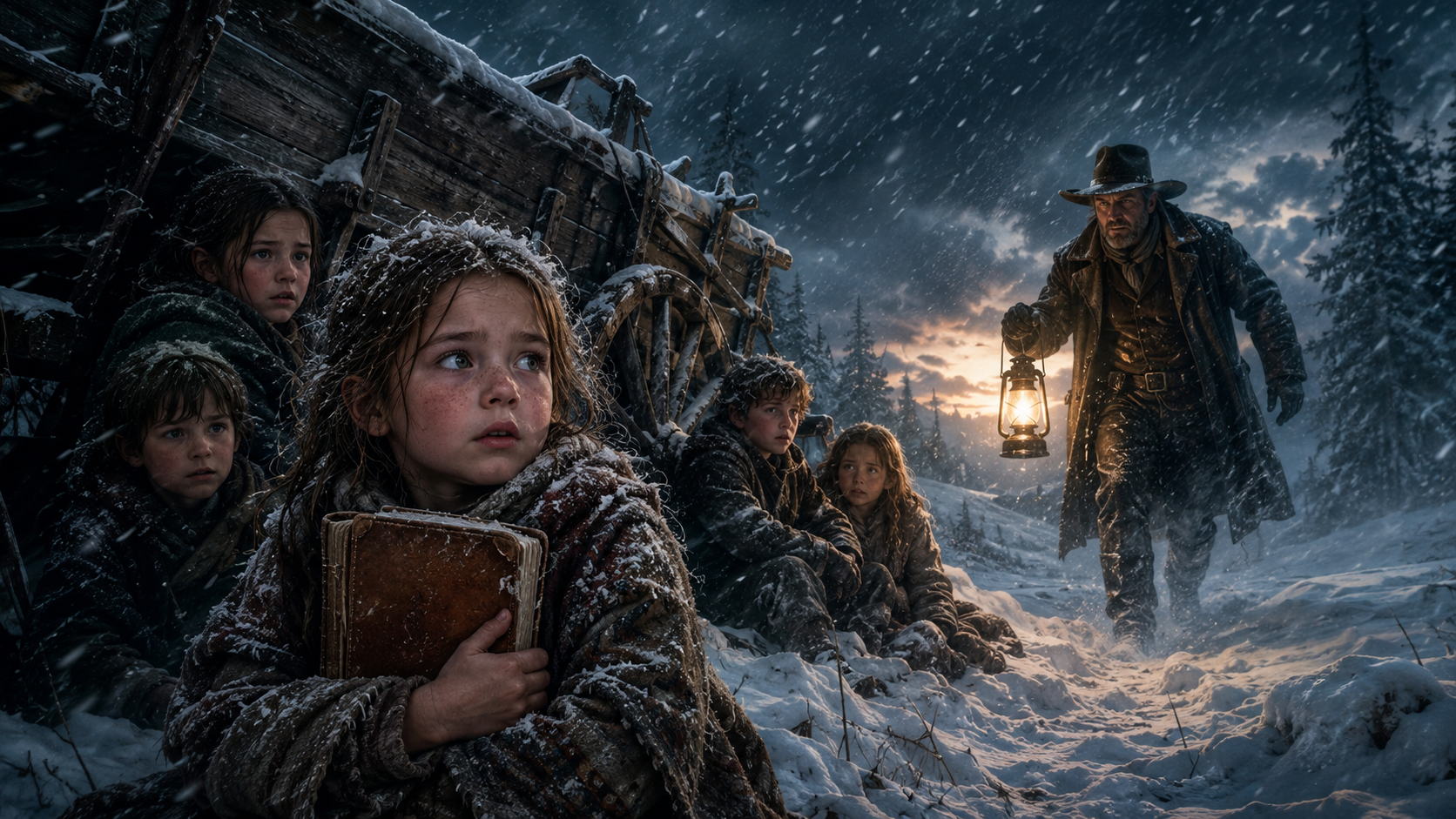
“I can make soup,” the smallest child whispered.
No one laughed.
Not in that storm. Not with the wind clawing at the broken wagon like a living thing. Not with five children huddled beneath a canvas stiff with ice while their mother lay wrapped in a quilt that no longer rose and fell with breath.
The man who heard the whisper was Jonah Vale, a widower who had come down from the north ridge only because his horse had refused the lower trail. Jonah had learned long ago to trust animals before men. Men lied. Horses only stopped when the world ahead was trying to kill them.
He had expected a fallen tree. Maybe a wolf pack. Maybe a washed-out bridge under the snow.
He had not expected children.
The oldest boy stood in front of them with a hatchet in both hands. He could not have been more than thirteen, but his eyes had the hard, sleepless look of someone who had already made promises too large for his bones.
“Don’t come closer,” the boy said.
Jonah stopped. He raised both hands slowly.
“My name is Jonah Vale. I’m not here to hurt you.”
“That’s what men say before they do.”
The boy’s voice trembled only at the edges. Jonah respected him for that.
Behind him, two girls clung to each other beneath a torn blanket. A younger boy sat motionless beside the wagon wheel, his lips blue. The smallest child, a girl with tangled dark hair and cheeks raw from cold, held a little leather book against her chest as if it were warmer than fire.
Jonah looked past them.
The woman lay near the wagon bed.
He removed his hat.
The oldest boy noticed. His grip on the hatchet weakened.
“She was our mother,” he said.
“I figured.”
“She walked until she couldn’t.”
The wind slammed a sheet of snow between them.
Jonah took one step closer, careful and slow. “What’s your name?”
The boy hesitated.
“Caleb.”
“And the others?”
Caleb swallowed. “Nora, Beth, Isaac, and Ruth.”
The smallest girl lifted her chin when her name was spoken.
Jonah nodded once. “I have a cabin two miles west if the trail hasn’t vanished. Food, firewood, blankets.”
“We were going east,” Caleb said. “To Braddock Crossing.”
“You won’t reach it tonight.”
“My father went for help.”
“When?”
Caleb looked away.
The girl named Nora answered. “Yesterday morning.”
Jonah did not say what all of them already knew. In a Wyoming blizzard, yesterday was not time. It was a death sentence.
But Ruth, the smallest one, opened her book.
“Mama said if Papa didn’t come back, we had to keep the recipes.”
Caleb spun toward her. “Ruth, hush.”
“But she said—”
“Hush.”
The sharpness in his voice made the little girl flinch.
Jonah watched that closely. The boy was not angry. He was afraid.
“What recipes?” Jonah asked.
Ruth hugged the book tighter. “Soup. Bread. Dumplings. Things like that.”
“I can cook,” she whispered again.
Jonah looked at the dead woman, then at the five children she had dragged through snow, hunger, terror, and whatever else had chased them into the storm.
“Then we’ll need your help,” he said. “Because cold children don’t argue well on empty stomachs.”
Caleb stared at him as if kindness were more dangerous than a gun.
Jonah did not blame him.
He had seen what hunger did. He had seen what powerful men did when winter gave them a convenient way to erase people.
He wrapped the dead woman more carefully in the quilt, then turned to the children.
“We can’t carry her far in this wind.”
Caleb’s face changed.
“No.”
“Son—”
“No. We’re not leaving her.”
Jonah crouched so they were eye to eye.
“I did not say leave. I said we cannot carry her far. There’s a stand of pines south of the creek. The ground will be softer there. We’ll lay her where the storm can’t take her.”
Caleb’s mouth twisted, fighting tears he considered betrayal.
“She hated the cold.”
“I know.”
“You don’t.”
Jonah looked at the snow, and for a moment he saw another winter, another grave, another woman’s hand slipping from his.
Then he said, “No. Not yours. But I know enough.”
They buried Miriam Cole beneath three leaning pines while the sky turned black behind the mountains.
Caleb dug first. He would not let Jonah take the shovel until his arms shook too badly to lift it. Nora tied a red thread from her sleeve around her mother’s wrist. Beth placed a button in the grave because, she said, Mama was always losing buttons and might need one in heaven. Isaac stood silent, staring at nothing.
Ruth opened the leather recipe book.
“Does Mama need this?” she asked.
Caleb reached for it quickly. “It was hers.”
Ruth stepped back. “She said I keep it.”
“Ruth.”
“She said recipes remember what people try to forget.”
Jonah’s hand tightened around the shovel.
That was no ordinary thing for a dying woman to say.
Caleb saw the question in Jonah’s face and spoke fast.
“She had fever. She didn’t know.”
Maybe.
Maybe not.
They covered Miriam Cole with earth and snow. Jonah took off his hat again.
“Lord,” he said quietly, “this woman carried five children farther than any road had mercy. Keep her warm where we couldn’t.”
No one said amen.
Ruth whispered, “And don’t let Papa be scared.”
Caleb’s face broke for half a second.
Then the storm came down hard.
Jonah gathered what he could from the wagon: a sack of beans, a strip of salt pork, two dented cups, a tin pot, and a small bundle of clothes. He put Isaac inside his own coat because the boy had stopped shivering, and that scared Jonah more than crying would have.
They walked.
The horse, Gideon, carried Beth and Ruth first, then Nora behind them. Caleb refused to ride.
“I can walk.”
“You can also freeze standing up,” Jonah said.
“I said I can walk.”
Jonah studied him. “Then walk beside me. If I fall, you take the reins.”
That gave the boy a duty. Pride accepted what fear would not.
Snow erased the road within minutes.
The wind came sideways, full of ice needles. The world narrowed to Gideon’s dark neck, Caleb’s pale face, and the sound of five children trying not to cry because crying wasted breath.
After the first mile, Jonah knew they would not reach his cabin.
The storm had turned them. The creek markers were gone. The ridge had disappeared. Even Gideon began to stumble.
Then Ruth lifted her head.
“Smoke bends before it rises.”
Jonah thought he had misheard. “What?”
“When Mama cooked outside,” Ruth said, “the smoke went where the trees made a wall.”
She pointed with a mitten that had no thumb.
“There. Snow isn’t biting so hard.”
Jonah followed her finger.
A line of black spruce leaned together along a low rise, their branches locked like shoulders. Something stirred in his memory. Years ago, before grief made him sell most of his traps, he had used a hunter’s shelter somewhere near that line. A forgotten place with a stone hearth and a roof low enough to survive wind.
He had not thought of it in years.
But the child had seen what he missed.
“Caleb,” Jonah called, “we’re leaving the road.”
Caleb’s jaw tightened. “Are you lost?”
“Yes.”
The honest answer startled him.
Jonah pulled Gideon toward the trees. “But I know how to be lost better than the storm knows how to kill us.”
They found the shelter half-buried in snow.
It was hardly a cabin. More a square of old logs with a crooked door and a roof sagging under white weight. But when Jonah kicked it open, the inside smelled of dust, mice, old ash, and salvation.
He broke a crate for kindling. Caleb helped without being asked. Nora rubbed Isaac’s hands. Beth cried silently. Ruth sat near the cold hearth and opened the leather book in her lap.
Jonah struck a match.
The first flame died.
The second caught.
Orange light crawled over the children’s faces, making them look younger and more breakable than they had outside.
Ruth lifted the pot.
“I can cook now.”
Jonah almost smiled. “You can supervise.”
“I’m good at stirring.”
“I believe that.”
They melted snow. Added beans. Salt pork. A handful of flour. The soup was thin, smoky, and ugly, but the smell of it filled the room like a promise.
When Jonah handed Ruth the first cup, she shook her head.
“Cooks taste last.”
“Cooks who fall over don’t finish supper.”
She considered this, then took the cup with both hands.
They ate in careful silence. Not greedy. Not loud. These were children who knew food could disappear if you trusted it too much.
Jonah watched Caleb scrape his cup clean and then look at the others before asking for more.
“You can have another,” Jonah said.
Caleb stiffened. “I wasn’t asking.”
“You were checking if they’d had enough.”
The boy looked down.
“That’s asking in the language of older brothers.”
For a moment, Caleb’s face softened.
Then hoofbeats sounded outside.
Every child froze.
No sane rider would be traveling in that storm.
Caleb rose so fast his cup tipped over.
“Put out the fire,” he whispered.
Jonah reached for his rifle. “Why?”
Caleb’s lips barely moved.
“Because if it’s Silas Greer, he didn’t come to save us.”
The hoofbeats drew closer. Lantern light flickered through cracks in the wall.
Jonah moved to the window.
Three riders passed between the trees, wrapped in heavy coats, their horses snorting steam. One man cursed the storm. Another laughed.
“If the brats froze, let them freeze,” he said. “We need the book.”
Inside the shelter, Ruth clutched the leather recipes to her chest.
The third rider spoke. “And Cole?”
The first voice answered, cold and amused.
“Buried deep enough. Nobody crawls out of the north mine with a busted leg. By morning, snow will swear he ran off.”
Caleb made a sound like he had been struck.
Jonah caught him before he could move.
The riders continued into the white dark.
For several seconds, no one breathed.
Then Caleb tore free.
“My father’s alive.”
Jonah blocked the door.
“Move,” Caleb said.
“No.”
“You heard them.”
“I heard.”
“They buried him.”
“I know.”
“I have to go.”
Jonah grabbed his shoulders.
“If you go now, you die before you find him.”
“He’s my father!”
“And you are the only thing standing between your brothers and sisters and the same men who want that book.”
Caleb shook with rage. “You don’t know what it feels like!”
Jonah’s voice dropped.
“I know what it feels like to arrive too late. I know what it feels like to dig in frozen ground. And I know the difference between bravery and handing death an extra body.”
The boy’s eyes filled.
“My father didn’t leave us.”
“No,” Jonah said. “He didn’t.”
Those words did what comfort could not.
Caleb folded forward, sobbing silently into Jonah’s coat.
Ruth opened the leather book.
“Mama wrote the mine down,” she said.
Everyone turned.
She flipped past recipes in neat handwriting.
Corn cakes for Sunday.
Pepper beans for cold nights.
Winter soup for hungry children.
Near the back, the writing changed. The titles still sounded like food, but the measurements were strange.
Two cups west of Crow Creek.
One spoon past the split pine.
Bake under the old north shaft door.
Jonah stared.
“That isn’t a recipe.”
Ruth shook her head. “It is if you know Mama.”
Caleb wiped his face with his sleeve.
“Pa found out Greer was stealing wages from miners. Changing ledgers. Making men owe money they’d already paid. Mama copied the proof into her recipe book because nobody searched women’s kitchens.”
Jonah looked toward the storm where the riders had vanished.
Silas Greer owned the freight office, the company store, three mines, and the loyalty of every deputy in Braddock Crossing who liked being paid. If he had buried Thomas Cole alive, half the town might already be prepared to call it an accident.
Ruth placed one small finger on a page titled Snow Soup for Bad Weather.
“Mama said this one was for when the smiling man came.”
Jonah read the hidden line beneath the ingredients.
North Mine. Lower timber door. Behind the broken winch.
Caleb saw his face.
“We can reach it.”
Jonah shook his head.
“We can reach it after dawn.”
“My father might not have until dawn.”
“Then we give him the best chance by not stumbling blind into Greer’s gun.”
Caleb wanted to argue.
He did not.
That was how Jonah knew the boy was stronger than most men.
Just before dawn, the storm loosened its teeth.
Jonah left Nora, Beth, Isaac, and Ruth in the shelter with the fire built high and Gideon tied close by. He gave Nora his small pistol and showed her how to hold it.
“Don’t open the door unless you hear me say the word ‘Mercy.’”
Ruth frowned. “Why Mercy?”
Jonah paused.
“My wife’s name.”
“Is she dead like Mama?”
“Yes.”
Ruth nodded solemnly. “Then she can help guard us.”
Jonah had no answer.
Caleb went with him. There was no force in Wyoming that could have kept him behind.
They found the north mine less than a mile away, hidden below a ridge of black stone. Snow had drifted against the entrance, but the boards nailed across it were fresh.
Jonah touched one.
“Greer’s men were in a hurry.”
Caleb lifted the lantern.
“Pa!”
Only the wind answered.
Jonah drove an iron pry bar under the first board. It cracked. Then another. Together they tore open a hole just wide enough to crawl through.
The mine breathed cold air in their faces.
Caleb called again.
“Pa!”
Silence.
Then, from somewhere deep below, faint as a memory:
“Cal?”
The lantern shook in Caleb’s hand.
“Pa!”
Jonah caught his arm before he ran.
“Slow. Mines punish hurry.”
They moved into the dark.
The tunnel smelled of wet stone, rust, and old danger. Broken beams leaned overhead. Ice glazed the floor. Somewhere water dripped steadily, counting seconds they did not have.
They found Thomas Cole behind a fall of timber near the lower passage.
He was alive.
Barely.
One leg was pinned beneath a beam. Blood had dried along his temple. His beard was white with frozen breath. But when the lantern light touched Caleb’s face, the man smiled.
“I told your ma,” he rasped, “I’d come back.”
Caleb fell beside him.
“Mama’s gone.”
Thomas closed his eyes.
The grief that crossed his face looked larger than the mountain above them.
“I know,” he whispered. “I felt something go quiet.”
There was no time to mourn.
Jonah wedged the iron bar beneath the beam.
“When I lift, pull him clear.”
Caleb swallowed. “I’ll hurt him.”
“He’s already hurt. Pull anyway.”
Thomas bit down on his glove to keep from screaming. Jonah lifted until fire burned through his shoulders. Caleb pulled with everything in him.
The beam shifted.
Thomas came free.
Then a gun cocked behind them.
“Well,” said a smooth voice. “Family reunions do warm the heart.”
Jonah turned slowly.
Silas Greer stood in the tunnel with a lantern in one hand and a revolver in the other. Beside him was Deputy Harlan Pike, whose badge shone brighter than his conscience.
Greer wore a fine wool coat, polished boots, and the calm expression of a man accustomed to owning the room even underground.
“I wondered who left fresh tracks by the old shelter,” Greer said. “Jonah Vale. Should’ve known. You always had poor manners around other men’s business.”
Caleb stepped in front of his father.
Greer sighed. “Move, boy.”
“No.”
Deputy Pike aimed his gun at Caleb.
Jonah’s voice turned flat.
“Point that at me.”
Pike smiled. “Gladly.”
Greer stepped closer.
“Where is Miriam’s book?”
No one answered.
Greer’s smile thinned.
“She was clever, your wife,” he said to Thomas. “Too clever for a miner’s woman. She should have baked bread and kept quiet. Instead she copied numbers she had no right to understand.”
Thomas tried to rise and failed.
“You stole from men who trusted you.”
“I gave those men work.”
“You gave them debt.”
Greer’s eyes hardened.
“Debt is how civilization teaches obedience.”
Jonah looked at him. “That line sounds expensive. Did you buy it with stolen wages?”
Pike struck him across the mouth with the revolver.
Caleb shouted.
Jonah staggered, tasted blood, and smiled anyway.
Greer looked at the boy.
“This can still end quietly. A mother dead from the storm. A father lost in a mine. Five children frozen on the road. Tragic, but believable.”
Jonah wiped blood from his lip.
“You forgot something.”
Greer raised an eyebrow.
“Children remember.”
Greer laughed softly.
“Not if no one listens.”
A voice behind him answered.
“I’m listening.”
Sheriff Edwin Marr stepped out of the tunnel shadows with three miners behind him, all armed.
Deputy Pike spun too late. One miner knocked the gun from his hand. Another slammed him against the wall.
Greer went still.
Jonah stared at the sheriff.
“Took you long enough.”
Marr’s face was grim.
“A little girl came to the church before sunrise carrying a recipe book and a pistol nearly bigger than her arm.”
Caleb blinked.
“Ruth?”
Jonah closed his eyes.
Of course.
The sheriff continued, “She told my wife she could cook soup, but only for people with clean hands. Then she opened that book and read Miriam Cole’s notes to half the congregation.”
Greer’s face lost color.
From behind the miners, Ruth appeared wrapped in a blanket, holding Nora’s hand. Beth stood beside her. Isaac rode on the back of a broad miner named Amos Reed, bundled in quilts.
Caleb stared. “You were supposed to stay inside.”
Ruth looked offended.
“Mr. Jonah said don’t open the door unless he said Mercy. I didn’t open the door. I climbed through the back window.”
Even Thomas, broken and half-frozen, made a sound almost like laughter.
Greer lunged for the lantern.
Jonah moved first.
He slammed into Greer, driving him against the tunnel wall. The lantern fell. Glass shattered. Fire spilled across the floor in a bright, hungry sheet.
The old mine groaned.
“Out!” Sheriff Marr shouted.
The miners lifted Thomas. Jonah grabbed Ruth with one arm and shoved Caleb ahead with the other.
They ran.
Smoke filled the tunnel. Burning oil crawled over the boards. The ceiling cracked above them. Daylight appeared ahead, white and impossible and beautiful.
They burst from the mine just as the first timber collapsed behind them.
The ridge shook.
A moment later, the entrance caved in, swallowing the fire, the dark, and nearly every secret Silas Greer had tried to bury.
But not all of them.
Ruth still had the book.
By noon, Braddock Crossing knew.
By evening, the church was packed with miners, widows, teamsters, shopkeepers, and men who had spent years lowering their eyes when Greer walked by.
Sheriff Marr stood at the pulpit and read from Miriam Cole’s recipe book.
Every recipe held a record.
Pepper Beans for Cold Nights listed stolen wages.
Corn Cakes for Sunday marked false debts.
Molasses Bread for Company recorded bribes paid to Deputy Pike.
Snow Soup for Bad Weather gave the location of the north mine.
And on the final page, beneath a recipe written in Miriam’s careful hand, was a note.
If I do not live, believe my children. Thomas did not abandon us. Silas Greer would rather bury a family than answer for what he has done. Caleb protects too much. Nora notices everything. Beth is braver than her tears. Isaac must be kept warm. Ruth remembers what adults think children cannot understand. Please do not let my children become another debt this town refuses to pay.
No one spoke when the sheriff finished.
Then Amos Reed stood.
“My brother died owing Greer money,” he said. “Or so we were told.”
Another miner rose.
“My wages vanished twice.”
Then another.
“And my house.”
“And my claim.”
“And my husband.”
The silence that had protected Greer for years cracked open like river ice.
Silas Greer was taken east under guard before the next storm. Deputy Pike went with him. The company store was seized. The ledgers were opened. Men who had been called lazy, drunk, careless, or indebted learned their poverty had been designed by a man who smiled while robbing them.
Thomas Cole survived, though he walked with a limp for the rest of his life.
The children stayed first with Sheriff Marr’s family, then in a small house rebuilt by every miner in town. Jonah came by to mend the stove, split wood, fix the door, repair the roof, and pretend each task was the reason he stayed for supper.
Ruth always made soup.
At first, it was thin soup. Beans, salt, potatoes when they had them. Later, when spring softened the ground and hens began laying again, she added carrots, onions, barley, and sometimes a little cream.
Jonah never took the first bowl.
Ruth never let him take the last.
“Cooks taste last,” she would remind him.
“And stubborn cooks get carried to bed when they fall asleep in the chair,” he would answer.
Caleb grew taller that year. He still watched doors. Still counted heads before sleeping. Still woke sometimes reaching for a hatchet that was no longer there.
But he also laughed again.
Nora learned sums and helped the sheriff’s wife copy clean records from the stolen ledgers.
Beth planted red flowers beside her mother’s grave when the snow melted.
Isaac, who had nearly gone silent forever in the storm, began talking to Jonah’s horse as if Gideon were an old friend with excellent judgment.
And Ruth kept the recipe book wrapped in blue cloth.
Years later, when people told the story, they always made it sound grand.
They said a wicked mine owner was undone by courage.
They said a father was pulled alive from the earth.
They said a town found its conscience in the middle of winter.
But Jonah knew the truth was smaller and stronger than that.
A dying mother hid justice where cruel men would never look.
Five children refused to disappear.
And the smallest girl, with frozen fingers and a book full of recipes, made soup for people with clean hands.
That was how the storm ended.
Not all at once.
Not with thunder.
But with a child stirring a pot over a rescued fire, whispering what her mother had taught her:
“Recipes remember.”

