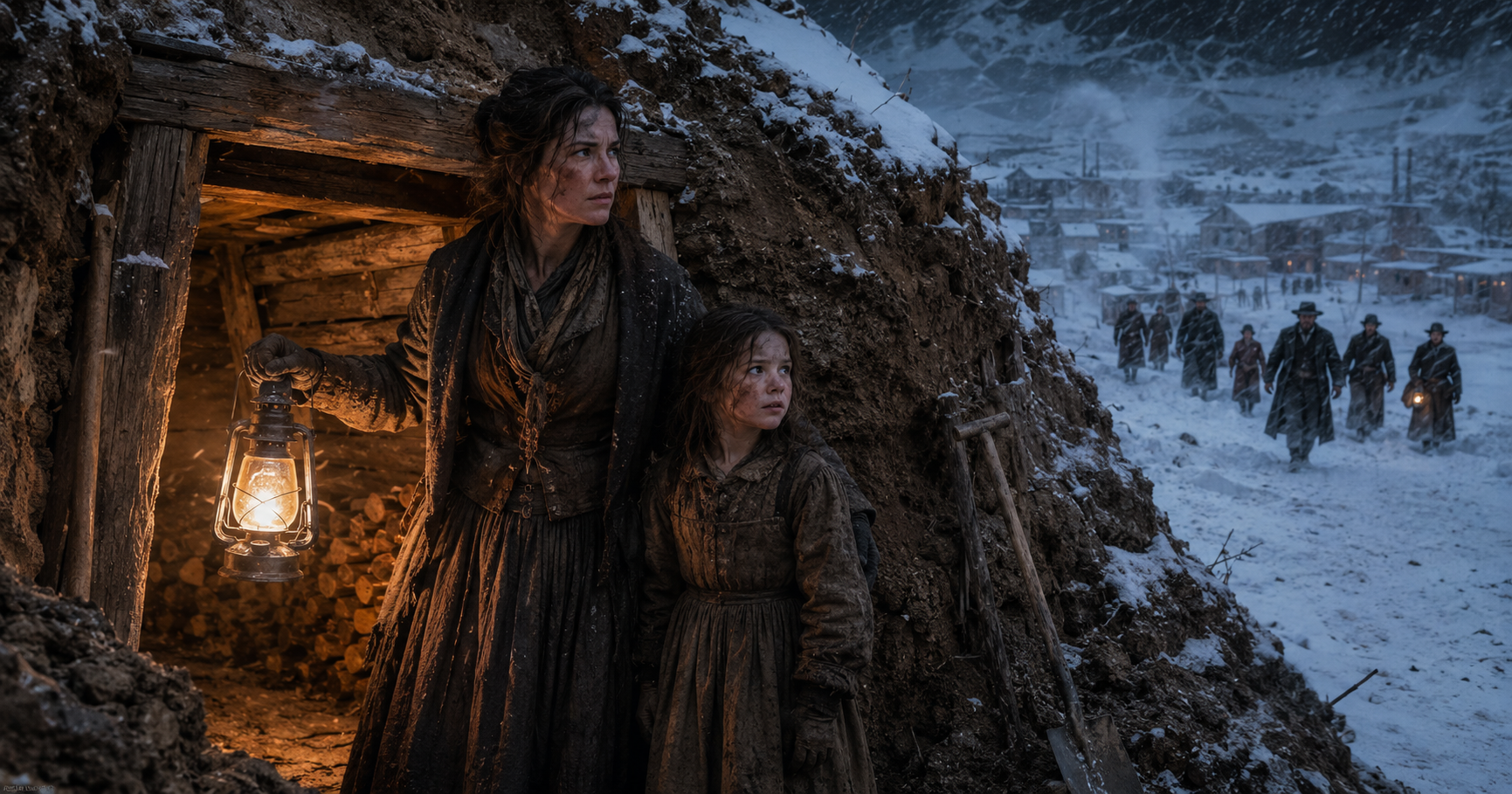
The Widow Dug a Breathing Tunnel Beneath the Hill — The Town Laughed and Said She Was Burying Herself… Until the Winter Came for Them All

The first time Mara Whitlock put her ear to the clay wall of the hill, her daughter thought grief had finally stolen the last sensible part of her.

“Ma,” Lottie whispered, standing behind her with a shovel too tall for her narrow shoulders, “are you listening to dirt?”

Mara did not move.

The hillside rose north of their cabin like a sleeping animal, brown and wind-bitten, with last year’s grass lying flat against its ribs. Above it, clouds dragged themselves across a pale September sky. Below it, the Whitlock cabin leaned into the valley wind as if it had learned to bow without falling.

At last Mara lifted her head.

“No,” she said. “I’m listening for winter.”

Lottie’s fingers tightened around the shovel handle.

“Winter doesn’t make a sound yet.”

“That’s why you listen now.”

The girl glanced toward the road. It was empty, but not for long. People in Cold Hollow had a way of appearing whenever a widow did something they did not understand. Since Edward Whitlock had died beneath a fallen pine two winters ago, every hammer blow Mara struck, every fence post she replaced, every acre she refused to sell had become public entertainment.

Lottie was twelve, old enough to recognize pity, young enough to still be wounded by it.

Mara pointed to the clay bank.

“We start here.”

Lottie swallowed. “Start what?”

“A drying tunnel.”

“For wood?”

“For survival.”

The girl looked at the hill, then at the stack of green-cut logs beside the shed, then back at her mother.

“Wood dries outside.”

“Wood dries where air moves.”

“There’s no sun inside a hill.”

“There doesn’t need to be.”

Lottie stared at her as if waiting for the part that would make sense.

Mara crouched and pressed her palm against the earth. Her father had taught her long ago that land spoke in small ways: through dampness, through slope, through wind, through the way frost lingered in one hollow and vanished early from another. He had burned charcoal in the mountains of Tennessee, and he had known more about fire than any man in Cold Hollow who laughed around a stove.

“This hill catches the north wind,” Mara said. “The bank is clay, but there’s a gravel seam behind it. If we cut in low, brace the roof, and open a vent shaft near the back, the air will pull through on its own. Slow and steady. It will drink the water out of the wood.”

Lottie frowned. “Like the hill breathes?”

Mara looked at her daughter and smiled for the first time that morning.

“Yes,” she said. “Like the hill breathes.”

They began before noon.

The mouth of the tunnel was not large, only wide enough for a person to walk through bent at the neck and careful at the shoulders. Mara marked the opening with twine and stakes, measuring twice, then a third time because a careless inch underground could become a coffin. She set Lottie to clearing stones while she drove the pick into the bank.

The first blow rang dull.

The second sent clay crumbling.

By the tenth, sweat ran down Mara’s spine despite the cold wind. By the twentieth, Lottie had stopped asking questions and begun working beside her.

They dug into the hill day after day.

Clay stuck to their boots. Their palms blistered. Their shoulders ached so badly at night that neither could lift a cup without wincing. Mara cut support posts from deadfall pine and set them close together. She shaped crossbeams with Edward’s drawknife, though every time her hand closed around the handle, memory cut deeper than the blade.

Lottie noticed.

“You don’t have to use Pa’s tools,” she said one evening.

Mara kept shaving the beam.

“Yes, I do.”

“Why?”

“Because tools are meant to keep working after the hands that held them are gone.”

Lottie looked away quickly.

The next morning, people began to slow their wagons along the ridge road.

By the second week, they stopped altogether.

Mr. Cale Branson, who owned the feed store and believed any silence existed only because he had not yet filled it, leaned over his wagon seat and shouted, “Mrs. Whitlock, you planning to live under there when the roof gives up?”

Mara did not answer.

His wife gave a sharp little laugh and covered it too late with her glove.

At the blacksmith’s shop that afternoon, the joke grew legs. By supper, half the town had heard that the Whitlock widow was digging herself a grave big enough for firewood.

“She’s gone queer with sorrow,” someone said.

“No,” another replied, “she’s gone proud. Same sickness, different hat.”

Lottie heard it at the well.

She came home with water sloshing over the bucket rims and anger burning bright in her face.

“They said you were burying wood because you couldn’t bury Pa twice.”

Mara’s jaw tightened, but she went on stacking split pine beside the tunnel mouth.

“Who said that?”

“Mrs. Branson.”

“Then Mrs. Branson has a mean mouth and too much time.”

Lottie set the buckets down hard. “Why don’t you tell them how it works?”

Mara lifted a piece of wet pine. It was heavy, sappy, useless for a clean fire.

“Some people ask because they want to learn,” she said. “Some ask because they want a better way to laugh. Know the difference before you spend your breath.”

Lottie stood silent.

Mara handed her the green split.

“Feel this.”

Lottie took it.

“Now take that one.”

She pointed to a piece of dead pine that had been standing dry on the upper slope for two seasons. Lottie lifted it easily.

“This one’s lighter.”

“Why?”

“Less water.”

“And when it burns?”

“It burns hotter.”

“Why?”

“Because the fire isn’t wasting itself boiling water out first.”

Mara nodded toward the dark mouth of the tunnel.

“That is all we’re doing. Taking the water out before the cold comes.”

Lottie looked at the hillside again. For the first time, her expression changed from doubt to calculation.

“And if it works?”

Mara picked up the axe.

“Then we live.”

The tunnel was finished on the twenty-sixth day.

It ran deep enough that the light at the mouth thinned to blue and then to gray. Mara and Lottie dug the rear vent shaft by hand, lying flat in dirt, scraping upward through clay and gravel until at last Lottie’s trowel broke through into daylight.

She screamed so loudly Mara thought the shaft had collapsed.

“I see sky!”

Mara stumbled up the slope, breathless, and found Lottie’s muddy fingers poking through a little hole in the earth like roots reaching for air.

They widened the opening and tested it with smoke from dried grass.

The smoke bent inward at the tunnel mouth. It slid through the dark passage, thin and obedient, then rose from the vent in a pale ribbon.

Lottie laughed.

“It’s breathing!”

Mara stood below, her face lifted to the hillside, feeling the draft move past her skirt.

“Yes,” she whispered. “Now let’s feed it.”

They filled the tunnel with wood in careful rows.

Not packed tight. Mara would not allow it. Every stack had space behind it. Every row had gaps. Every split piece faced the draft. The driest deadfall went deepest. The greener wood stayed nearer the mouth where it could begin its slow surrender.

Lottie tried to fill every empty place.

“Space looks like waste,” she muttered.

“Space is the part that does the work,” Mara said.

That became the rule of the tunnel.

Space for air.

Space for patience.

Space for being right before anyone believed it.

In October, Abel Rowan came.

He owned the sawmill three miles east of town and had spent thirty years turning trees into boards. He was not cruel, but he had the solemn certainty of a man used to being consulted. He stood at the tunnel mouth with his hat in his hands, peering into the dark.

“Mara,” he said carefully, “wood kept underground can rot.”

“It can.”

“It can mold.”

“It can.”

“It can sour until it smokes black and coats your chimney like tar.”

“It can.”

He turned to her. “Then why are you doing this?”

“Because none of those things happen when the air moves right.”

Abel looked tired. “You’re betting your winter on a draft.”

“I’m betting it on work I understand.”

He glanced at Lottie, who stood inside the tunnel with clay on her cheek and defiance in her eyes.

“I could sell you seasoned slab wood at a fair price,” he said. “Enough to get through the worst months.”

Mara heard kindness in his voice. That made the refusal harder.

“I thank you,” she said. “But I have my own.”

“You have an experiment.”

“I have my father’s method.”

“Your father wasn’t from here.”

“No. But fire is fire everywhere.”

Abel sighed. “I hope you’re right.”

“So do I.”

He left unconvinced.

Gideon Pike came at dusk.

Gideon did not own the town, but he had spent twenty years persuading people that he did. He owned freight wagons, cattle, three rental houses, and enough unpaid notes to make half of Cold Hollow careful in his presence. Since Edward’s death, he had made four offers for the Whitlock land. Mara had refused all four.

The fifth offer arrived without paper.

Gideon sat on his horse by the fence, looking toward the tunnel with open amusement.

“I hear you’ve dug yourself a miracle.”

Mara kept stacking wood.

“I didn’t dig it for you.”

“No. You dug it because grief makes women stubborn.”

Lottie stiffened.

Mara did not look up. “Leave my daughter out of your mouth.”

Gideon smiled. “I’m only saying what others are thinking. A woman alone on land this hard ought to accept help when it’s offered.”

“I have help.”

He looked at Lottie and laughed softly.

“You have a child.”

The axe in Mara’s hand stopped midair.

Lottie went pale.

Gideon leaned forward on the saddle horn. “There’s a difference between courage and foolishness, Mrs. Whitlock. Winter will teach it better than I can.”

“Then let winter teach.”

His smile thinned.

“You know, Edward carried debt.”

Mara turned then.

“What debt?”

“Freight. Seed. Tools. Men don’t always tell their wives everything.”

The words struck with precision. That was Gideon’s gift. He did not swing wildly. He found the seam and drove the wedge.

“Bring proof,” Mara said.

“I can.”

“Then bring it.”

“If I do, you may wish you’d sold when I was feeling generous.”

Mara stepped closer to the fence.

“Mr. Pike, if you ever feel generous, I expect the sun will rise in the west just to see it.”

For one second, Gideon’s face emptied.

Then he laughed.

It was not a pleasant sound.

“You’ll come to me before February,” he said. “You and that girl. Cold makes beggars honest.”

Mara met his eyes.

“No,” she said. “Cold makes liars visible.”

He rode away hard.

That night, after Lottie climbed into the loft, Mara sat at the kitchen table with Edward’s old ledger open beneath the lamp.

She knew the accounts. She had counted them until numbers followed her into sleep. But Gideon’s words moved inside her like a draft under a door.

Men don’t always tell their wives everything.

She hated him for placing doubt beside grief.

Near midnight, she took down Edward’s tool chest. The brass latch stuck. She forced it open and lifted the tray.

Under the auger bits and a folded rag lay a flat oilskin packet.

Her name was written across it.

Mara’s hands began to shake before she opened it.

Inside were two receipts and a letter.

Mara,

If I have put this somewhere foolish and you find it after scolding me in your head, know that you are right to scold. Pike tried again for the north slope. I paid the last of the freight account and made him sign the receipt in front of Rowan and Reverend Hale. Keep this safe.

Also, I walked the hill this morning. You were right about the wind. That old drying trick your father used would work there. I should have listened sooner. Come spring, we’ll cut a tunnel together.

E.

Mara read it once.

Then again.

Then a third time, though the words blurred.

She did not cry because Edward had paid the debt.

She cried because he had believed her.

In the morning, she showed Lottie.

The girl traced the edge of the letter with one finger.

“Pa knew the tunnel would work?”

“He thought it would.”

“And Mr. Pike lied?”

“He tried to.”

Lottie looked toward the hill. Something in her young face settled into place.

“Then we finish it for Pa.”

Mara folded the letter carefully.

“No,” she said. “We finish it for us. That is what he would have wanted.”

By late October, the tunnel changed.

The wood nearest the rear had lost its green weight. Sap smell faded into clean resin. Bark loosened. The cut ends showed tiny cracks like pale stars. When Lottie struck two pieces together, they rang instead of thudding.

She froze.

“Ma.”

Mara turned from the vent shaft.

Lottie held up the wood. “Listen.”

She struck it again.

The sound was small, bright, impossible.

Mara took the piece and weighed it in her palm.

The hill was working.

The town still laughed, but the laughter had begun to wobble. At church, women lowered their voices when Mara passed. Men nodded with the careful politeness given to people one still thinks wrong but no longer finds amusing.

Mrs. Branson asked, “Still tending your grave, Mara?”

Mara smiled. “Every day. It’s getting healthier than your gossip.”

That ended the conversation.

The first hard cold came in November.

Mara carried three pieces of tunnel wood into the cabin, laid them over kindling, and let Lottie strike the match.

The fire caught fast.

No hiss.

No sap popping.

No lazy smoke choking the stove pipe.

The flames climbed clean and yellow, and within minutes heat rolled from the iron belly of the stove.

Lottie stepped back, laughing in disbelief.

“It’s too hot.”

Mara held her hands toward the warmth.

“Too hot,” she repeated. “That is a fine complaint.”

That night, she banked the stove before bed. In other winters, dawn had always arrived like punishment: dead ashes, frozen wash water, breath white in the air, Lottie curled under every quilt they owned.

But that morning, Mara woke to warmth.

The coal bed still glowed.

She stood in the dark, staring.

From the loft, Lottie whispered, “Ma?”

“The fire held.”

A pause.

Then the ladder creaked as Lottie climbed down in her nightdress, hair wild, eyes wide.

“It held?”

Mara smiled.

“It held.”

By Christmas, Cold Hollow began to understand that something was wrong.

Not at the Whitlock place.

Everywhere else.

Wet wood burned badly. Chimneys clogged. Stoves smoked. Families burned twice as much fuel for half the heat. Men chopped emergency trees from frozen slopes, but green wood was heavy with locked water. It hissed, spat, and died unless fed constantly.

At Gideon Pike’s freight yard, wood stacked under tarps had not seasoned at all. He sold it anyway, calling it “winter-ready,” because fear paid well when snow buried the roads.

Abel Rowan’s mill had slab wood, but too much of it had been stacked tight, trapped under its own dampness. Even he had trusted habit over airflow.

Then January came down like a hammer.

The first storm buried fence lines.

The second sealed the road east.

The third arrived without mercy.

Wind drove snow so hard that houses disappeared from one another though they stood fifty yards apart. Cattle froze standing in draws. Barn doors vanished behind drifts. The church bell rope iced solid. At night the temperature dropped so low that nails cracked in porch boards like pistol shots.

On January seventeenth, Gideon Pike’s youngest boy disappeared in the storm.

His name was Eli. He was thirteen, proud, thin as a rail, and always trying to prove he was old enough to be sent with men. Gideon had sent him with two ranch hands to bring in cattle from the lower ravine before the whiteout thickened.

Only one hand came back before dark, half blind from snow glare and frostbitten to the wrists.

Eli was still out there.

Gideon searched until his horse stumbled.

He found the boy after midnight, curled beside a dead heifer, barely breathing, his lashes white, his boots frozen stiff.

The Pike ranch house lay too far through the storm.

The town road was gone.

The nearest light was Mara Whitlock’s cabin.

So Gideon came to the door of the woman he had mocked, carrying his son like a broken bundle.

Lottie opened it.

For a moment, she only stared.

Gideon’s face was gray beneath the ice in his beard.

“Please,” he said.

Mara appeared behind Lottie.

She took one look at the boy.

“Bring him in.”

Gideon staggered across the threshold. Snow followed him. Two men came behind, carrying Mrs. Branson, who had collapsed after her chimney smoked back into the house. Reverend Hale arrived with a boy from the Mercer farm whose hands were wrapped in rags.

The cabin filled with fear.

Mara’s stove burned steady and hot.

“Lay him near the stove,” she ordered. “Not too close. Lottie, warm water. Warm, not hot. Blankets from the chest.”

Gideon knelt beside Eli, frantic.

“He’s freezing.”

“Yes,” Mara said. “And if you heat him too fast, you’ll harm him worse.”

“Will he live?”

Mara looked at him.

“I’ll do the next thing that must be done. That is all anyone gets to know.”

The words silenced him.

Lottie brought cloths. Mara wrapped Eli’s hands and feet, slowly, carefully. The boy whimpered. Gideon made a sound like something tearing.

“Pa?” Eli whispered.

Gideon bent over him.

“I’m here. I’m here, son.”

“It’s cold.”

Lottie looked toward the stove.

Mara placed another piece of tunnel-dried pine inside.

“Not anymore,” she said.

By dawn, twenty-three people had come to the Whitlock place.

Some were half frozen.

Some were coughing from smoke.

Some brought children wrapped in quilts.

Some came because their fires had gone out and would not relight.

The cabin could not hold them all.

Abel Rowan stood by the stove, holding a piece of Mara’s firewood. He struck it lightly against another.

The clean ring cut through the room.

His face changed.

He turned toward the dark window, where the hill rose beyond the storm.

“The tunnel,” he said.

Mara nodded.

Lottie went to the wall and took down the coil of rope they used during blizzards.

“We’ll tie from the porch to the mouth,” she said.

No one laughed.

They moved the weakest first.

Through the whiteout, one by one, they followed the rope from the cabin to the hill. Mara carried a lantern. Lottie carried another. Abel and Reverend Hale shoveled the entrance clear.

Inside, the tunnel smelled of pine, clay, smoke, and cold stone. Compared with the cabin, it was chilly. Compared with the world outside, it was mercy.

Wood lined both walls in pale, orderly rows. The center path remained open. The draft moved softly through the passage, steady as breath.

Mrs. Branson stared at the stacks.

“This is what we laughed at?”

Lottie looked at her.

“Yes.”

The woman lowered her eyes.

Abel stepped deeper into the tunnel and touched the wood.

“Dry,” he whispered. “All the way through.”

Mara began giving orders.

“Children to the back. Keep the center clear. No one blocks the airflow. Gideon, put Eli there, against the side wall. Abel, take three men and bring more wood from the cabin stack. Lottie, count blankets.”

Gideon looked around the tunnel, seeing every beam, every gap between the stacks, every careful measurement he had called madness.

For the first time since Mara had known him, he looked afraid of something other than losing money.

“How much wood do you have?” he asked.

“Enough for us.”

“And for them?”

Mara turned to him.

“That depends on what you do next.”

His eyes narrowed despite everything.

“What does that mean?”

“You have teams. You have men. You have a freight barn full of wet wood you sold as seasoned.”

Abel turned sharply.

“Wet?”

Gideon said nothing.

Mara stepped closer, lantern light cutting hard across her cheekbones.

“My dry wood goes first to homes with children, the elderly, and the sick. Your teams will haul it. Your men will bring your wet wood here and split it smaller. Abel will help stack it properly. When the roads open, you will replace every cord you sold falsely.”

Gideon stared at her.

“You’re giving orders on my property now?”

“No,” Mara said. “I am giving the price of shelter in mine.”

The tunnel went still.

Gideon’s pride twitched like a wounded animal.

“That wood is mine to sell.”

“Then carry your son back into the storm and sell it to the snow.”

No one breathed.

Eli coughed weakly.

That tiny sound did what argument could not.

Gideon lowered his head.

“All right.”

Mara did not soften.

“And when daylight comes, you will tell them the truth.”

“What truth?”

“That the wood was wet. That you knew it. That you sold fear because fear fills a purse.”

His jaw clenched.

“Careful, Mara.”

“No,” she said. “I was careful in September. I was careful in October. I was careful while you laughed. Tonight I am finished being careful.”

Abel Rowan stepped beside her.

“She’s right.”

Gideon looked at him.

Abel’s voice was rough with shame.

“And I was wrong. I told her wood could not season in darkness. I told her sun mattered more than air. I said it kindly, which only made my ignorance sound respectable.”

He lifted the split pine.

“This is better wood than half of what my mill has sold.”

The admission moved through the tunnel like another current.

Reverend Hale bowed his head.

“Then we learn.”

For three days, the Whitlock place became the heart of Cold Hollow.

Gideon’s teams hauled dry wood to families whose stoves had died. Abel showed men how to split wet cordwood smaller and stack it with space enough for air. Mara directed the tunnel, the cabin, the stove, the sick, the frightened, and the ashamed.

Lottie became fiercer than any foreman.

“Not tight!” she snapped at a ranch hand twice her size. “Air needs a road!”

The man looked to Mara for rescue.

Mara only said, “You heard my daughter.”

By the fourth day, the storm broke.

Sun came weak over a white world that looked remade by punishment.

Eli Pike lived.

Two of his toes did not recover, but his hands did. Mrs. Branson’s cough eased. Old Mr. Fenn survived the night everyone expected him not to. Children slept in the tunnel wrapped in quilts, breathing pine-scented air while the wind screamed itself empty above them.

On the fifth morning, Gideon came to Mara’s kitchen.

His son lay asleep near the stove. Lottie sat at the table, mending one of Eli’s torn gloves with stern concentration.

Gideon removed his hat.

“I owe you.”

Mara poured coffee into one cup.

Hers.

“You owe several people.”

“I’ll make it right.”

“Yes,” she said. “You will.”

He reached into his coat and placed a folded paper on the table.

“Edward had an unpaid freight note.”

Mara did not touch it.

“No, he didn’t.”

Gideon froze.

Lottie looked up.

Mara crossed to the shelf, opened Edward’s Bible, and removed the oilskin packet. She laid the signed receipt beside Gideon’s paper.

“Paid in full. Witnessed by Abel Rowan and Reverend Hale.”

Gideon’s face drained.

For a moment, the only sound in the cabin was the steady draw of the stove.

Lottie stared at the receipt.

Then at Gideon.

“You lied about my father.”

Gideon swallowed.

“Accounts get tangled.”

Mara’s voice was calm, and that made it colder than shouting.

“Snow gets tangled. Rope gets tangled. Accounts do not sign themselves twice.”

His gaze flicked toward Eli.

Mara saw it.

She hated him for using the boy even silently. She also understood that a child should not wake to his father ruined in front of him.

“You will write a statement today,” she said. “In front of Abel, Reverend Hale, and Cale Branson. You will state that Edward Whitlock’s account was paid in full and that you hold no claim against this land.”

Gideon breathed hard.

“And after that, your teams haul community wood without charge until thaw.”

His eyes flashed.

“Without charge?”

“You prefer I take both papers to the marshal when the road opens?”

He looked at the receipt.

Then at the stove.

Then at his sleeping son.

“I’ll sign.”

Mara pushed paper and ink toward him.

“No,” she said. “You’ll write it in your own hand. Men remember truth better when their fingers have to shape it.”

And he did.

That afternoon, Gideon Pike wrote the truth at Mara Whitlock’s kitchen table while Abel Rowan witnessed it, Reverend Hale stood with his Bible under one arm, and Mrs. Branson watched from the corner with the hard-eyed satisfaction of a woman who had chosen the winning side too late but intended to stand there firmly now.

When Gideon finished, Mara read every line.

Then she handed it to Lottie.

“You read it too.”

Lottie read slowly.

By the end, her chin had lifted.

The land was theirs.

Not because the town approved.

Not because Gideon allowed it.

Because Edward had paid.

Because Mara had kept proof.

Because a tunnel mocked as a grave had become the one place in Cold Hollow where breath, truth, and fire still moved.

The killing winter did not end quickly.

Hard winters never do. They retreat by inches, loosening their grip in daylight and tightening it again after dusk. They leave behind dead cattle, cracked hands, empty barns, and people who no longer speak lightly about preparation.

But Cold Hollow survived better than it should have.

Mara’s tunnel did not save everyone by itself. No one woman’s work could undo a season of arrogance. But it bought time. It gave dry fire to cold rooms. It taught desperate hands how to stack wet wood so air could do what pride had not. Abel rebuilt part of his mill shed into a drying house with vents along both walls. Reverend Hale organized cutting crews. Mrs. Branson, having learned that a sharp tongue did not warm a bed, spent the rest of winter delivering soup and apologies in equal measure.

Gideon’s teams hauled until March.

Some said he did it because Mara kept his signed confession in her Bible.

Some said he did it because Eli, who walked with a slight limp after that winter, refused to let his father speak one cruel word about the woman who had saved him.

Both were probably true.

When spring finally came, it came quietly.

Snow shrank from fence posts. Water ran beneath the crust. The hill above the Whitlock cabin darkened first at the tunnel mouth, where warm breath had passed all winter.

One afternoon, Abel Rowan arrived carrying a notebook.

Mara found him standing outside the tunnel, hat in hand.

“I came to ask,” he said.

“That is new.”

He nodded. “Earned.”

Lottie, who had grown taller over the winter or perhaps only straighter, leaned on a shovel nearby and smiled without mercy.

Abel opened the notebook.

“I want to build one behind the mill. Properly. I need the measurements. The slope. The vent angle. How wide the center path should be. How long the first stacks took. Everything.”

Mara studied him.

“For profit?”

“For use first,” he said. “Then profit, maybe. But if I sell tunnel-dried wood, it will be tunnel-dried wood. Not hope wrapped in a tarp.”

Mara looked past him toward Cold Hollow. Chimneys smoked across the valley, thin and steady. People who had mocked her now stacked wood with gaps between the rows. Men who once laughed at her tunnel now argued about vent placement. Women who had pitied her now brought questions, not sympathy.

“My father used to say knowledge kept too tightly grows mold,” Mara said.

Abel waited.

She took the notebook from him.

“Write this down.”

By the next September, three more drying tunnels had been dug in Cold Hollow.

Abel’s was the largest, framed with mill scraps and fitted with two vents. The Bransons built one behind the store and allowed families to season wood there before winter. Reverend Hale organized a shared tunnel near the church for those who had no land suitable for digging.

Gideon Pike built none.

But his teams hauled for those who did.

As for Lottie, she changed most of all.

Before the tunnel, she had been a grieving girl standing beside a grieving mother, trying not to collapse under the weight of other people’s pity. After the winter, she became someone who knew what her hands could make. She knew the sound of dry pine. She knew the patience of moving air. She knew adults could be loud and wrong, and that being right did not require shouting.

One evening in October, Mara found her at the tunnel mouth, tapping two split pieces together.

“Checking the rows?” Mara asked.

Lottie nodded. “This side needs four more days.”

Mara lifted one of the pieces, weighed it, pressed the end grain, and struck it once.

A dull note answered.

She smiled.

“Four days.”

Lottie’s face brightened, not with surprise, but with the calm satisfaction of knowledge confirmed.

Together, they looked into the tunnel.

It was full again. Ordered. Breathing.

Not a grave.

Not madness.

Not a widow’s refusal to accept the world.

A method.

A promise.

A future cut by hand into the side of a hill.

The Widow Dug a Breathing Tunnel Beneath the Hill — The Town Laughed and Said She Was Burying Herself… Until the Winter Came for Them All
Bold and shocking: the public is in shock, her ex-husband is stressed, but Lopez feels great.