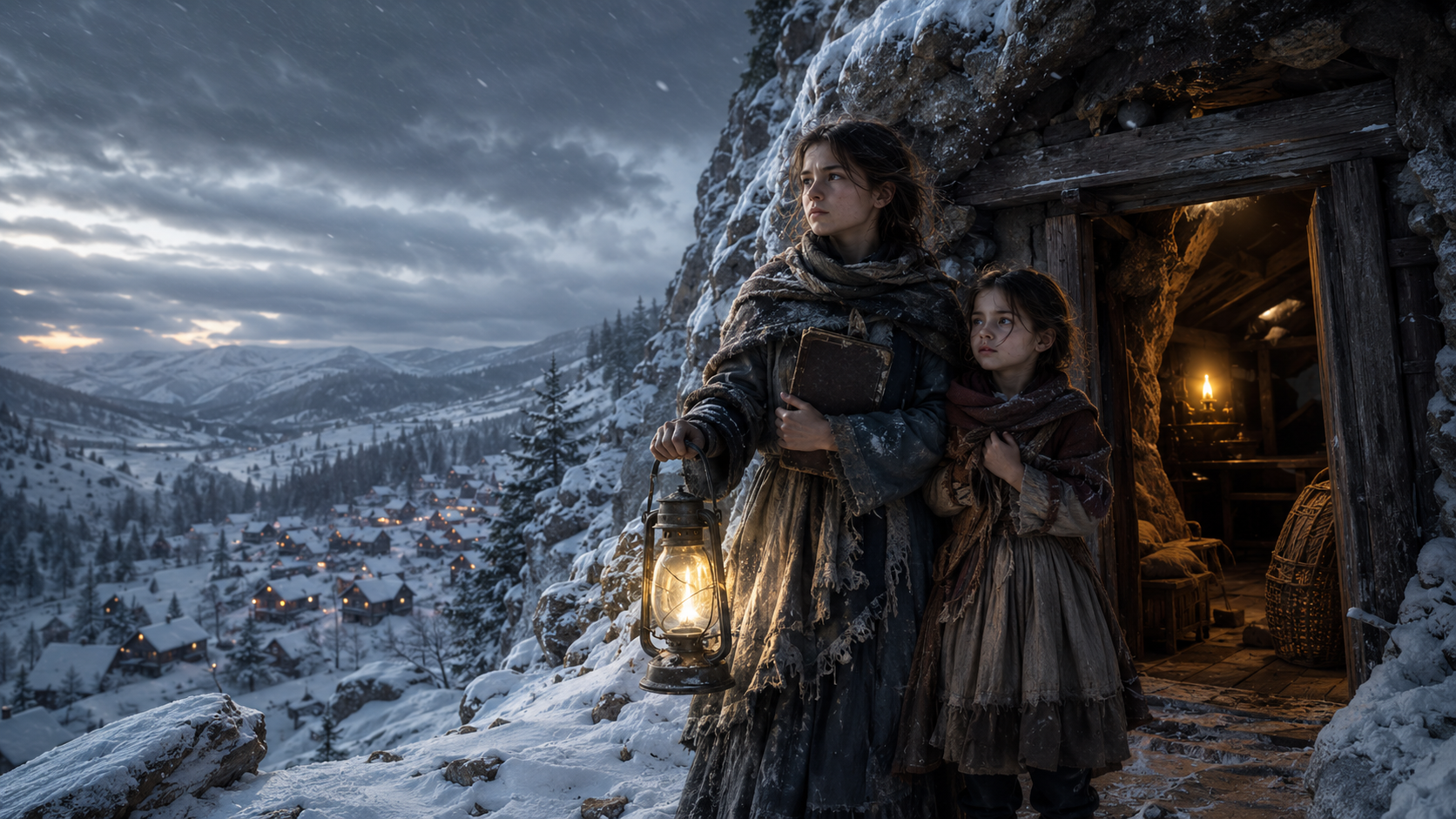
When the Valley Mocked the Orphan Sisters for Living Beneath Stone, Winter Knocked on Their Door First

“Tell me honestly,” Elsie whispered, staring at the black mouth of the cave, “are we surviving… or have we finally lost our minds?”

Mara Vale did not answer at once.

The wind moved through the pines above them with a long, warning sound, like someone dragging a hand across a closed coffin. Below the ridge, the town of Briar Glen sat in a basin of white fields and crooked roofs, every chimney puffing smoke into the December-gray sky. From up here, it looked peaceful. Gentle. Safe.

Mara knew better.

Safety was what people called a thing after it had failed someone else.

She tucked a loose strand of dark hair beneath her wool cap and held up the leather-bound notebook in her hand. Its cover had gone soft with age. The corners were chewed by damp. The pages smelled of smoke, oil, dust, and the careful patience of a man who had spent his life noticing what other people ignored.

“Our grandfather didn’t draw this place because he was mad,” Mara said. “He drew it because he understood the mountain.”

Elsie hugged herself tighter. She was seventeen, thin from grief and winter, her cheeks hollowed by the months since fever took their mother and a logging accident took their father before the year had even finished burying itself. She looked too young to be standing in front of a cave with a shovel in her hands, deciding whether stone could become a home.

But then again, Mara thought, nobody ever looked ready for the life that arrived.

“He wrote a hundred things in that book,” Elsie said. “Root cellars. Smokehouses. Drainage pits. Spring shelves. Storm walls. That doesn’t mean he meant for his granddaughters to sleep under a cliff.”

Mara opened the notebook to the page she had studied until the lines appeared behind her eyelids at night.

There it was.

A drawing of the ridge above Briar Glen. The creek bend. The split pine. The sloping pasture behind their ruined cabin. The stone shelf hidden behind blackberry canes. And beneath that, in their grandfather Orson Vale’s square, stubborn handwriting:

SOUTH-FACE HOLLOW. IF THE HOUSE FAILS, BUILD HERE.

Beneath the words was a careful drawing of the cave mouth. A timber wall fitted under the overhang. A door set slightly to the left to break the north wind. Two small windows facing morning light. A raised plank floor with air beneath it. Drainage trenches carved along both sides. A stone fireplace built deep into the back wall, not for beauty, but for heat storage. A vent line through a natural crack overhead.

Not a den.

Not a grave.

A plan.

Mara stepped forward into the cave and held out her bare hand. Outside, the wind bit through gloves. Inside, after twenty paces, it changed. The air did not warm, exactly, but it steadied. It stopped attacking. It wrapped itself around the skin with the stillness of earth that had not cared about yesterday’s weather and would not care about tomorrow’s.

Elsie followed her in, boots scraping stone.

“It feels strange,” she murmured.

“It feels honest,” Mara said.

Elsie glanced at her. “Honest?”

“A regular house lies to you. It stands there looking proud and upright, but if the wind finds every crack and snow piles on the roof, pride won’t keep anyone alive.” Mara touched the cave wall. “This doesn’t pretend. It says, ‘I am stone. Learn my rules or leave.’”

Elsie looked back toward the valley, where a faint line of smoke rose from the church chimney.

“They’ll laugh.”

“They already laugh.”

“They’ll call us cave rats.”

“They called us poor before that. Orphans before that. Stubborn before that.” Mara turned a page in the notebook. “Let them choose a new word. We still need a place to live.”

Their cabin below the ridge had become unfit before winter even arrived. The roof sagged where wet snow had collected too many years in a row. Wind slipped through the plank walls no matter how much rags and clay Mara pushed into the gaps. The chimney smoked in bad weather. The floor froze so hard some mornings that Elsie’s wash water formed ice in the basin before sunrise.

The townspeople had offered advice.

Advice, Mara had learned, was what people gave when they wanted to feel generous without giving anything useful.

Mrs. Blythe from the mercantile said the sisters should hire a man to repair the cabin, though everyone knew they had no money.

Reverend Callum said hardship was a test and humility a virtue, which was easy to say beside a church stove fed by other people’s wood.

Nathan Crowe, the largest landowner in the valley, said the Vale girls should sell their useless upper acres before taxes swallowed them whole.

His son Caleb laughed in front of the blacksmith shop and said, “Maybe the mountain will take them in. It’s got more room than sense.”

Mara had been there buying nails with the last of her mother’s egg money.

She had said nothing.

Silence, she had discovered, frightened certain men more than argument.

Now, standing in the cave, she looked at the place her grandfather had marked and felt something inside her shift from grief into purpose.

“Tomorrow we clear the entrance,” she said.

Elsie stared. “Tomorrow?”

“Before the next snow.”

“We don’t know how to build this.”

“No,” Mara said. “But we know how to learn.”

Word reached Briar Glen by the end of the week.

By Sunday, the whole valley had decided the Vale sisters were either touched by sorrow or ruined by pride.

By Monday, people began climbing the ridge just to see the foolishness for themselves.

They came in twos and threes, stamping snow from their boots, pretending concern while their eyes shone with entertainment.

Mrs. Blythe stood outside the cave with her hands tucked into a fur muff and declared that grief had made the girls “unsuitable for their own decisions.”

A cattleman named Otto Reese bet half the general store that the cave wall would collapse before New Year’s.

Reverend Callum said, “The Lord gave mankind timber for homes.”

Mara, carrying a basket of stones from the cave floor, replied, “He gave us mountains too.”

The reverend frowned as if scripture had been used without permission.

Caleb Crowe came on the coldest afternoon of the month. He arrived on horseback, wearing a black coat too fine for a man who claimed to work harder than anyone else. His father owned the best meadowland, the sawmill share, and most of the debt in Briar Glen. Caleb had inherited the family gift for standing in a place as if he had already bought it.

He dismounted and looked at the half-cleared cave.

“So it’s true,” he said. “You’re moving into a hole.”

Mara leaned on her shovel. “A dry hole.”

Elsie, behind her, tried not to smile.

Caleb stepped inside. He examined the ceiling, the side walls, the natural overhang, and the rough stakes Mara had placed where the front wall would stand. He tried to look amused, but the cave’s steadiness unsettled him. Mara could see it.

“This is animal shelter,” he said.

“Then animals may be wiser than we are.”

His jaw tightened. “A storm will bury that entrance.”

“We’ll build a snow shed and drainage lip.”

“The smoke will choke you.”

“Not if the throat is built correctly.”

“Spring melt will flood you out.”

“The floor will be raised. Water moves lower than people if people are smart enough to let it.”

He looked at the old notebook resting on a crate near the wall.

“You think a dead mason’s scribbles make you builders?”

Mara picked up another stone and dropped it into the basket.

“No. I think a dead mason’s scribbles are still more useful than a living fool’s laughter.”

Elsie made a small choking sound behind her.

Caleb’s face darkened. “When this ridge becomes your tomb, don’t expect the valley to risk men digging you out.”

Mara lifted the basket.

“If you come,” she said, “bring someone who knows how to use a shovel.”

After he rode away, Elsie sat on an overturned bucket and laughed until tears came.

“I thought he was going to burst.”

“I almost hoped he would,” Mara said.

Then she bent and went back to work.

The first month nearly broke them.

The cave had held years of windblown dirt, fallen branches, nests, animal bones, and stone loosened by freeze and thaw. Every bucket they carried out revealed another job beneath it. Their hands cracked. Their backs ached. Elsie fell asleep sitting upright beside the stove in the old cabin, still wearing her boots. Mara woke each morning feeling as if someone had filled her shoulders with gravel.

But the cave changed.

Slowly, stubbornly, it began to answer them.

The floor became level enough to measure. The walls showed where they could cut storage alcoves. The overhang proved broader than it looked once the brush was cleared. The natural vent crack above the rear wall drew a candle flame upward when Mara held it beneath the opening.

That discovery sent her running back to Elsie like a girl instead of a woman who had forgotten how to be young.

“It draws,” she said, breathless.

Elsie blinked from where she was sorting salvage nails. “What does?”

“The chimney crack. Grandfather was right. It pulls.”

For the first time in weeks, Elsie smiled without effort.

Help arrived in March from a man nobody expected.

Hiram Pike was seventy-nine years old, half deaf, one-eyed, and said to have been born disagreeing with weather. He had worked mines in Colorado, cut stone in Missouri, and built icehouses before most of Briar Glen’s men knew which end of a hammer to hold. He came limping up the ridge with a cane, a tobacco pouch, and a face like dried leather.

Mara saw him at the entrance and braced for mockery.

Instead, he studied the notebook, spat neatly into the snow, and said, “Your grandfather had a brain.”

Mara stared at him.

“You knew this kind of building?”

“Knew it?” Hiram snorted. “Girl, I slept warmer inside a coal bank shack than I ever did in my brother’s fancy clapboard house. Stone don’t care about fashion. That’s why fools distrust it.”

Elsie stepped closer. “So this could work?”

“Anything can fail if built stupid.” Hiram tapped the drawing with one bent finger. “But this? This is not stupid.”

He could not lift beams, but he could see a crooked line from twenty paces. He knew how wet mortar should feel, how smoke behaved before it became dangerous, and why drainage was a religion whether people admitted it or not. He returned the next day with chisels, two plumb lines, and a sack of iron hinges he claimed had been “annoying his shed.”

In April, another helper came.

Her name was Beatrice Ward, though everyone called her Bea. She was a widow with broad shoulders, sharp eyes, and a way of speaking that made politeness feel unnecessary. Her husband had died three winters earlier when their barn roof collapsed under wet snow. Since then, Bea had repaired everything herself because depending on pity had proven less reliable than a good mallet.

She watched Mara and Elsie work for nearly an hour before speaking.

“I didn’t come to encourage you.”

Mara wiped sweat from her brow. “Why did you come?”

“To find out whether my husband died because weather is cruel or because we built like idiots.”

Nobody said anything for a moment.

Then Mara handed her the notebook.

Bea read for a long while. When she finished, her face had gone very still.

“Show me the raised floor,” she said.

So Mara did.

She explained the crossbeams, the gap beneath, the way cold traveled through solid contact, the need for still air, the reason the fireplace had to be massive instead of pretty. She explained how the cave’s constant temperature would not heat them by itself but would keep winter from stealing every bit of warmth they made.

Bea listened with the intensity of a woman hearing a confession from the dead.

At last she said, “Most houses are just boxes begging the wind to be kind.”

Hiram, sitting on a stone, grunted approval.

By June, the cave had a floor frame.

By July, the sisters and their helpers had laid thick planks over the beams, tight enough that crumbs would have trouble finding a crack. The first time Elsie walked across it in stocking feet, she laughed aloud. It was such a startled sound that Mara turned quickly, thinking she had hurt herself.

“It doesn’t feel like stone,” Elsie said.

“No,” Mara replied. “It feels like ours.”

The front wall rose in August.

They cut logs from the slope, peeled them, notched them, and set them beneath the overhang. They packed gaps with clay, straw, ash, and pine pitch. Hiram insisted every joint be tested twice. Bea insisted they build a storage bench under the window because “survival is easier when you have somewhere to put beans.” Elsie carved small marks into the inside of the doorframe when Mara was not looking: one line for each week they had not quit.

The accident came in September.

They were lifting a heavy beam into place above the doorway when one of the temporary braces slipped. The beam lurched. Elsie, standing too close, lost her balance and fell backward toward the stone ledge.

Mara moved without thought.

She caught her sister around the waist and twisted hard enough to throw them both sideways. Elsie landed on Mara instead of the rock. The beam crashed down where Elsie’s head had been.

For several seconds, nobody breathed.

Then pain exploded through Mara’s ribs.

Bea was beside them first.

“Elsie?”

“I’m fine,” Elsie gasped.

“Mara?”

Mara tried to sit and failed. The world narrowed to white sparks.

Hiram cursed in a low, ancient voice.

Bea pressed careful hands along Mara’s side. “Cracked rib, maybe two. Not broken clean through. You’ll breathe angry for a month.”

Elsie burst into tears. “We should stop. Mara, we should stop. This place almost killed you.”

Mara lay on the floor they had built and stared at the unfinished doorway.

“No,” she whispered.

Elsie wiped her face with both hands. “How can you say that?”

“Because falling timber almost killed me. Not the cave.”

“That’s not enough difference.”

“It is exactly the difference.” Mara forced herself to breathe shallowly. “People die in barns, churches, kitchens, and beds. That doesn’t make shelter the enemy. Bad building is the enemy. Carelessness is the enemy. Quitting just because Caleb Crowe is waiting to be right is the enemy.”

Elsie knelt beside her, shaking.

“What if he is right?”

Mara turned her head and looked at her sister.

“If we stop now,” she said, “then he won’t have been right. We will have made him right.”

The next morning, Elsie tightened the brace herself.

By November, the house under the mountain was almost ready.

The fireplace took longest.

Hiram would not let them hurry it. The firebox had to be deep enough to pull cleanly but not so deep that it swallowed heat. The back had to be fitted into the cave’s own stone mass. The throat had to narrow in exactly the right place. The vent channel had to be lined where loose grit might fall. Mara’s ribs ached through every hour of it, but she worked anyway, slow and careful, refusing to give pain more authority than purpose.

The first test fire filled the room with smoke.

Elsie coughed until her eyes watered. Bea swore so fiercely that Hiram told her to save some words for the funeral if they had built it wrong. Mara stood frozen, watching smoke gather under the ceiling instead of rising.

Then Hiram raised one hand.

“Wait.”

Mara wanted to scream at him. Instead, she waited.

The smoke curled.

The flame shifted.

A thin line of gray bent toward the rear crack.

Then another.

Then the chimney caught.

The smoke lifted in one steady column and vanished into the stone throat above.

Elsie began laughing and coughing at once. Bea sat down heavily on a crate. Hiram nodded as if he had personally argued the mountain into cooperation.

Mara lowered herself to the floor in front of the new hearth.

The fire burned small and bright.

The stone behind it accepted the heat without haste.

For the first time since the fever took their mother, Mara cried.

Elsie sat beside her and touched her sleeve.

“Are you hurting?”

“Yes.”

“Your ribs?”

Mara shook her head.

Elsie understood then and leaned against her carefully.

They moved in before the second hard frost.

Everything they owned came in two wagon loads: quilts, tools, a cracked mirror, their mother’s Bible, three chairs, sacks of flour, a kettle, two trunks, and the blue china bowl Elsie insisted made any place civilized. Their old hound, Finch, chose the warmest stone near the hearth and settled there with the expression of a judge approving a verdict.

That first night, frost silvered the outside of the door.

Inside, after the fire burned down to coals, the air held steady.

Elsie stared at the thermometer Hiram had nailed beside the shelf.

“Fifty-eight,” she whispered.

Mara sat wrapped in a quilt, watching the firelight move over the stone.

“We are not finished,” she said.

Elsie smiled. “No. But we are not freezing.”

Winter began as winter always did in Briar Glen: first with gossip, then with snow.

People still laughed, though not as loudly. A few men came to the ridge pretending to inspect the sisters’ foolishness and left rubbing their hands in surprise at the warmth. Mrs. Blythe admitted it was “less dreadful than expected,” which from her was nearly a hymn. Reverend Callum said Providence sometimes worked through unconventional shelter, though he had not said so before the shelter proved comfortable.

Caleb Crowe did not come again.

But his younger cousin, Jonah Reed, did.

Jonah was twenty-three, quiet, and more curious than proud. His family lived near the north creek in a house so drafty that snow sometimes sifted through the bedroom wall. He arrived with a notebook of his own and questions he was almost embarrassed to ask.

When Mara opened the door, warm air rolled out into the white afternoon.

Jonah stopped on the threshold.

Inside, Elsie was mending a sleeve by lamplight. Bea was stirring beans over the fire. Finch slept on his back, shamelessly comfortable.

Jonah removed his hat.

“I came to see the cave,” he said.

Mara stepped aside. “Then see it.”

He walked through slowly, not laughing, not smirking, not pretending expertise. He crouched to examine the floor gap. He studied the fireplace. He touched the wall near the hearth, then the wall farther back.

“It holds heat differently,” he said.

Mara looked at him with new interest. “Yes.”

“My mother’s hands ache all winter,” he said. “Our stove burns through wood like sin, and the house still wakes up cold.”

“Where is your land?”

“Beyond Miller’s draw.”

“When the snow breaks, I’ll come look.”

Jonah turned to her. “You would?”

“My parents died in a house everyone called normal,” Mara said. “Normal is not holy. It’s just familiar.”

After that, Jonah came often.

He helped split wood, repair the snow shed, and widen the outer trench. He learned quickly and spoke carefully. Elsie teased Mara about the way he watched her when she explained things, but Mara pretended not to notice because noticing made her clumsy, and Mara disliked feeling clumsy.

The great storm announced itself three days before it arrived.

The air turned heavy.

Birds vanished from the ridge.

Finch paced at night, whining at the door and then returning to the hearth, unable to settle. Hiram came up before sunset with his barometer wrapped in wool and his expression grim.

He set it on the table.

The needle had dropped lower than Mara had ever seen.

“Bad?” Elsie asked.

Hiram looked toward the door. “Worse than bad.”

“How long?”

“Maybe tomorrow night. Maybe sooner.”

Mara did not waste fear on questions the sky would answer soon enough.

She inventoried everything: wood, beans, potatoes, dried apples, salt pork, flour, candles, lamp oil, bandages, willow bark, blankets, water buckets, rope. She checked the door bar twice. She cleared the vent screen. She made Jonah and Elsie carry extra wood inside until both complained. She ignored them and made them carry more.

At two in the morning, the mountain roared.

Mara woke instantly.

Not to cold.

To sound.

The wind came over the ridge with such force that the cave seemed to hum around them. Snow struck the timber front in hard, dry bursts like thrown sand. The door shuddered once, then held. Finch rose from the hearth and growled deep in his chest.

Elsie sat up in the loft. “Mara?”

“I’m here.”

Bea stirred near the fire. Jonah, trapped there by the storm after helping late, was already on his feet.

Mara crossed to the window and saw nothing.

Not darkness.

Nothing.

Snow moved so thickly beyond the glass that the world had become a white wall.

By morning, the valley was gone.

The lower halves of both windows disappeared behind packed snow. The wind screamed against the overhang but could not strike the entrance directly. The fire drew hard and clean. The stone around the hearth warmed slowly and then held. The floor remained cold at the edges but never cruel.

Inside, the thermometer read fifty-seven.

Outside, Briar Glen began to break.

The first knock came on the second night.

At first, Mara thought it was a branch hitting the wall. Then Finch lifted his head and made a sound she had never heard from him before: not warning, not anger, but urgent grief.

Thud.

Silence.

Thud.

Elsie froze with a cup in her hand.

Jonah moved toward the door. “Someone’s out there.”

Mara grabbed blankets. “Bar.”

The wind fought them when they opened the door. Snow spilled inward. For a moment, there was only white.

Then a man collapsed across the threshold.

Caleb Crowe.

His fine black coat was crusted solid with ice. His face was raw and gray. Behind him, half-buried in the drift, was a woman Mara recognized as his mother, Delia Crowe. She was wrapped in a quilt stiff with frozen snow, her head lolling against Caleb’s shoulder.

Caleb tried to speak.

Only one word came.

“Roof.”

Mara did not hesitate.

“Jonah, help him. Elsie, warm water, not hot. Bea, stones from the hearth wrapped in cloth. Hiram, clear the bench. Move.”

Caleb looked at her as if he expected refusal even while falling through her door.

Mara caught Delia under the arms.

“Inside,” she ordered.

They dragged both Crowes into the cave house. The cold came with them like a living enemy. Jonah forced the door shut and dropped the bar. Elsie knelt beside Delia, shaking but steady. Bea cut away the frozen outer quilt with a knife.

“Not too close to the fire,” Mara said. “Warm her slow. If she starts shivering, that’s good. Caleb, sit down.”

He tried to stand.

Mara shoved him into a chair.

“I said sit.”

For once in his life, Caleb Crowe obeyed her.

For nearly an hour, the cave became more than a home. It became a battlefield.

Warm stones went under blankets. Wet clothes came off. Water touched lips one careful spoon at a time. Finch pressed his body against Delia’s side and refused to move. Caleb sat with both hands around a mug, trembling so violently the water spilled over his fingers.

At last, Delia began to shiver.

Elsie covered her mouth and cried.

“She’s alive,” Mara said. “Let her shake. Her body is fighting.”

Caleb stared at the fire, then at the walls, then at the door that had opened for him.

His voice came out ruined.

“I mocked this place.”

No one answered.

He swallowed hard.

“I told everyone you were building a grave.”

Mara adjusted the blanket around his mother.

“And yet,” Caleb whispered, “when my house fell, this was the only door still standing.”

Mara looked at him then.

“Your mother needs warmth more than I need an apology.”

His face twisted.

That hurt him worse than anger would have.

By morning, more came.

The Mercer family arrived tied together with rope, three children between two adults, all of them crying without sound because their mouths were too numb. Otto Reese stumbled in with his teenage brother on his back. Reverend Callum arrived with frost in his beard and one boot missing. Mrs. Blythe was brought by two neighbors after her stove pipe tore loose and filled her kitchen with smoke.

By the end of the third day, twenty-two people were inside the cave house.

It had been built for four.

It held twenty-two because stone did not care who had laughed.

People slept beyond the finished room, deeper in the raw cave where the air was cooler but still merciful compared with the killing dark outside. Mara rationed food. Bea managed blankets like a commander. Elsie soothed children. Jonah tended the fire and never let the coal bed drop too low. Hiram sat near the hearth, pale but alert, correcting anyone who tried to block airflow with stacked baggage.

On the fourth night, Otto Reese came to Mara holding a folded bill.

She was adding wood to the fire.

“What is that?” she asked.

“My bet,” he said.

She stared at him.

He looked at the floor. “I said this place would crush you before New Year’s.”

Behind him, his little brother slept under Elsie’s quilt, alive because the cave had held.

Mara turned back to the fire.

“Keep it.”

“You should take it.”

“Buy your brother gloves.”

Otto’s mouth trembled once.

“If you were like me, he’d be dead.”

Mara placed another log on the coals.

“If the door had stayed closed, he’d be dead,” she said. “That’s the only thing that matters.”

The storm ended on the fifth morning.

The silence woke them.

Mara opened the door and found a world remade in white.

Snow lay in huge drifts against the slope. Fences had vanished. Trees had snapped halfway up their trunks. Roofs sagged or split across the valley. Smoke rose from some chimneys. From others, nothing rose at all.

Briar Glen survived.

But not untouched.

The Crowe house had collapsed over the kitchen. The Mercer barn was gone. Mrs. Blythe’s back wall had blown inward. A shepherd named Alden Frost was found near his woodpile, one hand still gripping a split log. Two children on the lower road lived only because their mother tied them together with apron strings and crawled with them beneath an overturned wagon until morning.

Three people died.

Not because they were foolish.

Not because they were weak.

Because they had built the way everyone built, and everyone had mistaken repetition for wisdom.

The funeral filled the church a week later.

People stood shoulder to shoulder in damp wool and bandages. Frostburned hands rested in laps. Children leaned against parents who had not stopped touching them since the storm, as if warmth might vanish if they forgot to guard it.

Before Reverend Callum spoke, Caleb Crowe stood.

A hush moved through the room.

He turned toward Mara and Elsie.

“I owe words,” he said.

His voice shook, but he did not sit.

“I called Mara Vale proud. I called Elsie foolish. I called their home a hole, a den, and a grave. I said those things in the street, in the store, and to their faces because I was certain that what I knew was the same thing as truth.”

No one moved.

Caleb looked down once, then forced himself to continue.

“On the second night of the storm, my roof came down. My mother was freezing in my arms. The only shelter left to us was the door I had mocked. Mara opened it before I apologized. Before I deserved mercy. She opened it because she had built a real shelter, and real shelter does not ask whether pride is worth saving.”

His mother, sitting in the front pew, began to cry silently.

Caleb looked back at the congregation.

“If Briar Glen has any sense left, we will stop laughing at what saved us and start learning from it.”

For a long moment, no one spoke.

Then Hiram Pike stood with the help of his cane.

“Learning is allowed,” he said. “But foolish building is not. A cave with a stove is not a house. A hole is not a miracle. You will measure. You will drain. You will vent. You will build with humility or you will build another coffin.”

That time, a few people laughed softly.

Not in mockery.

In relief.

By spring, seven families had asked Mara to inspect their land.

By summer, Jonah had become her best student.

By autumn, three new earth-sheltered homes were rising into the hillsides around Briar Glen. From the road, they looked almost shy: timber fronts tucked beneath stone, small windows facing morning sun, smoke rising from chimneys that followed the mountain’s own lines. Men who once laughed now argued over drainage angles. Women who once pitied the Vale sisters now came with notebooks. Children carried stones in buckets and boasted that their houses would be warmer than anyone’s.

One evening in October, Jonah walked with Mara above South-Face Hollow.

Below them, the valley glowed gold and brown beneath the last light of day. Smoke rose from the new homes. Elsie’s laughter drifted from the cave entrance, where she and Bea were arguing about whether bread could be improved with dried apples. Finch slept in a patch of sun like an old king.

Jonah stopped beside Mara.

“I came here first because my mother was cold,” he said.

“I remember.”

“I kept coming because of you.”

Mara looked at the valley. “That sounds dangerous.”

“It is.”

She turned to him then.

Jonah’s expression was open, frightened, and steady all at once.

“I love you, Mara Vale,” he said. “Not because you proved everyone wrong. Not because you survived a storm. I love you because when the world tried to make you hard, you became useful instead. You built a door wide enough for even your enemies to enter.”

Mara, who could explain chimney draw, floor insulation, drainage, mortar, and thermal mass under pressure, found herself without one sensible sentence.

Jonah smiled faintly.

“I did not think silence was possible from you.”

“Enjoy it,” she said. “It will not last.”

He took her hand.

“Will you marry me?”

Mara looked toward the cave that had begun as desperation and become a lesson the whole valley could no longer ignore.

“Yes,” she said. “But I will not live in a foolish house.”

Jonah laughed.

“I would never ask you to.”

They married the next spring in the meadow above the cave.

Elsie wore green and cried before the vows even began. Bea stood beside Mara like a soldier guarding a bridge. Caleb Crowe brought a cedar chest he had built himself, every joint clean, every edge smoothed by hand. He did not call it an apology.

He did not need to.

Years passed.

The notebook grew thicker.

Mara added what Orson Vale had never lived to write: how to turn seepage before it reached the floor, how to size a fireplace for six people instead of two frightened sisters, how to brace a snow shed against crosswind, how to test a vent with candle smoke, how to teach proud people without wasting breath on their pride.

Elsie eventually built her own earth-sheltered home on the east slope and made several improvements Mara pretended not to envy. When Mara finally admitted the pantry design was better, Elsie smiled and said, “Of course it is. I had a good teacher and fewer people laughing in my ear.”

Bea built a small stone-fronted place near the creek and filled it with tools, jars, and the kind of peace that made visitors lower their voices without knowing why.

Hiram died in his sleep beside a stove he had rebuilt three times because “almost right” offended him. At his funeral, half the valley brought stones instead of flowers and set them around his grave.

Caleb Crowe became one of the method’s loudest defenders. Whenever someone mocked a new idea too quickly, he would say, “Careful. I once laughed at the only door that saved my mother.”

People listened.

Not because he had been wise.

Because he had been wrong and had learned the cost of it.

Many years later, a reporter came from Helena to write about the strange hillside homes of Briar Glen. By then Mara’s hair had gone silver, Elsie had grandchildren, and the original cave house had been repaired, improved, and copied so many times that strangers assumed it had always been respected.

The reporter sat beside the old fireplace and asked Mara, “What made you keep going when everyone said you were foolish?”

Mara looked at the first page of her grandfather’s drawing, framed above the mantel.

“The laughing people were not the mountain,” she said. “They were only noise. The mountain was the one I had to answer to.”

The reporter wrote that down.

Mara continued.

“People think courage means not hearing them laugh. That is not true. I heard every word. I remembered most of them. But a house does not stand because someone approves of it. It stands because it was built correctly.”

The article traveled farther than anyone expected.

Letters came from Wyoming, Colorado, Maine, and the Dakotas. Some asked for drawings. Some asked for advice. Some asked whether a woman could really build such a house without a husband directing her.

Elsie answered those letters herself.

“Yes,” she wrote on one, “provided she can read, measure, listen, and ignore fools.”

When Mara died, the church could not hold everyone.

People stood outside in falling snow, wrapped in coats, breathing white into the cold. Many had been born in houses the Vale sisters’ work had helped build. Many had survived winters they had once believed were simply meant to be endured.

They buried Mara beside Jonah, not far from the pine where Finch slept beneath the roots.

Her stone read:

MARA VALE REED
1874–1943
SHE BUILT WHAT WINTER COULD NOT BREAK.

Below it, Elsie had one more line carved:

AND WHEN THE VALLEY KNOCKED, SHE OPENED THE DOOR.

South-Face Hollow still stands.

The timber front has been rebuilt. The floor has been replaced. The fireplace stones are blackened by generations of flame. But on winter mornings, when visitors step inside from the cutting wind, they still feel the same impossible change Mara felt the first day she entered: the cold losing its teeth, the air growing still, the mountain keeping the promise it had always offered to anyone humble enough to learn its terms.

Near the old doorway hangs a framed note in faded ink.

No one knows whether Orson wrote it first, or Mara, or Elsie, or one of the many hands that carried the knowledge forward.

But the words remain:

Build for the weather that comes, not the pride that hopes it will not. Stone does not flatter. Winter does not forgive. But if you listen before you build, the mountain may yet become a home.

When the Valley Mocked the Orphan Sisters for Living Beneath Stone, Winter Knocked on Their Door First
Eleven countries with the most beautiful girls