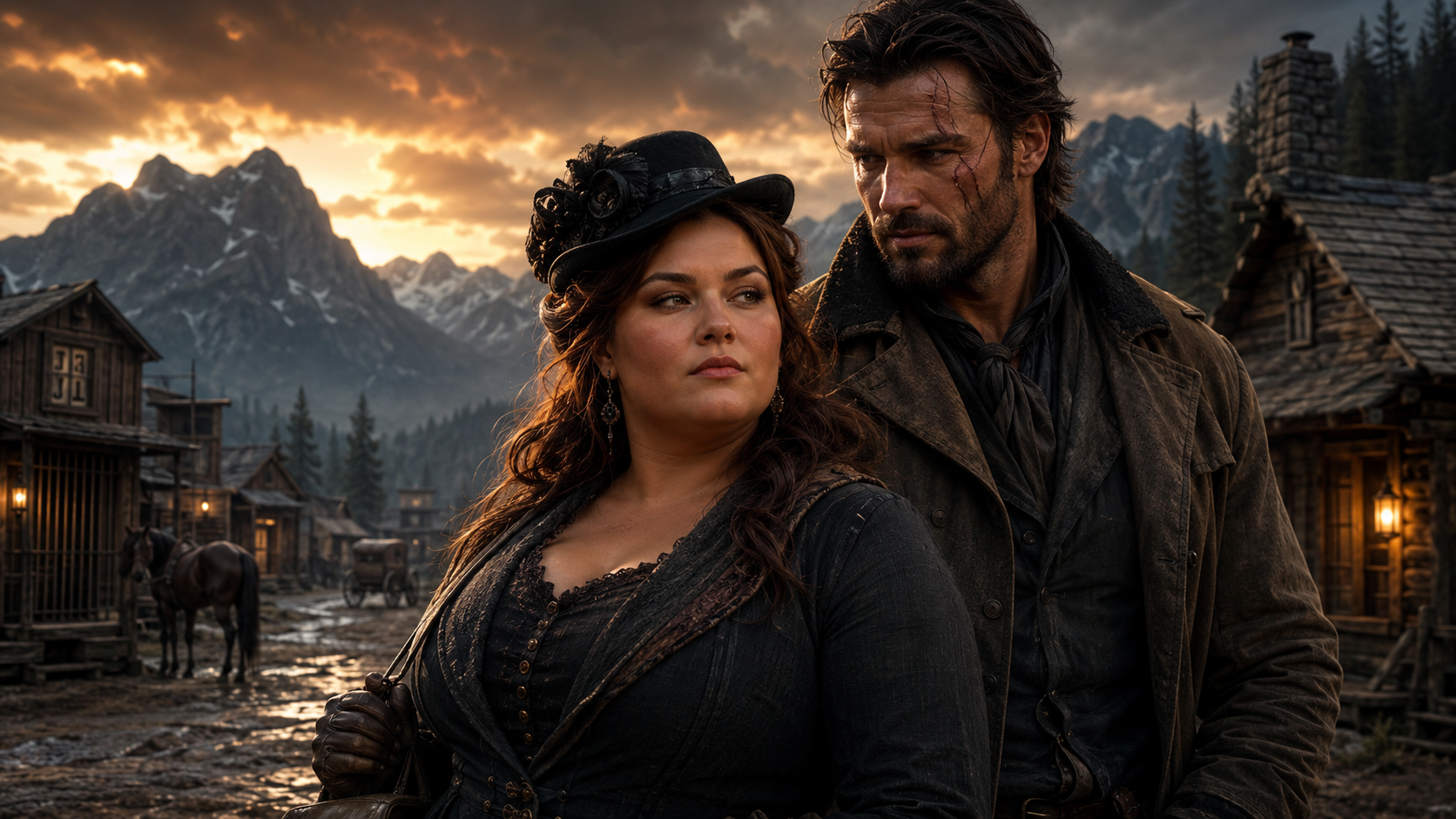
By the time the sixth bride stepped down from the mail wagon, the town had already decided how her story would end.
They had decided it before she put one boot in the mud.
They had decided it before the driver climbed down to lift her trunk.
They had decided it before she straightened her dark traveling dress, adjusted the little hat pinned to her chestnut hair, and looked around at the steep-roofed buildings of Briarfall with the calm, measuring eyes of a woman who had buried too many people to be frightened by gossip.
“She’s bigger than the last one,” someone whispered from the porch of the general store.
“Bigger than all five put together,” another voice muttered.
A few people laughed.
Not loudly. Not bravely.
Briarfall was the sort of town where cruelty liked to pretend it was only observation.
Miriam Bell heard them.
She had spent thirty-four years hearing people believe her body made her deaf, stupid, desperate, harmless, grateful for any crumb of kindness thrown in her direction. She had heard women call her sweet when they meant plain. She had heard men call her sturdy when they meant undesirable. She had heard children repeat insults they were too young to invent.
So she did what she had learned to do.
She let the words pass over her like rain over stone.
Then she reached into her coat pocket, took out a folded letter, and looked once more at the name written on it.
Gideon Rusk.
The scarred rancher of Blackpine Ridge.
The man five brides had come to marry.
The man five brides had fled.
The man the town said was cursed, cruel, half-mad, and hungry for a wife only because no woman with sense would touch him after seeing his face.
Miriam had not come because she wanted a husband.
She had come because her sister had died with Gideon Rusk’s name hidden in the hem of her mourning dress.
The mail wagon driver dragged her trunk from the back and set it down in the mud with a grunt.
“Best leave that here,” he said, not meeting her eyes. “No need hauling it up the ridge if you’ll be back by morning.”
Miriam looked at him.
“I paid you to bring it from Helena.”
“You did.”
“Then I expect it handled like it belongs to a paying passenger, not a doomed animal.”
The driver blinked, startled by the coolness in her voice.
From the general store porch, the laughter stopped.
Miriam bent, gripped the trunk handle herself, and pulled it upright. The mud sucked at the wheels. She pulled again. The trunk came free with an ugly wet sound.
Someone clapped slowly.
The man doing it stood in front of the general store with a cigar between his fingers and a smile that showed every tooth but no warmth.
He was lean, silver-haired, and dressed too well for a town with more snow than money. His waistcoat was blue velvet. His boots were polished. His watch chain flashed against his stomach when he moved.
“Mrs. Bell, I presume,” he said.
“Miriam Bell.”
“Elias Crowe.” He tipped his hat. “Owner of this establishment, half the freight office, and most of the patience left in this town.”
“That sounds exhausting.”
His smile thinned.
A woman beside him coughed into her glove.
Elias Crowe came down the steps. “We’ve been expecting you. Gideon Rusk rarely comes to town unless forced, and when he does, most people prefer not to stand too close.”
“I was told he would meet me.”
“You were told a hopeful lie.” Elias looked past her toward the road climbing into the pines. “Blackpine Ridge is a hard place. Harder than it looks. I feel honor-bound to say that before you make the same mistake as the others.”
“The others?”
“Surely you know.” He lowered his voice as though offering kindness, but his words were meant for the whole street. “Five women came before you. Five decent women. Each of them believed she could tame loneliness. Each of them discovered loneliness was not the danger.”
Miriam folded the letter and tucked it away.
“What was the danger?”
Elias Crowe’s eyes gleamed.
“Gideon Rusk.”
At that moment, a boy came running around the corner so fast he nearly slipped in the mud.
“Mr. Crowe!” he shouted. “Sheriff’s got Rusk tied behind the jail!”
The street changed.
Windows opened.
Doors creaked.
Men stepped from shadows with sudden interest. Women gathered their skirts and moved toward the jail in pairs, eager and afraid.
Elias’s expression flickered.
Only for a heartbeat.
Miriam saw it.
Then he smiled again. “It appears your bridegroom has made your decision easier.”
“My decisions are rarely made by crowds.”
She took hold of her trunk and began dragging it toward the jail.
“Mrs. Bell,” Elias called after her, “that is not wise.”
Miriam did not look back.
“I have survived a train wreck, a winter childbirth that ended in two graves, and a room full of church ladies deciding which pies were acceptable for a funeral supper. I do not frighten easily.”
The crowd followed her.
Briarfall’s jail sat at the end of the street, a square timber building with iron bars and a crooked sign. Behind it, in a yard churned with mud, a man stood with his wrists tied to a hitching post.
He was taller than Miriam expected.
Not merely tall, but built like the mountain had taken a human shape and forgotten to make it gentle. His shoulders strained against a weather-dark coat. His hat lay in the mud. Black hair fell across his brow. A long scar cut from his left temple down across his cheek and vanished into the beard along his jaw.
It was not a tidy scar.
It was pale, raised, and brutal.
It pulled slightly at the corner of one eye, giving his face a permanent look of pain or anger, depending on what a person wanted to see.
The town had clearly chosen anger.
Miriam chose pain.
Sheriff Cale Dobbs stood a few feet away with a shotgun resting over one arm. He was a thick man with nervous eyes.
“Gideon Rusk,” Elias said smoothly, stepping into the yard, “you have a visitor.”
Gideon did not look at the storekeeper.
He looked at Miriam.
His eyes were gray.
Not cold, exactly.
Tired.
He looked at her face first. Then at the trunk behind her. Then at the crowd. His mouth tightened.
“You should leave,” he said.
His voice was low, rough from disuse or weather.
Miriam stepped closer. “That is a poor greeting for a man expecting a bride.”
“I stopped expecting brides after the third one.”
“And yet you wrote.”
“I answered a letter. That is not the same as asking a woman to ruin herself.”
A murmur moved through the crowd.
Miriam heard the word ruin repeated twice.
She looked at the sheriff. “Why is he tied?”
Sheriff Dobbs shifted his weight. “Disturbance.”
“What sort?”
“He struck Mr. Crowe.”
Miriam turned her head toward Elias.
Elias touched a finger to the bruise blooming along his jaw. “A misunderstanding.”
Gideon’s expression darkened. “Tell it plain.”
“All right,” Elias said, still smiling. “Mr. Rusk accused me, in front of witnesses, of hiding his mail.”
“Were you?”
The question landed quietly.
Elias’s smile vanished.
Sheriff Dobbs stared at her. “Mrs. Bell, you don’t know what you’re stepping into.”
“That is why I asked.”
Gideon looked at her more carefully now.
Elias gave a small laugh. “You see? Already he has begun. This is how it happens. First he convinces a woman the town is against him. Then he takes her up that ridge where no one can hear her change her mind.”
Miriam studied him.
“Did the first five change their minds before or after speaking with you?”
The yard went silent.
Gideon’s shoulders went still.
Elias Crowe did not move.
But something in his face tightened, like a shutter pulled too quickly across a window.
“I beg your pardon?” he said.
“The five brides. Did they speak with you before they fled?”
“That is an offensive question.”
“Yes.”
Miriam turned back to the sheriff. “Untie him.”
Sheriff Dobbs laughed once. “Ma’am, this is not your business.”
“It became my business when your town used my arrival as theater.”
“He assaulted a man.”
“Then charge him or release him.”
Dobbs looked at Elias.
Miriam noticed that too.
So did Gideon.
A small change passed over Gideon’s face. Not surprise. Confirmation.
Elias sighed as if surrounded by unreasonable children. “Sheriff, let him go. We don’t need more unpleasantness in front of Mrs. Bell.”
The sheriff hesitated, then untied Gideon’s wrists.
Gideon pulled free and rubbed one wrist with the opposite hand. The rope had bitten deep enough to leave blood.
Miriam took a handkerchief from her sleeve and held it out.
He stared at it.
The crowd stared harder.
“Take it,” she said. “Before you bleed on your own pride.”
Something almost like amusement moved through his eyes.
He accepted the handkerchief.
Their fingers did not touch.
He wiped the blood from his wrist and handed it back.
“Keep it,” Miriam said.
“I’ll ruin it.”
“It is a handkerchief, Mr. Rusk. Its purpose is not decoration.”
A faint sound escaped him.
Not quite a laugh.
Not quite forgotten.
But close enough that the town seemed offended by it.
Miriam saw it then: the town did not merely fear Gideon Rusk.
They needed him to be fearsome.
A monster was useful.
A lonely man was not.
Gideon picked his hat from the mud and struck it once against his thigh. “My horse is at the livery.”
“My trunk is behind me.”
“You brought a trunk?”
“I dislike arriving unprepared.”
“You won’t need half of what’s in it.”
“You don’t know what’s in it.”
He looked toward the ridge road. “Trail turns mean after dusk.”
“Then we should not waste daylight.”
Elias stepped forward. “Mrs. Bell, I urge you—”
Miriam faced him fully.
“Mr. Crowe, I have received your warning, your insult, and your performance. That is enough of you for one afternoon.”
A few people gasped.
Gideon looked at her as if she had done something more dangerous than slap a wolf.
Elias bowed slightly.
But his eyes had gone flat.
“As you wish,” he said. “The mountain keeps what it takes.”
Miriam smiled without warmth.
“Only if no one digs.”
For the first two miles, Gideon said nothing.
Miriam rode a brown mare he had borrowed from the livery, while he rode ahead on a black horse with one torn ear. Her trunk had been tied to a pack mule that looked as offended by the arrangement as the town had been by her confidence.
The road climbed quickly out of Briarfall.
Below them, the town shrank into a scatter of roofs, smoke, and judgment. Above them, Blackpine Ridge rose dark and steep, its trees packed so tightly that sunlight entered in broken pieces. Spring had touched the valley, but winter still hid beneath the pines. Snow lingered in the shadows. Meltwater ran in silver threads down the rocks.
Miriam’s thighs ached after the first hour.
She did not complain.
A lifetime in a large body had taught her the price of admitting discomfort. People used it as proof. Proof she was weak. Proof she was burdensome. Proof she had no business attempting anything difficult.
So she set her jaw and rode.
Gideon slowed after a while.
“You can say if you need to stop.”
“I know.”
“You’re not saying it.”
“I don’t need to stop.”
“You’re gripping the saddle horn like you plan to strangle it.”
“I dislike falling.”
“So do most people.”
“Then most people are sensible.”
He glanced back. “The fourth bride cried by now.”
“I am not the fourth bride.”
“The second fainted.”
“Did she have a tight corset?”
“Yes.”
“Then she was defeated by architecture, not the mountain.”
This time Gideon did laugh.
It was brief and rusty, but real.
Miriam kept her face forward, giving him the dignity of not being watched while surprised by his own humanity.
After another stretch of silence, he said, “You didn’t come here to marry me.”
“No.”
He nodded once, as if the answer hurt less because he had already expected it.
“Then why?”
“My sister.”
His horse slowed.
Miriam reached inside her coat and removed the folded letter again. “Her name was Beatrice Bell. She came west two years ago to work as a seamstress. Six months later, she wrote that she had discovered something in Briarfall. Something dangerous. Then she stopped writing. The official notice said fever took her.”
Gideon’s face changed.
“You’re Beatrice’s sister.”
“You knew her?”
“Everyone did. She mended half the town’s clothes and refused to let men pay late.”
“That sounds like her.”
“She died at Crowe’s boardinghouse.”
“So I was told.”
His eyes narrowed. “You don’t believe it?”
“My sister was buried in a borrowed dress. When her effects were returned, the hem of her own dress had been ripped open and poorly sewn shut. Inside it was a scrap of paper with your name on it, the words Blackpine Ridge, and a drawing of a bird with a broken wing.”
Gideon stopped his horse.
The forest seemed to lean closer.
“A bird?” he asked.
“A crow, I think.”
He looked back toward the valley, though Briarfall had long disappeared.
“Elias Crowe.”
“Yes.”
“What else was on the paper?”
“Numbers. I think they were parcel records.”
Gideon’s jaw worked. “Why didn’t you take this to the sheriff?”
“Sheriff Dobbs wrote the notice of death.”
He had no answer for that.
Miriam tucked the letter away. “I wrote to you because your name was hidden in my sister’s dress. Your reply was cautious, bleak, and badly punctuated, but it did not sound like a murderer.”
“Generous.”
“I am known for my charity.”
“You called me stubborn twice.”
“You are.”
“I answered three questions.”
“You avoided nine.”
He looked at her then, and for the first time the scar did not dominate his face. His attention did.
“What do you want from me, Mrs. Bell?”
“The truth.”
“Truth is rarely enough.”
“It is when a lie is standing on someone’s grave.”
Gideon turned forward again.
The road narrowed.
A hawk screamed above the trees.
After a while, Miriam asked, “What happened to the five brides?”
“They left.”
“That is the town’s answer. I asked for yours.”
His shoulders stiffened.
“First was Cora Lane. She saw my face at the stage stop and turned white. Elias Crowe offered her a room to recover. By morning she was gone.”
“And the second?”
“Agnes Miller. She made it to the church steps. Someone told her I had buried my mother under the kitchen floor. She left before supper.”
“Had you?”
“No.”
“Where is your mother buried?”
“Under the aspen trees above my pasture.”
“The third?”
“Lydia Marsh. She came to the cabin. Stayed two nights. On the third, she found a dead raven nailed above the door and said it was an omen.”
Miriam felt a cold pressure at the back of her neck.
“A raven?”
“Black bird. Could have been a crow. Hard to tell once a thing has been butchered.”
“And the fourth?”
“Ruthie Crane. She heard a woman crying in the woods each night. Said the mountain hated wives.”
“Did you hear it?”
“Yes.”
“Did you find the woman?”
“No.”
“The fifth?”
His hand tightened on the reins.
“Nell Ward.”
Miriam recognized the pause.
Not love, perhaps.
But guilt had its own shape.
“What happened to Nell?”
“She stayed eleven days. She was brave. Kinder than she needed to be. I thought…” He stopped. “Doesn’t matter.”
“It does.”
“She found a child’s shoe in the creek. Pink ribbon still tied through it. She thought it belonged to some poor soul I had hidden. She left before dawn.”
“Did you search?”
“For the child? For her? For whoever planted it? Yes. I found nothing.”
“Did Elias Crowe speak to each of them?”
Gideon pulled his horse to a halt so sharply the pack mule snorted.
Slowly, he turned.
“What did you say?”
“Did Elias Crowe speak to each bride before she fled?”
His face went very still.
Miriam watched the memories assemble behind his eyes.
“Cora stayed at his boardinghouse,” he said. “Agnes bought a cloak from his store. Lydia had tea with his sister. Ruthie sent a telegram from his office. Nell…” His voice dropped. “Nell told me Crowe warned her not to trust any man who lived above a graveyard.”
“Do you live above a graveyard?”
“No.”
“Then he lied.”
“People lie about me often.”
Miriam looked into the darkening trees.
“Yes,” she said. “But this lie had a pattern.”
They reached Gideon’s cabin near sunset.
It stood in a clearing beneath a wall of black rock, built from whole logs and roofed in cedar shakes. A creek ran behind it, wild with snowmelt. Beyond the creek, the pasture sloped toward a stand of aspens whose white trunks glowed like bone in the fading light.
The cabin was plain, but not neglected.
Wood was stacked under the eaves. Tools hung in order beside the door. A small barn stood nearby, its doors repaired with newer planks. The porch held two chairs.
One had been used often.
The other had hardly been touched.
Miriam saw Gideon notice her noticing.
“It came with the place,” he said.
“The chair?”
“The hope.”
She said nothing.
Inside, the cabin was warm and spare. A stove. A table. Shelves of flour, beans, coffee, lamp oil, cartridges, and medicine. A bed behind a curtain. A narrow cot near the hearth. A carved wooden horse sat unfinished on the mantel, its legs only partly shaped.
“You carve?” Miriam asked.
“When the weather traps me.”
“It is good.”
“It has no legs.”
“Many good things begin unfinished.”
He looked away as if the compliment had touched a bruise.
Miriam removed her gloves. “Where would a guest sleep?”
“The cot.”
“And where did Nell sleep?”
“The cot.”
“Where did she find the shoe?”
“Creek bank. East side.”
“I want to see it.”
“It’s nearly dark.”
“Then bring a lantern.”
His expression hardened. “You just arrived.”
“My sister has been dead two years.”
“That doesn’t mean you should walk into the trees at night.”
“No. It means I have already waited too long.”
For a moment, Miriam thought he would refuse.
Then Gideon took a lantern from a hook, lit it, and opened the door.
The creek was loud in the twilight. Miriam followed him along a narrow path edged with wet grass. The air smelled of pine resin and cold water. Somewhere far off, an owl called once.
Gideon stopped near a bend where the bank dipped lower.
“There,” he said. “Caught between those stones.”
Miriam crouched carefully. The mud was soft. Old footprints would not have lasted, but the shape of the place mattered.
“Could a shoe drift here from upstream?”
“Yes.”
“Is there a settlement upstream?”
“No.”
“A cabin?”
“Mine is the only one for eight miles.”
“Then someone placed it.”
“That was my thought.”
“Did you tell the sheriff?”
“I told Dobbs many things. He heard what he wanted.”
Miriam stood.
A branch cracked behind them.
Gideon moved instantly.
He stepped in front of her, one hand reaching beneath his coat.
“Who’s there?” he called.
The creek answered.
The trees did not.
Another sound came.
Soft.
High.
A woman crying.
Miriam’s skin tightened.
It drifted through the pines like grief with no body. A thin, broken sob. Then another. Then a whisper that might have been a name.
Gideon’s face turned to stone.
“That,” he said, “is what Ruthie heard.”
Miriam forced herself to breathe slowly.
The crying stopped.
From somewhere deeper in the trees came a man’s low chuckle.
Then silence.
Gideon grabbed the lantern and strode forward.
Miriam caught his sleeve.
“No.”
“They’re close.”
“Yes. And they want you angry.”
His nostrils flared. “I am angry.”
“I can see that. Try being useful instead.”
He stared down at her hand on his sleeve.
She released him.
For a second, neither of them moved.
Then he lowered his voice. “Back to the cabin.”
They had taken only three steps when something struck the ground at Miriam’s feet.
A stone.
Wrapped in white cloth.
Gideon raised his pistol toward the trees.
Miriam bent before he could stop her and picked up the cloth.
It was not cloth.
It was a torn piece of bridal veil.
Pinned through it was a scrap of paper.
The message had been written in block letters.
SIXTH BRIDE, SIXTH GRAVE.
Gideon went pale beneath the scar.
“You’re leaving at first light.”
“No.”
“You saw this.”
“I read it.”
“Then understand it.”
“I do.”
“No, you don’t.” His voice rose. “This is not a parlor game. Someone followed us. Someone came onto my land. Someone knows you’re here.”
“Good.”
“Good?”
“Yes. It means I frightened them.”
Gideon looked as if he could not decide whether to shake her or admire her.
“They threatened to bury you.”
“People who intend murder quietly do not usually send invitations first.”
“You’re gambling with your life.”
“I have been doing that since I opened my sister’s trunk.”
His anger faltered.
The crying sound began again, farther away now.
Miriam turned toward it.
This time, beneath the false sobbing, she heard something else.
A metallic scrape.
A hinge.
Not a ghost.
Not a woman.
A device.
She said, “Tomorrow we search the ridge.”
“We?”
“Yes.”
“No.”
“Then I search alone and fall into a ravine. You will feel terrible.”
“You are difficult.”
“You are observant.”
He exhaled through his nose.
The crying stopped once more.
Above them, the pines shifted in the wind like witnesses changing their stories.
They did not sleep much.
Gideon dragged a chest against the cabin door and sat in a chair facing the window with his pistol on his knee. Miriam lay on the cot, still dressed, a blanket pulled over her. The fire burned low. Shadows moved across the ceiling.
Around midnight, Gideon spoke.
“Mrs. Bell.”
“Yes?”
“Why did your sister come to Briarfall?”
“To start over.”
“From what?”
“A man who mistook love for ownership.”
Gideon said nothing.
Miriam watched the fire sink and glow.
“Beatrice was pretty in a way that made people forgive her before she spoke,” she said. “I was not. So I learned to speak clearly.”
“That sounds lonely.”
“It was useful.”
“Useful things can still be lonely.”
She turned her head toward him.
His scar looked harsher in the firelight. Not monstrous. Simply permanent.
“How did it happen?” she asked.
He knew what she meant.
“A mine blast. I was twenty-two. My father was trapped below. I went in after him. Came out with half my face opened and him dead in my arms.”
“I’m sorry.”
“Most people ask if it hurt.”
“Did it?”
“Yes.”
“Then I’m sorrier.”
His eyes lowered.
After a while he said, “When the first bride ran, I understood. When the second ran, I expected it. By the fifth, I thought maybe the mountain was warning women away from me because I had stopped deserving company.”
Miriam felt the ache in that confession more than she wanted to.
“Loneliness is a poor judge of worth,” she said.
“So is a town.”
“Yes. But towns are louder.”
At dawn, they found footprints by the creek.
Two sets.
One large, one narrow.
Both leading away from the cabin toward the east ridge.
Gideon knelt in the mud. “Not mine.”
“Crowe?”
“Maybe. The larger print has a nailed heel.”
“Does Elias Crowe wear nailed heels?”
“No. But his freight men do.”
They followed the tracks with a rifle, a lantern, rope, and two biscuits wrapped in cloth. Miriam insisted on bringing her notebook. Gideon looked at it as if paper could not possibly help in a forest full of threats.
“You would be amazed what men confess to paper,” she said.
“I prefer when they confess to my fist.”
“That is why one of us is frequently tied behind jails.”
He grunted.
The trail climbed through black pines and granite outcrops. Twice Gideon offered a hand over difficult stones. Twice Miriam accepted without apology. She did not mistake help for weakness, and he did not offer it like charity. That made the taking easier.
They found the first machine inside a hollow stump.
It was a small bellows, a reed pipe, and a cord threaded through brush.
When the cord was pulled from a distance, the air pushed through the reed and made a sound like a woman crying.
Gideon stared at it.
His face emptied.
Then filled with something worse than anger.
“Ruthie,” he said.
Miriam crouched beside the stump. “Someone used this to drive her away.”
“She thought it was a spirit.”
“She was meant to.”
He ripped the device free and hurled it against a rock. It shattered.
Miriam did not stop him.
Some grief deserved the dignity of breaking something.
Farther up the ridge, they found a second trick: a line of black feathers tied to fishing wire, arranged so they would flutter against a window in the wind. Near it, nailed to a tree, was a strip of rotted leather from a child’s shoe.
Gideon touched it as if it were a bone.
“Nell,” he said.
Miriam wrote everything down.
“What did Nell know?” she asked.
“What do you mean?”
“Five women were frightened off. Not robbed. Not killed. Frightened. That suggests they were obstacles, not targets.”
“To what?”
“To you.”
He looked at her.
“Your land,” she said. “Your name was in my sister’s dress with parcel numbers. You own something someone wants.”
“I own rocks, trees, bad weather, and debt.”
“Who holds the debt?”
“Crowe bought my note from the bank last winter.”
Miriam closed her notebook.
“There it is.”
“No. If he wanted my land, he could foreclose.”
“Not if there is something beneath it that would make a court ask questions.”
Gideon’s eyes shifted toward the upper ridge.
“The old Raven Spur claim,” he said.
“What is that?”
“An abandoned mine. My father said part of it crossed under our pasture, but no survey ever proved it.”
“Who owned the claim?”
“A company from Denver. Gone now.”
“Companies rarely vanish. They become other companies wearing cleaner gloves.”
He almost smiled.
Then a gunshot cracked across the ridge.
Bark exploded from the tree beside Miriam’s shoulder.
Gideon threw himself into her, driving her behind a boulder. She hit the ground hard enough to knock the breath from her lungs.
A second shot sparked against stone.
Gideon crouched over her, rifle in hand.
“Miriam.”
It was the first time he had used her name.
She heard it through the ringing in her ears.
“I’m not hit,” she said.
“You’re sure?”
“I am angry, which suggests I am alive.”
Another shot struck high.
Gideon lifted his rifle, waited, and fired once.
Somewhere through the trees, a man cursed.
Then came crashing footsteps, retreating fast.
Gideon started after him.
Miriam grabbed the back of his coat.
“Don’t chase a man who wants to lead you somewhere.”
He froze.
His breathing was hard.
“You were almost killed.”
“Yes. Which makes my advice unusually informed.”
He looked down at her, still half-sprawled in mud and pine needles, her hat crooked, her cheek scratched, her eyes furious.
Something changed in him then.
Not softness.
Respect.
He held out a hand.
She took it.
He pulled her to her feet as if her weight did not surprise him, offend him, or require comment.
Miriam brushed mud from her skirt. “Now we know they will shoot before they will let us reach that mine.”
“Then we go back.”
“To the cabin?”
“To town.”
She blinked. “Town?”
“You wanted truth. Truth needs witnesses.”
“Briarfall will not believe you.”
“No.”
His jaw tightened.
“But they might believe you.”
By afternoon, they rode into Briarfall with the broken crying device tied to Gideon’s saddle and the strip of child’s shoe wrapped in Miriam’s handkerchief.
The town gathered immediately.
People always found time for disgrace.
Elias Crowe came out of the general store, wiping his hands on a linen cloth.
“How surprising,” he said. “The bride returns alive.”
Miriam dismounted slowly. Her whole body hurt. She refused to show it.
“Disappointed, Mr. Crowe?”
His smile held.
“Relieved, of course.”
Gideon untied the device from his saddle and threw it into the mud at Elias’s feet.
The crowd leaned closer.
Sheriff Dobbs stepped out of the jail. “What’s this?”
“A voice,” Miriam said. “A false one.”
Elias glanced at it, then back at her. “I have no idea what that means.”
“It means Ruthie Crane did not hear a ghost. Someone built a machine to make her believe she did.”
A murmur went through the crowd.
Miriam held up the strip of leather. “Nell Ward did not find a child’s shoe by chance. Pieces of it were planted above the creek.”
Gideon looked at the faces around them.
Some curious.
Some ashamed.
Some afraid.
Miriam continued, “Five women were driven away from Blackpine Ridge. Each fright was tailored to what each woman feared. The stories spread afterward made Gideon Rusk look dangerous, unstable, cursed.”
Elias laughed softly.
“This is quite a tale.”
“Yes,” Miriam said. “But not as impressive as the one you have been telling.”
His eyes sharpened.
Sheriff Dobbs frowned. “Careful now.”
Miriam turned to him. “My sister died in your town two years ago. You signed the notice.”
Dobbs paled.
Elias went still.
The crowd shifted.
“Beatrice Bell,” Miriam said. “Seamstress. Buried after a supposed fever. Her belongings were searched before they were returned. Someone missed the paper hidden in her dress.”
Elias’s voice lowered. “Mrs. Bell, grief can twist memory.”
“My memory is excellent.”
“That does not make your accusations sane.”
“No. Evidence does.”
She took the folded scrap from her pocket.
Elias moved before anyone else understood why.
He reached for it.
Gideon caught his wrist.
The street froze.
Elias’s mask slipped entirely.
For one second, Miriam saw the man underneath: not polished, not patient, not amused.
Afraid.
Gideon leaned close. “Don’t.”
Elias pulled his hand back.
Miriam opened the paper. “Parcel numbers. A crow mark. Blackpine Ridge. My sister found records tying the Raven Spur claim to land beneath Gideon’s pasture.”
Sheriff Dobbs swallowed. “That don’t prove—”
“No. But the county office will have copies. Unless, of course, they burned.”
Elias said nothing.
Miriam looked at him. “Did they burn, Mr. Crowe?”
His smile returned in pieces.
“You are a clever woman,” he said.
“How unfortunate for you.”
The crowd made a sound—half shock, half delight. Briarfall enjoyed cruelty, but it enjoyed a clean strike even more.
Elias stepped closer, lowering his voice so only Miriam and Gideon heard.
“You should have stayed home, fat bride.”
Gideon moved.
Miriam stopped him with one hand.
She looked Elias Crowe in the eye.
“My body has carried grief, work, hunger, winter, and more insults than a small man like you could invent in a lifetime. It has carried me across five states to stand here. It will carry me to the county office tomorrow. And if necessary, it will carry me to court.”
Elias’s face flushed.
Miriam smiled.
“But yours may have trouble carrying you to prison.”
That night, no room in Briarfall would take them except the church.
The preacher’s wife, Mrs. Lark, unlocked the side door without meeting Gideon’s eyes.
“You can sleep in the meeting room,” she said. “Both of you. Doors stay open.”
Miriam almost laughed. “Madam, if impropriety were my intention, I would choose a warmer floor.”
Mrs. Lark colored and hurried away.
Gideon spread his coat on the boards for Miriam.
She looked at it.
“I am not a porcelain doll.”
“No. Porcelain breaks easier.”
“Is that a compliment?”
“I’m poor at them.”
“I noticed.”
He sat with his back against the wall. Moonlight fell across the scarred side of his face.
After a while he said, “He called you that.”
“He was not original.”
“I wanted to break his mouth.”
“I know.”
“You stopped me.”
“I need you free.”
He looked at her. “Only for that?”
The question was quiet.
Dangerous in a way no gunshot had been.
Miriam felt the answer rise too quickly.
She looked down at her hands. Strong hands. Capable hands. Hands that had closed her sister’s trunk, copied legal papers, kneaded bread, dressed bodies for burial, and held no one in tenderness for a very long time.
“No,” she said.
Gideon did not move.
Outside, the town slept badly.
Inside, Miriam listened to her own heart behaving like a foolish girl’s.
At dawn, they found Mrs. Lark gone and the church door locked from the outside.
Gideon rose at once.
“Stand back.”
“From what?”
“The door.”
He kicked it once.
The wood cracked.
A second kick splintered the latch.
They stepped into pale morning and found the street empty.
Too empty.
Then the bell above the jail rang three times.
A warning.
Or a summons.
They ran.
In front of the jail, a wagon waited with a canvas-covered load. Sheriff Dobbs stood beside it, hat in hand, sweating through his shirt though the morning was cool.
Elias Crowe stood near the general store, surrounded by four freight men.
One of them had a bandage around his upper arm.
Miriam recognized him.
The shooter from the ridge.
Elias saw her notice.
His smile said it no longer mattered.
“Mrs. Bell,” he called. “You wanted evidence.”
Gideon’s hand moved toward his pistol.
Miriam saw the freight men shift.
“Wait,” she whispered.
Elias nodded to the sheriff.
Dobbs pulled back the canvas.
A woman lay beneath it.
Alive.
Barely.
Her hair was tangled. Her face hollow. Her wrists bruised raw. But when the morning light touched her, she turned her head.
Gideon stopped breathing.
“Nell,” he said.
The fifth bride opened cracked lips.
“Gideon?”
The town erupted.
Gideon moved toward her, but the freight men raised their guns.
Elias lifted one hand. “Careful. We found her wandering near Rusk’s land. Half-starved. Raving. She says he kept her hidden.”
Nell’s eyes widened.
“No,” she rasped.
Sheriff Dobbs flinched.
Elias’s voice sharpened. “The poor woman is confused.”
Miriam walked forward.
A gun pointed at her.
She kept walking.
“Miriam,” Gideon warned.
She ignored him and climbed onto the wagon step.
Nell looked at her.
Miriam took her hand gently. “My name is Miriam Bell. Did Gideon Rusk hurt you?”
Nell’s fingers tightened with surprising force.
“No.”
The word was small.
But the town heard it.
Elias laughed. “She’s delirious.”
Miriam did not look away from Nell. “Who took you?”
Nell’s eyes shifted.
Fear swallowed her face.
Elias said, “Enough.”
Miriam leaned closer. “You survived. Say it once. That is all.”
Nell’s lips trembled.
“Crowe,” she whispered.
The street went dead silent.
Elias’s hand dropped toward his coat.
Gideon drew first.
So did the freight men.
For one terrible second, Briarfall balanced on the edge of slaughter.
Then Mrs. Lark stepped out of the church holding a shotgun.
“Elias Crowe,” she said, voice shaking but loud, “you lower that pistol or I swear before God I’ll put you down in the street.”
Everyone turned.
The preacher’s wife stood in her plain gray dress, hair falling loose from its pins, eyes full of holy fury.
Behind her came the blacksmith.
Then the livery owner.
Then the mail driver.
Then two women from the laundry, both carrying rifles too large for them but held steady enough.
Briarfall had believed lies for years.
But belief was not loyalty.
And Elias Crowe had forgotten that cowards often changed sides when the winning side became unclear.
The freight man with the bandaged arm dropped his gun first.
Then another.
Sheriff Dobbs backed away from Elias.
“You fool,” Elias hissed.
Dobbs’s face crumpled. “You said no one would get killed.”
Nell began to sob.
Miriam held her hand.
Gideon’s pistol never left Elias.
“Where is Beatrice Bell buried?” Miriam asked.
Elias looked at her.
Then at the armed townspeople.
Then at the road, calculating.
He smiled once more.
“I don’t know.”
Nell whispered, “Raven Spur.”
Miriam closed her eyes.
Gideon’s face turned murderous.
Elias lunged.
Not at Gideon.
At Miriam.
He seized her and dragged her against him, a derringer pressed under her chin.
Gideon froze.
The whole street froze with him.
Elias’s breath was hot against Miriam’s ear.
“Move,” he said, “and she dies.”
Miriam felt the barrel under her jaw.
She felt the old, familiar rage of being underestimated.
Elias believed her body made her slow.
He believed size meant softness.
He believed fear would make her obedient.
Miriam drove her heel down on his instep with every ounce of strength she possessed.
Elias screamed.
She slammed her head backward into his nose.
The derringer fired into the air.
Gideon crossed the distance like a storm breaking.
He struck Elias once.
Only once.
Elias fell into the mud and did not rise.
The town exhaled.
Miriam touched her jaw where the gun had bruised her skin.
Gideon reached her and stopped just short of touching.
“Miriam.”
“I am all right.”
“You say that too often.”
“And you brood too often.”
His hands were shaking.
She took one of them.
The town saw.
This time, no one laughed.
They found Beatrice before sunset.
Raven Spur Mine lay above Gideon’s pasture, hidden behind fallen timber and old brush. Elias had used it for years to store stolen ore samples, forged deeds, and anything else that tied him to the land he planned to steal. Beatrice had discovered the first copy while mending his coat. Nell had found the second while staying at his boardinghouse after fleeing Gideon’s cabin.
Neither woman had been foolish.
Both had been dangerous because they had paid attention.
Beatrice’s grave was shallow, marked with stones piled to look like a natural fall. Miriam stood beside it as Gideon and the blacksmith dug.
No one spoke.
When they reached the torn blue cloth of her sister’s dress, Miriam made one sound.
Not a scream.
Not a sob.
A broken breath.
Gideon climbed out of the grave and stood beside her.
“I’m sorry,” he said.
Miriam looked at the sky.
The sun had gone red behind the peaks.
“She hated being cold,” she whispered.
Gideon removed his coat and laid it over the remains as if Beatrice might still feel the evening air.
Miriam pressed both hands to her mouth.
It was the gentlest thing anyone had done for her sister since she died.
Two weeks later, Elias Crowe was taken east in chains.
Sheriff Dobbs resigned before anyone could remove him. Nell Ward recovered slowly in Mrs. Lark’s spare room. Ruthie Crane sent a letter saying she had known, deep down, that the crying in the woods had sounded too human to be holy. Lydia Marsh wrote an apology. Agnes Miller sent money for Beatrice’s proper burial. Cora Lane sent nothing, but Miriam did not judge her. Fear made debtors of many people.
Briarfall changed the way towns change when shame becomes public.
Not all at once.
Not beautifully.
But enough.
People stopped crossing the street when Gideon came down from the ridge. The blacksmith repaired his wagon without charging double. The livery owner returned the mule he had “misplaced.” Mrs. Lark brought curtains to the cabin and pretended they were extra.
Miriam stayed through Beatrice’s burial.
Then through Nell’s testimony.
Then through the first snowmelt survey that proved Gideon’s land included part of the Raven Spur vein.
Then, somehow, through spring.
One evening, she stood on the porch of the Blackpine cabin while Gideon repaired the second chair.
“You don’t need to fix it,” she said.
“Yes, I do.”
“Why?”
He did not look up. “Because you keep sitting on the step.”
“It is a good step.”
“It is a poor chair.”
She smiled.
The creek flashed silver below. The aspens moved in the wind. The cabin no longer looked like a place waiting to be abandoned. There were curtains now. A pot of herbs near the door. Books on the shelf beside the ammunition. A blue ribbon tied around the handle of Miriam’s trunk in memory of Beatrice.
Gideon tightened a screw and set the chair upright.
“There,” he said.
Miriam sat.
The chair held.
“So,” she said, “now what?”
He leaned against the porch post. “Now you go back to Helena, I suppose.”
“Do you want me to?”
“No.”
The answer came quickly.
Too quickly for him to hide.
Miriam’s heart gave one hard beat.
“Gideon Rusk,” she said softly, “that was nearly a clear statement.”
He looked at her, scar silver in the evening light.
“I don’t want you to go.”
She folded her hands in her lap.
“Why?”
“Because the cabin sounds wrong when you’re not in it.”
“That is not romance.”
“It’s true.”
“Truth is a beginning.”
He stepped closer.
“I don’t know how to ask a woman to stay without making it sound like a trap.”
“Then don’t ask like a man setting one.”
“How should I ask?”
“Like a man opening a door.”
He looked toward the cabin door, then back at her.
“Miriam Bell,” he said, voice rough, “there is room here if you want it. Not because I need a wife to silence a town. Not because you need a man to protect you. Not because loneliness is easier with any warm body beside it. There is room because I want you here. Because you see me plain. Because when trouble came, you stood your ground. Because I have spent years thinking I was the thing women ran from, and you were the first person to ask who taught them to run.”
Miriam’s throat tightened.
For once, she had no clever answer ready.
Gideon looked terrified by his own honesty.
She stood.
“Gideon.”
“Yes?”
“I did not come here to be your bride.”
“I know.”
“I came to bury a lie.”
“I know.”
She stepped closer.
“But I may stay to plant something honest.”
His eyes changed.
Slowly, giving her every chance to move away, he lifted one hand and touched her cheek.
His palm was rough.
His touch was not.
“May I kiss you?” he asked.
Miriam smiled.
“All this time on a mountain, and you finally ask a sensible question.”
He laughed then.
A real laugh.
Warm, startled, alive.
Then he kissed her beneath the darkening pines, on the porch where five women had once been frightened away by lies, while the sixth woman stayed—not because she was desperate, not because she was fearless, and not because the town had been wrong about her size.
She stayed because the town had been wrong about everything.
And because some graves, once opened, do not only give up the dead.
Sometimes they give the living back their names.

