People in Briar County had a way of weighing women without ever touching a scale.
They weighed them in doorways, in church pews, in grocery aisles, in the silence after a joke went too far and everyone pretended it had not been cruel. They weighed them with eyes, with whispers, with little smiles that said, Poor thing, as if pity were kinder than contempt.
For most of her life, Iris Marlowe had been measured that way.
Too broad in the hips.
Too soft in the arms.
Too round in the face.
Too loud when she laughed.
Too much woman for a porch swing, too much woman for a wedding dress, too much woman for a man to proudly claim in daylight.
She had heard it all by the time she turned thirty-two.
At fourteen, boys at school had called her “the barn door” because she once blocked a hallway while carrying books. At seventeen, a girl she thought was her friend told her she had a beautiful face, then added, “It’s a shame about the rest.” At twenty-four, a ranch hand named Miller Tate kissed her behind the county fair stables, sweet as summer rain, then pretended not to know her the next morning when his friends laughed.
At twenty-nine, she had believed a man named Eli Boone when he said he did not care what anyone thought.
He cared.
He cared enough to visit her at night and avoid her in town. He cared enough to make promises in whispers and break them in public. He cared enough to leave when her belly began to show.
Now Iris lived six miles above the old wagon road, in a cabin her father had built with hands that never learned how to be gentle but always knew how to be loyal. Her father had been dead two winters. Her mother had gone long before that. Eli was a rumor somewhere in Kansas.
And Iris had Micah, her baby boy, nine weeks old, angry at the world whenever his blanket slipped from his chin.
She also had two goats, one aging mare, a stove that smoked when the wind turned east, and a debt at Harlan’s Feed & Supply that Mr. Harlan mentioned with the solemn disappointment of a priest.
She had learned to survive.
Survival was not pretty. It did not wear ribbons. It did not come with music. Survival was splitting wood with sore wrists, mending the same coat twice in one month, boiling potatoes until they became dinner three different ways, and smiling at her son even when fear sat at the table with them.
On the night everything changed, the snow began before sunset.
Not soft snow. Not the kind that made postcards beautiful.
This snow came sideways, driven hard by a mountain wind that rattled the shutters and shoved itself through cracks in the walls. By eight o’clock, the path to the well had vanished. By nine, Iris had dragged in enough firewood to last through morning. By ten, Micah was asleep in the cradle beside the stove, one small fist tucked beneath his chin.
Iris sat at the table with a needle and an old blue dress across her lap. The dress had once belonged to her mother. It had been made for a slimmer woman, one who floated rather than worked, one who had never chopped ice from a water bucket or carried feed on her shoulder.
Iris was letting out the seams.
Again.
The needle flashed in the lamplight.
Outside, the storm howled like something alive.
She was tying off a thread when she heard the first sound.
Not thunder.
Not wind.
A pounding.
Three hard strikes against the door.
Iris froze.
No one came to her cabin in weather like this unless they were lost, desperate, or dangerous. Sometimes all three were the same thing.
She stood slowly, reached for the rifle above the mantle, and crossed the room without making the floorboards complain. Micah stirred but did not wake.
The pounding came again.
Then a man’s voice, broken by cold and panic.
“Please! Open the door!”
Iris did not answer.
She lifted the rifle.
“Who are you?”
A pause.
Then, “My name is Callum Reid. My baby’s sick. She’s not breathing right. Please, ma’am. I’m begging you.”
The word baby went through Iris like a knife.
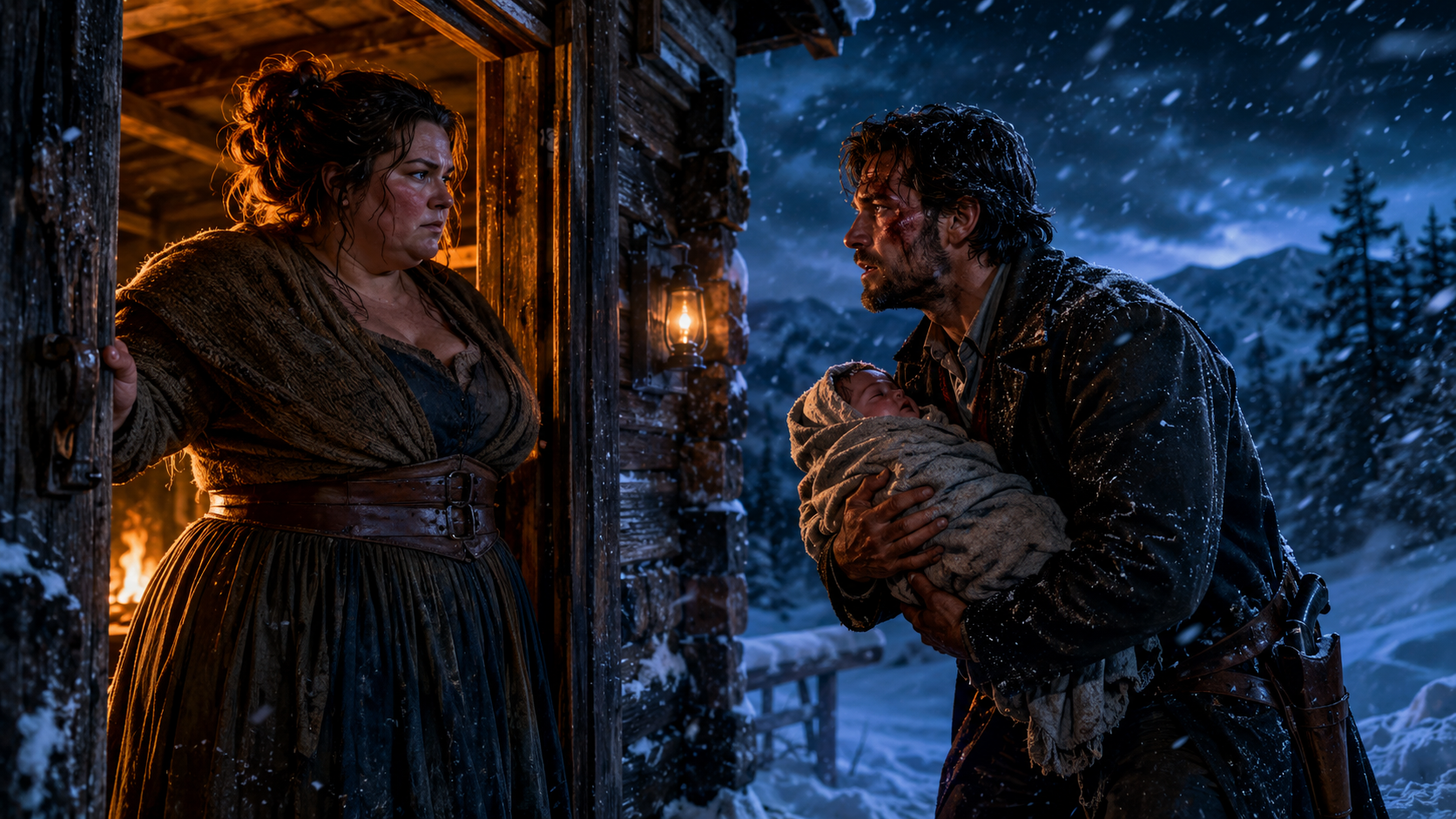
She unlatched the door but kept the chain fastened. When she opened it the width of her hand, snow blew into the room.
A man stood on her porch, tall, broad-shouldered, half-covered in white. Blood had frozen dark along one side of his forehead. His coat was torn. In his arms, bundled beneath his jacket, was a tiny child wrapped in a blanket already stiff with frost.
The man’s eyes were not proud. Not commanding. Not rich-man eyes.
They were terrified.
“Please,” he said again. “She’s burning up. Then she went cold. I don’t know what to do.”
Iris saw the baby’s face.
The little girl’s lips were pale blue.
Iris dropped the chain.
“Get inside.”
The man staggered over the threshold so suddenly she had to grab his sleeve to keep him from falling. He smelled of snow, blood, leather, and horse sweat. Not whiskey. That mattered.
“Set her near the stove, but not too close,” Iris ordered.
He obeyed at once.
Most men did not. Most men heard a woman’s command and needed a moment to wrestle with their pride before common sense won.
This man simply moved.
Iris shut and barred the door, then dropped to her knees beside the baby.
“How old?”
“Four months.”
“Name?”
“June.”
The baby made a thin, catching sound. Not quite a cry. Not enough air for that.
Iris unwrapped the blanket, touched the child’s cheek, then her chest, then the hollow of her throat. Heat burned beneath the skin, but her hands and feet were chilled dangerously cold.
“How long has she been sick?”
“Since yesterday morning. Fever. Cough. I was trying to get her to the doctor in Alder Creek, but the road washed out near the pass. Then the storm hit. Then—”
He stopped.
Iris looked up.
“Then what?”
Callum’s jaw tightened. “Then my horse went down.”
“That cut on your head wasn’t made by a horse.”
He said nothing.
Iris held the baby upright against her chest and listened to the wet rattle in her breathing. Pneumonia, maybe. Or close enough that the difference did not matter tonight.
“Boil water,” she said.
The man blinked. “What?”
“Pot. Water. Stove. Move.”
He moved.
Iris carried the baby closer to the warmth, not enough to shock her cold limbs, and began rubbing her back in small firm circles. The child’s breath shuddered. Iris tilted her carefully, supporting the tiny head.
“Come on, little bird,” Iris whispered. “You don’t leave the sky yet.”
Callum turned from the stove.
“Can you save her?”
The question was raw.
Iris hated questions like that. They asked a person to become God for a moment, and God had never answered Iris when she needed him most.
“I can help her breathe,” she said. “That is what I can do.”
Callum swallowed hard.
“What else?”
“You can stop asking questions and bring me that kettle when it sings.”
He nodded.
Iris crushed dried mint and pine needles into a bowl, added hot water, and made a tent with a blanket so the steam could rise around the baby without burning her. She worked from memory. Her father had taught her mountain remedies. Her mother had taught her how to sit with sickness without flinching. Her own son had taught her that fear could make a woman’s hands steadier, not weaker.
Callum knelt across from her, watching every breath his daughter took.
Only then did Iris notice his clothes.
Even ruined by storm, they were expensive. His boots were custom-made. His coat, though torn, had been cut by a tailor who expected payment in large bills. His gloves were fine leather, one missing, one soaked through.
She knew his name now.
Callum Reid.
Everyone in Briar County knew that name.
The Reids owned Blackthorn Ridge, the largest cattle spread west of Denver, with land that rolled from foothills to high pasture and a house made of stone, glass, and old money. Callum Reid had been on the front page of the state paper three months ago when his father died. He was the millionaire cowboy, the man who inherited cattle, mineral rights, rail contracts, and half the valley’s gossip.
Iris had once heard two women in Harlan’s store sigh over his photograph.
A man like that, they said, could marry anybody.
A man like that would never look twice at a woman like Iris Marlowe.
Now he was kneeling on her floor, bleeding into his collar, helpless as any poor man in a storm.
June coughed.
It was a small, horrible sound.
Then she drew a deeper breath.
Callum leaned forward.
Iris lifted one hand. “Slow.”
He froze.
The baby’s lips lost a little of their blue.
Iris exhaled.
“There she is.”
Callum covered his mouth with his hand. His shoulders shook once, violently, before he forced himself still.
“Thank you,” he whispered.
“Don’t thank me. Not yet.”
He looked at her.
“She’s alive.”
“She’s fighting. There’s a difference.”
His face changed at that. Not anger. Understanding. The kind that had already been punished.
Iris glanced at his wound.
“Sit.”
“I’m fine.”
“Men say that right before they fall on my floor.”
“I won’t.”
“If you fall on my floor, I’ll leave you there until morning.”
That startled a faint laugh out of him. It vanished almost immediately, as if he had forgotten laughter was allowed.
He sat.
Iris set June carefully in a padded basket near the stove, still upright and wrapped in warmth, then took a clean cloth from the shelf. When she touched Callum’s forehead, he flinched.
“That wasn’t your horse,” she said.
“No.”
“Tree branch?”
“No.”
“Then we’re done pretending.”
His eyes met hers.
For the first time, Iris saw the full force of them. Gray, tired, fevered with worry, but steady. He did not glance away from her face to her body the way men often did, as if checking whether the rumors were accurate.
He looked at her like she was the only solid thing left in the storm.
“My brother,” he said.
Iris’s hand stopped.
“Your brother did that?”
“Stepbrother. Warren Vale.”
“Names don’t soften bones.”
“No,” Callum said. “They don’t.”
Iris cleaned the wound. It was deep enough to need stitches and angry enough to worry her. He had lost blood. He had been riding hurt through mountain weather with a sick baby against his chest.
Either he was foolish, or he loved that child more than he loved his own life.
Maybe both.
“Why would your brother strike you while your baby is sick?”
Callum looked toward June.
“Because my father left Blackthorn Ridge to me. All of it. Warren believed half should be his.”
“Was it?”
“No.”
“Why?”
“My father knew him.”
That was answer enough.
The wind slammed against the wall so hard the lamp trembled.
Callum lowered his voice.
“Three nights ago, Warren sent men to the north pasture house where June and I were staying. My nursemaid was killed. My foreman was shot. I got June out through the washroom window while they searched upstairs.”
Iris felt the room shrink around her.
“Why take the baby?”
“If I die, she inherits through me. Warren petitions for guardianship. He controls the ranch until she’s grown.”
Iris looked at the tiny girl fighting for breath near the stove.
“That man wants to turn a baby into a bank account.”
Callum’s face went still.
“Yes.”
“Will he come here?”
“I don’t know.”
“That means yes.”
“It means I pray he doesn’t.”
Iris almost laughed. “Prayer is not a lock.”
“No,” he said quietly. “It isn’t.”
Micah cried then, a hungry, offended little sound from the cradle.
Callum turned toward him.
Iris moved fast.
“My son,” she said.
“I wasn’t—”
“I know. Don’t move.”
She lifted Micah and settled him against her shoulder, shame rising from habit before she could stop it. She hated being watched while mothering. Hated the judgment that always came.
No husband.
No ring.
No respectable story.
A baby in her arms and a body people already considered proof of appetite, weakness, lack of discipline, lack of worth.
Callum did not look judgmental.
He looked surprised, then gentle.
“How old?”
“Nine weeks.”
“He’s beautiful.”
Iris’s throat tightened before she could defend against it.
People said babies were beautiful all the time. But Callum said it like he meant Micah, not manners.
“Thank you,” she said, stiffly.
Micah fussed. She rocked him, aware of her size, her worn dress, her unbound hair, the fact that this wealthy, wounded man had landed in the middle of her poverty and would later remember it as part of his nightmare.
Callum watched her for a moment.
“You live here alone?”
“I live here with my son.”
“I didn’t mean—”
“Yes, you did.”
He accepted that. “All right. I did.”
“Then yes. We live here alone.”
“That’s hard.”
“Most true things are.”
He looked as if he wanted to say more, but did not.
That was the first thing Iris liked about him.
He understood when silence was better than repair.
Through the night, they worked.
Iris kept steam near June’s face. Callum held his daughter upright when Iris needed both hands for Micah. Iris cleaned his wound, packed it with herbs, and bandaged it tight. He obeyed every instruction without turning gratitude into flirtation or shame into pity.
Near dawn, June’s fever climbed.
Callum’s fear returned sharp enough to fill the room.
“She’s worse.”
“She’s burning through it.”
“What if she can’t?”
“Then we get her to Dr. Bell as soon as the road opens.”
He stood too quickly, swayed, and caught the table.
Iris rose with Micah in one arm.
“You are no use to her face-down on my floor.”
“I need to go.”
“You need to breathe.”
“My daughter—”
“Your daughter needs you thinking, not panicking.”
That struck him like a slap.
He stared at her.
Iris braced herself. Men did not like being spoken to that way by women like her. Poor women. Large women. Women they could imagine needing them.
But Callum only nodded once.
“You’re right.”
The words unsettled her.
She turned away.
By noon, the storm weakened but did not leave. Snow packed the windowsills. The mare in the lean-to stamped and snorted, unhappy with the weather. Micah slept against Iris’s chest while June rested in Callum’s arms, still feverish but breathing a little easier.
For a fragile hour, the cabin felt almost peaceful.
Then Iris heard bells.
Not church bells.
Harness bells.
She stiffened.
Callum saw it instantly.
“What?”
Iris crossed to the window and lifted the edge of the curtain.
Three riders came through the snow, dark shapes moving between pines.
Her heart dropped.
“Did you have men searching for you?”
“Yes.”
“Would they know to come here?”
“No.”
“Then these aren’t yours.”
Callum rose.
Iris was already moving. She pushed aside the pantry shelf, revealing the narrow storage hollow her father had built into the back wall during a winter when thieves had been moving along the mining road.
“In there.”
“No.”
She looked at him.
“This is not a request.”
“I won’t hide behind you.”
“You’ll hide behind me if you want your daughter alive.”
“Iris—”
“You know my name?”
His expression flickered.
“I knew your father. He worked horses for my family before he bought this land.”
That stopped her for half a breath.
“My father never mentioned the Reids warmly.”
“He had reasons.”
The riders were closer.
Iris did not have time for old ghosts.
“Then honor him by not being stupid in his house. Get in.”
Callum hesitated.
She stepped close enough that he had to look down at her.
“Those men expect a rich rancher. They do not expect me.”
His gaze moved over her face. Not her body. Her face.
Then he nodded.
She put June in his arms, tucked Micah carefully beside her, and helped him squeeze into the hidden space with both children. Callum barely fit. His jaw clenched from pain, but he made no sound.
Iris pushed the shelf back.
Then she took the rifle.
The knock came a moment later.
A polite knock.
That frightened her more than a violent one.
She opened the door with the rifle held low but visible.
Three men stood on her porch. One was older, with a gray beard and careful eyes. One had a scar across his lip. The youngest looked barely twenty and too eager to be cruel.
“Afternoon, ma’am,” the older man said.
“It’s not.”
His smile did not reach his eyes.
“We’re looking for a man. Tall fellow. Dark coat. Carrying an infant.”
Iris leaned one shoulder against the doorframe.
“In this storm?”
“Yes, ma’am.”
“Does this look like a road house?”
The young man snorted.
“Maybe he thought you’d be grateful for company.”
The older man shot him a warning glance.
Iris felt the familiar old sting, but this time it did not fold her inward. Something had changed. Maybe it was the babies behind the wall. Maybe it was exhaustion. Maybe she had spent too many years being wounded by small men and had finally grown tired of bleeding for free.
She lifted the rifle.
The young man stopped smiling.
“You may check the barn from the outside,” she said. “You may check the lean-to. If any of you step one boot inside my house, I’ll shoot the floor first and your foot second.”
The scarred man laughed.
“You got a hard mouth for a woman alone.”
Iris smiled.
“No. I’ve got a loaded rifle and poor patience.”
The older man studied her.
His gaze swept over her body, pausing with the practiced insult of men who believed a woman’s shape could tell them her weakness.
“Big woman like you,” he said softly, “ought to know when to stay out of men’s business.”
Iris stepped fully into the doorway, filling it.
“For once,” she said, “being big is useful. You’ll have to go through me.”
The wind carried her words across the porch.
The older man’s eyes narrowed.
For one terrifying second, she thought he would try.
Then June coughed behind the wall.
Small.
Muffled.
But there.
The young man’s head turned.
Iris fired into the snow beside his boot.
The blast shook the porch.
The horses screamed.
All three men lurched back.
“I said,” Iris told them, her voice steady as iron, “outside.”
The older man’s face went dark with rage.
But he had not expected resistance. That was the thing about cruel men. They prepared for weakness. Courage inconvenienced them.
They searched the barn. They searched the lean-to. They cursed the storm, the mountain, and Iris in language she had heard before and survived. At last they mounted up and rode toward the south trail.
Iris waited until the bells faded.
Then she barred the door and pushed the shelf aside.
Callum emerged slowly, both babies held close. His face had changed.
Not with pity.
Not with shock.
With respect.
“You stood there like a fortress,” he said.
Iris reached for Micah before her hands could shake.
“I had something worth guarding.”
His eyes softened.
“So did I.”
She ignored the warmth in her chest.
“Your men?”
“No. Warren’s.”
“I figured.”
“They’ll come back.”
“Probably.”
“You should take your son and leave.”
“Where?”
He had no answer.
That was honest too.
June coughed again, worse this time. Her whole tiny body shook with it.
Callum looked down, and every line of him went pale.
“Iris.”
She was already reaching for the kettle.
For two more hours, they fought for the baby’s breath. Iris used steam, warm cloths, careful positioning, and every mountain remedy she trusted. Callum whispered to June in a low voice, telling her stories about horses she had never seen and sunlight she had not yet learned to chase.
But by late afternoon, the baby’s fever had climbed too high.
Iris touched June’s forehead and made the decision neither of them wanted.
“She needs a doctor now.”
Callum looked toward the window.
“The road is buried.”
“The old ridge path will be passable if we take Fern.”
“Fern?”
“My mare.”
“No.”
Iris stared at him.
“No?”
“I’m not taking the only horse from you and your son.”
“You’re not taking her. We’re all going.”
“That’s impossible.”
“Most necessary things are.”
“Iris, your baby is nine weeks old.”
“Your baby may not have nine hours.”
He closed his eyes.
The words were cruel.
They were also true.
They packed quickly. There was not much to pack. Blankets. Bread. A jar of boiled water. Extra cloths. The rifle. Iris strapped Micah to her chest beneath her coat, his tiny face protected from the wind. Callum carried June inside his jacket, keeping her upright against him. The mare, patient old Fern, stepped into the snow with the weary dignity of a creature who had endured human foolishness for years.
They left the cabin at dusk.
The world outside had been erased.
Trees stood black against white hills. The sky hung low and bruised. Every breath cut the lungs. Snow swallowed sound until even fear seemed muffled.
Callum walked beside Fern, one hand on the bridle, one arm around June. Iris rode only when the drifts were too deep to cross on foot, then climbed down again when the mare needed relief.
After the first mile, Callum stumbled.
“You’re bleeding through the bandage,” Iris said.
“I’m fine.”
“You are a terrible liar.”
“I’ve had little practice lying to you.”
That made her glance at him.
He was watching the trail, not her, but his mouth curved faintly.
“Don’t start being charming,” she said. “It wastes energy.”
“Was that charm?”
“Barely.”
“Then I’ll save the better version for when we’re not freezing.”
Against her will, Iris smiled.
It vanished at the sound of a rifle shot.
The bullet struck a tree ahead of them, exploding bark into the air.
Fern reared.
Iris grabbed the saddle horn with one hand and Micah with the other. Callum seized the bridle and pulled the mare down before she could bolt.
Another shot cracked across the ridge.
“Down!” Callum shouted.
He dragged Iris behind a granite outcrop just as two riders emerged between the trees.
The young man from the porch.
And the scarred one.
Warren’s men.
The scarred rider called out, “Mr. Reid! Your brother wants you home!”
Callum’s eyes went flat.
“My brother wants me dead.”
The young one laughed. “That depends how difficult you are.”
June whimpered weakly.
The sound was so small it tore through every adult thing in Iris.
Callum looked at her.
“Take June.”
“No.”
“Take her.”
“What are you doing?”
“Giving them what they came for.”
“You can’t.”
“I can if it gets both babies away.”
Iris clutched Micah, then looked at June’s pale face.
Before she could answer, the scarred man raised his rifle again.
“Come out, Reid!”
Callum stepped from behind the rock with his hands visible.
“Don’t shoot. My daughter needs a doctor.”
“Then stop making this hard.”
“My daughter goes first.”
The young man spat into the snow.
“She goes where Warren says she goes.”
Something in Iris went quiet.
Not calm.
Quiet.
The kind of quiet that came before a kettle screamed, before a branch snapped under too much ice, before a woman who had swallowed a lifetime of insults decided her mouth was no longer a grave.
She looked up at the slope above the riders.
A long shelf of wind-packed snow hung over the trail. Her father had warned her about shelves like that. Sound could break them. Vibration could loosen them. A careless gunshot could start what no horse could outrun.
The young man aimed at Callum.
Iris stepped out.
Callum’s head snapped toward her.
“No.”
The scarred man laughed.
“Well, look at that. Mountain mama wants another chance to be brave.”
Iris held both babies close, one against her heart, one against her side.
“I’m not brave,” she said. “I’m observant.”
The young man frowned.
“What’s that supposed to mean?”
“It means you’ve been firing rifles under a loaded snow shelf.”
The scarred man looked up.
Too late.
Iris screamed.
It was not a scream of fear. It was a sharp, cutting sound thrown straight at the mountain.
The snow answered.
A deep crack rolled across the slope.
Callum lunged toward her.
“Move!”
The shelf broke loose.
Not a killing avalanche. Not the kind that took whole cabins. But enough. A white wall of snow slammed down across the trail, striking the riders’ horses, throwing both men sideways, swallowing legs, rifles, curses.
Callum pulled Iris behind the outcrop as snow burst around them.
For several seconds, there was no world.
Only white.
Only cold.
Only the babies crying against their chests.
Then silence.
Iris coughed, blinking snow from her lashes.
“Micah?”
Her son wailed.
Good.
“June?”
Callum opened his coat. The baby shuddered but breathed.
“Alive.”
The riders were trapped waist-deep, alive and furious. Their horses had bolted. One rifle lay half-buried near the trail.
Callum picked it up.
The scarred man glared. “Warren will bury you.”
Callum’s voice turned dangerously calm.
“Warren has been trying. He keeps failing.”
“You won’t prove anything.”
“I don’t have to prove it to you.”
Iris expected rage to take him. Expected him to strike the man, maybe shoot him, maybe become the violence Warren had sent after him.
He did not.
He took the rifle, emptied it, threw the cartridges into the snow, and turned away.
That mattered.
They left the men trapped and alive, shouting curses into the mountain.
By the time they reached the old mining road, Iris could no longer feel her feet. Callum was shaking so badly he had stopped pretending it was cold. June’s breathing had grown shallow. Micah, miracle child that he was, slept through half of it and complained through the rest.
Near midnight, lanterns appeared below the ridge.
Callum stopped.
Iris tightened her grip on the rifle.
Then a man shouted, “Mr. Reid!”
Three riders came fast, followed by a wagon.
Callum nearly collapsed with relief.
His own men.
They wrapped June in heated blankets. They wrapped Micah and Iris too. One old ranch hand looked at Iris with tears frozen in his beard and said, “Ma’am, if you brought him down off that mountain, Blackthorn owes you a debt we can’t count.”
Iris did not know what to do with respect when it came without mockery hidden behind it.
So she nodded.
“Get the baby to Dr. Bell.”
The doctor’s office in Alder Creek burned with lamplight until dawn.
June had pneumonia.
Callum had a concussion, blood loss, and infection beginning in the wound near his temple.
Micah was declared healthy, hungry, and offended.
Iris sat in the hallway with her son asleep in her arms while ranch men moved in and out, speaking in low voices. She heard enough.
Warren had told the sheriff Callum had lost his mind with grief after his father’s death.
Warren had claimed Callum had run off with June in a delusional state.
Warren had already filed papers questioning his ability to manage the ranch.
The nursemaid’s death had been called an accident.
The wounded foreman had disappeared.
By sunrise, Iris understood the shape of it.
Warren had not merely attacked his brother.
He had written a story to explain the attack before it happened.
A doctor came out rubbing his eyes.
“The little girl is stable.”
Iris shut her eyes.
“And Mr. Reid?”
“He’s awake. Angry about being told to lie still.”
“That sounds healthy.”
The doctor smiled faintly.
“He’s asking for you.”
Iris did not move at first.
It was one thing to fight for a baby in a storm. It was another to walk into a quiet room where a man might look at her with gratitude and make her want something she had sworn off wanting.
But she went.
Callum lay in bed, pale and bandaged. June slept in a cradle beside him, her tiny chest rising and falling beneath a quilt. When he saw Iris, his whole face changed.
Not dramatically.
Not like in the romantic novels hidden under Mrs. Harlan’s counter.
Simply.
As if the room had been too dark and someone opened a curtain.
“You stayed,” he said.
“I’m waiting for the snow to clear.”
“No, you’re not.”
She lifted her chin. “You always argue with women who save your life?”
“Only when they lie badly.”
Iris looked away.
He pushed himself up and winced.
“Don’t,” she said.
“Iris.”
“I said don’t.”
He obeyed, but his eyes stayed on her.
“You saved my daughter.”
“Your daughter fought hard. I helped.”
“You saved me.”
“You were heavy. I considered leaving you.”
A weak laugh escaped him.
Then quiet.
He looked at Micah sleeping against her shoulder.
“You saved us when you owed us nothing.”
“I owed the baby mercy.”
“And me?”
She looked back at him.
“That depended on your behavior.”
His mouth curved, then faded.
“I don’t know how to repay you.”
The words landed wrong.
Iris stiffened.
“I don’t want your money.”
“I didn’t mean—”
“I know what men with money mean even when they don’t mean to mean it.”
He absorbed that, and she saw him choose his next words carefully.
“Then tell me what not to do.”
The question undid her more than any compliment.
Men had told Iris what they wanted from her. What they thought of her. What she should change. What she should accept. What she should be grateful for.
No man had ever asked what not to do.
She sat in the chair near the bed because her knees suddenly felt unreliable.
“Don’t look at me like you pity me.”
“I don’t.”
“Don’t make me into a charity story.”
“I won’t.”
“Don’t call me brave because you can’t think of anything else to call a woman who looks like me.”
Callum’s face tightened.
“I call you brave because armed men came to your door and you did not move aside.”
“I was scared.”
“I know.”
“Brave women in stories aren’t supposed to be scared.”
“Then the stories are written by fools.”
She wanted not to feel that.
Failed.
“I am a large woman,” she said quietly. “People have used softer words when they wanted to sound kind, uglier ones when they didn’t. I know what I am.”
Callum’s eyes sharpened.
“Do you?”
Her throat closed.
He continued, voice low.
“I see a woman who made room in a cabin that barely had enough warmth for herself. I see a mother who carried two babies through a mountain storm. I see someone who has been taught to apologize for the space she occupies, then used that space to shield my child.”
Tears burned behind her eyes.
She hated that.
Kindness was dangerous. Cruelty bruised, but kindness invited belief, and belief could break a person deeper.
“You’re grateful,” she said. “Fear makes gratitude sound like devotion.”
“Then wait until I’m not afraid.”
She looked at him.
He held her gaze.
“Wait until June is well. Wait until my brother is in chains. Wait until my head stops splitting open. Then ask me what I see.”
Iris stood before her heart could answer.
“I should feed Micah.”
“Iris.”
She paused at the door.
“Thank you,” he said.
That was all.
No plea.
No promise.
No trap.
She left before tears could make a fool of her.
Three days later, Warren Vale filed an emergency petition in Denver, claiming Callum Reid was mentally unstable, violent, and unfit to care for June or manage Blackthorn Ridge.
By then, Callum’s attorney had arrived.
Her name was Evangeline Cross, and she looked like the kind of woman who ironed her gloves before destroying a man’s life with documents.
She met Iris in a back room at the doctor’s office.
“You’re our strongest witness.”
Iris laughed once.
It was not humor.
“Me?”
“Yes.”
“Have you looked at me?”
Evangeline did not blink. “Yes.”
“Then you know what Warren’s lawyer will do.”
“I do.”
“He’ll mention my son.”
“Yes.”
“My size.”
“Almost certainly.”
“My debts.”
“Yes.”
“No husband.”
“Yes.”
“The whole town already has opinions about me.”
Evangeline folded her hands.
“Mrs. Marlowe, cruel men often mistake shame for silence. Are you silent?”
Iris looked through the doorway.
Callum stood near the window holding June, who was wrapped in white and breathing easier. He did not look away when Iris saw him. He did not look ashamed to be connected to her.
He looked proud.
That terrified her most of all.
Iris turned back to the attorney.
“No,” she said. “I am not silent.”
The courtroom in Denver was full.
Rich family scandals drew spectators the way blood drew wolves. Men in fine coats filled the benches. Women leaned close to whisper behind gloved hands. Reporters waited with pencils ready.
When Iris entered with Micah in her arms, the room changed.
She heard it.
The hush. The inhale. The small laughter quickly swallowed.
“That’s her?”
“The woman from the cabin?”
“Is that her baby?”
“She’s bigger than I expected.”
Iris heard all of it.
She always did.
Callum stood when she approached.
He offered his arm.
For a moment, she almost took it.
Then she shook her head.
Not because she rejected him.
Because she had spent her life being dragged into rooms by shame. This one, she would enter under her own power.
Callum understood. He lowered his arm and walked beside her anyway.
Warren Vale sat at the opposite table, polished and calm in a dark suit that probably cost more than Iris’s mare. He had Callum’s height but none of his warmth. His eyes slid over Iris and dismissed her before she sat down.
That was his first mistake.
Warren’s lawyer spent the morning building a neat little coffin for Callum’s reputation.
Callum was grieving.
Callum was unstable.
Callum had fled with a sick child.
Callum had invented threats because he could not bear responsibility.
Callum had always been reckless, always emotional, always unfit to hold the empire his father left him.
Then Iris took the stand.
The lawyer smiled as if he had been waiting to enjoy her.
“Mrs. Marlowe, you live alone in a remote cabin, correct?”
“With my son.”
“Yes. Your infant son. And there is no husband in the home?”
“No.”
“Limited income?”
“Yes.”
“Debts?”
“Yes.”
“No close family nearby?”
“No.”
“And yet you want this court to believe that when a wealthy, unmarried rancher came to your door in distress, you saw no opportunity for yourself?”
The room rustled.
Callum moved.
Evangeline put one hand on his sleeve.
Iris sat very still.
“What kind of opportunity?” she asked.
The lawyer’s smile widened.
“Money. Protection. Attention. Perhaps affection.”
Iris looked at him for a long moment.
Then she looked at the judge.
“Your Honor, should I answer the insult first or the question?”
A ripple moved through the courtroom.
The judge cleared his throat.
“Answer the question, Mrs. Marlowe.”
Iris nodded.
“I saw a baby who could not breathe. That was the opportunity.”
The lawyer’s smile thinned.
“You expect us to believe you risked your safety for a stranger’s child?”
“Yes.”
“Why?”
“Because mercy is not something children should have to qualify for.”
Silence fell.
The lawyer changed direction.
“Mrs. Marlowe, is it true you have been the subject of ridicule in Briar County?”
“Yes.”
“For your appearance?”
“Yes.”
“Your size?”
“Yes.”
“Is it true men have rejected you?”
“Yes.”
“Is it true the father of your child abandoned you?”
Callum’s face turned hard.
Iris kept her hands folded.
“Yes.”
“So when Callum Reid, a handsome and wealthy man, appeared at your cabin, isn’t it possible you created a dramatic story in order to make yourself valuable to him?”
There it was.
The blade.
Not sharp because it was clever. Sharp because it had been used before.
Iris looked at Warren.
He watched her with satisfaction, waiting for old shame to do his work.
But shame was familiar territory. Iris had lived with it long enough to know its tricks. It told her to lower her eyes. To soften her voice. To make herself smaller. To prove she knew her place.
She was tired of making homes for things that hated her.
“No,” Iris said.
The lawyer lifted his brows.
“No?”
“No. I did not invent danger so Callum Reid would value me.”
She leaned forward slightly.
“I told the truth because men like your client rely on women like me being too ashamed to speak. They believe if a woman is poor, large, unmarried, or unwanted by someone, her testimony weighs less. They believe they can point at her body and make people stop listening to her mouth.”
No one moved.
“My body is not evidence against my character. My son is not evidence against my judgment. My poverty is not evidence against my honesty. And being unloved by the wrong man does not make a woman unable to recognize love when she sees a father carry his dying baby through a blizzard.”
The lawyer said nothing.
Iris continued.
“Warren Vale sent men to my cabin. They asked for Callum and the baby. They mocked me because they thought cruelty would make me weak. When that failed, they followed us into the mountains and raised rifles near two infants. Callum did not endanger his daughter. He risked everything to save her.”
The courtroom held its breath.
Then Evangeline Cross rose.
“Your Honor, the defense calls Deputy Marshal Adrian Pike.”
Warren’s face changed.
The door opened.
The scarred man from the mountain walked in wearing shackles.
Iris’s heart lurched.
Callum leaned forward.
Evangeline’s voice remained calm.
“Deputy Marshal Pike has taken a sworn confession from Mr. Silas Greer, who identifies Warren Vale as the man who paid him to intercept Callum Reid, seize June Reid, and destroy travel records proving Mr. Reid was fleeing an attack.”
Warren stood.
“That’s a lie!”
The judge slammed the gavel.
The deputy placed a sealed packet on the table.
Evangeline opened it.
“We also submit an unsigned guardianship petition recovered from Mr. Vale’s private office, dated two days before the attack.”
The courtroom erupted.
Iris stared at Warren.
She understood it all at once.
The petition.
The dead nursemaid.
The missing foreman.
The lies about Callum’s mind.
The men at her cabin.
The riders in the snow.
Warren had not taken advantage of tragedy.
He had built it.
By sundown, Warren Vale was in custody.
Callum retained custody of June and control of Blackthorn Ridge while the criminal case moved forward. The reporters outside the courthouse shouted questions. Ranch hands formed a wall around Callum. Evangeline Cross spoke to officials with the cold precision of a woman who had not yet begun to enjoy herself.
Iris stood apart with Micah.
She was ready to leave.
Leaving was easy. Leaving was what people expected of women like her once the important people were done needing them. She would go home, fix the stove, feed the goats, hold her son, and try not to remember what it felt like to be looked at as if she mattered.
Then Callum said her name.
Not softly.
Not privately.
“Iris.”
Every face turned.
She froze.
Callum walked toward her with June in his arms. He looked exhausted, bruised, and unguarded.
“This is not the time,” Iris whispered.
“It is.”
“No. You’re relieved. You’re emotional. Your brother just—”
“I love you.”
The words struck harder than any insult ever had.
She stared at him.
The courthouse steps went silent.
Callum did not move closer than she allowed.
“I love you,” he said again, steadier. “Not because you saved my daughter, though you did. Not because you stood between me and bullets, though you did that too. I love you because when the world gave you every reason to become hard, you became clear instead. You tell the truth. You protect what is helpless. You do not mistake cruelty for strength. And when you walk into a room, Iris Marlowe, the room should be grateful for the space you fill.”
Her eyes burned.
“People are watching.”
“Let them.”
“I don’t know how to be loved where people can see.”
His face softened.
“Then we’ll start where you can breathe. No rushing. No claiming what you haven’t chosen. I’m not asking you to become smaller for me. I’m asking you not to disappear because they’re looking.”
Iris looked at June, asleep against his chest.
Then at Micah, warm against her own.
Then at the courthouse where men had tried to turn her shame into a weapon and watched it break in their hands.
She did not say yes that day.
But she did not run.
Six months later, Iris returned to her mountain cabin.
The snow had melted. Wildflowers grew beside the porch. The door still bore a pale mark where the rifle blast had splintered the wood. Inside, the stove smoked as badly as ever. The hidden space behind the pantry shelf waited in the wall like a secret the house had kept faithfully.
Callum came with her, but he stayed outside because she asked him to.
Iris walked through the cabin alone.
She touched the table where she had crushed mint for June’s steam. The floor where Callum had knelt with snow in his hair. The cradle where Micah had slept while danger knocked at the door.
She had thought this cabin was proof that life had abandoned her.
Now she understood it had also sheltered the woman she was becoming.
When she stepped outside, Callum stood near the porch with both babies in a double carriage his ranch hands had assembled with great seriousness and suspiciously red eyes.
“You ready?” he asked.
Iris looked back at the cabin.
“For what?”
“For whatever you want next.”
That answer did what diamonds had not.
Callum had offered her a ring two months earlier, his hands shaking more than hers. She had said, “Not yet.” He had kissed her knuckles and answered, “Then not yet.”
He had offered her rooms at Blackthorn Ridge. Dresses. A nurse for Micah. Anything she needed.
None of it convinced her.
But whatever you want next did.
For a woman who had spent her life being told what she could expect, what she should accept, and what kind of love was too fine for her, those words felt larger than land.
“I want to keep the cabin,” she said.
“Then we keep it.”
“I want it repaired.”
“Then we repair it.”
“I want women who have nowhere else to go to have a warm place here.”
Callum looked at the cabin, then back at her.
“A refuge?”
“A real one. Not charity. Not pity. A place with strong locks, full cupboards, clean blankets, and no one laughing when a woman walks through the door.”
His eyes shone.
“We’ll build it.”
Iris took his hand.
“And Callum?”
“Yes?”
“If you ever call me your rescue project, I will push you off this porch.”
His smile broke slowly.
“I believe you.”
“You should.”
One year later, Marlowe House opened on the mountain road above Briar Pass.
Women came at dusk with bruises hidden beneath sleeves, babies wrapped in thin blankets, fear packed heavier than luggage. Some came in silence. Some came weeping. Some apologized for needing help before they had even crossed the threshold.
Iris met them at the door every time.
She did not ask why they stayed so long.
She did not ask why they believed the apologies.
She did not ask why they returned after the first time they left.
She simply opened the door and said, “Come in. You’re safe tonight.”
Callum funded the house but did not put his name on the sign.
That had been Iris’s condition.
“It’s your work,” he told her.
“Our work,” she corrected.
He accepted that because he had learned the wisdom of agreeing with Iris Marlowe.
On the first winter anniversary of the storm, snow fell gently over the mountain. Not violent snow this time. Soft snow. Forgiving snow. The kind that made the world look almost innocent.
Iris stood on the porch of Marlowe House wrapped in a wool shawl. Behind her, firelight glowed in every window. Women’s voices rose from the kitchen. Someone laughed. A baby cried and was comforted. Micah toddled near the doorway, waving a wooden spoon like a sword. June sat beside him with solemn concentration, offering him a carved horse.
Callum came up behind Iris and draped a blanket over her shoulders.
“You’re cold.”
“I’m thinking.”
“That usually means I’m about to be given work.”
She smiled.
“I was thinking about the first sound I heard that night.”
“The knocking?”
“No.”
He looked at her.
“June’s breathing,” she said. “That tiny, broken sound. I thought opening the door would ruin my life.”
Callum stood beside her.
“Did it?”
Iris watched snow gather on the railing.
Then she leaned into him.
Not because she needed help standing.
Because she had learned there was no shame in being held.
“No,” she said. “It ended the life where I thought I had to survive alone.”
Inside, June laughed.
Micah laughed back.
The sound moved through the house, warm and alive.
Iris Marlowe Reid, because she had chosen the ring, the name, and the man in her own time, looked out at the falling snow and understood the truth she wished every lonely woman could know before the world taught her otherwise.
Love had not come because she became smaller.
It came because she finally stopped disappearing.