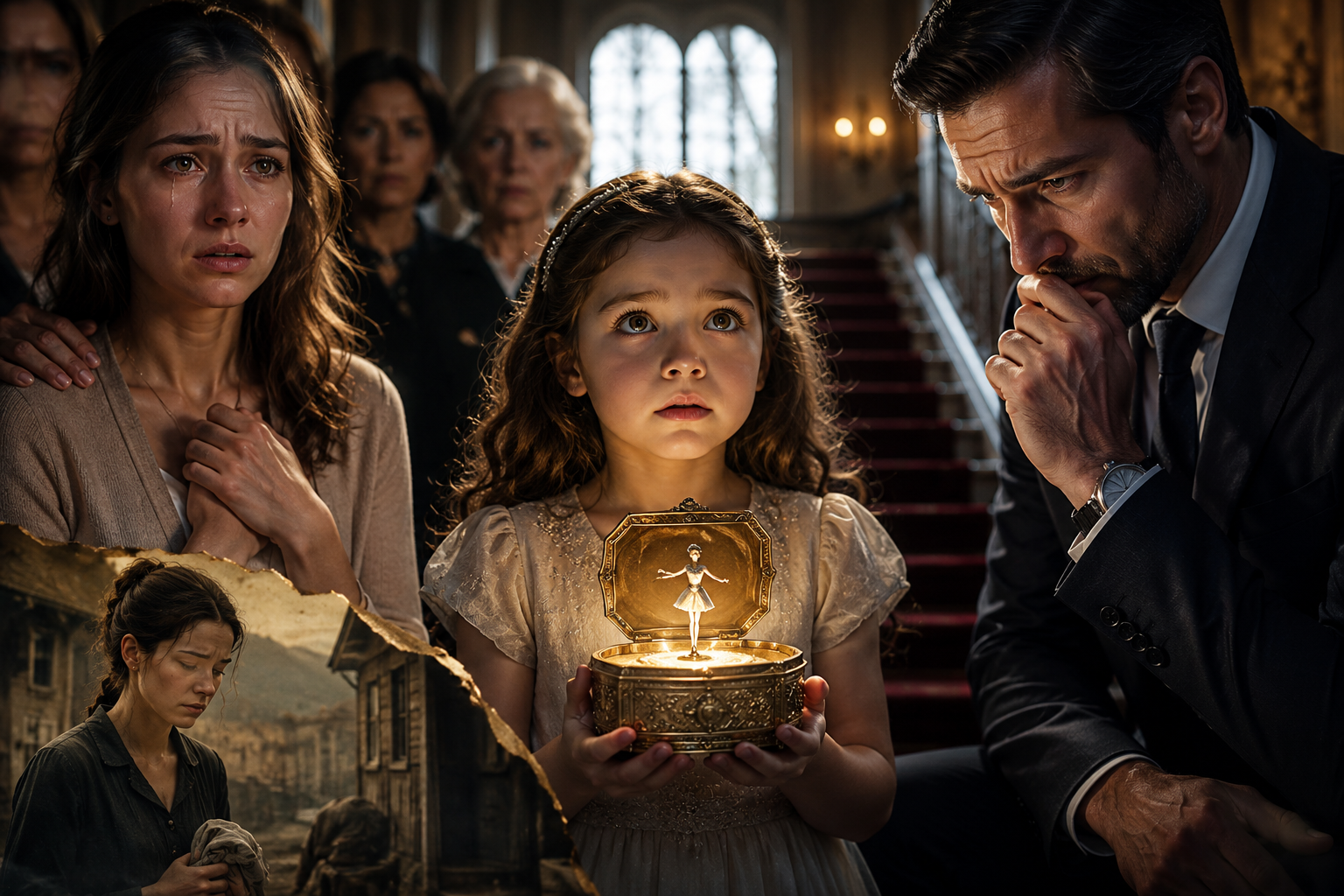
The store manager froze in the middle of the aisle.
For several seconds, he did not speak. He only stared at the small silver charm hanging from the old man’s coat pocket, as if the past had stepped out from behind the shelves and placed a hand around his throat.
The woman in the red store uniform, who had just accused the little girl of trying to steal, looked between them with a confused frown.
“Mr. Whitmore?” she asked. “Is something wrong?”
But the manager did not answer her.
His eyes stayed on the old man.
“Sir,” he said carefully, “may I ask your name?”
The old man looked down first.
Beside him, eight-year-old Lily stood with both hands wrapped around his sleeve. Her cheeks were still wet. She had been crying silently since the saleswoman told her poor children should not touch expensive dolls.
The old man’s jaw tightened.
Then he looked back at the manager.
“Thomas Vale.”
The name changed the air.
The manager’s face lost the last of its color.
Most customers inside Wonderlight Toys saw only a tired grandfather in a frayed brown coat. They saw scuffed shoes, silver hair, rough hands, and a child wearing a winter jacket two sizes too big.
But anyone who knew the true beginning of Wonderlight Toys knew the name Thomas Vale.
He had built the first display shelves with his own hands.
He had painted the first wooden sign.
He had stood beside Eleanor Whitmore when her little shop opened with eleven handmade dolls, a box of painted animals, and a dream too large for the narrow building that held it.
But money has a cruel memory.
It remembers signatures.
It forgets hands.
The manager swallowed.
“My grandmother used to talk about you,” he said.
Thomas stared at him.
“Your grandmother was Eleanor?”
The man nodded.
“I’m Julian Whitmore. I run this location now.”
Thomas studied his face.
Julian Whitmore.
He had seen the name in business articles. He had heard it on television when Wonderlight Toys opened stores in airports, malls, and luxury shopping districts. Julian would have been a child when everything happened.
Too young to know the truth.
Too young to stop the lie.
But old enough now to choose what to do with it.
The saleswoman tried to regain control.
“Mr. Whitmore, I was simply enforcing store policy. The child was handling merchandise without permission.”
Julian turned to her slowly.
“You told her she looked like she came in to beg.”
The woman’s mouth opened.
“I didn’t mean it like that.”
“I heard how you meant it.”
The silence that followed was hard and cold.
Lily pressed closer to her grandfather’s leg.
Thomas placed one heavy, gentle hand on her shoulder.
Julian’s gaze returned to the silver charm.
It was shaped like a tiny moon with a star cut into the middle. Old. Scratched. Worn smooth by twenty-two years of grief.
“May I see it?” Julian asked.
Every muscle in Thomas’s body resisted.
That charm had belonged first to Eleanor Whitmore.
Then to his daughter, Clara.
Now it belonged to him.
He closed his fist around it.
“It doesn’t leave my hand.”
Julian nodded immediately.
“Of course.”
That small respect surprised Thomas more than he wanted to admit.
For twenty-two years, every Whitmore who came near him had wanted something.
His silence.
His signature.
His apology for “misunderstanding.”
His agreement to stop “damaging the company’s reputation.”
Julian was the first one to ask permission and accept no for an answer.
The manager looked past Thomas toward the glass display at the center of the store.
Inside sat a blue music-box doll with painted lashes, a velvet dress, and a silver crank in her back.
“Why did you come here today?” Julian asked.
Lily’s fingers tightened around Thomas’s sleeve.
Thomas answered because lies had already taken too much.
“She wanted to see the doll her mother used to sing about.”
Julian’s expression shifted.
“The Moonlight Melody doll?”
Thomas looked at the blue doll.
He did not know that name.
But he knew the tune.
Clara had hummed it in their kitchen when Lily was a baby.
She hummed it when she was tired.
She hummed it in the hospital room during the last week of her life, when rain tapped against the window and machines breathed beside her bed.
“Yes,” Thomas said quietly. “That one.”
Julian went still.
“That doll was never supposed to be sold.”
The saleswoman blinked.
“What are you talking about? We sell those every Christmas.”
Julian shook his head.
“We sell the remake. The original prototype disappeared before the first collection launched.”
A murmur moved through the store.
Parents stopped pretending not to listen.
A cashier covered her mouth.
Lily looked up.
“Grandpa, what’s a prototype?”
Thomas lowered himself to one knee, though pain shot through both legs.
“It means the very first one, sweetheart. The one someone made before all the others.”
Her little face became hopeful.
“Did Mommy make it?”
That question nearly broke him.
Because for twenty-two years, the world had said Clara Vale stole it.
But Thomas had watched his daughter draw those dolls at the kitchen table.
He had watched her sew blue velvet dresses under a yellow lamp.
He had watched her record lullabies into a cheap tape recorder because she believed toys should comfort lonely children, not just entertain rich ones.
So he looked Lily in the eye and told the only thing that had survived every lie.
“Yes. Your mommy made it.”
The saleswoman gave a sharp little scoff.
Julian turned on her.
“Go to the office.”
“But I—”
“Now.”
She left without another word.
The store remained silent.
Thomas wished that silence felt like justice.
It did not.
Justice was not one embarrassed employee walking away.
Justice was Clara’s name being cleaned.
Justice was Lily growing up without strangers whispering that her mother had been a thief.
Justice was the truth finally doing what money had prevented it from doing for more than two decades.
Julian looked at Thomas again.
“Mr. Vale, I need to ask you something, and I know I have not earned the right.”
“At least you understand that.”
Julian accepted the blow.
“My father always told me Clara Vale stole the Moonlight Melody designs and tried to sell them to a competitor.”
Thomas’s mouth hardened.
“Your father lied.”
Pain moved across Julian’s face.
“I’m beginning to think so.”
“No,” Thomas said. “You’re beginning to suspect it. Understanding weighs more.”
The words landed.
Julian looked down.
Then he said, “Will you come to my office?”
Thomas almost refused.
He had spent twenty-two years avoiding Wonderlight Toys.
He had walked past its windows with groceries in his arms and anger in his throat.
He had watched Clara’s designs become Christmas bestsellers while his daughter’s name remained buried beneath the word thief.
But Lily tugged his sleeve.
“Grandpa,” she whispered, “can we hear Mommy’s song?”
That was why he stayed.
Not for Julian.
Not for the store.
Not for the customers suddenly watching him with guilty eyes.
For Lily.
Thomas looked at Julian.
“Bring the doll.”
Julian hesitated.
“The case is locked.”
“You asked me to come to your office,” Thomas said. “I asked you to bring the doll.”
For the first time, Julian looked less like a manager and more like a grandson carrying an inherited curse.
He took a key from his pocket, opened the glass case himself, and lifted the blue doll with surprising care.
Lily reached for it, then stopped.
“Can I hold her?”
Julian looked to Thomas.
Thomas nodded.
Julian placed the doll in Lily’s arms.
Her face changed the instant she touched it.
Children know things adults explain away.
Lily held the doll as if she had found a piece of her mother’s voice.
The office was behind the store, past shipping boxes and framed photographs of grand openings.
On one wall hung a black-and-white picture of Eleanor Whitmore standing in front of the first Wonderlight Toys.
Thomas was in the photo too.
Younger.
Broader.
Holding a hammer behind a half-built shelf.
But someone had cropped most of him out.
Only part of his shoulder remained.
He stared at the picture for a long time.
Julian noticed.
“I didn’t know,” he said quietly.
“That’s the problem with edited pictures,” Thomas replied. “People start believing the missing parts were never there.”
Lily sat in a chair with the blue doll in her lap.
Thomas stood beside her.
Julian closed the door but did not sit behind his desk.
That mattered.
Men who sit behind desks while asking painful questions usually want control.
Julian stood like someone ready to be judged.
“My grandmother died when I was thirteen,” Julian said. “She used to tell me Wonderlight had two hearts. Hers and someone else’s.”
Thomas said nothing.
“I thought she meant my grandfather.”
“She didn’t.”
Julian nodded.
“I know that now.”
His eyes returned to the silver charm in Thomas’s hand.
“The family story was that Clara stole Eleanor’s founder charm before she disappeared. My father said it proved she planned everything.”
A bitter laugh left Thomas.
“Clara didn’t disappear. She was pushed out.”
Lily looked up.
Thomas softened immediately.
She had heard enough ugliness for one day.
“Sweetheart,” he said, “can you turn the doll’s handle for Grandpa?”
Lily nodded.
Her small fingers found the silver crank on the doll’s back.
She turned it slowly.
A melody filled the room.
Soft.
Fragile.
Familiar enough to hurt.
Thomas closed his eyes.
For one moment, Clara was alive again.
He saw her at nineteen, sitting cross-legged on the floor, surrounded by fabric scraps and pencil sketches.
He heard her say, “Dad, what if a toy could feel like it remembered you? Not really, but almost. Like it was made for one lonely child at a time.”
He had laughed.
“You’re going to make the world cry over dolls?”
She had smiled.
“Maybe the world needs to.”
Now, twenty-two years later, her daughter held one of those dolls while the world finally listened.
When the music ended, Julian wiped his eyes quickly.
Then Lily tilted her head.
“Grandpa, it’s wrong.”
Thomas frowned.
“What do you mean?”
“Mommy’s song had words at the end.”
His heart stumbled.
“What words?”
Lily hugged the doll and sang softly.
“Under the moon, beneath the snow, find the truth where blue flowers grow.”
Julian went completely still.
“What did she just say?”
Lily looked frightened.
Thomas touched her back.
“It’s all right.”
Julian moved quickly to an old filing cabinet. His hands trembled as he pulled out a folder and opened it on the desk.
Inside were copies of product sheets from the original Moonlight Melody collection.
Each doll had a symbol.
A star.
A snowflake.
A flower.
A moon.
Julian flipped through the pages.
Then he stopped.
The drawing showed the same blue doll.
At the bottom, in faded handwriting, were the words:
Blue Moon Doll — music-box prototype. Hidden memory chamber pending final design.
Thomas stopped breathing.
“Hidden chamber?”
Julian looked at the doll in Lily’s lap.
“I thought it was just an abandoned idea.”
Thomas’s fingers went cold.
Clara had once told him Eleanor wanted every special doll to hold something secret.
A lock of hair.
A tiny note.
A baby tooth.
Something a parent could place inside so a toy became part of a family.
Thomas had forgotten.
Or maybe grief had buried it.
Julian knelt in front of Lily.
“May I look at the doll for a moment?”
Lily hugged it tighter.
He did not reach for it.
Smart man.
Thomas said, “Lily, we’ll stay right here.”
After a moment, Lily handed it over.
Julian turned the doll carefully. Beneath the velvet dress was a seam so fine it almost vanished into the stitching.
He pressed near the crank.
Nothing happened.
He checked the shoes.
Nothing.
Then Lily whispered, “Mommy said blue flowers grow under the moon.”
Thomas looked at the little moon charm in his palm.
Julian looked too.
Slowly, Thomas lifted it.
For twenty-two years, he had carried that charm without knowing it was anything more than a keepsake.
But Eleanor Whitmore had loved puzzles.
She made toys for children.
She hid secrets for adults.
Thomas ran his thumb along the edge of the tiny moon.
A metal point shifted.
Julian inhaled sharply.
The moon opened like a miniature key.
Thomas’s hand began to shake.
Lily whispered, “Grandpa?”
“I’m fine,” he lied.
Julian held the doll steady while Thomas inserted the tiny key into a slot hidden at the base of the music box.
There was a soft click.
The back panel opened.
Inside lay a rolled piece of yellowed paper sealed in plastic.
Julian did not touch it.
Thomas did.
Because it belonged to Clara.
His daughter.
His girl.
The one they had called a thief while she cried at his kitchen table and said, “Dad, I swear I didn’t take anything.”
Thomas unrolled the paper.
It was a letter.
The handwriting nearly brought him to his knees.
Clara.
Dad, if you are reading this, then I was right not to trust them.
The room blurred.
Lily slid off the chair and pressed herself against his leg.
Thomas forced himself to continue.
Eleanor signed the Moonlight Melody collection over to me two weeks before she died. She said the company had grown hungry and that toys made without love become products instead of memories. She wanted the designs protected until the board stopped trying to sell them to investors who would strip them of everything gentle.
Julian covered his mouth.
Thomas kept reading.
Victor found out. He demanded the documents. When I refused, he accused me of stealing designs from the company. But the truth is inside the blue doll, the one with the moon key. Eleanor said Thomas would keep the key safe because Thomas was the only man she trusted before Wonderlight had money.
Victor.
Julian’s father.
The man who had given interviews for years about betrayal.
The man who had turned Clara into a villain so he could steal what Eleanor had left her.
Thomas’s hands shook harder.
Julian whispered, “No.”
Thomas looked at him sharply.
“Don’t say no because it hurts. Say no only if it isn’t true.”
Julian had no answer.
The letter continued.
If anything happens to me, please make sure my child knows I did not steal. Please make sure my father knows I tried to come home with my name clean. And please make sure Lily hears the song. She deserves one beautiful thing from me.
A sound came out of Thomas that did not feel human.
Lily began crying because he was crying.
Julian looked destroyed.
For years, Thomas had wanted proof.
He had begged lawyers.
He had written letters to newspapers.
He had stood outside Wonderlight headquarters with copies of Clara’s sketches until security threatened to call the police.
And the proof had been inside a doll the entire time.
A doll locked behind glass in a store that profited from his daughter’s imagination.
Julian backed away from the desk.
“I need to call my father.”
Thomas folded the letter carefully.
“No. You need to call the police.”
Julian looked up.
The boyish shock disappeared.
The manager returned.
Then something better appeared.
A man making a choice.
“You’re right,” he said.
He picked up the phone.
Twenty minutes later, the office was full.
Police officers.
A company attorney on a video call.
Two assistant managers whispering near the door.
The saleswoman stood pale and silent, finally understanding that the poor old man she had humiliated was holding the match that could burn down a dynasty.
Lily sat on Thomas’s lap with the blue doll in her arms.
Every few seconds she looked around as if afraid someone might take it from her.
Thomas held her tighter.
No one would take another thing from his family.
Victor Whitmore arrived before the police finished photographing the letter.
He entered wearing a dark coat, polished shoes, and the expression of a man accustomed to doors opening before he touched them.
He was older now, but Thomas recognized him immediately.
Same hard mouth.
Same cold eyes.
Same smooth voice that had once told reporters Clara Vale was “troubled.”
Victor stopped when he saw Thomas.
For one second, fear crossed his face.
Then he buried it.
“Thomas,” he said. “You should have called me.”
Thomas stared at him.
“I spent twenty-two years calling.”
Victor’s jaw tightened.
Julian stepped forward.
“Dad, the letter is real.”
Victor barely looked at him.
“You have no idea what you’re talking about.”
“It was hidden inside the Blue Moon prototype.”
Victor’s eyes flicked to the doll in Lily’s arms.
There it was.
Recognition.
Not surprise.
Recognition.
Thomas saw Julian see it too.
That was the moment a son learned his father was not misunderstood.
He was guilty.
Victor looked at the police.
“This is a private family matter.”
Thomas laughed.
Everyone turned.
It was not a happy laugh.
It was the sound of a man who had buried too much pain to be polite at the funeral of a lie.
“You called my daughter a thief in public,” Thomas said. “You ruined her name in public. You let this company sell her work in public. So no, Victor. You don’t get privacy now.”
Victor’s face hardened.
“She stole company property.”
Thomas lifted the letter.
“Eleanor gave it to her.”
“That woman was old and confused.”
Julian flinched.
Thomas stepped closer.
“Careful. That woman built the company you hide inside.”
Victor turned to Julian.
“You are making a terrible mistake.”
Julian’s face was pale, but his voice held.
“No. I think I inherited one.”
The room went silent.
For the first time, Victor Whitmore looked around and realized the old rules were not working.
His employees were watching.
His son was watching.
The police were watching.
A little girl holding his family’s stolen legacy was watching.
And outside the office door, customers had begun filming.
The truth had found witnesses.
Victor pointed at the doll.
“That prototype belongs to Wonderlight Toys.”
Lily hugged it tighter.
Thomas stood between them.
“No,” he said. “It belongs to the child her mother made it for.”
By midnight, the story was everywhere.
By morning, Wonderlight Toys was trending for all the wrong reasons.
But none of that mattered to Lily.
What mattered was that she slept that night with the blue doll beside her pillow.
For the first time since Clara’s funeral, Lily did not wake up crying.
Thomas sat in the chair beside her bed until sunrise.
The letter rested in a plastic sleeve on his lap.
He read Clara’s words again and again.
Not because he needed proof.
He had never needed proof to believe his daughter.
But the world had.
And now the world would finally have to listen.
The investigation began slowly.
Then all at once.
Eleanor Whitmore’s old attorney came forward with archived documents.
A retired assistant admitted she had seen Victor removing boxes from Clara’s design room the night before the accusation.
Former employees began sending messages.
Some apologized.
Some said they had always suspected.
Thomas did not know which hurt more.
The people who believed the lie.
Or the people who doubted it but stayed quiet because their paychecks felt safer than his daughter’s name.
Three days after the store incident, Julian came to Thomas’s house.
No lawyers.
No cameras.
No crisis team speech.
He stood on the porch holding a folder and looking like he had not slept.
Lily watched from behind the curtain.
Thomas opened the door but did not invite him in.
Julian seemed to understand.
“I found more,” he said.
Thomas waited.
Julian held out the folder.
“My grandmother’s private ledger. My father kept it locked in storage. It names Clara as the creative heir to the Moonlight Melody collection.”
Thomas’s hand tightened on the doorframe.
Julian continued.
“It also names you.”
“Me?”
Julian nodded.
“Eleanor gave you five percent of the original shop. She wrote that the first Wonderlight shelf was built by your hands and that the company’s beginning belonged to you too.”
For a moment, Thomas could not breathe.
Five percent.
Of a company now worth millions.
He thought of winters when he turned the heat down because Lily needed boots.
He thought of Clara skipping appointments because insurance delayed approval.
He thought of standing in a toy store with thirteen dollars in his pocket while a saleswoman treated his granddaughter like trash.
Julian’s voice cracked.
“My father hid it.”
Of course he did.
A cruel man does not steal once.
He builds a house out of theft and calls it success.
Thomas took the folder.
“Why bring this to me?”
Julian looked toward the window, where Lily quickly disappeared behind the curtain.
“Because my grandmother was right. Wonderlight had two hearts. My family cut one out and pretended the body could still live.”
That was the first time Thomas believed Julian might truly understand.
Not enough.
Never enough.
But truly.
Over the next month, Wonderlight Toys began to collapse from the inside.
Victor resigned before he could be removed.
Then he was arrested for fraud, document destruction, and conspiracy connected to the concealment of Eleanor’s estate records.
The company’s stock fell.
News programs showed photos of Clara smiling beside sketches.
People who had mocked her years ago posted apologies as if regret could travel backward.
It could not.
An apology cannot sit beside a hospital bed.
An apology cannot buy back birthdays.
An apology cannot remove the word thief from all the years when a little girl asked why her mother cried in grocery stores.
But the truth still mattered.
It mattered because Lily heard it.
It mattered because when her teacher asked about family, Lily no longer whispered that her mommy “got in trouble.”
She said, “My mommy made a famous doll, and people lied about her, but Grandpa found the truth.”
That sentence was worth more than every headline.
One afternoon, Julian asked Thomas and Lily to return to the flagship store.
Thomas almost refused.
Then Julian said, “We’re changing the wall.”
Thomas knew which wall he meant.
The founder wall.
The wall with the cropped photo.
The wall where Thomas had been reduced to half a shoulder.
When they arrived, the store was closed to the public.
The saleswoman was gone.
In her place stood employees, board members, reporters, and a few former workers from the earliest days of Wonderlight.
A black cloth covered the wall near the entrance.
Lily held Thomas’s hand.
She wore a blue dress because she had chosen it herself.
In her other arm, she carried the music-box doll.
Julian stepped forward.
His voice shook as he addressed the room.
“For years, Wonderlight Toys told an incomplete story about its beginning. Worse, we repeated a false story about Clara Vale, whose work became one of this company’s most beloved collections.”
Thomas looked at Lily.
She was listening with all her heart.
Julian continued.
“Today, we correct the record publicly. Clara Vale did not steal the Moonlight Melody collection. She created it. She protected it. And she paid for that truth with her reputation.”
A reporter lowered her camera and wiped her eyes.
Julian turned toward Thomas.
“And Thomas Vale was not a stranger to this company. He was part of its foundation from the first shelf.”
He pulled the cloth down.
The new wall showed three photographs.
Eleanor Whitmore smiling in front of the first store.
Thomas beside her, no longer cropped out, holding a hammer and laughing.
Clara at nineteen, sitting at a table covered in sketches, the blue doll half-finished in her hands.
Underneath, a brass plaque read:
Eleanor Whitmore, Thomas Vale, and Clara Vale — The Hands, Heart, and Imagination Behind Wonderlight’s Beginning.
Lily stared at the photograph of her mother.
Then she reached up and touched it.
“She looks happy,” Lily whispered.
Thomas swallowed hard.
“She was.”
Julian stepped beside him.
“There’s more.”
He gestured toward a covered display in the center of the store.
When the cloth was removed, there stood a glass case holding the original Blue Moon doll, Clara’s letter, Eleanor’s ledger, and the old silver charm with the moon key.
Thomas touched his pocket automatically.
It felt strange without the weight there.
Julian noticed.
“It can stay with you, if you want.”
Thomas looked at the display.
For twenty-two years, he had carried that charm because it was all he had left.
Now it had done its job.
“No,” he said quietly. “Let it open doors for someone else.”
Lily slipped her hand into his.
The ceremony should have felt like victory.
In some ways, it did.
But grief stood beside Thomas the entire time, quiet and loyal.
Because the cruelest part of justice is that it often arrives after the person who needed it most is gone.
That night, after everyone left, Thomas and Lily stayed in the store alone for a few minutes.
The lights were dim.
The music was off.
Without the noise, Wonderlight Toys looked less like a dream and more like a place that had finally stopped pretending.
Lily stood in front of the doll display.
“Grandpa,” she said, “do you think Mommy knows?”
Thomas closed his eyes.
He wanted to say yes with certainty.
He wanted to tell her Clara was watching from somewhere beautiful, smiling because the world finally knew.
But he had lived too long to pretend certainty was comfort.
So he gave Lily something better.
“I think love knows when it has been defended.”
Lily thought about that.
Then she nodded, satisfied in the way children sometimes are when adults tell the truth gently.
A week later, Julian came to the house again.
This time, Lily opened the door before Thomas could stop her.
“Are you here to take the doll?” she asked suspiciously.
Julian smiled sadly.
“No. I’m here to give something back.”
He handed Thomas a legal packet.
His five percent stake in Wonderlight Toys had been restored.
Clara’s royalties had been calculated.
The Moonlight Melody collection had made more money than Thomas could understand at first glance.
The number on the final page blurred before his eyes.
It was not wealth that broke him.
It was what the absence of it had cost.
Clara might have had better doctors.
Lily might have had her mother longer.
He might not have stood in a toy store with worn shoes and shame in his pocket while an employee called his granddaughter a beggar.
Julian seemed to read his face.
“I know this doesn’t fix it.”
“No,” Thomas said. “It doesn’t.”
Julian nodded.
“But Lily will never have to wonder if her mother left her nothing.”
Thomas looked at the little girl playing with blocks on the floor.
Clara had left songs.
Sketches.
A doll.
A truth stubborn enough to survive inside a hidden compartment.
And now, finally, a name cleared in public.
Months passed.
Victor Whitmore’s trial became one of those stories people followed like television.
Reporters loved the drama.
A toy empire.
A hidden letter.
A poor grandfather.
A granddaughter who held the key to a twenty-two-year lie.
Thomas hated how easily the world turned pain into entertainment.
He attended court only once.
Lily did not come.
He would not let her sit in the same room as the man who helped ruin her mother.
Victor looked older in court.
Smaller somehow.
Without the company around him, he was just another man in a suit trying to explain why greed should be called business.
When Thomas stood to speak, the courtroom became still.
His hands shook.
His voice did not.
“Victor Whitmore did not only steal designs,” he said. “He stole belief. He stole the way people looked at my daughter. He stole job offers, friendships, peace, and years she should have spent proud of herself.”
Victor stared forward.
Thomas continued.
“He stole from a little girl who had not even been born yet. Lily grew up hearing whispers about a mother she loved but could not defend.”
His throat tightened.
“But he did not steal everything. He did not steal Clara’s truth. He did not steal my memory. And he did not steal Lily’s right to know her mother was brilliant.”
The judge listened.
The reporters wrote.
Victor did not look at him once.
That was fine.
Thomas had not come for remorse.
He had come so the record would hear Clara’s name spoken without shame.
Victor was convicted on several charges.
Not all.
Men like him rarely pay for everything.
But enough.
Enough to remove him from the company forever.
Enough that when Lily asked, “Did the bad man get in trouble?” Thomas could say, “Yes, sweetheart. He did.”
The first Christmas after the truth came out, Wonderlight Toys released the Moonlight Melody collection again.
Not the stolen version.
The real one.
Each box carried Clara Vale’s name.
Each doll came with a small card that said toys should hold memories, not secrets.
A portion of every sale went to a foundation in Clara’s honor, helping children who had lost parents receive birthday gifts, school supplies, and grief counseling.
Julian asked Lily to choose the foundation’s logo.
She drew a blue flower under a moon.
Thomas cried when he saw it.
On opening day, the line outside the store wrapped around the block.
Parents came with children.
Former employees came with flowers.
Women who had once worked with Clara came to tell stories Thomas had never heard.
One said Clara always kept candy in her drawer for interns.
Another said Clara fixed a broken toy for her son during a bring-your-child-to-work day.
Another admitted she had believed Victor because it was easier.
Thomas thanked the first two.
He walked away from the third.
Forgiveness, he had learned, was not a public service.
Inside the store, Lily stood beside a display of Blue Moon dolls.
She wore a small name tag Julian had made for her.
It said:
Lily Vale — Keeper of the Song.
She took the job seriously.
When children came near the display, she turned the handle and let the melody play.
Then she told them, “My mommy made this song.”
Not once did she lower her voice.
Not once did she look ashamed.
That was the ending Thomas wanted more than money.
Near closing time, he noticed a woman standing by the entrance.
The former saleswoman.
She looked smaller without the red uniform.
Less certain.
Thomas almost turned away, but Lily saw her.
“That’s the mean lady,” she whispered.
“Yes.”
The woman approached slowly.
Julian moved as if to stop her, but Thomas lifted a hand.
Let her come.
She stopped a few feet away.
“I’m sorry,” she said.
No excuse.
No speech about stress or policy.
Just sorry.
Thomas studied her face.
She looked at Lily.
“I was cruel to you. You didn’t deserve that.”
Lily hid partly behind Thomas’s coat.
The woman’s eyes filled.
“I had no right to make you feel small.”
Lily looked up at Thomas.
He did not tell her what to say.
Adults had forced enough feelings onto children.
After a moment, Lily said, “You hurt my feelings.”
The woman nodded.
“I know.”
“My mommy said people who make kids cry should have to sit alone and think about it.”
A surprised laugh escaped someone nearby.
The woman nodded again, crying now.
“Your mommy was right.”
Lily considered this.
Then she said, “Okay.”
Not forgiveness.
Not friendship.
Just okay.
For an eight-year-old, that was plenty.
That night, Thomas and Lily walked home under Christmas lights.
Snow began falling, soft and silver, dusting her hair and the shoulders of his old coat.
He had money now.
He could have called a car.
He could have bought a warmer coat that same day.
But Lily wanted to walk, and Thomas had spent too many years rushing through grief to refuse a peaceful moment.
She carried a Blue Moon doll in one arm and held his hand with the other.
“Grandpa,” she asked, “was Mommy famous?”
Thomas thought about it.
Famous was not the right word.
Fame was cameras, headlines, names printed on boxes.
Clara had deserved those things.
But they were not what made her matter.
“Your mommy was loved,” he said.
Lily frowned.
“That’s not what I asked.”
Thomas chuckled softly.
“No, it isn’t.”
He looked at the snow falling beneath the streetlights.
“Yes,” he said. “She’s famous now.”
Lily smiled.
“Good.”
Then she added, “But she was always famous to me.”
Thomas stopped walking.
The world blurred again.
Lily tugged his hand.
“Grandpa?”
He knelt in the snow and hugged her carefully, so carefully, because she was still the last fragile piece of his heart.
But maybe not the last.
Maybe his heart had more pieces than he thought.
Maybe some pieces were hidden like letters in music boxes, waiting for the right song to open them.
One year later, Wonderlight Toys held a public memorial for Clara.
Not in a boardroom.
Not at a corporate banquet.
In the first store.
The one Eleanor built.
The one Thomas helped build.
The one where it all began.
Children filled the aisles, each holding a small blue paper moon.
Julian spoke briefly.
Then he handed the microphone to Thomas.
For a long moment, Thomas only looked at the crowd.
He saw parents.
Employees.
Reporters.
Old friends.
Children who knew nothing about fraud, courtrooms, or family betrayal.
They only knew the dolls played a beautiful song.
That was enough.
“My daughter used to say toys were not about fabric or paint,” Thomas began. “She said they were about giving children something soft to hold when the world became too hard.”
His voice shook.
“She understood that because the world was often hard on her.”
Lily stood beside him, one hand wrapped around his coat.
Thomas continued.
“For twenty-two years, people called Clara Vale a thief. Today, in the store that sold her dreams without her name, I ask you to remember her correctly.”
The room was silent.
“She was a daughter. A mother. An artist. A woman who protected what was hers even when powerful people tried to scare her into silence.”
He looked down at Lily.
“And she was loved by the child she left behind.”
Lily lifted her blue paper moon.
Then one by one, every child in the store lifted theirs.
A hundred tiny moons rose into the air.
Thomas could not speak after that.
He did not need to.
The song began to play over the speakers.
Not the commercial version.
Clara’s original recording.
Her voice, soft and young, sang the words Lily had remembered.
Under the moon, beneath the snow, find the truth where blue flowers grow.
People cried openly.
Julian covered his face.
Thomas closed his eyes and listened to his daughter sing inside the store that had tried to erase her.
And for once, the walls did not feel stolen.
They felt returned.
Later, after the crowd left, Lily placed her paper moon beneath Clara’s photo.
“Mommy,” she whispered, “we did it.”
Thomas stood behind her, one hand on her shoulder.
“Yes,” he said. “We did.”
But deep down, he knew the truth.
Clara had done it.
She had hidden the letter.
She had taught Lily the song.
She had trusted Thomas with the key before anyone knew it was a key.
She had built a truth small enough to fit inside a doll and strong enough to bring a toy empire to its knees.
As they walked out of the store that evening, Julian stopped Thomas near the door.
“Mr. Vale,” he said, “the board wants to offer you an honorary chair position.”
Thomas looked at him.
Then he laughed.
A real laugh this time.
“I’m too old for chairs that don’t rock.”
Julian smiled.
“Then what do you want?”
Thomas looked across the store.
At the children.
At Lily.
At the wall where Clara’s name finally belonged.
“I want a shelf,” he said.
“A shelf?”
“One shelf in every Wonderlight store. Low enough for children to reach. Toys no child is told they can’t touch just because their pockets are empty.”
Julian’s face softened.
“We can do that.”
“And no child gets chased out for looking.”
Julian lowered his eyes.
“Never again.”
Six months later, every Wonderlight Toys had a Clara Shelf.
Children could choose one toy from it for free on their birthday.
No proof of income.
No humiliating questions.
No cold employee deciding who looked worthy.
Just a shelf low enough for small hands and kind enough for tired families.
Lily visited the first one with Thomas.
She watched a little boy choose a stuffed bear, then hug it so tightly his mother started crying.
Lily leaned against her grandfather’s side.
“Grandpa,” she said, “Mommy would like this.”
Thomas looked at the shelf.
At the toys waiting to be held.
At the children walking out with something soft in their arms.
“Yes,” he said. “She would.”
That night, Thomas placed Lily’s Blue Moon doll on her dresser.
The original stayed in the store display, safe behind glass.
But Julian had made Lily a perfect copy.
Inside it, Thomas placed a tiny note written in his own shaky hand.
Your mother was not a thief. She was the song.
Lily would find it years later.
But that night, she only turned the silver handle and climbed into bed as the melody filled her room.
Thomas stood in the doorway listening.
For the first time in twenty-two years, the song did not feel like grief.
It felt like proof.
Proof that cruelty can be loud, but truth is patient.
Proof that poor hands can carry royal keys.
Proof that a child’s memory can outlast a corporation’s lie.
And proof that sometimes, the person a store tries to throw out is the one holding the key to everything it stole.
Lily’s eyes grew heavy.
“Grandpa?” she murmured.
“Yes, sweetheart?”
“Can we go back to the toy store tomorrow?”
Thomas smiled.
“Of course.”
She hugged the doll closer.
“But this time, can we stand as long as we want?”
His throat tightened.
He looked at the little girl who had once lowered her eyes because a stranger told her she did not belong.
Then he looked at the music-box doll, its blue dress glowing softly in the night-light.
“Yes,” he said.
“As long as we want.”
And that was the real victory.
Not the money.
Not the headlines.
Not Victor Whitmore in a courtroom.
The victory was a little girl walking into a toy store with her head high, touching the doll her mother made, and knowing no one had the right to move her along.
Because her mother’s name was on the wall now.
Her grandfather’s hands were in the foundation.
And the key that once unlocked a hidden letter had finally opened something much bigger.
A future where Lily Vale would never again have to beg with her eyes.
She would look straight ahead.
She would remember the song.
And she would know exactly where she belonged.

