The Billionaire Laughed at the Boy in Rags—Then Discovered the Child Carried His Blood

For most of his life, Victor Harrow believed silence was a form of strength.

He had built an empire with it.

A pause at the end of a boardroom table could make grown men confess their weaknesses. A quiet glance across a courtroom could make attorneys forget their own arguments. A single unanswered letter could punish a daughter for twenty-two years.

Silence had made him feared.

Silence had made him rich.

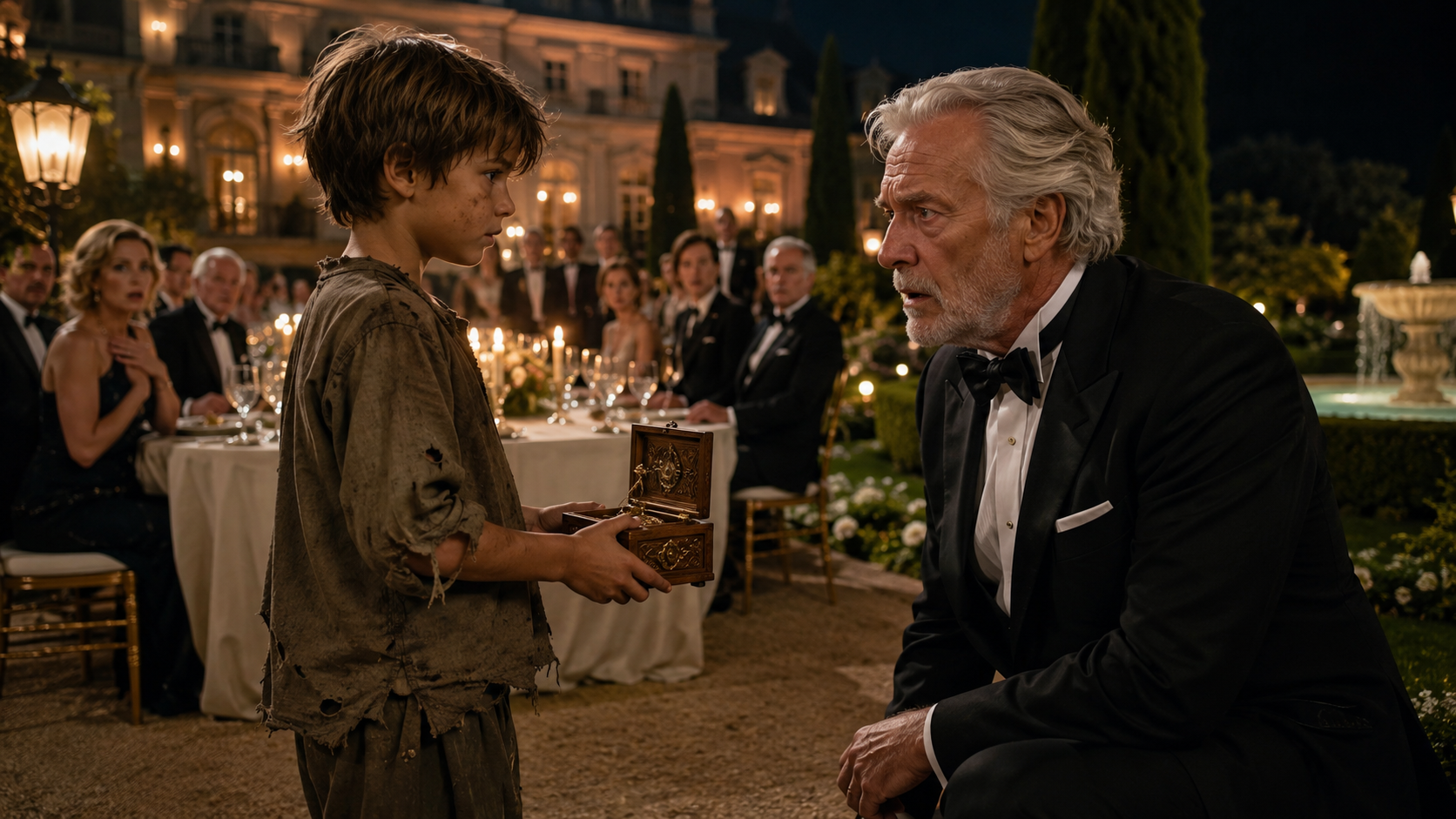
And on the night his past walked barefoot through the gates of Harrow House, Victor was hosting a dinner designed to remind the world that he was still untouchable.

The estate rose above the city like a private kingdom. White stone terraces overlooked a garden trimmed so perfectly it looked less grown than manufactured. Lanterns floated above the lawn. Silver cutlery gleamed beside crystal glasses. Violin music drifted through warm spring air, polite and expensive.

Around the long outdoor table sat senators, bankers, museum trustees, foreign investors, and people who laughed softly at things that were not funny because Victor Harrow expected them to laugh.

At the head of the table, Victor lifted his glass.

He was seventy-four, tall even with age bending at his shoulders, his white hair brushed back from a face carved by discipline and disappointment. His tuxedo fit as if the tailor feared him. His eyes, pale gray and sharp as winter water, moved over his guests with practiced boredom.

“To the Harrow Foundation,” he said. “May generosity remain useful.”

The guests laughed.

Victor did not.

Beside him, his nephew Bennett Chase smiled with polished confidence. Bennett was forty, handsome in the smooth and hollow way of men who had never truly suffered. For twelve years, he had stood close enough to Victor to look like an heir without ever being named one. He chaired committees. Shook hands. Appeared in photographs. Remembered donors’ wives by name.

And waited.

Everyone knew he was waiting.

Everyone also knew Victor had no children.

Not anymore.

The first course had just been cleared when the music faltered.

At first, Victor thought one of the hired violinists had made an error. Then he noticed the waiters had stopped near the garden arch. A security guard stood frozen beside the gravel path, one hand near his earpiece, unsure whether to interfere.

A boy stood under the archway.

He could not have been more than ten.

His trousers were too short. His coat was too thin. His hair, dark and messy, clung to his forehead as if he had walked through rain or sweat or both. His face was pale with hunger, his cheeks smudged with dirt. One shoe was missing. The other had a split at the toe.

In both hands, he held a small wooden music box.

The dinner fell silent.

The boy took one step forward.

“Mr. Harrow?” he asked.

His voice was so small it almost vanished beneath the fountain.

Several guests looked away with embarrassed smiles, the way wealthy people often did when poverty appeared too close to the table.

Victor set down his glass.

“This is private property.”

The boy swallowed. His hands tightened around the music box.

“I know. I’m sorry. I tried the front gate, but they wouldn’t let me in.”

Bennett leaned toward Victor and murmured, “Security will remove him.”

Victor raised one finger.

Bennett stopped.

The boy looked at Victor as though he had spent all his courage getting there and had very little left.

“I need help,” he said.

A woman near the middle of the table gave a soft, uncomfortable laugh.

Victor heard it. So did the boy.

“What kind of help?” Victor asked.

“My mother is sick.”

“That is unfortunate.”

The boy flinched, but continued. “She said your name in her sleep.”

A few guests exchanged glances.

Bennett’s smile thinned.

Victor leaned back in his chair. “Many people know my name.”

“She said it like she knew you.”

At the far end of the table, someone whispered, “Oh dear.”

Victor’s jaw tightened.

“What is your mother’s name?”

The boy hesitated.

Then he said, “Mara Vale.”

The name moved through Victor like a blade that had waited twenty-two years to be pulled free.

For a moment, the garden disappeared.

The lanterns, the guests, the crystal, the servants, the fountain—all of it faded until there was only a young woman standing in a marble foyer with a suitcase in her hand and tears in her furious green eyes.

Mara.

His daughter.

His only child.

The child he had loved with the kind of love powerful men often ruin by trying to own it.

Victor did not speak.

Bennett did.

“That’s impossible,” he said quickly. “Mara has been gone for years.”

The boy turned toward him. “She’s not gone. She’s at Mercy General.”

Victor’s eyes moved to Bennett.

“Mercy General?”

Bennett’s smile returned, but weaker now. “Uncle, this is clearly some kind of trick. Someone sent him. Perhaps a journalist. Perhaps one of the protesters from last month.”

“I’m not a trick,” the boy said.

The guests shifted.

Victor looked back at the child. “What is your name?”

“Eli.”

“Eli what?”

“Eli Vale.”

The name struck again.

Vale.

Not Harrow.

Never Harrow.

Victor remembered the man Mara had chosen. Jonah Vale. A pianist with worn shoes, gentle hands, and no family fortune. Victor had called him temporary. Mara had called him good. Victor had forbidden the marriage. Mara had married him anyway.

So Victor had done what Victor Harrow did best.

He punished.

He cut off her accounts. Removed her from the family trust. Ordered the staff not to accept her calls. Returned her letters unopened until she stopped sending them.

At first, he told himself she would come back.

Then he told himself she was stubborn.

Then he told himself she was gone.

And finally, he stopped telling himself anything at all.

Now a barefoot boy stood in his garden holding a music box.

Victor’s voice lowered. “Why did you come here?”

Eli looked down at the box. “Because Mom needs medicine. The doctor said they can’t keep doing the treatment unless we pay more. I don’t know how much. It sounds like a lot.”

One of the guests sighed with theatrical pity.

Bennett stood. “This has gone far enough.”

Eli stepped back.

Victor noticed it.

The child expected to be grabbed.

Expected to be dragged out.

Expected cruelty.

Victor hated that he recognized the expectation.

Bennett gestured to the guard. “Take him to the service entrance and call whoever handles these situations.”

Victor did not raise his voice.

“Sit down, Bennett.”

Bennett froze.

“I’m only trying to protect you.”

“You are trying to protect dinner.”

The table went still.

Bennett’s face tightened, but he sat.

Victor turned back to Eli.

“What is in your hands?”

The boy lifted the wooden music box.

“My mother said it belonged to her mother. She told me if I ever got lost, I should keep it because it knew the way home.”

Victor’s breath stopped.

He knew that box.

Of course he knew it.

His wife, Celeste, had carved it herself when Mara was seven. Dark walnut, polished smooth, with a small silver bird inlaid on the lid. Celeste had loved birds. “They leave,” she once told Victor, “but only because they trust the sky.”

Victor had hated that sentence after she died.

He had hated anything that sounded like leaving.

The music box had disappeared with Mara the night she walked out.

Victor stood so suddenly his chair scraped against the stone.

The guests watched him with widened eyes.

“Bring it here,” he said.

Eli hesitated.

Victor heard himself then, heard the command in his own voice, and softened it with visible effort.

“Please.”

The boy approached slowly.

Every step seemed to cost him.

When he reached the head of the table, Victor held out his hand, but Eli did not immediately give him the box.

“My mom said not to let anyone take it.”

“Then don’t,” Victor said.

Eli looked confused.

Victor lowered his hand.

“Open it.”

The boy placed the box on the table and lifted the lid.

A thin melody began to play.

Not perfect anymore. Age had made it uneven. One note dragged. Another trembled. But Victor knew it before the third turn.

Celeste’s lullaby.

She had sung it to Mara when storms shook the windows.

She had sung it when Mara cried after falling from a horse.

She had sung it in the hospital when illness made her voice soft and far away.

And Victor, who had not cried at his wife’s funeral because grief felt too public, closed his eyes.

A memory rose unwanted.

Celeste in bed, pale but smiling. Mara curled beside her. Victor standing at the window, pretending not to listen.

“One day,” Celeste had whispered to their daughter, “when your father forgets how to be gentle, remind him.”

Mara had asked, “How?”

Celeste had tapped the music box.

“With this.”

Victor opened his eyes.

The boy was watching him.

Eli’s eyes were green.

Mara’s green.

Celeste’s green.

Victor gripped the edge of the table.

“How old are you?”

“Ten.”

“When is your birthday?”

“October third.”

Victor closed his eyes again.

Ten years.

Ten years he had been a grandfather and had not known.

Or had chosen not to know.

“Uncle,” Bennett said carefully, “even if the box is genuine, that proves nothing. Mara could have given it away. She could have—”

Victor turned on him.

“Say her name once more like she is an inconvenience, and you will leave this house with nothing but the suit you wore in.”

Bennett’s mouth closed.

The guests looked down at their plates.

Victor stepped away from the table and knelt in front of Eli.

The movement shocked the garden.

Victor Harrow did not kneel. Not before kings, presidents, judges, or God. Yet there he was, one knee pressed to the stone path, lowering himself until his eyes met the child’s.

Eli stared at him with suspicion.

Good, Victor thought.

Suspicion was honest.

“I was unkind to you,” Victor said.

Eli said nothing.

“I should not have spoken to you that way.”

Still nothing.

Victor swallowed.

“I am sorry.”

The words were strange in his mouth, like a language he had once known and forgotten.

Eli looked toward the table.

“They laughed at me.”

Victor’s face hardened.

“Yes,” he said. “They did.”

“Why?”

Because they are cowards, Victor thought.

Because I taught them by example.

Because money can make people mistake comfort for worth.

But he did not say that to a child.

Instead, he said, “Because they were wrong.”

Eli looked back at him.

“Will you help my mom?”

There it was.

Not forgiveness.

Not affection.

Not reunion.

Only the one question that mattered.

Victor stood.

“Yes.”

Bennett rose again. “Uncle, the mayor is still here. The foundation announcement—”

“My daughter is in a hospital.”

Bennett’s eyes flickered.

“After all this time, are you certain you want to rush into something emotional?”

Victor looked at him for a long, dangerous second.

“Emotional,” he repeated.

The word hung in the air like an insult.

Then Victor removed his tuxedo jacket and placed it around Eli’s shoulders. It swallowed the boy, hanging nearly to his knees.

Eli clutched it with one hand.

Victor turned to the staff.

“Shoes. A car. Now.”

Servants moved at once.

The guests remained frozen.

Victor faced the table.

“Dinner is over.”

No one argued.

Within three minutes, Eli was wearing oversized house slippers and sitting in the back of Victor’s black car, the music box held tightly in his lap.

Victor sat across from him.

The city moved past the tinted windows in streaks of gold and red.

For a while, neither spoke.

Victor wanted to ask everything.

Did Mara still laugh through her nose when she was embarrassed?

Did she still tuck her hair behind her ear when she lied?

Had Jonah been good to her?

Was Jonah alive?

Had Eli gone hungry?

Had Mara hated him every day, or only on birthdays?

But the questions felt like theft.

So he asked the only simple one.

“Are you hungry?”

Eli looked ashamed.

“A little.”

Victor reached for the intercom. “We’ll stop.”

“No.” Eli leaned forward quickly. “Please. Mom first.”

Victor’s hand paused.

A ten-year-old should not know how to prioritize emergencies.

A ten-year-old should not have eyes that old.

“You’re right,” Victor said.

Eli stared at him.

“What?”

“I said you’re right.”

The boy looked down, as if adults admitting things made him uncomfortable.

After a moment, Eli asked, “Did you hate her?”

Victor’s chest tightened.

“No.”

“Then why didn’t you come?”

Because pride is easier than apology.

Because I wanted obedience more than happiness.

Because I confused control with love.

Because after your grandmother died, I became a house with no lights on.

Victor looked out at the city.

“Because I was a fool.”

Eli considered this.

“My mom said you were powerful.”

“She was too generous.”

“She said you were proud.”

“That is more accurate.”

“She said you loved Grandma.”

Victor’s throat closed.

“I did.”

“Did Grandma love Mom?”

“More than anything.”

“Did she love you?”

Victor’s reflection stared back from the window, older than he felt, smaller than he had believed.

“Yes,” he said quietly. “Though I gave her many reasons not to.”

Eli opened the music box just enough for one thin note to escape, then shut it again.

“Mom said Grandma would have liked me.”

Victor looked at him then.

“She would have adored you.”

The boy’s face softened for the first time.

Only slightly.

But Victor saw it.

And it nearly undid him.

Mercy General was everything Harrow House was not.

Too bright. Too crowded. Too loud. The emergency entrance smelled of disinfectant, vending machine coffee, and fear. A man slept in a chair with his work boots still on. A woman argued with an insurance representative near the elevator. Nurses moved with the exhausted speed of people holding too many lives together with too little help.

Eli jumped from the car before the driver could fully open the door.

Victor followed.

At the desk, a nurse looked up.

“Eli Vale! Where have you been?”

Then she saw Victor.

Her expression changed.

Not surprise.

Recognition.

And then contempt.

Victor almost welcomed it.

At least someone had been angry for Mara.

“I need to see Mara Vale,” he said.

The nurse folded her arms. Her badge read: Nadine Brooks.

“Family only.”

“I am her father.”

The nurse’s eyes sharpened.

“Oh,” she said. “Now?”

Victor accepted the blow.

“Yes.”

Eli grabbed the nurse’s sleeve. “Please, Miss Nadine. He came.”

Nadine looked down at the boy, and everything about her softened.

Then she looked back at Victor.

“She is very weak.”

“I understand.”

“No,” Nadine said. “I don’t think you do.”

Victor nodded once.

“You’re probably right.”

That answer seemed to unsettle her more than argument would have.

After a tense silence, she pointed toward the elevators.

“Fourth floor. Room 417. But listen to me carefully, Mr. Harrow. If you upset her, if you use that voice rich men use when they think hospitals are hotels, I will have security remove you. I don’t care who you are.”

For the first time that night, Victor almost smiled.

“Good.”

Nadine blinked.

Victor turned toward the elevator.

Eli walked beside him, still wearing the oversized jacket, still carrying the music box.

On the fourth floor, the hallway was quieter.

Machines beeped behind half-closed doors. Shoes squeaked on polished floors. Somewhere, someone cried softly and tried to hide it.

Outside room 417, Eli stopped.

“She told me not to go,” he whispered.

Victor looked at him.

“I know.”

“She’ll be mad.”

“She may be.”

“I only wanted to help.”

Victor crouched beside him again.

“I know that too.”

Eli’s chin trembled, but he fought it.

Victor wanted to touch his shoulder and did not dare.

Instead, he said, “Whatever happens in there, you did not do wrong.”

The boy nodded once.

Then he opened the door.

Mara Vale lay in a narrow hospital bed beside a window with the blinds half-drawn. She was thirty-nine, but illness had carved years from her face and left shadows beneath her cheekbones. Her dark hair was tied loosely at the back of her neck. An IV line ran into her hand.

She turned her head when Eli entered.

Fear came first.

“Eli,” she whispered. “Where were you?”

“I found him.”

Mara’s eyes moved past her son.

And landed on Victor.

The room became very still.

Victor had imagined this moment many times, though he had never admitted it. In those imagined versions, Mara shouted. Accused. Wept. Asked him why.

He had prepared answers for all of it.

But the woman in the bed did not shout.

She only looked at him.

And after twenty-two years, she said, “You’re late.”

The words were soft.

Almost tired.

That made them worse.

Victor stepped into the room.

“Yes,” he said.

Mara’s eyes narrowed slightly, as if she had expected defense.

Eli climbed onto the chair beside her bed. The tuxedo jacket slipped from one shoulder.

Mara noticed it.

“You gave him your coat.”

“He was cold.”

“He’s been cold before.”

Victor closed his eyes briefly.

“I didn’t know.”

Mara’s voice sharpened. “You didn’t ask.”

No lawsuit had ever landed so cleanly.

Victor nodded.

“No. I didn’t.”

The silence that followed was not empty. It was crowded with birthdays missed, letters returned, holidays survived without apology. It held Jonah’s funeral, which Victor had not attended because no one had told him, because he had made himself impossible to tell. It held every bill Mara had paid late and every night Eli had gone to sleep pretending not to be hungry so his mother would eat.

Mara looked at Eli.

“I told you not to leave.”

“I’m sorry,” he whispered. “But you kept saying his name.”

Her face changed.

Pain. Shame. Anger. Exhaustion.

Victor moved one step closer.

“What do you need?”

Mara gave a short, humorless laugh.

“That’s what you ask?”

“Yes.”

“Not ‘how could you disappear?’ Not ‘why didn’t you come crawling back?’ Not ‘where is your husband with the beautiful music and empty pockets?’”

Victor flinched at Jonah’s name without meaning to.

Mara saw it.

“He died four years ago,” she said.

Victor’s hand tightened on the back of a chair.

“How?”

“Pneumonia that became something worse because we waited too long to see a doctor.”

The room seemed to tilt.

Mara looked away.

“He never blamed you. I did enough for both of us.”

Victor absorbed that.

“I deserve it.”

“You deserve more than that.”

“Yes.”

Again, she seemed thrown by his refusal to fight.

A doctor entered then, young but tired around the eyes. She introduced herself as Dr. Sahana Mehta and gave Victor a look that said she knew exactly who he was and was not impressed.

Good, Victor thought again.

The world had too few unimpressed people.

Dr. Mehta explained Mara’s condition with clinical precision. A severe infection. Complications from an untreated autoimmune disorder. Delayed medication. A procedure needed within forty-eight hours. Specialized treatment afterward. Expenses that had become impossible.

Victor listened without interrupting.

“How much?” he asked.

Mara’s face hardened. “No.”

Victor turned to her.

“No?”

“You don’t get to buy your way into this room.”

“I’m not trying to buy my way into anything.”

“That’s all you know how to do.”

The old Victor would have commanded.

He would have called hospital administrators, private physicians, drivers, lawyers. He would have transferred her while congratulating himself on action. He would have confused control with care and called resistance ingratitude.

But Eli was watching.

And Mara was waiting for the father who had always turned love into orders.

Victor breathed once.

Then asked, “What do you want?”

Mara stared at him.

The question seemed to hurt more than the argument she had expected.

“I want to stay with Dr. Mehta,” she said slowly. “She knows my case. I don’t want reporters. I don’t want a Harrow Foundation statement. I don’t want my illness turned into proof that you have a heart.”

Victor nodded.

“Then you stay with Dr. Mehta.”

Dr. Mehta looked surprised.

Mara did too.

Victor turned to the doctor.

“What does this hospital need to treat her properly?”

“Resources,” Dr. Mehta said bluntly.

“You’ll have them.”

Mara closed her eyes.

“That easy,” she whispered.

Victor understood.

That was the cruelty of it.

For him, salvation was a phone call.

For Mara, it had been years of choosing which bill could wait and which pain could be endured.

He took out his phone.

Bennett had called seven times.

Victor ignored him and called his chief counsel instead.

“I want a private medical fund established tonight,” he said. “No press. No foundation announcement. No Harrow branding. Mercy General receives whatever Dr. Sahana Mehta requests for Mara Vale’s treatment and for any department involved in her care. Quietly.”

He listened for three seconds.

“No, not tomorrow. Tonight.”

He ended the call.

Mara watched him with unreadable eyes.

Eli reached for her hand.

She took it.

Victor stood there feeling like a stranger in his own bloodline.

After a while, Mara said, “You look older.”

Victor almost laughed.

“So do you.”

Her mouth tightened.

Then, unexpectedly, a faint smile touched the corner of it.

Only for a second.

But it was Mara.

The girl who used to steal raspberries from the kitchen and deny it with red fingers.

The girl who once hid in his office because thunder frightened her.

The girl he had driven away because she loved someone he had not chosen.

Victor sat slowly in the chair by the door, far enough not to presume closeness.

“I won’t ask you to forgive me,” he said.

“Good.”

“I won’t ask Eli to call me anything.”

“Also good.”

“I won’t make decisions for you.”

Mara studied him.

“That one sounds difficult for you.”

“It will be.”

This time, her faint smile lasted a little longer.

Then she grew serious.

“Why now?”

Victor looked at Eli.

“Because your son walked through my garden with Celeste’s music box.”

Mara’s eyes filled at her mother’s name.

“I almost sold it once,” she admitted. “After Jonah died. Rent was overdue. Eli needed shoes. I took it to a pawnshop.”

Eli looked at her, startled.

“You did?”

Mara stroked his hair.

“I didn’t sell it.”

“Why?”

“Because your grandmother made it. Because some things have to survive even when you’re angry.”

Victor looked down at his hands.

“I returned your letters,” he said.

Mara’s expression closed.

“Yes.”

“I told myself I was teaching you consequence.”

“You were teaching me I had no father.”

Victor nodded.

“I know.”

“No,” she said. “You know it tonight. You didn’t know it when I was twenty-three and pregnant and scared. You didn’t know it when Jonah worked nights until his hands shook. You didn’t know it when Eli asked why other children had grandparents. You didn’t know it when I called your office from the hospital after Jonah died and your assistant said Mr. Harrow was unavailable.”

Victor’s face went still.

“I never received that message.”

Mara gave him a tired look.

“Of course you didn’t.”

Something cold moved through Victor.

“Who did you speak to?”

“I don’t remember.”

“Think.”

Mara frowned. “A man. Polite. Said he handled family inquiries.”

Victor stood slowly.

Bennett.

The answer formed before proof arrived.

Bennett, who had managed Victor’s personal correspondence for years.

Bennett, who had quietly removed reminders of Mara from the house.

Bennett, who had spoken her name tonight with relief.

Victor’s phone rang again.

Bennett.

This time, Victor answered.

“Uncle,” Bennett said immediately, his voice smooth and urgent. “Where are you? People are confused. The mayor left offended. I’ve told everyone you had a health concern.”

Victor looked at Mara.

“Did Mara call my office after Jonah died?”

Silence.

Small.

Precise.

Enough.

Bennett laughed softly. “I handled many calls over the years. I can’t possibly—”

“Answer me.”

Mara watched Victor’s face change.

Eli held tighter to her hand.

Bennett’s voice lowered. “You told me you wanted nothing to do with her.”

“I told you not to bring me gossip. I never told you to hide a death.”

“She chose her life.”

Victor’s grip tightened around the phone.

“She was my daughter.”

“She was a liability,” Bennett snapped, and in that single unguarded sentence, everything became clear. “Do you have any idea how many people would have used her against you? A broke daughter married to a lounge pianist? A child? Medical debt? It would have been humiliating.”

Victor’s voice became very quiet.

“You kept my grandson from me.”

“I protected the Harrow name.”

“No,” Victor said. “You protected your inheritance.”

Bennett breathed hard.

“Uncle, listen to yourself. One sick woman and one child appear, and suddenly you’re ready to throw away the future of everything you built?”

Victor looked at Mara, pale against the pillows.

At Eli, barefoot in oversized slippers.

At Celeste’s music box on the bedside table.

Then he said, “They are the future of everything I built.”

Bennett said nothing.

Victor continued, “You are removed from all foundation duties as of tonight. You will not enter Harrow House again. Counsel will audit every message, account, and instruction you handled regarding Mara Vale. If you intercepted anything, destroyed anything, profited from anything, or lied about anything, I will bury you legally so deep that your grandchildren will need maps to find your name.”

Bennett’s voice cracked.

“You can’t do this.”

“I should have done it years ago.”

Victor ended the call.

For a long moment, the only sound was the monitor beside Mara’s bed.

Mara stared at him.

“He did that?”

“I believe so.”

She turned her face toward the window.

Victor expected anger.

Instead, she looked exhausted.

“I used to imagine you getting my messages,” she said. “I imagined you listening to them and deciding not to call back. It hurt so badly I had to stop calling.”

Victor’s throat burned.

“I don’t know which is worse,” he said. “That I didn’t receive them, or that you believed I could and still had reason to.”

Mara looked at him then.

For the first time, her eyes softened.

Not forgiveness.

Not yet.

But something less locked.

Dr. Mehta returned with papers and a plan. Treatment would begin before dawn. Specialists would be contacted. Medication would be arranged. A private room was offered, but Mara refused anything that felt like spectacle, so Victor asked only that she be safe, comfortable, and kept away from press.

When the doctor left, Eli began to droop in the chair.

His head nodded once.

Then again.

Mara touched his cheek.

“He hasn’t slept.”

Victor stood. “There’s a family lounge?”

“Down the hall,” Mara said.

Eli woke at once. “I’m not leaving.”

“No one is making you,” Victor said.

Eli looked suspicious again.

Victor removed his phone, called Harris, and spoke quietly. Within an hour, food arrived. Not catered luxury. Soup, bread, fruit, tea, a blanket, socks, and clean clothes for Eli from a nearby store.

Eli ate like he was trying not to seem hungry.

Victor pretended not to notice, because dignity was sometimes the only gift that cost nothing.

Mara watched him watching her son.

“You were never patient,” she said.

“No.”

“You’re being patient now.”

“I’m learning.”

“From whom?”

Victor looked at Eli.

“Apparently, from him.”

Eli looked up with bread in his mouth.

“What?”

“Nothing,” Victor said.

Near midnight, Mara fell asleep.

Eli refused to leave her side, so Victor sat in the chair by the door and remained awake.

Hours passed.

The hospital settled into its strange nighttime rhythm. Footsteps. Machines. Murmurs. Distant alarms. The soft opening and closing of doors.

At three in the morning, Eli whispered, “Are you still awake?”

“Yes.”

“Rich people don’t sleep?”

“Not when they’ve made a mess of things.”

Eli considered that.

“My mom says everybody makes messes.”

“She is kind.”

“She says fixing matters more than feeling bad.”

Victor looked at Mara.

“She is wise.”

“Are you going to fix it?”

Victor turned back to the boy.

“I’m going to try.”

“That’s not the same.”

“No,” Victor said. “It isn’t.”

Eli nodded, satisfied with the honesty.

Then he said, “Can I ask you something?”

“Yes.”

“If you’re my grandfather, what do I call you?”

Victor felt the question in his chest.

“You don’t have to call me anything.”

“But if I wanted to?”

Victor could have said Grandfather.

He could have said Sir, because some old habits die stubbornly.

But then he remembered Celeste laughing on the porch, telling Mara that love should never sound like a business card.

So he said, “Victor is fine.”

Eli wrinkled his nose.

“That sounds like a villain.”

Despite everything, Victor laughed.

It startled him.

It startled Mara too, because her eyes opened.

She looked at him from the bed, tired but awake.

“What’s funny?”

“Your son thinks my name sounds villainous.”

“It does.”

Eli smiled.

A real smile.

Small, quick, and gone almost at once.

But Victor saw it.

By morning, the story had already begun to leak.

A billionaire leaving his own dinner party with a barefoot boy was not the kind of image guests kept to themselves. Photographs had been attempted. Rumors had spread. Reporters gathered near the hospital entrance before sunrise.

Victor’s legal team called. His public relations director called. Board members called. Donors called.

Victor ignored almost everyone.

At seven, he made one statement through counsel.

Mara Vale and her son were private citizens. Any attempt to photograph, follow, harass, or identify them would be met with legal action. The Harrow Foundation would be undergoing immediate internal review. Bennett Chase no longer represented Victor Harrow, Harrow House, or any Harrow charitable entity.

No explanation.

No performance.

No redemption speech.

Mara read the statement on Dr. Mehta’s tablet and looked at Victor.

“You didn’t call me your daughter.”

Victor stiffened.

“I thought you might not want that made public.”

She studied him.

Then nodded.

“Thank you.”

Two words.

Small.

But Victor carried them like absolution he had not earned.

Over the next days, the world outside became loud.

Inside room 417, life narrowed to quieter things.

Medication schedules.

Doctor updates.

Eli’s homework, which Victor discovered was weeks behind because the boy had been spending afternoons at the hospital.

Hospital coffee, which Victor declared criminal.

Mara’s pain, which came and went in waves.

And conversations.

At first, they were practical.

Insurance.

Treatment.

School.

Housing.

Then, slowly, they became dangerous.

Memories.

Celeste.

Jonah.

The night Mara left.

“You called him a beggar,” Mara said one afternoon.

Victor sat near the window. Eli was asleep on the small couch, one arm hanging off the side.

“I remember.”

“He heard you.”

“I know.”

“He still tried to convince me to call you when I got pregnant.”

Victor looked down.

“He was a better man than I was.”

“Yes,” Mara said.

Victor accepted it.

Then she added, “But he wasn’t perfect either.”

Victor looked at her, surprised.

Mara smiled faintly. “Don’t look so relieved.”

“I wasn’t.”

“You were.”

He almost denied it.

Then stopped.

“I was.”

She shook her head, but there was less bitterness in it now.

“Jonah was gentle. Too gentle sometimes. He thought love meant never asking for help. I thought pride meant never accepting it. We made a beautiful disaster.”

Victor looked at Eli.

“And him?”

Mara’s expression softened.

“He was the beautiful part.”

Victor felt something old and frozen inside him begin to thaw.

Not all at once.

Not easily.

Thawing hurts.

A week later, Mara had the procedure.

Victor waited in the hall with Eli.

The boy sat beside him, swinging his legs. He wore new sneakers now, but still kept the music box in his backpack.

“What if it doesn’t work?” Eli asked.

Victor’s first instinct was to promise.

It will work.

I will make it work.

Money, influence, power—all the old gods.

But the hospital had taught him something already.

There were rooms money could enter but not command.

So he said, “Then we keep going.”

Eli leaned against his arm.

Victor went still.

The weight was light.

Almost nothing.

But he did not move for fear of losing it.

Two hours later, Dr. Mehta came out.

The procedure had gone well.

Eli cried first.

Then Victor did.

He turned toward the window, but Eli saw anyway.

“It’s okay,” the boy said.

Victor wiped his face.

“I’m aware.”

“No, I mean…” Eli searched for the words. “It’s okay if you’re not made of stone.”

Victor looked at him.

“My mother used to say something like that.”

“Grandma?”

“Yes.”

“What did she say?”

Victor smiled sadly.

“She said even stone cracks when spring comes.”

When Mara was strong enough to leave the hospital, she refused Harrow House.

Victor had expected it.

He still felt the sting.

“I’m not moving into your mansion like a rescued orphan from one of your donor brochures,” she said.

“I didn’t ask you to.”

“You were about to.”

“I was considering how to ask badly.”

That made her laugh.

A real laugh this time, though it hurt her ribs.

In the end, Victor arranged a quiet apartment near the hospital, in Mara’s name, with no press, no conditions, and no Harrow crest on anything. Mara argued. Victor listened. They fought over rent, furniture, privacy, doctors, school, and whether Eli needed a tutor.

They fought like family.

Carefully at first.

Then honestly.

Bennett’s audit uncovered more than Victor expected.

Calls never logged.

Letters redirected.

A trust document delayed.

A small account Mara should have received from Celeste’s estate, quietly folded into foundation reserves through legal language Bennett had recommended and Victor had signed without reading closely enough.

That last discovery nearly broke him.

He brought the documents to Mara himself.

“I signed it,” he said.

Mara read every page.

Eli sat at the kitchen table doing math homework, pretending not to listen.

When Mara finished, she folded the papers carefully.

“Did you know?”

“No.”

“Should you have known?”

“Yes.”

She nodded.

“That’s the answer I needed.”

Victor waited.

Mara looked toward the window.

“I spent years thinking you were the monster in the story.”

Victor did not defend himself.

She looked back at him.

“You were. Just not the only one.”

He accepted that too.

Months passed.

Not all wounds closed.

Some became scars.

Some stayed tender.

Mara improved slowly. She gained weight. Color returned to her face. She began teaching music part-time from the apartment, then more often. Eli started at a better school but refused to let Victor’s driver drop him at the front gate because “that’s embarrassing.”

Victor learned to text.

Badly.

His first message to Mara read: Are you alive.

She responded: Is that your version of good morning?

His second message read: Good morning. Are you alive.

She sent back a laughing face.

Victor stared at it for several minutes, unsure whether it counted as progress.

On Eli’s eleventh birthday, Mara agreed to come to Harrow House.

Not for a gala.

Not for donors.

Just dinner.

The long outdoor table was gone. In its place, a smaller table sat beneath the old chestnut tree, set for three. No crystal towers. No violinists. No mayor. No people laughing because they wanted money.

Harris served roast chicken, potatoes, green beans, and chocolate cake because Eli had requested “normal food.”

The music box sat in the center of the table.

After dinner, Eli ran through the garden with the kind of energy that made Victor worry about every stone edge and fountain step. Mara watched him from her chair, wrapped in a shawl that had once belonged to Celeste.

“You kept it,” she said.

Victor followed her gaze to the shawl.

“Yes.”

“I thought you threw everything away.”

“No,” he said. “Only the living parts.”

Mara looked at him.

Victor regretted the sentence as soon as he said it.

But Mara did not turn away.

Instead, she reached across the table and touched the music box.

“I used to play this when I missed Mom.”

“So did I.”

Mara’s eyes lifted.

“You did?”

Victor nodded.

“At night. After the staff went to bed.”

“I never knew.”

“I made sure no one did.”

She smiled sadly.

“You were very committed to being miserable.”

“I excelled at it.”

Eli ran back then, breathless.

“Can we open presents?”

Mara looked at Victor. “One present.”

Victor handed Eli a wrapped box.

The boy tore into it carefully at first, then with increasing excitement.

Inside was a small wooden bird, hand-carved, unfinished in places, imperfect.

Eli turned it over in his hands.

“You made this?”

Victor looked uncomfortable.

“I attempted it.”

Mara stared at him. “You carved?”

“Badly.”

Eli grinned. “It looks kind of angry.”

“It does not.”

“It does.”

Mara took it and laughed. “It really does.”

Victor frowned at the bird.

“I’ll make another.”

“No,” Eli said quickly, taking it back. “I like this one.”

Victor looked at him.

The boy held the crooked bird against his chest.

“I like that you made it.”

Victor could not speak for a moment.

Mara saw.

She looked away kindly.

Later, after Eli fell asleep on the sofa in the library, Mara stood beside Victor near the fireplace.

“You know this doesn’t erase it,” she said.

“I know.”

“Some days I still hate you.”

“I know.”

“Some days I don’t.”

Victor turned to her.

That was more mercy than he had expected in this lifetime.

Mara crossed her arms.

“I don’t know what we become from here.”

Victor looked toward Eli, asleep beneath a blanket, one hand curled near his face.

“Neither do I.”

“You always hated not knowing.”

“I’m learning to tolerate it.”

She leaned her shoulder lightly against his arm.

Not an embrace.

Not forgiveness.

But contact.

Victor stared straight ahead because if he looked at her, he might weep again, and Eli had already informed him that crying was acceptable but “dramatic when overdone.”

After a while, Mara said, “Mom would be furious with you.”

Victor closed his eyes.

“Yes.”

“She would also be glad you finally came.”

He breathed out slowly.

“I was late.”

Mara nodded.

“Yes.”

Then she added, “But you’re here.”

Outside, the garden lights glowed softly against the dark.

Years ago, Victor had believed a house was proven by its gates, its guards, its stone walls, its polished rooms, its distance from ordinary suffering.

Now he looked at the sleeping boy on the sofa, the daughter beside him, the music box on the table, and understood the truth far too late.

A house was not protected by keeping people out.

It became a home only when the right people were finally allowed back in.

And for the first time in twenty-two years, Harrow House was not silent.

It was listening.

The Billionaire Laughed at the Boy in Rags—Then Discovered the Child Carried His Blood
Mein Mann verließ mich mit neugeborenen Drillingen – Jahre später traf ich ihn zufällig wieder