For five years, Elias Reed believed sorrow was the deepest hole a man could fall into.
He had learned its shape. He knew how grief sounded when a house stayed too quiet. He knew how it tasted in cold coffee left untouched beside stacks of condolence cards. He knew the weight of it in a wedding ring that never came off, in a closet he could not empty, in a nursery door he had locked because the walls inside were painted for a child who had never arrived.
Grief had rules.
It came with a funeral. A black suit. A polished coffin that held ashes someone told him belonged to his wife. It came with dates carved into stone and relatives lowering their voices as if volume could make loss less violent.
But betrayal had no rules.
Betrayal did not bury the dead.
It taught them how to disappear.
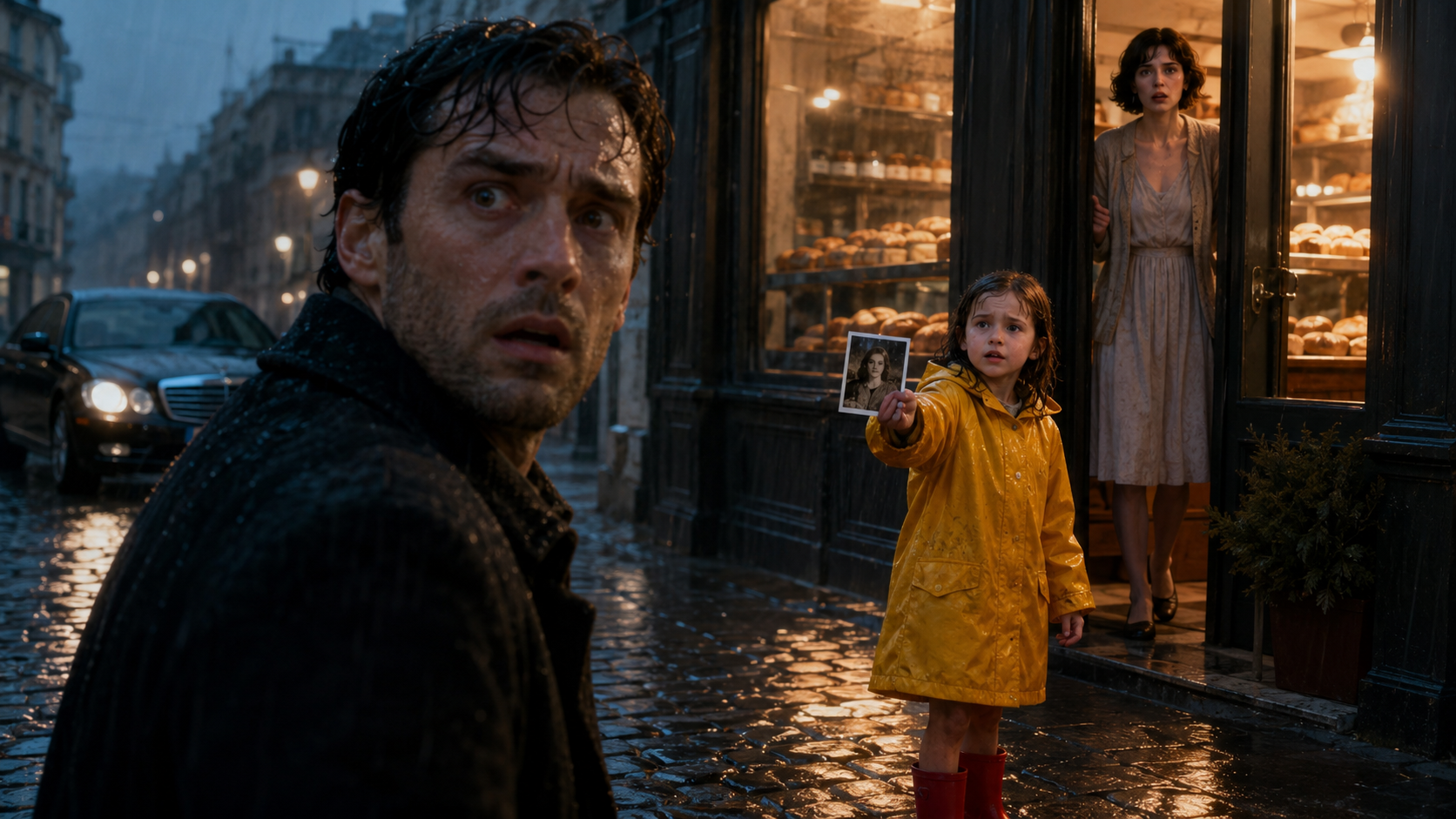
The photograph slipped from Elias’s coat pocket on an ordinary Tuesday afternoon.
He did not notice at first. He was crossing Briar Lane, a narrow cobblestone street in the old part of the city, where bakeries opened before sunrise and flower sellers arranged lilies beneath striped awnings. Rain had fallen that morning, leaving the stones glossy and dark. The air smelled of yeast, wet brick, and roasted coffee.
A small voice called behind him.
“Sir! You dropped this.”
Elias turned.
A little girl stood near the curb, no more than six years old, wearing a yellow raincoat and red boots with tiny white clouds painted on them. In her hands, she held the photograph.
At first, Elias only saw the picture.
Then he saw the child’s face.
And the world narrowed.
The girl had gray-green eyes.
Mara’s eyes.
The same startled seriousness. The same dark lashes. The same little crease between her brows when she was trying hard to understand something.
Elias could not move.
The child looked down at the photograph, then back at him.
“Is this lady yours?” she asked.
His throat closed.
In the picture, Mara stood on the porch of their old lake house, barefoot and laughing, her hair whipped sideways by the wind. Elias had taken that photo two weeks before the accident. He had kept it in his wallet for five years, folded behind his license like a private wound.
“Yes,” he said, though his voice hardly sounded human. “She was.”
The little girl frowned.
“Was?”
Before Elias could answer, the bakery door opened behind her.
A woman stepped out carrying a paper bag of bread.
And Elias forgot how to breathe.
She had shorter hair now. It fell just below her jaw instead of down her back. There was a faint scar near her left temple that had not been there before. Her face was thinner, her body held tighter, as if she had spent years bracing for something terrible to happen.
But it was her.
Mara.
His wife.
The woman he had buried.
The woman whose name he had whispered into an empty bedroom until grief stripped his voice raw.
The paper bag slid from her hands and hit the wet street.
The little girl turned.
“Mommy?”
Mara stared at Elias as if he were not a man, but a nightmare that had found her in daylight.
“No,” she whispered.
Elias took one step forward.
“Mara.”
She flinched violently.
“My name is Nora.”
The name struck him like a slap.
Behind her, an older woman emerged from the bakery. Silver-haired, round-shouldered, wearing a flour-dusted apron. She froze when she saw Elias.
He recognized fear before he recognized guilt.
“You,” he said softly.
The older woman grabbed Mara’s arm.
“Nora, take Sophie inside.”
Sophie.
The little girl.
His gaze dropped to her again. Six years old. Mara’s eyes. His own stubborn chin. The age was wrong and right in the same devastating second.
Elias looked back at Mara.
“You have a daughter.”
Mara’s hand moved protectively to the child’s shoulder.
“Stay away from us.”
A black sedan rolled to the curb.
Elias turned before the door opened.
He knew that car.
He knew the polished black paint, the driver, the quiet arrogance of money arriving where it had not been invited.
His older brother, Victor Reed, stepped out wearing a charcoal suit and no expression at all.
For five years, Victor had stood beside Elias at gravesides, boardrooms, and family dinners. He had managed the estate. He had handled the documents. He had signed papers with calm hands while Elias fell apart.
Now Victor looked at Mara like a man watching a locked door swing open.
“Elias,” Victor said. “Step away from them.”
Elias almost laughed.
There were many tones Victor could have chosen.
Shock. Confusion. Relief.
He chose command.
That told Elias enough.
“You knew,” Elias said.
Victor’s jaw tightened by a fraction.
“This is not the place.”
Mara looked between them.
“You know him?” she asked Victor.
Victor softened his face instantly.
“Nora, listen to me. He is unstable. You need to go inside with Sophie.”
Elias felt something old and broken inside him begin to burn.
“Don’t call her that.”
Victor’s eyes cut toward him.
“She has lived as Nora Hale for five years.”
“She is Mara Reed.”
Mara shook her head, backing toward the bakery.
“No. No, I don’t know you. I don’t know any of this.”
Elias forced himself to lower his voice. Every instinct in him wanted to run to her, grab her hands, prove he was real, prove she was real, but her terror stopped him.
“Mara, I thought you died. They told me you died in the bridge crash. I buried ashes. I stood at your grave every Sunday for a year. Whatever he told you, whatever name they gave you, please just listen to me.”
Her face crumpled in confusion.
Victor stepped closer.
“She suffered neurological trauma. You forcing this on her is cruel.”
Elias turned on him.
“You identified her body.”
Victor’s expression did not change.
“I identified what could be identified.”
“No,” Elias said. “You identified her bracelet.”
For one second, Victor’s mask cracked.
Only one.
But Elias saw it.
He remembered that night with sickening clarity. The rain. The wreckage. The hospital hallway. The medical examiner saying dental confirmation would take time because the remains had been badly burned. Victor arriving with Mara’s gold bracelet sealed in an evidence bag, his voice low and steady.
It is hers, Eli. Let her rest.
Elias had been too shattered to ask questions.
Too desperate for the nightmare to have an ending.
The older woman in the apron whispered, “Inside. Now.”
Mara heard the tremor in her voice.
She looked at her.
“Agnes?”
Victor’s head turned sharply.
“Agnes, don’t.”
That was the moment.
That one word cracked the street open.
Mara saw it too. The warning. The familiarity. The old guilt that had just stepped into daylight.
“You know him,” Mara whispered.
Agnes covered her mouth.
“I’m sorry, sweetheart.”
Victor reached into his pocket.
Elias moved before he thought.
He crossed the space between them, grabbed Victor’s wrist, and slammed him hard against the side of the sedan. Metal groaned beneath the impact. People stopped on the sidewalk. Someone gasped.
Victor stared at him, stunned.
For five years, he had known Elias as a grieving man.
He had forgotten grief could preserve rage like a blade wrapped in cloth.
“Take your hand out of your pocket,” Elias said quietly.
Victor’s lips barely moved.
“You have no idea what you are interfering with.”
“I’m beginning to.”
Agnes unlocked the bakery door with shaking hands.
“Everyone inside.”
This time, Mara did not argue.
She pulled Sophie close and hurried in.
Elias released Victor only long enough to shove him backward. Victor straightened his sleeve, smoothing the cuff as though humiliation could be brushed away.
“You think she will run into your arms?” Victor asked.
Elias looked through the bakery window.
Mara stood inside, pale and shaking, one arm around Sophie. She looked frightened of him. Frightened of herself. Frightened of whatever truth had begun to move under the floor of her life.
“No,” Elias said. “I think she deserves to know who stole her life.”
Victor’s smile faded.
“The truth will ruin her.”
Elias stepped closer.
“No, Victor. The truth will ruin you.”
Inside the bakery, Agnes locked the door and flipped the sign to CLOSED.
Warm air wrapped around them, thick with cinnamon, butter, and coffee. It felt obscene, that sweetness, while the world fell apart.
Sophie sat at a small table by the window, still holding the photograph. Mara stood beside the counter, one hand pressed to her temple. Elias stayed near the door, keeping distance between them. He wanted to touch her face so badly his hands ached, but he kept them visible and still.
Agnes pulled down the blinds halfway.
“We don’t have long.”
Mara turned toward her.
“Then talk.”
Agnes seemed to shrink.
“I should have told you years ago.”
“Told me what?”
Agnes looked at Sophie, then at Elias, then back at Mara.
“That your name is Mara Reed.”
Mara’s knees buckled.
Elias moved, but she recoiled from him.
Agnes caught her instead.
“No,” Mara whispered. “No. I remember waking up in the clinic. I remember you telling me there had been an accident. I remember you saying my husband was dangerous.”
Agnes closed her eyes.
“I said what Victor told me to say.”
The bakery went silent.
Even Sophie understood enough to stop swinging her legs beneath the table.
Elias felt rage rising in his chest, but Mara’s face stopped him.
This was not his moment to explode.
It was hers to break.
Agnes guided her into a chair.
“I was a recovery nurse at St. Catherine’s,” Agnes said. “Five years ago, they brought you in after the bridge crash. You were unconscious, badly concussed, burned along your shoulder, and listed under a false name before the police even arrived.”
Mara stared at her.
Agnes’s voice shook.
“And you were pregnant.”
Elias gripped the back of a chair.
The room tilted.
Pregnant.
His eyes moved to Sophie.
The age.
The eyes.
The mouth.
The way she held the photograph as if it were evidence in a trial only she could understand.
His daughter.
Victor had not only stolen his wife.
He had stolen his child.
Mara followed his gaze. Her face changed slowly, horror blooming beneath confusion.
“No,” she whispered.
Elias said nothing.
He could not.
Sophie looked at her mother.
“Mommy?”
Mara pulled the little girl onto her lap and held her so tightly Sophie squeaked.
Agnes continued.
“Victor told me Elias caused the crash after learning about the pregnancy. He said if anyone knew you survived, Elias would come back to finish what he started. He had documents. Police contacts. Money. He moved you before anyone asked too many questions.”
Mara began to cry silently.
Elias shook his head.
“Mara, no. I never hurt you.”
“I remembered fire,” she said. “Water. Someone shouting. Someone kept saying your name.”
Elias froze.
“My name?”
She nodded.
“Over and over.”
Victor’s voice returned from memory.
Eli, she’s gone.
Eli, don’t make them keep cutting into what’s left.
Eli, let her rest.
His brother had used his grief as a weapon from the first night.
Agnes pressed both hands together.
“At first, I believed him. Then I started seeing holes. Your records disappeared. The doctor who signed them vanished from the hospital system. Victor paid my son’s gambling debt and made it clear those men could return if I opened my mouth.”
Mara stared at her.
“So my life here…”
“Was built on a lie,” Agnes said. “But my love for you and Sophie was not.”
Mara stood so abruptly the chair scraped backward.
“You do not get to call it love after stealing my name.”
Agnes flinched.
“You’re right.”
“You let me teach my daughter to fear a man who was mourning us.”
This time Agnes said nothing.
Elias looked at Mara.
Mara.
Nora.
A woman with two names, one stolen past, and five years of fear stitched into her bones.
“I never hurt you,” he said softly. “I need you to know that, even if you do not know anything else.”
Her eyes found his.
“I don’t know what I know.”
“That is all right.”
“No, it isn’t.”
“No,” he said. “It isn’t. But I will not ask you to become my wife again just because you are alive. You are allowed to be whoever survived.”
Her tears spilled over.
For the first time, something in her expression shifted.
Not trust.
Not yet.
But recognition of mercy.
Sophie slid down from her lap and walked toward Elias with the photograph.
Mara tensed, but she did not stop her.
The little girl held it out.
“Were you sad?” Sophie asked.
The question nearly destroyed him.
Elias knelt slowly, making himself smaller.
“Yes,” he said. “Very sad.”
“Because you thought Mommy died?”
He nodded.
Sophie looked back at Mara.
“But she didn’t.”
“No,” Elias whispered. “She didn’t.”
Sophie thought about that with a child’s brutal simplicity.
“Then maybe you can stop being sad.”
No one breathed.
Children could say impossible things because they did not yet understand how adults ruined miracles. Sophie thought being found should be enough. She did not know about forged records, stolen years, corporate shares, trauma, custody battles, or men who built empires on other people’s pain.
Elias took the photograph carefully from her.
Then he reached into his wallet and pulled out another one.
Mara barefoot on the porch of their lake house. Wind in her hair. One hand resting lightly over her stomach.
He had never noticed the gesture before.
He showed it to her.
Mara went white.
“I know that porch.”
Elias stopped breathing.
“You remember?”
She reached toward the picture, then pulled back before touching it.
“I dream about it. Blue railing. Cold wind. Someone behind me laughing.”
“That was me.”
Her eyes squeezed shut.
“Please don’t say it like that.”
“Say what?”
“My name. Like you have been waiting five years to breathe it.”
Elias swallowed.
“All right.”
A hard knock struck the front door.
Everyone jumped.
Victor stood outside with two men behind him.
Not police.
Not customers.
Security.
Agnes whispered, “Back door.”
Elias tucked both photographs away.
“Mara, take Sophie.”
She looked at him, fear flooding back.
“Where?”
Agnes snatched a ring of keys from a drawer.
“There is an alley behind the flour room.”
Victor pounded again.
“Nora,” he called through the glass. “Open the door. Elias is dangerous. You are confused.”
Mara flinched at the name Nora.
Not because she trusted it.
Because it had begun to feel like a locked room.
She grabbed Sophie’s hand and followed Agnes through the kitchen. Halfway there, she stopped and looked back toward the dark silhouette beyond the blinds.
“What does he want from me?”
Elias hesitated.
Agnes answered.
“The company.”
He turned.
Agnes’s hands shook as she unlocked the rear door.
“Mara owned thirty-five percent of Reed Harbor Development through her mother’s trust. If she died, the shares moved under your temporary control, Elias. Victor helped manage them while you grieved.”
Elias felt sick.
He remembered signing documents after the funeral. Stacks of papers Victor slid across the desk while saying, I’ll handle the ugly parts.
He had handled them.
He had built a kingdom from ashes that were not Mara’s.
Agnes pushed open the door.
“If she is alive, every signature can be challenged. Every transfer. Every vote. Every account.”
Mara’s face hardened.
For the first time, fear was not the only thing there.
Anger had arrived.
Good.
Anger could stand when terror collapsed.
Glass shattered at the front of the bakery.
Sophie screamed.
Elias pushed them into the alley.
Cold rain began to fall, turning the brick walls black. Agnes locked the door behind them, though they all knew it would not hold.
A white delivery van sat near the alley mouth.
Agnes tossed Elias the keys.
“Take it.”
“You are coming with us.”
She shook her head.
“I have to slow them down.”
Mara turned.
“Agnes.”
The older woman’s eyes filled.
“I stole years. Let me give you minutes.”
Forgiveness did not happen.
But something passed between them anyway.
Something wounded, human, and unfinished.
Elias got Mara and Sophie into the van. Sophie climbed into the middle seat and clutched her mother’s hand with both of hers. Elias started the engine as shouting erupted inside the bakery.
Mara looked at him.
“Where are we going?”
For five years, Elias had no answer to anything.
Now he had one.
“To the only woman Victor never managed to frighten.”
They drove north through wet streets while Elias’s phone buzzed again and again.
Victor.
Unknown number.
Victor.
Attorney.
Victor.
Then a message appeared.
Do not make this worse. She is unstable. The child is not yours.
Mara saw it.
Her face paled, but her voice stayed steady.
“Is she?”
Elias stopped at a red light and looked at Sophie in the mirror.
She was watching him with Mara’s eyes.
“I do not need a test to know what my heart already knows,” he said. “But we will do one if you want the world to stop lying.”
Mara turned toward the rain-streaked window.
“I want the world to stop lying.”
“Then that is what we do.”
Forty minutes later, they reached an old stone courthouse that now housed private legal offices. On the third floor was Beatrice Lorne, Mara’s godmother, a retired federal judge with silver hair, pearl earrings, and a reputation for making powerful men regret speaking too quickly.
Mara had loved her once.
Elias had avoided her after the funeral because Beatrice looked at grief without softening it.
Today, she was their only hope.
Beatrice opened the office door herself.
The moment she saw Mara, her hand rose to her mouth.
“Mara.”
Mara tightened her grip on Sophie.
“I don’t remember you.”
Beatrice steadied herself.
“That is all right, darling. I remember enough for both of us.”
Elias told her everything.
Not calmly. Not neatly.
The story came out in broken pieces: the street, the photograph, Sophie, Agnes, Victor, the false name, the shares, the crash, the bracelet, the fear. Beatrice listened without interrupting, but her expression grew colder with every word.
When he finished, she pressed a button on her desk phone.
“Clear my afternoon. Call Dr. Naveen for emergency DNA collection. Then find me someone at the Bureau who still owes me a very large favor.”
Her assistant said something.
Beatrice replied, “No. Larger.”
Mara sat on the sofa with Sophie curled against her. She looked exhausted, but she was no longer shrinking. Her gaze moved over the office, testing objects for memory.
Beatrice approached slowly with a wooden box.
“May I show you something?”
Mara hesitated, then nodded.
Inside were birthday cards, photographs, postcards, and yellowed notes. Beatrice handed her one picture.
It showed Mara at twenty-two, standing beside Beatrice in a courthouse hallway, both of them laughing.
Mara stared.
“I wore that green dress.”
Beatrice’s eyes filled.
“Yes.”
“The zipper stuck. I hated it.”
Beatrice laughed through tears.
“You threatened to sue the designer.”
A sound escaped Mara.
Almost a laugh.
Almost a sob.
Memory did not return like lightning.
It returned like water beneath a locked door.
First a line.
Then a flood.
For the next hour, Beatrice showed her pieces of a life Victor had tried to erase. Mara remembered lemon tea. A charity gala. A law school fundraiser. A blue silk scarf. A joke about lilies being terrible funeral flowers but beautiful at weddings.
Then Beatrice found a photograph of Elias and Mara dancing barefoot in a kitchen.
Mara went completely still.
Elias did not move.
She stared for so long Sophie grew worried.
“Mommy?”
Mara looked up at Elias.
“You sang badly.”
His breath caught.
“What?”
“In the kitchen,” she whispered. “You sang badly on purpose because I was angry with you.”
Tears burned his eyes.
“You said no woman could stay mad at a man willing to embarrass himself that completely.”
She laughed once, but it broke.
Then she began to cry.
He wanted to go to her.
He waited.
This time, she came to him.
Only two steps.
Not into his arms.
Not yet.
But closer.
“I don’t know how to be her,” she said.
“You do not have to become her in one day.”
“What if I never get all of it back?”
“Then I will learn who you are now.”
Her face collapsed.
Sophie slid off the sofa and wrapped both arms around their legs. It was awkward, sudden, innocent, and devastating.
For one suspended moment, the three of them were almost a family.
Almost.
Then Beatrice’s assistant rushed in.
“Judge Lorne, Victor Reed is downstairs with police.”
Beatrice’s mouth tightened.
“Of course he is.”
Victor entered ten minutes later with two officers and a corporate lawyer Elias recognized from the family company.
He looked composed again.
But his eyes gave him away.
He had expected fear.
He had not expected Beatrice Lorne.
“Beatrice,” he said.
“Mr. Reed,” she replied. “I stopped allowing snakes to use my first name years ago.”
One officer coughed into his fist.
Victor’s lawyer stepped forward.
“We are here for the child. We have reason to believe Mr. Elias Reed abducted a minor from her lawful guardian.”
Mara rose.
“I am her mother.”
The lawyer offered a practiced expression of sympathy.
“Ma’am, you are a vulnerable adult under the influence of a man connected to your traumatic past.”
Mara’s hand trembled.
Elias started to speak, but she lifted one finger.
“No.”
The room turned to her.
Her voice was soft, but it did not break.
“For five years, I was told to fear my husband. Today I learned the people telling me that were lying. I am not confused about my daughter.”
Victor sighed.
“Nora—”
“Mara,” she said.
The name shook the room.
Victor went still.
Mara’s eyes filled, but her voice strengthened.
“My name is Mara Reed.”
Elias felt the words in his chest like sunrise.
Beatrice stepped forward with a folder.
“Officers, before anyone makes a regrettable career choice, I suggest you review these documents. We have evidence of identity fraud, unlawful concealment, conspiracy, medical record falsification, financial manipulation, and a pending emergency DNA verification.”
Victor’s lawyer stiffened.
Beatrice smiled.
It was not a kind smile.
“I have also contacted federal authorities. If your goal was to intimidate a traumatized woman and remove a child before jurisdiction became inconvenient, you are late.”
The officers exchanged glances.
Victor’s calm slipped.
“This is absurd.”
“What is absurd,” Beatrice said, “is that you believed grief would make everyone stupid forever.”
Mara looked directly at Victor.
“Why?”
One word.
Five stolen years inside it.
Victor stared back at her.
Something almost like regret crossed his face, but it did not stay.
“You were going to ruin everything.”
“What did I know?”
He said nothing.
Elias stepped forward.
“What did she know?”
Beatrice answered.
“Mara had scheduled a meeting with me the week of the crash. She said she had found irregularities in Reed Harbor’s charitable housing fund.”
The room chilled.
Victor’s face confirmed it before his mouth could deny it.
Mara pressed a hand to her forehead.
“I remember files,” she whispered. “A blue folder. Numbers that did not match.”
Beatrice nodded.
“You believed someone was laundering money through housing projects meant for widows and displaced families.”
Elias’s hands curled into fists.
Mara had not disappeared because of an accident.
She had almost died because she found rot inside his own family.
Victor’s lawyer said, “My client will not be answering further questions.”
Beatrice’s smile sharpened.
“Wise. Start now.”
The next forty-eight hours moved like a storm made of paper.
DNA samples were collected under court supervision. Emergency protective orders were filed. Mara and Sophie were placed under private security arranged by Beatrice, not Elias, because Mara needed protection that did not feel like possession.
Elias slept in a chair outside their guest suite the first night.
No one asked him to.
He simply could not bear the thought of waking and finding them gone again.
Before dawn, the door opened.
Mara stood there in borrowed pajamas and one of Beatrice’s old cardigans. Her hair was loose around her face. For one second, Elias saw the woman from before, then the woman from now, then both together.
“You do not have to sit there,” she said.
“I know.”
“But you will anyway?”
“Yes.”
She looked down the hallway.
“I remembered the nursery.”
His heart stopped.
“Green walls,” she said. “A little wooden moon over the crib.”
Elias closed his eyes.
“I took it down after the funeral.”
Her face softened with pain.
“You didn’t know.”
“No.”
“Victor knew I was pregnant?”
“I think he must have.”
She leaned against the doorframe.
“I missed her first life with a lie in my head.”
Elias stood slowly.
“Mara, you gave her love. That was real.”
Tears shone in her eyes.
“I gave her fear too.”
“No. They gave you fear. You gave her safety inside it.”
That sentence broke something open in her.
She covered her face and cried.
This time, when Elias stepped closer, she did not move away. He did not pull her into his arms. He only stood near enough that she could choose.
After a moment, she rested her forehead against his chest.
His hands hovered, then settled gently on her shoulders.
It was not reunion.
Not yet.
It was survival finding a place to stand.
The DNA results arrived the next afternoon.
Sophie was his daughter.
Elias read the report once.
Then again.
Then he folded it because his hands were shaking too badly to hold it open.
Sophie watched him from the sofa.
“Are you my dad?” she asked.
The room went silent.
Mara sat beside her, one arm around her shoulders. Beatrice stood near the window, pretending not to cry.
Elias knelt in front of Sophie, just as he had on the street.
“Yes,” he said. “I am.”
She studied him seriously.
“Did you know?”
“No.”
“Did Mommy know?”
Mara answered through tears.
“No, sweetheart.”
Sophie thought about that.
“Are you going to live with us now?”
The question was so simple it nearly destroyed every adult in the room.
Elias looked at Mara before answering.
“That depends on what your mother wants. But no matter what, I am not leaving you again.”
Sophie nodded as though this was acceptable.
Then she climbed into his arms.
Elias held his daughter for the first time.
She smelled like strawberry shampoo and crayons.
He buried his face in her curls and felt five years of grief become something else.
Not joy.
Joy was too clean a word for something born from so much pain.
Hope.
Terrifying, fragile hope.
Victor was arrested three weeks later.
Not for everything at first. Men like him wrapped crimes in paperwork, signatures, favors, and people too afraid to speak. But Agnes spoke. The doctor who falsified Mara’s records spoke after Beatrice gave him a choice between truth and ruin.
The financial records spoke loudest of all.
The charitable housing fund had been Victor’s private river of stolen money for years. Mara discovered it, confronted him, and planned to meet Beatrice. Victor arranged the crash, bribed the wrong people, and turned one woman’s survival into a secret he believed he could control.
He did not expect a photograph to fall.
He did not expect a six-year-old girl to recognize her mother.
And he did not expect the woman he erased to remember enough to stand in court.
The day Mara testified, she wore a navy dress and no jewelry except the thin gold wedding band Agnes had kept hidden inside a tin of flour for five years.
She did not wear it on her finger.
She wore it on a chain around her neck because she said she was not ready to pretend time had not happened.
Elias understood.
He wore his on his hand because he had never taken it off.
In the courtroom, Victor refused to look afraid.
But when Mara took the stand and stated her name clearly, his face changed.
“My name is Mara Reed,” she said. “For five years, I was told I was Nora Hale. I was told my husband tried to kill me. I was told my past was dangerous because a man who needed me erased decided my fear was useful.”
Her voice shook once.
Only once.
Then she looked straight at Victor.
“But I am not erased.”
That sentence became the headline.
The trial did not heal everything.
Nothing did.
Agnes accepted a plea agreement and testified fully. Mara could not forgive her, but she visited once before sentencing and told her Sophie would know the woman who baked her birthday cakes was both wrong and loving, because children deserved truth that was complicated but not poisoned.
Elias and Mara began again slowly.
Not as husband and wife pretending five years had vanished.
As two people standing in ruins with a child between them and a life that had to be chosen again.
Some mornings, Mara remembered his favorite coffee.
Other days, she could not bear the sound of his voice because trauma woke before memory did.
He learned not to take either personally.
They attended therapy together.
Separately too.
They answered Sophie’s questions honestly, even when the answers hurt.
Yes, Daddy loved Mommy before.
Yes, Uncle Victor did something very wrong.
No, Mommy did not lie to you.
No, Daddy did not leave you on purpose.
Yes, families can be broken and still become real.
Six months after the trial began, Mara asked to see the old house.
Elias almost said no because every room inside it was haunted.
But he had promised not to make choices for her.
So he drove Mara and Sophie to the home he had locked up after the funeral.
The nursery door was the hardest.
Mara turned the knob herself.
The room was empty except for dust and sunlight.
The green walls were still there.
So was the pale outline where the wooden moon had once hung above the crib.
Mara walked into the center of the room and closed her eyes. Sophie held her hand. Elias stood in the doorway, afraid to step into a memory that belonged to all three of them in different ways.
Then Mara looked back.
“Where is the moon?”
“In the attic.”
Sophie gasped.
“There’s an attic?”
For the first time that day, Mara laughed.
A real laugh.
Small, but real.
They found the wooden moon wrapped in an old blanket. Elias had put it away because looking at it hurt too much. Sophie insisted on carrying it herself, though it was nearly half her size.
Together, the three of them hung it back on the nursery wall.
Not because Sophie would sleep there.
Not because the past could be rebuilt exactly.
Because some symbols deserved to return to the places they had been stolen from.
One year after the day on Briar Lane, they went back to the bakery.
It had new windows now.
Agnes no longer owned it. A young couple had bought the place and kept the blue shutters. Sophie insisted on wearing her yellow raincoat even though it barely fit anymore because she called it “the discovery coat.”
Mara rolled her eyes.
Elias bought three hot chocolates, and they sat on the stone step where Sophie had found the photograph.
The city moved around them.
People passed.
Shoes clicked over cobblestones.
A bell rang above the bakery door.
Mara sat beside Elias, her shoulder touching his. She was not fully the woman from the photograph. She was not fully Nora either. She was Mara with scars, memory gaps, sharper edges, and strength no old picture could have captured.
Elias loved all of her.
But he had learned to say it carefully.
Without demand.
Without expectation.
“Mara,” he said.
She looked at him.
“I’m glad the photo fell.”
Her eyes softened.
“So am I.”
Sophie leaned across her mother’s lap.
“Show me again.”
Elias pulled out the photograph.
The old one.
The one that started everything.
Mara laughing in the wind.
Sophie studied it like she always did.
“You look happy,” she told her mother.
Mara smiled.
“I was.”
Sophie looked at Elias.
“Were you happy too?”
He nodded.
“I was.”
The little girl considered this with six-year-old seriousness.
“Are you happy now?”
Elias looked at Mara.
Mara looked back at him.
There were too many answers.
Yes, because they were alive.
No, because so much had been stolen.
Yes, because Sophie’s hand was in his.
No, because justice could not return first steps, first words, first birthdays, five years of mornings he never knew existed.
Mara answered first.
“We are learning how to be.”
Sophie seemed satisfied.
She slipped the photograph back into Elias’s hand.
“Don’t drop it again.”
Elias laughed, and the sound surprised him.
It had been years since laughter had come out without cutting him on the way.
“I won’t.”
Mara reached over and closed his fingers around the picture.
“Maybe you should,” she said softly.
He looked at her.
She looked toward the street where strangers walked beneath the afternoon sun, never knowing that one small fallen photograph had once broken open a grave and returned a life.
“Some things need to fall,” she said. “So the truth can be picked up by the right person.”
Years later, people would tell the story in softer ways.
They would say a little girl found a picture.
They would say a widower found his wife alive.
They would say a powerful family was destroyed by one impossible question on a rainy street.
But Elias would know the truth was not soft at all.
The truth came with shattered glass, forged records, stolen years, a child raised under a false name, and a woman brave enough to reclaim herself piece by piece.
He would know something else too.
Mara was not returned to him like lost property.
Sophie was not a prize for suffering.
Their family was not restored in one dramatic moment.
It was rebuilt slowly, carefully, honestly, with apologies that did not demand forgiveness and love that finally understood freedom.
And whenever Sophie asked to hear the story, Mara always began the same way.
“Your father was walking like the saddest man in the world.”
Sophie would grin.
“And he dropped the picture.”
Elias would pretend to be offended.
Mara would smile.
And for a moment, sunlight would touch all three of them.

