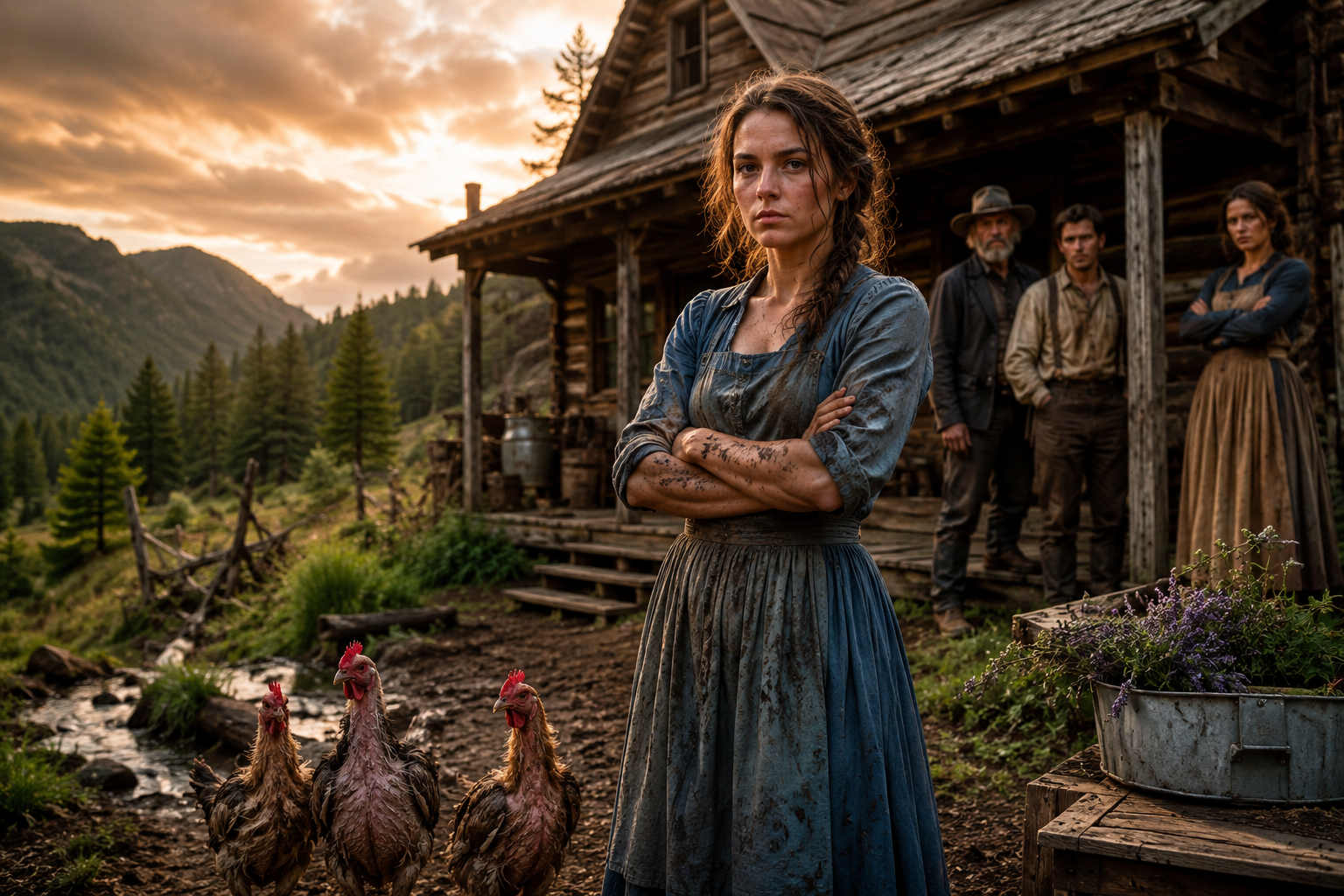
The Cabin That Wouldn’t Die

For one long breath, Mara Whitlow stood in the kitchen doorway and listened to her own life being divided without her.

Her uncle Jonah sat at the head of the table, his thick fingers resting on the deed papers as if the wood beneath them belonged to him by birthright. Beside him, his wife Elspeth wore her Sunday collar and the careful face she used whenever she wanted cruelty to look like duty. Their son Garrett leaned against the stove with one boot crossed over the other, smiling like a man watching a dog learn it was no longer welcome indoors.

Mara had washed that stove.

She had scrubbed that floor.

She had baked bread in that oven, mended shirts by that window, nursed Elspeth through winter fever, and spent twelve years being called “family” only when there was work too heavy for anyone else to carry.

Now the house was warm with lamplight and meat gravy, and Mara was standing outside the circle of it.

“You heard your uncle,” Elspeth said, folding her hands. “It’s only sensible.”

Mara looked at the papers. “Sensible for whom?”

Garrett laughed under his breath.

Jonah’s jaw hardened. “Don’t start.”

That was what he always said when she was close to telling the truth. Don’t start. Don’t make trouble. Don’t speak above your place. Don’t remember too loudly what we owe you.

Mara stepped farther into the room. She was twenty-seven years old, but in that house, they still spoke to her as if she were the hungry girl they had taken in after her mother died. They liked that version of her best. Small. Grateful. Easy to command.

“I have worked here since I was fifteen,” she said. “I never asked for wages. I never asked for my mother’s share. I never asked for anything because you told me this house was my home.”

Elspeth’s mouth tightened. “And we gave you shelter.”

“You gave me work.”

Jonah slapped his palm against the table. The plates jumped.

“You’ll watch your tone.”

Mara did not flinch. That surprised all of them. It surprised her too.

Garrett pushed off the stove. “The old ridge cabin is better than most women in your position could expect. You’ll have a roof.”

“A roof?” Mara almost smiled. “Last I heard, that roof had holes big enough to let the stars visit.”

“It was your great-aunt’s place,” Jonah said. “And now it can be yours, if you stop acting proud.”

There it was. The gift with teeth.

Everyone in the county knew the ridge cabin was dead land. A leaning shack above the north road, abandoned after Aunt Willa passed, surrounded by bramble, mud, and timber too hard to cut without money. No one wanted it. No one had wanted it for years.

So they were giving it to Mara.

Not because they were generous.

Because they wanted her gone.

Elspeth rose and crossed the kitchen. Her perfume smelled of rosewater and judgment. “You should be grateful, child. A woman alone needs somewhere to go.”

Mara looked at her. “I am not a child.”

“No,” Garrett said softly. “Just dependent.”

The words struck, but they did not pierce as deeply as they once might have.

Something inside Mara had gone strangely quiet.

For years, she had survived by swallowing what hurt. She had swallowed insults, hunger, exhaustion, loneliness. She had swallowed the ache of watching cousins inherit rooms while she inherited chores. She had swallowed every reminder that mercy, in that house, came with a chain around its ankle.

But there was a limit to what a body could hold.

Mara looked at her uncle. “If I go, I take what belongs to me.”

Jonah scoffed. “You own nothing.”

“I own my mother’s sewing chest. My blue kettle. The seed jars in the pantry. The hens behind the shed.”

Garrett laughed. “Those hens? They’re half dead.”

“Then you won’t miss them.”

Elspeth stared. “You can’t be serious.”

Mara met her eyes. “For the first time in years, I am.”

No one spoke for several seconds.

Then Jonah pushed the papers toward her.

“Sign. Or stay and remember who feeds you.”

Mara looked down at the ink, at the blank line waiting for her name. The room smelled of roast pork and lamp oil. Somewhere outside, the wind dragged bare branches against the side of the house like fingernails.

She picked up the pen.

Garrett’s smile widened.

But Mara did not sign where Jonah pointed.

She turned the sheet around, wrote one careful line beneath his terms, and signed her name under that.

Jonah snatched the paper back.

His face darkened.

“What is this?”

Mara set the pen down. “A receipt. It says the ridge place, the well road, and everything standing on it is mine from this day forward. You signed the transfer. You wanted me gone badly enough to put it in writing.”

Elspeth went pale.

Garrett stepped closer. “You think you’re clever?”

“No,” Mara said. “I think I learned from thieves.”

Jonah rose so fast his chair scraped across the floor.

For one terrible second, Mara thought he would strike her.

Instead he leaned close enough for her to smell tobacco on his breath.

“Don’t make this harder than it needs to be.”

Mara looked at the house around her, at the walls that had held her like a box for half her life.

Then she turned and walked out.

She did not cry in front of them.

She would not give them that.

She cried later, behind the smokehouse, where the cold wind could tear the sound apart before anyone heard it.

By sunrise, Mara had packed everything she could call her own.

Two dresses. A patched shawl. Her mother’s sewing chest. A blue kettle with a dent near the handle. A loaf of bread wrapped in cloth. Six jars of seeds she had saved year after year in secret: beans, squash, corn, onion, turnip, and lavender.

The three hens came last.

They looked insulted by life itself.

Their feathers stuck out in sad, uneven clumps. Their bones showed under skin. One had a bare neck, one had a crooked foot, and one simply stared at the world with the weary suspicion of a creature that had seen too much.

Mara placed them gently in a crate.

Garrett came out onto the porch just as the hauler’s wagon rolled up.

“Don’t get too comfortable up there,” he called. “Winter takes what pride leaves behind.”

Mara lifted the crate into the wagon and climbed after it.

She did not answer.

The hauler, a quiet man named Otis Bell, glanced at her once and said nothing. Mara appreciated that. Some silences were kinder than questions.

They left the Whitlow house behind in a ribbon of dust.

At first, Mara stared straight ahead.

Then the road curved through the trees, and the roof disappeared.

Only then did she breathe.

The ride took nearly two hours.

The north ridge road was less road than memory. The wagon jolted through ruts, over stones, and past pines that leaned close as if trying to listen. Fog hung low in the hollows. Crows crossed the gray sky. The higher they climbed, the colder the air became.

When Otis finally stopped, he did not say, “We’re here.”

He said, “I’m sorry.”

Mara looked.

The cabin leaned at the edge of the clearing like a tired animal waiting for permission to fall. Half the roof sagged. The porch dipped in the middle. The chimney had lost stones near the top. One window was boarded. The other had no glass. Briars had swallowed the fence, the path, and most of the yard. The small barn behind the cabin had collapsed on one side, leaving broken beams clawing at the air.

For a moment, Mara could only stare.

Then one of the hens sneezed.

Mara laughed.

It was not happiness. It was not amusement.

It was the sound a woman made when the world had become so cruel it had accidentally become ridiculous.

Otis unloaded her things onto the porch.

“You got family nearby?” he asked.

Mara looked at the dead cabin, the dead yard, the dead garden, the three nearly dead hens.

“No.”

Otis shifted his hat. “You need help, you send word down to Bell’s Crossing. I pass through every Thursday.”

That nearly undid her.

Kindness was harder to receive than insult. Insult had familiar edges. Kindness had no handle.

“Thank you,” she said.

He nodded, climbed back into the wagon, then paused.

“Miss Whitlow?”

“Yes?”

He looked at the cabin. “A place can be ugly and still be waiting.”

Then he drove away.

Mara stood alone in the clearing until the wagon sound faded.

The wind moved through the pines.

The hens muttered in their crate.

The cabin watched her with its empty window.

Mara wiped her face with the back of her hand.

“All right,” she whispered. “Let’s see which one of us gives up first.”

The first night, rain came through the roof in eight places.

Mara found two buckets, one cracked basin, and a cooking pot. That still left four leaks to fall freely onto the floor. She pushed the bed frame into the driest corner, dragged her trunk onto boards that seemed less rotten than the rest, and sat awake listening to water hit wood.

By morning, her hands were stiff from cold.

She built a fire with damp kindling and stubbornness.

Smoke filled the room before it found the chimney. Mara coughed until her eyes watered, then laughed again because there was no one there to complain.

The cabin did not become livable in a day.

Or a week.

It fought her.

The door stuck. The floor splintered. The hearth smoked. The roof leaked. The yard scratched her arms bloody. The well rope snapped the first time she tried it. The barn shed a beam in the middle of the night with a crash loud enough to make her reach for a knife.

But Mara had lived under Jonah Whitlow’s roof.

A broken cabin had nothing new to teach her about endurance.

She worked from dawn until dark.

She cleared the porch first, cutting back briars with a dull blade until her wrists shook. She swept out nests, leaves, mouse droppings, and old dirt. She patched the window with oiled cloth. She dragged stones to strengthen the hearth. She fixed the door latch with wire and a bent nail. She dug a trench to carry rainwater away from the foundation.

The hens watched with cautious interest.

On the fourth morning, the crooked-footed hen laid an egg.

Mara stared at it like it was gold.

“Well,” she said, picking it up carefully, “look at you.”

She named that hen Queenie.

The bare-necked one became Duchess.

The suspicious one became Mercy, because Mara thought it might improve her character.

It did not.

By the second week, Mara found the spring.

She discovered it by accident while fighting through a wall of thorn and dead leaves behind the collapsed barn. Her boot sank into soft mud, and when she pulled it free, she heard water.

Not the tired drip of a broken roof.

Real water.

Cold, clear water bubbling between two flat stones beneath the brush.

Mara dropped to her knees.

The spring was half buried, clogged with leaves and roots, but it was alive.

She put her hands into it.

The cold shocked her wrists. She laughed softly, then covered her mouth because the sound was too close to crying.

“There you are,” she whispered.

After that, everything changed.

Not easily.

But truly.

Mara cleared the spring. She lined it with stone and dug a shallow channel so overflow would run toward the lower patch of earth instead of the cabin. The soil near the water was black and rich beneath the weeds. She turned it over one small square at a time.

Her hands blistered. Then split. Then hardened.

She planted beans first. Then turnips. Then onion. She saved the corn for a warmer patch near the fence line. She spoke to the rows as she worked, not because she believed seeds needed conversation, but because she did.

For years, Mara’s words had been measured, corrected, punished, or ignored.

In the garden, no one told her to be quiet.

By late autumn, the cabin still looked poor from the road.

But from inside the clearing, it had begun to breathe.

Smoke rose from the chimney without choking the room. The porch no longer sagged as badly. The spring ran clear. The hens had grown glossy from scraps, grain, and freedom. Mara had beans drying near the hearth, turnip greens under cloth, and three jars of eggs packed in limewater.

Her dresses were patched.

Her face was thinner.

Her eyes were different.

She noticed that most when she caught her reflection in the spring.

The woman looking back at her was not soft in the old way. Not worn down. Not waiting to be chosen.

She looked like someone who had survived being thrown away and had taken root out of spite.

One cold morning, while Mara was repairing the fence with strips of wire, she heard a horse on the ridge road.

She straightened, hammer in hand.

A man appeared between the pines on a dark bay mare. He was broad-shouldered, maybe thirty-five or forty, with a weathered face and quiet eyes. A little girl sat in front of him on the saddle, wrapped in a brown coat too large for her. She had black curls, solemn eyes, and the stillness of a child who had learned to disappear while present.

The man lifted a hand.

“Morning.”

Mara did not lower the hammer. “You’re on my land.”

His mouth twitched. “Then I’ll apologize from your land.”

She almost smiled. Almost.

He dismounted carefully, lifting the girl down before tying the mare to a pine.

“Name’s Silas Reed,” he said. “My place sits two ridges east.”

Mara looked from him to the child. “That doesn’t explain why you’re here.”

“No,” he said. “It explains why I noticed smoke from a cabin that’s been dead ten years.”

The girl looked at Mara’s hands.

Mara noticed and curled her fingers against the hammer handle.

Silas saw the motion but did not comment.

“This is my daughter, Liora.”

The child gave the smallest nod.

Mara nodded back. “Mara.”

Silas looked around the clearing. His gaze moved over the patched roof, the cleared spring, the turned soil, the hens scratching near the fence.

“You did all this alone?”

Mara’s chin lifted. “Does that trouble you?”

“No,” he said. “It impresses me.”

Compliments made Mara suspicious. They often came before requests.

Silas reached into his saddlebag and pulled out a small sack.

“I brought nails. And salt. Thought whoever was up here might need both.”

Mara stared at the sack.

“Why?”

He looked confused. “Because I had extra.”

“That’s not a reason.”

“Where I come from, it is.”

Mara almost handed it back.

Pride rose in her like a match flame.

But then Duchess scratched near the empty grain pan, and the wind slipped through the patched window, and Mara remembered how foolish it was to refuse help only because cruelty had taught her help was dangerous.

She took the sack.

“Thank you.”

Silas nodded once.

The little girl stepped closer to the hens. Mercy stared at her with open distrust.

Liora whispered, “That one looks mean.”

Mara glanced at Mercy. “She is.”

The girl’s mouth moved slightly. Not a smile. The ghost of one.

Silas saw it.

His face changed so quickly Mara almost missed it. Grief passed through him like a shadow over water.

Mara knew that look.

She had seen it in mirrors.

“How old is she?” Mara asked softly.

“Seven.”

Liora crouched near Queenie, careful not to touch.

Silas lowered his voice. “Her mother died last spring.”

The clearing seemed to still.

Mara looked at the child again. At the too-large coat. At the careful silence. At the way she stayed near her father but not close enough to ask for comfort.

“I’m sorry,” Mara said.

Silas accepted the words with a small nod, as if they were too heavy to hold for long.

Liora pointed at the garden. “Did you wake it up?”

Mara blinked. “What?”

“The ground,” the girl said. “It was sleeping.”

Mara looked at the black rows, the pale turnip leaves, the bean poles tied with twine.

“Yes,” she said after a moment. “I suppose I did.”

Liora nodded, satisfied.

Silas looked at Mara then, and something unspoken passed between them.

Not romance.

Not yet.

Recognition.

The knowledge that some people were not living so much as learning how to continue.

After that, Silas and Liora came often.

Never too often.

Never without a reason.

One week he brought a saw blade he said he no longer needed. Another time he left two jars of molasses on the porch because “trade is easier when both parties pretend it was business.” Mara sent him home with eggs, greens, and a repaired tear in Liora’s coat.

At first, Mara watched him for the hook.

There had to be one.

People did not give without wanting.

But Silas did not press. He did not ask questions she refused to answer. He did not walk into her cabin without permission. He did not laugh at her repairs or make himself large in her small space.

He simply showed up when showing up mattered.

When the first hard frost came, he and a carpenter named Abel Crowe repaired the worst part of the roof. Abel was a square man with a crooked nose and hands like mallets. He climbed onto the cabin, examined the beams, and shouted down, “This place is stubborn.”

Mara looked up from the yard. “That makes two of us.”

Abel grinned. “Then it might survive.”

They worked all day while Mara cooked beans, cornbread, and fried eggs. No one complained. No one called the meal plain. No one acted like helping her gave them ownership over her gratitude.

That evening, after Abel left, Silas lingered by the porch while Liora fed crumbs to Queenie.

Mara stood beside him, watching smoke twist from the chimney.

“It looks less dead,” he said.

“It was never dead,” Mara answered before thinking.

Silas looked at her.

She swallowed. “Just neglected.”

His voice softened. “There’s a difference.”

“Yes,” she said. “There is.”

Winter came down hard after that.

Snow sealed the ridge road. Ice thickened along the spring stones. The pines cracked under cold nights. Mara slept close to the hearth and woke before dawn to break water for the hens.

Loneliness changed shape in winter.

In summer, it spread wide.

In winter, it sat close.

Some nights, the silence in the cabin grew so deep Mara thought she could hear every year she had lost. She would sit by the fire with her mother’s sewing chest open beside her and repair things that did not urgently need repair just to keep her hands moving.

Then one afternoon, while searching beneath a loose board for a dropped needle, she found the tin.

It was hidden under the floor near the old bed frame, wrapped in oilcloth and tied with string gone brittle from age.

Inside were three silver dollars, a yellowed map, two property receipts, and a letter.

Mara knew the handwriting at once.

Aunt Willa.

She sat back on her heels.

Her hands began to tremble before she unfolded the page.

The letter was short, but it struck harder than any speech.

Willa wrote that the ridge place was not worthless. The spring had never run dry. The lower slope held rich soil. The timber, if managed well, could pay for roof, fence, livestock, and seed. She wrote that Jonah Whitlow had tried twice to convince her to sell it cheap, and she had refused because she knew greed when it wore family skin.

Then came the line that made Mara stop breathing.

I leave this place to the one girl in our bloodline who knows how to make broken things useful again.

Mara read it once.

Then again.

Then a third time through tears that blurred the ink.

All those years, she had believed no one saw her.

But someone had.

Aunt Willa had seen her hands.

Not soft hands. Not pretty hands. Not hands admired at church or kissed in courtship.

Working hands.

Hands that lifted, planted, mended, washed, carried, soothed, and built.

Hands everyone else had used.

Hands one woman had trusted.

Mara pressed the letter to her chest and wept harder than she had wept the day she left the Whitlow house.

Not because she was broken.

Because someone had left proof that she was not invisible.

By spring, the ridge cabin had become a place people noticed.

That was when trouble came.

Mara saw the wagon first.

It rolled into the clearing behind two glossy horses that had no business climbing a road that rough. Garrett sat at the reins. Jonah sat beside him in a black coat. A thin man in city clothes rode in the back, clutching a leather case like it contained the law itself.

Mara stepped onto the porch.

Queenie, Duchess, and Mercy scattered under the steps.

Garrett smiled.

“There she is. Queen of the weeds.”

Mara folded her arms. “You’re lost.”

Jonah climbed down, looking around the clearing.

His eyes moved over the repaired roof. The clean spring. The fenced garden. The straight rows of green shoots. The smokehouse Mara had built from salvaged boards. The hens. The stacked firewood. The signs of life.

His expression tightened.

“Well,” he said. “You’ve been busy.”

“You didn’t come to admire the beans.”

The city man opened his case. “Miss Whitlow, I represent your uncle in a property clarification matter.”

Mara laughed.

The lawyer blinked.

“I’m sorry,” she said. “I usually wait until the lie is finished.”

Garrett’s face hardened. “You still got that mouth.”

“Yes,” Mara said. “But now it’s attached to my own roof.”

Jonah stepped forward. “Enough. We let you stay through winter. That was mercy. But the transfer was informal.”

“No, it wasn’t.”

“You had no witness.”

“I have paper.”

The lawyer gave a thin smile. “Paper can be challenged.”

Mara looked at him. “So can thieves.”

Garrett moved fast, grabbing her arm.

He did not hold it long.

A shotgun clicked behind him.

Everyone turned.

Silas Reed stood at the edge of the clearing with Liora behind him on the horse, Abel Crowe beside him, and old Magistrate Bellamy walking slowly between them with a cane in one hand and a badge on his vest.

Silas’s voice was low.

“Take your hand off her.”

Garrett released Mara as if burned.

Jonah flushed. “This is family business.”

“No,” Magistrate Bellamy said. “Family business is supper and funerals. This looks like trespass and attempted theft.”

The lawyer straightened. “Sir, with respect—”

“I’m old,” Bellamy said. “Not decorative. Hand me what you brought.”

The lawyer hesitated.

That hesitation said enough.

Mara went inside and returned with Aunt Willa’s tin, the letter, the receipts, and Jonah’s signed transfer.

Jonah’s face changed when he saw the oilcloth.

Garrett noticed.

“What is that?”

Mara looked at her uncle. “Something you hoped rotted under the floor.”

Bellamy read slowly.

No one spoke.

Even the hens seemed to understand that the world had narrowed to ink and silence.

At last, Bellamy folded the papers.

“Well,” he said.

The lawyer cleared his throat. “There are complications, obviously.”

“There are,” Bellamy agreed. “For your client.”

Jonah’s mouth tightened. “That land was abandoned.”

“By you,” Bellamy said. “Not by her.”

Garrett snapped, “She was nothing in our house.”

Silas moved one step forward.

He did not raise his voice.

That made it more dangerous.

“She was the only reason your house ran.”

Garrett glared. “You don’t know that.”

“I know what work looks like,” Silas said. “And I know men who mistake possession for worth.”

Mara looked at him, startled by the force in his voice.

He did not look away from Garrett.

Bellamy tapped the papers against his palm. “Miss Whitlow has a signed transfer, supporting receipts, a letter of intent from the previous owner, and clear improvement of the property under her care. If you wish to fight that, Mr. Whitlow, you may do so in court. But you will explain why you discarded the place as worthless until a woman made it valuable.”

Jonah’s face went dark.

Garrett stepped closer. “This isn’t over.”

Mara stepped off the porch.

For the first time in her life, she stood close to them without shrinking.

“Yes,” she said. “It is.”

Garrett laughed once. “You think a garden makes you somebody?”

“No,” Mara said. “Leaving you did.”

Silence.

Then Jonah turned away.

“Come on,” he snapped.

The lawyer packed his papers with shaking fingers. Garrett climbed into the wagon, but before he took the reins, he looked back at Mara with hatred so naked it almost looked like fear.

“You’ll regret humiliating us.”

Mara looked at her land.

The spring. The cabin. The hens. The rows of green life pushing through black soil.

Then she looked back at him.

“I survived belonging to you,” she said. “I can survive being hated by you.”

The wagon left in a spray of mud.

When it disappeared into the trees, Mara’s knees nearly gave way.

Silas caught her elbow.

“You all right?”

She wanted to say yes.

Instead, she told the truth.

“Not yet.”

Liora slid down from the horse and ran to her. The girl wrapped both arms around Mara’s waist and buried her face against her apron.

Mara froze.

Then slowly, carefully, she placed one hand on the child’s hair.

Liora whispered, “Don’t go back.”

Mara’s throat closed.

“I won’t.”

That was the day the ridge stopped being a place of exile.

It became home.

The years that followed did not turn into a fairy tale.

Fairy tales were too clean.

Mara’s life remained full of mud, splinters, broken tools, failed crops, sick animals, cold mornings, and worry. But now the labor belonged to her. That changed everything.

She sold eggs in Bell’s Crossing.

Then greens.

Then preserves.

Then lavender soap wrapped in brown paper, because the small lavender bed she planted near the spring grew wild and fragrant enough to make the whole cabin smell like summer after rain.

People who once looked past her began greeting her by name.

Some did it because they respected her.

Some did it because success made them forget their own silence.

Mara knew the difference.

She was polite to both and trusted only the first.

Silas and Liora remained part of the ridge as naturally as the spring.

Liora learned to collect eggs, plant beans, and sit quietly without being lonely. She began speaking more, first to the hens, then to Mara, then to other people when she felt safe.

One evening, while Mara was kneading bread, Liora said, “Mama used to sing when she made dough.”

Mara slowed her hands.

Silas, sitting near the hearth, went very still.

“What did she sing?” Mara asked.

Liora hummed a broken piece of melody, too soft to catch fully.

Mara listened.

Then she hummed it back, not perfectly, but gently.

Liora’s eyes filled.

“She would have liked you,” the child whispered.

Mara looked at Silas.

His face was turned toward the fire, but tears shone in his eyes.

After that, something changed between them.

Not all at once.

Love did not arrive for Mara like lightning.

It arrived like spring.

Quietly.

Then everywhere.

It was in Silas fixing a gate and asking where she wanted the hinge, not assuming. It was in the way he listened when she said no. It was in the way he taught Liora to admire Mara’s strength without demanding it from her. It was in evenings where they sat on the porch after work, saying little, watching the ridge darken blue.

One night, a storm rolled over the mountains, and Silas stayed late because the road was too dangerous.

Liora slept in the small room Mara had prepared for her months before.

Mara and Silas sat by the hearth while rain struck the roof.

A roof that did not leak.

That still felt like a miracle.

Silas stared at the fire for a long time before speaking.

“I need to say something before cowardice talks me out of it.”

Mara’s hands stilled around her cup.

“All right.”

He looked at her.

“I love you.”

The words were plain.

That made them harder.

No decoration. No performance. No trap.

Mara felt the old fear rise anyway.

“You shouldn’t.”

“I know why you’d say that.”

“No,” she said. “You don’t. I come with trouble.”

“So does weather.”

“I don’t trust easily.”

“I’m not asking for easy.”

She stood and crossed to the window, though there was nothing to see but rain and dark glass.

“You have a child.”

“Yes.”

“She already lost one mother.”

Silas’s voice softened. “I’m not asking you to replace anyone.”

Mara closed her eyes.

That was the sentence that broke through.

Because everyone else had always wanted her to become something useful to them. A servant. A burden. A grateful dependent. A quiet woman. A convenient shame.

Silas was asking her to remain herself and be loved anyway.

“I don’t know how to do this,” she whispered.

He came no closer.

“Then we learn slow.”

She turned.

His face was steady, but not fearless. That mattered too. Courage without fear was just ignorance. Silas knew what could be lost, and still he stood there.

Mara looked down at her hands.

Scarred. Strong. Rough. Alive.

“These hands don’t know how to hold something without working to keep it,” she said.

Silas smiled sadly. “Then let mine work too.”

From the doorway came Liora’s sleepy voice.

“Are we staying here?”

Mara and Silas both turned.

The girl stood wrapped in a quilt, curls wild, eyes half closed.

Mara looked at her, then at Silas, then around the cabin.

The hearth. The table. The shelves. The dry roof. The seed jars. The life she had built plank by plank, row by row, breath by breath.

“Yes,” Mara said softly. “We’re staying.”

Liora nodded as if that settled the matter and went back to bed.

The following spring, Mara married Silas beside the spring.

Not in a church.

Not under polished glass.

Under pine branches, with Abel Crowe as witness, Magistrate Bellamy reading the vows, and Liora holding the rings in a little cloth pouch Mara had sewn from her mother’s old handkerchief.

Mara wore a plain blue dress.

Her hands trembled only once.

When Bellamy asked if she took Silas Reed as her husband, Mara looked at the cabin that had once been her punishment. She looked at the hens scratching beneath the porch, fat and glossy now. She looked at the garden waking under sun. She looked at Liora, who watched her with open hope.

Then she looked at Silas.

“I do,” she said.

And for once, those words did not mean obedience.

They meant choice.

Years passed.

The ridge place grew.

The cabin became a farmhouse. The barn stood straight again. Apple trees took root on the lower slope. Lavender spread along the path. The spring was lined with stone and shaded by a bench Silas built for Mara after their first son was born.

Queenie lived long enough to become a family legend.

Duchess became round and lazy.

Mercy remained mean until the end, which everyone agreed was proof of character.

Liora grew tall. She laughed more. She still went quiet sometimes when grief came near, but she no longer vanished inside it. She called Mara by her name for years, until one winter morning, while helping with bread, she said “Mama” by accident.

Both of them froze.

Then Mara kept kneading because some sacred things survived better when not stared at directly.

Later, behind the smokehouse, Mara cried into her apron.

Not from pain.

From the strange mercy of being chosen slowly and completely.

Jonah Whitlow died bitter.

Garrett tried twice to stir legal trouble and failed both times. Elspeth once sent a letter asking for forgiveness without quite admitting wrong. Mara read it, folded it, and placed it in the stove without anger.

Some debts did not need collecting.

Some doors did not need reopening.

One summer evening, many years after the wagon left her on the ridge with three starving hens and a broken kettle, Mara stood beside the spring holding her youngest daughter on her hip.

The farm glowed gold around her.

Silas was in the field with their son, setting fence posts. Liora, nearly grown, walked up from the henhouse with a basket of eggs. Apple leaves flashed in the wind. Lavender moved in purple waves along the path. Smoke rose from the chimney of a house that no longer leaned.

The little girl in Mara’s arms pointed at the cabin.

“Is that where you came when you had nothing?”

Mara looked at the house.

She thought of the first night, the rain, the cold, the broken roof.

She thought of Jonah’s hand on the papers.

Garrett’s laugh.

Elspeth’s false pity.

She thought of Aunt Willa’s letter and the line that had saved something inside her.

The one girl who knows how to make broken things useful again.

“I had more than nothing,” Mara said.

Her daughter frowned. “What did you have?”

Mara lifted one hand.

The hand was older now. The scars had faded. The fingers were strong, the nails short, the palm lined by years of work and love.

“These,” she said.

Liora came to stand beside her, basket on her hip.

“And three terrible hens,” she added.

Mara laughed.

Silas heard it from the field and turned toward the sound, smiling as if after all these years he still could not believe he got to come home to it.

The child looked around at the farm.

“And you made all this?”

Mara looked at the spring, the garden, the barn, the porch, the family, the life that had risen from insult and mud.

“No,” she said softly. “We did.”

But deep in her bones, she knew the first truth.

No one had given her a home.

They had given her ruin.

And with her own hands, she had taught it how to live.