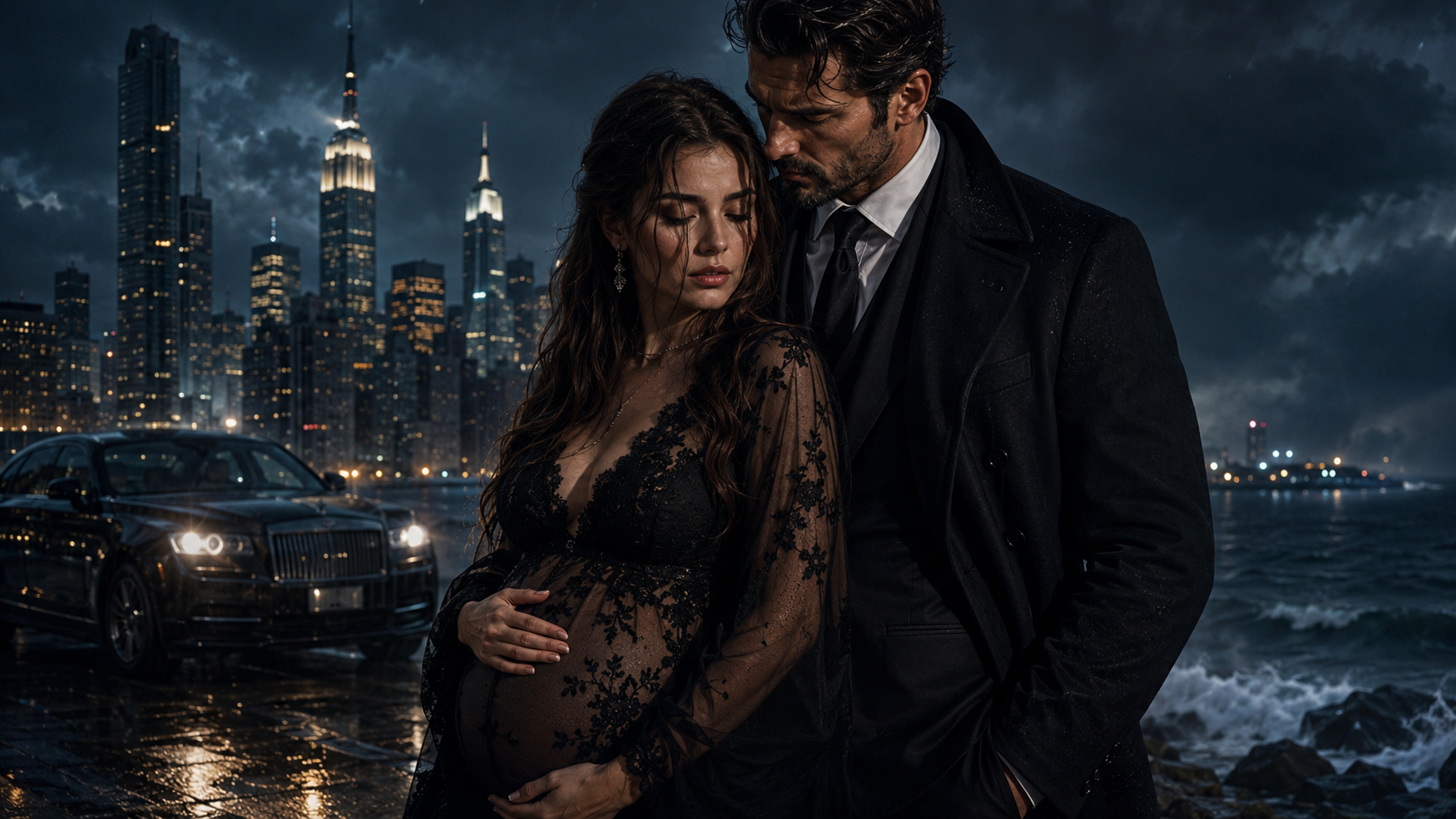
The first thing Mara Whitlock learned about rich men was that they never raised their voices when they were taking something from you.
They smiled.
They offered tea.
They used words like arrangement, opportunity, protection.
And by the time you realized you had been trapped, the door was already locked behind you.
Luca Bellarosa did not smile the night he bought her life.
He sat across from her in the private room of an old Manhattan restaurant where the waiters moved like ghosts and the windows were blackened by rain. He wore a charcoal suit, no tie, no wedding ring, no visible weapon. He did not need one. Men like Luca made the room itself feel armed.
Mara’s father owed money to the wrong people.
Not a small amount.
Not the kind of debt a second job or a desperate prayer could fix.
Her father had borrowed from one man, who sold the debt to another, who disappeared after losing a war nobody outside the underworld knew had happened. By the time Luca Bellarosa took possession of the debt, Mara’s family name had become an entry in a ledger written in blood.
“You are not responsible for your father’s choices,” Luca said.
His voice was low. Controlled. Almost kind.
Mara hated him for that.
“Then let him go,” she said.
Luca studied her across the candlelight. “It isn’t that simple.”
“It never is with men like you.”
Something passed through his eyes. Not anger. Recognition.
“My enemies believe your father knows where a certain account book was hidden,” Luca said. “He doesn’t. But they will not believe that.”
“My father is a mechanic.”
“Yes.”
“He forgets where he puts his own glasses.”
“I know.”
“Then why are you here?”
Luca leaned back. “Because they will come for him anyway. And when they cannot break him, they will take your mother. Or your younger sister. Or you.”
Mara’s fingers tightened around the napkin in her lap.
Luca’s gaze dropped for half a second, noticing the movement. Nothing escaped him.
“I can make that stop,” he said.
“At what price?”
His answer was immediate.
“Marriage.”
Mara laughed because the alternative was screaming.
The sound came out sharp enough to make the waiter near the door look away.
“You’re insane.”
“No.”
“You expect me to marry you because my father borrowed money?”
“I expect you to survive.”
She rose so quickly her chair scraped the floor.
Luca did not move.
That bothered her more than if he had grabbed her. He looked like a man who had already calculated every possible escape and found them all wanting.
“I am not some payment you can collect,” she said.
“No,” Luca replied. “You are the only person your family’s enemies cannot touch if my name is attached to yours.”
“My family’s enemies?” she repeated. “You mean your enemies.”
“At the moment, they are the same thing.”
Mara stared at him, breathing too fast.
The rain pressed against the glass like a crowd of fingers.
“What do you get?” she asked.
For the first time, he hesitated.
Then he said, “A wife people believe matters to me.”
The honesty chilled her.
“You want a shield.”
“I want a reason for certain families to hesitate before attacking mine.”
“And I’m that reason?”
“If you become Mrs. Bellarosa, yes.”
She hated the way her heart lurched at the name.
She hated even more that Luca saw it.
“No,” she said.
He nodded once, as if he had expected that.
Then he placed a folder on the table and slid it toward her.
Mara did not want to open it.
She did anyway.
Inside were hospital invoices paid in full. Her mother’s surgery. Her father’s debt. Her sister’s college tuition. The mortgage on the small house in Queens where Mara had grown up painting the kitchen walls yellow because her mother said sunlight should live somewhere even in winter.
Every impossible burden had been erased.
Her throat burned.
“This is manipulation,” she whispered.
“Yes.”
The answer was so plain she looked up.
Luca’s expression had not changed.
“You admit it?”
“I won’t insult you by pretending otherwise.”
“You paid for everything before asking me.”
“I paid for everything before you could say yes for the wrong reason.”
“That makes no sense.”
“It makes perfect sense.” His voice softened, barely. “Your family is safe whether you marry me or not.”
Mara stared at him.
For the first time that night, she had no words.
Luca stood.
He was taller than she had expected. Not huge, not theatrical, but built with the stillness of a blade.
“The offer remains until tomorrow night,” he said. “After that, I move your family under protection anyway. They won’t know why. They will live.”
“And me?”
His dark eyes held hers.
“You may walk away.”
Mara wanted to believe him.
She wanted to take the folder, throw it in his face, and go home to her mother’s kitchen where the walls were yellow and the world still made sense.
But she thought of strangers watching her father’s garage.
She thought of her sister laughing on a campus where she would never know men were paid to follow her.
She thought of her mother sleeping peacefully after surgery because a monster had paid the bill.
And she realized the most dangerous cages were not built from force.
They were built from gratitude.
The wedding happened forty-eight hours later.
No church.
No music.
No guests who loved her.
A judge with nervous eyes pronounced them husband and wife in a private library that smelled of cedar, old paper, and secrets.
Mara wore a pearl silk dress she had not chosen. Her hair was pinned by a stylist who never asked what she wanted. A diamond ring heavy enough to feel like a shackle slid onto her finger.
Luca did not touch her until the judge said he could kiss the bride.
Then he turned to her.
He waited.
It took Mara a moment to understand.
He was asking.
Not with words. Not where anyone could hear.
But his eyes asked clearly enough.
May I?
The question almost broke her.
She gave the smallest nod.
His kiss was brief. Warm. Careful. Not possessive. Not hungry.
Careful.
That was the first thing about Luca Bellarosa that frightened her more than his reputation.
A cruel man was easy to hate.
A careful one was dangerous.
After the ceremony, he led her through the halls of his penthouse, a glass palace above the city.
“This is your room,” he said, opening a door.
Mara stopped.
“My room?”
“Yes.”
Not ours.
The word hung between them, unspoken.
Inside was a bedroom with pale walls, fresh flowers, a balcony, and books stacked on the nightstand. Books she loved. Books she had once mentioned in an interview years ago when she worked at a small publishing house and believed literary taste was the most intimate thing a person could reveal.
Her stomach tightened.
“You researched me.”
“Yes.”
“You don’t see how disturbing that is?”
“I see exactly how disturbing it is.”
“Then why admit it?”
“Because lying would be worse.”
Mara turned away before he could see how close she was to crying.
Luca remained at the door.
“You are not expected in my bed,” he said.
She looked back at him.
His face was unreadable.
“Is that supposed to make me grateful?”
“No. It is supposed to make you informed.”
“And if I lock the door?”
“Then no one enters.”
“Not even you?”
“Especially not me.”
She searched his face for mockery.
There was none.
“I don’t understand you,” she said.
His mouth curved without warmth.
“That may be safest for both of us.”
For the first month, Mara lived as if the penthouse were a museum where she was the stolen artifact.
She attended dinners beside Luca. She stood at charity galas while photographers shouted his name. She learned the geography of power: which men kissed Luca’s ring without a ring being offered, which women watched him with old regret, which businessmen laughed too loudly because they were terrified.
In public, Luca’s hand sometimes rested at her back.
Never too low.
Never too long.
Always just enough to announce ownership to the room.
Mara told herself she hated it.
Then, one night, a man with silver hair and snake-thin eyes approached her while Luca was speaking to a senator across the room.
“Mrs. Bellarosa,” the man said. “You are prettier than expected.”
Mara had grown up poor. She knew an insult when it wore perfume.
“And you are exactly as expected,” she replied.
His smile widened.
“Does Luca know you have teeth?”
“He seems to appreciate them.”
The man leaned closer.
“Be careful, little bride. Men like your husband don’t keep pretty things forever.”
Before Mara could answer, Luca appeared at her side.
He did not touch the man.
He did not threaten him.
He simply said his name.
“Orsini.”
One word.
The man went pale.
Mara had never seen power move so quietly.
Orsini bowed his head and left.
Luca watched him go, then turned to her.
“Did he touch you?”
“No.”
“Did he frighten you?”
Mara wanted to say no.
Pride rose first.
Then honesty.
“A little.”
Something hard passed over Luca’s face.
“I’ll have him removed from the guest list permanently.”
“From the charity?”
“From the city, if necessary.”
She stared at him.
“You can’t just exile people because they made me uncomfortable.”
“I can.”
“That wasn’t permission.”
“I didn’t ask for permission to protect you.”
“No,” Mara said, stepping closer. “You asked for permission to kiss me at our wedding, but not for this?”
The words struck him.
For one second, Luca Bellarosa looked almost human.
Then he said, “You’re right.”
Mara blinked.
“I am?”
“Yes.”
He looked back toward the crowd.
“I will not act against him unless you ask me to.”
That should have pleased her.
Instead, it unsettled her.
Because the next day, when flowers arrived from Orsini with an apology written in elegant ink, Mara found herself carrying the card to Luca’s office.
He looked up from his desk.
She placed the card in front of him.
“What do you want done?” he asked.
The question was quiet.
Respectful.
Terrifying.
Mara swallowed.
“I want him to understand I’m not alone.”
Luca’s eyes darkened.
“He already does.”
“I want him to understand it from me.”
For the first time, Luca smiled.
It was small and brief and devastating.
“Then we’ll teach him properly.”
That was how it began.
Not love.
Not even affection.
A conspiracy.
Luca taught her how to stand in a room full of wolves without lowering her eyes. Mara taught him that silence was not always strength. Sometimes it was cowardice dressed in expensive tailoring.
He learned she hated roses because they reminded her of funeral homes.
She learned he drank coffee bitter enough to qualify as punishment.
He learned she talked to plants when she thought no one was listening.
She learned he had a scar near his ribs from a knife wound he never explained.
At night, sometimes, they met in the kitchen by accident.
At first, Mara believed the meetings were accidental.
Then she noticed the tea she liked waiting on the counter.
“You don’t sleep,” she said one night.
Luca was standing by the window, sleeves rolled to his elbows, city lights reflected in the glass.
“Neither do you.”
“I’m trapped in a mafia penthouse. What’s your excuse?”
“My father used to say sleep was when enemies became creative.”
“That’s bleak.”
“He was a bleak man.”
“Was?”
Luca’s face went still.
Mara regretted the question immediately.
But instead of shutting down, he said, “He died when I was twenty-two.”
“I’m sorry.”
“Don’t be. You didn’t kill him.”
The answer was too quick.
Too practiced.
Mara wrapped her hands around her mug.
“Did you?”
Luca looked at her.
Any other man might have lied.
He didn’t.
“No.”
“But people think you did.”
“Yes.”
“Does that bother you?”
“Less than it should.”
Mara studied him in the dim kitchen light.
“You say things like that so people stop asking.”
“It usually works.”
“I’m not people.”
“No,” he said softly. “You are not.”
The air changed.
Mara felt it in her skin before she understood it.
Luca was looking at her the way he looked at locked doors, coded messages, distant threats.
As if she were a problem he could not solve.
As if he wanted to try anyway.
She set down her mug.
“I should go.”
“Yes,” he said.
Neither of them moved.
Then Mara stepped away first.
Luca let her.
That mattered.
Weeks became months.
The marriage contract sat unsigned in a safe because Mara refused to sign any clause she had not read three times, and Luca, to her surprise, never forced the matter. Her family remained safe. Her sister sent photographs from campus. Her mother called every Sunday and asked if Mara was eating enough.
Mara lied and said she was happy.
The terrible part was that, sometimes, it was not entirely a lie.
One evening, Luca came home bleeding.
Mara found him in the entry hall, one hand pressed beneath his jacket, his men speaking in clipped Italian around him.
The blood was dark against his white shirt.
Her body moved before her mind did.
“Sit down,” she ordered.
Every man in the hall froze.
Luca looked at her. “Mara.”
“Sit. Down.”
His right-hand man, Enzo Varric, opened his mouth.
Mara pointed at him.
“You. First-aid kit. Now.”
Enzo glanced at Luca.
Luca, unbelievably, sat.
Mara knelt in front of him and opened his shirt with shaking fingers.
The wound was a graze, ugly but shallow.
“You’re lucky,” she snapped.
Luca watched her clean it.
“You’re angry.”
“I’m furious.”
“Because I’m bleeding?”
“Because you walked in here like blood is a scheduling inconvenience.”
His mouth twitched.
“Would you prefer panic?”
“I would prefer survival instincts.”
“I have survived this long.”
“Despite yourself, apparently.”
Enzo coughed.
It might have been a laugh.
Luca’s eyes cut toward him.
Enzo became very interested in the floor.
Mara pressed gauze against Luca’s side harder than necessary.
He inhaled.
“Careful,” he murmured.
“Now you want careful?”
His gaze returned to her face.
“I always want careful with you.”
Her hands stilled.
The room disappeared around them.
Mara suddenly became aware of how close she was to him. Of the warmth of his skin beneath her fingertips. Of the way he had not once tried to take control back from her.
She taped the bandage in place and stood.
“There. Try not to get shot before breakfast.”
“I wasn’t shot.”
“Try not to get dramatically grazed before breakfast.”
This time, Luca smiled.
A real smile.
Small.
Unprepared.
Mara forgot how to breathe.
Later that night, he came to her door.
He knocked once.
She opened it because she already knew it was him.
For a long moment, neither spoke.
Then Luca said, “You were afraid.”
Mara folded her arms. “People generally dislike seeing blood on their husbands.”
“Is that what I am?”
The question was so quiet she almost missed it.
Her anger vanished.
“What?”
“Your husband.”
The word sounded dangerous in his mouth.
Not because he claimed it.
Because he did not.
Mara looked at him standing outside her room, still pale beneath his controlled expression, and realized the most frightening part of this marriage was no longer the force that had created it.
It was the choice growing inside it.
“I don’t know what you are,” she said.
Luca nodded.
Pain moved behind his eyes, then disappeared.
“I can accept that.”
He turned to leave.
Mara spoke before she could stop herself.
“Luca.”
He looked back.
“If you die,” she said, “I’ll be very angry.”
His expression changed.
Not much.
Enough.
“I’ll keep that in mind.”
That night, Mara dreamed not of cages, but of open doors she was too afraid to walk through.
The first kiss that belonged only to them happened in the library during a thunderstorm.
Mara had gone there because storms made the penthouse feel less like glass and more like shelter. Luca was already inside, seated in the dark, a file open on his lap and a drink untouched beside him.
“You hide here too?” she asked.
“I don’t hide.”
“No. Of course not. You strategically occupy shadows.”
He looked up.
Lightning flashed, cutting his face into silver and black.
“You should be asleep.”
“You say that often for a man who never sleeps.”
“I say many hypocritical things.”
“At least you’re self-aware.”
Mara crossed the room and sat across from him.
He closed the file.
That small gesture warmed her in a way she did not want to name.
“What’s in the file?” she asked.
“Nothing you want to know.”
“Try me.”
His jaw tightened.
“No.”
The refusal landed between them.
Mara looked away.
There it was.
The wall.
No matter how many late-night teas, bandaged wounds, almost-smiles, and careful glances passed between them, Luca had rooms inside him she was not allowed to enter.
“You want me to trust you,” she said.
“Yes.”
“But only with the parts of yourself you polish first.”
His face went very still.
“That isn’t fair.”
“No,” she agreed. “But it’s true.”
Thunder rolled over the city.
Luca stood and walked to the shelves. For a moment, Mara thought he would leave.
Instead, he said, “My mother was killed in this house.”
Mara’s breath caught.
He kept his back to her.
“I was sixteen. I found her before anyone else did. My father told me emotion was a luxury men like us could not afford. At the funeral, he made me shake hands with the man we both knew ordered it.”
Mara rose slowly.
“Luca.”
“I learned that day that softness was evidence. If people saw where you hurt, they pressed there until you broke.”
He turned.
His face was calm, but his eyes were not.
“So yes, Mara. I polish what I show you. Because the rest is not fit for anyone to hold.”
Something inside her broke cleanly.
She crossed the room.
He did not move.
“You don’t get to decide that for everyone,” she whispered.
His gaze fell to her mouth, then back to her eyes.
“Mara.”
A warning.
A plea.
She stepped closer anyway.
“Do you want me to leave?”
His answer came rougher than she had ever heard his voice.
“No.”
“Then don’t tell me to.”
He reached for her slowly.
Always slowly.
As if giving her every chance to choose distance.
Mara chose him.
The kiss was not careful this time.
It was restrained, yes, because Luca’s restraint was carved into his bones. But beneath it was hunger, grief, need, a thousand locked doors opening at once.
Mara kissed him back with the fury of a woman who had spent months pretending survival was the same as living.
When they parted, Luca rested his forehead against hers.
“I don’t know how to do this,” he said.
“Good,” Mara breathed. “Neither do I.”
After that, everything changed.
And nothing did.
Men still arrived at odd hours.
Doors still closed when Mara entered.
Luca still carried a gun beneath expensive jackets and secrets beneath his skin.
But he also came to her room, and sometimes stayed until morning.
He memorized how she liked her eggs.
She learned that he hummed under his breath when he cleaned a weapon, which should have been alarming and somehow became familiar.
He let her visit her family under protection so discreet her mother only complained that Luca’s driver looked “too handsome to be trustworthy.”
Mara laughed for the first time in days.
Luca heard it from across the small kitchen and looked at her as if the sound had changed the weather.
Love arrived like that.
Not as a declaration.
As evidence.
A cup of coffee left on the right side of her desk.
A hand at her back that asked before it claimed.
A man who could order cities to move but waited outside her locked door until she opened it herself.
Then came the morning sickness.
At first, Mara blamed stress.
Then the smell of Luca’s coffee made her run to the bathroom three mornings in a row.
Rosa, the housekeeper who had been with Luca’s family for thirty years and knew too much about everyone, found Mara sitting on the bathroom floor with her head against the cabinet.
Rosa said nothing.
She simply returned five minutes later with water, crackers, and a small paper bag from the pharmacy.
Mara stared at the bag.
“No.”
Rosa lifted one eyebrow.
“You are a smart woman, Mrs. Bellarosa. Don’t waste time arguing with your own body.”
The test showed two lines before Mara had finished praying for one.
She sat on the edge of the bathtub, holding the plastic stick like it was a verdict.
Pregnant.
The word did not feel real.
It felt enormous.
It felt impossible.
It felt like standing in a room that had suddenly grown a sky.
At the doctor’s appointment, Luca was in Chicago handling a crisis Mara was not supposed to know about. Rosa went with her instead.
The doctor smiled at the ultrasound screen.
“Well,” she said. “That explains why you’ve been so tired.”
Mara gripped the paper sheet beneath her.
“What?”
The doctor turned the screen slightly.
“There are two.”
Mara did not understand.
Then she heard it.
Two fast, tiny rhythms.
Two heartbeats.
Not an echo.
Not a mistake.
Two.
Her hand flew to her mouth.
Rosa began crying before Mara did.
Twins.
Luca’s children.
Her children.
Two little lives created in a marriage that had begun as a bargain and become something neither of them had been brave enough to name.
Mara left the clinic with a photograph folded inside her coat pocket.
All day, she imagined telling him.
She pictured his face going blank first because Luca always met emotion like an ambush. Then she imagined the crack in his armor. The fear. The wonder. Maybe, if she was lucky, joy.
He came home after midnight.
Mara woke when she heard voices below.
She reached for her robe and stepped into the hallway.
Luca’s office door was not fully closed.
She did not mean to listen.
Then she heard her name.
“She cannot know yet,” Luca said.
Mara froze.
Enzo answered, voice grim. “If Mara is pregnant, every family we’ve angered will smell weakness.”
Her blood turned cold.
Luca said something too low to hear.
Enzo’s reply came sharper.
“You know what has to happen. Remove the problem before it becomes permanent.”
Mara’s hand went to her stomach.
The problem.
Her breath vanished.
The room tilted.
Luca spoke again.
His voice was colder than winter.
“I’ll deal with my wife.”
The words sliced through whatever fragile hope she had been holding.
Mara stepped back.
Once.
Twice.
Then she ran without making a sound.
By sunrise, Mara Whitlock Bellarosa no longer existed.
She left her phone in the penthouse.
She took cash, plain clothes, a fake ID she had found months earlier in one of Luca’s emergency safes, and the ultrasound photo folded against her heart.
She did not wake Rosa.
She could not risk saying goodbye.
At the bus station, she cut her hair in a bathroom with flickering lights and a pair of nail scissors. She bought a gray coat two sizes too big. She traded her earrings for cash at a pawnshop where the owner did not ask questions because desperate women were good business.
By the time Luca discovered she was gone, Mara was already three states away.
For five months, she became Emily Hart.
Emily rented a small apartment above a closed-down bakery in a coastal town in Maine where fog rolled in every morning and nobody cared who you used to be if you paid in cash and kept quiet.
Emily worked afternoons at a diner with cracked red booths and a cook named June who cursed at the radio.
Emily learned to sleep with a chair beneath the doorknob.
Emily spoke to the twins every night.
“Your father is dangerous,” she whispered, one hand spread over the curve of her stomach. “But he once stood outside my door and waited. He once smiled like it hurt. He once made me believe monsters could choose not to bite.”
The babies kicked as if arguing.
Mara cried more often than she admitted.
She missed Luca in humiliating ways.
His silence.
His hands.
The way he looked at her when he thought she wasn’t watching.
The way danger bent around him but never quite touched her when he was near.
Then she remembered his voice through the office door.
Remove the problem.
I’ll deal with my wife.
And love became a wound she pressed on to keep herself moving.
She grew larger.
Slower.
The twins became real in every practical way.
Two cribs from a secondhand store.
Two stacks of tiny folded clothes.
Two names written on a napkin during a late shift at the diner.
Nico, if one was a boy.
Lila, if one was a girl.
If both were boys, Nico and Theo.
If both were girls, Lila and Seraphine.
June found the napkin and snorted.
“Seraphine? That baby better come out wearing pearls.”
Mara laughed so hard she had to sit down.
For one bright second, she felt normal.
Then the bell over the diner door rang.
Every instinct in her body went silent.
Not loud.
Not panicked.
Silent.
The kind of silence prey feels when the forest stops singing.
A man stood in the doorway.
Tall.
Broad-shouldered.
Black coat damp with rain.
Luca Bellarosa looked thinner than when she had left him.
Harder.
As if five months had sharpened every edge.
His eyes found her behind the counter.
Mara’s hand went to her stomach.
The diner disappeared.
June said something.
A plate shattered somewhere.
Luca did not move.
He only looked at Mara.
Not at her stomach first.
At her face.
That hurt more.
Mara expected rage.
She expected accusation.
She expected the cold command of a man reclaiming stolen property.
Instead, Luca looked like someone had finally shown him where his heart had been buried.
“Mara,” he said.
Her name in his voice nearly destroyed her.
June stepped between them with a coffee pot in one hand and a steak knife in the other.
“I don’t know who you are,” June said, “but if she doesn’t want you here, you’re leaving with holes.”
Luca’s gaze shifted to the knife.
Then back to Mara.
“I deserve that.”
Mara could not breathe.
“You shouldn’t be here.”
“No,” he said. “But I have been looking for you since the night you left.”
Fear hardened her.
“Then stop.”
“I tried.”
“Liar.”
Pain crossed his face.
He accepted it.
“I found you six weeks ago.”
Mara went still.
Luca’s eyes lowered then, finally, to her stomach.
His breath changed.
Only slightly.
But she knew him.
She saw the moment the truth became physical.
Not an idea.
Not a fear.
Two lives moving beneath her hand.
“You found me six weeks ago?” she whispered.
“Yes.”
“And you waited?”
“I needed to know if anyone else had followed your trail.”
Her pulse hammered.
“Did they?”
“Yes.”
The diner seemed to tilt.
Luca took one step forward.
June lifted the knife.
He stopped immediately.
“There is a Moretti soldier in town,” Luca said. “He arrived yesterday. He does not know where you live yet. By tomorrow, he might.”
Mara’s knees weakened.
June caught her elbow.
“You brought this here,” Mara said.
“No.” Luca’s voice roughened. “You were always the place they would look once they understood what you carried.”
“What I carry?” she repeated, hatred rising because terror needed somewhere to go. “They are not cargo.”
His face broke.
Just a little.
Enough.
“No,” he said. “They are our children.”
Mara wanted to slap him.
She wanted to collapse against him.
She did neither.
“You don’t get to say that.”
“I know.”
“You don’t get to come here and look wounded.”
“I know.”
“You said you would deal with me.”
His expression changed.
There it was.
The sentence that had haunted her.
Luca closed his eyes for half a second.
“When?”
“Your office. The night I left.”
Enzo’s name flickered across his face like a match.
Mara saw it and understood there was more.
She hated that part of her wanted to listen.
“Tell me exactly what you heard,” Luca said.
“No.”
“Mara—”
“No.” Her voice cracked. “I heard enough.”
“You heard Enzo say to remove the problem.”
Her throat tightened.
“You knew.”
“Yes.”
“And you said you would deal with your wife.”
“I did.”
Luca stepped closer, slowly this time, not like a predator.
Like a man approaching a wounded animal he had once loved and might never be allowed to touch again.
“The problem was not you,” he said. “It was the man inside my organization selling information about you.”
Mara stared at him.
Luca’s jaw flexed.
“Enzo suspected someone had discovered I was trying to move assets out of the city and build a safe house under your name. He said if you were pregnant, the leak would make you a target. He told me to remove the complication before it became permanent.”
“He meant the babies.”
“No,” Luca said, and for the first time his control cracked openly. “He meant the traitor.”
Mara’s heartbeat roared in her ears.
“I said I would deal with my wife because I was going to tell you everything that night. I was going to ask you to leave New York with me until I cleaned my house.”
“No.”
“Yes.”
“No.” She shook her head, tears blurring him. “You sounded so cold.”
“I was terrified.”
“You don’t sound terrified.”
“I was raised by men who killed fear if they saw it.”
The words hit her chest.
Luca looked down at her stomach.
“When I came upstairs, you were gone. Your phone was on the bed. Your ring was on the table. For five months, Mara, I have lived in the sentence I should have explained sooner.”
The babies moved.
Mara flinched.
Luca saw.
His face changed again.
“Are you in pain?”
The question was immediate. Gentle. So Luca it hurt.
“I’m fine.”
“You’re pale.”
“I said I’m fine.”
He nodded once, forcing himself still.
June looked between them.
“I hate to interrupt whatever tragic rich-people storm this is,” she said, “but did you say there’s a soldier in town?”
Luca did not take his eyes off Mara.
“Yes.”
June lowered the knife a fraction.
“Then maybe we relocate the pregnant woman before finishing the emotional knife fight?”
Mara almost laughed.
Almost.
Luca said, “I have a car outside. Armored. A doctor waiting at the safe house. Rosa is there.”
“Rosa?” Mara whispered.
“She has cursed me every day since you left.”
Despite everything, a sob escaped her.
Luca’s hands twitched at his sides.
He wanted to reach for her.
He did not.
That was the final blow.
Mara had expected him to drag her back.
To command.
To claim.
Instead, Luca Bellarosa stood in a diner in the rain, surrounded by the ruins of his own power, and waited for permission.
“What happens if I say no?” she asked.
His face went pale.
“Then I put men around this town, remove the threat, and leave when you tell me to.”
“You would leave?”
“No.” His voice broke. “But I would go.”
The difference shattered her.
June muttered, “Well, hell.”
Mara looked at the man she had run from.
The man she had loved.
The man she had misunderstood because he had built himself from secrets and she had learned to survive by assuming the worst.
“You hurt me,” she said.
“I know.”
“I was alone.”
His eyes shone.
“I know.”
“I was scared every day.”
“I know.”
“You missed everything.”
Luca looked at her stomach.
The grief on his face was quiet and complete.
“I know.”
Mara wiped her cheek with the back of her hand.
“I don’t forgive you.”
He nodded.
“I know.”
“But I’m tired.”
“I know.”
“And if there is truly danger—”
“There is.”
“Then I will come with you until it’s safe.”
Luca’s eyes closed briefly.
Not relief.
Not victory.
Prayer.
“But I am not coming back as your possession,” Mara said.
His eyes opened.
“You were never that.”
“I felt like it.”
The words landed.
He accepted them.
“Then I failed you.”
Mara did not answer.
There was nothing clean enough to say.
Luca helped her into the black car outside without touching her until she reached for his hand.
His fingers closed around hers like a vow he did not deserve to make.
The safe house was not a mansion.
It was a stone home near the cliffs, surrounded by pine trees and winter sea. Rosa opened the door before the car stopped moving.
She took one look at Mara and began crying in Italian.
Mara cried too.
Luca stood behind them in the rain, letting the reunion happen without him.
For two weeks, the world narrowed to security reports, doctor visits, and the strange domestic ache of living beside someone you loved but did not yet trust.
Luca slept outside Mara’s door the first night.
Not in her bed.
Not even in the room.
Outside.
She found him there at dawn, sitting on the floor, head tipped back against the wall, gun beside his hand.
“You look ridiculous,” she said.
His eyes opened instantly.
“You needed rest.”
“I needed a guard dog?”
“You needed to know no one could reach you.”
Mara looked at him.
“You could have slept in a chair.”
“I didn’t want you to wake and think I had entered without asking.”
Her heart twisted painfully.
“You’re impossible.”
“Yes.”
“Come have breakfast.”
He stared at her like she had handed him something sacred.
Then he stood.
Breakfast became a routine.
So did walks along the cliff road, Luca always three steps away unless she invited him closer.
He spoke to the twins awkwardly at first.
Mara caught him one evening standing beside her chair, looking at her stomach with visible terror.
“You can say hello,” she said.
He swallowed.
“They can hear?”
“The doctor says voices, yes.”
He crouched slowly, as if approaching a bomb.
Mara tried not to smile.
Luca looked at her belly.
Then he said, very seriously, “This is your father. I apologize in advance for my enemies, my emotional limitations, and the size of the security detail.”
Mara burst out laughing.
The babies kicked.
Luca froze.
Mara took his hand and placed it where the movement had been.
At first, nothing.
Then a small, firm push beneath his palm.
Luca’s face changed.
There were no words for it.
The most feared man in three cities looked down at Mara’s stomach as if the universe had reached out and touched him.
“Mara,” he whispered.
“I know.”
Again, the baby kicked.
Luca bowed his head.
His shoulders shook once.
Only once.
Mara placed her hand over his.
She did not forgive him in that moment.
Forgiveness was not a door that opened because someone looked sorry.
But something inside her loosened.
A knot.
A chain.
A fear.
Three nights later, Luca found the traitor.
It was not dramatic in the way movies made such things dramatic.
No midnight execution.
No blood on marble.
He received a call during dinner, listened silently, then looked at Mara.
“It’s done,” he said.
“What does that mean?”
“It means the information leak has been contained. The Moretti soldier is in custody. His family has been warned off.”
“Warned how?”
Luca’s expression closed.
Mara set down her fork.
“No. Don’t do that.”
His eyes lifted.
“Do what?”
“Decide what parts of your life are too ugly for me.”
“You’re pregnant.”
“I’m still me.”
He looked away.
Silence stretched.
Then he said, “The soldier is alive. The traitor is alive. Both will remain that way as long as they continue being useful.”
Mara absorbed that.
It was not clean.
It was not soft.
But it was true.
“Thank you,” she said.
“For what?”
“For not lying.”
Luca’s mouth tightened.
“I don’t want our children raised inside lies.”
“Our children?”
The words slipped out before she could stop them.
He went still.
Mara looked down at her plate.
“I didn’t mean—”
“I would like them to be ours,” Luca said quietly. “But only if you allow it.”
Her eyes burned.
“You’re their father.”
“That is biology. I am asking for more.”
Mara looked at him across the table.
The candles flickered between them.
“You’ll have to earn more.”
“I know.”
“Every day.”
“Yes.”
“Even when I’m angry.”
“Especially then.”
She nodded.
“Then start by passing me the bread.”
He blinked.
Then, slowly, Luca Bellarosa passed his wife the bread as if it were a peace treaty.
The twins arrived during a storm.
Of course they did.
Rain battered the hospital windows. Thunder rolled over the coast. Luca held Mara’s hand through seventeen hours of labor and looked more frightened than he had ever looked facing guns.
At one point, Mara gripped his collar and hissed, “If you tell me to breathe one more time, I will become your enemy.”
The nurse turned away, laughing.
Luca nodded solemnly.
“Understood.”
“You did this to me.”
“Yes.”
“I hate you.”
“I know.”
“I don’t actually.”
His eyes softened.
“I know that too.”
The first baby was a boy.
Nico Luca Bellarosa screamed like he had arrived ready to argue with the world.
Luca cried silently when the nurse placed him in Mara’s arms.
The second was a girl.
Lila Rose Bellarosa opened her eyes and stared at her father with such solemn judgment that Mara whispered, “She knows.”
Luca, pale and wrecked, nodded.
“She does.”
When he held them for the first time, he looked terrified of his own hands.
Mara watched him cradle two impossibly small lives against his chest.
The man who had once offered her a marriage contract now stood beneath fluorescent hospital lights, undone by five pounds of daughter and six pounds of son.
“They’re so small,” he whispered.
“They won’t be forever.”
“No.”
He looked at Mara then.
Something passed between them.
A promise.
A warning.
A beginning.
They did not return to the penthouse.
Not right away.
Luca moved pieces of his empire like a man dismantling a bomb from the inside. He cut alliances, exposed enemies, burned old ledgers, and turned legitimate businesses into the spine of something that might one day be clean enough for his children to inherit without blood on the paperwork.
It was not redemption.
Redemption was too simple a word.
It was work.
Ugly, dangerous, daily work.
Mara did not pretend Luca became harmless.
He never would.
But he became honest with her.
That mattered more.
Months later, when the twins were sleeping and the sea wind pressed against the windows, Mara found Luca in the nursery, standing between the cribs.
Nico slept with one fist raised.
Lila slept like a tiny queen.
“You should rest,” Mara whispered.
Luca did not turn.
“I keep thinking someone will take them.”
Mara stepped beside him.
“For how long?”
“Forever, probably.”
She slipped her hand into his.
He looked down, surprised even now when she chose him.
“You can’t guard them from everything,” she said.
“I know.”
“You’ll try anyway.”
“Yes.”
She leaned her head against his arm.
“So will I.”
They stood in the soft blue darkness, listening to their children breathe.
After a while, Luca said, “I thought finding you would be the hardest thing I ever did.”
Mara looked up.
“It wasn’t?”
“No.” His thumb moved over her knuckles. “The hardest thing was standing in that diner and realizing I had no right to ask you to come back.”
Her throat tightened.
“And yet I did.”
“Yes.”
“Do you know why?”
He looked at her.
“Because of the threat.”
“No.”
His face stilled.
Mara turned toward him fully.
“Because you waited.”
Luca’s eyes changed.
“You found me,” she said. “You could have taken me. You could have used fear. You could have done what everyone expects men like you to do.”
“I wanted to.”
“I know.”
“But you waited.”
His voice was barely there.
“Yes.”
Mara touched his face.
“That was the first time I believed you loved me more than you wanted to own me.”
Luca closed his eyes.
When he opened them, there was no armor left.
Only the man beneath it.
“I do,” he said.
“I know.”
He leaned down slowly.
Still asking.
Always asking.
Mara kissed him first.
Beyond the nursery windows, the storm moved out to sea.
Inside, two babies slept.
And for the first time in a long time, the house did not feel guarded.
It felt protected.
Not by walls.
Not by men with guns.
But by the fragile, stubborn choice two damaged people made every day:
To stay.
To tell the truth.
To love without turning love into a cage.
And when morning came, Luca Bellarosa, feared by enemies and obeyed by men who never questioned him, sat barefoot on the kitchen floor with his son asleep against his shoulder and his daughter gripping one of his fingers.
Mara stood in the doorway, watching.
He looked up.
For once, he did not look like a king.
He looked like a father.
He looked like a man who had finally found something he could not command, buy, threaten, or control.
Something he could only cherish.
“Are you laughing at me?” he asked softly.
Mara smiled.
“No.”
“You are.”
“A little.”
Nico made a tiny sound in his sleep.
Luca froze.
Mara walked over and sat beside them on the floor.
Lila opened one eye, judged them both, and went back to sleep.
Luca looked at his wife.
“Stay,” he said.
Not an order.
Not a demand.
A request.
Mara rested her head on his shoulder.
“I already did.”
And this time, when silence settled around them, it was not the silence of fear, or secrets, or things left unsaid.
It was the silence of a home still learning how to be safe.

