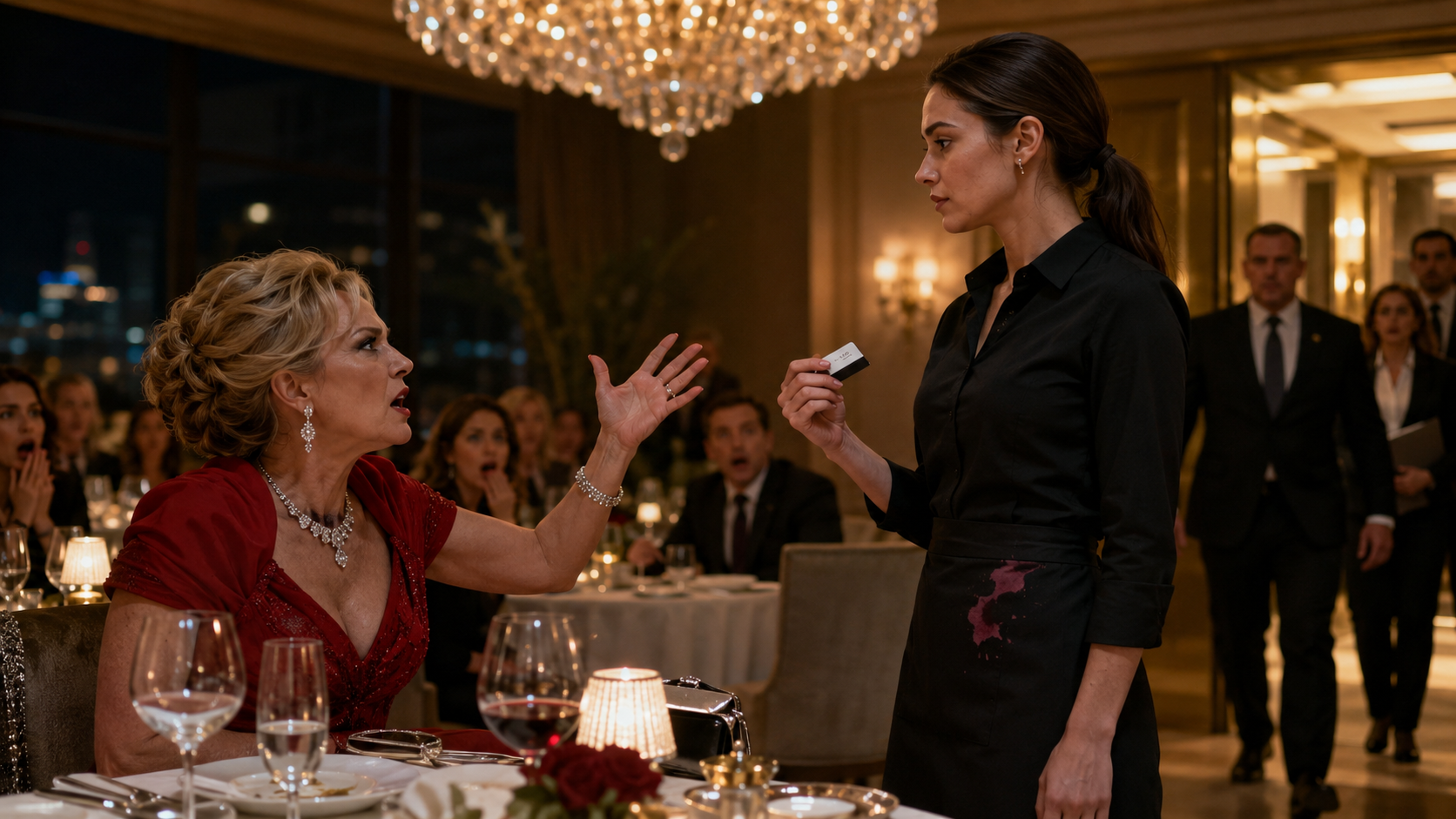
The chandelier above the dining room looked like frozen rain.
Every crystal drop caught the light and broke it into soft gold, spilling it over white tablecloths, silver knives, polished glasses, and faces that knew how to smile without meaning it. The restaurant was full that evening, full in the way only expensive places could be full: controlled, quiet, and proud of itself.
The waiters moved like shadows.
The guests spoke in low voices.
The piano near the bar played something slow and expensive.
And at table seven, Celeste Arden decided that a young waitress was beneath her.
“Excuse me,” Celeste said, lifting two fingers without turning her head.
The waitress stopped beside the table.
Her name tag read Nora.
Her hair was tied back. Her black uniform was plain. Her shoes had been chosen for pain, not beauty, and her smile was calm in the way people smiled when they had learned that anger cost more than silence.
“Yes, ma’am?”
Celeste looked at the glass in front of her as though it had personally offended her.
“This water is warm.”
“I’m sorry. I’ll replace it right away.”
Celeste leaned back in her chair. Her diamond bracelet slid down her wrist and caught the candlelight.
“You should be sorry. That is usually what people say when they fail at something simple.”
A man at the table gave a nervous laugh.
Another woman lowered her eyes to the menu.
Nora did not move.
She had been trained well. Not by the restaurant. By life.
“Of course,” she said. “I’ll bring you a fresh glass.”
She reached for the water carefully, but Celeste placed one manicured hand over the rim.
“No. Wait.”
Nora paused.
Celeste finally looked at her.
It was not a look. It was an inspection.
From the tied-back hair to the cheap name tag, from the clean but ordinary uniform to the hands that carried plates for people who never remembered them.
“What is your name again?”
“Nora.”
Celeste smiled.
“No, I mean your real name.”
A small silence formed around the table.
Nora kept her voice even.
“That is the name I use here, ma’am.”
“How mysterious.” Celeste turned to her friends. “They all have stories now. Everyone wants to be interesting.”
The others smiled because Celeste expected them to.
Nora had seen that kind of obedience before. Rich people often thought staff were the only ones who served. They rarely noticed how carefully their friends served them.
“I’ll get your water,” Nora said.
Celeste’s hand tightened around the glass.
“You’ll get it when I am finished speaking.”
This time the silence spread.
A waiter near the service station looked over. The floor manager, Julian, noticed and immediately looked away. Nora saw that.
She had seen a lot that evening.
She had seen Julian ignore the young hostess when a drunk investor grabbed her wrist.
She had seen the kitchen porter flinch when Celeste’s assistant snapped his fingers in his face.
She had seen three servers change their route through the dining room to avoid table seven.
And now she understood why the letters had started arriving at her office.
Not complaints.
Not formal reports.
Letters.
Anonymous at first. Then desperate.
Someone had written: Please come see what happens here when the owners are not watching.
So she had come.
Not as the owner.
Not as the woman whose signature was on the lease.
Not as the person who had spent five years building The Marlow House from a failing hotel restaurant into the most sought-after dining room in the city.
She had come as Nora.
A temporary waitress.
Invisible enough to hear the truth.
Celeste lifted the glass and held it toward her.
“Take it.”
Nora reached for it.
At the last second, Celeste let go.
The glass fell.
Water splashed across Nora’s uniform and spilled onto the floor. The glass did not break, but the sound it made against the marble was sharp enough to turn heads.
Celeste gasped.
“Oh, how clumsy.”
Nora looked down at the dark stain spreading across her apron.
Celeste’s voice became sweeter.
“You should clean that up before someone important slips.”
A few people at nearby tables turned away.
Not because they had not seen.
Because they had.
That was worse.
Nora bent down, picked up the glass, and placed it on her tray.
“I’ll have someone take care of the floor.”
Celeste laughed softly.
“No. You will take care of it. That is your job, isn’t it?”
Julian appeared then, smooth and pale, with the expression of a man who had survived for years by apologizing to the wrong people.
“Is there a problem here?”
Celeste looked up at him.
“There is always a problem when staff are not properly trained.”
Julian’s eyes flicked to Nora.
“Nora, apologize to Mrs. Arden.”
Nora stared at him.
“For what?”
Julian’s jaw tightened.
“For upsetting a valued guest.”
Celeste smiled.
There it was.
The whole machine.
The cruelty. The silence. The manager who protected money instead of people. The staff who learned to swallow humiliation because rent was due on the first of the month.
Nora stood very still.
“I did not upset her,” she said.
Julian lowered his voice.
“Do not make this difficult.”
Celeste’s smile widened.
“Oh, let her. I find it educational when people forget their place.”
Nora turned back to Celeste.
“And what place is that?”
The question landed harder than anyone expected.
Celeste’s eyes cooled.
“The place where you bring what I ask for, smile when spoken to, and remember that one complaint from me could end your little job before dessert.”
A server near the wine station stopped breathing.
Nora heard it.
A tiny break in the room.
Celeste heard it too.
Power always recognizes fear.
She leaned forward.
“You think I’m being cruel?”
Nora said nothing.
Celeste picked up her red wine.
“I am being generous. I am telling you how the world works. Some people sit at the table. Some people serve it.”
Then she threw the wine.
Not all of it.
Just enough.
A deliberate flick of the wrist.
Red spread across Nora’s white shirt like a wound opening.
The dining room froze.
The piano player missed a note.
Julian whispered, “Mrs. Arden…”
Celeste did not look away from Nora.
“There. Now you have a reason to look miserable.”
For one long second, Nora felt the heat of the wine on her skin.
She felt the eyes.
The embarrassment.
The old instinct to hide.
Then she remembered the first letter.
They laugh because they know no one will defend us.
She remembered the second.
Julian tells us to apologize even when guests touch us, insult us, threaten us.
And the third.
Mrs. Arden said she could have me blacklisted. I believed her.
Nora slowly reached up and removed her name tag.
Celeste tilted her head.
“What are you doing?”
Nora placed the name tag on the table beside the untouched bread plate.
“Finishing the shift.”
Julian went white.
“Nora—”
She looked at him.
“My name is not Nora.”
The room changed.
No one moved, but something shifted.
Like a door opening somewhere no one could see.
Celeste gave a short laugh.
“Oh, please. Is this where you tell us you’re secretly someone important?”
Nora wiped a drop of wine from her wrist with a napkin.
“No,” she said. “This is where I stop pretending I’m not.”
The private elevator at the back of the dining room opened.
Two people stepped out.
One was a tall man in a dark suit, carrying a leather folder.
The other was a woman with silver hair and glasses, the restaurant group’s legal director.
Behind them came the head of security.
Julian took one step back.
Celeste noticed.
For the first time all evening, uncertainty touched her face.
The man in the suit approached Nora, not Celeste.
“Ms. Vale,” he said quietly.
A gasp moved across the room.
Not loud.
Not theatrical.
But enough.
Celeste blinked.
“Ms. Vale?”
Nora turned back to her.
“Elena Vale,” she said. “Founder and principal owner of The Marlow House.”
The silence after that was not empty.
It was full of calculation.
Guests looked from Nora’s stained shirt to Celeste’s frozen smile. Phones appeared under tables. A businessman near the window leaned back slowly, as if distance could save him from being included in the scene.
Celeste recovered with impressive speed.
People like her usually did.
“Well,” she said, forcing a laugh, “that is quite a performance. Do you often dress as staff to spy on paying customers?”
Elena smiled faintly.
“Only when my staff are too afraid to tell me the truth in daylight.”
Julian swallowed.
“Ms. Vale, perhaps we should discuss this privately.”
Elena turned to him.
“Privately is how this survived.”
That sentence seemed to strike the staff harder than anyone else.
A young hostess covered her mouth.
One of the waiters lowered his tray because his hands were shaking.
Celeste stood.
“I will not be insulted in public.”
“No,” Elena said. “You prefer doing the insulting.”
Celeste’s face hardened.
“You should be careful. I know people.”
“Yes,” Elena said. “That is why this has gone on so long.”
The legal director opened her folder.
Elena did not take it yet.
Instead, she looked toward the security director.
“Play the first file.”
Celeste’s smile disappeared.
Julian whispered, “What file?”
The speakers in the dining room clicked.
For a moment there was only static.
Then Celeste’s voice filled the room.
Cold.
Clear.
Unmistakable.
“Girls like you are replaceable. I could make one call and no decent restaurant in this city would touch you.”
The sound of the recording seemed to pass through the room like a blade.
A server near the bar began to cry silently.
Celeste’s face went pale.
“That is taken out of context.”
The recording continued.
“You people always act wounded. You should be grateful I even remember your face.”
No one spoke.
Elena watched the staff, not Celeste.
That mattered.
Because this had never been about one spilled glass.
It had never been about one insult.
It had never even been about Elena’s pride.
It was about every person who had ever carried a plate with shaking hands because a powerful guest enjoyed making them feel small.
The recording stopped.
Celeste laughed once, sharp and desperate.
“You recorded me illegally?”
The legal director stepped forward.
“The recording was captured by the restaurant’s own security system in a public dining area after repeated written complaints involving threats toward employees. We can discuss admissibility with your attorney.”
Celeste’s friends began to move away from her.
Not dramatically.
Just enough.
A chair shifted.
A hand left the back of her seat.
A woman who had laughed five minutes earlier suddenly became fascinated by her napkin.
Elena noticed.
So did Celeste.
Bullies understand loyalty perfectly. They know how quickly it disappears when shame becomes expensive.
Elena turned to Julian.
“Now the second file.”
Julian’s mouth opened.
“No, please—”
The speakers clicked again.
This time Julian’s own voice filled the dining room.
“Apologize to Mrs. Arden. She spends more in one month than you make in a year. If she wants you gone, you’re gone.”
A young waitress near the kitchen doors broke down.
Julian closed his eyes.
The recording continued.
“I don’t care what she said. I don’t care what she threw. You smile, you apologize, and you keep her happy.”
Elena looked at him with something colder than anger.
Disappointment.
Anger can burn out.
Disappointment stays.
“How many complaints did you bury?” she asked.
Julian stared at the floor.
“How many?” Elena repeated.
The legal director answered.
“Fourteen written complaints in eleven months. Nine involving Mrs. Arden or her private guests. Five involving staff being pressured not to file reports. Three employees resigned within two weeks of making complaints.”
The room erupted in whispers.
Celeste turned on Julian.
“You kept those?”
The question betrayed her.
Not That is false.
Not I never did that.
Not What complaints?
Just: You kept those?
Elena gave a sad little smile.
“Powerful people always forget something.”
Celeste’s eyes narrowed.
“What?”
“Frightened people keep evidence.”
Celeste grabbed her clutch.
“I am leaving.”
“No,” Elena said.
The word was quiet, but it stopped her.
Celeste looked back.
“You cannot detain me.”
“I won’t. But you will listen first.”
“I have listened enough.”
“For once,” Elena said, “you will listen to the people who had to listen to you.”
The staff did not move.
Elena turned toward them.
“No one is required to speak. No one will be punished for silence. But if anyone wants to say something, you may.”
At first, nothing happened.
Then the hostess stepped forward.
Her name was Lily.
She was nineteen, maybe twenty, with a black dress and eyes that looked older than the rest of her.
“She told me I looked cheap,” Lily said, voice trembling. “Then she asked Julian why the restaurant hired girls who looked like they came from bus stations.”
Celeste rolled her eyes.
“Oh, for heaven’s sake—”
Elena lifted one hand.
Celeste stopped.
A waiter named Mateo spoke next.
“She made me throw away a dessert because she said my hand shook when I placed it down. Then she told her guests I was probably drunk.”
Another server stepped forward.
“She called my accent ugly.”
Another.
“She said she would have my visa checked because I asked her guest not to smoke inside.”
Another.
“She told me people like us should be grateful to be near people like her.”
Each sentence was small.
Each sentence was simple.
Together, they became a wall.
Celeste’s confidence began to crack.
Not because she felt sorry.
Elena could see that she did not.
Celeste was not ashamed of cruelty.
She was ashamed of exposure.
That was different.
Julian sank into a chair as though his bones had given up.
Elena faced him.
“You were hired to protect this room.”
“I was protecting the business,” Julian said weakly.
“No,” Elena said. “You were protecting access to money.”
He looked up.
“I thought that was the same thing.”
“That is why you are done here.”
His face collapsed.
“Elena, please.”
“You will leave tonight. Legal will handle the rest.”
Celeste laughed.
“You fire him, and you think that fixes anything? How noble. How theatrical.”
Elena turned slowly.
“No. It does not fix everything.”
She stepped closer to table seven.
“But it begins something.”
Celeste lifted her chin.
“You have no idea how much influence I have.”
“I know exactly how much you had,” Elena said. “Had is the important word.”
The legal director placed a document on the table.
“Elena,” she said quietly, “the board has already approved the ban notice.”
Celeste stared at the paper.
“What is that?”
Elena answered.
“You are no longer welcome in this restaurant. Or any restaurant under the Vale Hospitality Group.”
Celeste’s mouth tightened.
“You cannot do that.”
“I own them.”
The words landed cleanly.
No shouting.
No drama.
Just fact.
Celeste looked around the room, searching for someone who would rescue her. Her friends avoided her eyes. The man beside her suddenly checked his watch. Her assistant stood frozen near the wall, pretending not to exist.
Elena almost pitied her.
Almost.
Then Lily sniffed behind her, trying not to cry, and the pity vanished.
Celeste leaned closer, lowering her voice.
“You think this makes you better than me?”
Elena looked down at her wine-stained shirt.
“No. I think how we treat people when we don’t need anything from them tells the truth.”
Celeste’s lips parted, but nothing came out.
For the first time all night, she had no audience that belonged to her.
The security director stepped forward.
“Mrs. Arden, I’ll escort you out.”
Celeste snatched the ban notice from the table and crushed it in her fist.
“You will regret this.”
Elena nodded.
“I doubt it.”
As Celeste passed through the dining room, no one stood. No one apologized. No one rushed to soften the blow.
That, more than anything, seemed to wound her.
She had expected resistance.
She had expected fear.
She had not expected to become ordinary.
When the front doors closed behind her, the restaurant remained silent.
Elena turned to the staff.
The wine had dried cold against her skin.
Her uniform was ruined.
Her hands were steady.
“I owe you an apology,” she said.
No one seemed to know what to do with that.
Owners did not apologize often.
Power rarely did.
“I built this place to be excellent,” Elena continued. “Somewhere beautiful. Somewhere disciplined. Somewhere people would remember. But somewhere along the way, I allowed beauty to become an excuse for cruelty, and discipline to become a weapon used against the wrong people.”
Lily wiped her face.
Mateo stared down at the floor.
Elena’s voice softened.
“I should have seen it sooner.”
The legal director stepped beside her.
“Beginning tomorrow, every complaint will go directly to an independent employee advocate. Managers will no longer have authority to erase, bury, or discourage reports. Anyone who resigned after filing a complaint will be contacted. Anyone who wants to speak privately tonight can do so with legal present.”
Julian made a broken sound from the chair.
No one looked at him.
Elena took a breath.
“And every person working tonight will be paid for the full shift, plus the week. The restaurant will close for three days.”
That got a reaction.
A murmur.
Surprise.
Confusion.
Elena continued.
“Not as punishment. As repair. Training will happen. Interviews will happen. Changes will happen before another guest sits at these tables.”
The chef appeared at the kitchen entrance, arms folded, eyes wet.
Elena had known him for seven years.
He nodded once.
It nearly undid her.
Then a guest near the window stood.
An older woman in a navy suit.
She placed her napkin on the table.
“I would like to pay my bill,” she said.
Elena turned.
“Of course.”
“And I would like the service charge doubled and divided among the staff.”
Another guest stood.
“Same for my table.”
Then another.
“And ours.”
Soon the room was moving again, but differently now. Not with the old polished rhythm. Something human had entered the space and ruined the performance.
Or saved it.
Elena looked at the name tag still lying on Celeste’s table.
Nora.
A fake name.
A real witness.
Mateo approached quietly.
“Ms. Vale?”
“Elena,” she said.
He hesitated.
“Elena. What happens to her?”
“To Celeste?”
He nodded.
Elena looked toward the doors.
“That depends on how many people she threatened outside this room.”
Lily stepped forward.
“I know two.”
The hostess’s voice was small.
But it did not shake this time.
Elena met her eyes.
“Then we start there.”
Later, long after the guests left and the candles burned low, Elena stood alone in the dining room.
The chandelier still looked like frozen rain.
The tables were half-cleared.
The piano was silent.
Her ruined uniform hung from her shoulders like proof.
The legal team had taken statements. Julian had left through the service entrance without saying goodbye. Celeste’s assistant had stayed behind and asked, in a whisper, whether threats made by text counted as evidence.
They did.
Elena picked up the plastic name tag from table seven.
For a moment, she thought about throwing it away.
Instead, she slipped it into her pocket.
Not as a disguise.
As a reminder.
Because tomorrow she would return in her own clothes. People would call her Ms. Vale. They would open doors. They would bring reports. They would speak carefully.
That was the danger of power.
It made truth quieter around you.
She looked once more at the room she had built.
Then she turned off the last lamp.
At the door, Lily waited with her coat on.
“Elena?”
“Yes?”
“Why did you really do it yourself? You could have sent someone.”
Elena thought about that.
Because she could have.
She could have hired investigators. Read reports. Held meetings. Fired Julian from a distance and called it leadership.
But she had needed to feel it.
The heat of the wine.
The weight of the silence.
The particular loneliness of being humiliated in a room full of people waiting for you to disappear.
So she told the truth.
“Because I needed to remember what invisible feels like.”
Lily looked at her for a long moment.
Then she nodded.
Outside, the city moved on, bright and careless.
Inside The Marlow House, something had ended.
And something better, though fragile, had begun.

