When Clara Whitmore stepped off the mail wagon at the edge of Briar Creek Ranch, the first thing she noticed was not the size of the house, though it was large enough to swallow three ordinary homes. It was not the wide stretch of dry pasture, nor the weathered barn leaning into the wind like an old man with secrets.
It was the silence.
A house with seven children should have been loud.
There should have been shrieking, laughter, boots on stairs, someone crying over a stolen toy, someone else begging for biscuits before supper. Clara had worked in enough homes, boarding houses, church kitchens, and widow’s parlors to know the sounds of children. They filled walls the way smoke filled a room.
But the Caldwell house sat quiet beneath the afternoon sun.
Too quiet.
The front porch boards creaked under her boots. Her carpetbag bumped against her knee. A yellow dog lying in the shade lifted its head, studied her, then dropped it again as if deciding she was not worth the effort.
Clara raised her hand to knock.
Before she could, the door opened.
A girl stood there, thin as a candle and nearly as pale. She could not have been more than fourteen, but her tired eyes belonged to someone much older. Her dress was clean, but patched at both elbows. Her hair had been braided in a hurry.
“You’re the cook?” the girl asked.
“I am,” Clara said. “Clara Whitmore.”
The girl looked past her toward the empty road. “You came alone?”
“I usually do.”
“You got references?”
“I got hands, recipes, and patience. References are in my bag if your father wants them.”
At the mention of father, something flickered across the girl’s face.
Not fear exactly.
Exhaustion.
“I’m Elsie Caldwell,” she said. “Pa is out by the south fence. He said to show you the kitchen and tell you supper is at six.”
Clara glanced over the girl’s shoulder into the dim hallway. Somewhere inside the house, a baby coughed. A chair scraped. A boy whispered, “Is she old?”
Clara lifted one eyebrow.
Elsie flushed. “That’s Nate. He doesn’t mean anything.”
“I’m thirty-two,” Clara said, stepping inside. “Old enough to know when a child is hiding behind a door.”
A small boy’s face vanished from the crack of a room to the left.
For the first time, Elsie almost smiled.
Almost.
The kitchen told Clara more than any letter could have.
There were dishes stacked in a basin, bread gone hard beneath a cloth, a stew pot scorched black at the bottom, three jars of peaches open and attracting flies, and a flour sack left untied beside the table. Someone had tried to keep the place running. Someone young. Someone tired. Someone who knew how to work but not how to breathe.
Seven tin plates waited on the shelf.
Only seven.
Clara turned slowly. “Where does your father eat?”
Elsie looked at the floor. “Mostly in his office.”
“Mostly?”
“When he remembers.”
A little girl stood in the doorway holding a wooden horse missing one leg. She had enormous brown eyes and a solemn mouth.
“That’s Molly,” Elsie said. “She doesn’t talk much.”
Molly stared at Clara as if deciding whether she was another person who would leave.
Clara crouched, keeping her hands folded. “Hello, Molly.”
Molly said nothing.
Behind her came two boys, one about eleven, one maybe eight. The older had sunburned cheeks and a defiant chin. The younger had jam on his shirt and guilt in his eyes.
“I’m Nate,” said the older one before Elsie could introduce him. “I can shoot, ride, and mend a gate.”
“You can also burn eggs,” Elsie muttered.
Nate scowled. “Only once.”
“Three times.”
The younger boy raised his sticky hand. “I’m Sam. I can eat six biscuits.”
“That may be your finest talent,” Clara said.
Two red-haired twins appeared next, both barefoot, both grinning as if trouble had personally invited them to dinner.
“Ruby and Ruth,” Elsie said. “Don’t ask which is which. They lie.”
“We don’t lie,” one twin said.
“We improve the truth,” said the other.
A small child, no more than four, shuffled in last, dragging a blanket behind him. His curls stuck to his forehead. He looked at Clara, then hid behind Elsie’s skirt.
“That’s Benji,” Elsie said softly.
Clara counted them.
Elsie. Nate. Sam. Molly. Ruby. Ruth. Benji.
Seven children.
No mother.
No laughter.
No father at the table.
Clara set down her bag.
“Well,” she said, rolling up her sleeves. “First thing, we wash every dish in this kitchen. Second, someone opens those windows before I faint from the smell of old stew. Third, if there’s a hen on this ranch willing to part with eggs, I intend to meet her.”
Sam brightened. “Does that mean biscuits?”
“It means supper,” Clara said. “And supper means everyone sits down.”
Elsie went still. “Pa won’t.”
Clara looked at the girl.
“Then your father and I will have our first disagreement.”
Wyatt Caldwell came in at dusk with dust on his hat, blood on his knuckles, and grief carved into every line of his face.
He was taller than Clara expected. Not handsome in the polished way gentlemen in town tried to be, but weathered and hard-made, like fence wire stretched too tight. His dark hair needed cutting. His beard had been trimmed with the impatience of a man who no longer cared what the mirror thought.
He stopped in the kitchen doorway when he saw the table.
Seven children sat waiting.
Eight plates were set.
One at the head.
The room went quiet.
Clara stood by the stove with a spoon in her hand. “Mr. Caldwell.”
His eyes moved from the children to the plate at the head of the table. “What’s that?”
“Your supper.”
“I eat in my office.”
“Not tonight.”
Nate’s mouth fell open.
Elsie stared at Clara as if she had just slapped a rattlesnake.
Wyatt’s jaw tightened. “I hired you to cook, Mrs. Whitmore.”
“And I cooked.”
“I didn’t hire you to run my house.”
“No,” Clara said. “But from the look of things, someone should.”
The twins sucked in identical breaths.
Wyatt stepped into the room slowly. “You’ve been here half a day.”
“That was enough.”
His eyes hardened. “You don’t know anything about this family.”
“I know your eldest daughter looks ready to collapse. I know your boys are trying to become men because no one told them they were still allowed to be children. I know one little girl has decided silence is safer than speech. I know your baby watches the door like he expects it to steal everyone he loves.”
Wyatt’s face changed.
Only for a moment.
But Clara saw the blow land.
“And I know,” she continued, softer now, “that grief may excuse a messy kitchen, but it does not excuse an empty chair.”
For one terrible second, Clara thought he would dismiss her before she had even unpacked.
Instead, Wyatt Caldwell removed his hat.
He looked at the plate.
Then he sat down.
No one moved.
Clara picked up the biscuit basket. “Good. Now, Mr. Caldwell, pass these to your son before Sam starts chewing the table.”
Sam grinned.
The meal was not cheerful. It was awkward and stiff, with every child watching Wyatt as if he might vanish if they blinked too hard. He barely spoke. He ate like a man performing a duty. But halfway through supper, Benji climbed off Elsie’s lap, waddled to his father, and pushed a biscuit against his knee.
Wyatt looked down.
Benji whispered, “Butter.”
The word cracked something in the room.
Wyatt took the biscuit, spread butter on it, and handed it back.
Benji stayed beside his chair for the rest of supper.
Clara pretended not to see Wyatt wipe his eyes with the back of his wrist.
By the end of the first week, Clara understood three things.
The house had not been neglected because Wyatt Caldwell did not love his children.
It had been neglected because he loved them so much he could not bear to look at what they had lost.
His wife, Marian, had died the previous winter during a fever that swept through the valley. The fever took six people in Briar Creek. Marian had been the youngest. She had left behind seven children, one unfinished quilt, a row of dead herbs in clay pots, and a husband who seemed to have mistaken breathing for living.
Elsie had become mother by force.
Nate had become guard dog.
Sam had become clown.
The twins had become noise.
Molly had become shadow.
Benji had become a child who cried only in his sleep.
And Wyatt had become a ghost who still knew how to saddle a horse.
Clara had known grief too.
Her own husband, Peter, had died under a collapsed mill roof three years earlier. There had been no children, no ranch, no land to save. Only debts, neighbors’ pity, and a room that grew colder every morning. Clara had survived because survival was the one thing she had always done well.
She did not consider herself kind.
Useful, perhaps.
Stubborn, certainly.
But kindness required softness, and softness had been beaten out of her by hunger, death, and men who believed widows should be grateful for scraps.
Still, the Caldwell children crawled under her defenses one by one.
Sam brought her eggs warm from the coop and asked if cakes could be breakfast if a person prayed first.
The twins filled her apron pockets with stolen apples and declared it a “kitchen tax.”
Molly followed her silently from room to room, always keeping three steps of distance, until one rainy afternoon Clara handed her a bowl and said, “If you’re going to haunt me, you may as well stir.”
Molly stirred.
The next day, she whispered, “More cinnamon.”
Clara did not cry.
She added more cinnamon.
Elsie was harder. She resisted rest like it was a sin. Clara had to trick her into it, sending her to fetch imaginary things from the porch, asking her to read recipes aloud, making her sit with Benji while Clara finished the work Elsie had been trying to carry alone.
“You don’t have to fix everything,” Clara told her one evening.
Elsie’s hands tightened around a towel. “Someone does.”
“No. Some things get fixed by everyone carrying one corner.”
Elsie looked toward the yard, where Wyatt was showing Benji how to hold a brush for the old mare.
“He used to laugh,” she said.
“He may again.”
Elsie’s mouth trembled. “What if he doesn’t?”
“Then we teach him badly until he learns from embarrassment.”
That earned Clara the girl’s first real smile.
Wyatt changed slower.
But he changed.
He started coming to breakfast.
Then supper.
Then both.
He repaired the broken chair in Molly’s room. He took Sam riding. He let the twins paint the chicken coop blue, though the result was so ugly even the chickens seemed offended. He listened when Elsie spoke instead of staring through her.
At night, he sometimes remained on the porch after the children went to bed.
Clara would come out with coffee. At first they spoke of beans, fences, feed prices, and weather. Safe subjects. Practical subjects. The kind of things people discussed when they were afraid of what silence might reveal.
Then, little by little, the dead entered the conversation.
Marian, who had sung off-key.
Peter, who had danced badly and never admitted it.
Marian, who had hidden coins in flour jars.
Peter, who had once tried to fix a roof and fallen through it into a laundry basket.
Grief became less like a locked room and more like a door they sometimes opened together.
One night Wyatt said, “Marian would have liked you.”
Clara leaned against the porch rail. “Are you sure? I’ve been told I’m difficult.”
“She was difficult too.”
“Then perhaps we would have respected each other from opposite corners.”
He smiled.
It was brief.
It was tired.
But it was real.
And Clara, who had promised herself never to become foolish over a lonely man with wounded eyes, felt something dangerous shift inside her.
The first warning came from town.
Clara had gone into Briar Creek with Elsie and Nate for flour, salt, lamp oil, and thread. The general store was crowded with women pretending not to stare and men pretending not to gossip.
Clara had barely ordered sugar before she heard Wyatt’s name.
“Banker’s been out there twice this month.”
“Land note is past due.”
“Caldwell should have sold after Marian died.”
“He won’t last the summer.”
“Seven children and no wife. Mercy, what did he expect?”
Clara kept her face still.
Elsie heard too. Her chin lifted, but Clara saw her fingers tremble around the cloth bag.
Outside, near the bank, Wyatt stood with Hiram Voss, the town banker. Hiram was short, round, and polished, with hands too soft for honest work. Beside him stood Sheriff Alden Pike, looking uncomfortable beneath his hat.
Hiram held papers.
Wyatt looked as if every word being spoken cost him blood.
When Hiram tapped the papers against Wyatt’s chest, Wyatt snatched them from him and shoved them into his coat.
Then he saw Clara across the street.
His face closed.
That night, she asked him plainly.
“What does Hiram Voss want from you?”
Wyatt was in the barn, rubbing oil into a cracked harness. “Money.”
“That much I guessed.”
“It’s ranch business.”
“Ranch business does not make a sheriff avoid looking at your daughter in the street.”
His hands stilled.
For a moment Clara thought he might tell her.
Then he said, “It’s nothing you need to carry.”
Clara laughed once, without humor. “Men are always very generous when deciding what women need not carry.”
He looked up sharply.
She held his gaze.
But he said nothing more.
After that, things began to disappear.
Not large things.
Small things.
A silver-backed hairbrush that had belonged to Marian. A pair of good candlesticks. A saddle Wyatt had once said belonged to his father. Three calves from the lower pasture. Then four.
When Clara asked, Elsie pressed her lips together.
Nate avoided her eyes.
Wyatt spent more time in his office and locked the door whenever he left.
The house had been warming.
Now a cold thread ran through it.
Clara felt it most at night, when she passed the office and saw lamplight under the door. Sometimes she heard paper sliding. Sometimes she heard Wyatt cough like a man choking on words he would not speak.
Then came the fever.
Benji woke before dawn burning hot, his small body rigid and shaking. Clara knew fever. She knew the smell of it, the speed of it, the way it could turn a child from restless to limp in the space of an hour.
“Elsie,” she said, calm because panic was useless, “cool water. Nate, saddle the mare in case we need the doctor. Sam, wake your father.”
“Pa’s not here,” Nate said.
Clara turned.
“He rode out before dawn,” Elsie said. “Said he had business at the west line.”
Clara swallowed a curse.
They worked through the morning. Wet cloths. Willow bark tea. Cool air. Soft prayers from Elsie, who pretended she was not praying. Benji cried for his father until his voice rasped.
By noon, his fever climbed higher.
“There used to be medicine,” Elsie said. “Ma kept it in Pa’s desk. Bottom drawer.”
Clara looked toward the hall.
The office door was locked.
“Where’s the key?”
Elsie hesitated.
“Elsie.”
The girl’s face went pale. “There’s a spare inside the blue sugar tin. Pa forgot I know.”
Clara did not ask permission from a man who was not there while his child burned.
She took the key.
The office smelled of dust, ink, and whiskey that had been poured but not drunk. It was neat. Too neat. Ledgers stacked square. Papers tied. Chair pushed in. A room arranged by someone trying to control the only things left obedient.
Clara found the medicine in the bottom drawer.
And under it, a packet of envelopes.
She should have closed the drawer.
She should have taken the bottle and left.
Instead, one envelope slid loose.
On the front, in Wyatt’s careful handwriting, was written:
Elsie Caldwell.
Beneath that envelope were more.
Nate Caldwell.
Ruby Caldwell.
Ruth Caldwell.
Molly Caldwell.
Sam Caldwell.
Only six.
Clara’s breath stopped.
No envelope for Benji.
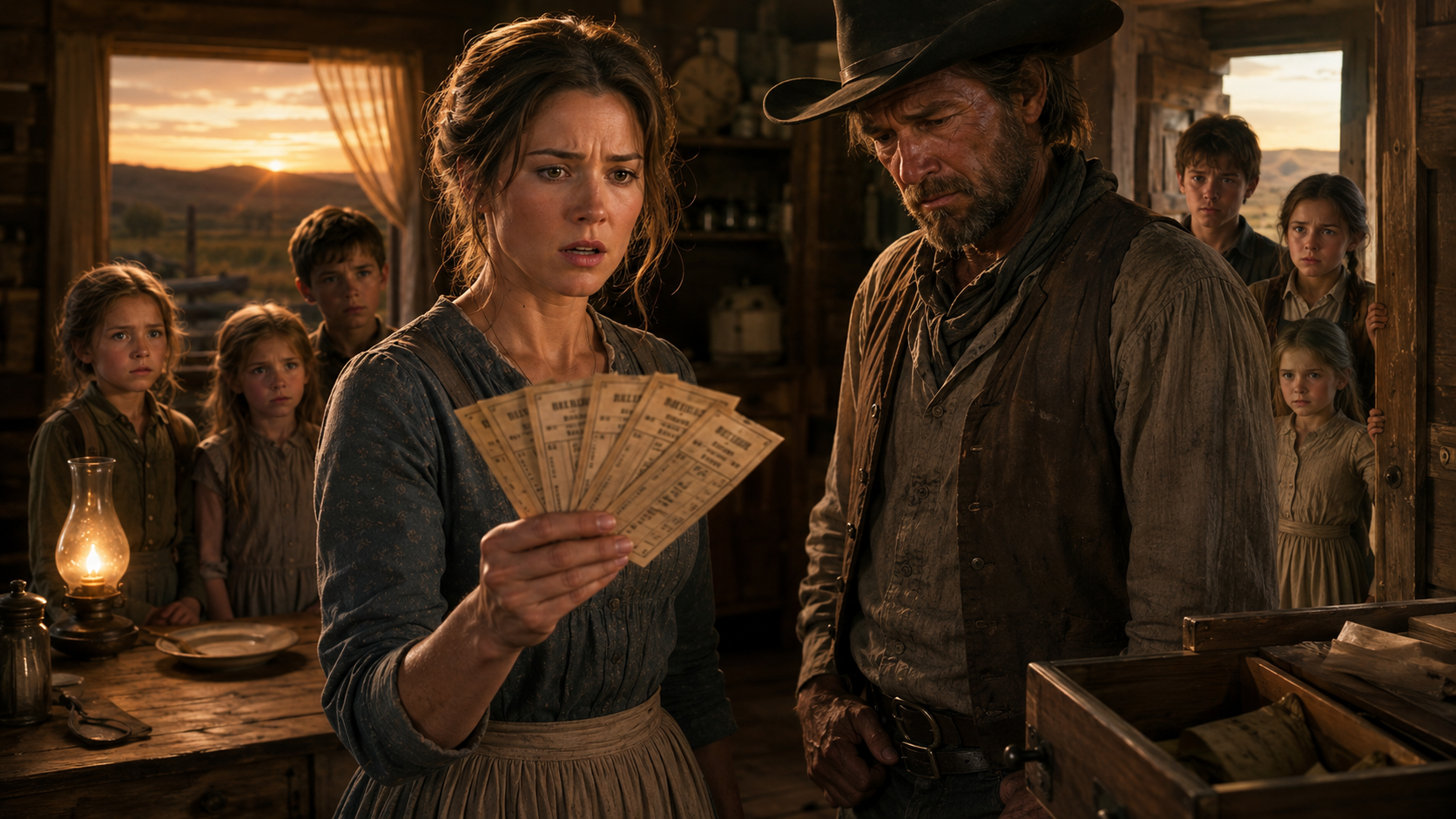
Under the envelopes lay six train tickets.
One-way.
Six different destinations.
Kansas City.
Omaha.
Denver.
St. Louis.
Cheyenne.
Wichita.
Her fingers went cold.
She unfolded the papers beneath them.
Guardianship agreements.
Letters to distant relatives.
Church recommendations.
A list of families willing to take children “temporarily.”
Beside Molly’s name, someone had written: quiet, obedient, suitable for domestic household.
Beside Nate’s: strong boy, useful for farm labor.
Clara gripped the desk to steady herself.
No.
No, no, no.
Wyatt was not just losing the ranch.
He was preparing to scatter his children like belongings from an estate sale.
Six tickets.
Six children sent away.
And Benji?
Why no ticket for Benji?
The question struck her harder than the rest.
A sound came from the hall.
Boots.
Voices.
Wyatt’s voice.
Clara turned with the papers in her hands as he appeared in the doorway.
For one second, neither of them moved.
Then Wyatt saw the open drawer.
The envelopes.
The tickets.
His face drained of color.
Behind him stood Nate, frozen.
“Pa?” Nate asked.
Wyatt stepped into the room. “Clara.”
His voice sounded like warning.
She lifted the tickets. “Tell me these are not what they look like.”
Nate’s eyes dropped to the tickets.
The boy went white.
“Go outside,” Wyatt said.
Nate did not move. “What are those?”
“Nate.”
“What are those?”
Clara’s voice shook with fury. “They are train tickets.”
The hallway filled with small sounds.
Elsie appeared, holding Benji wrapped in a blanket. Sam stood behind her. The twins peered around the wall. Molly clutched the banister upstairs.
Wyatt closed his eyes.
Elsie whispered, “For who?”
No one answered.
She stepped into the office and saw her name on the first envelope.
Something broke in her face.
“For us?”
Wyatt said, “I can explain.”
“No,” Clara said. “You can confess.”
The twins began to cry.
Sam stared at his father as if trying to recognize him.
Nate snatched one ticket from Clara’s hand and read the destination. His mouth twisted. “You were sending me to Kansas?”
“To your uncle,” Wyatt said.
“I don’t have an uncle in Kansas.”
“Marian did.”
“She’s dead!” Nate shouted.
The words hit the room like a gunshot.
Wyatt flinched.
Elsie looked down at the envelopes. “Six tickets.”
Her voice was quiet now.
Too quiet.
“Why six?”
Wyatt did not answer.
Clara watched him.
The truth was somewhere in his silence.
Elsie slowly looked at Benji in her arms.
“No,” she whispered.
Wyatt’s eyes filled.
“No,” Elsie said again, louder. “Pa, no.”
Nate looked between them. “What?”
Wyatt sank into the chair behind the desk as if his legs had failed.
“The ranch note comes due in eight days,” he said. “Voss will take the land. The cattle won’t cover the debt. The bank already has buyers waiting. I tried selling stock. I tried borrowing. I tried every man I ever helped and every one of them looked away.”
“Then we leave together,” Elsie said.
Wyatt’s hands curled into fists. “With what? No land. No money. Seven children. Winter coming. You think the world is kind to families that fall?”
“So you were going to break us apart?” Nate demanded.
“I was trying to keep you alive.”
“You were trying to get rid of us!”
Wyatt stood so fast the chair scraped backward. “I was trying to make sure you had roofs over your heads!”
“Different roofs!” Elsie cried. “Different towns! Different lives!”
Sam began sobbing silently.
Molly disappeared halfway behind the banister.
Clara stepped forward. “And Benji?”
The room went still.
Wyatt’s face changed again.
There it was.
The secret beneath the secret.
Clara’s anger did not soften, but it sharpened.
“Why was there no ticket for Benji?”
Elsie clutched the little boy tighter.
Wyatt looked at his youngest son.
Benji’s fever-glazed eyes opened. “Pa?”
Wyatt covered his mouth with one hand.
When he spoke, his voice was barely human.
“Because Benji is dying.”
For a moment, no one understood.
Then Elsie made a sound Clara would never forget.
“No.”
Wyatt’s eyes were wet now. “Doc Mercer told me three weeks after Marian passed. His lungs never healed from the fever. He said maybe spring, maybe summer, but not winter. Not unless we got him to St. Louis. There’s a physician there. A hospital. Treatment. But it costs money I don’t have.”
Clara’s stomach twisted.
Wyatt pointed at the papers. “Voss offered to buy the ranch early. Enough to send Benji for treatment. Enough to place the rest of you somewhere safe until I could work and bring you back.”
“Bring us back?” Nate spat. “From six different towns?”
“I wrote every letter myself. I chose people I thought Marian would trust.”
Elsie shook her head, tears running freely now. “You chose strangers over us.”
“I chose life over pride!”
“You chose silence!” Clara snapped.
Wyatt turned to her.
Her voice rose. “You let them believe they were being abandoned because you were too afraid to ask them to stand with you.”
“They are children.”
“They are your children.”
His shoulders sagged.
Clara held up the guardianship papers. “And this? Suitable for domestic household? Useful for farm labor? Did Marian teach you to describe your children like tools?”
“I didn’t write those notes,” he said, disgust breaking through his grief. “Voss did. He said it would make placements easier.”
“Placements,” Elsie repeated.
The word tasted poisonous.
Wyatt reached for her, but she stepped back.
Benji whimpered.
Clara turned immediately. “Enough. This child needs medicine.”
For all the anger in the room, Benji’s fever ruled them.
Clara gave him the dose, then sent the children upstairs except Elsie, who refused to leave him. Nate slammed out the back door. The twins cried themselves sick. Molly sat in the hall all night with her arms around her knees.
Wyatt remained in the office as if condemned there.
Clara did not speak to him until near dawn.
Benji’s fever had finally broken. He slept in Elsie’s lap, damp curls pasted to his cheeks.
Clara walked into the office and found Wyatt sitting on the floor, surrounded by the tickets he had not picked up.
He looked ruined.
Good, Clara thought.
Some ruins deserved to be seen.
“Do you love them?” she asked.
He looked at her as if the question hurt. “More than anything.”
“Then stop deciding alone.”
“I don’t know how to save them.”
“Then say that.”
His laugh was bitter and broken. “To who? The banker? The sheriff? The town that has already written us off?”
“To your children. To me. To anyone who might still have a spine.”
He shook his head. “You don’t understand. Voss doesn’t just want the land. He wants me gone. He wanted it before Marian died. There’s water beneath the east pasture. He knows it. He’s been buying every ranch along the creek.”
Clara narrowed her eyes. “Water?”
Wyatt nodded. “A spring line. My father found it years ago and never filed the survey. Voss found out somehow. If he gets this land, he controls half the valley.”
“And the debt?”
“Real. But the terms changed after Marian died. Fees. Penalties. Charges I never agreed to. I was too buried in grief to fight.”
Clara stared at him.
There was the second secret.
Not a helpless rancher.
A cheated one.
“Where are the original loan papers?”
Wyatt looked toward the locked cabinet.
Clara held out her hand. “Open it.”
He hesitated.
“Wyatt.”
For the first time, he obeyed without argument.
Inside were papers, receipts, old contracts, tax notices, maps, letters from Marian written in a neat, practical hand. Clara spread everything across the desk. She had worked for a judge’s widow once. She knew enough about paperwork to recognize when numbers had been made deliberately muddy.
By sunrise, she had found three things.
The bank had charged interest twice in the same quarter.
A payment Marian made before her death had never been credited.
And one page of the loan renewal was missing.
Clara tapped the gap. “Who witnessed this renewal?”
Wyatt rubbed both hands over his face. “Marian. Sheriff Pike. Hiram Voss.”
“Marian signed?”
“Yes.”
“Then she kept a copy.”
Wyatt looked at her. “What?”
“You said she hid coins in flour jars. Women who hide money also hide paper. Where would she put something important?”
He stood very still.
Then he ran.
Clara followed him through the kitchen, past the startled children, out to the smokehouse, then to the little herb shed behind it. The shed had been Marian’s. No one had touched it since she died.
Dust lay over everything.
Dead lavender hung upside down.
Clay pots lined the shelves.
Wyatt went to a loose board beneath the workbench and pulled.
Inside was a tin box.
His hands shook so badly Clara had to open it.
There were coins.
Two letters.
And a folded loan renewal.
The missing page was there.
Clara read it once.
Then again.
Then she looked at Wyatt.
“This says the bank cannot call the note early if the household contains minor heirs of Marian Caldwell.”
Wyatt blinked. “What?”
“It says the land remains protected until the youngest child reaches twelve, unless you willingly surrender it or fail three full years of payments.”
He stared at the paper as if it might vanish.
Clara’s pulse quickened. “Wyatt, how late are you?”
“Six months.”
“Not three years.”
He grabbed the paper.
His eyes moved over the words. Once. Twice.
Then he sank onto an overturned crate.
“Voss lied.”
“Yes.”
“He made me think I had days.”
“Yes.”
“He made me think selling was the only way to save Benji.”
Clara folded the paper carefully. “Then we give him a very bad morning.”
By eight o’clock, Clara had coffee on the stove and a plan forming sharp enough to cut.
By nine, Elsie knew the truth.
By ten, Nate had returned from wherever angry boys go when their hearts are broken and listened from the doorway with red eyes and clenched fists.
By noon, Sheriff Pike arrived at the ranch because Clara sent Sam into town with a note that read:
Come to Briar Creek Ranch immediately unless you prefer explaining in court why you helped Hiram Voss frighten seven children out of their home.
The sheriff arrived fast.
Hiram Voss arrived faster.
He came in a polished buggy, wearing a cream waistcoat and the expression of a man annoyed by poor people taking too long to lose.
Wyatt met him on the porch.
Clara stood beside him.
Elsie stood behind them holding Benji. Nate stood near the steps with the twins. Molly held Sam’s hand.
The whole family was present.
That mattered.
Voss climbed down, smiling thinly. “Caldwell, if this is about the transfer, I told you—”
“It is,” Wyatt said.
Voss glanced at Clara. “Household staff should remain inside.”
Clara smiled. “Bank thieves should avoid giving etiquette lessons.”
The sheriff coughed.
Voss’s smile vanished. “Excuse me?”
Clara held up the loan renewal. “This is Marian Caldwell’s copy.”
Voss froze.
Just slightly.
But enough.
Wyatt saw it.
Sheriff Pike saw it.
Clara stepped down from the porch. “You told Mr. Caldwell the ranch note could be called within days. You told him the land would be seized. You encouraged him to sign away property protected under a clause witnessed by you, Marian Caldwell, and Sheriff Pike.”
Voss recovered quickly. “That document is outdated.”
“No,” Sheriff Pike said slowly, taking the paper. “It isn’t.”
Voss shot him a murderous look.
The sheriff read. His face darkened.
Clara pressed on. “There are also duplicate interest charges, missing credits, and placement letters describing children as labor. Shall I continue on the porch, or would you prefer the town hear it from the courthouse steps?”
Voss’s cheeks flushed. “You have no standing here, Mrs.—”
“Whitmore,” she said. “And I have enough standing to read numbers.”
Wyatt stepped forward. “You tried to make me sell my children’s home.”
“I offered you mercy,” Voss snapped. “You were drowning.”
“You pushed my head under water and called it mercy.”
For once, the ranch was not silent.
The wind moved through the cottonwoods.
The twins sniffled.
Benji coughed against Elsie’s shoulder.
Sheriff Pike folded the paper. “Hiram, I think you’d better come with me.”
Voss laughed. “On what charge?”
“Fraud will do until the judge finds prettier words.”
Voss’s face hardened. “You think this saves you, Caldwell? Paper doesn’t put food on the table. That boy still needs a doctor. Your cattle are thin. Your fences are bad. Your wife is dead, and your pride won’t raise these children.”
Wyatt moved so fast Clara barely saw him.
He stopped inches from Voss.
“My wife is dead,” he said, voice low. “But her name just saved this ranch. Speak of her again, and fraud will be the least painful thing that happens to you today.”
Voss swallowed.
The sheriff took his arm.
As they led him away, Clara looked back at the children.
For the first time since she had arrived, all seven of them looked at their father not like a ghost, not like a stranger, not like a man about to leave.
They looked at him like a wall standing between them and the storm.
But saving the ranch was not the same as saving Benji.
That truth settled over them by evening.
The tickets were gone. Wyatt burned them himself in the stove while the children watched. The envelopes followed. The guardianship papers curled black in the flames.
“I was wrong,” Wyatt said.
No one spoke.
He turned to them, face raw. “I thought carrying fear alone made me your father. It didn’t. It made me a coward with good intentions. I am sorry.”
Elsie cried first.
Then Sam.
Then the twins.
Nate tried not to, failed, and looked furious about it.
Molly crossed the kitchen and placed one hand against Wyatt’s sleeve.
It was the smallest forgiveness.
It was enough to break him.
He knelt and pulled them in, all of them, even Nate, who resisted for one second before collapsing against him like the boy he still was.
Clara turned away to give them privacy.
But Elsie reached for her.
“You too,” she said.
Clara shook her head. “This is family.”
Elsie’s chin lifted. “Then come here.”
Clara stood very still.
Then Benji, pale and small in Wyatt’s arms, whispered, “Miss Clara stays.”
So she did.
The next weeks became a battle fought with paperwork, pride, and pie.
Sheriff Pike took the bank records to the county judge.
Hiram Voss discovered that a town happy to gossip about a falling man was even happier to gossip about a cheating banker.
Wyatt sold two horses, not seven children.
Clara wrote letters to three doctors and one hospital in St. Louis. Elsie copied them in her neat hand. Nate rode messages into town. Sam collected coins in a jar labeled Benji’s Breath, because he said lungs sounded too ugly.
The twins charged visitors one penny to see the blue chicken coop.
Molly drew pictures of trains going away empty.
The town, ashamed of itself in the manner of towns that had known exactly enough to be guilty, began showing up.
Mrs. Bellamy brought quilts.
The blacksmith refused payment for wagon repairs.
The church ladies brought preserves, though Clara had to stop one of them from reorganizing her pantry and nearly started a war over peaches.
Even Sheriff Pike came by with an envelope of money and his hat in his hands.
“I should have read closer,” he told Wyatt.
Wyatt looked at him for a long time. “Yes.”
The sheriff nodded. “I’ll spend a while making that right.”
Benji had good days and frightening days.
On good days he sat in the sun and laughed when Ruby and Ruth pretended to be bank robbers stealing biscuits.
On frightening days his lips went pale and Wyatt carried him for hours, whispering stories against his hair.
Clara saw the fear in Wyatt every time.
But he no longer hid it.
That was something.
One night, after the children slept, Wyatt found Clara in the kitchen kneading dough. The lamp turned the windows black. Outside, the prairie wind moved softly around the house.
“I wrote to the hospital,” he said. “They answered.”
Clara stopped kneading.
“They’ll see him. It will cost less than Mercer feared. Still more than I have, but less.”
“That’s good.”
Wyatt nodded.
He stood there, hat in both hands though he was indoors.
Clara narrowed her eyes. “Why do you look like a man about to confess to stealing my rolling pin?”
“I’m going to St. Louis with Benji.”
“Of course you are.”
“I want Elsie to come.”
“She should.”
“And Nate, if he’ll agree.”
“He will pretend not to want to and then pack first.”
Wyatt almost smiled.
Then the smile faded.
“I want you to come too.”
Clara looked down at the dough.
“Benji trusts you,” Wyatt said. “The children trust you. I trust you.”
“That is not a reason to drag a cook across three states.”
“No,” he said quietly. “It’s not the only reason.”
The room changed.
Clara hated that her hands trembled.
“Wyatt.”
“I know.” He stepped back immediately, as if afraid of frightening her. “I know you came for work. I know grief makes fools of lonely people. I know this house is chaos and debt and children and trouble.”
“That is a very romantic list.”
He laughed softly, then sobered. “I’m not asking for anything tonight. I have no right. I just needed to say that somewhere between the first supper you forced me to attend and the morning you stood on my porch ready to fight a banker, I stopped thinking of you as someone passing through.”
Clara swallowed.
She wanted to say something sharp. Sharpness was safer.
Instead, she said, “I do not make promises when a child is sick.”
“I’m not asking for a promise.”
“Good.”
“I’m asking you not to run just because staying might matter.”
That was worse.
Far worse.
Clara turned back to the dough. “You should go to bed.”
“Clara.”
She closed her eyes.
He did not move closer. That was why she trusted him.
Finally, she said, “I will go to St. Louis for Benji.”
“And after?”
She looked at him then.
“After,” she said, “we will see what is still standing.”
They left for St. Louis two weeks later.
Not with six one-way tickets.
With four round-trip tickets bought openly, folded into Wyatt’s coat pocket where everyone knew they were.
Wyatt, Clara, Elsie, and Benji went.
Nate stayed to help Sheriff Pike and the neighbors watch the ranch, though he gave Wyatt a goodbye hug so fierce it looked almost like a fight.
“Bring him back,” Nate said.
Wyatt gripped the back of his neck. “I will.”
“Don’t say it if you can’t.”
Wyatt’s eyes shone. “Then I’ll say this. I will do everything God lets me do.”
Nate nodded once.
At the station, Benji leaned weakly against Clara while Elsie stared at the train like it might bite.
“I hate trains,” Elsie whispered.
Clara looked at the smoke rising into the sky. “So do I.”
Wyatt heard.
His face twisted with shame.
Elsie saw it and reached for his hand.
Not forgiveness fully.
Not yet.
But enough for the journey.
St. Louis was too loud, too crowded, too full of smells that made Clara long for dust and horses. The hospital was clean and terrifying. Doctors spoke in careful voices. Benji was examined, tested, listened to, watched.
The verdict came after three days.
Not easy.
But not hopeless.
Benji’s lungs were damaged, but not beyond help. Treatment would take time. Medicine. Clean air. Careful winters. Money, yes. But not a death sentence.
Wyatt sat down hard when the doctor said it.
Elsie covered her mouth.
Clara held Benji, who was asleep and knew nothing of the miracle being handed around the room.
That night, Wyatt wept in the boardinghouse hallway.
Not loudly.
Not dramatically.
Just a man folding under the weight of relief.
Clara found him there and sat beside him on the floor.
Neither spoke for a long time.
Finally he said, “I almost sent them away.”
“Yes.”
“I almost let fear make the worst choice of my life.”
“Yes.”
“Do you forgive me?”
Clara looked at him. “That is not mine to give.”
He nodded.
“But I think,” she said, “you may spend the rest of your life becoming the kind of man they can forgive without regretting it.”
He looked at her.
“And you think I can?”
“I think you already started.”
His hand rested on the floor between them.
He did not reach for her.
After a while, she reached for him.
They returned to Briar Creek before the first frost.
The ranch house was loud when they arrived.
Actually loud.
Sam ran into the yard screaming, “He’s alive!”
“He was alive when he left,” Nate shouted, but his voice cracked.
The twins nearly knocked Benji over hugging him. Molly cried without making a sound. Nate stood back until Benji held out both arms. Then the older boy crossed the yard in three strides and lifted him clean off the ground.
Wyatt watched his children.
Clara watched Wyatt.
The man who had once stood outside his own family like a stranger now stepped into the middle of them and let himself be surrounded.
The ranch did not become easy.
Stories lie when they end at the rescue and pretend the rest of life behaves.
There were still debts to untangle, fences to fix, bad weather to survive. Benji still coughed. Elsie still woke some nights afraid she would find envelopes on the desk again. Nate still watched Wyatt too carefully. Molly still went silent when strangers came near.
But the house had changed.
The kitchen stayed warm.
The head chair stayed filled.
No one locked the office anymore.
And above the stove, Sam hung a small sign painted badly by the twins:
NO ONE LEAVES ALONE.
Clara pretended to hate it.
She dusted it every morning.
Winter came hard that year. Snow covered the fields and turned the world white and cruel. The Caldwells survived on stored apples, beans, stubbornness, and Clara’s bread. In January, Benji caught a cold that frightened everyone for five terrible days. Wyatt did not sleep. Clara did not either.
On the sixth morning, Benji demanded pancakes.
Wyatt stepped outside and cried behind the woodpile, where Clara found him and said nothing.
By spring, the bank had new management. Hiram Voss stood trial for fraud and forgery after three other ranchers came forward with stories too similar to ignore. Sheriff Pike testified. So did Wyatt. So, to everyone’s surprise, did Elsie, who spoke clearly and did not shake until after she stepped down.
The ranch was declared protected under Marian’s clause.
The stolen payments were credited.
The worst of the debt was cut away.
When Wyatt brought the news home, Sam asked if that meant they were rich.
“No,” Clara said. “It means we are poor with better paperwork.”
The twins cheered anyway.
That evening, Wyatt asked Clara to walk with him to the east pasture.
The grass had begun to return in shy green patches. The sky was wide and violet. Somewhere below the ridge, water moved underground, secret and steady.
Wyatt stopped near the cottonwoods.
“I found something,” he said.
Clara looked at him suspiciously. “If it is another packet of train tickets, I may shoot you myself.”
“No tickets.”
He handed her a folded paper.
She opened it.
It was not legal paperwork.
It was a recipe.
Marian’s handwriting filled the page.
At the top:
Apple cake for hard days. Add more cinnamon than seems reasonable.
Clara smiled despite herself.
“She would have liked you,” Wyatt said.
“You already said that once.”
“I was less sure then.”
“And now?”
“Now I think she sent you.”
Clara looked at him sharply. “Do not make me into providence. I am difficult enough as a person.”
He smiled. “Clara Whitmore, will you stay?”
The question was simple.
No ring.
No grand speech.
No demand.
Just stay.
She looked toward the house. Light glowed in the windows. Children moved behind the curtains. The ugly blue chicken coop stood crooked beside the barn. The yellow dog barked at nothing. Somewhere inside, Benji was probably stealing jam.
Clara had spent years leaving before anyone could need her too much.
But need, she had learned, was not always a trap.
Sometimes it was a table with one more plate set.
She folded the recipe carefully.
“I will stay through supper,” she said.
Wyatt’s face fell so fast she almost laughed.
Then she added, “And breakfast.”
His eyes searched hers.
“And winter,” she said.
He took one step closer.
“And after that,” Clara whispered, “we will see.”
Wyatt smiled then, not the tired shadow of one, not a broken attempt, but a real smile that changed his whole face.
From the house came Sam’s voice yelling, “Are you two getting married or just staring at dirt?”
Clara closed her eyes.
Wyatt laughed.
A full laugh.
The kind the children had been waiting to hear for more than a year.
Clara looked back at the house and saw seven faces crowded in the window.
Seven children.
No tickets.
No silence.
No one leaving alone.
And for the first time in years, Clara Whitmore stopped thinking of herself as a woman passing through.
She walked back toward the warm kitchen, toward the noise, toward the family that had nearly been broken by fear and saved by truth.
Behind her, Wyatt followed.
Not as a ghost.
Not as a man drowning.
But as a father coming home.

