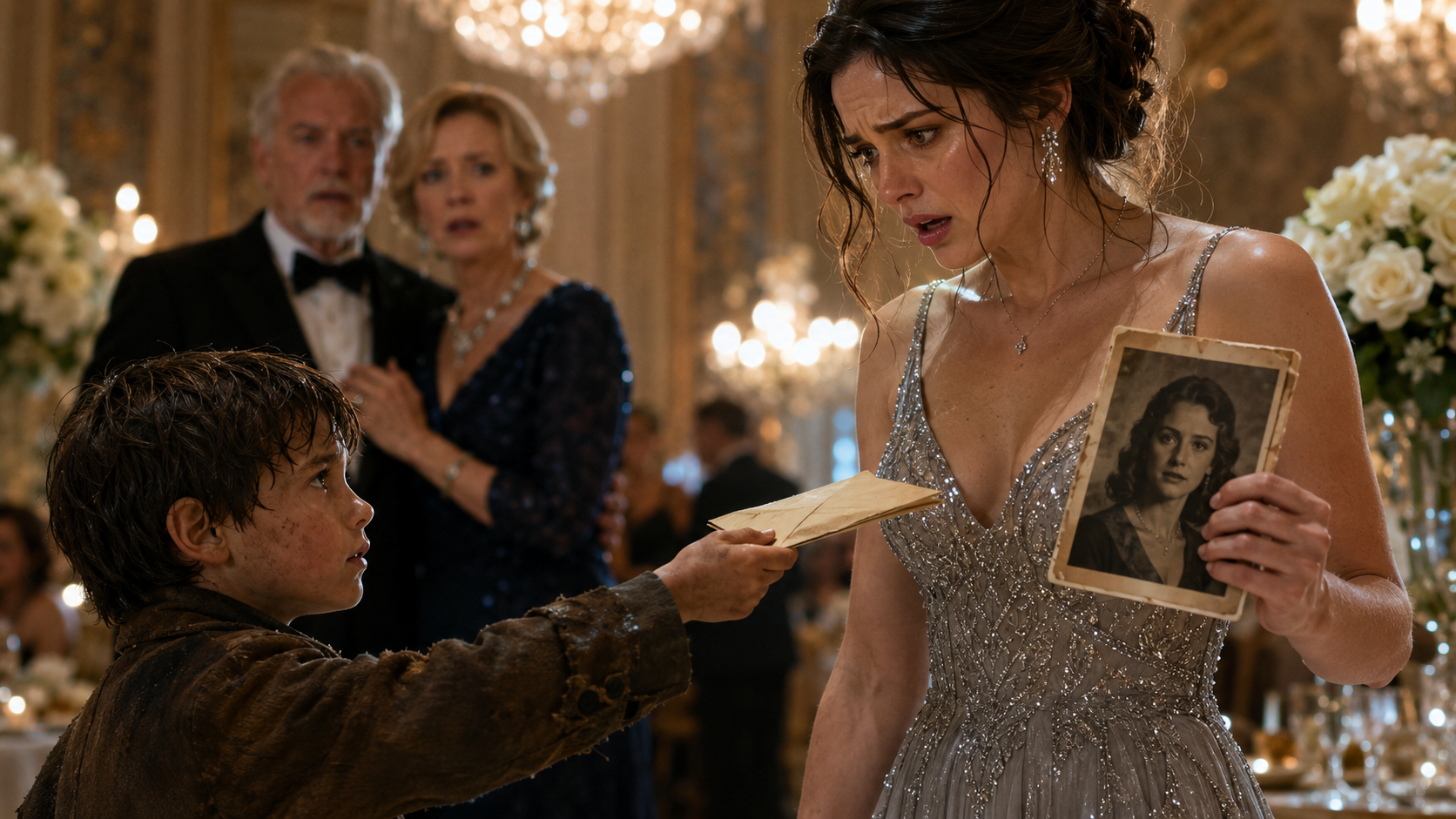
The Boy Said His Mother Had Your Face — Then You Discovered Your Family Paid to Make Her Disappear


The first time the boy says it, you think you heard him wrong.

The ballroom is too loud.

Crystal glasses sing against one another. Laughter rises in polished waves. A string quartet plays near the marble staircase, soft enough to feel expensive and meaningless enough to be ignored. Everywhere you look, people are smiling the careful smiles rich people wear when cameras are nearby.

Your father is on the stage, accepting another award for generosity.

Your mother is in the front row, dabbing the corner of her eye with a silk handkerchief, as if kindness has exhausted her.

And you are standing beside a tower of white roses, wearing a silver dress that costs more than most people’s rent, when a little boy in an oversized brown coat tugs at your hand.

“Are you Serena Ashford?” he asks.

You turn.

He cannot be more than eight.

His hair is dark, cut badly, like someone did it with kitchen scissors. His shoes are wet. One sleeve of his coat is torn at the cuff. He has the hollow, watchful look of a child who has already learned not to expect help from adults.

For one second, irritation moves through you.

Not cruelty. Not hatred.

Just the cold reflex of a woman raised to believe interruptions are problems someone else should handle.

Security is only twenty feet away. Your assistant, Hannah, is searching for you with a phone pressed to her ear. Your father is halfway through a speech about “lifting the forgotten.” There are reporters in the room.

A child like this does not belong here.

Then he says it again.

“My mom said to find Serena Ashford. She said you would have her face.”

Your smile freezes.

“My face?”

The boy nods. His fingers tighten around a folded envelope so old and soft it looks like it has been opened a hundred times.

“She said if anything happened, I should bring this to you.”

The ballroom disappears around you.

Not fully. You can still see the chandeliers, the flowers, the donors, your father at the podium with one hand over his heart.

But sound pulls away from the world.

The boy holds out the envelope.

Your name is written on the front.

Not Serena Ashford.

Serena Vale.

A name you have never used.

A name no one has ever called you.

Your fingers go cold.

“Where did you get that?” you ask.

“My mom gave it to me.”

“What is your mother’s name?”

The boy looks at you with confusion, as if the answer should already be inside your bones.

“Lena,” he says. “Lena Vale.”

The name means nothing.

And somehow, it feels like something buried under your ribs has just heard itself being called from a grave.

You take the envelope.

It is thin. Soft. Stained at the edges.

Inside is a photograph.

At first, you think it is a mirror.

The woman in the picture has your eyes. Your mouth. The same small shadow beneath the left cheekbone. The same stubborn tilt of the chin your mother always told you came from the Ashford side.

But the woman is not you.

Her hair is shorter. Her face is thinner. There is exhaustion around her eyes that no spa treatment could erase. She is holding the boy when he was younger, maybe three or four, his head tucked beneath her chin.

On the back of the photo, written in blue ink, are four words:

For my sister, Serena.

Your breath stops.

Sister.

You have no sister.

You have been told this so many times it became part of your name.

Serena Ashford. Only child. Miracle baby. Born after eleven years of failed treatments and private doctors. Beloved daughter of Malcolm and Vivienne Ashford. Heiress to hotels, foundations, and lies dressed in satin.

The boy watches your face carefully.

“She said you wouldn’t know,” he whispers. “She said they made sure.”

You look toward the stage.

Your father is still speaking.

“My wife and I have always believed that every child deserves to be seen,” Malcolm Ashford says, voice warm and powerful. “No child should ever be erased by circumstance.”

Applause rolls through the ballroom.

Your mother lowers her handkerchief.

For one terrifying second, she sees you.

Then she sees the boy.

The color leaves her face.

That is when you know.

Not because of the photograph.

Not because of the envelope.

Because your mother looks at that hungry little child like he is not a stranger.

She looks at him like he is a door she locked thirty-two years ago and suddenly heard opening behind her.

“Who are you?” you ask him, though your voice barely works.

“My name is Milo,” he says. “Milo Vale.”

The surname cuts deeper the second time.

“Where is your mother, Milo?”

He looks down at the marble floor.

“She told me to wait in the church basement. She said she was going to get medicine.” His voice trembles, but he forces the words out. “She didn’t come back.”

“How long ago?”

“Yesterday morning.”

You kneel before you can think about whether the floor will ruin your dress.

Around you, people start noticing. A woman nearby whispers. Someone lowers a champagne flute. Your assistant finally spots you and begins walking quickly in your direction.

You ignore all of them.

“Milo,” you say, softer now. “Did your mother tell you anything else?”

He nods and opens his small hand.

Inside is a hospital bracelet.

Old. Yellowed. Fragile.

Not his.

Not his mother’s.

A newborn bracelet.

The printed ink is faded, but you can still read part of it.

Baby Girl Vale A.

Beneath it, another line.

Baby Girl Vale B.

Twin delivery.

Your heart begins to pound so violently it hurts.

Hannah reaches you.

“Serena, the press wants a photo with your father after the speech. Is everything—”

“Get him food,” you say.

Hannah blinks. “What?”

You stand slowly, never taking your eyes from the bracelet.

“Food. Water. A coat that fits him. And find Dr. Ellis. He’s here tonight.”

“Serena, who is this child?”

You turn toward her.

“I don’t know yet.”

Then you look back at your mother.

Vivienne Ashford is no longer seated.

She is moving quickly toward the side hallway.

Your father sees her leave. His sentence falters for half a second.

Only half a second.

Enough.

Enough to confirm the photograph, the bracelet, the boy, the name, the fear.

You hand the photograph to Hannah.

“Keep him with you,” you say. “Do not let security touch him.”

“Serena—”

“If anyone tries to remove him from this building, call the police.”

Milo grabs your wrist.

His hand is tiny and cold.

“Please don’t be mad at her,” he says. “My mom said she tried to find you.”

Something breaks inside you.

“I’m not mad at her.”

“Then who?”

You look toward the hallway where your mother disappeared.

“I don’t know yet,” you say. “But I’m going to find out.”

You follow Vivienne Ashford through the side doors.

The music and applause die behind you.

The corridor smells like lilies and expensive perfume. Your heels strike the polished floor like a countdown.

At the end of the hall, your mother is already on the phone.

“No,” she says sharply. “No, you listen to me. A child is here. He found her. I don’t care what you were told. This is happening now.”

She turns and sees you.

The phone lowers.

For the first time in your life, Vivienne Ashford looks old.

Not elegant. Not untouchable. Not perfect.

Old.

Afraid.

“Serena,” she says.

You hold up the hospital bracelet.

“Tell me this is fake.”

Her lips part.

“Tell me,” you repeat.

She takes one step toward you, then stops.

“Darling, you need to calm down.”

It is the wrong thing to say.

You almost laugh.

For thirty-two years, this woman controlled every room by making other people feel unreasonable. Your pain was dramatic. Your questions were rude. Your anger was unattractive. Calm down was her favorite ribbon to tie around your throat.

Not tonight.

“Was I born Serena Vale?”

Her eyes fill with tears.

You hate that tears still have power over you. You hate that some childish part of you wants to comfort her.

“Answer me.”

“Yes,” she whispers.

The hallway tilts.

You press one hand against the wall.

“Yes, what?”

“You were born Serena Vale.”

“And Lena?”

Your mother closes her eyes.

“Your sister.”

The word does not enter you gently.

It tears.

You think of every birthday cake with one candle arrangement. Every framed portrait of you alone. Every time your mother said, “I always knew you were special.” Every time your father joked that one daughter was enough trouble.

You had a sister.

A living sister.

A woman with your face raised somewhere outside the golden cage that held you.

A woman who had a son.

A woman who may now be lying in a hospital, or a shelter, or a ditch, while your parents collected awards for compassion.

“What did you do?” you ask.

Vivienne shakes her head. “We loved you.”

“That is not an answer.”

“We gave you everything.”

“That is not an answer either.”

Your father’s voice comes from behind you.

“It was complicated.”

You turn.

Malcolm Ashford stands at the corridor entrance. The applause has ended. His public face is gone, but not completely. He still carries himself like a man expecting obedience.

Behind him, two security guards hover uncertainly.

Your father dismisses them with a glance.

“Go back inside,” he says.

They leave.

He closes the hallway doors.

Now it is only the three of you.

The parents who raised you.

And the daughter they purchased from a life they never meant to acknowledge.

“Complicated?” you repeat. “I just met a hungry child downstairs who says his mother is my twin sister. I have a hospital bracelet with two babies listed on it. My name was changed. My entire life was changed. So please, Father, explain the complication.”

His jaw tightens.

“We saved you.”

The words land like a slap.

“From what?”

“From poverty. From instability. From a woman who could not care for two infants.”

“My birth mother?”

Vivienne begins to cry quietly.

Malcolm does not.

“Yes,” he says. “Your birth mother. Her name was Maribel Vale. She was nineteen. No husband. No money. No family who would help her. She gave birth in a public hospital and disappeared twice in the first week.”

“That sounds like a woman who needed help.”

“It sounds like a woman who could not provide a future.”

“So you took one of her babies?”

“We adopted you.”

“Did she agree?”

Silence.

Your mother covers her mouth.

Your father looks away.

A new kind of cold moves through you.

“Did she agree?” you ask again.

Malcolm’s voice hardens. “There were papers.”

“That is not what I asked.”

“There are always papers.”

You stare at him.

For the first time, you understand that the law can be used the same way wealthy people use curtains.

Not to protect.

To hide.

“What about Lena?”

Vivienne whispers, “Maribel kept her.”

“Why?”

Your mother’s tears spill freely now.

“Because she came back.”

The corridor is silent.

“What?”

“She came back,” Vivienne says. “Two days after signing. She was hysterical. She said she didn’t understand what she’d done. She said the medication, the exhaustion, the social worker, all of it—she said she wanted both babies.”

Your father cuts in. “She had no legal ground.”

You turn on him.

“She was a teenage mother who had just delivered twins.”

“She signed.”

“And you made sure she stayed poor enough not to fight.”

His expression changes.

There.

There is the truth.

Not guilt.

Not love.

Calculation.

“What did you pay for?” you ask.

Malcolm says nothing.

You step closer.

“What did you pay for?”

Vivienne grips your arm. “Serena, please. We can talk at home.”

You pull away.

“Home is a word people use when they haven’t been stolen.”

Your mother flinches.

Your father’s face darkens.

“You will not speak to your mother like that.”

“My mother?” you say. “Which one?”

He goes still.

The cruelty of it hangs in the air.

You do not take it back.

“Where is Maribel Vale?”

Vivienne looks down.

Your father answers. “Dead.”

“How?”

“Overdose.”

“Did you confirm that?”

He hesitates.

Just once.

But now you are watching every breath.

“You didn’t,” you say.

Vivienne whispers, “We were told.”

“By whom?”

No answer.

“By whom?”

Your father exhales. “A lawyer.”

“What lawyer?”

“This is enough.”

“No. This is the first honest conversation we’ve ever had.”

He steps toward you, lowering his voice.

“Listen carefully. Whatever fantasy that child’s mother put into his head, you are still an Ashford. You have responsibilities. You have a name. You have a position that can be destroyed by reckless accusations.”

You stare at him.

A few hours ago, those words might have worked.

Name. Position. Reputation.

The holy trinity of your childhood.

But now all you can see is Milo’s wet shoes on marble. A hospital bracelet. Your mother’s face draining of color. A twin sister who lived somewhere beyond the Ashford walls and still managed to send her son to you.

“You’re worried about the family name?” you ask.

“I’m worried about you.”

“No,” you say. “You’re worried I’ll open the wrong door.”

Malcolm’s silence is enough.

You walk past him.

He catches your arm.

Not hard enough to hurt.

Hard enough to remind you he believes he still can.

“You leave this building with that boy,” he says quietly, “and you will regret it.”

You look at his hand on your arm.

Then you look at him.

“Take your hand off me.”

Something in your voice makes him release you.

You return to the ballroom.

Nobody applauds now.

The mood has shifted. People can smell scandal the way animals smell smoke. Conversations stop as you pass. Your father’s donors pretend not to stare. Your mother’s friends lower their eyes.

Hannah is near the coatroom with Milo. He is sitting on a velvet bench, holding a plate piled with food. He is eating carefully, like he has been taught not to seem too hungry.

Dr. Ellis, your family physician for twenty years, stands beside him with a concerned expression.

“Is he hurt?” you ask.

“Undernourished, exhausted, possibly feverish,” Dr. Ellis says. “He needs a proper examination.”

Milo looks up quickly.

“I’m not sick.”

You kneel in front of him.

“No one is saying you did anything wrong.”

His shoulders relax a little.

“Are we going to find my mom?”

“Yes.”

The word comes out before you know how.

Before you have a plan.

Before you know whether Lena Vale is alive, dead, hiding, arrested, hospitalized, or already erased the way your family erased everything inconvenient.

But the promise is made.

And for the first time all night, Milo looks almost like a child again.

You stand.

“Hannah, cancel everything on my calendar for the next week.”

“Done.”

“Call my driver.”

“He’s already outside.”

“Tell him we need to go to the church basement Milo mentioned.”

Hannah nods, then lowers her voice.

“Your father told security not to let the boy leave.”

Your blood turns hot.

“Did he?”

“Yes.”

You look toward the main entrance.

Two security guards are standing there now, pretending not to watch you.

Your father emerges from the hallway behind them.

Perfect suit. Perfect posture. Perfect monster.

The old Serena might have hesitated.

The old Serena might have chosen privacy over truth.

The old Serena might have protected the family before protecting the child.

But that woman was raised inside a lie.

And lies do not get loyalty anymore.

You take Milo’s hand.

“Come on.”

The guards move as you approach.

“Ms. Ashford,” one says carefully, “Mr. Ashford asked us to—”

You do not slow down.

“Move.”

“I’m sorry, ma’am, but—”

You stop inches from him.

“There are twelve reporters in this room,” you say quietly. “If you touch this child, I will scream that my father is holding a hungry eight-year-old hostage at his own charity gala. Then I will make sure your face is in every photograph.”

The guard steps aside.

Milo’s hand tightens in yours.

You walk out under the chandeliers while the wealthiest people in the city watch in silence.

Outside, cold rain hits your face.

Your driver, Owen, opens the car door.

Milo hesitates at the sight of the black sedan.

You recognize the hesitation.

Not because you ever feared expensive cars.

Because you suddenly understand what they represent.

A car can rescue.

A car can kidnap.

A car can carry a child from one life into another while adults call it paperwork.

“It’s okay,” you tell him. “You sit next to me.”

He climbs in.

As the car pulls away, your phone begins to ring.

Father.

You decline.

It rings again.

Mother.

You decline.

Then a message appears.

Come home before you make this worse.

You type back only one sentence.

You already made it worse thirty-two years ago.

Then you turn off the phone.

The church basement is on the east side of the city, far from the hotels with your father’s name on them.

It sits below a brick building with cracked steps and a flickering sign. A volunteer opens the door after Hannah knocks three times.

She recognizes Milo immediately.

“Oh, thank God,” she says, reaching for him. “Where did you go?”

Milo shrinks back against you.

The woman stops, eyes widening.

“I’m not here to take him from you,” she says gently. “We were worried.”

“I went to find my aunt,” Milo says.

The word aunt hits you with unexpected force.

Aunt.

Not stranger.

Not heiress.

Aunt.

The volunteer looks at you.

You can see the moment she notices your face.

Her mouth opens.

“You’re her,” she whispers.

“Lena?” you ask.

“She showed me a picture once. I thought…” The woman shakes her head. “I thought grief made her imagine things.”

“Where is she?”

The volunteer’s expression changes.

“She was sick. Very sick. She didn’t want to go to the hospital because she was afraid someone would take Milo. Yesterday morning she left to find antibiotics from a clinic. She never came back.”

“Which clinic?”

The woman gives you the name.

Hannah writes it down.

“Did she have enemies?” you ask.

The volunteer hesitates.

“Not enemies exactly.”

“What does that mean?”

“She was scared of a man.”

Your body stiffens.

“What man?”

“She never said his name. Only that he worked for the family who took her sister.”

The room seems to narrow.

“What did he look like?”

“Older. Gray hair. Expensive coat. He came here three weeks ago asking about her. She hid in the supply room until he left.”

Your father’s lawyer.

The thought comes instantly.

“What did he want?”

“To know if she had contacted you.”

Milo’s small voice cuts in.

“Mom said the man told her to stop digging.”

You turn to him.

“What digging?”

Milo reaches into his coat and pulls out a little notebook.

“My mom wrote things down so she wouldn’t forget.”

You take it carefully.

The pages are filled with names, dates, addresses, and fragments written in hurried handwriting.

Ashford Foundation.

Judge Harlan.

Cedar Row Maternity Ward.

Adoption seal.

Payment records.

Vale file destroyed?

One page has a name circled three times.

Edmund Price.

Your father’s oldest attorney.

The man who sent birthday gifts every year and once told you that your parents “fought very hard to have you.”

Now you understand what kind of fight he meant.

You photograph every page.

Then you call Dr. Ellis.

“I need you to check every hospital within twenty miles for a woman named Lena Vale,” you say. “Possible pneumonia, fever, maybe collapse. She may not have ID.”

“I’ll do what I can.”

“And doctor?”

“Yes?”

“Do not call my parents.”

A pause.

Then, quietly, “I won’t.”

You hang up.

Milo is watching you.

“My mom said rich people always know where to look,” he says.

You close the notebook.

“She was right.”

Three hours later, you find your sister in a county hospital under the name Elena Voss.

Not Lena Vale.

Not Ashford.

Not anyone your parents could easily track.

She is alive.

Barely.

When you step into the hospital room, the first thing you see is not her face.

It is her hands.

Thin. Chapped. Resting on the blanket like they have been holding the world together with no help.

Milo runs to the bed.

“Mom!”

Her eyes open.

Slowly.

Painfully.

Then she sees him.

Her whole face changes.

“Milo,” she breathes.

He climbs onto the bed carefully, sobbing into her shoulder. She wraps one weak arm around him and kisses his hair again and again.

“I told you to wait,” she whispers.

“I found her.”

Lena looks past him.

At you.

For a moment, neither of you speaks.

It is like standing before your own reflection after it has survived a war you were spared.

She has your face, yes.

But life has carved different lines into it.

Your skin has been protected by privilege. Hers has weathered fear, hunger, work, and disappointment. You look like the version of her that was kept indoors. She looks like the version of you that had to learn how to run.

Her eyes fill with tears.

“You came,” she says.

The simplicity of it destroys you.

You move closer, but stop beside the bed, suddenly unsure what right you have to touch her.

“I didn’t know,” you say.

It is too small.

Too useless.

Too late.

“I know,” Lena whispers.

“You knew about me?”

She nods.

“All my life.”

Your throat tightens.

“How?”

“Our mother told me.”

“Maribel?”

A faint smile touches her mouth.

“She never stopped talking about you. She said one day we would find you. She said no money in the world could erase blood.”

“What happened to her?”

Lena looks away.

The machines beep softly.

“She died when I was sixteen.”

“I’m sorry.”

“She spent her whole life trying to get you back.”

The sentence enters you like a blade.

“She tried court,” Lena continues. “Letters. Legal aid. Journalists. Every door closed. Every file disappeared. Every person who promised to help suddenly changed their mind.”

“Because of my father.”

“Because of your father’s money,” Lena says. “And your mother’s silence.”

You sit down heavily in the chair beside the bed.

“I thought they were my whole world.”

“They made sure of that.”

There is no bitterness in her voice.

That makes it worse.

Bitterness would give you somewhere to put your guilt. Anger would let you defend yourself. But Lena is simply tired, and tired truth has no sharp edges to grab.

“I should have found you,” you whisper.

“You were a baby.”

“Then when I was older.”

“How would you search for a sister no one told you existed?”

You look at Milo.

He has fallen asleep against her side, one hand still gripping her hospital gown.

“Why now?” you ask. “Why send him to me?”

Lena’s eyes darken.

“Because Edmund Price found me.”

Your hands curl.

“What did he do?”

“He offered money first. Enough to move away. Enough to stop asking questions.”

“And when you refused?”

“He said accidents happen to women who disturb powerful families.”

The air leaves your lungs.

“He threatened you?”

“He smiled while doing it.”

Of course he did.

Men like Edmund Price never need to raise their voices. They can ruin lives with clean fingernails.

“I had proof,” Lena says. “More than Mom ever had.”

“What proof?”

She closes her eyes.

“In my bag.”

You look around.

“There was no bag when she was admitted,” a nurse says from the doorway. “Paramedics said she collapsed outside the clinic.”

Lena’s face crumples.

“No.”

“What was in it?”

“Copies. Records. A payment ledger. A letter from the nurse who was there when we were born. She wrote that Maribel was drugged when she signed the papers. She wrote that the social worker told her she could see you again if she cooperated.”

You stand.

“Where did you collapse?”

Lena gives you the street.

Hannah is already moving toward the door.

“I’ll check cameras,” she says.

“No,” you say. “We’ll do it together.”

Lena grabs your wrist.

Her grip is weak, but desperate.

“Serena.”

You look down.

“If they took the bag, they know Milo found you.”

“I won’t let them touch him.”

“You don’t know what they can do.”

For the first time, anger fills you cleanly.

Not panic.

Not shock.

Anger.

“I know exactly what they can do,” you say. “They raised me.”

By morning, you have three things your father does not know you have.

First: a video from a pharmacy camera showing Edmund Price picking up Lena’s canvas bag less than two minutes after she collapsed.

Second: a nurse named Ruth Calder, eighty-one years old and living in assisted care, who cries when you call and says, “I knew this day would come.”

Third: the key to your father’s private archive, because Hannah once organized his estate files and remembers everything.

At six in the morning, you walk into the Ashford mansion with wet hair, no makeup, and a rage so quiet the housekeeper steps aside without speaking.

Your parents are in the breakfast room.

Of course they are.

Coffee poured. Fruit sliced. Newspapers folded.

As if the world did not split open overnight.

Vivienne rises when she sees you.

“Serena, thank God.”

Malcolm stays seated.

His calm is almost impressive.

“Where is the boy?” he asks.

“Safe.”

“With whom?”

“Not you.”

His mouth tightens.

You place the hospital bracelet on the table.

Then the photograph.

Then a printed still from the pharmacy video showing Edmund Price holding Lena’s bag.

Your father looks at it.

Only once.

But once is enough.

“I want every file,” you say.

He folds his hands.

“You are emotional.”

“I am finished being managed.”

Vivienne whispers, “Please, Serena, don’t destroy us.”

You look at her.

That plea might have worked yesterday.

Yesterday, you were still her daughter in the only way you knew how to be.

Today, you are also Maribel’s daughter.

Lena’s sister.

Milo’s aunt.

And the truth belongs to all of you.

“You destroyed a mother,” you say. “You destroyed two sisters. You let one child grow up in wealth and the other in fear, then called it love. I’m not destroying anything. I’m opening the room where you hid the bodies.”

Your mother sobs.

Your father stands.

“There are no bodies.”

“Not all deaths need graves.”

He slaps the table.

The sound cracks through the room.

Vivienne flinches.

You do not.

“Enough,” he says. “You have no idea what your life would have been. We gave you education, safety, dignity.”

“You gave me stolen comfort.”

“We are your parents.”

“You were my owners.”

His face changes.

For one second, the mask drops completely.

“You ungrateful little—”

“Careful,” you say.

He stops.

You take out your phone and play the recording.

His voice from last night fills the breakfast room.

You leave this building with that boy, and you will regret it.

Then Lena’s voice from the hospital.

Edmund Price found me… He said accidents happen to women who disturb powerful families.

Then Ruth Calder’s trembling voice.

Maribel Vale was not lucid when they brought those papers. I told the attorney. He told me rich families make better mothers.

Your father’s face turns gray.

Vivienne sits down as if her legs no longer work.

“I have copies,” you say. “With a journalist. With an attorney. With someone outside this city. If anything happens to Lena, Milo, Ruth Calder, Hannah, or me, the story releases before lunch.”

Malcolm stares at you.

For the first time in your life, your father looks at you and sees not his daughter.

An opponent.

“What do you want?” he asks.

The question is so ugly, so perfectly him, that you almost smile.

Because to Malcolm Ashford, everything is negotiation.

Every wound has a price.

Every person has a number.

You lean forward.

“I want the files. I want Edmund Price disbarred and charged if the evidence supports it. I want every payment record connected to Maribel Vale, Judge Harlan, Cedar Row Hospital, and the adoption sealed under my name. I want a public statement that I was adopted from Maribel Vale and separated from my twin sister. I want Lena and Milo protected, housed, and medically cared for from funds that do not require them to thank you.”

Your mother whispers, “And us?”

You look at her for a long moment.

Vivienne Ashford, who kissed your forehead before school.

Who taught you how to hold a teacup.

Who lied every birthday while crying over a cake for one.

“I want you to tell me why,” you say.

Her face crumples.

Not the elegant crying.

Not the controlled tears.

This is something uglier.

Human.

“I couldn’t have children,” she whispers. “And then your father came home and said there was a baby. A beautiful baby. A girl. He said the mother couldn’t keep both. He said it was legal.”

“You knew about Lena.”

“I knew there was another baby.”

“You knew there was my sister.”

She covers her face.

“At first, I told myself it was better. One with us. One with her mother. Everyone had someone.”

“Everyone?” you ask. “Or you?”

She cannot answer.

“Did Maribel come here?”

Vivienne looks up.

Your heart sinks.

“She did.”

“When?”

“You were almost two.”

The room goes quiet.

“She came to the gates,” Vivienne says. “In the rain. She had Lena with her. She begged to see you. Just once.”

You grip the back of a chair.

“What did you do?”

“I watched from upstairs.”

“And?”

“Your father called the police.”

The words hollow you out.

“Did I see her?”

Vivienne’s voice breaks.

“You were in the nursery window. You waved.”

You close your eyes.

Somewhere inside you, a memory moves.

Not clear. Not complete.

Rain on glass.

A woman outside the gate.

A child beside her.

Your small hand pressed against a window.

Then your nanny pulling the curtains shut.

For years, you dreamed of rain and woke up crying for no reason.

Now the reason is sitting across from you with pearls at her throat.

“You let me wave goodbye to my mother,” you whisper, “and then you closed the curtains.”

Vivienne reaches for you.

You step back.

“No.”

She freezes.

“No more touching me to make yourself feel forgiven.”

Your father’s voice is low.

“You think the world will embrace them? Lena and her boy? You think they won’t resent you? You think blood fixes poverty?”

“No,” you say. “But truth gives us somewhere honest to start.”

You leave with three boxes of files and the first real piece of your life.

By evening, the Ashford story breaks.

Not the polished version.

Not the statement your father’s crisis team drafts, full of words like private family matter and painful misunderstanding.

The real story.

Hospital records.

Payments.

Sealed filings.

A nurse’s testimony.

A lawyer on camera stealing a sick woman’s bag.

A foundation built on saving children while its founders paid to erase one.

The city reacts the way cities always do: with shock, hunger, judgment, sympathy, and noise.

Your father resigns from two boards before midnight.

Edmund Price disappears for twelve hours, then reappears with an attorney of his own.

Vivienne does not leave the mansion.

You do not go back.

For three days, you stay at the hospital.

You learn your sister in pieces.

Lena likes coffee too sweet. She hates roses. She hums when she is nervous. She can fix a broken zipper with a paperclip. She remembers every place she and Maribel ever lived, not by addresses, but by what they could hear at night: trains, sirens, church bells, a neighbor’s television, dogs fighting in an alley.

You tell her about yourself too, though every detail feels embarrassing now.

Private schools. Riding lessons. French tutors. Summers in places she has only seen in magazines.

But Lena does not make you feel ashamed.

That is the worst mercy.

She listens.

Sometimes she laughs.

Once, when you admit you never learned to cook anything beyond toast, she looks at you in horror and says, “Maribel would haunt me if I let that continue.”

For the first time, you both laugh together.

It sounds strange.

Like a door opening in an abandoned house.

Milo begins sleeping properly after the second night.

He still wakes if someone enters too quickly. He still hides food in napkins until Lena gently reminds him there will be breakfast. He still watches you like he is trying to decide whether you are temporary.

On the fourth day, Lena is strong enough to sit in a chair by the window.

You bring the boxes.

She stares at them for a long time.

“Our whole life fits in cardboard,” she says.

“Not our whole life,” you answer. “Only what they stole.”

Together, you open the first box.

There are documents inside. Birth certificates. Court filings. Letters returned unopened. Photographs of Maribel as a young woman.

You look like her too.

Not exactly.

But enough.

She had your eyes and Lena’s smile.

One photograph shows Maribel holding both of you as newborns. She is exhausted, hair stuck to her forehead, hospital gown falling off one shoulder.

But she is smiling.

Not because she is comfortable.

Because she is holding everything she loves.

On the back, in her handwriting:

My girls. Serena and Lena. No one will ever split my heart.

Lena touches the words.

A tear falls onto the cardboard.

You do not tell her not to cry.

You cry with her.

A week later, you stand outside the Ashford mansion again.

This time, you are not alone.

Lena stands beside you, thinner than you but upright. Milo holds her hand. Hannah waits near the car. A lawyer stands by the gate.

Your father has agreed to meet.

Not because he wants to.

Because he has run out of locked doors.

The mansion looks smaller now.

You used to think it was beautiful.

Now all you see are windows where a little girl once waved at the mother she was taught to forget.

Vivienne opens the door.

She sees Lena.

Her face collapses.

For a moment, no one speaks.

Then Lena says, “You saw us at the gate.”

Vivienne puts one hand to her mouth.

“I did.”

“My mother begged you.”

“Yes.”

“You had my sister upstairs.”

Vivienne nods, tears spilling.

“Yes.”

Lena’s voice shakes, but she does not break.

“Then I don’t have anything to say to you.”

Vivienne makes a sound like pain.

You feel it.

But you do not rescue her from it.

Some pain is simply the shape of consequence.

Malcolm is in the study, thinner somehow, though only days have passed. He looks at Lena the way a man looks at evidence he cannot discredit.

Milo stays behind his mother.

Your father notices.

For the first time, shame flickers across his face.

Not enough.

But something.

Lena places a photograph of Maribel on his desk.

“You remember her?” she asks.

He does not answer.

“You should,” Lena says. “She spent her life remembering you.”

His hands tighten.

“I did what I thought was best.”

“No,” you say. “You did what you wanted and paid people to call it best.”

Silence.

Then Milo steps forward.

He is small in the huge room.

But his voice is steady.

“My grandma loved both babies,” he says. “My mom told me.”

Your father looks at him.

And maybe this is the first time Malcolm Ashford truly understands what he stole.

Not a file.

Not a legal problem.

A grandmother.

A mother.

A sister.

A nephew.

A life where two girls might have grown up knowing each other’s laugh.

He lowers his eyes.

“I’m sorry,” he says.

The words are late.

Too late to heal anything by themselves.

But they lie on the desk between you, small and insufficient.

Lena looks at you.

You look at Milo.

Then at Maribel’s photograph.

Sorry is not justice.

But it can be evidence that the lie has finally stopped pretending to be love.

Months later, the Ashford name no longer opens every door.

Some remain open because people are curious.

Some close because people are afraid of scandal.

Some were never worth entering.

You legally restore part of your name.

Serena Vale-Ashford.

Not because you forgive.

Because you refuse to choose between the life stolen from you and the life you survived.

Lena gets stronger.

Not quickly. Not magically.

Real healing is slow and often inconvenient. There are doctors. Lawyers. Nightmares. Arguments. Days when she cannot look at you because your face reminds her of everything she lost. Days when you cannot look at her because her life reminds you of everything you were given.

But then there are other days.

Milo’s first proper birthday party.

Lena teaching you to make Maribel’s soup, laughing when you burn the onions.

You and your sister sitting on a kitchen floor at midnight, comparing childhood scars, favorite songs, the strange way you both hate sleeping with closet doors open.

Blood does not fix everything.

It does not erase poverty.

It does not return the dead.

It does not rewind thirty-two years.

But it recognizes.

And recognition is where truth begins.

On the first anniversary of the night Milo found you, the three of you visit Maribel’s grave.

The stone is simple.

Too simple for a woman who fought giants with empty pockets.

You place white lilies there.

Lena places a photograph of both of you together.

Milo places a toy car because, he says, grandmothers should get presents too.

You kneel and touch the engraved name.

Maribel Vale.

Mother.

The word feels strange.

Sacred.

Yours.

“I’m sorry,” you whisper.

Lena kneels beside you.

“She knew you were out there.”

You close your eyes.

Rain begins softly, tapping leaves overhead.

For once, no one closes the curtains.

Lena takes your hand.

Milo leans against your shoulder.

And for the first time in your life, you understand that family is not the story powerful people tell about you.

It is the hand that reaches through the lie.

It is the child brave enough to cross a city with an old envelope.

It is the sister who never stopped believing your face would remember hers.

It is the mother who lost one daughter but taught the other to find her.

You look at Lena.

She looks back.

Same eyes.

Same blood.

Different lives.

One truth.

And this time, no one gets to erase either of you.

The Boy Said His Mother Had Your Face — Then You Discovered Your Family Paid to Make Her Disappear
A television star of the 1980s married a Hollywood actor who was sixteen years her senior, and then gave up her career to devote herself to raising their children!