The Empty Place at the Wedding Door

You noticed something was wrong the moment the music changed.

Not stopped.

Changed.

It was the kind of delicate mistake most guests would never catch—the harpist shifting too early, the violin softening before the flower girls had even appeared, the wedding coordinator raising two fingers instead of three from the back of the aisle. But you had spent three months listening to that entrance song in the kitchen with your daughter, watching her practice walking slowly across the tile while holding a basket of silk petals against her chest.

“One step, then breathe,” you had told her.

Your daughter, Lily, had taken the job seriously in the way only an eight-year-old could. She had practiced her smile. She had practiced not dropping the basket. She had practiced not looking back at you until she reached the front.

So when the double doors opened and someone else stepped through them wearing the pale blue dress that had been made for Lily, your hands went cold.

The girl at the entrance was not your daughter.

She was about the same height, maybe a little taller, with curled hair and a silver bow clipped above one ear. She smiled wide, as if the entire room belonged to her, and scattered petals in perfect little handfuls while the guests tilted their heads and whispered how adorable she was.

Beside you, your sister-in-law Marissa leaned close and murmured, “Don’t make a scene.”

You turned slowly toward her.

“What did you do?”

Marissa’s smile never moved. Not fully. Only the corners tightened.

“Not here, Elena.”

Your eyes searched the back of the hall. The doors were closing. Behind them, somewhere out of sight, was your daughter.

Your little girl who had been promised a place.

Your little girl who had been told by this family that she was finally being included.

Your little girl who had cried with happiness when her cousin Vivian asked her to be in the wedding.

You stood.

Marissa grabbed your wrist under the table. Her nails pressed into your skin.

“Sit down,” she whispered. “This is Vivian’s day.”

You pulled your hand free.

“No,” you said quietly. “This was Lily’s moment.”

A few heads turned. Your mother, sitting two rows ahead in a lavender suit that smelled like expensive perfume and old disappointment, shot you a warning look. Your brother Graham, father of the bride, didn’t look at you at all. He sat stiffly beside his wife, pretending he had no idea why your face had gone pale.

But he knew.

They all knew.

And as the replacement girl reached the end of the aisle, curtsied sweetly, and took the seat that had been saved for Lily near the front, you understood with a sick certainty that this had not been a mistake.

It had been planned.

The bride’s entrance began.

Everyone stood.

You didn’t.

You walked toward the back doors.

“Elena,” Marissa hissed behind you. “Elena, don’t you dare.”

But you had spent too many years obeying whispered warnings from people who only cared about appearances. You had swallowed too many insults because they were delivered at family dinners. You had smiled through too many moments when your daughter was treated like an afterthought, a burden, an inconvenience that came attached to you.

Not today.

The hallway outside the ballroom was dim and quiet, decorated with white roses and gold ribbons. The music inside swelled behind the closed doors, beautiful and cruel.

You found Lily sitting on a velvet bench near the coatroom.

Her basket was on the floor.

Her shoes were still buckled.

Her hair had been brushed into the soft curls she had been so proud of that morning, but one side had fallen loose. Her cheeks were wet. She was holding the blue sash from her dress in both hands because someone had taken the dress itself.

Your breath broke in your chest.

“Baby.”

She looked up fast, trying to wipe her face with the back of her hand.

“I didn’t cry loud,” she said immediately, as if that mattered. “I promise I didn’t.”

You knelt in front of her.

“What happened?”

Lily looked toward the ballroom doors as if she expected someone to come out and scold her.

“Aunt Marissa said there was a problem.”

“What problem?”

“She said my dress didn’t match the pictures anymore.” Lily’s voice trembled. “She said Vivian changed her mind because photographers like things to look balanced. Then she told me I could still watch from the back if I was good.”

Your throat tightened.

“Who took your dress?”

Lily looked down at the sash in her hands.

“Mrs. Caldwell.”

The wedding coordinator.

“And she gave it to that other girl?”

Lily nodded. “She said it was already decided. She said I shouldn’t ruin the bride’s mood.”

For a moment, you couldn’t speak.

You had known your family could be shallow. You had known they valued money, status, polished photographs, perfect seating charts, perfect table settings, perfect lies. But this was not shallow.

This was deliberate cruelty.

You touched Lily’s face gently.

“Listen to me,” you said. “You did nothing wrong.”

Her lower lip shook.

“But maybe I embarrassed them.”

“No.”

“Maybe because Dad didn’t come, and everyone knows—”

“No.” Your voice sharpened, then softened. “No, Lily. You are not embarrassing. You are not less than anyone in that room. Do you hear me?”

She nodded, but she didn’t believe you yet.

That was what hurt most.

The lie had already reached her.

Behind you, a cane tapped once against the marble floor.

You turned.

Your father stood at the end of the hallway.

Walter Hayes was seventy-two years old, tall even with the slight bend in his shoulders, wearing his old navy suit and the silver tie Lily had picked for him. His white hair was combed back neatly. His face, usually calm and unreadable, was hard in a way you had not seen since the day your divorce papers were signed.

He looked from Lily’s tear-streaked face to the sash in her hands.

Then he looked at you.

“Tell me,” he said.

You didn’t want to.

Not because you were afraid of the family.

Because your father had already survived enough humiliation from them. After your mother died, your brother Graham had slowly taken control of every family gathering, every holiday, every tradition. He had money. He had the larger house. He had a wife who knew how to make cruelty sound like etiquette.

Your father had often stayed quiet to keep peace.

But today, his granddaughter was sitting in a hallway without her dress.

So you told him everything.

Every word made his expression colder.

Lily whispered, “Grandpa, please don’t be mad.”

He walked to her slowly, lowered himself onto one knee despite the pain you knew it caused him, and took her hands.

“I am not mad at you, little sparrow.”

“They said I could still have cake later.”

Your father closed his eyes.

When he opened them, something had changed.

“Did they?”

Lily nodded.

He kissed her knuckles. “Then they have mistaken kindness for permission.”

Inside the ballroom, the applause rose. Vivian must have reached the altar.

Your father stood.

“Stay with your mother,” he said.

“Dad,” you said carefully.

He turned toward the ballroom doors.

“What are you going to do?”

He adjusted his cuffs.

“What I should have done years ago.”

Then he walked inside.

You followed because you were afraid of what might happen.

But for the first time in years, you were not afraid of him making a scene.

You were afraid he wouldn’t.

The ceremony had begun. The officiant was speaking in a warm, practiced voice about love, family, and the sacred joining of two lives. Vivian stood under a white floral arch beside her groom, Nathan Pierce, who looked handsome and uncomfortable, like a man slowly realizing he had married into a house where everything beautiful had teeth.

Marissa saw your father first.

Her face changed.

Only for a second.

Then she smiled.

That was Marissa’s gift. She could smile through anything. She had smiled when she told you your apartment was too small for Thanksgiving. She had smiled when she said Lily was “sensitive” after your daughter overheard cousins joking about her secondhand coat. She had smiled when she explained that single mothers had to be realistic about what they could expect from family.

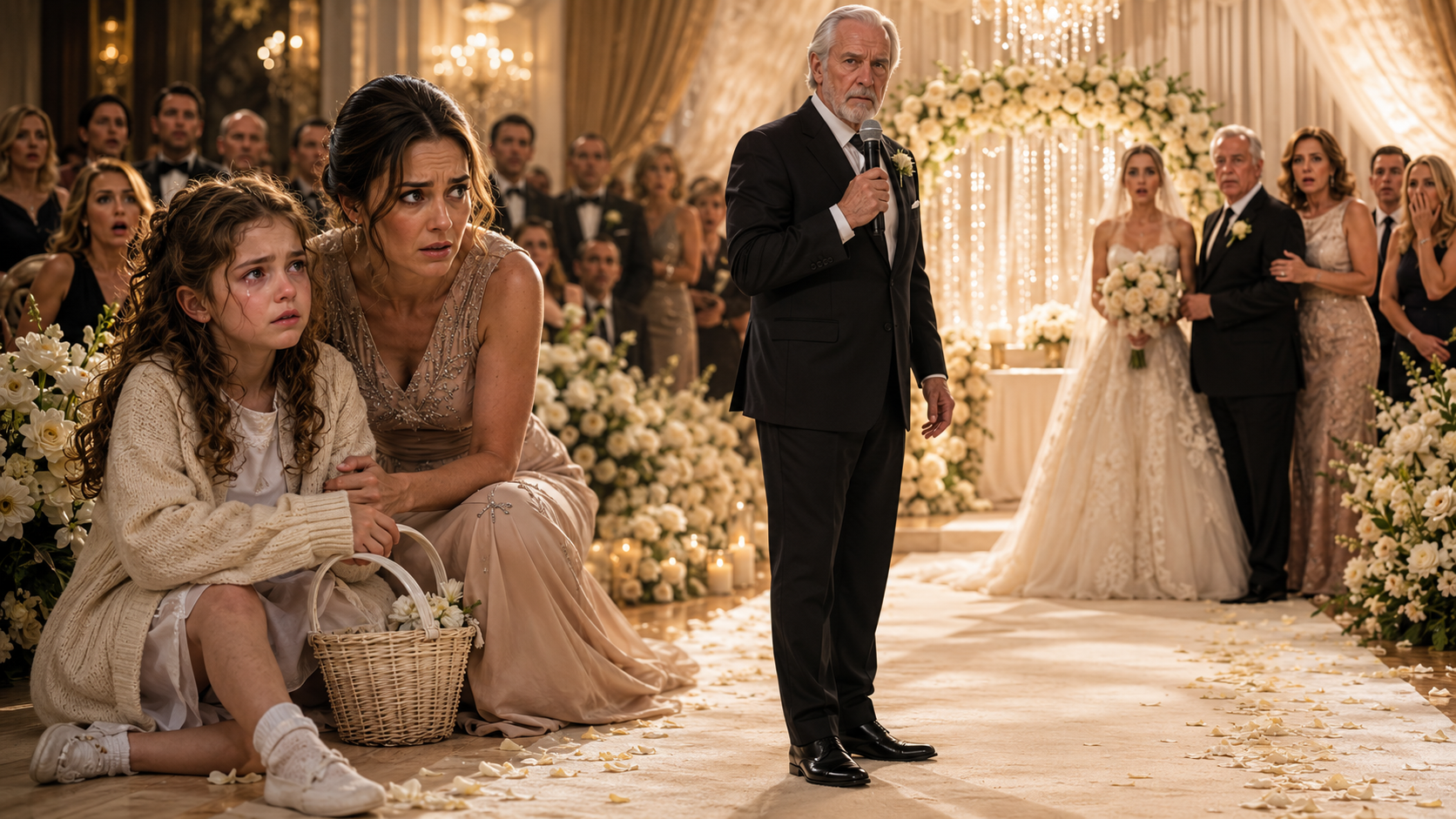
Your father walked down the side aisle, not toward his seat, but toward the small platform where the microphone stand had been placed for speeches later.

A ripple moved through the guests.

The officiant paused.

Graham finally looked over.

“Dad?” he mouthed.

Your father took the microphone.

A low squeal of feedback cut through the hall.

The harpist stopped.

The officiant cleared his throat. “Sir, we’re in the middle of—”

“I know exactly where we are,” your father said.

His voice filled the room.

Not loud.

Worse.

Clear.

Every guest turned.

Vivian’s smile froze at the altar.

Marissa stood from the front row. “Walter, this is not appropriate.”

Your father looked at her.

“No, Marissa. What happened in the hallway was not appropriate.”

A silence fell so complete you could hear the faint buzz of the chandeliers.

Your brother rose halfway from his seat. “Dad, give me the microphone.”

“No.”

One word.

It hit harder than a shout.

You stood near the back with Lily tucked against your side. She clung to your hand.

Your father looked past the rows of guests, past the expensive flowers, past the photographer who had lowered his camera in shock.

“My granddaughter Lily was invited to be part of this ceremony,” he said. “She practiced for weeks. She was fitted for a dress. She was told she mattered. Then, moments before the doors opened, she was removed from the wedding party and replaced with another child because someone decided she did not fit the image this family wanted to sell.”

Whispers erupted.

Vivian’s face went red.

Nathan looked at her. “Is that true?”

Vivian’s lips parted, but no answer came.

Marissa stepped into the aisle.

“This is a misunderstanding,” she said smoothly. “There was a wardrobe issue. We handled it privately.”

Your father’s eyes sharpened.

“Privately? You mean you stripped an eight-year-old child of her dress in a hallway and told her not to ruin the bride’s mood?”

A woman near the middle gasped.

The replacement girl’s mother pulled her daughter closer, suddenly horrified.

Graham’s face darkened. “Dad, enough.”

“No, Graham. It has been enough for a long time.”

That was when the room shifted.

Because everyone knew then this wasn’t only about a dress.

It was about years.

Your father held the microphone with both hands now, his knuckles pale.

“I have listened to this family explain away cruelty as tradition. I have watched Elena and Lily be seated at the folding table while guests were told it was a space issue. I have heard Lily called difficult because she cried after being excluded. I have heard my daughter called dramatic because she asked for basic respect.”

Your mother lowered her gaze.

Marissa’s smile finally vanished.

“Walter,” she warned.

He continued.

“I stayed quiet because I thought silence kept the family together. I was wrong. Silence only taught the cruel people in this room that they could keep going.”

A guest near the front whispered, “Oh my God.”

Nathan took one step away from Vivian.

“Vivian,” he said, not into the microphone, but everyone heard him. “Did you know?”

Vivian looked at her mother.

That was answer enough.

But your father wasn’t finished.

He reached into his inside jacket pocket and pulled out a folded envelope.

Marissa went pale.

For the first time that day, she looked afraid.

Your father saw it.

“Yes,” he said. “You recognize this.”

Graham stood fully.

“Dad, don’t.”

Your father turned toward him.

“You should have thought about that before your wife humiliated my granddaughter.”

He unfolded the paper slowly.

“This morning,” he said, “I came here prepared to give a blessing. I had written something kind about family, forgiveness, and new beginnings.”

He looked at Vivian.

“I loved you the day you were born. I still love you. But love is not the same as pretending.”

Vivian began to cry, but her tears looked angry, not sorry.

Your father lifted the paper.

“Last month, I received a call from the venue. They asked me to confirm whether the final payment would be coming from my account as originally arranged.”

The room murmured.

Graham’s jaw tightened.

Your father continued.

“That surprised me, because I had not agreed to pay for this wedding. I had only agreed, months ago, to contribute a modest amount toward Vivian’s dress.”

Marissa whispered, “Walter…”

“Then I reviewed the account.”

Your stomach dropped.

You didn’t know where this was going.

Your father’s voice remained steady.

“Over the past year, more than eighty-four thousand dollars was withdrawn from the family trust using authorization forms bearing my signature.”

A thunderclap could not have hit the room harder.

Your mother covered her mouth.

The officiant stepped back from the altar.

Nathan stared at Vivian as if he no longer recognized her.

Your father looked directly at Graham.

“My signature was forged.”

Graham’s face drained.

Marissa shook her head quickly. “That is a very serious accusation.”

“It is not an accusation,” your father said. “It is a documented fact.”

He lifted a second sheet.

“I have copies of the forms. I have bank statements. I have the notary confirmation that the signature was submitted electronically from your home office. I also have the email thread where you discussed moving the money before Elena could ask questions about Lily’s education fund.”

The room exploded.

“What?”

“Education fund?”

“Forged?”

You felt Lily press into your side.

“Mom,” she whispered. “What’s happening?”

You could barely answer.

“I don’t know, baby.”

But you did know one thing.

Your father had not come unprepared.

Marissa spun toward Graham. “Say something.”

Graham swallowed.

Your brother, who had spent years speaking over you, correcting you, laughing at your job, criticizing your choices, now stood mute under a ceiling of white roses.

Your father lowered the papers slightly.

“Would you like to explain, son?”

Graham’s mouth opened.

Nothing came out.

Nathan turned to Vivian again.

“Did you know about this?”

Vivian’s tears spilled over. “It was supposed to be paid back.”

Nathan stepped back another inch.

The bride reached for him. “Nathan, please. It wasn’t like that.”

Your father’s voice cut through.

“And this morning, when I arrived early, I overheard Marissa telling the coordinator to replace Lily because ‘no one wants a broken-family child in the main photos.’”

A cold sound moved through the room.

Not a gasp.

Something uglier.

Disgust.

You felt the words land in Lily even though she might not fully understand them. Her fingers tightened around yours until they hurt.

Your father saw.

For one second, his face broke.

Then he turned back to the guests.

“There it is,” he said quietly. “The truth. Not the polished version. Not the polite version. The truth.”

Marissa’s voice shook with fury. “How dare you do this at my daughter’s wedding?”

Your father looked at her for a long moment.

“You did this at your daughter’s wedding. I only turned on the microphone.”

A few people looked away, as if the sentence itself had slapped them.

Nathan’s mother rose from her seat.

She was a small woman in pearl earrings, but her voice was firm.

“Nathan,” she said, “come here.”

Vivian looked terrified.

Nathan didn’t move at first.

Then he removed Vivian’s hand from his sleeve.

“I need answers,” he said.

Vivian whispered, “After the ceremony.”

“No,” he replied. “Before.”

Your father placed the papers on the lectern beside the microphone.

“I have already contacted my attorney. The trust has been frozen. The police report will be filed tomorrow morning unless the funds are returned in full by midnight. And even then, the forgery remains.”

Graham stumbled forward. “Dad, please. We’re family.”

For the first time, your father laughed.

It was not a happy sound.

“Family?” he said. “You remembered that word when you needed money. You forgot it when a child was crying in the hallway.”

Your brother looked toward you then.

Not at Lily.

At you.

As if you might save him.

“Elena,” he said. “Tell him this is too much.”

Years ago, that might have worked.

You might have softened.

You might have said, “Dad, maybe we should talk privately.”

You might have protected the family that never protected you.

But Lily stood beside you in socks because the new dress they gave the replacement girl had included her shoes too.

You looked at Graham.

“No,” you said.

His face twisted.

“You don’t understand what this could do to me.”

You almost smiled.

Not because it was funny.

Because after everything, he still thought the worst outcome in the room was his embarrassment.

“I understand exactly,” you said.

Marissa pointed toward the doors. “Security. Remove them.”

No one moved.

The two venue staff members near the wall looked at each other, then at your father, then at Lily. One of them—a young man with a headset—quietly stepped away from Marissa.

Your father set the microphone back in the stand.

“I will leave now,” he said. “But before I do, I want my granddaughter to know something.”

He turned toward Lily.

The entire room followed his gaze.

Your daughter shrank behind your arm.

Your father’s voice softened.

“Lily, come here, please.”

You looked down at her.

“You don’t have to.”

She looked frightened.

Then she saw her grandfather holding out his hand.

Slowly, she walked down the aisle.

Not in the dress they had stolen from her.

Not carrying petals.

Not smiling for photographs.

Just a small girl in a cream cardigan and white socks, with her curls falling loose and her eyes still wet.

But every person in that room watched her.

And this time, nobody dared whisper.

Your father stepped off the platform and met her halfway.

He knelt again, right there on the white runner meant for the bride.

“I am sorry,” he said into the microphone, his voice trembling for the first time. “I am sorry I let people make you feel small.”

Lily shook her head quickly. “It’s okay.”

“No,” he said. “It is not. But it will be.”

He removed the silver pin from his lapel.

You recognized it immediately.

Your mother had given it to him on their fortieth anniversary. A small silver sparrow, wings spread.

He pinned it carefully to Lily’s cardigan.

“There,” he said. “Now everyone can see what I see.”

Lily touched the pin.

“What?”

He smiled, and his eyes shone.

“A brave little bird who kept singing even when the cage door closed.”

The room was silent.

Then someone clapped.

One person.

Then another.

Then half the room.

Marissa looked as if she might scream.

Vivian stood frozen at the altar, bouquet trembling in her hands.

Nathan did not clap. He was staring at the papers on the lectern.

Your father rose and held Lily’s hand.

He walked her back to you down the aisle.

This time, she didn’t look at the floor.

When she reached you, you pulled her into your arms.

Your father looked exhausted, but lighter somehow.

“Take her home,” he said.

“What about you?”

“I’m going to speak to Nathan’s parents.”

Graham moved toward him. “Dad—”

Your father lifted one hand.

“No more.”

Two words.

A lifetime ending.

You left through the back doors with Lily pressed against your side.

The hallway smelled of roses, wax, and expensive perfume. The same velvet bench waited near the coatroom, holding the sash they had taken from her hands. You picked it up, folded it once, and dropped it into the nearest trash bin.

Lily watched.

“Mom?”

“Yes?”

“Was I bad luck for the wedding?”

You crouched in front of her so your eyes were level.

“No. You were the only honest thing in that room.”

She thought about that.

Then she touched the silver sparrow on her cardigan.

“Grandpa was really mad.”

“Yes.”

“At them?”

“Yes.”

“At me?”

“Never.”

Her shoulders loosened a little.

Outside, the afternoon sun had softened into gold. Guests had begun spilling out of the ballroom behind you, some whispering into phones, some pretending not to stare, some openly looking ashamed.

You helped Lily into the car.

Before you closed the door, she looked back toward the venue.

“Do you think Cousin Vivian will still get married?”

You followed her gaze.

Through the tall windows, you could see movement inside. Nathan stood with his parents near the front. Vivian was crying. Marissa was arguing with the coordinator. Graham had both hands on his head.

Your father stood alone beside the lectern, his cane in one hand, the microphone in the other.

He looked old.

He looked tired.

But he did not look defeated.

“I don’t know,” you said.

Lily leaned back against the seat.

“I don’t want her dress anymore.”

You smiled sadly.

“Good.”

“I want chicken nuggets.”

That surprised a laugh out of you.

“Chicken nuggets?”

“And a milkshake.”

“After all that?”

She nodded solemnly. “Especially after all that.”

You kissed her forehead.

“Then chicken nuggets and a milkshake it is.”

As you drove away, your phone began buzzing.

First your mother.

Then Graham.

Then an unknown number.

Then Marissa.

You didn’t answer.

At the first red light, a message appeared from your brother.

You destroyed everything.

You stared at it for a moment.

Then you deleted it.

Because for once, he was wrong.

You had not destroyed anything.

The rot had already been there.

Your father had simply opened the door and let everyone smell it.

By evening, the wedding was over—not completed, just over.

Nathan had postponed the ceremony indefinitely. That was the polite word his family used when they left the venue. Postponed. As if trust could be rescheduled with a new deposit and a revised flower order.

The next morning, your father’s attorney called.

By noon, Graham called you seventeen times.

By three, Marissa sent a message that began with For Lily’s sake, we should all calm down and ended with you have no idea what your father’s accusations could cost us.

You did not respond.

At six, Vivian texted Lily.

You read it first.

I’m sorry you got upset yesterday. Everything was stressful. I hope you understand.

You showed it to your father when he came over that night with a folder under his arm and Lily’s favorite lemon cookies from the bakery down the street.

He read the message once.

Then he handed the phone back.

“That is not an apology.”

“I know.”

Lily was in the living room building a tower out of blocks. She had placed the silver sparrow pin on the very top.

Your father watched her for a long time.

“I changed my will today,” he said.

You turned toward him.

“Dad.”

“No. Listen.”

You sat beside him at the kitchen table.

He looked older than he had yesterday. The fire had gone out of his anger, leaving only the ache beneath it.

“I should have done it sooner. I kept thinking Graham would remember who he was. I kept thinking Marissa was the problem and he was just weak. But weakness can become cruelty when it keeps choosing the cruel side.”

You said nothing.

Because that was true.

He opened the folder.

“The house will be sold after my passing. Graham will not control any trust, account, property, or legal decision connected to this family again. Lily’s education fund is being restored separately, in an account only you can manage until she is grown.”

Your eyes burned.

“Dad, you don’t have to—”

“I do.”

He placed his hand over yours.

“I failed you in small ways because I wanted peace. Then I watched those small failures become a hallway where my granddaughter sat without her shoes.”

You looked away.

“I should have fought harder too.”

“No,” he said firmly. “You were surviving. There is a difference.”

In the living room, Lily laughed at something on television.

Your father smiled faintly.

“She still laughs,” he said. “That is a blessing.”

“It is.”

“Protect that.”

“I will.”

He tapped the folder.

“And when they call again—and they will—remember this. People who hurt children and then complain about consequences are not asking for forgiveness. They are asking for permission to do it again.”

You nodded.

Three days later, Graham came to your apartment.

He did not call first.

He never did.

He knocked hard enough to make Lily jump.

You opened the door only as far as the chain allowed.

Your brother stood in the hallway wearing the same suit pants from the wedding, wrinkled now, his eyes red from lack of sleep.

“Elena,” he said. “Let me in.”

“No.”

His jaw tightened.

“I need to talk to Dad.”

“Then call him.”

“He won’t answer.”

“Then you have your answer.”

He lowered his voice. “This is serious.”

“It was serious when Lily was crying in a hallway.”

“I didn’t know they were going to take the dress.”

You stared at him.

He looked away.

“You knew they were replacing her.”

He said nothing.

That was the thing about silence. Once you learned how to read it, it confessed everything.

“Marissa thought it would look better,” he said finally. “Vivian’s friend’s daughter matched the flower colors. It was stupid. I told them it was stupid.”

“But you let them do it.”

“I was trying to avoid a fight.”

“You avoided the wrong fight.”

His face crumpled—not with guilt, exactly. With panic.

“Elena, if Dad files that report, I could lose everything.”

You almost felt sorry for him.

Almost.

“Then maybe you shouldn’t have stolen from him.”

His eyes flashed. “I was going to replace it.”

“With what?”

He had no answer.

From behind you, Lily’s small voice said, “Mom?”

You turned.

She stood in the hallway holding her stuffed rabbit. When she saw Graham, she moved behind your leg.

Your brother looked at her.

For a moment, something like shame passed through his face.

“Lily,” he said. “Uncle Graham is sorry about the wedding.”

She stared at him.

Then she asked, “Why did you let them take my shoes?”

The question was so simple it destroyed him.

His mouth opened.

Closed.

He looked at you.

You did not help him.

Lily waited.

Finally, Graham whispered, “I don’t know.”

Lily nodded as if she had expected that.

Then she said, “Grandpa knows.”

And walked away.

You closed the door.

Two weeks later, the venue refunded part of the wedding cost after Nathan’s family threatened legal action over misrepresentation of payments. The forged trust documents became the subject of an investigation. Marissa stopped posting smiling family photos. Vivian deleted every wedding picture except one: a cropped image of her bouquet, no faces visible.

Your mother called one evening and said, “This has gone too far.”

You asked, “Which part?”

She sighed. “You know what I mean.”

“No. I don’t.”

“Your brother made mistakes.”

“Lily made none.”

Silence.

Then your mother said, “Marissa says Lily misunderstood.”

You laughed once.

It startled both of you.

“Mom, Lily was sitting in a hallway without her dress.”

“She’s a child. Children recover.”

“No,” you said. “Children remember.”

Your mother had no answer.

After that, the calls slowed.

Peace returned, but it was not the old kind of peace—the fake kind, the kind built from swallowed words and forced smiles.

This peace had space in it.

Clean space.

On Saturday morning, your father took you and Lily to a small garden café on the edge of town. It was not fancy. The tables were uneven, the coffee was too strong, and a sparrow hopped boldly near Lily’s chair waiting for crumbs.

Lily wore the silver pin on her jacket.

She had worn it every day since the wedding.

Your father pretended not to notice how carefully she checked it every few minutes.

After breakfast, he handed her a small white box.

“What is it?” she asked.

“Open it.”

Inside was a dress.

Not blue.

Yellow.

Soft cotton, with tiny embroidered birds along the hem.

Lily gasped.

Your father cleared his throat.

“I thought you might like a dress nobody can take from you.”

She hugged him so hard he nearly dropped his cane.

You looked away because you were crying.

That afternoon, Lily put on the yellow dress and ran through the grass behind the café while your father sat beside you on a bench.

“She’ll be all right,” he said.

You watched her spin in the sunlight.

“I know.”

But you also knew being all right did not mean forgetting.

It meant remembering correctly.

Not as shame.

As proof.

Proof that she had been hurt and still stood.

Proof that someone had finally spoken.

Proof that love did not always look like keeping the peace.

Sometimes love looked like an old man taking a microphone in a room full of expensive flowers and telling the truth so loudly that no one could pretend not to hear it.

Lily ran back breathless, cheeks pink, hair wild.

“Mom! Grandpa! Watch!”

She lifted the edges of the yellow dress and walked slowly across the grass, one careful step at a time.

One step.

Then breathe.

One step.

Then breathe.

At the end, she turned, gave a tiny curtsy, and smiled.

No stolen dress.

No perfect aisle.

No cruel audience deciding whether she belonged.

Only sunlight.

Only grass.

Only the people who should have chosen her from the beginning.

Your father clapped first.

Then you.

Lily laughed, bright and free, and the little silver sparrow on her jacket caught the sun like a wing opening.

The Empty Place at the Wedding Door
He lost everything, but he didn’t give up on her.