The first lie came wrapped in an apology.
Not a real apology. Not the kind that lowers its eyes and tells the truth. It came in the form of a pale blue text message from my mother, written with the soft, careful punctuation she used whenever she wanted cruelty to look like manners.
Ava, sweetheart, please don’t make this harder than it already is. The venue is very strict about numbers. Maribel is heartbroken, but there simply isn’t room.
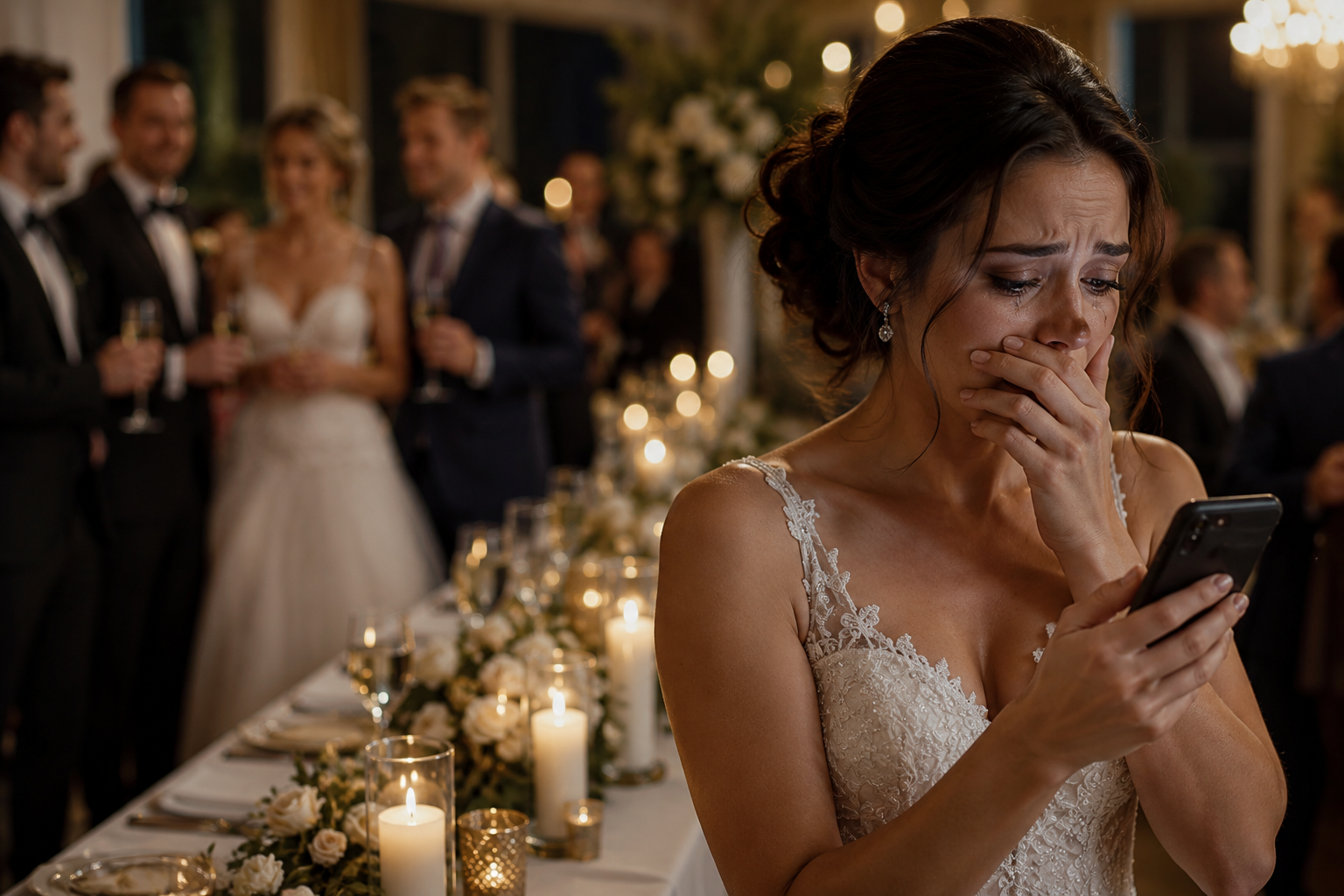
I read it twice while standing in the hallway outside the hospital pharmacy, my lunch untouched in one hand and my badge still clipped crookedly to my scrub pocket.
There simply isn’t room.
For a second, I thought I had misunderstood.
My sister, Maribel, was getting married in six weeks. She was my only sibling. We had shared a bedroom until she turned thirteen and decided my breathing bothered her. I had braided her hair before school, covered for her when she came home late, helped her write her college application essay, and wired her six hundred dollars during her first year in Boston when she claimed her rent check had bounced by accident.
Now there was no room for me at her wedding.
I stared at the message until the words stopped looking like words.
Then another text appeared.
Mom:
Please be gracious about this. You know how sensitive Maribel is right now.
Sensitive.
That was the word my family used when Maribel cried.
When I cried, I was dramatic.
When Maribel made mistakes, she was overwhelmed.
When I made mistakes, I was selfish.
When Maribel wanted something, the family rearranged itself around her.
When I needed something, I was asked why I always had to make everything about me.
I locked my phone and leaned against the wall.
The hospital smelled like disinfectant, coffee, and old fear. Somewhere down the corridor, a machine beeped steadily. Nurses moved past me with the tired, practiced speed of people who understood that pain did not wait for anyone to be ready.
I should have gone back to work.
Instead, I opened my phone again and typed one sentence.
Me:
You are telling me my sister has no seat for me at her wedding?
My mother replied almost instantly.
Mom:
It isn’t personal.
That was the second lie.
It was always personal.
It had been personal since childhood, when Maribel got the bedroom with the big window because she was “more artistic,” and I got the smaller one near the laundry room because I was “practical.” It had been personal when my father missed my nursing school graduation because Maribel had a gallery opening for three paintings she didn’t even finish herself. It had been personal when my parents used the money my grandmother left “for both girls” to pay for Maribel’s failed boutique, then told me I was old enough to understand family priorities.
But this was different.
A wedding was not a misunderstanding.
A missing invitation was not an accident.
A chair with no name on it was a decision.
I didn’t answer my mother.
For the rest of my shift, I did what I always did. I checked vitals. I changed dressings. I calmed a frightened teenager before surgery. I laughed when Dr. Patel made a terrible joke about hospital coffee being classified as a controlled substance. I held an old man’s hand while his daughter drove through traffic to say goodbye.
No one at work knew that something inside me had gone very quiet.
Not broken.
Just quiet.
There is a kind of pain that screams.
There is another kind that simply closes the door.
That evening, when I got home, Jonah was on the kitchen floor fixing the loose cabinet hinge I had been pretending not to notice for three months.
He looked up the moment I walked in.
“What happened?”
That was Jonah.
He didn’t ask if something had happened. He knew.
He had known me long enough to recognize the version of me that smiled too carefully.
I dropped my bag beside the door and handed him my phone.
He read the messages without speaking. His jaw tightened once, near the end, but he didn’t explode. Jonah never performed anger for attention. His anger arrived quietly, like a storm seen far out over water.
After a moment, he set the phone on the table.
“I’m sorry,” he said.
The words almost undid me.
Not because they were dramatic.
Because they were simple.
My family always explained pain.
Jonah acknowledged it.
I sat on the floor beside him, still wearing my shoes, and pressed the heels of my hands into my eyes.
“She didn’t even call,” I said. “Mom did it for her.”
Jonah was silent.
“And the worst part is, I knew,” I whispered. “Some part of me knew they’d find a way to make me smaller that day. I just didn’t think they’d erase me completely.”
He reached for my hand.
“You’re not erased.”
I laughed once, bitterly.
“I’m not invited to my only sister’s wedding.”
“No,” Jonah said. “You’re not invited into the story they want to tell about themselves.”
I turned to look at him.
He was still sitting there with a screwdriver in one hand, sawdust on his jeans, and that steady sadness in his eyes that made me feel both safe and exposed.
“My mother says it isn’t personal.”
“It is,” he said. “But not in the way she thinks. It says something personal about them. Not you.”
I wanted to believe him.
I wanted that so badly it hurt.
The wedding was held at a private estate on the coast of Rhode Island. I knew because Maribel had talked about it for thirteen months. White roses. Ocean view. String quartet. Champagne tower. A custom lace veil imported from Spain. A rehearsal dinner in a restored lighthouse.
Apparently, the estate was large enough for a champagne tower, a string quartet, and my father’s college roommate’s third wife.
But not for me.
I learned that last part two weeks before the wedding, when my cousin Tessa called me by mistake.
Not by mistake exactly. Tessa was one of those relatives who lived permanently halfway between guilt and gossip. She always knew more than she should and apologized less than she meant to.
“Ava,” she said carefully, “are you really not coming?”
I was folding laundry on the couch.
I stopped with one of Jonah’s shirts in my hands.
“I wasn’t invited.”
There was a pause.
Then Tessa said, very softly, “That’s not what Aunt Renee said.”
My mother had told people I couldn’t get time off work.
Of course she had.
It was perfect.
A nurse too busy to attend her sister’s wedding sounded noble. Understandable. Almost admirable. It protected everyone.
Except me.
“What else did she say?” I asked.
Tessa exhaled. “That you and Maribel had talked, and you didn’t want to make the trip because hospitals are understaffed.”
I closed my eyes.
My mother had not only removed me from the wedding. She had given me a line to say in the family play without asking whether I wanted the part.
“Tessa,” I said, “how many people are going?”
Another pause.
“Around one hundred and eighty.”
One hundred and eighty.
There simply isn’t room.
The words came back so clearly I almost heard my mother’s voice saying them.
Something hard settled in my chest.
Not rage.
Rage burns too hot to last.
This was colder.
Cleaner.
Understanding.
“Thank you for telling me,” I said.
“Ava, I’m sorry. I thought you knew.”
“I did,” I said.
But that was another lie.
I had known they could hurt me.
I had not known they could do it so neatly.
On the morning of Maribel’s wedding, I worked a double shift.
That was not an accident.
I volunteered for it.
I did not want to sit at home imagining white roses and ocean wind. I did not want to watch the clock and wonder whether my father cried when he walked her down the aisle, whether my mother adjusted Maribel’s veil with trembling hands, whether anyone noticed that the bride’s sister was missing from every photo.
At 3:17 p.m., while I was checking medication charts, my phone buzzed.
Tessa had sent one picture.
She must have sent it before thinking better of it.
The photo showed my parents in the front row.
My father wore a navy suit and a pink rose boutonniere. My mother wore silver and pearls, her smile wide enough to forgive nothing. Beside them were relatives I had not seen in years. Behind them, under a canopy of flowers, Maribel stood in white lace with the ocean behind her.
She looked beautiful.
That hurt too.
Love does not vanish just because someone injures you.
I looked at my sister’s face and remembered her at eight years old, missing her front teeth, climbing into my bed during thunderstorms. I remembered painting her nails badly before her first school dance. I remembered holding her while she cried after her first real breakup. I remembered thinking that no matter what our parents did, she and I had survived the same house.
But maybe we hadn’t.
Maybe she had been carried through it.
Maybe I had been used as padding.
Under the photo, Tessa wrote:
I’m so sorry.
I deleted the picture.
Then I washed my hands and went back to work.
That night, when I came home after midnight, Jonah had left soup on the stove and a note on the counter.
You don’t have to be okay tonight.
I stood in the kitchen and cried so hard I had to hold the counter to stay upright.
Three months later, Jonah proposed.
Not in a restaurant. Not in front of people. Not with a photographer hiding behind a tree.
He proposed on a Tuesday morning in our backyard, while I was wearing old sweatpants and trying to rescue our basil plant from whatever slow death I had sentenced it to.
He had built a small wooden bench beneath the maple tree because I liked sitting outside after night shifts. I thought that was the surprise.
Then he knelt beside the half-dead basil and opened a small green box.
“I know your family taught you love had to be earned,” he said, voice shaking. “I want to spend my life proving it can also be given freely.”
For a second, I could not breathe.
Then I started laughing and crying at the same time, which terrified our neighbor’s dog.
“Yes,” I said before he finished asking.
Jonah laughed too, his eyes wet, the ring trembling between his fingers.
“Yes?” he repeated.
“Yes.”
He stood, slipped the ring onto my finger, and pulled me into his arms beneath the maple tree.
It was the happiest I had ever been.
For almost eleven minutes.
Then my mother called.
I didn’t answer.
She called again.
Then again.
Then Maribel texted.
Maribel:
Mom says you’re engaged. Were you planning to tell us?
I stared at the message.
There were so many things I could have said.
Were you planning to tell me I had been replaced by a lie at your wedding?
Were you planning to tell me one hundred and eighty people fit where I didn’t?
Were you planning to tell me when exactly I stopped being your sister?
Instead, I wrote:
I’m telling the people who are happy for me first.
She didn’t respond for two days.
When she finally did, it was with a heart emoji.
Nothing else.
That tiny red heart felt more insulting than silence.
Wedding planning was strange after that.
I had spent so many years believing family was the center of every important room. Birthdays, holidays, graduations, funerals, weddings — family arrived first, family sat closest, family appeared in the photographs that survived.
But when Jonah and I sat at our kitchen table with a notebook between us, trying to make a guest list, my hand froze.
“Start with whoever you want,” Jonah said.
I looked down at the blank page.
Whoever I wanted.
It sounded simple.
It wasn’t.
I had spent my life being told who mattered. Who had to be forgiven. Who deserved patience. Who needed understanding. Who was “just like that.” Who would be hurt if I didn’t perform happiness correctly.
No one had ever asked me who made me feel safe.
So I made a different list.
Not family first.
Not obligation first.
Not blood first.
I wrote names as they came to me.
Tessa, because she told the truth even when it scared her.
Ben and Carla from the apartment downstairs, because they brought groceries when I had the flu and Jonah was out of town.
Dr. Patel, because he noticed when I was burning out and covered two hours of my shift so I could sleep in my car without getting written up.
Nina from night shift, because she sat with me outside the hospital after Maribel’s wedding and didn’t ask questions.
Mrs. Donnelly, my eighth-grade librarian, because she once gave me a quiet place to sit when my parents forgot to pick me up.
Jonah’s brother, Miles, because he treated me like family before anyone asked him to.
His mother, Grace, because the first time she met me, she hugged me and said, “We’re glad you’re here,” as if my presence was not something to be negotiated.
The list grew.
With each name, I wrote a note beside it.
Not for anyone else.
For myself.
A reason.
A memory.
Proof.
By midnight, I had forty-six names and forty-six small reminders that love had been present in my life, even when it had not come from the people assigned to give it.
Jonah came up behind me and rested his hands on my shoulders.
“What are those?” he asked gently.
“Reasons,” I said.
He leaned down and read a few.
For a long time, he didn’t speak.
Then he kissed the top of my head.
“This should be part of the wedding.”
I shook my head immediately.
“No.”
“Why?”
“Because it’s too much.”
“Too honest?”
I looked up at him.
Jonah had an irritating habit of asking questions that walked directly into locked rooms.
“I don’t want people to think I’m trying to make a point.”
“Ava,” he said, “you’re allowed to have a point.”
I looked back at the notebook.
Mrs. Donnelly — gave me a book and a sandwich the day no one came.
Nina — knew silence was sometimes kinder than questions.
Grace — made room without being asked.
Made room.
The phrase stayed with me.
The next morning, I called our wedding planner and changed the entire reception idea.
Instead of table numbers, every table would have a name.
The Ones Who Stayed.
The Ones Who Told the Truth.
The Ones Who Made Room.
The Ones Who Came Back.
The Ones Who Chose Kindness.
The Ones Who Never Asked Me to Beg.
Each guest would receive a small card with their place setting. On the front, their name. On the back, a private sentence about why they mattered to us.
Not a speech.
Not a performance.
Just gratitude.
The wedding would be held in an old brick train station that had been turned into an event hall. It had tall windows, worn floors, and iron beams that still showed their age. My mother would have hated it. She would have said it looked unfinished.
I loved it immediately.
It looked like something that had survived.
We chose October.
Not because it was fashionable.
Because Jonah said the trees looked honest when they changed color.
For weeks, everything was peaceful.
Then my mother found out she was not on the guest list.
I still don’t know who told her. Probably Tessa, accidentally. Possibly Maribel, deliberately. In my family, information moved like smoke under doors.
My mother called me at 7:42 on a Sunday morning.
I remember the time because Jonah and I were still in bed, and the ringtone startled both of us awake.
I almost let it go to voicemail.
Then I answered.
“Hello?”
There was no greeting.
“Are you seriously planning a wedding without inviting your parents?”
Her voice had that sharp, breathless tone she used when she had already decided she was the victim and was now gathering evidence.
I sat up slowly.
“Good morning to you too.”
“Don’t be childish, Ava.”
Jonah opened his eyes beside me.
I got out of bed and walked into the hallway.
“I’m not being childish.”
“You are punishing us because of Maribel’s wedding.”
“No,” I said. “I am making my guest list based on who has treated me with love and respect.”
She made a sound like I had slapped her.
“We are your parents.”
“I know.”
“Then act like it.”
That almost made me laugh.
Not because it was funny.
Because she truly did not hear herself.
“I was told there wasn’t room for me at my sister’s wedding,” I said. “Then I found out there were one hundred and eighty guests.”
“That was different.”
“How?”
“Maribel’s situation was complicated.”
“There was nothing complicated about inviting your daughter.”
My mother’s silence sharpened.
Finally, she said, “You have always been determined to see yourself as mistreated.”
There it was.
The family anthem.
The problem was not what they had done.
The problem was that I had noticed.
I leaned against the hallway wall and closed my eyes.
“For years,” I said quietly, “I thought if I explained my pain clearly enough, you would care. I’m not doing that anymore.”
“Ava—”
“You’re not invited.”
She inhaled hard.
“You will regret this.”
“No,” I said. “I think I already regret enough.”
I hung up before she could answer.
My hands shook afterward.
Jonah found me in the hallway and wrapped me in his arms.
“I did it,” I whispered.
“I know.”
“I told her no.”
“I heard.”
“She thinks I’m cruel.”
He pulled back and looked at me.
“People who benefit from your silence will always call your boundaries cruelty.”
I hated how much I needed to hear that.
Two days later, my father emailed me.
He did not text. He did not call.
He emailed, because my father believed email made anger look professional.
Subject: Wedding
Ava,
Your mother is extremely upset. Whatever issues you believe exist within this family, excluding us from your wedding is not an acceptable response. You are creating unnecessary embarrassment and forcing relatives to ask uncomfortable questions.
I expect you to correct this before permanent damage is done.
Dad
I read it at the kitchen table.
Then I read it again.
Permanent damage.
That was what he called the moment people might see the crack.
Not Maribel excluding me.
Not my mother lying.
Not years of comparison, dismissal, and silence.
The damage was not the wound.
The damage was the witness.
I wrote back:
Dad,
The permanent damage was done when you all decided I was easier to explain away than include.
I am not correcting the truth to make you comfortable.
Ava
He did not reply.
Maribel did.
She called that night.
For reasons I still cannot fully explain, I answered.
Maybe some part of me was still eight years old, waiting for my sister to crawl into my bed during a storm.
“Ava,” she said.
Her voice was small.
That was dangerous.
Maribel had always known how to sound wounded enough to make other people drop their own pain.
“Hi.”
“Are you really not inviting me?”
I looked out the kitchen window. Jonah was in the backyard, stacking firewood under the porch light.
“No.”
A long silence.
Then she whispered, “I’m your sister.”
“I know.”
“You’re really going to have a wedding and not have me there?”
The question was so perfectly shaped like mine that I had to grip the counter.
“Yes,” I said.
Her breathing changed.
“I wanted you there,” she said.
I closed my eyes.
“Then why wasn’t I?”
“Mom said you would make things tense.”
I laughed once.
I couldn’t help it.
Maribel flinched through the phone.
“That’s not an answer,” I said.
“She said you were still resentful about Grandma’s money and Dad missing your graduation and everything else, and I just… I couldn’t handle drama on my wedding day.”
Everything else.
My life reduced to an inconvenient list.
“Maribel,” I said, “did you know Mom told people I couldn’t get time off work?”
Silence.
That told me enough.
“You knew.”
“I didn’t correct it,” she said.
It was the closest thing to honesty she had given me in years.
“Why?”
“Because it was easier.”
There it was.
Not pretty.
Not polished.
But true.
I looked down at my ring.
For most of my life, I had confused confession with repair. I thought if someone finally admitted the truth, the hurt would loosen.
It didn’t.
Sometimes truth only shows you the size of the room you had been locked inside.
“It was easier for you,” I said.
She started crying.
“I don’t know how to fix this.”
I believed her.
That was the sad part.
Maribel knew how to be admired. She knew how to be forgiven. She knew how to stand in the center of a room and let everyone else adjust the lighting.
But she did not know how to repair something without being applauded for trying.
“I don’t need you to fix it before my wedding,” I said. “I need my wedding to be a place where I don’t have to wonder who secretly wishes I were smaller.”
“That’s unfair.”
“No,” I said. “It’s late.”
She was quiet for a long time.
Then she said, “So that’s it?”
“No,” I said. “That’s just where I’m standing now.”
I hung up gently.
I cried afterward.
Of course I did.
People think boundaries feel powerful.
Sometimes they do.
Mostly, at first, they feel like grief wearing armor.
The guest cards arrived from the printer three weeks before the wedding.
They were cream-colored, simple, and beautiful. No gold foil. No dramatic calligraphy. Just names and words.
I sat at the dining table, checking each one.
Miles — For making loyalty look easy.
Grace — For opening the door before I knew how to knock.
Nina — For sitting beside me when silence was all I had.
Tessa — For choosing truth over comfort.
Mrs. Donnelly — For seeing the lonely girl behind the good grades.
Dr. Patel — For reminding me healers need care too.
Ben and Carla — For proving neighbors can become family.
Jonah watched me read them, one by one.
“Are you okay?” he asked.
I smiled through tears.
“For once, yes.”
We didn’t know then that the cards would be the thing that exposed everything.
Not because we meant them to.
Not because we sent them to newspapers or posted them online.
Because three days before the wedding, our photographer asked if she could take detail shots of the reception setup for her portfolio.
I said yes.
The hall looked magical that afternoon. Autumn light came through the tall windows. The long wooden tables were covered with linen runners, candles, copper leaves, and small cards waiting at each place. Above the seating chart, our planner had hung a simple sign:
MAKE ROOM FOR THE PEOPLE WHO MADE ROOM FOR YOU.
I loved it the second I saw it.
It felt like a sentence my younger self had needed.
Our photographer posted one photo that evening.
Just one.
It showed the seating chart and a few of the table names. No full guest names, no private notes visible. But the sign was clear. So were the empty spaces where a traditional family table might have been.
Her caption was innocent:
One of the most meaningful seating displays I’ve ever photographed. This couple named every table after the kind of love that actually showed up.
By morning, the photo had been shared thousands of times.
By noon, it was everywhere.
People wrote comments about chosen family. About being excluded. About parents who cared more about appearances than children. About siblings who smiled in pictures while leaving someone out of the room.
Then someone from my extended family commented.
Not Tessa.
Not anyone kind.
My aunt Linda wrote:
Funny how she talks about people making room when she refused to attend her own sister’s wedding.
That was all it took.
Tessa replied before I could stop her.
She didn’t refuse. She was told there was “no room,” then her mother told everyone she couldn’t get off work. There were 180 guests.
I stared at the screen, heart pounding.
For thirty seconds, nothing happened.
Then everything happened.
Screenshots spread.
Comments multiplied.
People asked questions.
Relatives began arguing publicly, which was both horrifying and deeply on brand.
Someone posted a photo from Maribel’s wedding program showing the full bridal party, extended family, and guest count printed on the back.
Someone else noticed I wasn’t in a single picture.
Then a cousin from my father’s side wrote:
I always wondered why Ava wasn’t there. Renee told us she chose work.
My phone became unusable.
Calls. Texts. Notifications. Unknown numbers. Messages from people I hadn’t spoken to since childhood.
Some were kind.
Some were curious.
Some were cruel.
But the truth had left the house.
And once truth gets outside, families like mine don’t know how to catch it without looking guilty.
My mother called eighteen times in one hour.
I didn’t answer.
My father sent a message.
Dad:
Take down whatever you posted. Now.
I replied:
I didn’t post the truth. Other people recognized it.
He answered immediately.
Dad:
You are humiliating your mother.
I stared at those words for a long time.
Then I wrote:
No. Her choices are.
Maribel sent nothing.
That hurt more than my father’s anger.
The night before the wedding, I sat alone in the empty reception hall.
The rehearsal dinner had ended. Jonah had gone back to the hotel with his brother. Grace had kissed my cheek and told me to sleep, which I had no intention of doing.
The hall was dark except for the string lights above the tables.
I walked slowly past each place setting.
Each card.
Each name.
Each reason.
For most brides, maybe the night before a wedding is about nerves. Flowers. Weather. Makeup. Vows.
For me, it felt like standing between two lives.
In one life, I was still waiting for my family to turn around and say they had finally seen me.
In the other, I was walking toward a room full of people who already had.
I stopped at the table named The Ones Who Made Room.
Grace’s seat was there.
So was Mrs. Donnelly’s.
So was Tessa’s.
There was one empty chair at the end.
Not because someone had canceled.
Because I had asked the planner to leave it there.
A chair for the version of me who never got one.
I hadn’t told anyone.
Not even Jonah.
I touched the back of it lightly.
“You made it,” I whispered.
My phone buzzed.
For some reason, I looked.
Maribel.
For a long moment, I didn’t open the message.
Then I did.
Maribel:
I’m outside.
My whole body went cold.
I walked to the front entrance.
Through the glass doors, I saw her standing under the station awning in a beige coat, her hair pinned back, mascara smudged beneath her eyes.
She looked smaller than I remembered.
I opened the door but did not step aside.
“What are you doing here?”
She swallowed.
“I needed to see you.”
“My wedding is tomorrow.”
“I know.”
“You can’t do this tonight.”
“I know,” she said again, and her voice cracked. “I’m sorry.”
Those words stood between us.
Small.
Late.
Not enough.
But real enough to make me ache.
I folded my arms.
“For what?”
She looked down.
“For letting them keep you out. For knowing the lie and letting you carry it. For telling myself it was Mom’s decision when it was my wedding.”
The night air smelled like rain and leaves.
I said nothing.
Maribel wiped her cheek quickly, like she was embarrassed by her own tears.
“I was jealous of you,” she said.
That surprised me so much I almost laughed.
“Of me?”
She nodded.
“You left. Not physically, maybe, but inside. You stopped needing them the way I still did. I hated that. I hated that you could be disappointed and still keep going. I hated that Grandma trusted you. I hated that Dad respected you when he wasn’t busy pretending he didn’t. I hated that you didn’t have to be adored to be real.”
I stared at her.
All my life, I had thought Maribel got everything because she was loved more.
Maybe that was true.
Maybe it wasn’t.
Maybe she had been trapped too, just in a prettier cage.
But understanding someone’s cage does not unlock yours.
“I don’t know what you want me to say,” I whispered.
“I’m not asking to come tomorrow.”
That hurt in a strange way.
Because some wounded part of me had expected her to ask.
To pressure.
To make this about herself.
But she didn’t.
“I don’t deserve to be there,” she said. “I just couldn’t let you walk into your wedding thinking I still believed what they did was okay.”
I looked past her, into the dark parking lot.
“Do Mom and Dad know you’re here?”
“No.”
“Maribel—”
“I told them the truth tonight.”
My breath caught.
“What?”
She gave a shaky laugh.
“It went badly.”
I could imagine.
My mother’s tears. My father’s cold silence. The long family table becoming a courtroom.
“I told them I knew you hadn’t chosen work. I told them I let Mom lie. I told them the reason people are judging us is because what we did was wrong.”
The words moved through me slowly.
Not healing everything.
Not even close.
But entering places where nothing honest had been allowed for a very long time.
“My mother must have loved that,” I said.
Maribel almost smiled.
“She said you turned me against her.”
Of course she did.
I looked at my sister.
For the first time in years, she did not look like the golden child.
She looked like a woman standing in the wreckage of a role she had mistaken for love.
“I can’t fix us tonight,” I said.
“I know.”
“And I can’t make you part of tomorrow.”
“I know.”
“But maybe after,” I said carefully, “if you keep telling the truth when no one is clapping for you, we can talk.”
She cried then.
Not loudly.
Not beautifully.
Just honestly.
“Okay,” she said.
I stepped forward and hugged her.
It was not forgiveness.
Not yet.
It was not reunion.
It was not a movie ending.
It was two sisters holding the broken edges of something and admitting, finally, that it was broken.
When I pulled away, she touched my hand.
“I hope tomorrow is everything you never had to beg for.”
I watched her walk back to her car.
Then I went inside.
The next day, it rained.
Not all day.
Just in the morning.
By noon, the clouds thinned, and sunlight came through the tall windows of the old train station in long golden beams.
People worried I would be upset about the weather.
I wasn’t.
I liked that the day began by washing something clean.
Grace helped me button my dress.
Tessa cried before I even put on shoes.
Nina brought emergency snacks in a hospital supply bag.
Mrs. Donnelly tucked a tiny blue book into my bouquet ribbon and said every bride deserved a secret story to carry.
When the music began, I stood behind the doors with no father waiting to walk me down the aisle.
That had been my choice.
Not because it didn’t hurt.
Because truth mattered more.
I walked alone for the first half.
Then, halfway down the aisle, the people seated at the ends of each row stood one by one.
Tessa.
Nina.
Grace.
Mrs. Donnelly.
Miles.
Dr. Patel.
Ben.
Carla.
Not to take me from myself.
Not to give me away.
Just to stand as I passed.
By the time I reached Jonah, I was crying.
So was he.
“You okay?” he whispered.
I laughed through tears.
“No.”
He smiled.
“Me neither.”
The ceremony was short.
Our vows were not.
Jonah promised to make room for every version of me, even the ones still learning how to enter without apologizing.
I promised never to confuse peace with silence again.
When we kissed, the room erupted.
Not politely.
Joyfully.
Fully.
Like people who knew exactly what it had cost to get there.
At the reception, Jonah stood before dinner and explained the table names.
He did not mention my family.
He did not mention Maribel’s wedding.
He simply said, “We wanted every person here to know they were invited not because of obligation, but because of presence. Every seat in this room was chosen with gratitude.”
Then the servers placed the cards at each setting.
People read them.
Some laughed.
Some cried.
Some tucked them into purses and jacket pockets.
Mrs. Donnelly held hers against her heart.
Grace pressed hers to her lips.
Tessa looked at me across the room and mouthed, “Thank you.”
And the empty chair at The Ones Who Made Room stayed empty.
Until Jonah noticed it.
He looked at me with a question in his eyes.
I leaned close and whispered, “That’s for who I used to be.”
His expression changed.
Softened.
Then he took my hand and walked me to the chair.
No announcement.
No performance.
He simply pulled it out, touched the back of it, and said quietly, “She’s welcome too.”
That was when I finally understood.
The point of the wedding had never been to expose my family.
They had done that themselves.
The point was not revenge.
It was not humiliation.
It was not proving I could fill a room without them.
The point was that the room was full.
For years, I had stood outside doors, asking why there was no space for me.
That day, I stopped asking.
I looked around at the people who had come.
The people who had stayed.
The people who had told the truth.
The people who made room.
And for the first time in my life, I did not feel like an extra chair dragged in at the last minute.
I felt seated.
I felt seen.
I felt chosen.
My mother texted during dinner.
I saw her name light up on the screen and felt Jonah’s hand cover mine.
I could have ignored it.
Maybe I should have.
But I opened it.
Mom:
I hope you’re proud of yourself.
I looked around the room.
At Grace dancing badly with Dr. Patel.
At Nina stealing cake frosting with her finger.
At Tessa laughing so hard she had to sit down.
At Mrs. Donnelly telling Jonah’s brother a story with so much dramatic hand movement she nearly knocked over a candle.
At Jonah, my husband now, watching me with the kind of love that did not ask me to shrink.
I typed back one word.
I am.
Then I turned off my phone.
And I danced.